The Weight of Silence and the Price of the Trident on a Cold Grey Coast
CHAPTER 1: THE STONE AGE TABLE
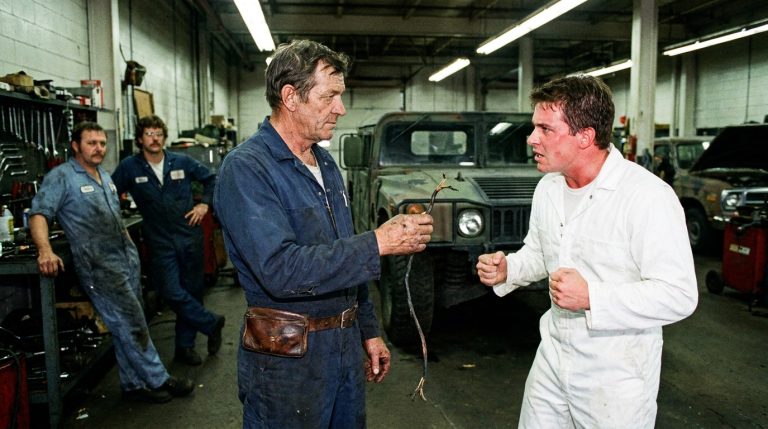
“Hey, old man. What rank did you hold back in the stone age?”
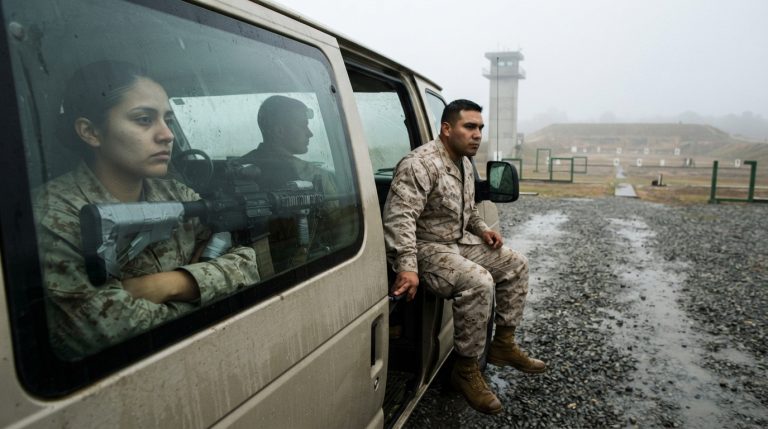
Jack Reynolds did not wait for an invitation. He stepped forward, his boots clicking with clean precision against the high-gloss concrete of the naval base mess hall. He stopped directly in front of the small corner table, blocking the natural light from the high, narrow windows. Behind him, three members of his squad let out short, dry laughs—the mechanical, practiced sounds of men who had never known the specific taste of a losing fight.
The old man, Henry Cole, did not look up. He sat with his spine perfectly vertical against the rigid metal back of the standard-issue chair. His worn canvas jacket was clean, the shoulders faded to a salt-and-pepper grey that matched the overcast sky outside the glass. He scooped another even portion of stew onto his spoon. He ate with an unhurried, rhythmic consistency.
“I’m talking to you,” Reynolds said, his voice dropping into the flat, demanding register of an active interrogation. “This is a controlled military installation. Do you have any identification on your person?”
The ambient noise of the room—the scraping of heavy metal trays, the collective murmur of two hundred sailors, the sharp clink of industrial silverware—began to thin out, dying from the edges inward. Forks remained suspended halfway to open mouths. Eyes shifted toward the corner, caught the black Trident pinned to Reynolds’s chest, and quickly darted back down to their respective trays.
Cole didn’t flinch. He set his spoon down softly, aligning it perfectly parallel to the edge of the molded plastic tray. His old hand was remarkably steady, the knuckles thick and scarred like old root wood. He didn’t reach for a pocket. He didn’t look up to meet the eyes of the young seal who stood towering over his space. Beneath the worn lapel of his jacket, a small, dark glint of metal caught the harsh fluorescent overheads—a tiny, non-regulation dull brass pin, its backing slightly asymmetrical, completely out of place among the modern digital patterns of the room.
Reynolds saw it. He leaned closer, the scent of sea salt and heavy wool pressing into the small gap between them. “Are you ignoring me? Or do you think staying silent gives you a pass to wander past the wire?”
A fresh smirk grew on the young seal’s face, but his eyes remained sharp, calculating the old man’s lack of response as an active threat to his authority. He placed his large palm flat on the laminate tabletop. The impact was clean, heavy, and loud enough to freeze the remaining conversations in the room. “Show me your ID. Now.”
Cole simply adjusted his posture by a fraction of an inch, his shoulders square, his breathing long and even through his nose. He looked at a spot on the wall three inches past Reynolds’s hip. The silence between them was no longer an absence of sound; it was a solid, freezing pressure that filled the mess hall.
Reynolds’s jaw tightened. The lack of an echo—the total refusal of the old man to acknowledge the rank, the uniform, or the physical presence—made the blood rush hot behind his ears. He reached out his right arm, his fingers hovering just an inch above the old man’s thin sleeve. “Fine,” Reynolds muttered, his tone shifting from mockery into a cold, transactional command. “If you won’t speak, we’ll verify it outside the gate.” His fingers closed tightly around Henry Cole’s arm.
CHAPTER 2: THE SERVING WALL PHONE
The concrete floor seemed to absorb the remaining warmth of the room the exact moment Jack Reynolds’s fingers locked around the old man’s sleeve. The fabric of the canvas jacket bunched under the pressure, a dry, abrasive sound that carried clearly through the unnatural silence of the mess hall. Reynolds stood rigid, his shoulder blades pulled tight, leaning his weight forward through his arm to enforce the command. He expected a flinch, a sudden jerk of resistance, or the loose, trembling compliance of age. Instead, he met the dead, unyielding mass of a man who simply chose not to move.
Twenty feet away, Lucas Parker stood frozen behind the metal tray slide of the serving line. His knuckles were white against the rolled steel edge of his tray, the metal vibrating slightly from the tremor in his hands. He wasn’t looking at Reynolds anymore; he was looking at the old man’s arm, gripped tightly by a modern operator wearing the black trident of the elite. The sight was a physical blow. It dragged a dormant, bitter memory out of the dark—his grandfather, smaller then than Cole looked now, standing on the linoleum of a brightly lit store while a younger, louder man pushed him along by the shoulder. His grandfather hadn’t fought back. He had simply looked down at his own shoes, his shoulders rounded in a quiet, devastating acceptance of his own vanished strength.
Parker felt a sudden, sour heat rise in his throat. The mess hall was filled with veterans, active fleet sailors, and petty officers who had spent years learning the explicit mechanics of chain of command and structural discipline. Yet, every single one of them had their eyes fixed on their plates or the distant corners of the room. The silence wasn’t respect; it was collective cowardice masking itself as professional distance. Nobody wanted to cross a seal. Nobody wanted to risk their own record for an unverified civilian in a faded coat.
Parker didn’t think about his career. He didn’t calculate the specific disciplinary infractions that came with abandoning his post in the mess line. He set his metal tray down on the steel track with a sharp, resonant clang that caused two nearby seamen to jump. He turned on his heel, his leather shoes squeaking against the polished concrete as he walked rapidly away from the table, heading toward the rear exit near the kitchen doors where the wall-mounted administrative phones were clustered in the shadow of the structural pillars.
His breath came in short, jagged cycles. His fingers shook as he reached for the heavy black plastic receiver of the base command line. The plastic was cold, smelling faintly of industrial disinfectant. He lifted it to his ear, his eyes darting back toward the corner table. Reynolds hadn’t pulled Cole up yet; he was still waiting, his jaw working as the old man remained completely inert, forcing the young seal to either increase the physical force or back down in front of the entire room.
Parker dialed the four-digit internal extension for the Command Master Chief’s office from memory. The internal line clicked thrice, a flat, mechanical drone that felt agonizingly slow.
“Command Master Chief’s office, Senior Chief Miller speaking. State your business.” The voice on the other end was dry, clipped, buried under the sound of rustling paper and the distant hum of a printer.
“Senior, this is Seaman Parker,” Lucas said, his voice dropping into a low, hurried whisper that scraped against his throat. He leaned his forehead against the cold cinderblock wall, shielding the receiver with his shoulder. “I’m down at the main mess hall. I need to speak with the Master Chief immediately. It’s an emergency.”
“The Master Chief is currently reviewing the quarterly readiness logs, Seaman. If this is a security matter, dial the master-at-arms extension. Clear the line.”
“No, Senior, listen to me,” Parker urged, his eyes locking back onto the table. Reynolds had shifted his feet, preparing to exert upward leverage. The squad behind him had stopped smiling; the atmosphere was souring fast. “There’s a seal—Petty Officer Reynolds—he’s harassing an elderly man at the corner table. He’s using physical force. He’s trying to drag him out.”
A brief, heavy pause came over the line, followed by a sigh that sounded like leather shifting. “Report it to the gate guards, Parker. We don’t handle mess hall disputes.”
“The old man’s name is Henry Cole,” Parker snapped out, the syllables cutting through his own hesitation.
The sound of rustling paper on the other end ceased instantly. The background noise of the office seemed to vanish, replaced by a sudden, absolute vacuum. It was the exact same species of silence that had just infected the mess hall, but this time it carried the weight of institutional memory.
“Say that name again,” the voice came back, no longer dry or administrative. It was low, compressed, and dangerous.
“Henry Cole,” Parker repeated, his knuckles aching against the receiver. “He’s sitting at the small table by the east windows. Reynolds has him by the arm right now.”
A sharp, violent crack echoed through the phone—the unmistakable sound of a heavy wooden office chair being thrown back against a desk with enough force to rattle the caster wheels. The line stayed open, but the Senior Chief wasn’t talking to Parker anymore. Parker could hear a muffled, urgent conversation across the room, the deep, rumbling baritone of Master Chief Donovan cutting through the office wall like a circular saw through soft pine.
“Parker,” the Senior Chief’s voice returned, stripped of all standard military courtesy, leaving only raw utility. “Do not hang up this phone. Do not leave that wall. Keep your eyes on that table and do not let anyone move that man outside the threshold of that room. Do you understand me?”
“Yes, Senior,” Parker whispered, his palms slick with sweat against the plastic.
The line didn’t go dead, but it went quiet, the open receiver transmitting only the distant, rhythmic thud of heavy boots accelerating down the command corridor upstairs. Parker lowered his head slightly, his gaze tracking across the expanse of the mess hall. The temperature in the room felt like it had dropped five degrees. Reynolds was still holding the arm, his face darkening as the old man’s stillness continued to turn his own show of force into a public exhibition of irrelevance. Parker held the phone tight against his ear, his heart hammering against his ribs like a trapped bird, knowing that somewhere beneath the concrete and steel of the base, the heavy iron gears of authority had just slipped their tracks.
CHAPTER 3: THE COMMAND COMMANDERS RECALL
The heavy rubber-soled boots of Command Master Chief Donovan struck the commercial linoleum of the upper administrative deck with a rhythmic, explosive force that rattled the glass partitions of the cubicles. Behind him, the phone receiver hung swinging on its coiled black cord against the drywall, a faint, rhythmic clicking leaking from its ear-piece as Seaman Parker held the open connection in the mess hall below. Donovan didn’t look back. His uniform cap was pinned low over his brow, the gold anchor insignia catching the cold glare of the overhead lighting as he crossed the threshold into the inner command suite without knocking.
Senior Chief Miller was already on his feet, his fingers hovering over a flat-panel keyboard. The high-speed laser printer in the corner was whirring, spitting out grey sheets of the morning’s logistics manifest. “Master Chief, I have the gate security grid up,” Miller said, his voice dropping into a tight, gravelly register that signaled a total departure from routine operations. “If that’s the Cole I think it is, the automated gate sensors should have flagged his vehicle at the outer perimeter. Every civilian pass issued since 0400 is locked into the local cache.”
Donovan stopped at the edge of the terminal desk, his hand coming down on the matte steel casing of the monitor with a heavy, metallic thud. His jaw was set so hard the muscles along his cheekbones twitched in the dim light of the screens. “Don’t check the local cache, Miller. Check the regional master directory. If Henry Cole is on this base, he didn’t sign in through a standard visitor kiosk. He doesn’t exist on a magnetic strip.”
“Sir, I’m pulling the raw entry logs right now,” Miller muttered, his fingers striking the keys with a frantic, metallic clatter. The blue glare of the terminal reflected across the sharp edges of his rank insignia. “We have the commercial delivery entrance, the main commuter lane, and the secondary officer transit point. Nothing. The digital register for the last six hours shows absolute zero for that name or any variance of his identification number. According to the database, the old man isn’t inside the perimeter.”
Donovan leaned closer, his eyes narrowing as he scanned the scrolling columns of green and white text. The screen flickered, casting deep, long shadows against the rear wall of the office. The system was seamless, a modern digital net designed to track every spark of electrical energy and every piece of authorized plastic that crossed the concrete barriers of the base. Yet the grid was entirely blank.
Suddenly, a sharp, metallic ping echoed from the lower console—an old, non-regulation mechanical bell that had been left wired into the primary terminal to monitor legacy analog backups. It was a dry, high-pitched ring that hadn’t sounded in months. The digital display on the primary terminal suddenly froze, the scrolling logs replacing themselves with a single, unformatted line of black text across a grey box: ENTRY VALIDATED VIA DIRECT LINE AUTHORIZATION – ZERO ARCHIVE RECORD GENERATED.
Miller’s hand stopped over the keys. He looked up at Donovan, his face pale under the fluorescent tubes. “Master Chief… that’s an override from the old harbor master’s landline. That circuit hasn’t been used since the digital modernization initiative in ’98. It bypasses the main security server entirely. Whoever authorized his entry didn’t use a keyboard.”
“The base commander’s personal staff car,” Donovan said, his voice dropping into a freezing, calculated whisper. He reached down and ripped the printed manifest from the tray, the paper tearing with a sharp, ragged hiss. “The Colonel’s driver uses the old southern commercial lane when they want to avoid the automated scanners on the main highway. Someone brought Cole in through the back door before the sun was up, and they intentionally left the digital ledger blank to keep his presence off the network.”
“But why keep him off the books?” Miller asked, his eyes tracking the frozen text on the monitor. “If he has the clearance, there’s no operational reason to quarantine the log.”
“Because if the current rotation of operators knew he was sitting in that mess hall, the entire training cycle would grind to a halt,” Donovan muttered, turning toward the heavy oak door that led directly into the base commander’s private briefing room. “The old man doesn’t want a parade, Miller. He wanted a quiet bowl of soup in the only room on this coast that still smells like the Navy he left behind. And right now, Reynolds is treating him like an intruder because he can’t find his name on a piece of plastic.”
Donovan gripped the cold brass handle of the commander’s door, turning it with a decisive, heavy click. The air inside the inner office was thick with the scent of stale coffee and premium shoe polish. Base Commander Colonel Vance was standing by the panoramic window, his hands clasped behind his back as he watched the grey rain begin to dimple the dark tarmac of the parade grounds below.
“Colonel,” Donovan said, his voice cutting through the quiet hum of the room’s air filtration system like a blade. “We have a structural failure in the main mess hall. Petty Officer Reynolds has just laid hands on Henry Cole. He’s attempting a forced civilian removal.”
Vance did not turn around immediately, but his shoulders dropped two inches, his formal posture stiffening into an unyielding line against the glass. When he finally turned, his face was flat, the skin around his eyes tight and dark. “Tell me you’re joking, Master Chief.”
“The line is open with Seaman Parker right now, sir. Reynolds has him by the arm. He’s calling the old man’s unit insignia a cheap surplus store souvenir.”
Vance reached for his command cover on the desk, his fingers locking around the polished black brim with enough force to deform the leather. “Get the Vice Admiral’s detail on the radio. Harper’s convoy just cleared the main gate ten minutes ago to head for the airport. Tell them to execute a hard pivot on the blacktop. Tell the Admiral that the foundation of his old unit is currently being handled like a trespasser in his own mess hall.”
Donovan saluted, his hand rising to his brow with a sharp, rigid snap that carried the collective anger of thirty years of service. “Moving now, Colonel.” He turned back into the administrative suite, his boots finding the concrete floor of the exit corridor as he began his descent toward the lower decks, the sound of his stride echoing down the stairwell like the first cracks of thunder before a coastal squall.
CHAPTER 4: THE TWISTED ENTRY LAYER
The amber warning prompt on the secondary monitor did not clear; it rhythmically pulsed, casting long, sharp-edged horizontal shadows across Senior Chief Miller’s rigid face. The mechanical ding of the landline interface still vibrated in the small, enclosed administrative office, a low hum that conflicted with the hum of the cooling fans. Outside, the rain was sweeping in angled sheets against the glass, blurring the dark shapes of the armory across the yard.
Miller’s fingers did not leave the plastic casing of the workstation. He stared at the unformatted text block that claimed an entry had been validated via an unmapped direct line. To a modern technician, the entry looked like an exploit—a deliberate, surgical security breach executed from inside the compound. A person who enters a base without hitting a single digital checkpoint is a ghost, a security risk, or a vulnerability that needs to be neutralized.
“Master Chief,” Miller muttered, his index finger tapping the hard bezel of the glass screen. “Look at the time-stamp on the landline override. It registered at 0412. If a staff vehicle came through the southern commercial gate using the legacy bypass, it had to trip the passive infrastructure loops near the fuel farm. I’m forcing a manual interrogation of the perimeter sub-routers right now.”
Donovan had already turned back toward the threshold of the room, his heavy coat rustling in the tight space. He stopped, his shoulder checking against the steel frame of the doorway. He looked back at Miller, his eyes cold and hollow under the low brim of his cover. “The loop won’t have anything, Miller. The southern commercial line doesn’t connect to the digital network. It’s old copper wire wrapped in lead conduit buried beneath four feet of gravel. It runs straight to the harbor master’s old shack. If there’s a log, it’s written in blue ink on a canvas ledger.”
“But the automated alarm is active,” Miller insisted, his voice tightening as his hand shifted to the trackball, dragging the cursor across a shifting schematic of the base’s perimeter fences. “Look at the screen. The terminal is treating the lack of a tracking token as a network breach. Layer 1 security protocols have already shifted to amber alert. The master-at-arms console is going to see this missing record within three minutes. To anyone running the grid right now, this looks like an unauthorized entry by an undocumented civilian who used a dead military line to slip past the wire.”
The logic was flawless, clean, and dangerous. Jack Reynolds, down in the mess hall, wasn’t just acting out of unprovoked arrogance; he was a symptom of a base that evaluated legitimacy strictly by the presence of a digital signature. To a young operator trained to view the world through the crisp lens of tactical grids and network tokens, an old man sitting in a grey coat without a scannable credential was an explicit tear in the defensive perimeter. The system itself was setting the trap, turning Cole’s quiet, unrecorded presence into a calculated provocation.
“Let the master-at-arms look,” Donovan said, his voice dropping into a flat, level register that carried no hesitation. “They’ll see exactly what the system wants them to see—a decoy. They’ll think some old timer found a loophole in the fence or bought a retired badge from a surplus store. They’ll spend their time hunting for a paper trail that doesn’t exist because they don’t understand that some authorities don’t require an active account on a server.”
“And if Reynolds pushes him out before the commander arrives?” Miller asked, his fingers clicking a final macro to lock the terminal window against automated deletion. “The digital alert gives him standard operating cover. He can claim he was securing a loose perimeter asset.”
“He can claim whatever he wants until his boots hit the floor of the command suite,” Donovan said, his hand dropping to the heavy black handle of his flashlight sheath. “But he’s running on a clock he can’t see. The base commander isn’t the only one moving toward that mess hall. I just got the automated transponder bounce from the main gate. The Admiral’s staff car just cleared the reverse loop on the approach highway. They didn’t even wait for the gate arm to fully raise; they took the shoulder.”
Miller looked up from the screen, the amber reflection fading from his eyes as he pulled his hands away from the keyboard. The terminal continued to pulse, its automated script searching for an electronic footprint that simply didn’t exist in the modern architecture. The physical reality of the situation was already outrunning the software. The old man wasn’t an intruder; he was the owner of the house, but he had entered through a door that the current generation had forgotten how to lock.
Donovan stepped into the corridor, the door closing behind him with a sharp, pneumatic hiss that cut off the hum of the cooling fans. The concrete hallway was dark, illuminated only by the low-intensity safety lights along the baseboards. He pulled his radio from his belt, his thumb pressing the heavy rubber PTT button with enough force to strain the casing. “Parker. Still on the line?”
Down in the mess hall, twenty feet from the table where Jack Reynolds still held Henry Cole’s arm, Seaman Lucas Parker tightened his grip on the receiver, his back pressed hard against the cold concrete pillar as he watched the young seal’s fingers dug deeper into the faded fabric of the grey jacket. “I’m here, Master Chief. He hasn’t moved him yet. But the room is running out of air.”
“Hold the line, Parker,” Donovan’s voice came back through the radio static, low and heavy like iron scraping across rock. “Don’t let them walk him. The three-star flag is already back inside the wire.”
CHAPTER 5: THE COMMAND CORRIDOR ATTACHMENT
The radio link inside Seaman Parker’s palm hissed with a sudden surge of atmospheric static, the heavy, compressed frequency of Master Chief Donovan’s voice flattening into a low roar. Outside the structural pillars of the mess hall, the dark, oil-stained tarmac of the perimeter lane was beginning to glint with an engineered sheen under the high-pressure sodium lamps. A line of matte-black utility vehicles stepped out of the freezing rain, their tires throwing thick, localized plumes of grey spray against the concrete blast walls. The lead vehicle—a modified heavy transport carrying the three-star insignia of the Vice Admiral—swerved hard across the white lane markers, its brakes groaning under a sudden, mechanical downshift.
Inside the perimeter corridor, the cold air smelled of wet wool and diesel exhaust. Donovan moved down the back staircase three steps at a time, his boots tracking parallel lines of dark moisture across the raw iron treads. His fingers stayed locked to the volume dial of his handheld unit, his eyes fixed on the low concrete overhead as the structural shadows lengthened. The automated alert from Senior Chief Miller’s office was still echoing through the tactical data lines, but the physical world was moving faster than the copper circuits.
“Parker,” Donovan muttered, his voice scratching against the plastic microphone casing as he reached the landing of the first deck. “Confirm Reynolds’s posture. Has he broken the old man’s vertical alignment?”
Down at the corner table, the silence had settled into something thick and structural. Jack Reynolds’s forearm was completely taut now, the veins along his wrist rising in dark, rhythmic lines against his skin as he maintained his downward pressure. He didn’t pull up; he was using his mass to pin Henry Cole into the metal chair, his eyes locked onto the side of the old man’s face like a marksman tracking a stationary target. He could feel the small, hard ridge of the brass backing pin pressing into the palm of his hand through the canvas lapel—a tiny, physical discrepancy that felt entirely out of place against the modern weave of his own uniform.
“He’s pinning him down, Master Chief,” Parker whispered into the wall phone, his shoulder blades wedged into the cold mortar joint of the rear pillar. “He isn’t moving him out yet. He’s waiting for him to break. But the squad… they’re closing the gap behind him. They’re forming a perimeter around the tray line.”
The three seals who had been standing by the utility doors had stepped forward by two paces, their boots clicking in perfect, unconscious sync against the polished floor. They didn’t draw weapons; they didn’t raise their voices. They simply occupied the space, their wide shoulders blocking the exit paths toward the galley doors. To any passing observer, it looked like a standard security intervention—a team of elite operators systematically isolating a non-compliant civilian asset who had triggered an automated perimeter discrepancy.
Suddenly, a loud, metallic pop rattled the administrative line. The line didn’t go dead, but the internal frequency shifted into an active dead-zone. The primary security terminal on the wall behind Parker flickered from amber to deep red, its digital interface locking into a local diagnostic loop. The sudden, localized interference was heavy, the high-frequency hum of a major military convoy overriding the standard administrative routers as the Admiral’s staff car cleared the low overhang of the mess hall’s loading bay.
Reynolds didn’t look toward the doors, but his fingers loosened by a millimeter. His tactical radio, pinned to his left shoulder strap, let out a short, high-pitched squawk—a priority command override from the base commander’s office that was cut short by the proximity of the three-star vehicle’s jamming arrays. He knew that frequency; it was the specific, raw signal used only when the command staff was executing a live field movement inside the compound.
“Something’s hitting the grid,” one of the seals near the tray line muttered, his hand dropping instinctively to the tactical pouch at his hip. “The internal net just dropped three channels. We’re on local line-of-sight only.”
Reynolds ignored the warning. His focus was entirely narrowed down to the old man’s shoulder, to the total, unyielding density of the body beneath his hand. He could see his own reflection in the small, polished surface of Cole’s water cup—a sharp, angular silhouette of a young man holding all the leverage, backed by the full authority of the active roster. Yet the old man’s breathing remained slow, a deep, rhythmic rise and fall that didn’t match the accelerating panic of the room’s electronics. Cole’s left hand remained flat on the laminate surface, his old fingers spread wide, anchoring his entire history to the wood.
Donovan hit the final set of double doors at the end of the lower corridor, the steel crash bars striking his chest with a heavy, resonant boom that echoed into the rear section of the galley. He didn’t pause to adjust his cover. He stepped through the steam of the industrial dishwashers, his boots cutting through the smell of grease and bleach as he entered the main room from behind the service counters. He could see Parker through the wire-glass window of the office alcove—the young seaman still holding the dead receiver to his ear, his face white under the red glare of the system alert. And past him, out in the open light of the east windows, Reynolds was still leaning over the old man’s table, his hand dark against the grey canvas sleeve, entirely unaware that the roof of his entire world was about to be lifted off its hinges.
CHAPTER 6: THE FLIGHT PATH BACKWARDS
Master Chief Donovan cleared the final stainless steel island of the kitchen line, his silhouette slicing through the thick, pressurized hum of the ventilation hoods. He didn’t break his stride, but his gaze immediately locked into the diagonal geometry of the room. Jack Reynolds was still there, a solid mass of muscle leaning across the small corner table, his dark fingers still digging into the grey canvas sleeve of Henry Cole’s jacket. The absolute immobility of the scene made it look like a physical installation, a permanent monument to a catastrophic miscalculation.
Then, the main double doors of the mess hall didn’t just open; they split apart with a sharp, synchronized pneumatic crack that caused the metal door frames to shudder against their anchor bolts.
The base commander, Colonel Vance, crossed the threshold first. His spine was perfectly vertical, his jaw set in a rigid, horizontal line that pulled the skin taut across his throat. But it was the figure directly behind him that caused the entire room to drop its collective center of gravity. A pristine white service dress uniform cut through the dim, overcast lighting of the high windows. Three silver stars gleamed from the shoulder boards, catching the cold, sharp edges of the fluorescent tubes. Vice Admiral James Harper had returned.
The transformation of the mess hall was instantaneous, a mechanical chain reaction driven by an institution’s deepest survival instinct. Across the concrete floor, two hundred bodies snapped upright at the exact same fraction of a second. Chairs scraped backward with a single, massive roar that sounded like a steel hull grinding across sand before freezing into total lock. Trays were abandoned. Forks were dropped flat. The silence that followed was entirely different from the cowardice that had filled the room two minutes prior; this was the dead, hollow pressure of an incoming shell.
Reynolds was the only man whose reaction lagged. His hand stayed clamped to the old man’s forearm for one final, devastating millisecond, his brain struggling to reconcile the sudden influx of three-star authority with the simple, unrecorded civilian he had been trying to extract. He felt the cold sweat track a clean line down the vertebrae of his back before he could physically pull his fingers away. When he did, his hand came back fast, his knuckles hitting the edge of his own tactical belt with a dull, hollow thud.
The Admiral didn’t scan the room. He didn’t look at the two hundred sailors frozen at attention along the walls. His boots clicked in a slow, unhurried, unbroken rhythm across the concrete, tracking a direct vector straight toward the east windows. Every step carried the weight of a man who didn’t need to ask for permission because his name was already carved into the foundation of the concrete beneath them.
Reynolds stood paralyzed, his arms pinned to his sides, his chest lifting in short, shallow cycles as Harper halted exactly two feet from the edge of the laminate table. The air between them was freezing. Reynolds could see his own reflection in the gold buttons of the Admiral’s tunic, distorted and small against the white fabric.
Harper ignored him completely. His eyes went directly to the seated figure in the grey jacket. For a three-second span, the only sound in the entire mess hall was the rhythmic, metallic dripping of the rain off the exterior eaves. Then, the Admiral’s right heels came together with a clean, sharp snap against the floor. His right arm rose, his hand aligning with perfect, rigid geometry against the brim of his cover.
A formal salute.
“Sir,” Harper’s voice was deep, clear, and perfectly level, carrying an absolute resonance that shook the glass panes in the high frames behind them. “I sincerely apologize for what has just occurred. You should never have been disturbed.”
Henry Cole lifted his head slowly. His old neck muscles worked beneath the collar of his canvas coat, the movement unhurried and precise. His eyes met the Vice Admiral’s without a single trace of surprise, confusion, or validation. It was the level, unblinking gaze of a man who had already stood in rooms far darker than this, surrounded by noises that made the authority of three silver stars sound like a whisper in a gale.
“It’s all right, Jim,” Cole said softly. His voice was rough with the grit of age, but it carried a clean, clear horizontal projection that cut through the silence like a wire. “It’s a small matter.”
The name cracked through Reynolds’s ears like a structural failure. Jim. A nameless old man sitting over a cold tray of navy stew had just used the first name of the regional commander without an operational prefix. The black trident pinned to Reynolds’s own chest suddenly felt like a lead weight pulling his shoulder forward, its sharp edges cutting into his uniform cloth as the full scope of the architecture he had crossed began to unlock itself in the cold light of the windows.
Colonel Vance stepped into the perimeter of the table, his face a mask of grey stone as his eyes dropped to Reynolds’s empty hands. He didn’t speak to the petty officer; he simply looked at him, an unspoken verdict that instantly stripped the air from the young seal’s lungs, leaving nothing but a vast, cold emptiness stretching out toward the horizon.
CHAPTER 7: THE STRIPPING OF THE TRIDENT
The grey stone mask of Colonel Vance’s expression remained fixed, a frozen expanse of absolute discipline that refused to offer Jack Reynolds even a shred of operational cover. The silent reprimand hung in the air of the mess hall like a low-frequency hum, vibrating through the stainless steel counters and the polished concrete floor. Reynolds stood rigidly at attention, his fingers pinned flat against the outer seams of his uniform trousers, but the blood had entirely drained from his face, leaving his skin a pale, sallow wax under the cold glare of the lights.
“Petty Officer Reynolds,” Colonel Vance said, his voice dropping into a dry, mechanical register that carried the total weight of the base command infrastructure. “You will break contact with this area immediately. You are ordered to report to the inner office of the command suite. Do not stop to speak with your squad. Do not return to your quarters. Move.”
“Yes, sir,” Reynolds choked out, the words scraping against his dry throat like gravel. His body responded by muscle memory alone. He executed a sharp, wooden about-face, his boots clicking with a heavy, hollow resonance against the concrete as he turned away from the table.
He did not look at his teammates. The three seals who had previously formed a defensive perimeter near the tray line now stood locked in rigid stance, their eyes fixed on the distant mortar joints of the far wall, completely disconnecting themselves from his trajectory. As Reynolds walked down the long, wide aisle toward the main exit doors, the two hundred sailors remaining in the hall stayed perfectly motionless, their collective silence tracking his exit like a physical weight pressing into his shoulder blades.
Every step away from the window felt like a descent into an unlit shaft. He passed Seaman Parker, who still stood by the wall-mounted phone alcove, the black plastic receiver resting silently in its cradle. Parker did not smirk; his expression was entirely flat, an unblinking witness to a systemic dismantling that was already past the point of intervention. Reynolds stepped through the heavy pneumatic double doors, their rubber seals closing behind him with a dull, airless hiss that instantly terminated the ambient noise of the mess hall.
The walk up the rear command stairwell was an exercise in real-time exhaustion. The iron treads felt steeper, the air inside the concrete shaft thick with the smell of damp mortar and institutional floor wax. Reynolds’s breath came in short, ragged gasps that echoed off the bare walls. In his mind, the image of the old man’s non-regulation brass backing pin kept flashing—not as a cheap piece of surplus junk anymore, but as a razor-sharp wedge that had cleanly split his reality down the center. He had evaluated security by a digital database, completely blind to the fact that the man sitting over the tray was the very reason the building existed.
He reached the upper deck and walked straight into the inner briefing room of the command suite, his boots finding the plush, low-pile carpet of the executive deck. Senior Chief Miller’s terminal was still pulsing in the outer office, its amber system alarm cast into a low-priority background queue now that the physical reality had overridden the network loop.
Reynolds stopped exactly three paces from the large oak briefing table, his eyes locked onto the matte-black surface of the empty conference chairs. The silence here was different from the mess hall; it was clinical, an administrative void designed to systematically strip an asset of its operational value.
Ten minutes passed in absolute stillness before the heavy oak door swung open. Colonel Vance entered first, followed immediately by Command Master Chief Donovan. Neither man spoke as they took their positions behind the primary table. Donovan did not sit; he stood to the left of the commander, his large hands clasped behind the small of his back, his jaw locked so tight the muscle fibers beneath his ear looked like braided wire.
Vance set a manila folder down on the table with a crisp, decisive slap. “The digital perimeter logs have been permanently reconciled, Petty Officer,” Vance said, his voice entirely devoid of anger, which made the delivery twice as lethal. “Senior Chief Miller has verified the legacy authorization that brought Henry Cole through the southern commercial lane before dawn. The system showed a discrepancy because the system was never programmed to index a sovereign legacy entry. You used that automated anomaly to justify a public display of unprovoked physical coercion.”
Reynolds opened his mouth to reply, to offer the standard operating protocol for unvetted civilian identification, but the words died before they reached his lips. Donovan’s eyes narrowed by a fraction of an inch, a silent warning that cut off any attempt at a procedural defense.
“You wore the trident on your chest while you did it,” Vance continued, his index finger tapping the cover of the folder. “A symbol earned through the preservation of standards, not the intimidation of the foundation that built them. Effective immediately, your current deployment orders are suspended. Your service record is reopened for comprehensive administrative review under Article 92. You will be stripped of your team placement and reassigned to the Naval Heritage curriculum under the direct supervision of the Master Chief.”
Donovan stepped forward by a half-pace, his shadow falling directly across Reynolds’s boots. “You’re going to learn the names, Reynolds,” the Master Chief said, his baritone voice rattling the glass display cases along the wall. “You’re going to read every after-action report from the frogman units that cleared the beaches before the landing craft ever dropped their ramps. And you will do it without your team designation. Hand it over.”
Reynolds’s right hand rose to his left lapel, his fingers trembling slightly as they brushed the polished black edges of the metal Trident pinned to his chest. The prongs felt sharp, digging into his thumb as he squeezed the backing pins. He pulled the emblem free from the fabric, leaving two small, dark punctures in the uniform cloth—unbroken entry wounds in his career that no manual could fast-forward or erase. He placed the heavy piece of metal flat on the oak table, its surface catching the dim, overcast light of the office windows as it slid to a dead stop between them.
CHAPTER 8: TWO EARS ONE MOUTH
The polished black metal of the Trident seemed to absorb the dim fluorescent lighting of the inner command room, casting no reflection against the dark grain of the oak table. Jack Reynolds let his hand drop completely back to his side, his fingers rubbing against the empty, punctured cloth of his uniform shirt where the metal prongs had lived. The small, neat tears in the fabric felt cold against his chest. Neither Colonel Vance nor Master Chief Donovan watched him as he executed his final, wooden turn toward the exit. The heavy timber door clicked shut behind him with an institutional finality that sounded like a cellular lock tumbling into place.
The journey away from the administrative core of the naval base required no fast-forwarding of the clock. Every foot of grey gravel road leading down to the auxiliary coastal barracks had to be walked in the steady, relentless drizzle. The wind coming off the grey ocean drove the rain at sharp angles against his face, the salt air stinging the raw skin of his jaw. The high-gloss concrete of the main complex gave way to rusted iron walkways and salt-corroded corrugated siding as he neared the older, isolated rim of the compound—the space where the modern digital network ended and the ancient, analog architecture of the station still breathed.
Henry Cole was sitting on a low wooden bench beneath the shallow overhang of the retired harbor master’s quarters. The building was a small, weather-beaten structure of concrete and cedar, its timber shingles silvered by decades of Pacific storms. The air here smelled heavily of creosote, decaying kelp, and wet earth. The old man didn’t move as Reynolds’s boots ground to a halt on the wet gravel ten feet from the porch. Cole’s hands were folded neatly in his lap, his back unrounded, his faded canvas jacket zipped tightly to the throat against the rising coastal chill.
“Sit down, son,” Cole said softly. The voice was thin, catching slightly on the damp air, but it had no tremor.
Reynolds moved forward, his knees stiff under his damp uniform trousers. He sat on the far edge of the raw timber bench, keeping his hands flat on his knees, his chin tucked slightly into his collar. The proximity to the old soldier brought no immediate speech, no rehearsed explanations, and no procedural justifications. The silence between them settled like the fog rolling over the breakers beyond the wire fence.
“I came to apologize, sir,” Reynolds said after a long, heavy minute. The word sir didn’t come from a manual this time; it was pulled directly from the hollow space behind his ribs. “I was wrong. I let the security ledger dictate what I saw.”
Cole turned his head slightly, his eyes tracking a grey gull as it fought the offshore headwind. Beneath his left lapel, the dark brass backing pin was visible where the cloth had frayed. “The grid is a convenient thing, Jack. It tells you exactly who has an account. But it doesn’t tell you who dug the ditch the cable sits in.”
The old man reached down to a small, weathered wooden crate resting between his boots. Inside was an antiquated brass pressure gauge, its glass face spiderwebbed with fine heat fractures, its copper fittings green with oxidation. Cole pulled a small piece of emery cloth from his pocket and began to work the metal with slow, circular motions. The abrasive hiss of the cloth against the scale was the only sound against the steady roar of the surf.
“My unit was put into the water three miles off the French coast in the winter of ’44,” Cole murmured, his fingers tracking the radius of the brass ring without looking at it. “No radios that worked. No digital transponders. Just swimming fins made of raw industrial rubber that tore the skin off your ankles within the first hour. We had a line of steel obstructions to blow before the standard infantry battalions arrived at dawn. Most of the boys didn’t make the sand. The current took them into the concrete pilings.”
Reynolds stayed perfectly still, his eyes fixed on the small circular scratches left by the emery cloth on the old gauge. The absolute lack of grandiosity in the description—the cold mechanics of water, iron, and skin—made the tactical lectures he had memorized in training feel thin and brittle, like dry paper.
“The team leader gave me this pin when the lead boat went down,” Cole continued, his voice dropping into a level, flat plane that carried no anger, only the weight of an unyielding record. “He told me to keep it out of the saltwater if I could. He didn’t survive the second obstacle. I spent three days hiding in the rocks under the gun emplacements with nothing but a pocketknife and six blocks of wet composition explosive. The ledger said we failed the first morning. The command suite had already struck our names from the active ration list.”
The ultimate reality of Layer 2 unlocked itself fully in the quiet texture of the porch. The old man hadn’t bypassed security to prove a point or breach a perimeter; he had returned to the base because his entire life had been defined by an order that modern networks had simply stopped tracking. He didn’t need a scannable token because his clearance was written into the very stone of the harbor walls.
“You have two ears and one mouth,” Cole said, setting the polished gauge back into the wooden box with a small, precise click. He looked directly at Reynolds then, his gaze clear, sharp, and empty of malice. “Use them in that proportion, Petty Officer. The trident isn’t a license to look down. It’s an obligation to look back.”
Reynolds stood up slowly, his body capturing the clean, cold alignment of the coastal air. He didn’t offer a modern tactical salute. He brought his right hand up to the brim of his cover with a slow, deliberate, and deeply earned precision, holding the position until Henry Cole gave a single, quiet nod of acknowledgment. The shame inside his chest hadn’t vanished, but it had changed shape, settling into a heavy, permanent foundation that he would carry through every dark mile of the road that lay ahead.