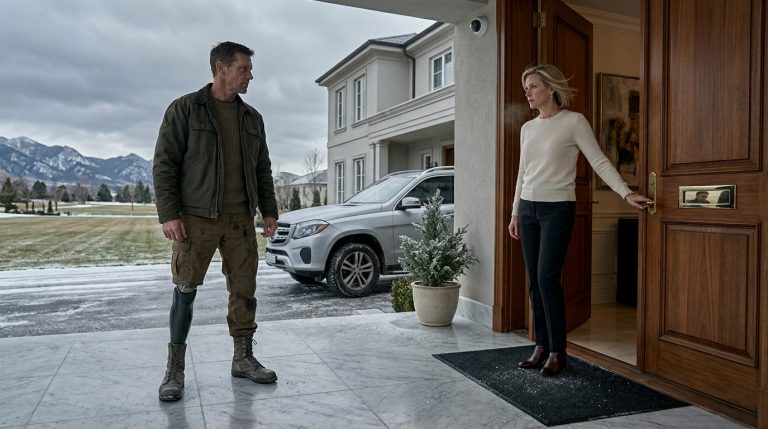
The Hydraulic Gambit: A Retired Engineer’s Precise Reconstruction of Justice in a Broken Suburban Landscape
CHAPTER 1: THE WEIGHT OF THE COLD
The smell of burned ozone was still lingering in the air, a sharp, metallic ghost of the life support we’d just lost. Outside, the ice storm had coated Willowbrook Heights in a translucent, suffocating shell, turning the suburban cul-de-sacs into a graveyard of snapped oak branches and downed power lines. But the silence inside my kitchen was heavier than the storm.
Sarah stood by the window, her silhouette framed by the faint, eerie glow of a battery-powered lantern. She didn’t speak, but her hands were trembling—not from the temperature, which was plummeting toward the single digits, but from the realization that our lifeline had been severed. My generator, the heart of our household and the only thing keeping the air—and the hope—circulating for our neighbor, Mrs. Graham, was dead.
I set the heavy, serrated metal of the bolt cutters onto the kitchen counter. The steel was cold, biting into my skin, but I didn’t feel it. Twenty-two years of calibrating missile guidance systems in the Navy had taught me one fundamental truth: when a machine fails, don’t look at the machine. Look at the operator.
“They cut it,” Sarah whispered. Her voice was flat, hollowed out by the sudden intrusion of reality.
“They did,” I replied. I walked to the drawer, my movements practiced and slow, retrieving the original 1963 subdivision blueprints I’d pulled from the crawlspace months ago. The paper was yellowed and brittle, smelling of dust and forgotten intentions.
I spread them out on the kitchen table. The house was dropping in temperature, but the cold was an external variable. I was calculating the internal pressure. Cheryl Blackwood thought she was enforcing a noise complaint; she thought she was pruning an invasive species. She had no idea she’d just kicked the supports out from under a gravity-fed drainage system that had been waiting forty years for someone with an engineer’s eye to notice it.
I traced the thick, faded ink lines of the storm water conduits, following them from the lowest points of the neighborhood—Cheryl’s pristine, white-trimmed ranch—upward to the highest elevation. Mine.
A sharp, persistent knock echoed from the front door. Not a neighbor’s tap, but the heavy, rhythmic thud of authority. It was 2:00 a.m. I looked at Sarah, then at the blueprints. The next move wasn’t about repair. It was about hydraulic pressure.
I didn’t reach for my coat. I reached for the flashlight. If they wanted a war, I was going to show them that in Willowbrook, the high ground wasn’t just a place to live—it was a weapon.
CHAPTER 2: THE VAULT OF GRAVITY
The cold didn’t just bite; it sought out the marrow. By the time I reached the edge of the property line, my breath was a jagged, white plume against the frozen dark. Willowbrook Heights was a tomb of silent, blacked-out houses, save for the occasional frantic sweep of a flashlight beam through a window. They were blind, huddled in their own insulation, waiting for the grid to magically reset itself.
They didn’t understand the geography of their own existence.
I found the utility cover beneath a thick, uneven drift of crusty snow near the northern ridge. It was an unassuming concrete square, flush with the frozen earth, marked only by a rusted iron ring that had been seized by decades of neglect. I jammed my pry bar into the seam, the metal groaning in protest against the ice. I leaned into it, my weight shifting, muscles burning, until with a sharp, percussive crack that sounded like a gunshot in the dead air, the seal broke.
I threw the cover back. It hit the frozen ground with a hollow thud.
Inside, the vault smelled of stagnant mud and the deep, earthy scent of ancient, undisturbed iron. I clicked on my high-intensity tactical flashlight. The beam cut through the dark, reflecting off six heavy valve wheels, each mounted to a secondary bulkhead. They were massive, industrial things, covered in a fine layer of orange oxidation, but they were still functional. I traced the labels etched into the brass plates mounted above them.
Zone 1. Zone 2. Zone 3.
The brass was cold enough to stick to my skin if I weren’t careful. I shone the light toward the end of the bank, where the Zone 6 valve sat. My pulse spiked, a rhythmic, steady thrum against the silence of the night. This was the choke point. The original developer had been an engineer’s engineer; he hadn’t built a neighborhood—he’d built a machine. He’d known that the natural topography of this basin would act as a funnel during a thaw, and he’d provided the manual overrides to prevent a catastrophe.
But Cheryl, in her infinite, arrogant wisdom, thought the HOA bylaws were the only law that mattered. She had no idea she was living downstream from a man who spent twenty years keeping destroyer-grade electrical systems from failing in the middle of a typhoon.
I reached out, my fingers curling around the cold, rusted spokes of the Zone 6 valve. I gave it a preliminary tug. It didn’t budge. The corrosion of forty years held it fast. I took a deep breath, braced my boots against the damp concrete wall of the vault, and applied slow, calculated torque.
Friction. The internal gears groaned, a protest of metal grinding against metal. A flake of rust drifted down like dead skin. I pushed harder, my knuckles whitening, my legs quivering with the strain. With a sudden, jarring shift, the valve stuttered. Then, it turned.
A deep, distant rumble began to vibrate through the soles of my boots—a subterranean, gurgling sound of trapped air and ice water shifting through the buried veins of the neighborhood. I froze, listening. It was the sound of the system waking up.
I looked at my watch. It was 2:24 a.m. I hadn’t just moved a valve; I’d shifted the neighborhood’s center of gravity. I needed to document this. I pulled out my digital camera and took a series of high-resolution shots of the vault, the valve position, and the serial markings on the housing. I needed a trail. If this turned into a fight, the “rules” would be the only thing keeping me out of a cell.
As I climbed out of the vault, I heard a distant, sharp sound—the slam of a car door from three streets away. Someone was moving. I shoved the cover back into place, kicking snow over the edges to obscure the disturbance. I didn’t need them to see the machinery yet. I needed them to feel the consequences first.
I walked back toward my house, my eyes scanning the dark landscape. The ice was starting to crack under the pressure of the rising water, a sound like glass breaking beneath the earth. Cheryl’s house was down there somewhere, dark and cold, blissfully unaware that the ground beneath her foundation was about to become the neighborhood’s lowest point.
I reached my porch and stopped. My security system, running on the backup battery bank I’d been nursing for hours, blinked a soft, rhythmic green. On the small monitor, a motion alert had just triggered. Someone was approaching the property line.
I didn’t turn on the lights. I simply sat on the porch steps, hidden by the shadow of the overhang, and watched the street. A white BMW sedan was idling at the curb, its headlights extinguished. It sat there for a long moment, a ghost in the ice. Then, a figure stepped out, clutching a clipboard like a shield.
Cheryl.
She wasn’t just here to complain about the silence. She was hunting for a reason to escalate. And I was going to give her everything she deserved, and not a drop more.
CHAPTER 3: THE BYLAW BATTLEGROUND
Cheryl didn’t see me sitting in the shadow of the porch, and I didn’t give her the courtesy of announcing myself. I watched her pace the frozen grass of my driveway, the beam of her flashlight dancing erratically over my garage door, searching for something—a violation, a loose wire, any excuse to declare my property a blight. She stopped, the light fixing on the conduit running from my generator shed.
“Compliance,” she muttered to herself, her voice thin and sharp, cracking in the sub-zero air.
I stood up, the floorboards of the porch creaking under my weight. The sound was distinct, a deliberate intrusion. Cheryl spun around, the flashlight beam hitting my chest before jumping to my face. She didn’t flinch. She just straightened her parka, her face hardening into that familiar, mask-like composure.
“Mr. Holloway,” she said, her tone a masterclass in performative surprise. “I hope you don’t mind me checking the premises. We’ve had reports of unauthorized modifications to electrical structures in the neighborhood. As HOA president, it’s my responsibility to ensure that everyone is abiding by the safety standards outlined in our covenants.”
“It’s two in the morning, Cheryl,” I said, descending the porch steps. The cold was a physical weight, but I felt strangely light. “And those ‘unauthorized modifications’ are the only reason your pipes haven’t already burst. My generator is permitted, inspected, and fully compliant with county fire codes. Try to shut it down, and you’re not just breaking bylaws; you’re obstructing emergency life support.”
She smiled, a tight, bloodless expression. “Emergency? This is a power outage, Rex, not a war zone. And I’m afraid the board has already drafted an emergency amendment. Effective immediately, all private power generation must be registered and subject to HOA ‘supervision’ to prevent inequitable distribution.”
She gestured to the board members—Janet and Dave—who had been lurking in the shadows of the street, just behind her BMW. They emerged like ghosts, their faces pinched with cold and a strange, eager malice.
“You can’t amend a contract like that without a vote, and you certainly can’t apply it retroactively to active emergency hardware,” I replied, my voice steady, stripped of all emotion. “Check your fine print, Cheryl. Section 12, Subsection 4. Emergency powers allow for management, not confiscation. You touch those cables, and you’re looking at a civil liability nightmare that will follow you long after this ice storm melts.”
Cheryl stepped closer, her perfume—a cloying, aggressive vanilla—fighting the sharp, metallic smell of the frozen air. “You think you’re so clever, don’t you? An engineer who thinks he can read law. But this is my neighborhood. I’ve built this place, brick by brick, contract by contract. And I don’t tolerate people who think they’re above the community standards.”
“I don’t think I’m above them,” I said, looking past her, toward the dark, sloping geography of our street. “I just think you don’t understand the ground you’re standing on. You see a neighborhood. I see a drainage basin. You see a generator. I see a piece of the city’s critical flood management infrastructure.”
She hesitated, a micro-flicker of uncertainty crossing her eyes. It was gone in a second, replaced by that stubborn, entitled fire. “Infrastructure? It’s a shed. And tomorrow morning, when the sun comes up, we’re going to have an emergency board meeting. You’ll be there, Rex. And you’ll bring that key, or we’ll have the county sheriff cut the lock for you.”
“I’ll be there,” I agreed.
She turned on her heel, her boots crunching sharply on the ice as she marched back toward the white BMW. Janet and Dave followed, their heads bowed against the wind.
As the car pulled away, the silence rushed back into the cul-de-sac, heavy and absolute. I turned back to the garage, my hand brushing against the pocket where I kept the vault key. I had twenty-four hours to prepare. I had to audit the HOA’s financial filings—the ones I’d been quietly scraping from the county website—and look for the seams in Cheryl’s story. If she wanted a battle of bylaws, I’d give her a war of ledgers.
I walked into the dark house, the cold air following me inside. Sarah was waiting in the kitchen, her eyes searching mine. I just nodded.
“She’s scared, Sarah,” I said, heading for my laptop. “But she’s doubling down. Which means she’s about to make a move that’s going to cost her everything.”
I opened the folder on my screen, the documents illuminating the room in a cold, white glow. The landscaping invoices from her husband’s company, the suspicious property acquisitions in the next county over, the sudden, unaccountable jump in HOA fees—the entire architecture of her fraud was laid bare before me. It was messy, it was greedy, and it was perfectly, legally damning.
I started to type, drafting a dossier that would turn tomorrow’s “emergency board meeting” into a courtroom of her own making. The ice outside continued to groan and snap, the storm showing no signs of breaking. The basement was dry for now, but the water was coming. And I was ready to turn the valve.
CHAPTER 4: THE SILENCE OF THE HARDWARE
The sound that jolted me from a fitful, adrenaline-fueled sleep at 2:17 a.m. wasn’t a bang. It was a dying gasp—the sudden, sickening pitch-shift of a diesel engine being choked to death, followed by the absolute, cavernous silence of a house deprived of its mechanical heartbeat. The temperature in the bedroom began to drop almost instantly, a tangible weight pressing against the skin.
I didn’t need to be told. I rolled out of bed, my feet hitting the hardwood floor, already reaching for the flashlight I’d left on the nightstand. Sarah stirred, her breath visible in the dark.
“Rex?”
“Stay put,” I said, my voice tight. “Don’t touch the medical equipment. I’m going outside.”
The house felt like a hollowed-out shell. As I moved through the hallway, the lack of the generator’s hum—a constant, rhythmic vibration I hadn’t realized I was relying on—made the silence feel like a physical assault. I kicked open the back door and stepped out into the frozen dark, the sub-zero air hitting my lungs like crushed glass.
My flashlight beam carved a path through the swirling mist of the ice storm. It found the generator shed, and my stomach turned. The heavy-duty padlock was still intact, but the rear housing of the generator had been smashed open with a blunt, desperate force.
I walked closer, my boots crunching rhythmically on the ice. The power cables, thick and insulated, had been severed with industrial-grade bolt cutters. The ends were clean, precise—the work of someone who knew exactly where to cut to kill the flow without risking their own life. It wasn’t an act of vandalism; it was a targeted, clinical assassination of our home’s survival.
I knelt, the cold of the concrete seeping through my trousers. I traced the copper strands, exposed and gleaming like bone in the flashlight’s glow. This wasn’t just Cheryl being petty. This was a direct, violent strike against the only thing keeping us—and Mrs. Graham—from the edge.
“Prove it,” I whispered, the words lost to the wind.
A sudden, sharp movement caught the edge of my periphery. A shadow, dark and flickering, darted behind the neighbor’s hedge. I didn’t chase. I stood, my chest burning with a cold, calculated rage that had no outlet. I was an engineer; I didn’t deal in frantic pursuit. I dealt in systems, and I knew exactly how to dismantle the one that had just targeted my family.
I returned inside, my hands trembling—not from the cold, but from the raw, unadulterated clarity of the situation. I walked to the kitchen and grabbed the thick Manila folder I had been working on. Inside were the bank statements and the invoices I’d pulled from the county’s public access portal. I flipped to the section on ‘Blackwood Landscaping Services.’
The numbers were staggering. The invoices were neat, professional, and entirely, breathtakingly fraudulent. They billed the HOA for twenty-four-hour snow removal during the height of the storm, for tree services in the middle of a blizzard, and for ’emergency drainage remediation’ that had never actually occurred. But it was the sub-total for the ‘community improvements’ that stopped me cold.
Fifty-three thousand dollars.
It was a beautiful, elegant web of greed. Cheryl wasn’t just hoarding power; she was laundering the neighborhood’s budget to cover her own bad bets on vacant properties in the neighboring subdivision. Every time she sent me a violation notice, every time she fined me for an imaginary infraction, she wasn’t just being a tyrant—she was balancing her own books.
I looked at the cut cable in my hand, then back at the folder. She thought she was cutting my power. In reality, she’d just handed me the switch to her entire life.
I walked to the living room, where Sarah was sitting, wrapped in a heavy wool blanket. She looked up, her face pale.
“The power is gone,” she said, her voice small. “The oxygen pump… it’s running on battery, Rex. Four hours, maybe five.”
I sat down next to her, the paper of the dossier rustling in the silence. I didn’t feel weak. I felt entirely, dangerously awake.
“We’re going to get the power back,” I said, my voice hard. “And we’re going to ensure that she never steps foot in this neighborhood again. She’s not just a bully, Sarah. She’s a thief. And she’s made the mistake of thinking I’m the one who doesn’t know how the system works.”
I stood up and walked to the window, watching the street. The white BMW was nowhere to be seen, but I knew she was out there, watching, waiting for us to panic, waiting for us to fold. I pulled out my phone. No signal. The neighborhood’s repeater, which I’d powered through my own generator, was dead.
She’d killed the communications, too. She wanted us isolated.
“I’m going to the police station,” I said, my resolve hardening into iron. “I’m going to tell them everything. But first, I’m going to check on Mrs. Graham.”
I grabbed my heavy coat, the weight of the dossier tucked firmly into my inner pocket. The war had officially moved past the property line. It was no longer about a shed or a generator; it was about the survival of the house, the integrity of the neighborhood, and the cold, hard truth of who held the power when the lights finally, inevitably, went out.
CHAPTER 5: THE WET RUN
The air in the utility vault was thicker now, heavy with the smell of wet earth and impending runoff. I was back inside, the flashlight clamped between my teeth, my gloved hands slick with condensation. The ice storm was officially ending, replaced by the relentless, mocking drip of a temperature spike that promised to liquefy the entire subdivision’s frozen foundation.
This was the “Wet Run.” I had to know if the Zone 6 valve would actually hold the pressure, or if forty years of sediment had turned the pipe into a sieve. If it leaked, the surge would be a trickle instead of a hammer.
I gripped the Zone 6 wheel. It was a massive, cast-iron ring, cold as deep space. I tightened my grip, my boots sliding slightly on the muddy floor of the vault, and forced the iron to rotate.
Grind.
The sound vibrated up through my forearms, the metal protesting the movement. I counted the turns. Half a rotation. A full rotation. The internal sluice gate was engaging. Suddenly, the deep, low-frequency hum of moving water returned, louder than before—the sound of a subterranean river being forcibly rerouted by a piece of metal the size of a dinner plate.
I stood in the dark, my heart hammering against my ribs, waiting. I checked my digital pressure gauge, which I’d wired into the secondary outlet. The needle began to climb. It was holding. The water wasn’t bypassing the gate; it was backing up. Downstream, in the lowest points of Willowbrook Heights, the sump pumps in those basements were about to start working significantly harder against a rising head of water they weren’t designed to handle.
I let out a breath I hadn’t realized I was holding. It worked. I had my hand on the throat of the neighborhood’s hydrology.
A sudden, sharp pinging noise erupted from above—the sound of a pebble hitting the vault’s metal cover.
I froze, the flashlight beam cutting off as I dropped to a crouch. My pulse echoed in my ears. Silence stretched out, heavy and expectant. Then, the rhythmic thud-thud of a car door closing. Footsteps. Fast, light, and purposeful.
“I know you’re in there, Rex,” a voice called out. It wasn’t Cheryl. It was Dave, her husband. The landscaping contractor. The voice was thin, stripped of its usual bravado, layered with a desperate, frantic edge. “The cameras don’t lie, buddy. I saw you walking this way on the footage. You’re tampering with HOA infrastructure. You think this is a game?”
I didn’t answer. I reached for the heavy pry bar I’d left on the floor.
“I’ve got the bolt cutters,” Dave continued, his shadow stretching across the gap in the vault lid. “And I’ve got enough of a headache from the damage to my company’s reputation. You come out of there, or I’m going to make sure that shed of yours isn’t the only thing that gets torn down.”
I looked at the valve. If I released the pressure now, the immediate danger to the neighborhood would dissipate, but the leverage I held over Cheryl—the leverage I needed to force the truth of her embezzlement into the light—would vanish with it. I had to stay the course.
I reached out, my fingers brushing the damp, silt-covered floor of the vault. My hand came away covered in a fine, gritty sludge. I paused. It wasn’t just common dirt. I held the flashlight beam over it, studying the texture. It was fine, grey, and oddly uniform. Industrial-grade abrasive grit. The kind used in commercial-grade water filtration or, more specifically, the kind used to clean heavy-duty pump impellers.
It was in the intake line.
I felt a cold shiver that had nothing to do with the freezing temperatures outside. This silt shouldn’t be here; the original design of this vault was a closed loop. If this grit was present, someone had been tampering with the intake valves before I’d even arrived. They’d been trying to force the system to fail, trying to create an artificial flood to justify even higher ‘remediation’ fees from their own landscaping company.
They weren’t just embezzling. They were sabotaging the entire neighborhood’s structural integrity to create their own ’emergency’ revenue stream.
“Dave,” I shouted up, my voice reverberating in the small concrete space, sounding hollow and strange. “You’re not here for the infrastructure. You’re here because you’re worried about what the county auditor is going to find when they look at those ‘remediation’ invoices for the Zone 6 drain.”
The silence above was absolute. I could almost feel his hesitation, the sudden, sharp realization that I wasn’t just a neighbor with a grievance—I was a man who knew the internal math of his crime.
“You don’t know what you’re talking about,” he snapped, though the confidence had drained out of his voice.
“I know that the grit in this line wasn’t here when I moved in,” I replied. “And I know that the Army Corps of Engineers doesn’t look kindly on private citizens who jam industrial sand into their flood-control systems.”
I heard a heavy metallic rasp as he shifted his weight. “You’re crazy. You’re going to get yourself killed.”
He didn’t wait for a response. I heard him scramble back, the crunch of his boots retreating rapidly toward the driveway. I stayed in the dark for a long time, listening to the drip of the water and the distant, groaning wind. My hand was still covered in the grey, abrasive grit.
The decoy secret—the embezzlement—was just the surface. This was something deeper. They weren’t just skimming off the top; they were intentionally breaking the spine of the neighborhood to ensure their services would always be required.
I climbed out of the vault, the cold air hitting me like a physical blow. The storm was turning to sleet, the ice on the trees beginning to release with sharp, echoing cracks. I had the evidence of the financial fraud, and now I had the physical trace of the sabotage.
I walked back to my house, the dossier in my pocket feeling heavier than ever. Tomorrow was the board meeting. I wouldn’t just be presenting a complaint. I would be presenting a forensic reconstruction of a crime. And if they tried to stop me, if they tried to use their board power to shut me down, they were going to find out exactly what happens when you push a system past its breaking point.
I looked back at the vault one last time. The earth was silent, but underneath it, the water was still shifting, still flowing, still waiting to reclaim its path. Justice, like the flood, was coming.
CHAPTER 6: THE PUBLIC RECORD
The bright, synthetic light of the Channel 7 news cameras made my eyes ache. It was a sharp, clinical contrast to the frozen shadows of the utility vault I’d crawled out of only hours before. I stood on the sidewalk in front of Cheryl’s home, my official emergency management vest feeling heavy and stiff against my chest. My hands were still stained with the grey, abrasive silt from the drainage intake—a detail I hadn’t thought to clean.
Mike Stevens, the news reporter, held his microphone with the casual detachment of someone who had seen a thousand suburban feuds but smelled, for the first time, a real story. Cheryl stood a few paces away, her face carefully composed into a mask of martyred indignation, her designer parka pristine despite the mud-slicked driveway behind her.
“Mr. Holloway,” Stevens began, his voice practiced and smooth. “Mrs. Blackwood is alleging that you are intentionally restricting drainage flow to specific sections of Willowbrook Heights as a form of retaliation. She claims your control of the subdivision’s infrastructure is a direct violation of community bylaws. How do you respond?”
I didn’t look at Cheryl. I looked directly into the camera lens.
“I’m not operating under HOA bylaws,” I said, my voice steady, amplified by the reporter’s mic. “I’m operating under Title 28 of the state emergency management code. During a declared disaster, private infrastructure—like this gravity-fed drainage system—is classified as critical emergency equipment. I have an approved operational plan on file with the county, and my duty is to prioritize life safety for vulnerable residents—the elderly, those on medical equipment, and families with young children.”
Cheryl stepped into the frame, her eyes glittering with a toxic cocktail of panic and rage. “That’s a lie! He’s just picking favorites! He’s using a secret valve in his backyard to flood my basement because I tried to enforce the rules on his noisy generator!”
“The valves aren’t secret,” I said, turning toward her. The camera shifted to capture the look on her face—the way her composure cracked at the edges. “They’re mapped in the 1963 site survey, documented as part of the county’s flood mitigation infrastructure. The reason your basement is flooding, Cheryl, isn’t because I’m picking favorites. It’s because your property sits at the lowest elevation in the basin, and you’ve been ignoring the maintenance protocols that keep the intake lines clear.”
I held up my hand, the grey, abrasive silt still visible on my fingertips. “I found industrial-grade grit in the Zone 6 intake line. The kind of grit that doesn’t just happen. It’s a deliberate sabotage designed to force ‘remediation’ work—work that, coincidentally, your husband’s landscaping company charges a three-hundred-percent markup for.”
The silence that followed was absolute. Stevens looked from me to Cheryl, his expression shifting from detached professionalism to sudden, sharp focus.
“Is that true, Mrs. Blackwood?” Stevens asked. “Are you billing the HOA for work caused by intentional sabotage of the drainage system?”
Cheryl’s face went white. She opened her mouth, but the only sound that came out was a strangled, indignant gasp. Behind her, the restoration trucks roared, their pumps fighting a losing battle against the rising groundwater.
“This is ridiculous!” she hissed, trying to move toward the camera, to block the shot. “He’s a disgruntled resident who’s trying to destroy my reputation! My husband and I have done nothing but serve this community!”
“Then you shouldn’t have any problem with the county audit,” I said, pulling the folder from my vest and holding it up. “I’ve already submitted the invoices and the site photos to the FBI’s regional field office. They’re very interested in how fifty-three thousand dollars in HOA fees managed to disappear into your family’s private accounts.”
Cheryl lunged for the folder, her nails raking the air near my face. I stepped back, and she stumbled into the icy slush of her own driveway. The cameras captured it all—the desperation, the raw, ugly reality of the woman who had thought she was the queen of the cul-de-sac.
“We’re done here, Cheryl,” I said, my voice cold and final.
I walked away, the weight of the moment pressing into me. I hadn’t won yet. I had only made it impossible for her to turn back. But as I reached the edge of the property, I felt the first heavy, wet flakes of snow begin to fall, and for the first time, I felt the true scale of what I’d started. I hadn’t just exposed a fraud. I had triggered a collapse. And tomorrow morning, when the authorities arrived, there would be no way to patch the damage I’d done.
CHAPTER 7: THE COLLAPSE OF THE CAUSEWAY
The living room of Cheryl’s ranch house was a testament to the vanity of suburban order, now rapidly dissolving into chaos. The air was heavy with the smell of damp carpet, the cloying stench of the vanilla candles Cheryl refused to extinguish, and the metallic, ozone-tinged scent of the industrial pumps straining in the basement below.
Twenty neighbors were crammed into the space, their faces a sea of nervous anticipation. When the front door opened, it didn’t just let in the chill of the evening; it let in the weight of the federal government. Agent Rodriguez didn’t need to shout to command the room. He simply walked in, his presence carving a clean line through the tension. He wasn’t alone. Two other agents flanked him, their movements rhythmic, disciplined, and entirely alien to this world of lawn maintenance and fence-height disputes.
Cheryl, standing by the makeshift podium, looked like a creature cornered. Her face was a patchwork of smeared makeup and rigid, defensive anger.
“Mr. Holloway,” Rodriguez said, his eyes scanning the room before settling on me. He didn’t offer a greeting. He simply nodded, a silent acknowledgment that the evidence I’d compiled—the folders, the photos of the grit in the lines, the audited invoices—was solid.
“This is a private meeting,” Cheryl snapped, her voice cracking. “You have no right to barge in here. I’m calling the police!”
“The police are already here, Mrs. Blackwood,” Rodriguez said, his voice quiet, calm, and terrifyingly final. “They’re currently cataloging the evidence in the utility vault on Mr. Holloway’s property. Specifically, the industrial-grade abrasives found in the intake lines. And they’re currently executing search warrants for your husband’s business records.”
The room went deathly silent. The only sound was the rhythmic thrum of the dehumidifiers in the basement, a heartbeat for a home that was physically sinking into the earth.
“Sabotage of critical utility infrastructure during a federal disaster declaration,” Rodriguez continued, his eyes never leaving hers. “Conspiracy to commit mail fraud. Embezzlement of HOA funds. It’s a compelling list, Cheryl.”
I watched her. I saw the moment her reality shifted. She wasn’t looking at the agents anymore. She was looking at the floorboards, at the walls, at the house she had weaponized against the very people she claimed to serve. She had treated this neighborhood like a kingdom, forgetting that a kingdom is only as stable as the ground it sits on—and she had spent three years digging out the foundation for her own profit.
“Rex,” she whispered, her gaze finding mine. There was no apology in it, no recognition of the lives she’d nearly destroyed, the oxygen machines she’d almost silenced. There was only a cold, jagged shock. “You were always the problem. You didn’t belong here.”
“I was the only one who bothered to read the blueprints,” I said.
I took a step toward her, the weight of the dossier in my hands finally feeling like something I could let go of. “You thought you were controlling the drainage. You thought you were controlling the neighborhood. But the developer knew better. He knew that when you build on a basin, you have to provide a fail-safe. You have to provide a way to flush out the rot before it pulls the whole thing down.”
She looked at me, then at the floor, where a hairline fracture was starting to snake through the hardwood, the wood groaning under the pressure of the rising water table. The house was settling, and it wasn’t just the foundation; it was the entire narrative she had built.
“It’s over,” Rodriguez said, stepping forward as the agents moved to surround her.
As the cold, unforgiving click of the handcuffs echoed through the room—a sharp, mechanical sound that cut through the humidity—I felt a profound, hollow exhaustion. I had won. The fraud was exposed, the sabotage was documented, and the neighborhood was safe. But as I looked at the neighbors, at Mrs. Graham sitting in her chair, holding her oxygen tube with white-knuckled intensity, I realized this wasn’t a triumph. It was a salvage operation.
I walked toward the door, leaving the wreckage behind. Outside, the night was cold and the ice was finally beginning to yield to the warming air. I reached the driveway and looked back at the ranch house, at the swirling lights of the federal vehicles reflecting off the ice-slicked street.
The system had worked, but it had required a catastrophe to prove it. I realized then that the true cost of the war hadn’t been the generator, or the money, or even the basement flooding. It was the fact that it had taken someone like me, someone with the tools to understand the mechanics of collapse, to stop a system that was designed to fail in the first place.
I walked into the dark, toward home, the sound of the water still gurgling deep beneath my feet—a constant, rhythmic reminder that the earth always levels itself, eventually.
CHAPTER 8: THE WEIGHT OF THE STEEL
The workshop was quiet, a stark, profound contrast to the chaos that had swallowed the neighborhood six months ago. The morning sun slanted through the window in thick, dust-moted shafts, illuminating the tools I had used to fight a war on a scale no one else had bothered to see. On the wall, framed in simple, dark wood, hung the official commendation from FEMA. It looked clinical, almost small, compared to the reality of the cold, wet nights I had spent in that utility vault.
I was cleaning the brass fittings of the valve wheels, my movements slow and meditative. The metal was cool and heavy in my hand, an artifact of an era that believed in permanence.
The door to the workshop opened, and Sarah stepped in, carrying two mugs of coffee. She didn’t say anything, just set them down on the workbench and watched me work. She knew the silence here. She knew that I wasn’t just maintaining the valves; I was honoring the design.
“The new audit results came in,” she said quietly. Her voice was steady, light with the kind of relief that only comes after the storm has completely passed. “The HOA board finished reconciling the books this morning. Every cent of the fifty-three thousand is accounted for, and the funds have already been moved into the emergency infrastructure account.”
I didn’t stop polishing. “And the drainage contracts?”
“Canceled,” she replied. “The new board voted unanimously to use the regional maintenance contractor. No more ‘emergency’ landscaping fees. No more ‘remediation’ scams.”
I nodded, setting the cloth aside. I looked at the framed documents on the wall. The embezzlement had been the decoy, the obvious, greedy surface of the rot. But beneath it had been the sabotage—the deliberate attempt to break the fail-safe, to turn a neighborhood into a victim of its own geography for a quick payout. Cheryl had been a parasite, but the system had been built by someone who understood that the only way to stop a parasite was to deny it the environment it needed to thrive.
The developer had known. He had buried his wisdom in concrete and cast iron, waiting for the moment when someone would be desperate enough—or cynical enough—to look beneath the surface.
“Mrs. Graham called,” Sarah added, a small, genuine smile touching her lips. “She says the new oxygen concentrator is quieter than a whisper. She wanted you to know she’s hosting the neighborhood picnic in her backyard this weekend.”
I finally looked up. The workshop felt solid, grounded, permanent.
“I’ll be there,” I said.
I picked up the heavy wrench I’d used to turn the Zone 6 valve, the tool that had been my primary weapon in a war fought with hydraulics and legal statutes. It was battered, stained with rust and silt, but it felt balanced.
I walked out to the backyard, toward the edge of the property where the utility vault was buried. The air was crisp, the smell of early autumn leaves replacing the stale scent of winter ice. I pushed aside the cover, revealing the six valve wheels. They looked different now—not like relics of a forgotten time, but like the controls of a ship that had finally weathered the storm.
I stood there for a long time, listening to the muffled, rhythmic gurgle of the system beneath me. The neighborhood was quiet, stable, and for the first time in years, truly secure. The drainage was perfect, the pressure balanced across every zone, the design functioning exactly as it had been intended forty years ago.
I realized then that the war hadn’t been about me against Cheryl. It hadn’t been about the HOA or the generator or even the money. It was about the weight of the steel. It was about taking responsibility for the ground you stood on and ensuring that the systems you built—the ones that keep the air flowing and the basement dry—were protected from the people who only saw them as assets to be drained.
I closed the vault, the heavy iron lid locking into place with a satisfying, final click. I didn’t need to check the valves again. I knew they would hold. I knew the design would stand. I walked back toward the house, my footsteps steady on the earth, leaving the machinery of the neighborhood to do exactly what it had been built to do: maintain the balance, hold the line, and wait for the next time the world tried to tear it all down.
I was home, and for the first time in a long time, the silence didn’t sound like a threat. It sounded like peace.