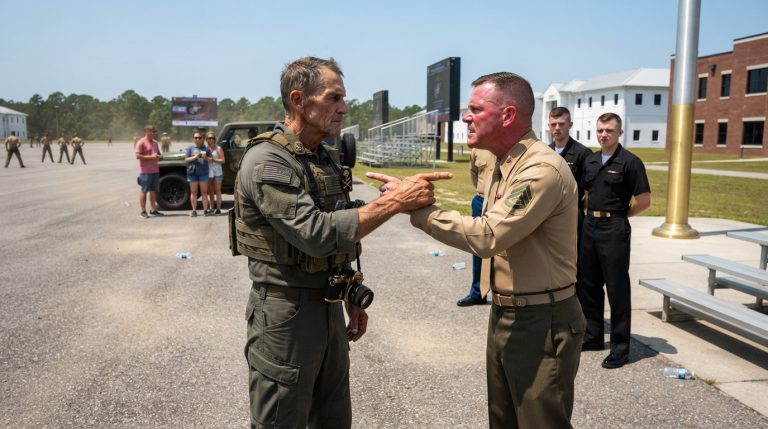
A Cold War in the Suburbs: The Calculated Demolition of an HOA Tyrant
CHAPTER 1: The Weight of Silence
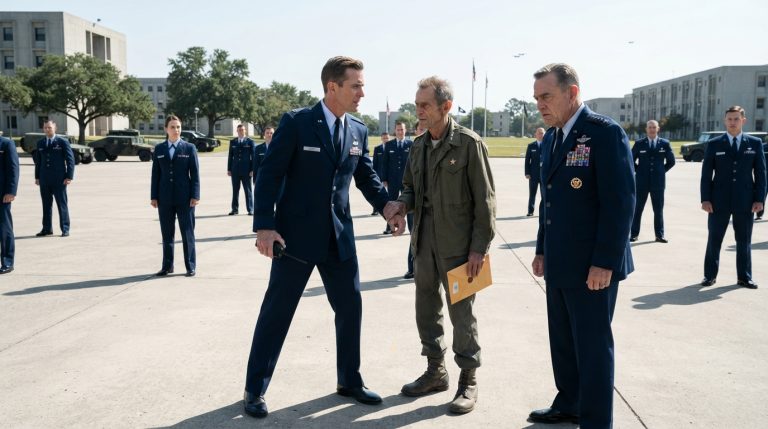
I stood in the center of what used to be my living room, the space now occupied by nothing but air and the bitter, cloying scent of fresh mulch. It was 3:00 a.m. My dress blues were heavy, stiff with the grit of a desert that felt a lifetime away.
Constance walked toward me, her heels clicking against the concrete foundation slab with the rhythm of a metronome. She held a small, shivering dog that looked more like a fashion accessory than a pet.
“Oh, honey,” she cooed, her voice barely rising above the hum of the distant highway. “You’re back earlier than expected. You really should have stayed on top of those dues. We had to reallocate the space for the community’s benefit.”
She didn’t look like a thief. She looked like a woman who had never known the weight of a ruck, a woman who measured the world in property tax assessments and visual consistency. She thought I was just another soldier who would fold, someone who would see a demolished house and accept it as the cost of doing business.
I looked at her, not with the rage she was clearly fishing for, but with the flat, dead-eyed focus of a technician checking a circuit. I thought of the Service Member Civil Relief Act—the bedrock of rights I’d spent months memorizing in the dark of a transport ship.
“Funny thing about that, Constance,” I said, my voice steady enough to be recorded for a deposition. “You seem to have forgotten that federal law doesn’t care about your community benefit. It doesn’t care about your ‘aesthetic guidelines.’ It only cares about the fact that you just committed a federal crime.”
Her smirk flickered, a momentary glitch in her practiced composure. She opened her mouth to interrupt, to offer a glib retort about private governance, but I cut her off. The air between us felt heavy, static-charged. She had no idea the scope of the machinery I had already set in motion before I’d even touched down on American soil.
She took a step closer, her eyes scanning my uniform, searching for a crack, an instability. She was the predator here, or at least she thought she was. She was looking for a veteran who would scream, someone who would lose his temper and hand her the evidence she needed to paint me as a threat.
“You’re a long way from a war zone, Mr. Thornfield,” she whispered, her voice dropping into that saccharine, dangerous tone she used to manipulate the neighborhood board. “Maybe you should have focused on your responsibilities at home instead of playing soldier overseas.”
I didn’t blink. I pulled a thin, leather-bound folder from my coat—not a weapon, but the beginning of an investigation. Her gaze dropped to it, and for the first time, her smile didn’t just freeze; it fractured. I hadn’t come home to a house, but I had come home to finish a war she didn’t even know we were fighting.
CHAPTER 2: The Paper Trail of War
“She’s a predator, Derek. She isn’t just playing by the rules of the HOA; she’s rewriting them in real-time.” Marcus’s voice crackled over the phone, tight and metallic, mirroring the state of my own mind.
I sat in the dim light of my temporary apartment, the air smelling of stale coffee and the ozone of a dying laptop battery. Around me, the floor was a graveyard of documents—receipts, bank statements, and the meticulously organized folders I’d built during my deployment. I held the power-of-attorney paperwork in my hand, my thumb tracing the embossed seal that Constance had so casually dismissed.
“She claimed my signature was invalid,” I said, my gaze locked on the document. “She told you civilian governance doesn’t recognize military proxies.”
“She didn’t just tell me, she bank-shot it through the local bank’s legal department,” Marcus replied. “I spent all day fighting their head teller. They have a paper trail, Derek. It looks like they have a signature from me—not yours, but a notarized document that says I surrendered my right to represent you.”
My stomach tightened, a familiar, cold sensation I hadn’t felt since the days of patrol. This wasn’t just administrative incompetence. This was a calculated strike. She hadn’t just bullied the HOA; she had infiltrated the financial institutions that backed it.
“Scan that document, Marcus. I need to see the notary’s stamp,” I commanded, pulling a fresh notebook toward me.
“Already on it. But that’s not the worst part,” Marcus hesitated, and the silence on the other end of the line was louder than the distant siren passing outside my window. “I did a deep dive into the property tax filings for the last three years. She isn’t just taking houses. She’s selling them to a company called ‘Pacific Property Solutions’ for pennies on the dollar, and then, six months later, they’re being flipped for three hundred percent profit.”
I began to scribble, connecting the dots. The math didn’t lie. Constance wasn’t interested in a well-managed neighborhood; she was interested in a high-velocity capital turnover. The “herb garden” she’d planted over my living room was a tactical choice—a way to keep the lot occupied and invisible while the property’s legal status was scrubbed clean for a future buyer.
“She’s using the HOA as a laundering front,” I whispered, the realization hitting me with the force of a physical blow.
“It’s bigger than that,” Marcus said. “I looked up the registered agent for Pacific Property Solutions. It’s a dead-end shell, but the IP address used to file the incorporation papers? It matches the HOA’s official server.”
The room felt suddenly smaller. My eyes moved to the window, watching the streetlights illuminate the edges of the room—sharp, unforgiving light that caught the dust motes dancing in the air. I wasn’t fighting a Karen; I was fighting an architect of ruin.
“She thinks I’m the one who’s going to break,” I said, my voice hardening. “She thinks that because I’m a veteran, I’m predictable. She thinks I’ll go to the police, file a harassment report, and let the bureaucracy grind me down while she finishes the job.”
“So, what’s the move?”
I looked at the map I’d drawn of the neighborhood, the houses marked with red and blue pens—the ones already targeted, the ones still standing.
“We don’t go to the police yet,” I said, my fingers gripping the pen until my knuckles turned white. “We need to hit the foundation. If she’s using the HOA server to file shell company paperwork, there’s a digital trail that even a real estate shark like her can’t scrub. I need to get into that server, Marcus. And I need to do it before she realizes I’ve identified the pattern.”
“That’s illegal as hell, Derek.”
“What she did to our homes is a federal crime,” I corrected, my tone clipped, transactional. “I’m not playing by the neighborhood rules anymore. I’m playing by the ones she established.”
I hung up and stood, walking to the window. In the distance, I could see the silhouette of my old neighborhood, dark and deceptively peaceful. Somewhere in that maze of manicured lawns, Constance was already planning her next move, likely drafting the next violation notice for a veteran currently serving in a desert halfway across the world.
She wanted a war of attrition. She wanted to see how much pressure a soldier could take before he snapped.
She had no idea that I had spent the last three years keeping the world’s most complex communication systems functional while missiles were screaming overhead. I didn’t snap. I calibrated.
I picked up my phone and dialed the number for the military legal aid office. It was 4:15 a.m. The operator sounded exhausted, but the moment I mentioned the Service Member Civil Relief Act and the specific patterns of the Willowbrook Estates property auctions, the tone shifted.
“Petty Officer Thornfield,” the voice said, suddenly sharp and professional. “We’ve been waiting for a lead like this. Can you provide the financial documentation?”
“I’m uploading the evidence to your secure cloud right now,” I said, my eyes tracking the reflection in the window—a man who had come home to nothing, but who was now ready to burn the whole structure down to find the truth.
But as I hit the send button, a ping sounded on my laptop. An email from an unknown sender. The subject line was blank. I opened it, my heart rate steady, my mind already calculating the risk.
It was a photo. A photo of my own front door, taken three years ago, before I’d left. But there was someone standing in the background, obscured by the shadows of my porch.
Constance.
She hadn’t just moved in after I left. She had been watching me before I even deployed.
CHAPTER 3: The View from the Trenches
The night air was thin, carrying the dry, metallic scent of iron pipes and disturbed earth. I kept low, my movements guided by muscle memory that hadn’t dulled in three years of service. Every snap of a twig sounded like a gunshot in the sterile silence of Willowbrook Estates.
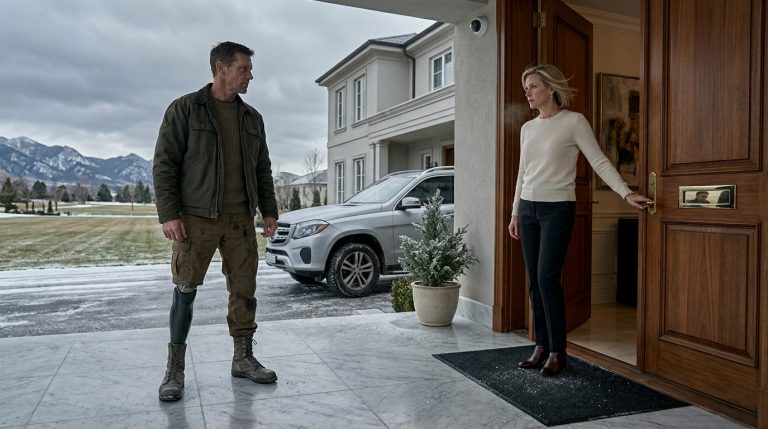
I was at the edge of the property that used to be mine. Now, it was a grid of freshly laid sod and the meticulously organized herb garden that Constance had installed to mask the void where my house once stood. From here, the mansion on the corner lot loomed like a fortress, its massive, circular driveway illuminated by spotlights that cut through the darkness with predatory precision.
I crept toward the center of the yard, pulling a small, handheld ground-penetrating sensor from my jacket. I wasn’t just here to document the destruction; I was here to find the flaw in her engineering.
The sensor hummed to life, a low, rhythmic vibration against my palm. I moved the device across the dirt. When it passed over the area beneath the basil rows, the screen flared red.
Commercial-grade irrigation piping. Thick, reinforced conduits that didn’t belong in a residential garden.
I knelt, digging my fingers into the dry soil. It was hard, compacted, and filled with sharp, crushed stone—fill dirt, not the organic topsoil a neighborhood HOA would use for a “community benefit” project. I traced the line of the pipe toward the corner of Constance’s mansion. It wasn’t just a garden; it was a utility bypass. She had tapped into the municipal main line without a permit, and she had done it with the kind of industrial hardware that required city-level access.
Suddenly, a light swept across the yard. I froze, pressing myself into the shadow of a decorative stone border.
A flashlight beam danced over the herb garden, then stopped, lingering on the patch of disturbed earth where I had been kneeling. A heavy set of footsteps crunched on the gravel walkway—Glenn Watsworth, the contractor. I could hear him breathing, a low, wet sound of exertion.
“I told you the soil wasn’t deep enough, Connie,” he muttered, his voice sounding oddly strained. “The inspectors are going to see the runoff if we don’t fix the drainage.”
“Fix it tonight,” came a sharper, more rhythmic voice. Constance. She was standing on her balcony, her silhouette framed by the harsh light of the mansion’s interior. “I don’t care how much it costs. That sight-line has to be perfect by the morning, or the broker won’t finish the paperwork.”
I didn’t breathe. I was less than ten feet from them. The “sight-line” wasn’t just about an aesthetic preference; it was about the valuation of her property. Every time a new house was cleared, her mansion became more central, more dominant, increasing the property value of the entire corner lot. It was a brutal, self-serving equation.
She turned back inside, and I heard the sliding glass door latch—a sharp, final sound.
I waited until Glenn retreated toward his truck before I pulled out my phone and triggered the camera, taking a series of high-resolution images of the exposed pipe and the illegal drain-valve he’d left partially uncovered.
This was the mid-point. The decoy secret. She wanted everyone to think this was a petty battle over property values and visual consistency. She wanted the neighbors to hate me for being a “troublesome veteran” while she silently stripped the financial value from the neighborhood.
But I knew better now. I thought of the shell company, the Pacific Property Solutions link. Why go to such extreme, high-cost lengths for a view? Because a view wasn’t just about aesthetic value; it was about inflating the assets in her shell-company portfolios.
I moved to the sidewalk, my pulse steadying. I had enough evidence for a municipal violation, but that wouldn’t stop her. She had a lawyer, Byron Crest, whose primary skill was delaying the inevitable. I needed something that would force the federal government’s hand.
I looked at the house again. My house. Or what was left of it. I realized then that the herb garden was just a symptom. The real disease was the paper trail in the HOA office, the one Marcus had warned me about.
As I turned to leave, my foot struck something buried just beneath the surface of the sidewalk: a small, hardened piece of plastic. I picked it up and brushed off the dirt. It was a keycard, embossed with the insignia of the local municipal building.
Constance hadn’t just bypassed the pipes; she had possessed the keys to the city’s utility infrastructure.
I slipped the card into my pocket, the sharp plastic edge digging into my skin. The game had just changed. She wasn’t just a rogue president; she was a ghost in the city’s own system, and she had left the door to her kingdom wide open.
CHAPTER 4: The Friction of Truth
The air inside the HOA office was stagnant, smelling of overheated toner and the dry, dusty rot of neglected paper. I stood in the dark, the small municipal keycard heavy in my pocket, its presence a constant, sharp reminder of the power I was playing with. I had twenty minutes before the night shift security patrol circled back to the front entrance.
My goal was simple: the HOA financial ledgers, specifically the logs for Pacific Property Solutions. If Marcus was right, the digital trail was mirrored in the hard-copy archives—a necessity for legal audits that Constance couldn’t fully scrub without triggering alarms.
I moved with the practiced, light-footed efficiency of a man who’d spent enough time in dark, confined spaces to navigate by heartbeat. I found the file cabinet. It was old, the drawer sliding open with a low, metallic groan that felt like a scream in the silence.
I flipped through the folders, my flashlight beam cutting a narrow, focused path across the rows of manila files. Rodriguez. Kim. Wright. Names of veterans I knew, families whose lives had been gutted just like mine. I pulled their files, the paper abrasive against my fingers. Every single one followed the exact same pattern: manufactured code violation, refusal of proxy, rapid auction, sale to a Watsworth-affiliated entity.
“Perfect,” I whispered, the word tasting like lead.
But as I reached for the ledger labeled ‘Financial Disclosures 2024-2025,’ my hand struck empty space. The slot was vacant. I pulled the drawer out further, scanning the gaps. The ledger wasn’t there. Nothing from the last six months was there.
I looked at the floor. Tucked behind the bottom runner of the filing cabinet was a scrap of paper. I retrieved it—a carbon copy of a ‘Property Abandonment’ notice. It was dated for tomorrow.
The name on the notice wasn’t mine. It was Martha Coleman.
My heart hammered against my ribs. This was the decoy. This was the moment she wanted me to find. She was baiting me, pushing the escalation forward to catch me in an act of breaking and entering before I could ever reach the shell company records.
A sharp, rhythmic click-clack echoed from the hallway outside. Heels.
I shoved the files back, the drawer sliding home with a violent, final metallic slam that seemed to vibrate through the walls. I dove into the shadows of the supply closet just as the door swung open.
Constance entered, her silhouette sharp against the light of the hallway. She wasn’t alone. Glenn Watsworth trailed behind her, his heavy boots sounding like hammers on the linoleum.
“He’s been here, Glenn,” Constance said, her voice devoid of any pretense of sweetness. It was cold, clinical, the tone of a technician evaluating a failed experiment. “I can smell the ozone from his thermal gear.”
“How are you so sure?” Watsworth asked, his voice low and guttural.
“Because he’s acting exactly according to the profile,” she replied, walking straight toward the filing cabinet. She didn’t look around; she knew. She walked with the confidence of someone who owned the air in the room. “He thinks he’s playing detective. He thinks he’s going to save the little widow down the street. It’s pathetic, really. These people are so tethered to their sentimentality that they can’t see the architecture of the move.”
She pulled the drawer open. I held my breath, my lungs screaming for oxygen, my hand hovering over the combat knife clipped to my belt. The light of her flashlight swept the room, resting momentarily on the very spot where I had been standing thirty seconds earlier.
“He took the hint about the Coleman file,” she noted, her voice showing a flicker of amusement. “He’s going to try to intervene. And when he does, he’ll be trespassing on an active, legally sanctioned auction. That’s a felony, Glenn. A felony for a veteran who’s already on thin ice with his command.”
“And if he doesn’t take the bait?”
“He will,” she said, shutting the drawer. “He’s incapable of doing anything else. The system is designed to trap his kind. By the time he realizes this isn’t about saving a house, he’ll be in a cell waiting for a court-martial that he’s already earned.”
They exited, the door clicking shut with a finality that hit me like a physical blow.
I stepped out into the room, the adrenaline leaving me in a cold, shivering rush. I hadn’t found the ledger. I had been out-maneuvered, and I had handed her exactly the leverage she needed to destroy my credibility. I was playing into her hand, and the more I tried to push back, the tighter the knot around my own neck seemed to pull.
I looked at the notice for Martha’s house again. Tomorrow. The trap was set. My instinct was to run to Martha, to scream, to force the issue, but that was the trap.
I leaned against the cold, unyielding steel of the filing cabinet, the weight of the realization sinking in: I was the variable she was waiting for. And if I didn’t stop acting like a hero and start acting like a strategist, both Martha and I would be finished by sunrise.
CHAPTER 5: The Auction of Broken Dreams
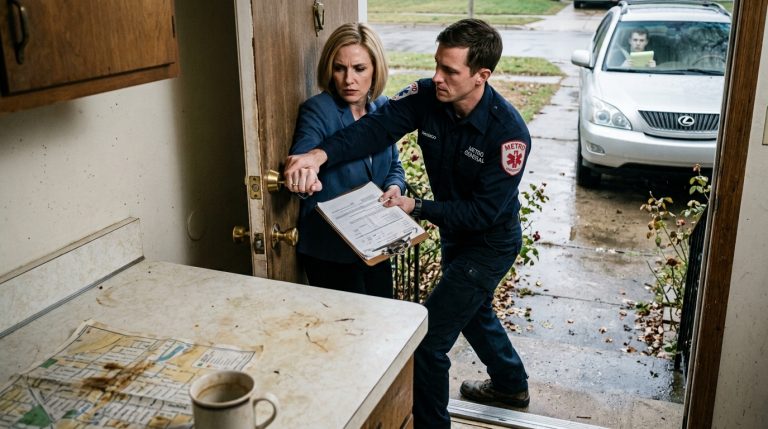
The morning air was thick with the scent of damp grass and the ozone from idling police cruisers. I pulled my car onto the curb just as a black SUV with tinted windows rolled up behind the modest blue cottage. Martha was standing on her porch, clutching a cardigan around her shoulders, her face a mask of trembling disbelief.
I didn’t wait. I hit the ground running, my boots biting into the soft earth of the yard.
“Martha! Don’t sign anything!” I shouted, my voice cutting through the mechanical drone of the neighborhood.
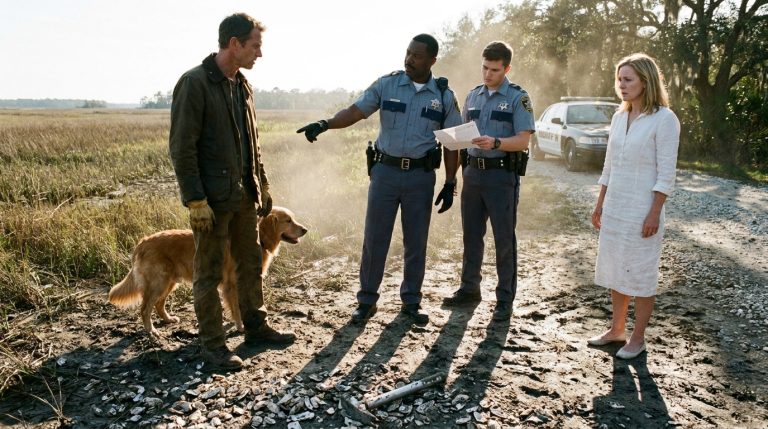
Two officers stepped out of their cruiser, their hands resting on their holsters. Their expressions weren’t hostile, just weary—the look of men who had been ordered to enforce a law they didn’t fully understand.
“Mr. Thornfield,” the lead officer said, his voice flat. “Stand back. There is a court-ordered lien enforcement currently in progress. You are in violation of a restraining order filed by the HOA board.”
“That order is based on perjury!” I retorted, stepping into the yard. “This is an illegal seizure under the Servicemembers Civil Relief Act. There’s an ongoing investigation!”
Constance Blackwater stepped out of the black SUV. She looked immaculate, wearing a light trench coat that seemed designed for the precise level of chill in the air. She didn’t look at me; she looked at her watch. She was holding a tablet, the deed for the house already prepared for an electronic signature.
“Officer, he’s creating a public disturbance,” Constance said, her voice smooth and conversational. “This is private property, and he has no legal standing here.”
“I have standing!” I stepped closer, my mind calculating the tactical layout. If I forced the police to arrest me, I would be out of the loop for the next forty-eight hours. If I didn’t, Martha’s home would be sold in ten minutes.
Glenn Watsworth stood by the porch, holding a set of legal documents. He looked at me with a smirk that was entirely devoid of empathy. He wasn’t the enemy; he was the tool, and he knew it.
“Give it up, Derek,” Watsworth called out. “The paperwork is filed. The judge signed off on it an hour ago. The house is already technically under the management of Pacific Property Solutions.”
The name hit me like a physical punch. Pacific Property Solutions. The shell company.
I looked at Martha, who was weeping silently now. My hands were balled into fists, the muscle in my jaw jumping. The trap was perfect. If I moved, if I tackled him, I was done. If I did nothing, the last piece of Martha’s life—her connection to her deployed son—would be gone.
“Let me see the deed,” I demanded, forcing my voice to remain calm, analytical.
Constance tilted her head, a flicker of genuine curiosity in her eyes. She handed the tablet to the officer, who stepped toward me with the caution one would use with a live grenade.
I scanned the digital document. It was a masterpiece of legal obfuscation. It wasn’t just an auction deed; it was a quit-claim document, signed by an agent representing the “authorized heir.”
The name on the deed: P. Williams.
The same alias Constance had used on the Facebook page.
I looked up at her, catching her eyes. For a fraction of a second, the mask slipped. There was no pity, no concern for community standards, just the predatory satisfaction of a move completed. She had used an alias to fake a legal claim to the property, creating a fraudulent paper trail that would take months to unwind in court. By the time it was exposed, the house would be gutted, the land sold, and the paper trail long gone.
“This is fraud,” I said, my voice quiet, terrifyingly steady.
“This is a legal transfer of assets,” Constance replied, her voice chillingly devoid of emotion. “You really should have learned when to walk away, Mr. Thornfield.”
She nodded to the officers. “Proceed.”
They moved toward Martha, their hands reaching for the papers. I didn’t tackle them. I didn’t scream. Instead, I pulled out my phone and dialed the only number that mattered.
“Agent Torres,” I said when the line connected, my eyes never leaving Constance. “The auction is happening right now. They’re using a fraudulent deed signed by an alias. You need to be here, and you need to bring the warrant.”
The line went silent for a second, then Torres’s voice cut through, sharp and fast. “I’m two blocks away. Do not engage. I repeat, do not engage.”
I turned to Constance, who was watching me with a smug, calculated patience. She thought she had won. She thought she had trapped me in a legal gridlock.
She didn’t know that the federal government was already parked around the corner. She didn’t know that every word of this conversation was being logged by the very federal agent who had been tracking her shell companies for the last six months.
I held my ground as the officer reached for Martha’s arm, my focus shifting from the house to the woman who thought she was the architect of this entire reality. The game wasn’t ending; it was just becoming public.
CHAPTER 6: The Architects Fall
The sound of the federal sirens wasn’t just a noise; it was the final note of a long-composed symphony. They converged on the scene like a tactical pincer movement, three black SUVs blocking the driveway and the service access behind the herb garden. Constance didn’t look at the officers; she looked at the sky, as if searching for a loophole in the clouds.
Agent Torres stepped out of the lead vehicle, her stride rhythmic and authoritative. She didn’t draw her weapon, but her presence was a blunt-force trauma to the atmosphere. Behind her, two marshals moved with practiced speed, flanking the porch where Martha stood, still clutching her documents.
“Constance Blackwater,” Torres announced, her voice echoing across the quiet suburban street. “You are under arrest for federal mail fraud, conspiracy to violate civil rights, and organized racketeering.”
Constance didn’t move. She turned, her gaze settling on me. For a second, the mask of the neighborhood curator didn’t just slip—it dissolved. There was no rage, only a hollow, terrifying pragmatism.
“You think you’ve won, Derek?” she whispered, her voice like grinding glass. “You think you’ve restored justice? You’ve just dismantled a profit engine that was keeping this entire municipal budget afloat. They didn’t just tolerate my methods; they relied on them.”
“Tell it to the judge,” I said, stepping forward. I reached into my pocket and pulled out the utility keycard I’d scavenged. I tossed it onto the grass between us. It landed with a dull thud. “And tell them about the irrigation bypass. That wasn’t just about a view. That was about funneling municipal water into your shell-company development sites.”
Her eyes widened, not in fear, but in recognition of the mistake. She hadn’t accounted for the physical evidence. She had assumed I was obsessed with the house, the emotional tether, the sentimentality she thought was my greatest weakness. She had completely failed to account for my training as an electronics and systems specialist. I didn’t just see the house; I saw the infrastructure underneath it.
As the marshals cuffed her, she didn’t struggle. She went limp, a calculated surrender. She was already mentally drafting the motion to suppress, already looking for the next layer of legal defense. But then Torres leaned in, her voice low and tight.
“We have the ledger, Constance. The one you tried to burn. We recovered the back-ups from the HOA server’s off-site cloud storage. Your own contractor gave us the encryption keys.”
Constance’s resolve shattered. The sound of the handcuffs clicking shut was the loudest thing in the world.
I turned my back on her as they led her toward the vehicle. I didn’t watch her go; I didn’t need the satisfaction of the visual. My focus was on Martha. I walked up to the porch and took the fake deed from the officer’s hand. I tore it in half, then into quarters, the paper fluttering to the ground like dead leaves.
“It’s over, Martha,” I said, my voice finally losing its edge.
She let out a long, shuddering breath, her hands finally relaxing. Around us, the neighborhood began to wake up. Front doors opened. Neighbors stepped out onto their lawns—the same people who had stood by and watched while families were evicted, the same people who had been too afraid to speak. They looked at me, then at the black SUVs, then at the patch of dirt where my home used to be.
The truth was laid bare: the herb garden wasn’t a community project. It was a grave marker for a series of crimes that had been happening in broad daylight.
Agent Torres approached me as the SUVs pulled away. She held out a file. “We have enough here to implicate the city treasurer, the bank branch manager, and two of the town council members. You didn’t just catch one bad actor, Derek. You pulled the thread on a regional systemic rot.”
I took the file, feeling the weight of the paper in my hand. It was thick, heavy, and full of names. I looked out over the yard, the sunlight finally breaking through the morning mist, hitting the empty space where my living room had been.
The house was gone, but the foundation was starting to settle.
I looked at the shell of the herb garden, the broken stone, the exposed, illicit pipes. It wasn’t about the property. It was never about the property. It was about the fact that once you know how the system works—once you understand the leverage, the hidden conduits, and the paper trails—you can never go back to just being a tenant of your own life.
I stood there for a long time, listening to the silence of the neighborhood returning to normal. But it wasn’t the same silence as before. It was the silence of a structure that had been gutted and was now, finally, ready to be rebuilt correctly.
I walked to my car, my boots heavy with the grit of a war I had finally finished. I didn’t look back at the lot. I didn’t need to. I had the truth, and for the first time in years, the ground beneath me felt solid.