A Legacy of Limestone and Law: How One Montana Family Held the Line Against encroaching Greed
CHAPTER 1: THE SOUND OF THE BORDER
The air in Fergus County held the sharp, metallic bite of a coming spring, the kind that smelled of melting snow and dormant limestone. I was on the back porch, a ceramic mug of black coffee warming my palms, when the sound arrived. It wasn’t the wind, and it wasn’t the rhythmic lowing of the herd in the south pasture. It was the distinct, sharp tension of high-tensile steel giving way to bolt cutters.
I set the coffee down on the weathered cedar railing. The porch boards creaked beneath my boots as I descended, my gaze already fixed on the northern perimeter of my grandfather’s land.
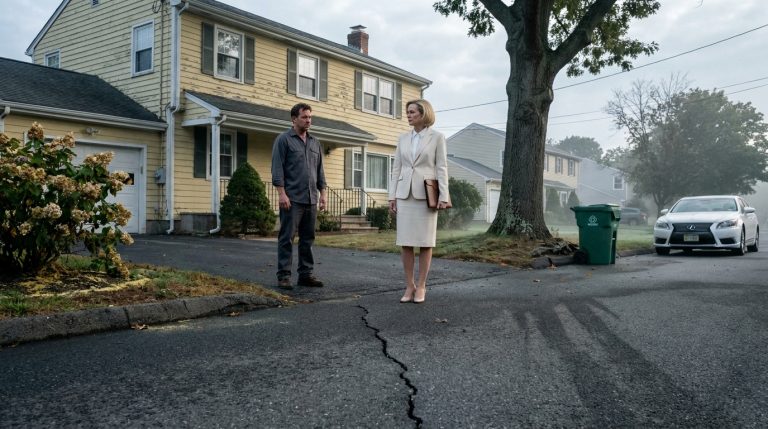
The pre-dawn gray did little to hide them. A fleet of ATVs sat idling like hungry insects near the fence line, their headlights cutting yellow swaths through the thin morning mist. Eight men in crisp, tactical polos stood in a line, their movements disciplined, purposeful, and completely foreign to the quiet solitude of Big Spring Creek. In the center of the staging ground stood Tatum Sinclair. She was dressed for a boardroom, not a pasture, in a quilted white vest that seemed to defy the rugged reality of the Montana dirt.
As I walked out across the gravel drive, the crunch of stone beneath my boots felt like a countdown. My father, William, had walked this ground for eighty-four years, his life measured in the slow growth of calves and the predictable cycles of the seasons. He was still inside, unaware that the boundary he had protected for nearly a century was currently being erased with a set of industrial shears.
Tatum turned as I approached. She didn’t look like a trespasser; she looked like an architect admiring a structural defect she was about to correct. Her smile was practiced, tight, and held no warmth.
“Mr. Peton,” she greeted, her voice carrying easily over the low hum of the idling ATVs. “Good morning. The Sweetgrass Hollow community has decided to exercise its prescriptive easement rights to our creek access. We’ll be here documenting use for the next sixty days.”
I stopped a few paces from her, my hands tucked into the pockets of my Carhartt jacket. The smell of exhaust hung heavy in the damp air, fouling the scent of pine and earth. My eyes drifted past her to the surveying tripods they were already leveling into the soft soil of my grandfather’s pasture.
She stood there, confident in her presumption, waiting for a reaction—an argument, a shout, an appeal to reason. She didn’t know that my mind was already shifting, bypassing the anger and settling into the cold, clinical rhythm of the bench I had occupied for twenty-five years. I looked at the wire, now swinging limply in the breeze, and saw not just a broken fence, but the first move in a game she thought she was winning.
“Mrs. Sinclair,” I said, my voice quiet, cutting through the morning stillness with the weight of absolute authority. “You are currently standing on private property. And you are about to discover that you have made a very expensive mistake.”
CHAPTER 2: THE ECHOES OF THE PORCH
The silence that followed my ultimatum didn’t just hang in the air—it curdled. Tatum Sinclair’s smile didn’t vanish so much as it hardened, calcifying into something brittle and dangerous. She stood there on the edge of my grandfather’s pasture, the morning light catching the pearls at her ears, making them look like small, polished bone. Behind her, the security crew in their tactical gear stood like statues, their attention shifted from the tripods to the tension radiating off their employer.
“A mistake, Mr. Peton?” she said, her voice dripping with a carefully curated condescension. She glanced at the bolt-cut fence, then back at me. “The law doesn’t care about your sense of ownership. It cares about documentation. And we have plenty.”
I didn’t answer. To engage her further here, on the edge of the creek, was to grant her the performance she was looking for. Instead, I turned my back. I didn’t rush, and I didn’t look back to see if she was watching. I walked with the deliberate, heavy stride of a man who knows the exact square footage of the ground beneath him.
The crunch of my boots on the gravel drive was the only sound for several seconds, rhythmic and steady. My mind was already parsing the legal landscape—not the one she wanted to debate, but the one defined by statute. I had spent twenty-five years on the bench, and one thing I knew about the law was that it was a machine built on momentum. Once you tripped the lever, the gears would turn whether the people involved wanted them to or not.
I reached the porch and paused, feeling the familiar, grounding texture of the wood beneath my hand. It was the same railing my grandfather had smoothed with his own calloused palms, the same one my father gripped every morning when he looked out over the limestone bluffs. I stepped into the house.
The kitchen was still cold, the air thick with the smell of my cooling coffee and the faint, lingering scent of my father’s Sunday cigar. William was sitting at the kitchen table, his hands wrapped around his mug, his eyes fixed on the blank space above the cabinets. He looked smaller than he had ten minutes ago, the fabric of his flannel shirt hanging loosely on his frame.
“They’re still there, aren’t they?” he asked without looking up.
“They are,” I replied, moving to the counter to pour a fresh cup. The liquid was dark and steady as it hit the mug. “But they won’t be for long.”
My father finally looked at me. His eyes were that pale, sharp blue—the eyes of a man who had seen drought, fire, and two world wars, and had kept his land through all of it. “You sound like your grandfather, Garrett. He didn’t raise his voice to Harold Sinclair, either. He just made sure the county records were so tight you couldn’t pull a thread loose without the whole coat coming apart.”
“That’s exactly what I’m going to do,” I said. I pulled my phone from my pocket. My thumb hovered over the screen. The urge to act—to call, to demand, to force—was a physical thrum in my blood, but I suppressed it. Pragmatism was the only weapon that held any weight here. I thought of the coffee shop scene, the way she had invaded his space, the way she had dared to suggest his own community didn’t respect his presence. It wasn’t just a trespass on the grass; it was an attempt to overwrite the history of the house itself.
A memory surfaced, unbidden, like a phantom in the kitchen: my mother’s hands, covered in soil, planting the wildflowers that were now being crushed by the tires of those ATVs. She had always said that if you took care of the land, the land would take care of you. I had lived my life believing in the fairness of the system, in the sanctity of the deed. Watching Tatum Sinclair on my property had shattered that illusion. She didn’t believe in the land; she believed in the leverage of the present.
I turned to the den, my footsteps muffled by the worn rug. I needed a different kind of record. I sat at my desk and pulled out a leather-bound journal, the one where I kept the notes on the regional zoning board proceedings. I didn’t need to shout at the sheriff or start a brawl. I needed the paper trail. If the Sinclairs wanted to talk about prescriptive easements, I would start by pulling the original deeds from 1924, then I would cross-reference the tax filings for the Sweetgrass Hollow development.
I looked at the window. The sun was rising higher now, casting long, sharp shadows across the valley. My father walked past the door, his gait slow but steady, heading out to the back porch. He was going to watch them. He was going to stand his ground, just as he always had.
“Garrett?” he called out from the porch.
“Yes, Daddy?”
“Don’t worry about the noise. They’re making a lot of it, but they don’t know the first thing about the soil under their feet. It’s too rocky for what they’re trying to build.”
I looked down at the documents on my desk—the tax assessments, the property maps. He was right. The land had a memory. And it was time to remind everyone else what that meant. I started typing, the keys clicking with the precision of a clock. Every line of the upcoming legal motion would be built on the bedrock of the truth, and unlike the Sinclair’s claim, the truth wasn’t something you could cut with a pair of shears.
The tension in my chest didn’t dissipate, but it clarified. It turned into a cool, sharp focus. I had a clear path forward, and for the first time in years, I felt the familiar weight of the bench beneath me—the sense that I wasn’t just a man on a porch, but a steward of the law itself.
CHAPTER 3: THE COFFEE SHOP CONFRONTATION
I didn’t move from the desk until the sun had fully cleared the limestone ridges, turning the valley into a bowl of harsh, unforgiving light. The notes on my screen were exhaustive. I had tracked the zoning filings, cross-referenced the land titles, and mapped the encroachment. But as I pulled up the latest digital submission from the Sweetgrass Hollow HOA, my eyes caught a detail that slowed my breath.
There, buried in the metadata of a document supposedly filed by their lead council, was a timestamp that didn’t align with the physical reality of the site. They claimed to have surveyed the creek bed on a day when the Fergus County records showed the area was under six inches of slush—impossible for the precise tripod measurements they claimed to have taken.
It was a physical discrepancy, a flaw in the fabric of their lie. I leaned back, the leather of my chair groaning, and realized that Tatum Sinclair hadn’t just been sloppy; she had been desperate. Or perhaps, she had simply assumed that no one would bother to look at the math.
I stood and walked out to the kitchen, where my father was still nursing the same cold mug of coffee. His posture was rigid, his gaze still directed toward the back door. He didn’t turn when I entered, but he spoke as if he’d been waiting for my signal.
“They’re packing up the tents, Garrett. They’re moving them closer to the water line.”
“Let them,” I said, my voice steady, stripped of the morning’s lingering agitation. “They’re building their own evidence against themselves.”
I didn’t tell him about the discrepancy. Not yet. I needed to see if they would double down on the error. Instead, I went to the mudroom and pulled on my boots. The leather was stiff, smelling of dust and dried oil, a sharp contrast to the sterile, electric air of the study.
“I’m heading into town,” I told him. “I need to talk to Helen at Mountainside Coffee. If they’re as confident as they look, they’ll be showing their faces there soon.”
“They go every Tuesday and Thursday at ten,” my father said, finally turning to face me. The age in his face seemed to weigh heavier in the daylight, a map of hard years written in deep, shadowed lines. “They sit in the back corner, the one Helen keeps for us. They think they own the room because they own the lots next door.”
“Then I’ll be there before they arrive.”
The drive into Lewistown was a study in stillness. The truck’s suspension rattled against the washboard ruts of the county road, a rhythmic, abrasive sound that matched the grinding of gears in my own mind. Every mile was a reminder of the geography of the conflict. This land wasn’t just dirt; it was the sum total of every choice my father and grandfather had made. To lose it would be to lose the anchor of our existence.
I arrived at Mountainside Coffee at 9:30 a.m. The shop was quiet, the air smelling of roasted beans and burnt sugar. Helen Brockway was behind the counter, her hands moving with a practiced, efficient grace as she wiped down the stainless steel. When she saw me, her expression didn’t change, but her eyes held a spark of recognition.
I didn’t head for the back corner. I sat at the counter, facing the front window.
“Garrett,” she said, her voice a low, gravelly note. “Your father’s been a fixture here since the shop opened. He doesn’t deserve to be talked down to in his own town.”
“He won’t be,” I said. “Not today.”
At 9:55, the door swung open. The sound of the chime was a harsh, discordant note in the quiet room. Tatum Sinclair walked in, flanked by two women I recognized from the HOA board meetings. They didn’t carry the tactical gear of their security team, but they wore the same look of smug, proprietary ownership. They headed straight for the back corner, their heels clicking against the hardwood floor with a deliberate, aggressive rhythm.
I didn’t turn around, but I watched them in the reflection of the glass display case. They were already laughing about something, their voices thin and sharp. They were comfortable. They were powerful. And they had no idea that they were standing on a map that I was currently dismantling, piece by piece.
Tatum paused as she reached the table, her eyes scanning the room. She looked at me, a brief flicker of recognition crossing her face, but she dismissed it with a wave of her hand, turning to pull out a chair. It was the same chair my father had sat in for thirty years.
I stood, my movements slow, calculated. I didn’t rush toward them. I walked with the deliberate pace of a judge entering a courtroom, the weight of the law—real, documented, and immutable—resting on my shoulders. As I approached their table, the laughter faded, replaced by a sudden, heavy silence that felt like the drop in pressure before a storm.
Tatum stopped in the middle of a sentence. She looked up at me, the smile she had been wearing for her friends faltering, her eyes narrowing as she processed my presence. She didn’t look like a woman who had just realized she was losing; she looked like a woman who couldn’t believe someone would dare to challenge her seating arrangement.
“Mr. Peton,” she said, her voice tight, the rehearsed warmth completely absent. “I don’t recall inviting you to our table.”
I stopped a few feet away, letting the silence stretch, forcing her to occupy the space I was creating. I could see the tension in the way she gripped her handbag, the subtle tightening of her jaw. She was used to being the one to define the environment, the one to set the tone.
“You aren’t going to have much of a table to sit at, Mrs. Sinclair,” I said, my voice quiet, cutting through the ambient noise of the shop. “Not by the time I’m finished with your documentation.”
Her eyes flared, a flash of genuine anger breaking through the veneer of her professional poise. “Is that a threat?”
“It’s a correction,” I replied. “And you might want to consider how much more you’re willing to lose before you decide to stop.”
I held her gaze for a beat longer than was comfortable, then turned and walked toward the exit. I didn’t look back to see how she reacted. I didn’t need to. The damage was done. The seed of doubt had been planted, and in the geography of the law, that was the first step toward a collapse.
CHAPTER 4: THE PAPER TRAIL
The walk back to my truck felt like moving through drying cement. My nerves were vibrating, not with adrenaline, but with the focused, rhythmic thrum of a clockwork mechanism. I didn’t look back at the coffee shop. I didn’t need to. I knew exactly what they were doing: they were huddled over their cold cups, convinced that their social influence was a shield, completely unaware that I had just turned the key in the lock of their cage.
I climbed into my truck, the smell of old upholstery and dry dust filling my lungs. I sat there for a moment, gripping the steering wheel. The leather felt cracked and worn beneath my palms, a tactile reminder of the time that had passed since I had last truly been in the fight. I had spent twenty-five years behind a bench, watching from a distance as the law was twisted, bent, and broken by people who viewed it as a suggestion rather than a mandate. But this? This wasn’t a civil case. This was a direct, calculated attack on the only thing that had ever mattered.
I reached for my phone. My movements were slow, deliberate. I bypassed the sheriff—Drew was a good man, but he was bound by county protocols—and dialed Bethany Llewellyn’s private line.
“Garrett?” she answered on the first ring, her voice tight. “I heard about the coffee shop. You shouldn’t have gone there.”
“I needed to see if they were still buying their own bluff,” I said, putting the truck in gear and pulling away from the curb. The tires crunched against the loose gravel and pavement, the sound sharp and grating. “They are. They think this is about land. They have no idea it’s about the fraud.”
“We’re ready,” she said, and I could hear the rustle of papers on her end, the sound of a lawyer preparing for a deposition. “I’ve got the zoning complaints they filed against your father. All three were filed in the last six weeks, Garrett. This wasn’t a grievance—it was a siege.”
“Keep digging,” I told her, my eyes fixed on the road ahead, watching for the turn that would take me back to the ranch. “I found a discrepancy in their digital survey logs. A timestamp error that puts them at the creek on a day when the county records show the ground was under six inches of slush. They’re building a foundation on top of a lie.”
“That’s a felony, Garrett. If we can prove they filed that with the county, we have them on wire fraud.”
“I’m going to prove it,” I said. “I’m going to go to the county recorder’s office right now. I don’t want digital copies. I want the physical filings. I want to see the notarization on those documents.”
I hung up and navigated toward the courthouse, a building of limestone and history that stood like a fortress in the center of the town. My heart wasn’t racing. It was steady. It was the rhythm of a man who was no longer guessing. As I walked up the courthouse steps, I felt the familiar weight of the building’s atmosphere—the smell of old parchment, the silence of a space designed to hold truths that had been buried by time.
The county recorder, a woman named Martha who had been there since before I was born, looked up as I approached the counter. She saw the look in my eyes and didn’t bother with the usual small talk about the weather or my father’s cattle. She just pulled the file.
I opened it on the counter, the pages heavy and stiff. I scanned the filings, my finger tracing the lines of the Sinclair development documents. The notary seal on the second page—the one that legalized their claim to the creek—was faint, the ink bleeding slightly into the grain of the paper. I pulled a magnifying lens from my pocket, a tool I’d kept in my chambers for years, and leaned in.
The name signed under the seal was Stanley Pierce.
A chill, cold and sharp as the mountain air, settled into my marrow. Stanley Pierce. He hadn’t just been a name in a file; he was someone I recognized from my own past. He had been a low-level clerk in the district court when I was a young prosecutor, a man who had moved to Billings years ago, reportedly to start a private consulting firm.
The room seemed to tilt. This wasn’t just a local dispute. If Stanley Pierce was involved, it meant the Sinclair’s web of fraud stretched far wider than Fergus County. It meant they were pulling strings that crossed county lines, leveraging a network of compromised professionals to manufacture their own version of reality.
I stood there for a long time, the silence of the office pressing in on me. The realization was like a physical weight. My perception of the conflict had shifted. I wasn’t just defending a boundary; I was tracking a system of rot.
I closed the file, my knuckles white against the heavy paper. Martha watched me, her expression unreadable, waiting for me to say something. I didn’t. I couldn’t. The magnitude of what I was seeing was too large, too complex to put into words, and I knew that if I spoke, I would give away the fact that the hunter had just become the architect of their downfall.
I left the courthouse and walked back to my truck. I didn’t drive back to the ranch. Instead, I pulled over to the side of the road, parked, and sat in the quiet. I looked out over the fields, the vast expanse of land that had belonged to my family for over a century. It looked the same as it had when I left, but I knew the truth now. It was under siege, and the enemy was far more dangerous than a woman in a quilted vest. They were a virus, and it was my responsibility, not as a rancher, but as a man who knew the law, to excise them from the earth.
CHAPTER 5: THE FORCED HAND
The roar of the engine was distinctive—a deep, modulated hum that didn’t belong to a tractor or a standard farm truck. It was the sound of something over-engineered, a high-end vehicle pushing too hard against the gravel of the Peton access road. I didn’t wait to identify the make or model. I jammed my truck into gear and spun the steering wheel, the tires biting into the dirt as I executed a tight, aggressive U-turn. My pulse was a steady, iron beat against my temples.
They weren’t just pushing; they were accelerating the timeline.
I kept my distance, staying low behind a line of brush as I followed them from a mile back. They were heading straight for the main gate, the one Tatum had cut with bolt cutters just days ago. When I reached the rise that overlooked the pasture, I saw them. It was a black SUV, sleek and out of place against the backdrop of the limestone cliffs. Three men had stepped out—not the security team from before, but men in suits that cost more than a year of my father’s calf crop.
I killed the engine and stepped out, the wind biting at my face. I didn’t reach for a weapon—I didn’t carry one. I reached for the weight of my position, the knowledge of the statutes, and the cold, hard memory of the man I had been for twenty-five years on the bench. I started walking down the slope, my boots finding purchase on the loose shale.
By the time I reached the gate, they were already debating with my father. William stood on the other side of the wire, his frame slight but his posture unyielding. He held his grandfather’s pocket watch in one hand, the gold chain glinting in the harsh afternoon light.
“Mr. Peton,” the lead man said, his voice smooth, practiced, devoid of any genuine human inflection. “We’re from the development office. We’ve been authorized to discuss the boundary adjustment. There’s no need to make this a legal circus.”
“The circus is already in town,” my father said, his voice gravelly but unshaken. “And you’re standing in the ring.”
I stepped around the bend of the fence, the crunch of my boots loud in the stillness. “Boundary adjustment?” I said, my voice cutting the air. “Is that what you’re calling it today?”
The lead man turned. He was younger than I expected, with eyes that scanned me the way a merchant scans a ledger—calculating risk, measuring worth, looking for a way to buy the problem. “Secretary Peton,” he said, and the way he said the title was meant to be a salute, but it felt more like a stain. “We didn’t know you’d be present. We thought we could settle this as neighbors.”
“We aren’t neighbors,” I said, moving to stand beside my father. The rust of the old fence felt cold under my fingertips. “And you aren’t here to talk. You’re here because you realized the notarization on your claims is about to fall apart.”
The man’s smile didn’t reach his eyes. “That’s a heavy accusation, sir. I’d be careful about who you share that with.”
“I’m sharing it with the Attorney General’s office,” I said, my voice rising just enough to carry the threat. “And I’m sharing it with the court-appointed receiver who’s already processing your dissolution.”
The silence that followed was absolute. For a second, the mask of professional indifference slipped, and I saw it—the flicker of genuine, primal fear. He hadn’t expected me to know that. He hadn’t expected that the ‘weekend judge’ was tracking their movements through the back channels of state government.
“We have a deed,” the man persisted, though his voice lacked the earlier conviction. “We have the right to access this creek.”
“You have a piece of paper, signed by a ghost of a notary who doesn’t even have a license in this state,” I said, stepping closer. I didn’t raise my voice; I didn’t need to. The facts were a weapon sharp enough to cut through any pretense. “Every survey you’ve filed, every easement you’ve claimed—it’s all being audited as we speak. If you’re here to offer another check, keep it. You’ll need it to pay for your defense counsel.”
The man looked at his associates, a silent exchange of panic passing between them. The arrogance that had fueled their morning was evaporating, replaced by the crushing realization that their institutional shield had been compromised.
“You’re making a mistake,” he whispered, a final, futile attempt at intimidation.
“The mistake was in 1928,” my father spoke up, his voice clear and resonant. He gestured to the land, the limestone, the creek that had run through these acres long before the first Sinclair had ever set foot in Montana. “When your lot tried to buy this place from my mother. We’re still here. You lot? You’re just passing through, and you’re leaving nothing but wreckage.”
They didn’t wait for a rebuttal. They retreated to the SUV, the heavy doors slamming with a sound that felt final. As they reversed, tires spinning and throwing gravel, I didn’t feel a sense of triumph. I felt only a grim, grinding exhaustion. This was the escalation. They had played their hand, and now, they were being forced to face the consequence of their own greed.
I looked at my father. He was looking at the fence, at the place where the wire had been cut, then repaired. He looked tired, but his eyes were steady.
“They’ll be back with a court order, won’t they?” he asked.
“They’ll try,” I said. “But the courts don’t work for them anymore. They work for the state. And the state has a very long memory.”
I turned to walk back to the house, but I stopped. I looked at the ground near the gate. There, partially buried in the dust, was a small, plastic survey marker—the kind the Sinclairs used to mark their “development sites.” I reached down and picked it up. It was cheap, synthetic, and utterly out of place on this ancient, limestone-streaked earth. I tossed it onto the hood of their retreating SUV as it passed, a small, symbolic act of rejection.
The battle was moving into its final, most dangerous phase. They knew I was the architect of their demise, and they would do anything to stop the hammer from falling. I took a deep breath, the smell of sage and dry earth grounding me, and walked back toward the porch. The work was only beginning.
CHAPTER 6: THE CAPITOL MANEUVER
The drive to Helena was a blur of high-desert monotony, the landscape stripped of color by the afternoon sun, yet my mind was moving with the precision of a clock. I didn’t stop for fuel or food. Every mile of asphalt was a step toward the office, toward the portfolio sitting on my desk that would effectively end the Sinclair project. My father had stayed behind at the ranch, a silent, steady sentinel who understood that the defense of our land had shifted from the fence line to the state capital.
When I pulled into the capitol complex, the building was a monolith of copper and marble, reflecting the dying light in a way that felt almost predatory. I walked the corridors, the sound of my boots on the polished stone echoing like a judge’s gavel. The security detail at the entrance nodded, their familiarity with my face now habitual, yet I felt a strange distance from them. I wasn’t just a bureaucrat today; I was an instrument of the very law they were sworn to protect.
I bypassed the main entrance of the Secretary of State’s suite and entered through the side door. Howell Brennan was waiting inside. He looked like he hadn’t slept since Friday. There were folders spread across the mahogany conference table—a thick, interconnected web of corporate registration, tax liens, and falsified bank statements.
“They’re panicking, Garrett,” Howell said, not bothering with a greeting. He shoved a file toward me. “They tried to move four hundred thousand dollars in ‘HOA reserve fees’ into a private account in Billings just two hours ago. My contact at the bank flagged it under the new directive. It’s sitting in escrow now, locked.”
I opened the folder. The numbers were staggering. It wasn’t just greed; it was an industrial-scale operation, a machine that had been designed to harvest wealth from unsuspecting homeowners and funnel it directly into the pockets of the Sinclair development firm. They had used the community’s trust as collateral for their own lifestyle, a betrayal so complete that it was almost clinical.
“This is it,” I said, my voice barely a whisper in the high-ceilinged room.
“It’s enough,” Howell replied. “The dissolution order is ready. The criminal referral package is complete. All it needs is your signature, and it’s public record.”
I picked up the silver fountain pen—the one that had sat in the desk since 1971—and held it in my hand. It was cold, the metal biting into my skin. For a moment, I looked at the signature page. This wasn’t a judicial ruling from the bench; it was a administrative act of force. By signing this, I was shattering the veneer of the Sinclair empire, exposing the rot for all to see.
“What happens when they find out?” I asked.
“They won’t have time to react,” Howell said. “The media is already circling the Northern Hotel for that real estate summit. I have a team ready to serve the dissolution papers the moment you hit send on the digital registry update.”
I signed my name. The ink was dark and steady against the paper, a permanent scar on the history of their corporation. I didn’t feel a rush of victory. I felt the weight of the office settling into my bones.
“Get it done,” I said.
As Howell hurried out, the room felt suddenly empty. I walked to the window and looked out over the city of Helena. The sun had dipped below the horizon, and the first stars were beginning to prick the darkening sky. Down below, the lights of the city hummed with the quiet, indifferent pulse of everyday life, unaware that three blocks away, a system of corruption was about to be dismantled.
My phone vibrated in my pocket. A text from Bethany. The HOA board is in an emergency meeting at the clubhouse. They’re tearing themselves apart.
I didn’t reply. I sat at the desk and pulled out a clean sheet of paper, beginning to draft the speech for the morning. It wasn’t the speech I had written on Sunday. It was something else entirely—a statement on the duty of the state to its citizens, a declaration that the land, and the laws that governed it, were not for sale.
I was exhausted, but it was the clean exhaustion of a task finally set right. I had spent years on the bench waiting for a case that mattered, a case where the right thing was also the hardest thing. I had found it. The Sinclair’s arrogance had been their undoing, but their mistake had been thinking that a rancher who knew the law was a man they could push aside.
The silence of the capitol was profound. Somewhere in the distance, I could hear the faint, melodic chiming of the clock tower, marking the passage of time—a time that was running out for the people who had dared to cut my father’s fence. I closed my eyes, picturing the creek, the limestone, and the way the morning light would look on the pasture tomorrow. It would be a new day, and for the first time in a long time, the land would belong to those who respected the history written in its soil.