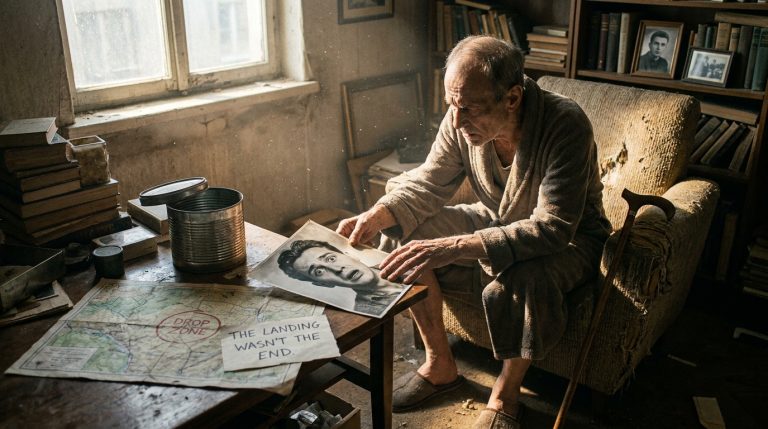
Iron in the Hedgerow: How Scattered Common Sense Shattered an Empire’s Machine
CHAPTER 1: THE BLACK SKY
The static hissed inside the empty harness long before the silk bloomed above my head.
There was no glory in the drop, only the deafening roar of engines and the violent snap of a strap biting hard into my collarbone.
I hit a flooded drainage ditch hard enough to rattle my teeth, the cold French mud rushing up to fill my mouth and blind my eyes in a single suffocating second.
Around me, the night was dead silent save for the distant, rhythmic thrum of transport planes fading toward the coast.
I spat out the grit, unbuckled the wet webbing with numb fingers, and reached instinctively for the radio strapped to my chest.
The toggle switch clicked loose, but nothing answered except a flat, unbroken hum of dead air.
The maps and frequency codes were soaked through, turned into useless pulp inside a ruined pocket.
I was completely alone in a tangled maze of unfamiliar hedgerows, and the first gray streaks of dawn were already beginning to bleed across the horizon.
CHAPTER 2: SILENCE IN THE DARK
The silence in the Norman orchard felt heavier than any wall of steel.
Across the wet grass, the dark silhouettes of ruined stone barns jutted into the mist like broken teeth.
I checked the cylinder of my Colt, the metal slick with a mixture of morning dew and river mud.
There were no radio signals to guide my steps, and no friendly voices echoing through the fog to tell me where the rest of the third battalion had fallen.
Every rustle of leaves in the underbrush carried the sharp weight of an unseen sentry waiting for a mistake.
A heavy iron latch clicked somewhere inside the nearest farmhouse, and the faint, dry scrape of boot leather on gravel cut short the stillness of the dawn.
CHAPTER 3: THE DECAPITATED LINE
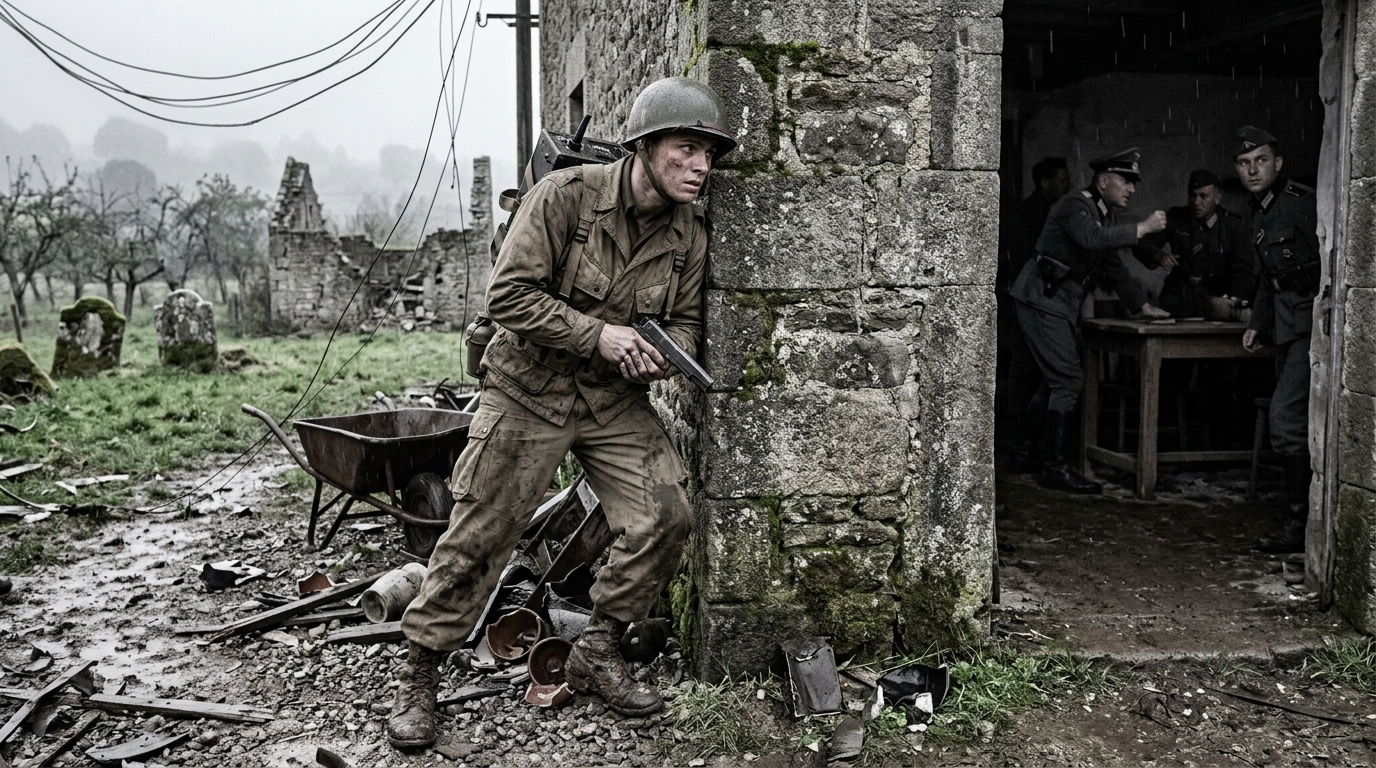
The shadow in the doorway did not belong to a friend, and the crisp, clipped German commands echoing from the kitchen proved that our scattered drop had landed right inside a local command node.
I kept my breathing shallow, tucking my shoulder hard against the damp stone wall while a staff officer inside slammed his fist down on a wooden table in pure frustration.
Telephone wires hung limp and severed from the exterior wall, trailing uselessly into the wet clover like dead serpents.
The enemy officers were shouting over one another, frantically demanding situation reports that no runner could deliver because every road outside was blocked by our isolated squads.
Their rigid communication network was fracturing under its own weight, paralyzed by the sheer impossibility of an enemy appearing everywhere at once.
A heavy boot scraped across the interior floorboards, heading directly toward the side exit where I stood waiting in the dark.
CHAPTER 4: THE HIDDEN BATTERY
The German officer stepped straight into the threshold, his eyes widening as he stared down the barrel of my weapon in the dim morning light.
— Drop it, — I muttered, my voice flat and exhausted from hours of crawling through wet ditches.
Instead of freezing, his hand twitched toward his holster with automated rigidity, entirely bound by a doctrine that refused to compute a lone, battered enemy standing in their doorway.
I didn’t hesitate, driving my boot forward to slam the heavy door back into his chest before he could clear leather.
Across the open courtyard, the distant thunder of heavy 105mm howitzers shook the dew from the apple trees, reminding us of the guns pounding our boys down on Utah Beach.
With only a handful of scattered men to back me up, we had to dismantle that artillery nest piece by piece using nothing more than grit and cold calculation.
A sharp burst of submachine gun fire rattled from the trench line behind the barn, signaling that the assault was already underway.
CHAPTER 5: THE ROAD TO CARENTAN
The water rose knee-deep, pulling at our legs with the heavy, sluggish suction of a Norman marsh.
Ahead of us, stone walls and slated roofs loomed through the gray drizzle, defended by an elite enemy regiment that refused to yield an inch of the crossroads.
Major Friedrich von der Heydte stood near a shattered brick pillar, his uniform soaked and his jaw set with the unyielding arrogance of a professional officer defending his last line.
— You think persistence replaces tactical science, — he barked over the crackle of distant rifle fire, his voice tight with disdain for our uncoordinated assault.
I didn’t answer with speeches or grand military theories, because we had no maps left to trace and no high command to guide our steps.
We simply kept moving forward through the freezing mud, wearing down their rigid defenses through sheer, exhausting stubbornness.
A sudden burst of heavy machine-gun tracer fire tore across the flooded ditch, forcing us down into the muck just yards from their primary barricade.
CHAPTER 6: THE DUSTY GRAY DAWN
Major von der Heydte clenched his jaw, refusing to offer a single word of surrender as his elite defensive line finally splintered under the relentless, stubborn weight of our advance.
He doubled down with a bitter demand for order, insisting that our scattered tactics violated every established rule of military science.
— Rules don’t hold a crossroads when the lines are gone, — I said, wiping a streak of dark mud from my forehead with a stiff sleeve.
We didn’t rely on high-level maps or corporate coordination to win the day, because those advantages had been stripped away the moment we hit the dark Norman sky.
Instead, we endured the grinding friction, kept our common sense intact, and forced their rigid machine to break against our sheer refusal to quit.
The heavy stone barricades stood silent at last, and the dusty gray light of morning settled peacefully across a secured road that now linked the entire beachhead from end to end.