The Weight of Quiet Stones: A Story of Suburban Malice, Federal Overreach, and the Enduring Architecture of Restoration
CHAPTER 1: THE ADRENALINE DUMP
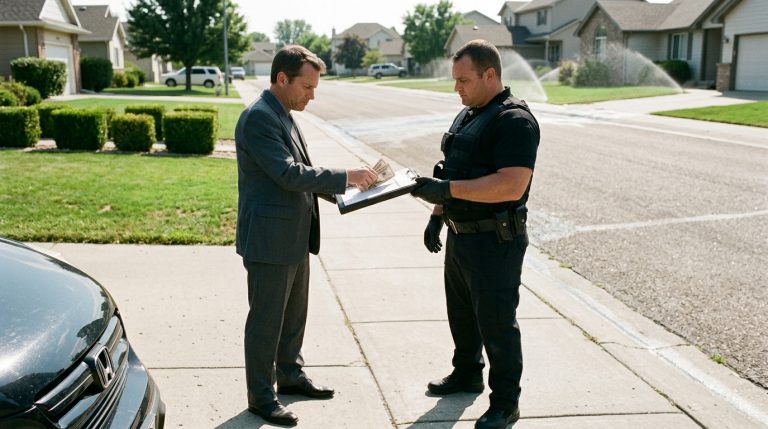
The steering wheel of the Subaru vibrated under Grant’s palms at seventy-four miles per hour, the concrete seams of Interstate 5 southbound ticking off a rhythmic, mechanical countdown. Through the hands-free receiver, the world had shrunk to the gravel driveway he had inherited from his father—a place built on the slow, unhurried logic of hemlock roots and dry stone. Now, it was a tactical grid. He could hear the low, deliberate register of an officer named Winston verifying identity cards, the wind catching the microphone of Jorge’s pickup, and the distinct, hollow silence that follows the arrival of federal authority in a residential zone. By the time Grant cleared the Nisqually flats, his throat tasted like copper.
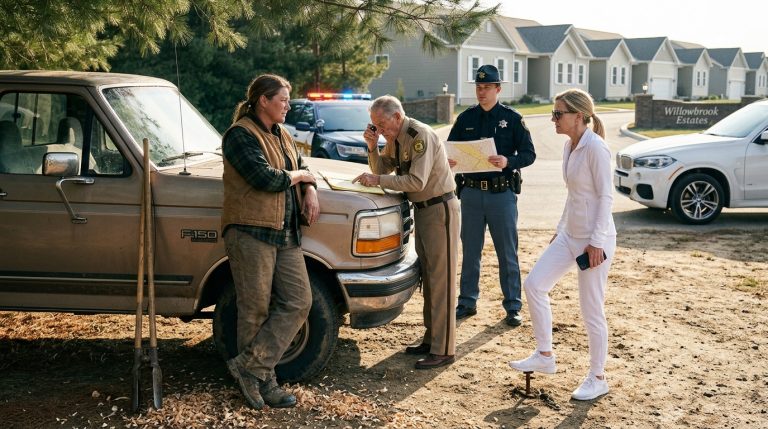
When the tires finally hit his own gravel at 5:44 p.m., the government SUVs were gone, leaving behind only the heavy scent of exhaust lingering in the damp April air. The Nieto Landscape Design truck sat idling near the turnoff, its exhaust pipe puffing faint white plumes against the dark backdrop of the cedars.
Grant killed the ignition. The silence of the property rushed back in, but it felt fractured, empty of the casual norteño rhythm that usually marked the late afternoon wrap-up. Jorge Nieto was sitting on the top step of the porch, his elbows resting on his knees, his work khakis dusted with the grey grit of the crushed basalt they had been laying for the path. His hands, usually so precise when adjusting a level or lining up a joints-faced stone, were shaking with the slow, rhythmic tremor of an adrenaline crash.
“Jorge,” Grant said, stepping out and letting the car door click shut with a heavy, deliberate thud. He didn’t offer a quick reassurance. He didn’t minimize it. He simply sat down on the cold wood beside him, his wool blazer brushing against Jorge’s canvas sleeve.
Jorge didn’t look up immediately. He watched a red-breasted nuthatch dart between the branches of an ocean spray bush near the dry ditch. “They had Luis behind the truck, Grant. Twenty-three years old. His first morning putting boots on a commercial site.” His voice was flat, stripped of the warmth that usually carried across the acreage. “He had his work authorization. He had his birth certificate from Oaxaca. He had everything folded in a plastic sleeve like his mother told him to keep it. But his hands were shaking so bad he dropped the I-94 in the dirt. The lead agent had to pick it up.”
Down in the cab of the idling truck, Rafael and Tomas sat with the windows rolled down, staring straight through the windshield at the cedar line. The space between the properties felt altered. To the north, across the dry ditch, the clean, white-painted cedar fences of Cedar Hill Ridge Estates gleamed under the gray sky, the towering two-million-dollar structures looking down like silent, neutral sentinels. Behind one of those triple-paned kitchen windows, Grant knew, the cream cardigan had disappeared, leaving only the silent consequence of a phone call.
“Where is Luis now?” Grant asked quietly.
“Lucia came,” Jorge said, finally looking over, his eyes bloodshot around the rims. “She took him back to Lacey an hour ago. He didn’t want to leave the truck, but he couldn’t stop looking at the road every time a utility vehicle passed. He kept saying, ‘Tio, I didn’t know America could do that to me.’ On my own job site, Grant. On a project named after Archer.”
Grant looked toward the back three acres, where the stone circle stood complete—hand-carried river rocks from Frog Run, set without mortar, held together purely by gravity and fit. His father had insisted on that design before the lung cancer took him; he said the earth didn’t need concrete to hold something true. Now, the circle looked small against the vast, shifting weight of the institutional machinery that had just rolled through the driveway.
“We cover the week for Luis,” Grant said, his voice dropping into the steady register he used when structural calculations shifted on site. “Full hours. No deduction. Tell Lucia he stays home until the air clears.” He stood up, the damp cold of the porch step settling into his joints. He extended a hand to Jorge, feeling the rough, calloused palm of a man who had spent eighteen years building the cleanest compliance record in Thurston County. “I am going to find out exactly how the tip came in, Jorge. We aren’t letting this settle into the dirt.”
Jorge stood, his frame straight but tired. “Rafael will be here tomorrow. Tomas will be here. We have the firecracker penstemon to plant before the May rains.” He walked down the steps toward the truck, his boots heavy on the gravel.
Grant watched the taillights of the landscape truck fade down the long driveway until the red glow vanished behind the hemlocks. The dusk was settling fast now, turning the vibrant green of the lupine leaves into shades of slate and charcoal. He walked inside the cold kitchen, didn’t turn on the overhead lights, and picked up the receiver to call the one person in Olympia who understood exactly how institutional systems moved when someone pulled a lever in the dark.
CHAPTER 2: THE RIGHT NUMBER
“Do not call her, Grant. Do not drive across the gravel, and do not let your anger breathe on a computer screen.”
Elaine Stanhope’s voice carried the precise, rhythmic cadence of someone who had spent thirty-five years listening to people ruin their lives over a telephone line. Through the speaker of the kitchen phone, her tone didn’t contain the heat Grant felt under his own skin. It was cool, thin, and rounded at the edges, like a river stone polished by decades of bureaucratic friction. In her Lacey apartment, thirty miles north, she would be sitting by her window, a heavy hardcover novel turned face-down on a faded linen tablecloth, watching the same gray Washington twilight bleed out of the sky.
Grant looked down at his palms, still dry from the steering wheel. “She stood at the window in an Eileen Fisher cardigan, Mom. On speakerphone with a federal tip line. Jorge’s nephew was trembling so hard he couldn’t hold his papers. She did it from behind a three-pane glass window.”
“I know what she did,” Elaine said. The faint rustle of her movement came through the line—the soft click of a ceramic mug meeting a wooden coaster. Faded textures. “And if you cross that property line, you give her the one thing she’s currently praying for: a reason to call the local sheriff and turn a civil rights violation into a neighborhood harassment dispute. You will sit at your kitchen table. You will pour a glass of water. And you will write down every single timestamp Jorge gave you.”
“Are you going to call the director?” Grant asked, his thumb tracing the frayed edge of the placemat. “One call from the front office changes the priority on a regional field check. You know who signs their inter-agency state vouchers.”
“No,” Elaine said, her voice dropping into a register that was absolute, stripped of maternal softness but heavy with a strange, protective weight. “I am not making a single call to ICE. I am not calling the director, and I am not calling the firm where her husband Austin practices his corporate compliance. If I pull a string from the governor’s office, it becomes a political favor. A favor can be undone by the next administration. A favor means the system only worked because Archer’s widow happened to have a desk in the capitol. That isn’t justice, Grant. That’s just nepotism with a cleaner coat of paint.”
Grant breathed in the quiet of the dark kitchen. The house felt too large without Cora home yet, the corners filled with the shadows of his father’s old geological maps rolled up in architectural tubes. “Then what are we doing?”
“We are using the architecture that was built to handle malice,” she said. “Tomorrow morning at exactly eight o’clock, your phone will ring. It will be a woman named Sylvia Hartwick. She runs the civil rights division out of the state Attorney General’s office. I am also sending your notes to Estrella Ibañez. She’s in private practice off Capitol Way. If you want this done so it sticks—so it leaves a mark that can’t be painted over by an HOA board—you retain Estrella by noon.”
“You already spoke to them,” Grant noted, a faint smile breaking the tension in his jaw.
“I didn’t ask them for a favor,” Elaine replied softly. “I told them that a citizen who was wronged has a yellow pad full of facts and needs the door opened. When people ask me what my thirty-five years in this building mean, that’s the answer. My job isn’t to fix the world, Grant. It’s to ensure that when the right phone number gets called, the person on the other end actually answers. Do the work. Write the timestamps.”
The line went dead with a soft, mechanical click.
Grant sat in the dim light for a long minute. He reached across the table and pulled the blue folder labeled Whitford toward him. The cardboard was faded at the corners, the tabs slightly bent from two years of filing petty grievances about commercial parking and the distant, muted sound of norteño music drifting over a blackberry ditch. He opened it under the low glare of the single pendant light.
His eyes stopped on the June 2025 letter. The HOA letterhead was crisp, but as he read the lines again—“the ongoing visual character of your project and the apparent inability of your labor crew to follow standard American workplace conventions”—he noticed a small detail he had overlooked during his initial irritation. The phrasing wasn’t just snobbish; it was technical. It used terms like visual character and community sense of place in a way that mimicked zoning exclusions. It was a calculated footprint, an attempt to build a legal shield before the weapon was ever drawn.
He opened a fresh yellow legal pad. The paper was rough, the margins faint pink. Using his drawing pen—the heavy technical drafting pen he used for scaling solar angles—he began to lay out the timeline in real-time cinematic detail.
3:01 p.m.: Two unmarked federal enforcement vehicles enter the gravel drive.
3:04 p.m.: Agent Winston requests documentation from four individuals.
3:17 p.m.: Rafael Vega states place of birth as Modesto, California, 1972.
He drew a neat, architectural diagram of the driveway, marking the exact radius where the truck had been stopped, the location of the dry stone path, and the distance to the northern fence line where Madison’s property sat elevated on the old Vandermeer dairy ridge. Every line was straight, every measurement precise. He wasn’t just recording an event; he was rebuilding the scene stone by stone, ensuring there were no gaps in the masonry where a defense attorney could insert a doubt.
At 11:10 p.m., the headlights of Cora’s car swept across the kitchen window, casting long, moving shadows of the hemlock branches against the white drywall. Grant didn’t move as the back door opened, the scent of the cool night air and the familiar, faint trace of high school classroom chalk entering the room ahead of her.
Cora set her bag on the counter, her eyes immediately falling on the yellow pad and the blue folder spread out like a blueprint. She walked over, her hand resting on the back of his neck, her fingers warm against his cold skin. “Jorge’s wife called me while I was leaving the district office,” she whispered, her voice thick with the shared exhaustion of thirty-one years of marriage. “She said Luis won’t eat his dinner.”
Grant reached up, placing his hand over hers, feeling the slight indentation where her wedding ring sat. “He’s twenty-three, Cora. He thought the dirt belonged to everyone who worked it.”
“Elaine’s right, you know,” Cora said, leaning down until her cheek rested against his hair, her eyes scanning the neat architectural columns of timestamps. “Don’t look across the fence line tonight. The law is a slow house, Grant. But if you frame it right, it doesn’t leak.”
He looked back down at the diagram, his pen resting on the exact spot where Luis had dropped his papers in the crushed basalt. The physical record was clean, but the space between the numbers felt fragile, held together only by the quiet promise of an old woman who knew exactly where the foundations of the city were buried.
CHAPTER 3: THE PAPER TRAIL
“Look at the third intake stamp, Mr. Stanhope. Tell me if the ink looks identical to you.”
Estrella Ibañez did not look up from her stack of manila folders as she slid the document across the laminate surface of her desk. The office smelled of old bindings, dry toner, and the faint, bitter trace of jasmine tea cooling in a ceramic mug. The morning sun cutting through the vertical blinds did not illuminate the room so much as it exposed the fine layer of dust settling over thirty years of Thurston County case files.
Grant leaned forward, his thumb catching on the rough edge of a forensic printout. The page was a certified duplicate of a federal communication log obtained via the Public Records Act emergency request that Sylvia Hartwick had pushed through the Attorney General’s regional liaison.
“The timestamp matches the April fifteenth layout exactly,” Grant said, his finger tracking a block of digital data. “Down to the seconds column. 14:41:08.”
“That is the decoy they want us to chase,” Estrella said, finally looking over her wire-rimmed glasses. Her eyes carried a sharp, analytical warmth, the quiet focus of a veteran litigator who viewed a legal complaint like a structural foundation. “That is the call routing from the Bellevue node. If we file solely on that, their civil counsel will argue spontaneous neighborly concern. They will claim Madison observed a commercial vehicle block a shared thoroughfare, grew concerned about neighborhood access, and made an aggregate inquiry to the authorities. They will paint her as a hyper-vigilant suburbanite who crossed a line out of anxiety, not malice.”
Grant pulled the paper closer, the texture rough against his fingertips. “But the letter in my folder—the one from June of last year—uses the same phrasing. She wasn’t asking an aggregate question. She was laying down a track.”
“Exactly,” Estrella murmured, leaning back into her worn leather chair. She tapped a thick, bound folder with a blunt index finger. “Which is why we aren’t looking at the front door. While Sylvia was requesting the Seattle field office audio, my investigators were tracking the digital footprint of matty_thoughtful_living. We pulled the meta-data from fourteen specific Instagram posts spanning twenty-four months. Look at the direct messages from February 2024.”
She slid a second packet across the desk. The printouts showed a sequence of private digital exchanges between Madison Whitford and a regional acquaintance in Bellevue. Grant read the lines, the cold weight from the previous afternoon returning to his stomach.
“If you think a crew is illegal, just tell ICE. They show up fast and they don’t care if you’re right.”
Below it, a message to her sister dated August 2024: “I had four Mexican roofers ID’d last month. Half my HOA was thankful.”
“She was coaching people,” Grant said, his voice dropping into a flat, hard register. “It wasn’t a sudden reaction to Jorge’s truck in my drive. She was using a federal agency as a private land-management tool.”
“It gets worse,” Estrella replied softly, her hand smoothing down the edge of a certified E-Verify printout. “Jorge’s compliance history is the cleanest I’ve seen in my career. Eighteen years of E-Verify filings, IRS 941s, state Labor and Industries payroll records. Every single person he has ever hired has been fully documented within seventy-two hours of their first shift. Madison knew that, or rather, she didn’t care to know. But look at this DM to her husband, Austin, from October of last year.”
Grant scanned the text. Madison had asked for a review of the reporting rules. Austin Whitford, a corporate compliance attorney whose firm occupied the thirty-seventh floor of the Columbia Center, had replied: “Just be factual. Don’t say anything that can be disproven.”
The subtext in the room grew heavy. The paper trail wasn’t just a record of a single neighbor’s prejudice; it was a blueprint of calculated evasion. Austin hadn’t told his wife to stop; he had instructed her on how to mask the footprint so it looked like an innocent mistake under federal reporting guidelines.
“He was protecting the asset,” Grant said, his mind tracing the straight, rigid boundaries of the Cedar Hill Ridge Estates layout. “He knew exactly what she was doing.”
“He thought he was,” Estrella countered, a cold smile appearing at the corners of her mouth. “But he forgot that under the Washington Law Against Discrimination, intent can be inferred from a pattern of behavior. Sylvia’s office just pulled the historical tip logs for a three-mile radius around their previous development projects in King County. We found two more detentions. Same voice on the audio match. Same target profile. Every single worker cleared.”
Grant looked out the window toward Capitol Way, where the gray transit buses hissed through the morning damp. The scope of the case was expanding, shifting from a localized dispute over a gravel driveway into a multi-tiered legal exposure that threatened to pull down the corporate standing of the Whitford family.
“Does Jorge know about the prior tips?” Grant asked.
“Not yet,” Estrella said, gathering the papers back into the manila folder with a crisp, definitive slap. “And we keep it locked until the depositions are filed. If Madison realizes we have the historical logs from the King County projects, her defense team will attempt to move for a federal preemption stay to tie us up in administrative appeals for two years. We let them think we are only suing over the April fifteenth incident on your driveway. We let them build their defense around a single, unfortunate misunderstanding.”
She stood up, reaching for her coat. “I need you to sign the formal engagement letter, Grant. And then I need you to go back to the property. Do not talk to the neighbors. Do not look at the fence line. Let them think the water is perfectly still.”
Grant signed the coarse bond paper, the ink drying dark and permanent under the fluorescent lights. But as he stepped out onto the damp pavement of Capitol Way, the micro-mystery of those identical timestamps lingered in his thoughts. The digital log didn’t just show a call to a tip line; it showed a sequence of automated responses that suggested the system itself had been primed to receive her input long before the truck ever parked by Frog Run.
CHAPTER 4: THE DEFAMATION COUNTER
The glare from the smartphone screen illuminated the dust motes hanging over the drafting table, casting a cold, flickering light across the blueprint layout of the stone circle. On the screen, the digital frame stuttered slightly before sharpening into the pristine, marble-tiled kitchen across the ditch. Madison Whitford stood by her polished island, the cream fabric of her cardigan draped over her shoulders, her fingers tracing the edge of a porcelain mug as she spoke directly to twenty-eight hundred live viewers.
“We are dealing with an orchestrated effort by a politically connected neighbor,” her voice drifted out of the tinny speaker, flat and rehearsed, yet vibrating with a sharp undercurrent of defensive calculation. “Let’s be perfectly clear about the realities here. Mr. Stanhope’s landscaper was running an undocumented operation on the property adjacent to our families, and I reported what I reasonably believed to be a structural violation. If federal authorities subsequently found them to be legal, that is simply a matter of administrative processing. It is not a fault of civic concern.”
Grant did not move his hand from the T-square. He watched the digital scroll of comments move up the left side of the screen—a blur of neighborhood validation, emojis, and local HOAs echoing the sentiment. The subtext was clear; she was rewriting the narrative in real-time, building a fortress out of suburban anxiety.
The phone buzzed in his palm, interrupting the stream. Estrella’s name flashed against the gray background.
“She’s handing us the matches, Grant,” Estrella said the moment he pressed the receiver to his ear. Her voice lacked its usual measured courtroom patience; it was tight, focused, and humming with the kinetic energy of an imminent shift. “She thinks she’s managing a public relations problem. She doesn’t realize she just transformed a standard tortious interference claim into actionable defamation per se.”
“She called them an undocumented operation,” Grant noted, his fingers tightening against the cold steel of the drafting tool. “In front of three thousand people.”
“She restated the original false reporting as a matter of business fact,” Estrella clarified, the sound of pages turning rapidly over the line marking the speed of her assessment. “The audio log Sylvia recovered from the federal tip line explicitly uses a racial characterization, not a business evaluation. By changing the terminology publicly to damage Jorge’s commercial standing, she just crossed the threshold. We are filing the amended complaint before the courthouse closes at five.”
“What about the lost contracts?” Grant asked, looking out toward the driveway where the gray afternoon light was catching the damp tips of the wild lupine.
“Two more residential clients backed out of Nieto Landscape Design this afternoon,” Estrella said, a heavy silence falling between her words. “One of them forwarded a direct message sent straight from Madison’s personal account, explicitly warning them that the crew was under ongoing federal investigation. That single message represents an immediate three-hundred-thousand-dollar drop in projected revenue. The economic damage is no longer speculative. It’s a physical footprint.”
Grant stood up, the chair scraping against the old hardwood floor with a sharp, dry screech. He walked toward the kitchen window, looking across the blackberry ditch toward the elevated ridge of Cedar Hill Ridge Estates. The sun was slipping behind the hemlocks, leaving a thin line of desaturated violet along the horizon.
“Austin’s firm is already reacting,” Estrella continued, her voice dropping into a lower register. “My contact at Crandall, Phelps and Yager confirmed that his office on the thirty-seventh floor was cleared by security less than two hours ago. The firm released a statement citing a personal matter, but the Washington State Bar Association just opened a professional responsibility file based on the coaching messages we uncovered in discovery. The institutional ripples are out of her control now.”
“But she’s still standing in the kitchen,” Grant said softly. “She’s still broadcasting.”
“Let her build the ceiling higher,” Estrella replied. “The higher it goes, the less room she has to move when the grand jury convenes next Thursday. I need you to print the timestamped logs from the live stream and place them in the blue folder. We need the physical record preserved before her counsel tells her to delete the archive.”
Grant hung up, the kitchen turning quiet once more save for the low, distant murmur of Frog Run moving through the lower acreage. He walked down the hallway to the study, pulling the yellow legal pad toward him to record the exact duration of the broadcast.
As he reached into the drawer for a fresh clip, his fingers brushed against a cold, thick piece of bond paper that hadn’t been filed in the primary sequence. It was a certified delivery receipt from the initial regional agency inquiry, dated three weeks prior to the driveway encounter. Grant pulled it into the light, his eyes tracking the signature line. The ink was faded, but the name written in the clearance box wasn’t Madison’s, nor was it Austin’s. It was a signature from an administrative clerk inside the state licensing bureau—a third party who had cleared a routine contractor registry pull weeks before any tip was ever recorded.
The realization settled heavily in the dark room. The context was shifting again. The neighborhood complaints weren’t just a reaction to a truck parked on a gravel road; someone had been mining the state records for Jorge’s corporate profile long before the first stone was ever laid for the memorial circle. The decoy secret of a sudden, impulsive call was beginning to splinter, revealing a deliberate, structural surveillance that extended far beyond a simple border dispute.
CHAPTER 5: THE BENCH TRIAL
The mahogany wainscoting of Room 302 had faded to a deep, bruised amber under the high fluorescent lights of the Thurston County Superior Court. Outside, the steady Olympia drizzle beat a muted, persistent rhythm against the tall, multi-paned windows, reducing the capitol dome across the lawn to a gray silhouette. Inside, the silence was heavy, broken only by the dry rustle of document folders and the deep hum of the building’s climate unit.
Grant sat at the plaintiff’s table, his shoulder lightly brushing Jorge’s canvas sleeve. Jorge sat perfectly still, his eyes fixed on the empty witness stand. His skin looked worn under the harsh lights, the deep lines around his mouth carved by a year of standing under public scrutiny while his business was quietly mined for compliance errors. Across the aisle, Madison Whitford sat behind a polished walnut table, appearing via a live closed-circuit feed from the northern federal facility. On the monitor, her cream cardigan had been replaced by a neutral linen blouse, her face perfectly composed, an unreadable mask of suburban detachment.
“The plaintiffs will call Jorge Nieto,” Estrella said, her voice cutting clean through the low courtroom murmur.
Estrella moved with an unhurried, mechanical grace, her long gray skirt sweeping the carpet as she approached the lectern. She carried no notes, only a single blue folder—the original file Grant had kept on his drafting table, its edges soft and fraying from months of handling.
Judge Lillian Chesterfield looked down over her wire rims as Jorge took the stand. At sixty-six, Chesterfield was a fixture of the local bench, known for an icy, mathematical precision that left no room for emotional posturing. She leaned forward, her fingers resting on a heavy stack of certified payroll logs. “You may proceed, counsel.”
“Mr. Nieto,” Estrella began, her voice soft but carrying a resonance that reached the back row where Grant’s mother sat in a dark coat, a neutral observer who had refused to look at a single reporter on the way in. “Let us talk about the structure of your company. In April of last year, how many active accounts did Nieto Landscape Design hold in the south Puget Sound region?”
“Fourteen,” Jorge said. His voice started thin, then caught its natural cadence—the calm, deliberate rhythm of a man who spent his mornings calculating soil density and drainage grades. “We had an eleven-month waiting list. Five residential projects were scheduled to break ground between Tumwater and the Lacey enclave.”
“And tell this court what happened to those five projects between April sixteenth and June first,” Estrella directed, stepping back to let the space between them fill with the weight of the records.
“They were cancelled,” Jorge said simply. He didn’t look at the monitor where Madison’s image hovered. “Three clients called our office manager directly. They cited community safety concerns. One client sent us a digital copy of a message received through a social media portal. The message stated that our crews were under active federal investigation for systemic immigration fraud.”
“Let the record reflect Plaintiff’s Exhibit D,” Estrella noted, signaling the clerk to project a forensic data capture onto the courtroom screen. The digital text filled the space—Madison’s private DM to a homeowner in the South Ridge development, its timestamp matching the precise afternoon Jorge’s truck had been stopped by Frog Run.
Grant watched Pearl Worthington, the civil defense co-counsel, lean forward to review her tracking log. The defense strategy was already visible in the way Worthington aligned her highlighters; they were preparing to argue that the digital messages were protected consumer commentary, an innocent sharing of public neighborhood events rather than a targeted campaign to destroy a commercial asset.
“On cross-examination,” Worthington rose, her voice gentle, almost conversational, as she approached the stand. “Mr. Nieto, you testified that your business has an extensive compliance framework. But isn’t it true that on the morning of April fifteenth, you brought a new worker, Luis Cavazos, onto a commercial site before his regional entry clearance had been cross-referenced with the state contractor database?”
Jorge’s hand tightened slightly on the wood of the rail. “Mr. Cavazos was fully verified through the federal E-Verify system within forty-eight hours of his employment agreement, as required by Title 8 of the United States Code. His documents were legal. They were in the truck.”
“But they were not verified in the state registry until three weeks later,” Worthington countered, her finger tapping a coarse white document that Grant recognized instantly. It was the same certified pull receipt he had found in his study drawer—the one signed by an unknown clerk weeks before the incident. “A reasonable civic observer checking the public state portal on April fifteenth would have seen an incomplete registration entry for that specific worker. Is that correct?”
Grant felt the air in the room turn static. The decoy secret—the assumption that Madison had simply looked out her window and made a sudden, prejudiced call—was being dismantled by the defense. They were building a parallel track, trying to show she had consulted a public state portal first, attempting to transform a civil rights violation into a justifiable inquiry based on an administrative lag in the state database.
Jorge looked over at Estrella, his jaw tight. Estrella didn’t object. She remained seated, her pen resting balanced across her index finger, her face entirely neutral. She knew what was behind that document trail, but the ultimate reality of how that state record had been pulled—and who had actually initiated the search weeks prior—remained strictly locked inside the grand jury folders Sylvia Hartwick was holding in the parallel federal proceeding.
“The state registry is an voluntary advisory database for residential consumers, Ms. Worthington,” Jorge said, his voice steadying. “It does not govern federal presence. My crew was legal when they stepped onto the dirt.”
“Thank you, Mr. Nieto,” Worthington said, retreating to her table with a small, precise nod that signaled a minor tactical victory. She had planted the seed of reasonable doubt, a physical justification that her client could hide behind to escape the enhancement damages under the discrimination statute.
Judge Chesterfield made a brief notation in her leather ledger, the scratching of her fountain pen loud against the silence of the room. She looked up at the clock on the back wall, then back down at the tables. “We will recess until nine tomorrow morning for the continuation of the plaintiff’s evidence.”
Grant stood up as the gavel fell, his eyes crossing the room to the back row. His mother was already gone, her seat empty, leaving behind only the impression of her presence in the faded plush fabric. He looked back at the monitor where Madison’s link was disconnecting, the screen dissolving into gray static. The battle lines had been drawn, but as he gathered his coat, the cold receipt in the defense’s folder felt like a warning—a sign that the structural malice they were fighting had deeper roots in the bureaucracy than a single neighbor’s voice across a wire fence.
CHAPTER 6: THE PENSTEMON BLOOM
“The stone matches the alignment, Grant. Exactly three degrees off the old survey line, just like your father calculated before the soil shifted.”
Jorge Nieto wiped his palm against his canvas work trousers, leaving a dry streak of dark silt across the fabric. The morning sun was rising over the ridge of Cedar Hill Ridge Estates, but its rays no longer felt like a harsh, exposing glare. Instead, the blue light of the early Washington spring dissolved into an unhurried, amber warmth, casting long shadows across the front three acres.
Grant took a sip from his ceramic mug, the warmth of the black coffee seeping through the glazed surface into his fingers. “Archer always said the ground doesn’t lie, Jorge. It just takes its time to settle back into place.”
Below them, near the bank where Frog Run cut its gentle curve through the hemlocks, Luis Cavazos was knelt in the dirt. He didn’t jump when the heavy metal door of a delivery truck slammed on the residential road half a mile away. He merely paused, a small clay starter pot balanced between his fingers, his eyes tracking a solitary bushtit working a stand of ocean spray before he returned to the soil. His movements were rhythmic and fluid, the careful gestures of a young man who had spent three semesters tracking the growth cycles of wild lupine and firecracker penstemon.
The final forty-one-page ruling from Judge Chesterfield had arrived months ago, its technical determinations establishing a total civil judgment of two million, four hundred and fifty-five thousand dollars against the defendants. The state database inquiry that Madison’s counsel had attempted to use as a legal shield had crumbled entirely when federal grand jury documents exposed the deeper reality: a systematic, multi-year history of targeted, bad-faith lookups designed to force Latino-owned firms out of regional development zones. The response from the state was final. The Whitfords’ residence across the shared ditch had been sold to cover the statutory enhancements, its clean, white-painted cedar fences now under the stewardship of a restructured HOA board that had formally banned the weaponization of federal reporting agencies.
“The transfer recommendation from the state university came through yesterday morning,” Grant said, his gaze remaining on the stone circle where his father’s ashes rested beneath a single flat piece of river basalt. “The civil rights fund cleared the initial endowment for the horticulture scholarship. Luis starts his advanced field botany residency in the fall.”
Jorge looked down at the stone network, his rough fingers tracing the micro-gaps where the native moss had begun to weave its green thread between the basalt fragments. “Lucia told me he stayed in the lab until midnight last week, analyzing the root structures of the dry-summer currant. He told her he wants to design restoration plans for the entire county drainage basin.” Jorge smiled, the deep lines around his eyes softening into patterns of resilient pride. “He doesn’t look at the SUVs in the grocery lot anymore, Grant. He looks at the plants.”
The subtext of the property had returned to its proper equilibrium. The artificial boundaries of the subdivision no longer dictated the value of the labor performed in the valley. The structural malice had been met not with an identical weight of personal anger, but with the unyielding, transparent machinery of an institutional process that preserved the dignity of the hands that worked the earth.
Cora stepped out onto the porch, her wool cardigan catching the morning breeze as she walked down the steps to join them. She carried a basket of freshly clipped native currants, their faint, peppery scent mingling with the damp wood smoke from the chimney. She placed a hand on Grant’s shoulder, her thumb finding the familiar notch of his collarbone. “The local press called the office again, Jorge. They wanted a statement about the new rewilding grant for the county park.”
“Tell them the designers are in the dirt,” Jorge said softly, his voice carrying across the quiet clearing. “Tell them the work speaks for itself.”
Grant watched Luis pat a final handful of coarse earth around the roots of a blooming penstemon, the vibrant red petals catching the full, gold illumination of the rising sun. The circle was complete. The legacy left behind by the old geologist wasn’t marked by concrete barriers or restrictive covenants; it was preserved in the slow, patient restoration of a landscape that had survived the winter, its roots holding firm against the shifting weight of the ridge above.