The Dusty Workshop Where a Small Brass Tube Shattered Hitler’s Secret Vengeance Weapon Over London
CHAPTER 1: THE GRIM STATISTICS
The basement room smelled of stale tobacco and cold iron.
Merl Tuve dropped a thick stack of combat casualty reports onto the scarred wooden table without looking at them.
The numbers inked on the top page did not require a magnifying glass to read.
One percent.
That was the average hit rate for anti-aircraft batteries trying to stop fast-moving aircraft with traditional impact-fused shells.
Aviation technology had outpaced the simple physics of chunks of metal fired from a cannon.
Across the room, an engineer rubbed a grease-stained thumb over his forehead, leaving a dark smudge across his skin.
“They want better optical sights,” the engineer said, his voice flat with exhaustion. “They want faster tracking computers and better slide rules for the gunners.”
Tuve picked up a scarred brass calibration dial from the workbench.
He rolled the cold metal between his calloused fingers, feeling the familiar weight of it steadying his temper against the rising tide of frustration.
“Direct hits are a luxury we cannot afford,” Tuve said, his tone dry and pragmatic. “We are trying to swat a bullet with another bullet.”
The room fell silent except for the low hum of a distant transformer down the hall.
The military officers sitting near the door shifted uncomfortably in their chairs, waiting for a conventional solution that wasn’t coming.
Tuve did not look at the officers.
He stared straight down at the blank notepad resting on the wood, his mind turning away from the demand for better accuracy.
“Stop trying to hit the target,” Tuve said quietly, setting the brass dial down with a sharp click. “What if the shell knows when it is close enough?”
CHAPTER 2: SHATTERED GLASS AND BRUTAL GS
The concrete floor of the makeshift testing facility was already gray with fine silica dust.
Alexander Ell dropped a pair of heavy leather tongs onto the metal tray, his jaw tight as he stared at the smoking ruin inside the chamber.
“Another failure,” Ell said, his voice dropping into a harsh register. “The filament snapped clean off the support posts before the shell cleared the muzzle.”
Merl Tuve did not look up from his ledger.
He reached out and picked up a jagged shard of clear glass, rolling the sharp edge back and forth across his calloused thumb without breaking the skin.
“Twenty thousand times the force of gravity,” Tuve muttered, his eyes fixed on the blank ink lines. “We are asking a delicate radio tube to ride the lightning out of a cannon barrel and expect it to survive without a scratch.”
Across the cramped room, Lawrence Hafstad kicked a discarded wooden crate out of the way with a heavy thud.
The air smelled intensely of burnt copper and ozone from the benchtop power supplies.
“Every textbook from MIT says glass cannot absorb that kind of shock,” Hafstad said, wiping sweat from his neck with a greasy rag. “We are chasing a ghost. The military wants us to build a radio out of wine glasses and hope for a miracle.”
Tuve set the glass shard down on the wood with a quiet click.
He picked up the cold brass dial, squeezing the metal until his knuckles turned white against the workshop gloom.
“The military does not want a miracle,” Tuve said, leaning forward into the circle of yellow light cast by the overhead bulb. “They want a blunt instrument that works when everything else falls apart.”
The door behind them creaked open on dry hinges, letting in a draft of damp English air from the hallway.
A military liaison officer stood in the doorway, holding a clipboard against his chest like a shield.
“General Headquarters just wired through another set of casualty numbers from the Channel,” the officer said, his voice clipped and devoid of warmth. “If you cannot make these components survive the launch phase by the end of the month, the entire project gets shelved.”
Tuve did not blink.
He stared past the officer at the rack of shattered prototypes lining the back wall, his mind locking onto the stubborn physics of the failure.
“Tell them to save their paper,” Tuve said, his voice dropping an octave as he gripped the edge of the workbench. “We are not shelving anything until we break this glass.”
CHAPTER 3: THE THICK FILAMENT BREAKTHROUGH
Merl Tuve dropped the jagged fragment back onto the wooden table with a sharp clack.
He reached out and grabbed a coil of heavy tungsten wire from the shelf, its matte gray surface entirely devoid of delicate polish.
“We stop trying to make them light,” Tuve said, his voice flat as he dropped the wire onto the iron plate. “We stop treating these tubes like scientific instruments and start treating them like bridge girders.”
Lawrence Hafstad wiped a smear of soot off his cheek, staring down at the thick wire with a skeptical frown.
“If we thicken the filament supports, the electrical draw goes up,” Hafstad muttered, crossing his grease-stained arms over his chest. “We will lose half our signal amplification before the current even reaches the grid.”
Tuve picked up his heavy brass calibration dial, rolling the cold metal between his fingers until the edges bit into his skin.
“An amplifier that does not survive the first ten feet of flight has zero amplification,” Tuve said, his gaze fixed on the cold iron. “Build it blunt. Build it thick enough to laugh at twenty thousand gravities.”
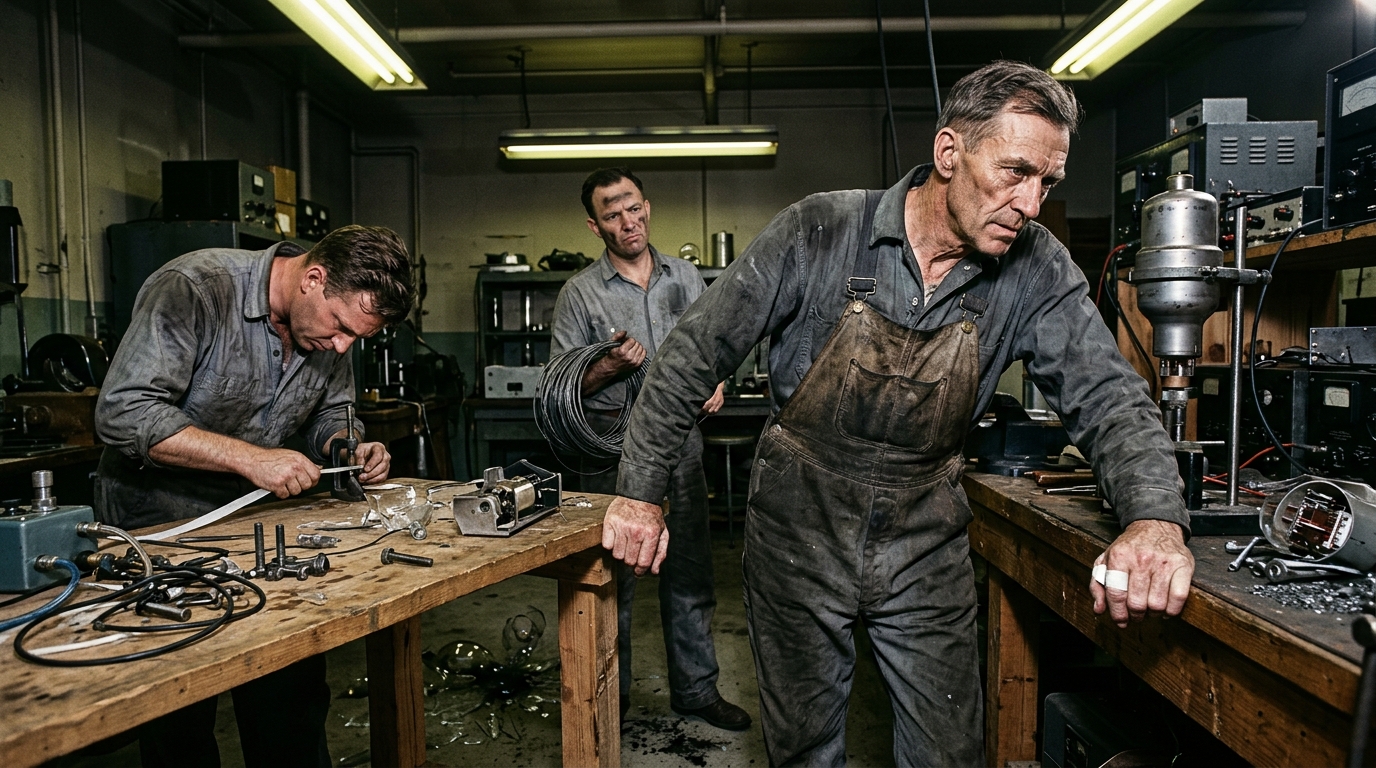
Alexander Ell pulled a crude wire-drawing die closer across the bench, his shoulders aching from twelve straight hours hunched over the vice.
“The glass walls will have to be twice as thick to hold those reinforced mounts,” Ell said, working a strip of raw silica through the clamp with a harsh scrape of metal on metal. “The weight balance of the nose cone is going to shift entirely.”
“Let it shift,” Tuve said, setting the brass dial down with a heavy thud that rattled the spare bolts across the workbench. “A slightly clumsy flight path beats a thousand shattered glass splinters every single time.”
The workshop filled with the screech of metal drawing wire and the steady, punishing scrape of files shaping stubborn glass.
No one spoke as the raw components took shape under the harsh yellow glow of the overhead lamp.
Hafstad clamped the new, thick-stemmed prototype into the pneumatic test rig bolted against the back wall.
“If this one cracks under the drop test, we are out of raw stock,” Hafstad said, his hand hovering over the heavy iron release lever.
Tuve did not step back.
He leaned his weight against the edge of the wooden bench, his eyes locked on the steel tube of the tester as he waited for the impact.
CHAPTER 4: THE SODA CAN RADAR
Merl Tuve did not flinch as the impact echoed off the concrete walls.
He leaned over the open steel housing of the test shell, his eyes narrowing as he inspected the miniature circuit board wedged inside the nose cone.
“The wiring held,” Tuve said, his voice carrying a raspy, exhausted relief. “Not a single solder joint shook loose under the simulated recoil.”
Lawrence Hafstad wiped a smudge of black grease off his forehead, staring down at the tiny transmitter tube packed tightly beside the battery housing.
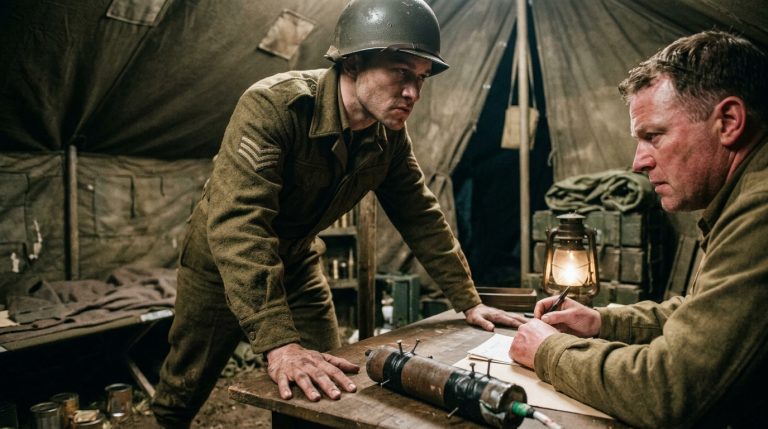
“We crammed a complete radio circuit into a space no bigger than a soup tin,” Hafstad muttered, tapping the side of the brass casing with his fingernail. “It shares components between sending and receiving, just like we mapped out on the chalkboard.”
Alexander Ell stepped closer, holding a small metal antenna piece that fit flush against the curved metal tip of the nose cone.
“The shell body itself acts as the aerial element,” Ell said, working the screw thread with a stiff, calloused thumb. “We don’t need external wires dragging in the slipstream.”
Tuve reached down and picked up his heavy brass calibration dial, rolling the cold metal between his fingers as he calculated the remaining hurdles.
“The mechanical switch activates the battery the exact millisecond the gun fires,” Tuve said, his gaze fixed on the crude prototype. “Before that, it is completely dead. Safe to handle, safe to load.”
The workshop door rattled as the wind outside picked up against the frame, carrying the distant, low grumble of heavy trucks rolling toward the coast.
The military liaison officer stepped back inside, holding a fresh dispatch envelope against his chest.
“The first batch of prototypes has been cleared for secret transport to the southern ports,” the officer said, his voice dropping as he looked around the cluttered workbench. “No technical briefings. Just orders to load them into the anti-aircraft batteries.”
Tuve set the brass dial down with a sharp click against the wood.
“Tell the gunners to fire them just like regular iron,” Tuve said, his jaw set hard. “The physics will handle the rest.”
CHAPTER 5: THE SILENT SKIES OVER LONDON
Gunner Thomas wiped the sea salt from his eyes and heaved the heavy wooden crate onto the wet concrete platform of the anti-aircraft pit.
The brass-capped shells inside carried no technical schematics, no instructions, and no warnings about what was packed inside their steel noses.
“The sergeant said drop the old impact rounds,” Thomas muttered, shoving a blunt-nosed cylinder straight into the loading breech with a metallic scrape. “Just load these and let the guns do the talking.”
Across the cramped pit, his loader jammed a second shell into place with a sharp metallic clang that echoed against the damp chalk cliffs.
Above them, the thin whistling drone of a pilotless flying bomb cut through the overcast Channel air at four hundred miles per hour.
“She is coming in low from the water,” Thomas yelled over the rising roar of the pulsejet engine, his hands locking onto the heavy elevation wheel. “Range finder says four thousand yards and closing fast.”
The gun barrel whipped upward, tracking the gray streak cutting across the heavy cloud cover.
Thomas slammed his foot down on the firing pedal without waiting for further calculations.
The heavy three-point-seven inch gun bucked backward against its recoil springs with a brutal, bone-jarring slam that rattled teeth.
The shell tore through the slipstream toward the unseen target, its internal battery switch snapping closed under the massive acceleration forces.
A fraction of a second later, fifty feet short of the flying bomb’s aluminum wing, the miniature radar circuit completed its calculation.
The fuse triggered instantly.
A sharp, jagged blossom of high explosive force ripped open the empty air beside the missile without needing a direct collision.
The blast wave hammered the thin metal skin, tearing the guidance fins completely off the chassis.
The unstoppable weapon spun out of control, tumbling through the gray sky in shattered pieces before crashing harmlessly into an empty field below.
Thomas stared through the drifting cordite smoke as the empty casing rolled across the wet concrete.
“It did not even touch it,” Thomas breathed, his fingers tightening around the cold iron aiming crank. “The damn thing detonated right in the open air.”
CHAPTER 6: THE UNSOLVED GERMAN MYSTERY
Three hundred miles away, the air inside the German intelligence bunker felt thick and dead.
Colonel Richter stared down at the heavy brass cylinder resting on the green felt of his desk, his face pulled tight with furious confusion.
“The interception rates have jumped to seventy-nine percent,” Richter snapped, slamming his fist against a stack of interception reports. “They are shooting our vengeance weapons out of the sky before they even cross the coast, and you are telling me this piece of pipe is doing it.”
Across the desk, the lead engineer adjusted his spectacles, his hands trembling slightly as he gestured toward the battered metal casing.
“We recovered it from an unexploded British anti-aircraft shell near the coast,” the engineer said, keeping his voice carefully neutral. “It is a vacuum tube, Colonel. But the glass is absurdly thick, and the filament supports look like they were built for a tractor.”
Richter snatched the brass cylinder off the desk, his knuckles turning white as he gripped the crude, heavy metal.
“It is a radio part,” Richter yelled, his voice echoing off the concrete walls. “Why in God’s name would the British put a primitive radio receiver inside an artillery shell?”
The engineer did not flinch, though a bead of sweat tracked slowly down the side of his neck.
“Some of the team theorize it is an acoustic sensor,” the engineer offered, swallowing hard. “Or perhaps a photoelectric trigger meant to lock onto the pulsejet exhaust flame.”
Richter laughed, a harsh, abrasive sound that held zero humor.
He threw the heavy brass cylinder back onto the green felt, the metal thudding dull and flat against the table.
“A radar system requires a transmitter, a receiver, and an antenna array larger than a staff car,” Richter said, his voice dropping to a dangerous whisper. “You cannot fit radar into the nose of a cannon shell. The physics do not allow it.”
The engineer fell completely silent, staring down at the thick-walled glass tube sitting entirely out of context on the general’s desk.
“They are cheating the mathematics,” Richter muttered, turning his back on the desk to stare blindly at the map of the Channel pinned to the wall. “They have found a loophole, and we cannot even see the strings.”
Back in the dusty workshop in Washington, the sharp scrape of metal on metal had finally ceased.
Merl Tuve sat alone at the scarred wooden bench, a damp rag resting across his grease-stained knuckles.
He picked up the heavy brass calibration dial one last time, feeling the familiar, cold weight of it against his calloused thumb.
The frantic demands from the military had stopped entirely; the daily casualty reports from London had dropped to near zero.
Tuve did not celebrate, and he did not smile.
He simply set the brass dial back onto the shelf, wiped the last smudge of engine grease from his palms, and turned off the harsh yellow bulb over the workbench.