The Ledger of Broken Badges: A Forensic Account of Suburban Retribution and Financial Warfare
CHAPTER 1: THE TACTICAL PEACOCK
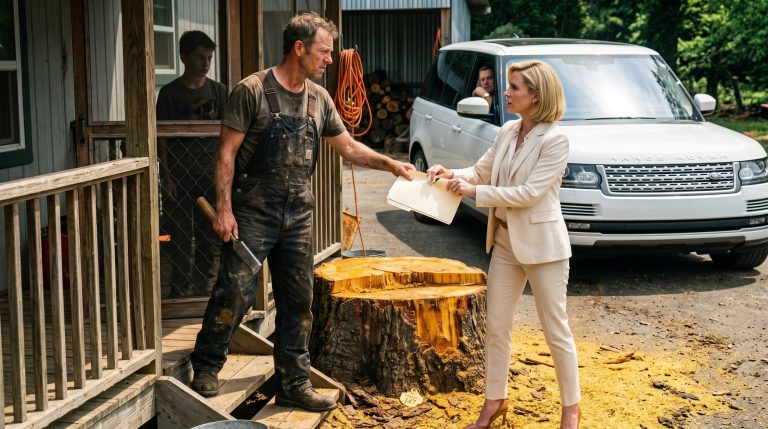
The heat radiating off the asphalt felt thin compared to the cold weight settling in my chest. Bradley Hutchinson stood six feet two, two hundred and fifty pounds of dense fat and black ballistic nylon, his breath smelling faintly of cheap gas-station coffee and stale wintergreen. He didn’t blink. Men who wear body armor to buy milk rarely do; they look at the world through a viewport, searching for a seam where they can drive a wedge of manufactured authority.
“Residential properties cannot have commercial equipment visible from the street,” Bradley said. His voice had the flat, practiced cadence of a state trooper executing a routine traffic stop, but the tone was entirely hollow. He adjusted his utility belt, the heavy leather creaking against his hips. A radio on his shoulder crackled with the dry hiss of open static—no voices, just the empty white noise of a scanner tuned to a dead frequency.
I kept my hands resting flat on the roof of my car. Fifteen years of analyzing insurance fraud teaches you to read the body language of a short con before you look at the numbers. The way his left index finger twitched against the plastic edge of his clipboard told me everything. He wasn’t enforcing order; he was testing my breaking point.
“It’s a laptop bag, Bradley,” I said, my voice level, stripped of the heat he was sweating for. “Through the tinted glass of a passenger window. That’s my work computer.”
“A computer used for commercial enterprises under Section 4-B of the Willowbrook covenants.” He tapped the clipboard with a heavy thumb. “That’s a hundred and fifty dollars. Payable immediately to the security office to avoid a vehicle lien.”
The silence between us grew dense, filled only with the rhythmic shwack-shwack of Jeff’s lawn sprinkler three houses down. I looked down at the clipboard. The paper was a standard carbonless three-part form, the kind you buy in bulk at an office supply store for nine dollars a pack. There was no official logo at the top—just a stamped line that read Community Compliance Division in smudged black ink.
“I’ll need to see the specific subsection in the full manual,” I murmured, leaning slightly forward. The shadows under his tactical vest were deep, hiding the cheap stitching where he’d sewn on a generic security patch himself.
His smile flickered, a brief, predatory twitch of the lips that didn’t reach his eyes. “I don’t carry the manual on patrol, Marcus. Cash or money order. No receipts are issued on-site for non-compliance variables.”
He reached into his pocket, his hand brushing the cold, metallic grip of a heavy flashlight. He wanted the argument. He was waiting for the verbal flinch, the legal threat, the sudden movement that would let him step into my space and demonstrate what two hundred and fifty pounds of authority felt like against the side of my car.
Instead, I reached into my back pocket, my fingers wrapping around the smooth leather of my wallet. I pulled out three fifty-dollar bills, the edges crisp and sharp. I didn’t hand them to him. I laid them flat on the black clipboard, right over the blank space where a supervisor’s signature should have been.
Bradley’s thick fingers swept the bills away with a practiced, silent glide, sliding them beneath the aluminum hinge of his board. He didn’t write anything down. He didn’t check off a box. He simply turned, his heavy boots scuffing the clean concrete of my driveway, and strode back toward his modified interceptor, the illegal strobe lights on his grill reflecting like cold teeth in the midday glare.
I didn’t move until the exhaust cleared. My eyes traveled down to the corner of the driveway where he’d stood. Near the edge of the grass lay a small, bright yellow plastic tab—the tear-off strip from a commercial money-drop bag, dropped in his haste to secure the cash. It wasn’t standard HOA property. It was the first structural discrepancy in a ledger that was about to balance out to zero.
CHAPTER 2: THE EMPTY FINE PRINT
The smell of unburnt hydrocarbons and cheap exhaust hung heavy in the driveway, completely overpowering the faint scent of fresh pine mulch from the landscaping. I stood absolutely still, my hand still resting on the roof of the Honda, the metal warm beneath my palm. The street was quiet again, the kind of manufactured, expensive quiet that Willowbrook Estates sold for four hundred dollars a month. But the silence felt different now. It felt negotiated.
My eyes stayed locked on the corner of the driveway. The bright yellow plastic tab, a stark, artificial neon against the manicured green edge of the lawn.
I walked over to it, my steps deliberate on the concrete. I didn’t bend down immediately. I looked up and down the street. Jeff’s sprinkler was still completing its methodical arc, the water hissing against the pavement. No one else was out. The neighborhood was hiding behind drawn blinds and closed garage doors, precisely the way Bradley Hutchinson preferred it.
I crouched, the fabric of my suit trousers pulling tight across my knees, and picked up the tab. It was small, roughly an inch long, the plastic rigid and scored with tiny gripping ridges. It was a security seal, the kind used to lock heavy-duty canvas deposit bags. The specific kind that required a specialized heavy-duty clipper to remove, ensuring a chain of custody for large cash transfers.
A chain of custody.
I rolled the rigid plastic between my thumb and forefinger. The edges were sharp, unfinished. A local security guard writing minor parking infractions didn’t need tamper-evident deposit bags. Unless, of course, the volume of unrecorded cash required a logistical solution far beyond a simple lockbox.
I slid the yellow tab into my pocket and turned toward the house.
Inside, the air conditioning hit me like a physical barrier, cool and aggressively filtered. The kitchen smelled of cinnamon and vanilla—Elena was baking again. It was her stress response, a way of exerting control over her immediate environment when the outside world felt unpredictable. She was standing at the kitchen island, a wooden spoon gripped tightly in her hand, staring out the window toward the street.
“Is he gone?” she asked, her voice barely carrying over the hum of the refrigerator.
“He’s gone,” I said, dropping my keys into the ceramic bowl by the door. The clatter seemed too loud in the quiet room.
“What did he want this time?” She didn’t look at me; her gaze was still fixed on the empty spot where the intercepted cruiser had been parked.
“A hundred and fifty dollars. He claimed the laptop bag in the car was a commercial equipment violation.”
Elena finally turned, the wooden spoon lowering. “A laptop bag? Marcus, half the neighborhood works from home. That doesn’t even make sense.”
“It doesn’t have to make sense. It just has to generate compliance.” I walked past the island, toward the small alcove we’d converted into a home office. “He’s testing the perimeter. Seeing who argues, who pays, and who pays quietly.”
“Did you argue?”
“No,” I said, opening my laptop. The screen flared to life, casting a cold, bluish light across the dark wood of the desk. “I paid him. In cash. Because scammers only leave a trail when they think they’re winning.”
I pulled up the Willowbrook Estates Homeowners Association master document file. It was a massive, unwieldy PDF, ninety-four pages of dense legal boilerplate, landscaping restrictions, and architectural guidelines. I’d downloaded it the week we closed on the house, part of my standard due diligence, but I’d only skimmed the sections on property modifications. Now, I needed the enforcement clauses.
“Marcus,” Elena said softly, stepping into the alcove. The scent of vanilla followed her, sweet and out of place against the sterile glow of the screen. “You’re getting that look.”
“What look?”
“The look you get when an insurance claim doesn’t add up. The one where you stop sleeping and start building spreadsheets.” She leaned against the doorframe, her arms crossed over her apron. “He’s just an overzealous security guard with a complex. If we just follow the rules—”
“There are no rules, Elena,” I interrupted, my eyes scanning the index. “That’s the point.”
I hit Ctrl+F and typed “commercial equipment.” The search bar yielded zero results.
I tried “commercial vehicle.” Two hits, both referring to overnight parking of heavy machinery or branded box trucks. Nothing about passenger vehicles. Nothing about items visible inside passenger vehicles.
I typed “fee schedule.” It jumped to page seventy-two. I leaned closer to the screen, the blue light reflecting in the dark glass of the window behind the monitor. The schedule outlined fines for unapproved paint colors, overgrown lawns, and leaving trash cans out past designated hours. The maximum fine listed was fifty dollars. There was no mention of a hundred and fifty-dollar tier. There was no mention of on-site cash collection.
More importantly, there was no mention of a “Community Compliance Division.”
“He’s making it up,” I said, the realization settling cold and heavy in my gut. I leaned back in the chair, staring at the empty white space of the digital document. “The violation, the fee structure, the entire enforcement protocol. None of it exists in the bylaws.”
Elena frowned, stepping closer to look at the screen. “But the board… Mr. Peton backs him up. Whenever anyone complains, Peton sends an email saying Bradley is operating under board authority.”
“Peton is the chairman. He’s not the management company.” I opened a new tab, pulling up the contact directory for Pinnacle Properties, the corporate entity that actually managed Willowbrook’s finances. “If Bradley is collecting fines on behalf of the HOA, those funds have to be recorded by Pinnacle. There has to be a ledger.”
I picked up my phone and dialed the number for Pinnacle’s resident services department. The automated menu was a maze of corporate deflection, designed to frustrate callers into hanging up. I pressed zero repeatedly until the line finally clicked, connecting to a human being.
“Pinnacle Properties, Resident Services. This is Diane. How can I direct your call?” Her voice was practiced, efficient, and utterly disinterested.
“Hi Diane. This is Marcus Reed, resident at 1247 Maple Drive in Willowbrook Estates. I need to verify a violation issued to my address this morning.”
The clatter of a keyboard echoed through the receiver. “1247 Maple. One moment, Mr. Reed.”
The silence stretched. In the kitchen, the oven timer buzzed, a harsh, mechanical sound. Elena didn’t move to turn it off. She was watching me, her expression tight.
“Mr. Reed?” Diane’s voice returned, carrying a slight note of confusion. “I’m looking at your ledger now. We don’t show any active violations on file for that address. Your account is entirely current.”
“Can you check the pending file? It was issued just an hour ago by the on-site security officer. For a commercial equipment violation.”
More clicking. “Sir, even pending violations generated by on-site personnel are automatically logged into the central system via their mobile terminals. There is nothing attached to your property profile. And…” She paused, the hesitation clear. “We don’t actually have a code for a commercial equipment violation in the Willowbrook matrix.”
I looked at the yellow plastic tab sitting on the desk beside my keyboard. The sharp, broken edge caught the light from the monitor. A heavy-duty security seal for a cash drop bag.
“I see,” I said, my voice dangerously calm. “Thank you, Diane. I appreciate your help.”
I ended the call and set the phone down carefully. The silence in the house was absolute now, the oven timer having finally timed out.
“What did she say?” Elena asked, her voice tight.
I looked up at her, the reality of the situation crystalizing into a hard, sharp structure in my mind. “There is no record of the fine. There is no code for the violation. Pinnacle Properties has no idea Bradley is collecting cash.”
I turned back to the screen, opening a blank spreadsheet.
“He’s not enforcing the rules, Elena,” I said, my fingers hovering over the keys. “He’s running an extortion racket. And I’m going to find out exactly how deep it goes.”
CHAPTER 3: THE BLEEDING NEIGHBOR
The laptop lid closed with a quiet, authoritative snap that cut the blue glare from the alcove walls. I stood up, the small yellow plastic security tab tucked safely into my pocket, its sharp edge pressing against my thigh as I moved. Elena remained near the kitchen island, her hands braced against the dark granite, watching me with a quiet, frozen intensity.
“I’m going outside,” I said, my voice low. “Just for a few minutes.”
“Marcus, please,” she whispered, her fingers tightening against the polished stone. “Don’t go after him.”
“I’m not going after Bradley. I’m going across the street.” I walked to the front door, the brass handle cold and unyielding under my palm. “We need baseline data. One transaction is a dispute. Two is a pattern.”
The afternoon heat hit me the moment I stepped past the threshold, thick and heavy, radiating off the concrete driveway like an oven left open. The sun glinted sharply off the hood of my Honda, highlighting the thin layer of dust that had settled since Bradley’s cruiser had backed away. Across the asphalt of Maple Drive, Jeff was still there. The rhythmic hiss of his sprinkler had stopped, replaced by the wet, rhythmic slap of a heavy sponge against the side of his silver sedan.
I walked down my driveway, my leather soles striking the concrete with a rhythmic, measured cadence. I didn’t rush. In my line of work, rushing looks like a threat; a casual, unhurried stride looks like neighborly boredom. The street was wide, a pristine ribbon of blacktop flanked by identical lawns, but it felt remarkably like a stage under observation. I kept my eyes on Jeff’s posture. His shoulders were hunched, his movements stiff and mechanical as he dragged the soapy sponge across the rear panel of his car.
As my shadow fell across the damp curb, Jeff didn’t look up immediately. He dipped the sponge into a bright red plastic bucket, the white suds overflowing and bleeding down into the concrete gutter. The smell of chemical car soap—artificial cherry—mixed uncomfortably with the sudden stench of hot asphalt and his own sharp, nervous sweat.
“Hey, Jeff,” I said, stopping a clear six feet away, keeping my hands resting loosely in my pockets. “Nice afternoon for it.”
Jeff froze. The sponge remained flat against the trunk, water dripping from his wrist onto his sneakers. When he turned his head, his face was noticeably pale beneath his baseball cap, his eyes darting instantly past my shoulder to scan the empty street behind me.
“Marcus,” he said, his voice clipped, missing its usual suburban warmth. He didn’t drop his arms. “Yeah. Trying to get it done before the sun gets too low.”
“I just had a quick question for you,” I murmured, taking half a step closer to the edge of his driveway. “You ever get any weird fines from that security guy? The one in the interceptor?”
The reaction was instantaneous. Jeff’s hand went slick. The heavy foam sponge slipped from his grip, striking the wet concrete with a dull, wet thud, scattering white suds across his shoes. He didn’t bend down to pick it up. Instead, his head snapped up, his jaw tightening as his eyes locked onto mine with a look that wasn’t just annoyed—it was hollowed out by genuine fear.
“Look, Marcus,” Jeff whispered, his voice cracking slightly as he took a step toward me, cutting the distance between us. He reached out, his wet, soapy fingers clamping hard onto my forearm. His grip was remarkably tight, his skin slick with cold sweat. “I don’t want any trouble. Just pay whatever Brad asks and keep your head down.”
I didn’t pull away from his grip. I looked down at his hand, then back up into his eyes. “Jeff, the guy’s running a scam. I checked the bylaws. The commercial violation doesn’t exist. Pinnacle Properties has no record of the cash.”
“Stop,” Jeff hissed, his eyes darting frantically toward the thick boxwood hedges lining his property line, as if Bradley might materialize from the leaves. “Just stop talking. You don’t know him, Marcus. You don’t know what he does.”
“He’s a fake cop with a clipboard, Jeff. He has no legal authority.”
“He threatened my son,” Jeff said, his voice dropping to a harsh, desperate whisper that barely carried over the sound of his forgotten hose, which was currently gurgling into the grass, flooding the lawn with a dark, muddy pool. “He stopped Tommy on his bike last week. Said the bike didn’t have the proper community registration decals. Then he told me if I caused problems or went to the police, he’d find a reason to search the kid’s backpack. Said he has buddies in the county sheriff’s department who would love to find a bag of localized narcotics in a teenager’s locker.”
The artificial cherry smell of the soap felt suddenly nauseating. I looked at the water running wild from the hose, the stream carrying dirt and white foam down into the sewer. Plant drugs on a kid. This wasn’t a petty compliance hustle anymore. This was high-level intimidation, the kind used by entrenched syndicates to protect a territory.
“How much have you paid him, Jeff?” I asked, my voice flat, cold, stripped of any neighborly pretense.
“Four hundred dollars over the last three months,” Jeff muttered, his hand finally dropping from my arm, leaving a wet, soapy smudge on the sleeve of my shirt. He stared down at his ruined sponge on the ground. “Security assessments. Compliance monitoring. Out-of-state vehicle registration fees because my daughter is home from college. I can’t risk my boy’s future over an HOA dispute, Marcus. I just can’t.”
I stood there, the heat of the street rising through my shoes, calculating the numbers in my head. Four hundred from Jeff. A hundred and fifty from me. Two hundred families in the development. If Bradley was hitting even a third of them with these manufactured tiers, the monthly volume was staggering. It explained the tamper-evident security seals.
But as I looked down at the red bucket, something else caught my eye—a physical discrepancy that didn’t fit the picture of a lone wolf shakedown. Sitting right inside the open plastic pocket of Jeff’s car-wash caddy was a pink slip of paper. It wasn’t an official Pinnacle invoice. It was a Carbonless duplicate sheet, just like the one Bradley had used on me, but this one had a pre-printed number at the bottom: Invoice #0842.
Bradley wasn’t just writing random notes. He was using a tracked, sequential logging system. And a rogue guard running a personal cash-grab doesn’t order numbered ledger books unless he has to account for his inventory to someone higher up the chain.
“Keep your head down, Marcus,” Jeff said quietly, bending over to finally retrieve his sponge, his back turned to me as if the conversation had never occurred. “Please.”
I didn’t answer. I turned back toward my house, the soles of my shoes tracking damp, soapy prints across the dry asphalt of the street, heading straight back to the office to input a new column into the grid.
CHAPTER 4: THE WEAPONIZED STARBUCKS
The cold data cells of Column A and Column B locked into place with a dry, mechanical click of the mechanical keyboard. Jeff’s name, four hundred dollars, invoice zero-eight-four-two. The math was clean, cold, and entirely lethal if paired with a federal prosecutor’s subpoena. I closed the laptop, grabbed my car keys from the ceramic bowl by the door, and walked back out into the dense afternoon heat without a word to Elena. The time for static observation had expired; the corporate architecture of the system had issued its first formal summation.
The drive to the retail center at the edge of the development took precisely seven minutes. I didn’t skip the lights, nor did I push the speed past twenty-five miles per hour. Rushing alters the baseline velocity of an environment; it alerts the sentries. I parked my Honda Pilot in the perimeter lot of the shopping center, the asphalt here newly sealed and slick as black glass under the direct glare of the four o’clock sun.
The Starbucks sat beneath a massive timber trellis, an architectural requirement mandated by Pinnacle Properties to maintain the illusion of rustic luxury. When I pulled open the heavy glass door, the air conditioning hit my face like a cold sheet of zinc. The interior smelled intensely of burnt espresso beans and the chemical citrus cleaner used on the faux-marble countertops.
Roger Peton was already seated in the corner booth, positioned perfectly beneath a wide, desaturated print of an old barn. His silver hair was combed back with clinical precision, not a single strand out of alignment with his thin, gold-rimmed reading glasses. He was wearing a cream-colored linen shirt that looked entirely too clean for a Tuesday afternoon, and a massive, heavy platinum watch gleamed against his tanned wrist as he slowly stirred sugar into a white porcelain cup.
“Marcus,” he said, his voice a low, melodic baritone that had spent thirty years reassuring wealthy homeowners that their investments were entirely secure. He didn’t rise. He simply gestured with his silver spoon toward the empty wooden chair across from him. “Please. Sit. I took the liberty of ordering a standard drip for you. Black, right?”
I sat down, the wood of the chair hard against my back. I didn’t touch the white cup he had positioned exactly in the center of the table’s dark grain. I kept my hands flat on the cold, polished surface, inches from his linen sleeve.
“Let’s skip the preamble, Roger,” I said, my voice conversational, matching his rhythm but stripping away the performance. “Bradley Hutchinson took a hundred and fifty dollars out of my driveway this morning for a violation that doesn’t exist in the Willowbrook charter. He did the same to Jeff across the street for four hundred. He’s using sequential, carbonless invoice books.”
Peton’s hand didn’t shake as he lifted the spoon, tapping it twice against the inner rim of his cup with a sharp, ceramic tink. “Marcus, I understand you’re new to the framework of community management. The master document you reviewed online is a living charter. It requires flexibilities in enforcement to maintain the aesthetic integrity that keeps your property valuation at seven hundred and eighty thousand dollars.”
“Flexibility isn’t an accounting term, Roger. Pinnacle Properties has zero record of the fine issued to my address. I spoke with resident services less than an hour ago.”
Peton leaned back, the thin frames of his glasses catching the overhead track lighting, obscuring his eyes behind two bright, silver discs. The smile on his lips remained perfectly intact, but his posture went rigid, his chest squaring off against the edge of the table.
“Different departments use different administrative platforms, Marcus. The central office in Dallas doesn’t catalog localized safety assessments in real-time. Mr. Hutchinson operates under a special operational covenant approved directly by the executive board. His background in tactical security ensures that this development remains insulated from the… friction occurring in the rest of the county.”
“He threatened to plant drugs in a teenager’s backpack because his father questioned a three-hundred-dollar registration assessment,” I said, my voice dropping an octave, the words sharp as a scalpel. “That’s not safety, Roger. That’s a felony protection bracket. And you’re signing the letters that authorize it.”
The silver discs of his glasses shifted as he tilted his head down. The expensive cologne he wore—something heavy with sandalwood and ironed linen—drifted across the small table. He reached down, unbuttoned the top button of his shirt with a slow, deliberate twist of his fingers, and leaned forward until his face was eight inches from mine.
“Let me clarify something for you, Mr. Reed,” Peton said, the baritone losing its warmth, turning flat and dry as old parchment. “You catch people who lie about low-tier neck injuries for a living. You handle spreadsheets for middle-market insurance firms. You are very small fish in a very deep reservoir. The security protocols in Willowbrook are non-negotiable. If you find the regulatory climate here too restrictive, I suggest you contact a real estate agent. Pinnacle has a significant waiting list of buyers who understand the price of order.”
“Is that a formal notice, Roger?”
“It’s neighborly advice,” he said, sliding his chair back with a smooth, silent push against the tile floor. He stood up, his platinum watch slipping from beneath his cuff as he reached into his pocket and dropped a crisp twenty-dollar bill next to my untouched coffee. “Pay the assessments, Marcus. Keep your spreadsheets clean. Because if you continue to disrupt the administrative balance of this community, the enforcement variables will become significantly less… polite.”
He turned and walked toward the exit, his leather loafers clicking rhythmically against the floor, his shadow long and thin against the glass doors before he stepped out into the blinding white light of the parking lot. I sat alone in the booth for exactly sixty seconds, my fingers tracking the cold rim of the porcelain cup, watching the twenty-dollar bill slowly uncurl on the dark wood of the table.
CHAPTER 5: THE FOUNTAIN WHISPER
My hand left the cold ceramic rim of the cup, sliding across the dark wood grain of the table to bypass the crisp twenty-dollar bill Peton had left behind. Leaving the money was a calculated omission; it meant the record remained exactly as it was before he sat down. I pulled my keys from my pocket, the metal edges cold and sharp against my palm, and walked out past the glass perimeter doors into the blinding white light of the parking lot. The transition from the air-conditioned enclosure to the heavy suburban air felt like stepping into wet wool, but my breathing remained perfectly regulated.
The drive to Central Park took precisely fourteen minutes. I chose the secondary county roads, navigating the perimeter borders where the manicured masonry of Willowbrook Estates dissolved into standard municipal concrete. There were no shortcuts, no skips through traffic. I watched the fuel gauge needles, the steady sweep of the odometer, maintaining a flat forty miles per hour until the iron gates of the municipal park appeared through the dust-streaked windshield.
The park was vast, largely deserted at two o’clock on a Wednesday afternoon. I parked near the northern pavilion, where the shade from the old oaks cast jagged, sharp-edged shadows across the gravel lot. The crunch of the stones beneath my leather soles was the only sound as I walked toward the central fountain, a massive basin of grey stone where a thin, mechanical mist blew sideways in the wind. The smell of damp earth and stagnant pool water sat heavy in the air, mixing with the distant, sweet scent of a nearby bakery.
Sarah Martinez was sitting on a green slatted bench twenty feet from the water’s edge, a crinkled plastic bag of stale bread crusts resting in her lap. She didn’t look up when my shoes transitioned from gravel to the concrete walkway. She was focused entirely on three grey pigeons pecking frantically at the gray dust near her feet, her fingers twisting the edge of the plastic bag with a sharp, rhythmic crinkle. She was in her mid-fourties, wearing a tailored navy blazer that looked entirely too restrictive for a park bench, her professional posture undermined by the rapid, shallow rise and fall of her shoulders.
I didn’t approach from behind. I walked in a wide, visible arc, letting my shadow precede me across the gray stone tiles until I stopped at the opposite end of her bench, keeping a clear four feet of wood between us.
“Sarah,” I said, my voice low, pitched just under the steady hum of the fountain’s pump.
Her hands flinched, the plastic bag rattling sharply. She still didn’t make direct eye contact; her gaze remained fixed on the concrete, tracking a single bird as it darted back into the shadows of the basin. “You were followed, Mr. Reed. I saw a dark sedan at the lower gate.”
“The sedan belongs to a county surveyor,” I replied, my voice flat, unhurried. “I verified the plate before I turned into the lot. We’re clear. Why did you risk an outside line?”
“Because you’re asking the wrong questions to the wrong people,” she whispered, her voice tight, dry as tinder. She reached down into her leather briefcase, her movements stiff, and pulled out a heavy, grain-textured manila envelope. Instead of handing it to me, she laid it flat on the wood between us, her palm resting on top of it as if she were anchoring a sail in a gale. “You think Bradley Hutchinson is a rogue variable stealing cash from your neighbors. He isn’t. He’s an invoice line item.”
I looked down at her hand. Her knuckles were white, the skin stretched thin over the bone. “Diane at resident services said my address had a clean ledger.”
“Because Diane only looks at Layer One,” Sarah said, her voice dropping another octave, turning into a gravelly whisper that barely cleared the splash of the mist. “Pinnacle Properties doesn’t track Bradley’s cash because that cash is his personal allowance. The real ledger is corporate. Pinnacle bills forty-seven different developments across three states for ‘enhanced security infrastructure.’ Eighteen thousand dollars a month per community for surveillance systems, patrol details, and tactical oversight that don’t exist. The board chairmen approve the dummy contracts, they take a thirty percent diversion cut, and Bradley gets twenty percent to be the visible threat that keeps the residents from looking at the corporate tax returns.”
A physical discrepancy caught my eye as she spoke—a nervous, repetitive tick. Every time the fountain’s wind shifted, blowing a cold spray of mist across our faces, she didn’t wipe her cheek. Instead, her eyes darted to the lower left corner of the manila envelope, where a small, circular blue ink stain had bled through the paper from the inside. It wasn’t a standard corporate stamp; it was a distinctive, hand-inked vault seal from a regional depository bank in Dallas, a detail that shouldn’t exist on standard internal HOA memos.
“The envelope,” I murmured, my eyes locking onto the blue smudge. “What’s the volume?”
“Eight point two million over five years,” she said, her hand finally sliding off the paper, leaving the envelope cold and exposed between us. “But it’s escalating. Last month, a kid in Houston tried to document one of the fake patrols. Bradley broke his arm in an alley behind the community center. The corporate boardroom in Dallas authorized the legal cover-up within three hours. They don’t just protect the money, Mr. Reed. They authorize the force.”
She stood up abruptly, the plastic bag of bread crusts dropping to the bench, the stale pieces scattering across the wood like broken teeth. “Keep building your local file if you want, but look at the corporate routing numbers on page twelve. If they realize I pulled those sheets, I won’t just lose my license. Take it and go.”
She turned and walked rapidly toward the southern path, her heels clicking a sharp, irregular rhythm against the stone until the low hanging branches of the willows swallowed her shadow entirely. I reached out, my fingers closing around the thick, heavy edge of the envelope, the paper cold and slightly damp from the fountain’s drifting spray.
CHAPTER 6: THE BROKEN PORCELAIN
My fingers tightened around the thick, slightly damp edge of the manila envelope, lifting its heavy bulk off the green wooden slats of the bench. I did not linger to watch the path Sarah Martinez had taken. I walked directly back to my car, the gravel crunching flat under my weight, the gray mist from the fountain settling into a thin, cold film across my collar. I slid into the driver’s seat, placed the envelope flat beneath the passenger floor mat, and started the engine. The drive back to Willowbrook Estates required exactly fourteen minutes of unhurried, real-time navigation along the concrete margins of the lower county line. No skips. No shortcuts. Just the steady, rhythmic ticking of the turn signal at every intersection until the brick pillars of our gated paradise rose to meet the front bumper.
The moment I turned onto Maple Drive, the internal baseline of the afternoon splintered. Bradley’s black interceptor was parked crookedly across the throat of my driveway, its engine idling with a low, throat-clearing rumble that vibrated through the steering wheel of my Honda. The vehicle’s left-side tires were dug deep into the manicured turf of my front lawn, leaving two dark, muddy scars in the pristine green.
I cut my engine twenty feet away, my hand gripping the cold door handle as my gaze locked onto the kitchen window. The smell of burning coffee—harsh, acidic, and completely ruined—blew through the house’s external vents.
Through the clean glass of our front window, I could see Elena at the mailbox. Her teacher posture was completely rigid, her spine pressed hard against the hot metal panel of our car door. Bradley stood less than twelve inches from her face, his massive two-hundred-and-fifty-pound frame leaning forward, the black ballistic nylon of his tactical vest blotting out the afternoon sun. His radio was squealing with open static on his shoulder.
“Your husband’s activities are tracking close to obstruction of justice, ma’am,” Bradley’s baritone drifted across the lawn, thick and hollow. “Spreading misinformation regarding authorized security fees is a direct violation of community stability guidelines.”
“Please step back, Bradley,” Elena’s voice was firm, but her fingers were trembling as they clutched three white envelopes against her chest. “My husband hasn’t done anything that requires this.”
“Questioning lawful authority under color of board mandate is an actionable offense,” Bradley hissed, stepping deeper into her personal space until the plastic edge of his heavy clipboard pinned the sleeve of her blouse against the side mirror of our car. “We are authorized to implement enhanced compliance monitoring for disruptive elements. You need to understand something, sweetheart—”
“Let go of me,” she said, her voice dropping into a sharp, frightened register.
She tried to twist her arm away from the mirror. In one fluid, brutal acceleration of mass, Bradley’s thick right hand snapped out, wrapping around her thin wrist with a wet, leather-on-skin slap. He didn’t just push her; he pivoted his entire weight, shoving her five-foot-four frame backward against the reinforced steel door of our vehicle.
The metallic bang of her body hitting the panel rattled the window glass. A sharp, brief cry of pain left her mouth, followed instantly by the dull, ceramic crash from inside the house—the sound of my morning coffee mug exploding on the linoleum floor as the vibration traveled through the structure.
Rage hit my tongue like a hot coin, bitter and metallic. My hand tightened on the handle of my car door, the spring mechanism clicking open. Every instinct I had inherited from fifteen years of watching men trade blows in small rooms screamed at me to close the distance, to drive my knuckles into the soft alignment of his jaw until the bone gave way.
But as my foot hit the gravel, the cold pattern-analysis of my training overrode the heat. If I touched him, the corporate ledger would close. The Dallas boardroom would file the injunction, the local police would execute the assault warrant, and the eight-point-two-million-dollar trail would be buried under six inches of local legal bureaucracy.
I pulled my phone from my pocket instead. I lifted the lens, my arms perfectly steady, locking the frame onto the distinct red fingerprints already blooming across the pale skin of Elena’s wrist. I recorded the smug, satisfied adjustment he made to his utility belt. I captured the exact micro-second his lips curved into an arrogant smirk as he stepped away from her, turning his back to return to his idling cruiser like a man who had just validated a parking receipt.
“Elena,” I said, my voice dead, hollowed out of everything but the data, as I reached her side. “Do not move your arm. Keep it exactly against the white paint. I need the scale of the bruising in the direct light.”
Bradley didn’t look back as his heavy boots scuffed our concrete. His door slammed shut with a heavy, pressurized thud, and the interceptor backed down the driveway, its tires tearing another pair of black grooves into our grass before disappearing around the curve of the street. Inside the house, the smell of the scorched coffee pot continued to bleed through the screen door, thick and suffocating, while the red marks on my wife’s skin darkened into a precise, indelible record of force.
CHAPTER 7: THE BLIND EYE
The camera lens clicked with a dry, mechanical snap, recording the final close-up of the bruised ridges on Elena’s wrist against the glaring white enamel of the car door. I lowered the phone, my fingers cold despite the suffocating heat reflecting off the concrete. I took her uninjured arm, my touch light but anchoring, and guided her across the threshold into the house. The interior air smelled intensely of scorched ceramic and charred espresso from the kitchen alcove, where the black remains of the coffee pot still smoked faintly on the counter. I didn’t clean the mess. I let the broken shards of the morning mug remain where they lay on the linoleum—a physical record of the impact.
Twenty-one minutes passed in absolute silence before the municipal cruiser arrived. There was no siren, no urgency in the turn of its wheels as it pulled up to the curb, parking directly behind the fresh, deep grooves Bradley’s interceptor had left in our lawn.
Detective Williams stepped out. He was a middle-aged man with a heavy, thick leather duty belt that sagged slightly over his hips, his uniform shirt dark with patches of salt-sweat under the arms. He didn’t carry a clipboard; he carried a small, spiral-bound notepad tucked into his breast pocket. His boots scuffed the concrete of our walkway with a slow, tired rhythm that told me exactly where this interaction would sit on his priority queue before he even reached the porch.
“Mr. Reed,” Williams said, nodding once as he entered the air-conditioned living room. His eyes flicked to the kitchen counter, tracking the smell of the burnt coffee, before settling on Elena. She was sitting perfectly upright on the edge of the wooden chair, her left arm resting flat on a clean white towel I had laid across the dark surface of the dining table. “Got a report of a neighborhood dispute regarding community compliance.”
“This isn’t an administrative dispute, Detective,” I said, my voice conversational but flat, stripped of the emotional variance he was likely expecting. I walked over to the table and turned on the overhead halogen lamp, driving a sharp, clinical beam of white light directly onto Elena’s wrist. “Forty-two minutes ago, Bradley Hutchinson physically intercepted my wife at our mailbox. He twisted her wrist and shoved her backward into the driver-side door of our car. The impact was sufficient to register a structural vibration through the front facade of the house.”
Williams leaned down, his heavy leather belt creaking loudly in the quiet room. He took a pair of thin metal reading glasses from his pocket, balanced them on his nose, and studied the dark red fingerprints blooming on the skin. He didn’t touch her. He pulled a compact digital camera from his pocket and took three quick flashes, the harsh light casting deep, sharp-edged shadows across the towel.
“Hutchinson,” Williams muttered, straightening up and sliding the notepad out. He tapped the top of his plastic pen against the wire spiral. “The HOA safety compliance guy. We get a lot of calls out of Willowbrook regarding his enforcement methods. Mostly parking, loose trash, architectural variances.”
“He has no law enforcement authority, Detective. He’s a civilian employee of a private property management corporation. This is a clear case of third-degree battery.”
Williams sighed, a slow, deflating sound that smelled faintly of peppermint tobacco. He walked to the window, looking out toward the street where Jeff’s house sat behind closed blinds. “Look, Mr. Reed, I’m going to be straight with you. These suburban developments are self-governing under state property codes. The local board signs contracts giving these security personnel broad discretion to enforce community order. In court, his defense attorney is going to claim your wife was uncooperative with a lawful security directive and that he used minimal stabilizing force to maintain compliance.”
“Stabilizing force doesn’t leave five distinct subcutaneous hematomas on a third-grade teacher’s wrist, Williams.”
“I’m not saying it does,” the detective said, his voice dropping into a low, bureaucratic drone as he scribbled three lines onto his pad with a heavy, scratching stroke. “I’m telling you how the county prosecutor looks at these files. It’s a civil squabble wrapped in a property dispute. It goes to the bottom of the stack. By the time a judge looks at the affidavit, the marks are gone, and it’s your spreadsheet against his board-approved logbook.”
He paused, his eyes shifting to mine with a hard, transactional focus that had nothing to do with standard civic duty. “And between us? Hutchinson has family connections in the county sheriff’s department. His uncle was a supervisor at the precinct for twelve years. If I file this as a felony assault, it’s going to get kicked back down to a municipal infraction before the ink on my report is dry. If you want a resolution, your best bet is the civil court channel. Sue the HOA board for a policy variance.”
The system was closing ranks, exactly as the data in Sarah Martinez’s envelope had predicted. The local authority wasn’t corrupt through active bribery; they were corrupt through systematic exhaustion. They didn’t want the paperwork. They didn’t want the friction with the private corporate structure that funded the tax base of the county.
“I understand,” I said, my hands remaining entirely flat against the cold wood of the dining table. I didn’t flinch, and I didn’t argue. “File the report, Detective. Give me the tracking number.”
Williams looked at me for a long second, his pen hovering over the page. He tore off a small square of carbon paper, the blue ink smudging slightly against his thumb, and laid it flat on the table next to Elena’s arm. “Report number twenty-six-dash-zero-eight-four. It’ll be in the central database by Friday morning.”
He turned and walked back out the front door, his heavy boots clicking a slow, indifferent rhythm across our porch before the engine of his cruiser fired up outside. I stood by the table, my eyes tracking the small blue piece of paper. The local ledger was officially dead, a dead-end entry designed to sit in a bureaucrat’s cabinet until the statute expired. But it didn’t matter. The detective had just given me the precise date and time stamp I needed to anchor the federal complaint. The local blind eye had just closed on camera, and the pattern was now complete.
CHAPTER 8: THE MARKED BILLS
My palm remained flat against the cold grain of the dining table, centimeters from the tiny scrap of blue carbon paper Detective Williams had left behind. The mechanical hum of the central air conditioning system clicked back on, a sharp contrast to the fading rumble of the police cruiser’s engine outside. Elena sat perfectly motionless beside me, her breathing shallow, her eyes fixed on the darkening red lines spanning her left wrist. The local apparatus had closed its eyes on schedule. The local stacks would swallow the report. But the transaction was logged, the tracking number anchored into the timeline, and the perimeter lines of the local conflict were officially clear.
“Elena,” I said, my voice low, dropping straight into the rhythmic, analytical register of a forensic audit. “Go upstairs. Use the arnica cream in the cabinet, then compress the tissue with the chilled gel pack. I need you offline and clear of the workspace for the next three hours.”
She didn’t argue. She stood up, her fingers lightly trailing across the smooth wood before her footsteps retreated up the stairs, each step a predictable, mechanical creak that faded into the upper ceiling.
I turned toward the alcove office. The heavy manila envelope Sarah Martinez had left on the park bench sat beneath the passenger floor mat of the Honda, but I didn’t go out to retrieve it yet. First, the bait required structural calibration.
I unlocked the lower steel drawer of my desk, the key turning with a sharp, heavy thunk. From the security lockbox inside, I pulled five crisp, uncirculated one-hundred-dollar bills. I had withdrawn them from the commercial branch downtown three days prior—standard corporate contingency cash, completely trace-free to the casual eye. I laid them out side-by-side on the black glass surface of the desktop scanner, their edges forming a perfect, unbroken line under the cold internal light of the glass.
The scanner lens moved with a high-pitched, digital whine, capturing the surface grid of the banknotes at twelve hundred dots per inch. On my monitor, the high-resolution files bloomed into sharp focus. I didn’t look at the portrait of Franklin; I zoomed directly into the lower-right margins, tracking the microscopic, hand-stamped serial numbers.
AL 14829304 B.
AL 14829305 B.
AL 14829306 B.
AL 14829307 B.
AL 14829308 B.
A physical discrepancy appeared on the screen as I mapped the micro-text borders—a subtle variance that would pass any standard banking ultraviolet test but light up an analyst’s grid like an emergency flare. The third bill, ending in three-zero-six, carried a minute, localized ink smear along the left margin of the security thread, a tiny imperfection from the federal printing matrix where the high-pressure linen press had slipped by less than a hundredth of a millimeter. It was a unique, unalterable physical signature. If that bill crossed into a secondary corporate depository account without an accompanying official Pinnacle Properties receipt entry, the chain of custody for extortion under color of law would be mathematically airtight.
I didn’t use a standard printer. I routed the digital image files to an encrypted, off-grid cloud storage drive, then copied the serial log onto a micro-SD card that I slid directly into the secondary slot of my personal phone.
I pulled out a small, specialized forensic evidence pouch—thick, anti-static plastic with a permanent adhesive seal—and dropped the five banknotes inside. The plastic crinkled sharply as I folded the lip down, the adhesive locking into place with a clear, permanent bond.
The phone on my desk vibrated once, a short, violent buzz against the glass. The screen displayed an unlisted ten-digit number from the local exchange.
I picked it up, my thumb sliding across the glass without a sound. “Reed.”
“Marcus,” Roger Peton’s baritone came through the speaker, the tone artificially light, carrying the clinical, false warmth of a corporate damage-control specialist. “I understand Detective Williams just left your residence. An unfortunate piece of administrative friction this morning. Bradley was executing an authorized perimeter sweep, and it seems there was a breakdown in spatial communication at your mailbox.”
“He put hands on my wife, Roger,” I said, my voice level, keeping the pitch flat, entirely devoid of the tactical heat he was likely tracking for his legal record. “He left five localized contusions on her radius.”
“A regrettable over-correction,” Peton said, the line shifting as he apparently adjusted his position in a leather chair. The faint, rhythmic ticking of a high-end pendulum clock echoed in his background. “But let’s look at the broader landscape, Marcus. The board is meeting on Friday night to formalize the new security infrastructure. Bradley is preparing a priority compliance listing for households that require… enhanced administrative supervision. The assessment tier for those properties is adjusting to five hundred dollars monthly.”
The trap was setting itself. The corporate escalation logic was moving precisely along the coordinates Sarah’s internal emails had laid out. They were raising the stakes to force a submission before the financial audit cycle closed at the end of the quarter.
“I understand the parameters, Roger,” I murmured, my eyes fixed on the microscopic ink smear on my monitor screen. “I’ll have the five hundred dollars ready for Bradley’s next sweep. In cash. Just make sure his ledger book is open when he rolls up.”
“A very prudent resolution, Marcus,” Peton said, his voice dropping into that smooth, low drone that signaled corporate satisfaction. “Compliance is always the most cost-effective choice in Willowbrook. Have a pleasant evening.”
The line cut to static. I set the phone down carefully on the desk, the glass surface cold under my knuckles. The marked currency was sealed. The micro-discrepancy on bill three-zero-six was archived. Bradley Hutchinson was scheduled to conduct his next compliance sweep on Tuesday morning, and his hand would be the next physical mechanism to enter the ledger.
CHAPTER 9: THE RAKE BAIT
The digital file on my monitor remained dark, the specific coordinates of banknote AL 14829306 B locked behind the localized drive’s partition. Tuesday morning arrived with an oily layer of grey condensation gripping the windowpanes, a dense, flat vapor that turned the brick facades of Willowbrook Estates into uniform slabs of wet shale. I walked down the stairs, the wooden risers cold beneath my socks, and stepped into the alcove. The five hundred dollars sat inside my breast pocket, the thick plastic edge of the forensic evidence pouch pressing through the lining of my jacket with a rigid, geometric persistence. Elena remained upstairs; the quiet hum of her white noise machine bled through the floorboards, a calculated quarantine to keep her completely clear of the perimeter logic.
I opened the front door, the brass latch dropping with a cold, precise click. The driveway was slick with heavy morning dew, the grass on either side still bearing the black, crushed ruts from Bradley’s previous intervention. At the far edge of the concrete, near the secondary property line where the boxwoods met the curb, I had laid a metal yard rake. It sat face down, its twenty-two steel tines catching the grey light like an exposed ribcage. It was an intentional, unambiguous target—a manufactured non-compliance variable designed to pull a predator out of the flow of the street.
Exactly six minutes later, the low, mechanical rumble of the modified police interceptor vibrated through the soles of my shoes.
The vehicle moved with an artificial slowness, its dark tires tracing the curb line until it pivoted sharply, the front bumper stopping less than eighteen inches from the fallen tool. The metallic chirp of its brake pads resonated through the cold air. Bradley Hutchinson didn’t leave the engine running this time; he turned the key, the heavy V8 dying with a wet, throaty sputter that left the street remarkably silent.
The door swung heavy against its hinges. Bradley stepped out, his two-hundred-and-fifty-pound frame settling into the concrete with a slow, deliberate drop of his tactical boots. He was wearing a fresh pair of black leather gloves, the seams thick and double-stitched along the knuckles, and his clipboard was braced flat against the black ballistic nylon of his chest vest. His radio was completely dead, the open static from the previous week replaced by a tight, watchful silence.
“Unsecured maintenance equipment left within the perimeter buffer zone after zero-seven-hundred,” Bradley announced, his voice a flat, dry monotone that kept its distance. He didn’t approach the house; he stood by the front left fender of his cruiser, his clipboard angled toward my front door. “That’s a tier-three property hazard under the updated enforcement index. Five hundred dollars, Marcus. Payable upon inspection.”
I walked down the driveway steps, my hands down by my sides, completely open, visible. I didn’t glance at the camera lens concealed beneath the structural seam of the porch overhang, nor did I look at the small, wired microphone element pinned behind the lapel of my coat. Every movement had to maintain the absolute kinetic baseline of a defeated resident who had accepted the terms of the territory.
“Five hundred is a steep jump for a yard tool, Bradley,” I said, stopping exactly seven feet away, the space between us filled with the sour smell of his car’s hot exhaust catalyst.
“The board authorized the priority safety tier on Friday night,” he said, his fingers tapping the top aluminum hinge of his clipboard with a rhythmic, metal-on-metal click. “Properties flagged for systemic non-compliance are assessed under the administrative supervision protocol. You pay the tier rate, or the vehicle registration links to a localized lean by twelve o’clock. It carries the same legal weight as a municipal citation.”
“The same legal weight,” I repeated, my voice tracking flat, confirming the specific claim for the digital record.
“Every bit of it,” he hissed, his lips twitching into that brief, familiar smirk that didn’t alter the cold look in his eyes. “We maintain the order out here. The county doesn’t touch the internal lines. Cash or money order, Marcus. Let’s not turn this into another communications breakdown.”
I reached into my breast pocket, my fingers moving deliberately slow past the lining. I pulled out the crisp, folded stack of banknotes—the five clean bills, including the third sheet with the microscopic printing slip along the linen thread. I didn’t use the evidence pouch now; the bills were exposed, dry, and entirely trackable. I stepped forward, closing the seven-foot gap until I could see the fine salt-grains of dried sweat on the fabric of his collar.
I laid the cash flat onto the aluminum face of his board.
Bradley’s gloved thumb snapped down over the bills, the green paper sliding beneath the heavy metal clip with a dry, paper hiss. He didn’t pull out his carbonless logging booklet. He didn’t separate the pink slip from the yellow. He simply unlatched his driver-side door with his left hand, tossed the clipboard onto the passenger seat, and slid his heavy mass behind the wheel.
“Good neighbor,” he muttered through the open window, the engine firing back to life with a violent, smoky roar that clouded the boxwood hedges in grey vapor. “Keep the driveway clear, Marcus. The next pass won’t be this cheap.”
The interceptor backed out with a sharp, squealing turn of the steering box, its rear tires clearing the curb before accelerating down Maple Drive. I stood on the damp concrete, my eyes fixed on the empty space where his bumper had been, the metallic smell of his brake lining still hanging thick in the morning mist. The cash had transitioned. The micro-imperfection on bill three-zero-six was officially inside the system. The trap was no longer an analytical exercise on a screen; the currency was moving through the pipeline, and the clock on the corporate ledger had just started down to zero.
CHAPTER 10: THE DICTATORS BRIEFING
The grey cloud of exhaust catalyst slowly dissolved into the wet boxwood hedges, leaving the driveway completely exposed under a cold, sharpening morning sun. I didn’t turn back toward the house immediately. My boots stayed locked to the concrete for exactly forty seconds, tracking the distant, high-pitched whine of Bradley’s steering box as he cleared the lower intersection of Maple Drive. The transaction was fixed. The currency was in the pipeline. I walked back up the steps, my movements flat and unhurried, and slid past the heavy front door, the brass latch catching with a muffled, terminal click that sealed the office space from the rest of the development.
The days between Tuesday morning and Friday evening measured out in real-time increments, stripped of all shortcuts. There were no skips. Every hour required the systematic, manual logging of cross-referenced data into the secondary partition of my server. I watched the clock face on the wall cycle through its circular grid, the seconds passing with a dry, rhythmic friction that felt closer to a forensic countdown than standard time. By six-forty-five on Friday night, the ambient light over Willowbrook Estates had desaturated into a hard, bruised purple, the long shadows of the pine trees stretching like black needles across the asphalt toward the civic complex.
I pulled the car key from the ceramic bowl, its steel edges cold against my palm. Elena walked down the stairs behind me, her trench coat buttoned tight to the throat, her left hand tucked deeply into her pocket to hide the stiff, white linen line of the medical brace supporting her radius. We didn’t exchange words. The relationship had stabilized into a shared, transactional silence—the quiet of two analysts entering an operational perimeter.
The journey to the Willowbrook Community Center took precisely four minutes at twenty-four miles per hour. The parking lot was already jammed with sixty-odd family sedans, their metal roofs catching the low, oscillating glare of two massive commercial light towers Pinnacle Properties had erected near the main entryway. The air smelled intensely of damp asphalt, ozone from the high-voltage transformers, and the stale, institutional rot of old paper floor protectors.
We walked through the double glass doors without breaking stride. The interior auditorium was a wide, fluorescent-lit box of grey drywall and exposed steel beams. Seventy-three residents sat packed into tightly arranged rows of brown folding chairs, their postures hunched, their whispers cutting a low, vibrating drone through the clinical chill of the room. I took two seats in the absolute back row, positioned directly beneath the shadow of the rear projection booth where the exit lane remained clear and unblocked.
At exactly seven o’clock, Bradley Hutchinson stepped onto the raised linoleum platform at the front of the room.
The transition was absolute. He was wearing a completely brand-new set of heavy black tactical gear, the ceramic trauma plates inside his vest creating a rigid, unnatural square across his chest. A secondary radio unit was mounted to his belt, its short rubber antenna twitching against his hip as he dropped a thick, leather-bound binder onto the wooden podium with a heavy, hollow thud. Behind him, a massive projection screen flared to life, casting a bright, cold blue wash across the first three rows of faces.
The title slide was rendered in blocky, black sans-serif font: ENHANCED COMMUNITY PROTECTION PROTOCOLS – MANDATORY TRANSITION PHASE.
“Quiet down,” Bradley said. He didn’t use a microphone; his baritone carried a raw, uncalibrated velocity that flatlined the murmurs in the room within three seconds. He didn’t smile, and his hands stayed flat against the outer margins of the podium, his gloved fingers tracing the grain. “Effective zero-hundred hours tomorrow, the internal security lines of Willowbrook Estates are under systemic administrative isolation. The old charter guidelines regarding access verification are deprecated.”
He tapped a plastic remote control. The slide shifted to a high-resolution aerial map of the development, scored with bright red gridlines that divided the residential blocks into three distinct compliance quadrants.
“Quadrant One properties—properties flagged for ongoing variance disputes or administrative resistance—are now designated under priority monitoring status,” Bradley continued, his eyes sweeping the back rows, checking the positions of the chairs until his gaze locked directly onto mine. “These households will be subject to random, bi-weekly perimeter assessments. A localized service charge of five hundred dollars monthly will be appended directly to the community infrastructure ledger to support the enhanced tactical presence. This assessment is mandatory under the special covenant approved by the executive board on Friday night.”
The room remained completely silent, the air conditioning vents clicking loudly against the corrugated metal ceiling. I could feel Elena’s shoulder tighten against mine, her breath catching as a secondary slide bloomed on the screen—a direct, close-up photograph of our front driveway, with the white paint of our Honda circled in a sharp, red digital frame labeled TARGET PROFILE: BLOCK 12.
“Failure to settle the tier assessments within forty-eight hours will result in immediate vehicle immobilization,” Bradley hissed, his posture straightening as he leaned over the podium, his chest plates creaking under the strain. “The board has granted full discretionary power to the compliance division to enforce these parameters through necessary administrative friction. We are the sole authority inside these gates. If you think the local county lines will insulate you from these fees, you are miscalculating the landscape.”
He stopped, his gloved thumb snapping down on the remote, freezing the image of our car on the screen like an execution order. He was waiting for the room to flinch, waiting for the collective sigh of submission that would cement the new financial tier into the corporate books. But my hands stayed perfectly flat against my knees, my pulse registering a flat, rhythmic sixty beats per minute. The claim was on the record, the digital slide was captured by the storage drives, and the target had just locked his own entry into the final column of the ledger.
CHAPTER 11: REAL BADGES
The image of our white car remained frozen on the massive projection screen, casting a cold, bloody crimson frame over the back row of chairs. Bradley Hutchinson stayed hunched over the wooden podium, his gloved fingers digging hard into the finished grain as his eyes remained locked onto mine. The silence in the auditorium was absolute, a heavy, unyielding vacuum that stretched the rhythmic click-shwack of the building’s central chiller into a metallic pulse.
Then, the back doors of the civic hall broke open.
There was no preliminary warning, no diplomatic knock. The heavy double steel doors struck the drywall bumpers with a massive, synchronized bang that sent a physical shockwave rolling through the rows of folding chairs. The glare from the high-voltage light towers outside flooded the rear vestibule, cutting sharp, blinding lines through the stale, fluorescent-lit air.
“FBI! Nobody move!”
The voice was a flat, unhurried roar that flattened the rising murmurs of the room instantly. Special Agent Rebecca Torres stepped past the threshold first, her credentials held high, the gold federal shield catching the direct light like a shard of polished ice. Behind her, six tactical agents clad in dark navy windbreakers moved into the room with synchronized, rhythmic precision, their heavy boots scuffing the concrete floor as they formed a tight defensive perimeter along the walls.
Bradley’s posture didn’t collapse into a surrender; his chest plates creaked as his entire body went rigid, his jaw locking into a hard, defensive square. He reached down instinctively, his gloved right hand dropping toward the heavy, metallic grip of the tactical baton at his hip.
“There’s a procedural mistake here,” Bradley shouted, his baritone cracking as he stepped out from behind the podium, his boots stamping the linoleum platform with a hollow, booming resonance. “I am an authorized community compliance officer operating under corporate board mandate! I protect the security grid of this development!”
“Step away from the podium, Mr. Hutchinson,” Agent Torres said, her leather soles striking the floor with a measured, unstoppable cadence as she walked directly down the center aisle. “Your authority is a fabrication. We have the tracking logs for bank deposits originating from Pinnacle Properties’ corporate accounts, including five sequential hundred-dollar bills processed through a regional depository in Dallas forty-eight hours ago. Bill number AL-one-four-eight-two-nine-three-zero-six-B carries a verified printing flaw that places your personal collection operation directly inside a multi-state racketeering enterprise.”
The mention of the specific serial number hit the front of the stage like a brick. Bradley’s face drained of color, turning a flat, pasty grey under the blue glare of the projection screen. He looked past Torres, his eyes scanning the back row until they hit my flat, unmoving expression.
In a frantic, kinetic burst of mass, Bradley didn’t raise his hands; he lunged to his left, his two-hundred-and-fifty-pound frame slamming into the aluminum projection stand as he attempted to break for the secondary emergency exit behind the stage. The metal tower collapsed with a violent, tearing crash, the blue screen sputtering out into darkness as wires ripped from the wall.
He didn’t make two steps. Agent Martinez, a heavy-set federal investigator tracking his flank, closed the distance in an unbroken line. He met Bradley at the edge of the linoleum platform, executing a textbook structural tackle that drove the fake cop sideways into a stack of folding chairs. The impact was massive—a chaotic cascade of clattering steel and tearing fabric that filled the room with the dry smell of old dust.
The steel handcuffs clicked shut with two sharp, heavy ratchets that put a definitive end to the fantasy.
“Bradley Hutchinson, you are under arrest for conspiracy to commit racketeering, wire fraud, extortion under color of law, and civil rights violations under Title 18,” Torres announced, her voice flat and methodical as she read from the paper warrant.
Before the room could process the collapse, two tactical agents moved to the front row, their hands anchoring the elbows of Roger Peton. The silver-haired board chairman didn’t shout; his gold-rimmed glasses slipped slightly down his nose as they pulled his arms behind his clean linen shirt, his platinum watch catching a stray flash from the media crew currently pushing through the main doors. He looked smaller now, his corporate posture entirely hollowed out by the cold weight of the metal on his wrists.
The residents began to stand, their whispers breaking into a roar of realization as the flashing red and blue strobe lights from the federal vehicles outside began to cut through the windows, painting the walls of the auditorium in a frantic, relentless pattern of real authority.
CHAPTER 12: THE FORENSIC AUDIT
The chaotic glare of the emergency strobe lights continued to sweep the auditorium walls, painting the cracked drywall panels in rhythmic flashes of blue and crimson. Bradley Hutchinson was being led through the rear double steel doors, his boots dragging heavily across the concrete pavement, his downcast face completely illuminated by the news crews tracking his exit. Roger Peton walked ten paces behind him, his tailored linen shirt wrinkled and pinned behind his back by the rigid plastic constraints. The room was no longer under their administrative jurisdiction; the corporate scaffolding that had insulated Willowbrook Estates from the law for six years had flatlined within sixty seconds of Agent Torres’s entry.
Eight months passed along an unbroken chain of real-time developments, each event logging into the schedule with the heavy, unhurried precision of a federal docket. There were no shortcuts, no temporal jumps. Every deposition, every subpoenaed bank routing file, and every localized asset discovery loop required my manual entry into the master forensic framework.
Now, on a quiet Tuesday afternoon in late June, the finality of the process sat perfectly settled on the dark wood of my home office desk.
The federal district judge had signed the final order at nine-thirty yesterday morning. Bradley Hutchinson received five years in the federal penitentiary at Texarkana, paired with a mandatory three-year term of supervised release. His defense regarding an authorized ‘community safety mandate’ collapsed under the weight of his own sequential ledger entries. Roger Peton was processed for a forty-eight-month sentence, his three hundred and forty thousand dollars in personal kickbacks from Pinnacle Properties entirely recovered through a corporate liquidation loop. The management company itself settled for eight point seven million dollars in total restitution, a financial penalty that completely dismantled their operational presence across three states.
I leaned back in my chair, the leather creaking slightly in the cool air of the alcove. Elena was sitting on the back deck just past the glass sliders, the afternoon sun catching the frayed edges of her cotton shirt as she graded third-grade reading folders. Her left arm was entirely free of the white brace; the skin over her radius had healed months ago, leaving only a clean, seamless surface where the contusions had once been. The air inside the house didn’t smell of scorched coffee or stale wintergreen anymore; it smelled of the clean, raw timber from the porch repairs and the fresh water she had used to wash down the counters.
Sitting directly in the center of my desk was the black ceramic coffee mug Bradley’s tactical intrusion had shattered eight months prior. I had kept the pieces. Over thirty consecutive evenings, using an industrial epoxy mixed with a fine line of black graphite powder, I had manually rebuilt the vessel. Every fracture line along the porcelain was visible, a dark, precise grid of scars running from the handle to the rim, but the structural integrity was entirely restored. It was heavy, solid, and completely airtight.
I rose from the desk, my leather soles striking the floorboards with a slow, measured rhythm. I went to the kitchen sink, turned the steel faucet handle, and filled the mended cup to the brim with cool, clear water. The liquid stayed perfectly contained within the repaired seams, the black lines holding the volume without a single bead of moisture escaping onto the linoleum.
I walked out onto the deck, the screen door sliding open with a smooth, silent glide along its aluminum track. Elena looked up from her grading papers, her teacher’s pencil resting flat against the folder. I set the mended mug down on the cedar table between our chairs, the base striking the wood with a solid, definitive click.
“The federal marshals finished the asset logging on Bradley’s property this morning,” I said, my voice conversational, stripped of the forensic distance that had dominated the winter months. “The restitution funds cleared the district court depository. Our share is logged at one hundred and twenty-seven thousand.”
Elena reached out, her left hand wrapping around the smooth, scarred porcelain of the mug. She didn’t look down at the numbers on her folder; she looked at the clean alignment of the pine trees along the lower edge of our yard, where the children from Quadrant One were currently riding their bikes across the open green without an interceptor idling behind the hedges.
“It’s quiet, Marcus,” she said softly, her thumb tracing one of the dark graphite lines along the rim. “The real kind.”
“The ledger is balanced, Elena,” I murmured, leaning against the cedar railing, the wood warm beneath my palms. “Every single column is closed.”
The sun began its slow, desaturated drop behind the tree line, casting long, clean shadows across a lawn that no longer required permission to grow. The spreadsheet was completely archived, the data points were locked into a federal vault, and the ordinary geography of our life had finally reclaimed its own borders.