The General Who Stood His Ground When Empire Demanded Absolute Obedience And Unquestioned Submission
CHAPTER 1: THE CANVAS TENT
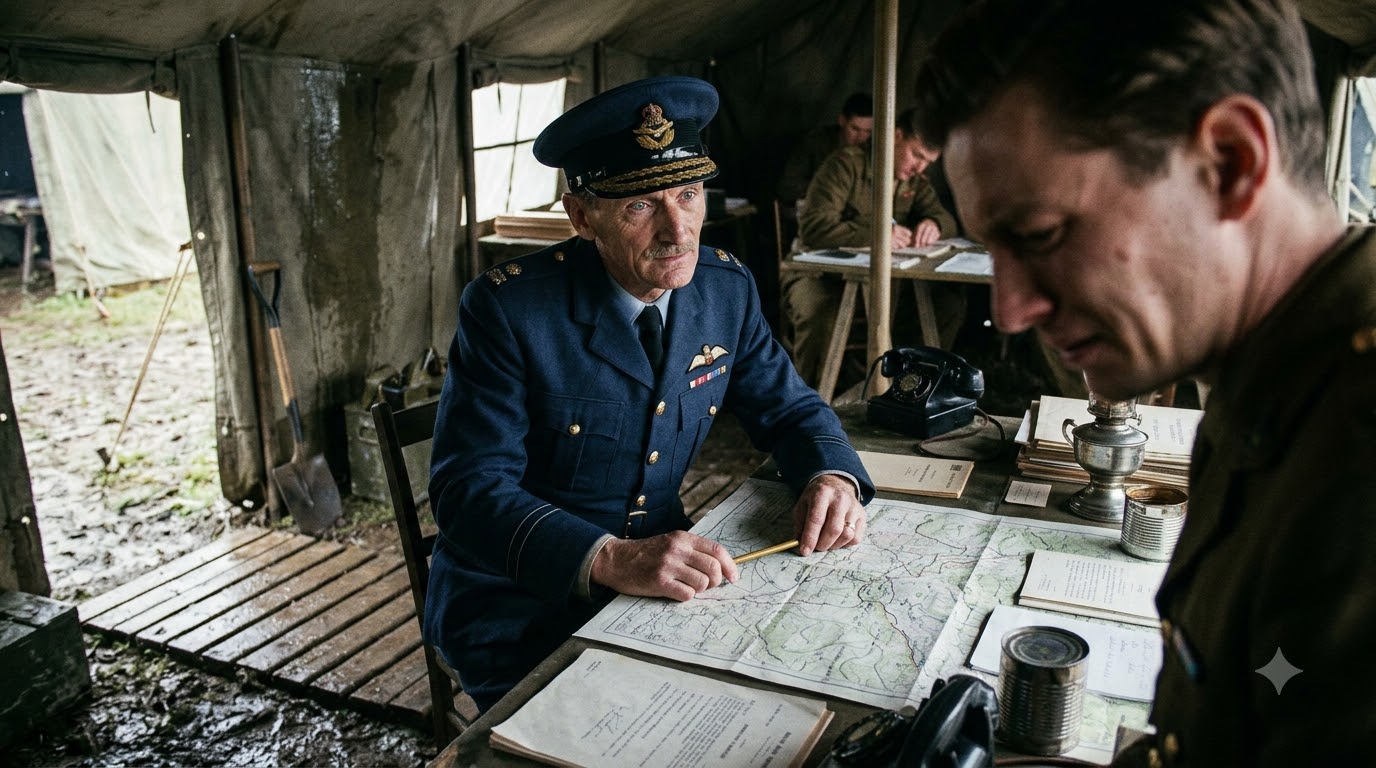
The canvas walls of the headquarters tent shuddered against a cold, wind-driven drizzle that smelled of wet canvas and distant cordite.
General Bernard Montgomery did not look up from the map spread across the trestle table. His hand hovered over the grid with a heavy, unsharpened brass drafting pencil, its blunt end tapping a steady, irritating rhythm against the wood.
“He isn’t here,” an aide murmured, keeping his voice carefully low.
Montgomery’s pencil stopped. The silence in the tent grew heavy, thick with the unearned expectation that everyone within his orbit should jump the moment he snapped his fingers.
“General Crerar is currently twenty miles west,” the aide added, wincing slightly. “At the anniversary service.”
Montgomery didn’t blink. He laid the brass pencil down with deliberate precision, parallel to the contour lines of the map.
“Bring me the replacement roster,” Montgomery said. His voice was flat, devoid of anger, carrying the chilling certainty of a man who believed the world turned strictly on his personal approval.
Outside, the heavy rumble of Allied artillery shook the mud under the duckboards, but inside, the only sound was the scratching of a nib preparing a career’s execution.
CHAPTER 2: THE MEMORIAL SILENCE
The wind off the Channel cut across the gravel of Dieppe with a clean, salt-laden bite that stripped away the bureaucratic noise of the command tents twenty miles away.
General Harry Crerar stood motionless before the low stone markers, his fingers tucked deep inside the pockets of his heavy trench coat.
A single dropped shell casing lay half-buried in the mud near the base of the nearest cross, a silent artifact from a morning two years ago that had bled half a division dry.
“They’re still asking for you at the headquarters tent, sir,” a junior officer whispered, his boots crunching softly on the wet stone as he stepped close.
Crerar didn’t turn his head, his gaze locked on the gray horizon where the tide pulled at the gray shale.
“Let them look,” Crerar replied, his voice level and entirely devoid of heat.
He reached into his pocket and brushed his thumb over an unsharpened brass drafting pencil—the kind used to draw boundaries on maps that others expected him to simply erase.
The distant rumble of artillery rolled across the coast, a heavy, rhythmic heartbeat that punctuated the stillness of the graves rather than the urgency of Montgomery’s agenda.
Crerar adjusted the collar of his coat against the spray, knowing full well that every minute spent standing on this blood-soaked shore was an unwritten defiance of the most powerful ego in Western Europe.
The wind shifted, carrying the sharp scent of wet earth and rusted iron up from the beach where the landing craft had torn open the seabed two summers ago.
“They expect compliance,” the officer muttered, casting a nervous glance toward the eastern road.
“They have forgotten what a nation looks like when it remembers its dead,” Crerar said, his eyes narrowing as he watched the white foam break against the seawall.
CHAPTER 3: THE DISMISSAL DRAFT
The nib of the fountain pen paused against the coarse grain of the requisition form, leaving a dark, spreading blot of ink that mirrored the darkening sky outside the command tent.
Major Vance straightened his back, rolling his shoulders to work out the stiff knot of fatigue settled between his shoulder blades.
“The general wants this cleared before midnight,” Vance said, sliding the fresh dismissal draft across the scarred deal table toward the adjutant.
The adjutant didn’t touch the paper. He stared at the name typed neatly at the top of the order—Crerar—as if the syllables themselves might catch fire under the lamplight.
“He was just at the ridge,” the adjutant muttered, his voice dropping into a flat, cautious register. “The men saw him standing out there in the rain.”
“General Montgomery doesn’t care about rain,” Vance replied, his hand closing tightly over the brass barrel of his pen until his knuckles turned pale. “He cares about obedience.”
Outside, a truck shifted gears on the wet track, its tires spinning deep into the mud before biting hard into the gravel.
Vance pulled the document back an inch, the rasp of paper against wood sounding uncomfortably loud in the cramped canvas compartment.
“If we send this up the line tonight,” the adjutant whispered, “Ottawa won’t read it with breakfast tomorrow. They’ll read it before the tea gets cold.”
“Then let them,” Vance said, though his eyes drifted instinctively toward the unsharpened brass pencil resting dead center on the blotter.
The weight of the paper felt light, but the consequences hitched to it were heavy enough to pull down an entire coalition.
Vance dipped the pen back into the well, the ink catching the amber light as he prepared to sign away a general who refused to bend.
CHAPTER 4: THE SOVEREIGN LINE
General Montgomery didn’t look up as the boots clicked against the floorboards, his gaze fixed entirely on the fresh dismissal order sitting dead center on his campaign desk.
“You missed the morning assembly, General,” Montgomery said, his voice dropping into an icy register designed to strip the room of oxygen.
Crerar didn’t flinch. He planted his boots firmly on the scarred linoleum, feeling the cold draft sweeping under the canvas wall behind him.
“I was elsewhere,” Crerar replied, his tone flat and measured.
Montgomery finally raised his eyes, his expression tightening into a mask of pure, unbridled irritation at the lack of deference.
“In this command structure, there is only one schedule that matters—mine,” Montgomery snapped, his finger tapping a sharp, rapid rhythm against the edge of the wood.
“That is a remarkably small view of a very large war,” Crerar said, stepping closer until the space between them hummed with raw administrative friction.
Montgomery’s jaw clenched as he picked up his unsharpened brass drafting pencil, rolling it back and forth between his palms with controlled fury.
“You think a memorial gives you immunity from direct orders,” Montgomery hissed, leaning forward. “I can have you on a transport back to London before sunset.”
Crerar didn’t blink, his face settling into a mask of weary, immovable resolve.
“Try it,” Crerar said softly, the silence stretching taut between them. “And you won’t just be answering to me—you’ll be answering to Ottawa, to Parliament, and to every citizen waiting for their soldiers to be treated as an army, not a ledger entry.”
CHAPTER 5: THE SILENT RETREAT
Montgomery stared at the space where the pencil had rested, his hand freezing mid-air as the full weight of the political trap settled over the room.
The dismissal order lay ignored on the blotter, its ink dry, its authority completely hollowed out by the immovable reality of a sovereign government standing behind its commander.
“You’re making a catastrophic error,” Montgomery muttered, though the sharp edge had vanished entirely from his voice, leaving only flat, exhausted disbelief.
“I am keeping an army intact,” Crerar replied, his posture unyielding as he looked down at the general who had never learned how to share a victory.
Montgomery reached down slowly, his fingers brushing against the cold wood of the floor to retrieve the fallen instrument, avoiding eye contact for the first time since the campaign began.
The silence that followed was heavy with the realization that absolute power had just struck a wall built of law, history, and national survival.
“Carry on with your sector,” Montgomery said without looking up, his voice tight and clipped.
Crerar turned on his heel, his boots striking the floorboards with rhythmic finality as he walked out of the tent and back into the cold Normandy rain.
CHAPTER 6: THE MUD AND THE LEDGER
The rain turned the polder tracks into a thick, gray slurry that sucked at the boots of every man moving forward through the mist.
General Harry Crerar stepped down from the command vehicle, his heels sinking two inches into the cold European soil without a hint of hesitation.
The maps in the rear tents were clean, but the ground here was heavy, wet, and relentlessly unforgiving.
A battalion commander trudged up through the downpour, wiping water from his eyes with a gloved hand.
“The dikes are breached ahead, sir,” the officer reported, his voice raspy from cold air and exhaustion. “Water’s up to the men’s chests in the lower fields.”
Crerar looked out over the flooded acreage where the North Sea gray met the horizon, feeling the deep, physical chill of a campaign built entirely on endurance.
“We push through it,” Crerar said, his tone flat, pragmatic, and absolute.
There would be no grand parades or polite acknowledgments for what was coming next, only the long, grinding march through freezing water and artillery fire.
Yet as the column moved out into the mist, every man carried the quiet weight of a boundary successfully held, proving that an army standing on national dignity could bend the iron will of an empire.
Crerar reached into his pocket, his fingers wrapping around the unsharpened brass pencil one last time before pressing forward into the mud.