The Weight of Silence: A Master Gunsmith Restores a Fragment of History and a Broken Soul
CHAPTER 1: THE GRAVEYARD BIN
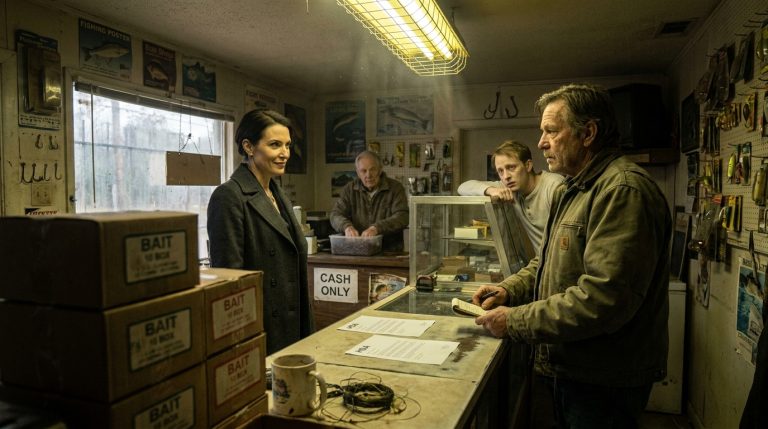
The air in Garrison’s Pawn and Trade tasted of ozone and trapped dust. It was a suffocating layer of stillness, the kind that settled over places where objects went to be forgotten. Rick Garrison sat behind the high glass counter, the blue light of his phone screen washing out his features, turning his face into a pale, disinterested mask. He didn’t look up when the bell above the door chimed, a thin, metallic sound that signaled another customer, another interruption.
Earl Joseph Whitfield didn’t mind the dismissal. He was seventy-six, his spine held straight by a habit of command that never quite faded, and he knew that invisibility was a useful shroud. He walked past the racks of overpriced electronics and the display cases of jewelry that had lost their luster, heading straight for the back corner of the shop.
This was the graveyard.
It was a chaotic sprawl of iron and neglect, a bin labeled scrap metal where the components of failed lives were dumped by the pound. Earl approached it slowly. His boots clicked against the linoleum, a rhythmic count that kept his mind focused. He didn’t look for gold; he looked for the truth hidden in the grime. His hands, weathered and scarred from thirty-one years of service, moved with the precision of a surgeon. He pushed aside a rusted clock, a tangle of copper wire, and the heavy, cold weight of a discarded wrench.
Then, he stopped.
Protruding from the pile was a length of steel, pitted and scarred by years of oxidation, wearing a greenish-brown coat of neglect. Most would see a pipe. Most would see garbage. Earl reached down, his breath hitching in his chest. As his skin made contact with the cold, jagged metal, a familiar, deep-seated vibration echoed up his arm.
It wasn’t just a barrel. It was a fragment of the past.
He lifted it carefully, his heart hammering against his ribs with a force that felt dangerously like youth. He carried the piece to the overhead fluorescent light, a harsh, buzzing glare that exposed the rot. He pulled a pair of bifocals from his pocket, his hands trembling—not from age, but from the realization of what he was holding. There, beneath a stubborn layer of corrosion, were the ghost-marks of a manufacturer’s code. He felt the weight of it, the specific balance of the steel, the unique geometry of the gas port.
It was an FG42. An elite paratrooper’s weapon. A ghost in the metal.
Earl looked toward the front counter. Rick was still staring at his phone, his posture slumped in a display of total apathy. Earl felt a sharp, cold spike of adrenaline. He had to keep his expression neutral. He had to hide the treasure he held in his hands. He wrapped the heavy steel in his shop rag, feeling the gritty texture of the rust against the fabric, and stepped back toward the light.
He didn’t notice the way the shop’s shadow lengthened, or the specific way Rick’s gaze flickered up from his screen just as Earl turned. He only felt the overwhelming, sudden terror that if he let go, the history he had unearthed would shatter.
CHAPTER 2: THE SILENT RETREAT
Earl’s heart hammered against his ribs—a steady, rhythmic thud that sounded unnaturally loud in the narrow confines of the shop. He held the bundled FG42 close to his chest, the weight of it surprisingly comforting despite the cold, corroded bite of the steel against his palms. The shop rag he had wrapped it in was thin, fraying at the edges, and it did little to mask the sharp, metallic tang of oxidized iron that now clung to his skin.
He moved with the practiced, predatory grace of a man who had spent three decades navigating dense jungle canopies where every snapped twig could mean an ambush. He did not rush. To run would be to invite suspicion; to hurry would be to break the fragile, invisible barrier of Rick’s indifference. Every step toward the front of the store was a calculation. He felt the floorboards beneath his worn boots—the slight give, the groan of tired wood—and adjusted his weight to mute the sound.
Rick was still hunched over his counter. The blue light from his phone cast deep, elongated shadows across his face, accentuating the slackness in his jaw. He looked like a man drifting in a dream, completely untethered from the physical reality of the objects surrounding him. Earl’s eyes flickered to the side, scanning the other shelves. A box of mismatched screwdrivers, a stack of water-damaged manuals, a display of cheap, mass-produced pocket knives. All of it was noise. The only thing that mattered was the secret wrapped in the rag, a secret that felt like a live wire sparking against his chest.
As Earl neared the counter, his mind drifted. The smell of the shop—a cocktail of stale floor wax, ozone, and old paper—suddenly warped. For a fleeting second, the walls of the store seemed to dissolve, replaced by the suffocating, humid density of a jungle floor in 1969. He could feel the weight of his standard-issue rifle, the slick mud on his fatigues, the overwhelming pressure of a patrol where silence was the only currency that kept you alive. The intrusive thought was like a phantom limb, a reminder of the thousands of hours spent keeping weapons functional when the margin between life and death was measured in fractions of a millimeter.
He blinked, anchoring himself back to the reality of Murfreesboro, Tennessee. The shop returned to focus, the fluorescent lights buzzing with a low-frequency hum that grated on his nerves.
Rick finally glanced up, his expression one of tired annoyance. “Anything else, or is that it?”
Earl tightened his grip on the bundle. His throat felt dry, his voice a gravelly rasp when he spoke. “Just this.”
He laid the two crumpled twenty-dollar bills on the glass counter. They looked small, insignificant, and utterly disconnected from the historical treasure they had just purchased. Rick grabbed them without a word, sliding them into the register with a clatter that sounded like a gunshot in the quiet room. He didn’t even look at the bundle in Earl’s arms. He didn’t look at the way Earl’s hands were steady, locked in a protective, professional cradle.
“Whatever,” Rick muttered, already looking back down at his screen. “It’s your problem now.”
Earl didn’t respond. He turned, the motion smooth and controlled, and made his way to the glass door. He paused, hand hovering over the handle. He looked back one last time at the graveyard bin in the corner. He realized then that he wasn’t just leaving with a piece of metal; he was carrying out a fragment of a story that Rick was too distracted, too broken, to see. The pawn shop owner was living in a digital haze, oblivious to the fact that he was literally sitting on a fortune of history, trading it away for the price of a dinner.
The bell chimed again as Earl pushed the door open. The autumn air hit his face, crisp and sharp, a welcome relief from the stale, stagnant heat of the shop. He stepped onto the cracked sidewalk, the sunlight hitting him with a gentle warmth. He didn’t look back. He started the walk to his truck, his pace brisk, his mind already partitioning off the next few days.
He knew exactly what the barrel assembly needed. It needed space. It needed light. And most of all, it needed the kind of quiet, solitary focus that the world outside couldn’t provide. As he reached his truck and placed the bundle onto the passenger seat, he felt a strange sense of mission. He wasn’t just going home to a quiet house in Murfreesboro; he was going home to be the guardian of a ghost.
His truck started with a familiar roar, a mechanical affirmation that silenced the persistent, lingering fear that someone would run out of that shop and try to take it back. As he pulled into the street, he glanced at the rearview mirror. The shop looked small, diminished, almost inconsequential in the wash of the afternoon light. Earl gripped the steering wheel, his knuckles white. The real work was only beginning. He would need to be methodical. No shortcuts. No assumptions.
Every piece of rust had a history, and he intended to read every single line of it.
CHAPTER 3: THE GHOST IN THE METAL
The drive from the pawn shop to his home on the outskirts of Murfreesboro felt like a descent into a different era. The hum of the truck’s engine was the only sound, a steady, low vibration that seemed to harmonize with the rhythmic pulsing of the metal bundle on the passenger seat. Earl kept one hand on the steering wheel and the other near the center of the seat, his fingers splayed slightly to ensure the rifle didn’t shift. He wasn’t just transporting an object; he was chaperoning a piece of history that had been discarded, forgotten, and left to rot.
When he finally pulled into his gravel driveway, the house stood silent and still, a sanctuary of fading memories. He killed the engine. The sudden absence of sound was heavy, thick with the absence of Dorothy. For a second, he just sat there, looking at the peeling white paint of the porch railings, the overgrown hydrangea bushes she had loved so much. The house felt smaller today, but the weight of the rifle felt larger.
He stepped out, the gravel crunching under his boots, and moved toward the front door. He walked with that same measured, careful gait he had used to leave the pawn shop. Inside, the air was cool, smelling faintly of the dried lavender she used to keep in the kitchen. He bypassed the living room entirely, heading straight for the spare bedroom at the end of the hall. This was his space now, the room he had claimed for his own silent, methodical labor.
He laid the bundle on the center of the folding table and turned on the clamp-on work lamps. The harsh, white light flooded the space, stripping away the comfort of the shadows and revealing the raw, pitted reality of the steel. With agonizing care, he began to unwrap the rag.
As the fabric fell away, the scent of stagnant history filled the room—a mix of old lubricant, oxidized oil, and the dry, mineral bite of rust. Earl pulled up a chair and sat, his breathing shallow. He took a set of brass picks from his kit, the tools catching the light with a dull, matte shimmer. He started with the receiver. He needed to be sure. He needed the truth that lay beneath the decay.
Minute by minute, the room seemed to fade away. The world outside, the passing cars, the ticking of the grandfather clock in the hallway—all of it ceased to exist. There was only the metal. He worked with a surgical focus, his hands steady despite the internal tremor of anticipation. He scraped away a crust of brown oxidation from the left side of the receiver, clearing a space no larger than a coin.
And then, he saw it.
He pushed his bifocals higher onto his nose, leaning so close he could smell the cold steel. The marking was faint, nearly erased by time, but it was there: a stylized, crisp set of numbers and a partial stamp of a manufacturer’s code. He checked it against his reference manual, his heart skipping a beat. It wasn’t just a generic mark. It was the specific production code for the Crehoff factory, dated late 1943.
But as he continued to work, cleaning a deeper pocket of grime near the trigger guard, he paused. He wiped away a smudge of heavy, solidified grease with a soft cloth and looked at the serial number again. He frowned. The sequence was stamped deep, but there was a discrepancy. The numbers didn’t align with the standard patterns he had spent decades studying. It was as if someone had hand-stamped them later, perhaps as a modification or a field repair that wasn’t reflected in any of the official logs he had ever seen at Quantico.
He reached for his calipers, measuring the space between the digits, his mind spinning. If these records didn’t match the factory output, it meant this piece hadn’t just been “captured.” It had been customized. He remembered the pawn shop owner’s words—the offhand, careless comment about the estate sale out near Shelbyville. Was it possible that the previous owner, the so-called “hoarder,” had been more than just a collector?
A thought flickered in the back of his mind, a cold realization that made him look at the rifle not as a prize, but as a map. He looked at the serial number one more time, the brass pick glinting in the light. He knew this level of precision. He knew this kind of hidden, deliberate alteration. It was the work of someone who wanted a weapon to be untraceable.
He sat back, the chair groaning beneath him. The mystery had shifted. It was no longer just about the history of the German airborne units; it was about how this piece of history had ended up in the hands of a man in Tennessee who had hidden it away in a box of farm equipment. The silence of the house felt different now—not empty, but watchful. Earl leaned over the rifle again, his resolve hardening into something cold and permanent. He wouldn’t stop until he traced every mark, until he understood exactly who had held this weapon last, and why they had gone to such lengths to obscure its past.
CHAPTER 4: THE CALL TO ARMS
The measurements stared back at him from the notepad, mocking the decades of experience he had banked on. Earl sat in the pool of yellow light, his fingers tracing the edge of the metal receiver. He had run the calipers across the stamps three times, and every time, the results defied the standard protocols he had memorized in the Quantico armory. The spacing was off. The depth of the die-strike was erratic, almost desperate.
He didn’t want to believe it. To admit that these marks were wrong was to admit that the foundational logic of his professional life had a crack in it. He stood up, the chair scraping sharply against the hardwood—a violent, jarring sound in the quiet house. He needed perspective, and in his world, perspective didn’t come from intuition. It came from the records.
He moved to the small bookshelf in the corner, his movements stiff. He pulled out his copy of Small Arms of the Second World War, a heavy, leather-bound volume that had been his constant companion since the late eighties. He flipped the pages, the paper dry and brittle against his calloused skin. He looked for the Crehoff production logs, his eyes scanning the technical specifications, the serial number ranges, the specific variances allowed during the final months of the war.
The more he read, the colder his hands became. The rifle in the other room, with its mismatched serial logic and hand-worked receiver, didn’t appear in any of the authorized factory logs. It wasn’t just a variant; it was an anomaly.
He needed someone else to look at it. He needed a second set of eyes, someone who couldn’t be accused of the same sentimental attachment that was currently clouding his judgment. He reached for the phone on the side table. He hesitated, his thumb hovering over the numbers for Martin Hail.
Martin was the best—a man who had spent his career cataloging the debris of history for the Department of Defense. But calling Martin meant bringing the outside world into his sanctuary. It meant admitting, out loud, that he had found something he couldn’t explain. He dialed. The rings were long, echoing through the empty rooms of the house like a rhythmic heartbeat.
“Earl?” Martin’s voice was clipped, professional, even at this hour.
“I have something,” Earl said, his voice flat. He didn’t offer a greeting. He didn’t mention the weather or the time. “I need you to look at a receiver. It’s an FG42, Type II, but the proof marks… they don’t align with the factory records.”
There was a silence on the other end of the line, the kind of heavy, pregnant pause that only two men who had spent their lives dealing in hard facts could understand. “Where did you get it, Earl?”
“A pawn shop. Scraps.”
“Send me the photos,” Martin commanded, the professional veneer dropping slightly. “I’ll run them through the secure database. But Earl, listen to me—if this thing is what you think it is, you need to be careful. There’s a reason certain weapons don’t appear in the logs. Some of these pieces were used for things that don’t belong in a museum.”
Earl hung up, the dial tone buzzing in his ear like an angry insect. He felt a sudden, sharp pang of regret. He had been looking for a project to fill the silence of his house after Dorothy, a way to anchor himself in the physical world. Instead, he had walked into something that felt increasingly like a trap.
He walked back into the spare bedroom. The room felt different now. The clamp lights seemed too bright, the shadows in the corners too deep. He looked at the rifle, really looked at it, and for the first time, he noticed a tiny, almost microscopic scratch on the underside of the trigger housing—a mark that hadn’t been caused by time or corrosion. It was a file mark. Someone had been working on the internal mechanism, not to repair it, but to modify it.
He sat back down, the cold sweat beginning to prickle at his hairline. He had been so focused on the history of the weapon that he had ignored the present-day reality: someone had been using this rifle as a tool for a specific, calculated purpose long after the war had ended. He looked at his hands, his own tools, the same ones he had used to restore the finish, and wondered if he had inadvertently reactivated something that should have stayed buried in the dark.
The house creaked, a settling of timber in the cooling night, and Earl tightened his grip on the edge of the table. He was a Marine. He had faced down things in the jungle that would have broken a lesser man. He wouldn’t be undone by a piece of steel, no matter what kind of ghosts it was carrying. He picked up his camera, adjusted the settings for macro photography, and began to document every inch of the receiver, the file marks, the mismatched stamps. He had to be sure. He had to know the truth, even if the truth turned out to be a warning he wasn’t ready to receive.
CHAPTER 5: THE MIRROR AT THE TABLE
Earl didn’t move. He stood in the center of his workshop, the digital camera still clutched in his hand, its small LCD screen glowing with the high-resolution proof of the file marks he had uncovered. The pounding at the door came again—heavier this time, more desperate. It wasn’t the rhythmic knock of a delivery man or the polite tap of a neighbor. It was the frantic, uneven percussion of someone who had lost their bearings.
He set the camera down on the folding table, his movements precise and unhurried. He didn’t put the rifle away. He left it exactly where it was, the barreled receiver catching the harsh glare of the work lamps. He walked toward the front of the house, his posture loose but ready, the weight of thirty-one years of service settling into his muscles, grounding him.
He opened the front door, the heavy oak swinging inward to reveal Rick Garrison.
The younger man was a mess. His shirt was untucked, his hair disheveled, and his eyes were wide, darting toward the hallway behind Earl as if he expected to find an entire battalion waiting in the living room. The arrogance he had worn at the pawn shop was gone, replaced by a raw, naked vulnerability that made Earl pause.
“Sir,” Rick gasped, his voice cracking. “I… I saw the article. The news report.”
Earl didn’t move out of the doorway. He stayed firmly in the threshold, a silent sentinel protecting the sanctity of his home. “You’re a long way from your shop, Rick.”
“I know,” Rick said, his hands wringing together. “But you don’t understand. I went back. I looked at the ledger—the one my father kept before he passed. There were pages… there were gaps. I never checked them. I thought it was just bad bookkeeping, just a sign of how much he’d let the business slide toward the end.” He swallowed hard, his gaze finally meeting Earl’s. “There was a record of a transfer. A private sale. Late 1945. It was linked to an estate in Shelbyville.”
Earl felt the air in the room change. The “hoarder” he had been told about—the story Rick had spun to dismiss the significance of the weapon—was beginning to fray. “Keep talking,” Earl said, his voice a low, gravelly command.
“It wasn’t a hoarder,” Rick whispered, looking down at his feet. “It was my father. He didn’t just sell the rifle to the estate; he bought it from them when things went bad, and he hid it. He told me the graveyard bin was just junk, but he knew. He kept it because he was terrified that if he ever lost the shop, it would be the only thing of value left to hold onto.” Rick looked up again, tears welling in his eyes. “He was so afraid of looking like a failure that he let that rifle rot in the dark, and then he passed that fear down to me.”
Earl watched the young man, the anger he had felt earlier softening into something more complex. This wasn’t just about a piece of German steel. It was about the heavy, suffocating inheritance of pride. He looked past Rick, out into the driveway where the younger man’s car was idling, headlights cutting through the growing dusk.
“Come inside,” Earl said finally, opening the door wider.
They walked to the kitchen, the space between them filled with the ghosts of men who had defined themselves by what they kept and what they lost. Earl poured two cups of coffee, the steam rising in the cool evening air. He didn’t rush to the workshop. He didn’t ask about the file marks on the receiver. Instead, he sat across from Rick and watched the man attempt to steady his trembling hands.
“You’re not your father,” Earl said, the words simple and hard. “But you’re not the man you were three weeks ago, either.”
Rick took a long, shaking breath. “I don’t want the money, Earl. I know you’re going to the museum. That’s where it belongs. I just… I needed to know that it wasn’t just junk. I needed to know that my father’s life—his history—meant something more than the clutter I let fill that shop.”
Earl looked at him, searching for the truth. He saw the genuine, aching desire for redemption. He also saw the potential for a man who could finally stop being a shadow. He stood up, signaling the end of the conversation.
“The rifle is in the back,” Earl said. “You want to see what you were throwing away? Come with me.”
He led Rick into the workshop, the bright lights snapping on with an authoritative click. Rick stepped into the room, his eyes instantly fixing on the table. He approached the rifle with a reverence that was almost painful to watch. He reached out, his fingers hovering just inches from the steel, and for the first time, he didn’t look like a man distracted by a screen. He looked like a man who had finally found the ground beneath his feet. The confrontation hadn’t ended in a struggle, but in a quiet, devastating admission that changed everything. The secret was no longer just Earl’s to carry; it was now a shared burden, and the weight of it was suddenly, impossibly, heavier.
CHAPTER 6: THE EXHIBIT OF GRACE
The gallery at the National World War II Museum was hushed, the sound of the public muted by the thick, sound-dampening walls. Earl stood in the center of the room, his dress blues pressing against his skin with the familiar, rigid comfort of decades past. He didn’t fidget. He didn’t look at his watch. He simply stood, a man of granite in a room built of memories.
Before him, the FG42 rested in its cradle, the light from the overhead display illuminating every contour he had spent three weeks restoring. It was no longer a piece of scrap metal covered in the sins of history. It was a centerpiece, a testament to the fact that nothing—not time, not neglect, not the crushing weight of fear—is truly beyond repair if one has the patience to look beneath the surface.
Rick stood a few paces to his left. He had traveled down to New Orleans with Earl, arriving on the train that morning. He looked different—his posture was no longer slouched, and his eyes carried a newfound clarity. He had spent the last month closing the loop on his father’s legacy, identifying the items in his shop with a rigor that would have made the old man proud. He had stopped being a spectator to his own life and had started being its caretaker.
“It looks right,” Rick whispered, his voice barely audible in the cavernous space.
“It looks like it finally stopped running,” Earl replied. He didn’t look at Rick; he kept his eyes on the rifle. The truth of the piece had been revealed during the final examination before the transfer: it had been part of a clandestine stash, a personal insurance policy for a man who had been terrified of losing his standing in a changing world. It was a decoy for his own inadequacy, a secret that had served no purpose other than to drain the life from the man who owned it.
Now, that secret was stripped of its power. It was just a machine, beautiful and terrible, resting under glass where its only function was to teach.
The museum director approached, a man whose face was lined with the weary intelligence of someone who spent his days guarding the fragility of the human story. He shook Earl’s hand, the grip firm and respectful. “Sergeant Whitfield, on behalf of this institution and everyone who will ever learn from this exhibit, thank you for your service and your knowledge.”
Earl nodded. “It was my honor.”
As the director drifted away to attend to other guests, Earl felt the tension that had been coiled in his spine for weeks finally begin to dissipate. He turned toward the gallery exit, the walk feeling light. They left the museum and stepped out into the humid New Orleans air. The sun was beginning to dip, casting long, golden shadows across the pavement.
They walked toward the river, the scent of brackish water and roasting coffee lingering in the breeze. Earl stopped at a bench overlooking the Mississippi. He pulled a small, worn object from his pocket—the brass cleaning brush he had used during the first days of the restoration. It was mangled, the bristles frayed and bent, but he held it with the same care he had once given the rifle.
He looked at the object, then at the river. The water moved with a persistent, inevitable grace, carrying the silt of the continent toward the sea. He realized that the restoration hadn’t been for the rifle at all. It had been the final act of his mourning for Dorothy, a way to channel the silence of his life into something that had weight, something that mattered.
“I think I’m going to close the shop for a week,” Rick said, sitting on the bench beside him. “There’s an estate sale in Nashville. I want to see if I can find the rest of those records. Not to sell them. Just to know.”
Earl smiled, a rare, slow movement that reached his eyes. “Take your time, son. The history isn’t going anywhere.”
He stood up, the movement fluid and free. He reached into his pocket, took the frayed brass brush, and left it on the bench—a small, physical closure for a journey that had spanned a lifetime. They turned back toward the city, walking side by side as the streetlights began to flicker to life. The air was cool now, the night promising a quiet, unbroken rest. Earl felt a sense of peace he hadn’t known since the house had gone silent in 2014. The world was still loud, still messy, and still filled with things that people misjudged, but for the first time in a long time, he felt entirely at home within it. He had seen the truth in the rust, and in doing so, he had finally allowed himself to be seen.