The Echo of the Unseen: A Veteran’s Journey from Ghost to Man in the Quiet Aftermath
CHAPTER 1: The Weight of a Shadow
The Naval Medical Center in Portsmouth did not care for legends. It cared for vitals, medication schedules, and the quiet dignity of fading out. Admiral James Reeves moved through the ward with the practiced grace of a man who knew his role: the symbol of gratitude. He shook the hands of men who had seen the world change from the decks of destroyers or the muddy trenches of a forgotten war. He offered the same nod, the same rehearsed thank-you, his movements rhythmic and predictable.
Then he saw the man by the window.
He was gaunt, his hair a close-cropped silver that looked almost like wire. A simple blue cardigan was draped over his thin frame, and his left sleeve was pinned with the military precision that only a career soldier could maintain. He wasn’t staring at the television. He was watching a single, persistent moth batting itself against the windowpane, a rhythmic, frantic sound that drew Reeves in.
“Excuse me, sir,” Reeves said, his voice dropping into that specific tone he reserved for the fragile. “I’m Admiral Reeves. I just wanted to thank you for your service.”
The old man turned. His eyes were not the milky, unfocused windows Reeves expected to see in this wing. They were pale green, sharp as shards of glass, and they hit Reeves with a weight that made him pause. The man’s right hand, when it rose to meet his, wasn’t shaky. It was calloused, firm, and startlingly cold.
“Appreciate that, Admiral,” the man said. The voice was raspy, the sound of gears long out of use.
Reeves pulled up a wooden chair, feeling a strange, magnetic pull. “UDT12 transition, then the Teams in ’68?” he asked, trying to find a footing.
The man nodded, his gaze shifting back to the window for a flicker of a second. “That was the time to be there.”
Reeves smiled, reaching for a common anchor, a piece of shared lore. “Every man has a story, sir. A call sign, back in the day.”
The old man went still. The moth at the window stopped its frantic dance. For a heartbeat, the room felt like it was shifting on its axis.
“Ghost Walker,” the man whispered.
The air behind Reeves audibly hissed as his two accompanying SEALs—instructors who lived and breathed the history of the Teams—froze. Reeves felt a chill, not of cold, but of realization. He knew the stories told in the dark of training bunkers. He knew the ghost stories about the operator who had become the jungle, the phantom who had made entire platoons vanish into the fog of war. He knew it was a myth, a bedtime story for recruits.
But this man was not a myth. He was sitting in a hospital chair, his sleeve pinned, his eyes holding the absolute, terrifying certainty of a man who had lived what everyone else only whispered about. And as Reeves looked at him, he realized with a sinking heart that he had just stepped into a room where the truth was about to destroy the comfort of the legend.
CHAPTER 2: The Anatomy of a Myth
The door to the private conference room clicked shut with a finality that felt like a vault sealing. Inside, the air was stagnant, tasting faintly of the antiseptic cleaner used in the hallway and the dry, recycled output of the ventilation system. Richard Cole sat in his wheelchair, his singular hand resting on the armrest with a stillness that was unnerving. He didn’t look like a legend. He looked like an anatomy of survival—gaunt, weathered, and etched with lines that hadn’t been earned in a gym, but in the slow, grinding misery of four years spent in the dark.
Vice Admiral Reeves felt the phantom weight of his own shoulder boards. He was the deputy commander of Naval Special Warfare, a man who had spent decades cultivating the image of the stoic, capable leader. Yet, under the gaze of this man—this ghost—he felt like a cadet again, clutching a textbook of lies.
“Sir,” Reeves began, his voice sounding thin in the cramped space. He pulled a chair closer, the legs scraping against the linoleum with a jarring, high-pitched screech. “If what you’re saying is true… if you were really there… the entire lineage of what we teach at the command is predicated on a misunderstanding of what isolation actually does to a human being.”
“You teach them that it’s a test of will,” Cole said, his voice raspy, yet rhythmic. “You teach them that the mind is a fortress that, if reinforced enough, can withstand anything. But the mind isn’t a fortress, Admiral. It’s an organism. It changes to fit the environment. You put it in a box, it becomes the box.”
Master Chief Thornton, standing rigid by the door, shifted his weight. His face was a mask of professional neutrality, but his eyes betrayed the tremor of a man seeing the foundations of his world shift. “Sir, with all due respect, we have records of every deployment. Every SCOP. If you were in country, there should be a paper trail. A requisition, a logistics entry, a medical slip.”
Cole let out a dry, mirthless laugh. It was a sound that didn’t reach his eyes. “That’s the beauty of being a ghost, Master Chief. You don’t exist, so you don’t leave footprints. I didn’t exist for the quartermaster. I didn’t exist for the payroll office. I was a budgetary anomaly, a line item hidden in the deep-black funding of an operation that was, on paper, nothing more than a series of disconnected reconnaissance errors.”
Reeves leaned forward, his hands clasped tightly together, his knuckles white. He noticed the way the light from the overhead fluorescent tube flickered, casting stuttering shadows across Cole’s face, highlighting the hollowness of his cheeks. It was a texture of profound, isolated pain.
“Operation Black Veil,” Reeves whispered, testing the name. It felt heavy on his tongue, like lead. “We heard rumors about a psychological program in the late sixties. We thought it was folklore. A cautionary tale about the dangers of losing one’s identity to the mission.”
“It wasn’t a cautionary tale,” Cole corrected, his eyes locking onto Reeves’. “It was a blueprint. They wanted to see if they could manufacture fear. They didn’t want a soldier; they wanted a catalyst for terror. They stripped away the human until all that was left was the tactical function. I wasn’t Richard Cole for those four years. I was a tool, sharpened to a razor’s edge, designed to vibrate at the frequency of the enemy’s nightmares.”
The younger SEAL, Senior Chief Valdez, moved to the edge of the table, his hand hovering over a notepad. He looked confused, his mind clearly struggling to reconcile the official history he had memorized with the visceral reality sitting in front of him. “If you were that successful, why the extraction agreement? Why sanitize the records? If you were the ultimate operator, they would have kept you as a template.”
Cole looked down at his pinned sleeve. The fabric was frayed at the edges, a testament to decades of neglect. “Because I started to fail, Valdez. Not in the mission. I never failed the mission. I failed the psychology. I started to remember who I was before. I started to hear my own name in the wind. And when you realize you’re a man again, you become dangerous to the people who need you to be a myth. You become a liability.”
The silence returned, pressing against their eardrums. Reeves felt a cold sweat break out along his spine. He looked at his men—Thornton, Valdez—and saw the reflection of his own dilemma. They were the ones who carried the torch now. They were the ones responsible for the next generation of operators. And for the first time in his career, he wondered if the weight of that torch was meant to burn the hands that held it.
“Tell me,” Reeves said, his voice softer, stripped of the command cadence. “What was the mission that broke the cycle? What was the moment the ghost finally had to choose between being a myth and being a man?”
Cole stared at the wall, his eyes drifting to a point far beyond the confines of the room, as if watching a scene unfolding on a screen made of dust and memory. The air in the room felt suddenly colder, the hum of the lights vibrating with a low, dissonant chord that set Reeves’ teeth on edge.
“March 1975,” Cole said, his voice dropping to a near-whisper. “The jungle wasn’t hunting them anymore. It was hunting me. And then, I heard the beacon.”
CHAPTER 3: The Memory of the Ravine
The air in the room seemed to thicken, the temperature dropping as Cole’s focus shifted from the men before him to a place that no longer existed on any map. He stared at his hand—the right one, the one that still held the weight of a life lived in increments of survival. His fingers twitched, a reflexive movement that suggested he was reaching for a piece of gear that hadn’t been there for fifty-one years.
“March 1975,” Cole repeated, his voice barely a whisper, yet it carried the weight of a verdict. “We were in the A Shau Valley. The canopy was so thick you could walk for days and never see the sky. I’d been alone for four months. My skin smelled of damp rot, of fermented earth, of the very jungle I was supposed to be scaring.”
Reeves sat back, his own breathing shallow, watching the way Cole’s posture shifted. It was subtle—a slight leaning of the shoulders, a squinting of the eyes, as if the light of the conference room was suddenly too intense, too artificial.
“I was running a psychological harassment pattern on an NVA supply line,” Cole continued. The rhythm of his speech had changed, becoming more deliberate, almost clipped. “Using acoustic decoys, making them think they were surrounded by a company-sized element. They were sleep-deprived, jumpy. They were shooting at shadows. It was effective. It was clean.”
“And then the beacon,” Thornton prompted, his voice low, respectful of the threshold they were crossing.
“I wasn’t supposed to monitor other channels,” Cole said, his gaze fixed on a spot on the wall behind Reeves’ head. “But I did. I heard the emergency burst, a standard pilot’s distress call—high-pitched, frantic, buried under static. Lieutenant Marcus Hayes. Shot down forty miles north, in territory so contested it was essentially an open grave. The order came down through the burst: ‘Abort recovery. Proceed to extraction. Do not deviate.'”
Cole’s hand gripped the arm of his wheelchair, his knuckles pale. “I spent four years as a ghost because that was the protocol. You don’t deviate. You don’t act as an individual. You are a sensor, a tool. But when I heard that voice—that human, terrified voice—I stopped being a ghost. For the first time in years, I felt the weight of my own skin.”
Reeves watched the older man’s face. The memories were clearly playing out in vivid, agonizing detail behind those pale green eyes. He saw the flicker of trauma—the involuntary flinch when the lights above hummed a little louder, the way his breath hitched as if he were inhaling the thick, cloying air of the ravine.
“I found him in a ravine,” Cole said, his voice now raspy and raw. “He was pinned, his leg shattered, his aircraft a smoking wreck in the trees above. The NVA were already moving in, tracking the beacon. I didn’t think about the mission. I didn’t think about the four years of conditioning. I just moved. It was the first time I had acted to save something instead of destroying its sense of safety.”
Cole paused, closing his eyes. “The firefight was a blur of noise and heat. It wasn’t the tactical precision of a SEAL mission; it was desperate, ugly, and frantic. I had to draw them away from him, to force them to look at the ‘jungle’ instead of the man in the ravine. I used every piece of ordnance I had left. I made the woods scream. I made them think the entire valley was turning on them. I bought him time.”
Reeves leaned forward, his elbows on his knees. He could almost see it—the lone operator in the dark, the desperate maneuvering, the decision to trade safety for a stranger’s life. “You reached him.”
“I reached him,” Cole whispered. “We started moving. Six miles to the extraction point. Through terrain that wanted to kill us. And then, at the three-mile mark, a grenade dropped near my position. The blast didn’t just take my arm, Admiral. It took my invisibility. It forced me back into the world of consequences.”
Cole opened his eyes. They were wet, the light catching the moisture in a way that made the room feel suddenly, painfully small. “Hayes carried me the rest of the way. A pilot who should have been dead, carrying a ghost who should have been a machine. We made it to the Huey, but the cost was absolute. I was brought back into the system, processed like a faulty component, and scrubbed from the ledgers because I’d acted like a human being instead of an asset.”
The silence in the room was absolute. Reeves could feel the weight of it—the decades of loss, the sacrifice that had been erased by a bureaucratic stroke of a pen. He looked at Thornton and Valdez. They were no longer instructors watching a legend; they were witnesses to a long-overdue confession.
“And now,” Cole said, his voice hardening, his focus snapping back to the present, “you want to know how it feels to have that story told. You want to know the cost of the myth.” He looked at Reeves with a piercing, uncomfortable intensity. “The cost isn’t the arm, Admiral. The cost is the fifty years I spent thinking I was the only person left in the world who remembered what it was like to be a man.”
The door to the conference room groaned, the handle turning with a metallic, decisive click, breaking the hypnotic hold of the memory. The tension in the room snapped, but the atmosphere remained heavy, charged with the lingering ghosts of the A Shau Valley.
CHAPTER 4: The Currency of a Life
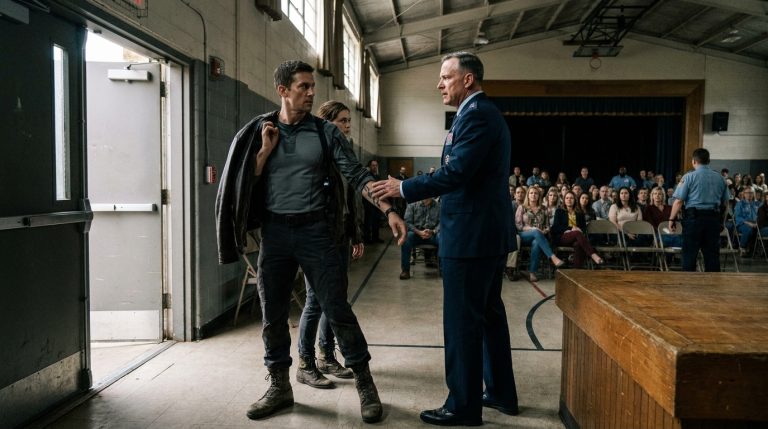
The newcomer stood in the threshold, his Navy dress uniform stiff, the gold of his commander’s rank catching the harsh fluorescent light. He was in his fifties, his hair thinning, but the eyes—the eyes were unmistakable. They were the eyes of the man Richard Cole had dragged through six miles of hell in 1975.
Admiral Reeves turned in his chair, his movement stiff. He had spent the last hour meticulously dismantling the legend of Ghost Walker, only to have the physical manifestation of that myth’s most human act stand before him.
“Commander David Hayes,” the officer said, his voice clipped and formal. He didn’t look at the Admiral. He looked past him, directly at the gaunt figure in the wheelchair. “I apologize for the intrusion, sir. My name is David Hayes. I’m a Navy helicopter pilot. My father was Lieutenant Marcus Hayes.”
The name hit the room like an atmospheric pressure change. Richard Cole, who had remained largely motionless throughout the briefing, seemed to recoil. His breath hitched, a jagged sound that tore through the sterile silence of the room. He didn’t speak. He couldn’t. His gaze was anchored to Hayes’ face, searching for a ghost of the man he had saved, and perhaps finding something even more unsettling: the living evidence that his sacrifice had actually mattered.
Hayes took a step forward, the sound of his heels clicking against the linoleum echoing with deliberate, rhythmic pace. He didn’t approach like a subordinate addressing a superior; he approached with the reverence of a pilgrim. He stopped a few feet from the wheelchair, his eyes glistening.
“He passed two years ago,” Hayes continued, his voice losing its formal edge, sliding into a cadence of deep, private grief. “He lived until he was seventy-eight. He spent forty-seven of those years telling my sister and me the story of the man who saved him. He didn’t call you a ghost, sir. He called you his brother.”
Reeves watched the interaction with a growing sense of discomfort. The “systemic” view of the Black Veil program—the idea of Cole as a discarded asset—felt brittle and hollow in the face of this. Hayes reached into the pocket of his jacket, his movements slow, deliberate. He withdrew something small, something that caught the light with a dull, metallic glint.
It was a challenge coin.
Hayes stepped closer and placed it in Cole’s remaining hand. The contact was brief, but the sound of the coin meeting skin and bone felt like a gavel striking a sounding board. Cole’s fingers closed around it, his knuckles trembling.
“He told me if I ever found you,” Hayes said, his voice barely audible, “I was to tell you that he made the most of every day you gave him. He taught for thirty years. He raised a family. He watched his grandchildren grow. All of it—every breath he took after that extraction—was an extension of your life, not his.”
The impact of the statement rippled through the room. Thornton, the Master Chief who had spent his life idolizing the legend of the “Ghost Walker,” looked away, his jaw tight. Valdez stared at the floor. Reeves realized then that the decoy secret he had been chasing—the tactical efficacy of the Black Veil program—was completely secondary. The real secret, the one that had been locked away in the shadows of sanitized records and forgotten service files, was the staggering, immeasurable value of a single human connection.
Cole opened his hand, looking down at the coin. He was crying now, silent, rhythmic tears that carved tracks through the weathered landscape of his face. He didn’t try to hide it. He didn’t try to look tough. For the first time, he looked entirely, painfully human.
“I thought,” Cole began, his voice thick, “I thought he blamed me. For the arm. For the fact that he was the one who had to carry me out, while I was the one who was supposed to be the predator.”
“He never blamed you,” Hayes said softly. “He honored you.”
Reeves stood up, feeling a sudden, urgent need to move. The room was too small for this level of revelation. He looked at the coin in Cole’s hand—the physical weight of forty-seven years of life—and then at his own team. He realized that the “truth” he had been trying to document was not about an operation. It was about an erasure. The Navy hadn’t just sanitized records; they had tried to sanitize the fact that a man had chosen another man’s life over his own anonymity.
“Commander,” Reeves said, his voice firmer, regaining some of his command presence. “I need to know everything your father told you. Not the mission reports. I need the details. The things that weren’t in the logs.”
Hayes looked up, his expression hardening, the shadow of his father’s past flickering in his eyes. “The logs are lies, Admiral. My father knew that. But the truth? The truth is that he died knowing the man who saved him was never forgotten. And now, I’m going to make sure the rest of this institution knows it, too.”
Cole looked up at the Admiral, the coin clutched to his chest. The fear was gone, replaced by a cold, hard, and terrifying resolve. He was no longer a discarded asset waiting to fade away. He was a witness. And he had just been given the one thing the system had tried to take from him: the validation that he had never been alone, even in the heart of the deepest, darkest jungle.
CHAPTER 5: The Weight of the Ledger
The air in the secure briefing room at Little Creek had shifted from a space of revelation to a pressure cooker of professional peril. Admiral Reeves looked at the faces of his instructors—men who had built their reputations on the ironclad reliability of the SEAL history they taught—and saw the cracks forming in real-time. Commander Hayes’ demand wasn’t just a request; it was a subpoena of their shared consciousness.
“The logs are lies,” Hayes had said. The words seemed to vibrate in the small, windowless space.
Reeves turned away from the coin in Cole’s hand and met the gaze of Master Chief Thornton. “Thornton, I want you to initiate a comprehensive pull on all archived Black Veil files. Not the sanitized versions—I want the raw, unredacted intercepts, the personnel manifests, and the mission debriefings that were classified beyond top secret.”
Thornton didn’t hesitate, though his face was gray. “Admiral, that level of clearance… that’s going to trigger an automatic notification to the Pentagon’s inspector general.”
“Let it trigger,” Reeves said, his voice flat. He felt a strange, liberating indifference to the consequences. He had spent his career upholding the architecture of the Navy’s reputation, but standing in front of Richard Cole—a man who had been reduced to a phantom by that very same institution—the institutional pride felt like a hollow, brittle shell.
Cole gripped the coin, his single hand steady. He was no longer the frail, tired man from the hospital ward. As the room erupted into the quiet, frantic activity of officers beginning to dismantle the very system that had created them, Cole seemed to draw energy from the chaos. He watched them with a keen, predator’s intuition. He knew the cost of exposing the truth, and he knew that once the machine started tearing itself apart, there was no going back.
“It’s not just the missions, Admiral,” Cole said, his voice cutting through the rising hum of the room. “It’s the intent. They didn’t just want a ghost. They wanted to prove that a human being could be disconnected from their own moral center. If you dig deep enough, you won’t just find my records. You’ll find the records of the men who designed the extraction protocols—the ones who decided that the cost of my humanity was a secondary line item to the efficacy of the program.”
Hayes moved to the table, his eyes fixed on the Admiral. “My father kept a journal. He didn’t know the operation’s name, but he knew the man who saved him. He wrote down the dates, the locations, and the specific way the NVA patrols were being systematically dismantled by a force that felt like it was everywhere and nowhere at once. If you combine that with the official logs, the mismatch will be undeniable.”
Reeves felt the weight of the moment. He looked at the screen, where the memorial design for the men of Black Veil was still displayed. Phantom. Whisper. Shade. Ghost Walker. He realized that the memorial wasn’t a tribute; it was a crime scene.
“We move now,” Reeves said. “Before someone decides that the ghost needs to be buried again.”
The transformation in the room was palpable. The instructors, usually so rigid in their adherence to command, were now working with a desperate, frantic intensity. They were no longer protecting the legacy of the SEALs; they were fighting to reclaim the humanity of a brother who had been left in the dark for over half a century. The atmosphere felt less like a briefing and more like a recovery mission.
As the printers whirred, spitting out decades of classified ink, Cole watched the room. The sensory memory of the jungle—the heavy, suffocating humidity and the absolute, paralyzing isolation—seemed to fade, replaced by the sharp, electric current of brotherhood. For the first time, he wasn’t just observing the mission; he was part of a team.
The security monitor near the door flashed a rhythmic, amber alert—the notification that the IG’s office had received the query. The room went silent for a split second, a collective breath held in the face of the oncoming storm. Reeves didn’t look at the screen. He kept his eyes on Cole.
“We have what we need,” Thornton announced, his voice tight. He laid a stack of yellowed, fragile documents on the table. The paper smelled of dust and time. “This isn’t just a training anecdote, Admiral. This is a history of betrayal.”
Cole reached out, his hand hovering over the documents. They were the physical evidence of his erasure. He felt the friction of the paper, the uneven texture of the ink, the cold reality of the lies that had been used to frame his existence. He was a survivor of the system, and now, he was its judge.
“Let’s show them,” Cole said, his voice a low, steady growl. “Let’s show them what a ghost looks like when he decides to finally come home.”
The room hummed with the sound of machinery, but underneath it, there was a new, singular rhythm. The rhythm of a collective, deliberate, and final act of reclamation.
CHAPTER 6: The Quiet Aftermath
The rain in Arlington was a soft, persistent mist that turned the white marble markers into blurred ghosts against the emerald grass. Richard Cole sat in his wheelchair, protected from the damp by the overhang of the small, private pavilion. Beside him, Commander David Hayes stood with his hands clasped behind his back, his posture as rigid as the monuments surrounding them.
The final act of the reclamation had been quiet. There were no cameras, no grand proclamations from the Pentagon, no formal apologies delivered with orchestrated pomp. There was only the truth, finally allowed to exist in the cold, clear air. The documents Thornton had pulled—the mission logs, the personnel manifests, the cold, bureaucratic directives that had classified a human being as a phantom—were now part of the record. The system, once triggered, had consumed itself, and in the wreckage, what remained was simply the man.
Cole looked at the challenge coin in his hand. It was duller now, worn smooth by the friction of his thumb. He turned it over, the metal catching the flat, gray light of the afternoon.
“My father would have wanted to be here,” Hayes said, his voice barely rising above the whisper of the rain. “He spent his life keeping your story alive in the only place he could—in his own home. He taught me that gratitude isn’t a debt you pay back. It’s a legacy you carry forward.”
Cole nodded slowly. The years of isolation, the decades spent feeling like a shadow, had begun to recede, leaving behind a profound, settled exhaustion. He felt the weight of his age, the ache of the phantom arm, but for the first time, the pain didn’t feel like a punishment. It felt like history.
“I spent fifty years waiting for someone to tell me I was real,” Cole said. His voice was no longer the raspy, broken instrument of the hospital ward; it was steady, anchored by the reality of the people standing with him. “But I realize now, I didn’t need the system to tell me that. I needed to see it in the lives of the people I saved.”
Admiral Reeves approached them, walking slowly through the wet grass. He carried a small, velvet-lined box. He stopped in front of Cole, his face showing the clear, unfiltered signs of a man who had seen his own world dismantled and rebuilt. He placed the box on the arm of the wheelchair.
“The Navy doesn’t have a medal for what you did, Chief,” Reeves said. “They don’t have a category for an operator who decides that his humanity is more important than his mission. So, we’ve created one. It’s not for the mission. It’s for the homecoming.”
Cole opened the box. Inside was a custom-cast pin, simple and unadorned—a silent, symbolic acknowledgment of the fourth man of Black Veil. He didn’t put it on. He simply looked at it, then at the sprawling rows of headstones.
“They were all there,” Cole whispered, referring to the brothers he had left behind in the jungle. “Phantom, Whisper, Shade. They were never just lines in a report. They were men who were asked to disappear.”
“They aren’t invisible anymore,” Reeves said. “The new curriculum—the one you helped us draft—begins with their names. Not as legends, but as the foundation of why we never operate alone. That is the truth we’re teaching now.”
The denouement felt like the slow settling of dust after a long, violent struggle. The frantic pace of the last few months, the digging through archives, the dismantling of institutional lies, all of it had led to this: a quiet, unremarkable Tuesday in the rain.
Cole reached out and touched the small, memorial marker that had been added to the base of the Naval Special Warfare monument, just a few feet away. His fingers traced the indentation of his own call sign. The granite was cold, real, and permanent. He pulled a small, worn piece of equipment from his pocket—a compass he had carried through the A Shau Valley, damaged and long since useless—and laid it at the base of the stone.
It was a small, quiet act of repair. He was leaving behind the tools of the ghost and embracing the reality of the man.
“We brought you home,” Hayes said, his voice cracking with a sudden, sharp clarity. “All the way home.”
Cole looked up at the two men—the pilot who represented the life he had saved, and the Admiral who represented the system that had finally, grudgingly, recognized him. He realized then that the “5-Pillar Catharsis” wasn’t about the system’s victory, or the defeat of the bureaucrats. It was about the simple, profound peace of being seen.
He took a long, slow breath of the damp, cool air. The weight he had carried for fifty-one years—the belief that he was a disposable instrument—was gone, replaced by the quiet, steady hum of belonging. He looked at the rain, then at the horizon, where the clouds were beginning to break.
“I’m ready,” Cole said.
And for the first time in his life, he didn’t mean he was ready for a mission. He meant he was ready to rest.