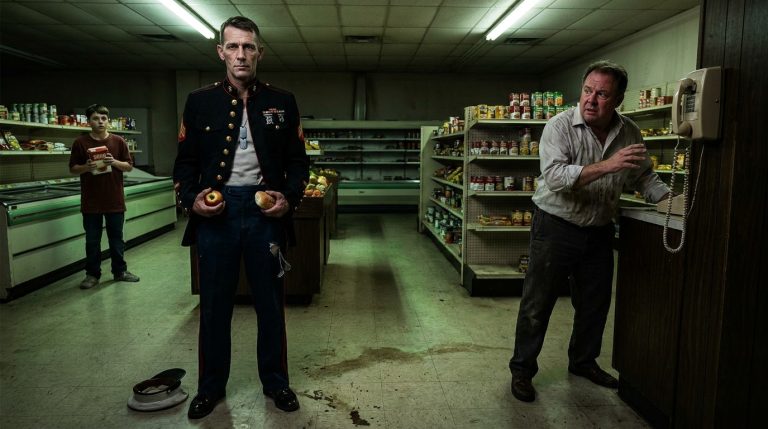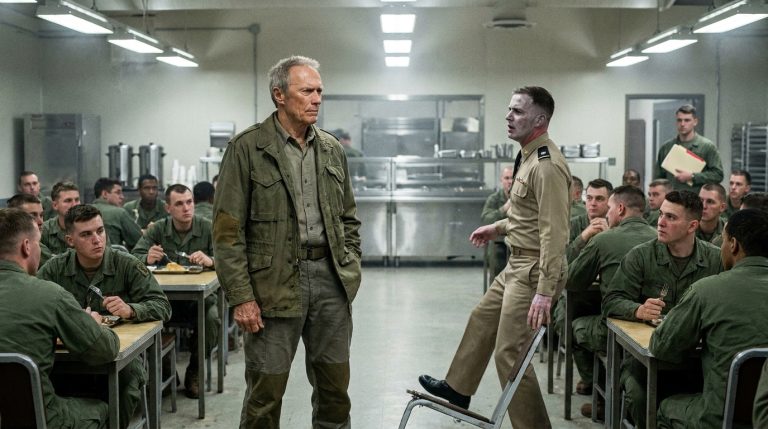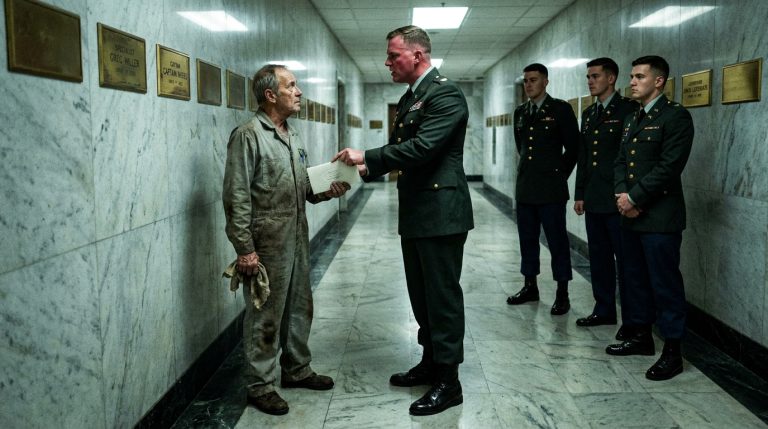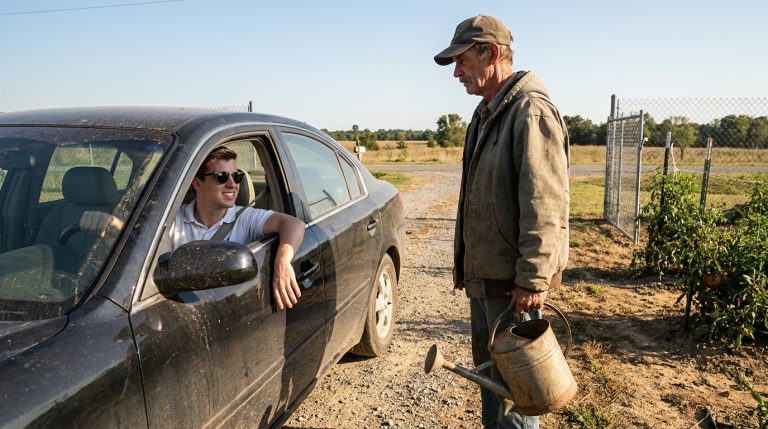
A Reckoning of Shadows: The Silent Ledger of Route Red and the Weight of Unfinished Names
CHAPTER 1: THE HITCH IN THE FREQUENCY
The air inside the field house tasted like floor wax and old secrets. It was a sterile, controlled environment designed for celebration, but the moment the General stopped mid-sentence, the atmosphere curdled. His eyes weren’t on my daughter, the newly minted officer; they were burning a hole into the ink on my forearm.
I felt the shift in the room before I heard it. The hush wasn’t reverent—it was predatory. My pulse, usually a steady, mechanical thrum, spiked. I wasn’t just a father in a folding chair anymore. I was a ghost pulled back into the light by a man who had every reason to want me buried in the archives.
“Atlas 2-3,” the General repeated, his voice barely a murmur, yet the microphone caught every syllable and broadcast it like a death knell.
Ellie stiffened beside me, her arm withdrawing from mine as if she’d been burned. She looked from the General to me, her eyes sharpening into the analytical gaze of a cadet who finally realized her father had been lying to her for a lifetime. “What did he say, Dad?”
I didn’t answer. I couldn’t. I was calculating the exits, measuring the distance to the doors, and cataloging the faces of the campus security detail near the stage. The General was stepping off the podium now, his movements deliberate, his eyes never leaving the broken link in the chain tattoo. He wasn’t walking toward a celebration; he was walking toward a liability.
The band members shifted, their instruments clattering against their chairs. The silence in the auditorium grew heavy, dense with the threat of things that were never supposed to be spoken aloud. I reached for my pocket, my fingers brushing against the cold, familiar shape of my lighter—a habit of a man who had spent too many nights in the dark of a cargo truck.
The General stopped three feet away, his shadow stretching long and thin across the polished wood, creating a sharp, obsidian line between us. He leaned in, the smell of ozone and old, pressed wool emanating from him.
“You weren’t supposed to be here,” he whispered, the tone devoid of the blessing he’d given the other cadets. “And you definitely weren’t supposed to be carrying the ledger.”
My stomach dropped. I hadn’t told anyone about the ledger. Not even the ghosts. The room felt like it was closing in, the rafters pressing down, and I realized with a sick, cold clarity that the error wasn’t in the paperwork—it was in the man standing in front of me. He didn’t come to fix a mistake. He came to ensure the story stayed dead.
CHAPTER 2: THE ANATOMY OF A LIE
The General’s hand, impeccably tailored and weighted with two stars, remained extended toward me, but it was no longer an invitation to a conversation. It was a barrier. Behind him, the graduation ceremony had become a static tableau; the ambient noise of a thousand parents, the rustle of programs, and the distant hum of the ventilation system seemed to drop away, replaced by the high-pitched ringing of a frequency I hadn’t heard since the road outside Kalat decided to become a graveyard.
“The ledger,” I repeated, the words feeling like gravel in my throat. I didn’t look at the General’s face. I looked at the slight tremor in the knuckles of his left hand, the one he was using to hide the pulse jumping in his wrist. He was terrified, not of me, but of the fact that I was breathing in a room full of witnesses.
“You don’t want to do this here,” he said, his voice dropping into the register of a man giving an order in a burning building. “The ceremony is for your daughter. Let’s keep it that way.”
My eyes flicked to Ellie. She was standing five feet away, her posture shifting from pride to the rigid, observational stance of a soldier learning that the world is more treacherous than the recruitment posters suggested. Her gaze wasn’t on the General; it was on the interaction itself, dissecting the power dynamic, watching how I reacted to the name of a document I had spent ten years convincing myself didn’t exist.
The scent of the room—polished floor wax, expensive perfume, and the faint, metallic tang of the heating vents—suddenly shifted. For a heartbeat, the field house dissolved. I was back in the cab of a cargo truck, the air thick with burning rubber and the acrid, chemical bite of a payload that wasn’t supposed to be on the manifest. The phantom heat of the fire roared in my ears, a sensory phantom that made my own skin prickle with the memory of shrapnel.
I locked that memory away, slamming the door on it with the same mental discipline I used to balance my checkbook. I looked the General dead in the eye. “I’m not here for the ceremony anymore, General. I’m here for the discrepancy.”
“There is no discrepancy,” he hissed, glancing toward a colonel who was watching us with narrowed eyes from the edge of the stage. “There is only a historical correction that was handled. The record is clean. You’re a ghost, and ghosts don’t carry ledgers.”
“This one does,” I said, my voice barely audible above the low murmur of the confused crowd. I adjusted my grip on my daughter’s arm, pulling her slightly behind the line of sight of the faculty members.
“Dad?” Ellie’s voice was steady, but there was a sharp edge of warning in it. She had heard the term ‘ledger’ before—not in a military context, but in the fragmented, whispered phone calls I’d made at 3:00 AM when I thought she was asleep. She knew that word meant the end of our quiet life.
“It’s fine, Ellie,” I said, though my heart was hammering against my ribs like a trapped bird. “Stay behind me. If anyone approaches from the stage, you go straight to the parking lot. You find the truck. You don’t wait.”
“I’m not a child,” she retorted, her chin lifting.
“I know,” I said. “That’s exactly why you need to move.”
The General’s face hardened. The mask of the benevolent commanding officer slipped, revealing the raw, tactical calculation underneath. He realized that the threat wasn’t the information itself, but the fact that I had prepared for the eventuality of his return. He took a half-step back, scanning the room, his eyes lingering on the exits. He was assessing the cost of an extraction.
“You think you’re the only one who kept a copy,” he said, the admission hanging in the air between us like a serrated blade. He wasn’t confirming the existence of the ledger; he was baiting me to reveal where mine was hidden.
“I don’t think,” I replied, my voice cold and precise, the way it had been when I was counting rounds in the dark. “I just know how to read the terrain.”
I turned my back on him. It was a calculated insult, a move designed to force his hand, but it was also a test of my own internal compass. I needed to see if I could still walk away from a fight I had spent a decade running from. My knee clicked—a sharp, mechanical reminder of the debt I had paid for that wall on Route Red—but I didn’t stumble.
As we walked toward the lobby, the air felt thinner, ionized by the tension. Every step was a negotiation with gravity, every glance from a nearby faculty member a potential threat I had to calibrate. I could feel the General’s gaze tracking the back of my neck, the weight of his authority pressing against my spine. He wouldn’t follow us out—not yet. He was too public, too guarded. But the game had shifted. The graduation was no longer the objective.
I reached the heavy double doors, the metal push-bars cold under my palms. Outside, the parking lot was bathed in the harsh, flat light of the afternoon sun. I could see my truck—the Hattie—sitting two rows over, looking like a piece of industrial grit amidst the polished sedans of the parents.
“Dad, talk to me,” Ellie said the moment the door swung shut, isolating us from the muffled applause of the ceremony. She didn’t ask for a story; she asked for a status report.
“The ledger isn’t a book, Ellie,” I said, my eyes scanning the perimeter of the lot, checking for the familiar silhouettes of men who looked like they were waiting for a signal. “It’s a set of coordinates. And the General doesn’t want them fixed. He wants them erased.”
I felt the weight of the coin in my pocket, a small, hard reminder that some decisions leave scars that never fade. The parking lot was silent, save for the wind whistling through the dry trees. It was a perfect, exposed stage for an ambush, and for the first time in years, I felt entirely, dangerously awake.
CHAPTER 3: THE WEIGHT OF THE HITCH
The Hattie sat in the third row, a battered monument to a decade of quiet survival. Its paint was faded to the color of dry river silt, and a light coat of pollen dusted the hood, but to me, it was the only honest thing left on campus. I didn’t stop at the driver’s side door. I moved to the rear, the heels of my boots clicking against the asphalt with a rhythmic, military precision that felt foreign in the civilian sprawl.
“Stay close,” I muttered to Ellie, not looking back. Her presence behind me was a constant, cooling pressure, a reminder of what was at stake. She didn’t complain, didn’t ask questions; she just moved with the silent, fluid grace of a trainee who knew when a perimeter was being established.
I pulled the key from my pocket—worn smooth, the teeth dulled by a thousand turns—and unlocked the heavy tailgate of the cargo bed. It swung open with a dry, protesting shriek of metal on rust. Inside, the space was arranged with the obsessive order of a man who lives in the cracks of the system: spare tires, emergency rations, a neatly coiled tow rope, and the heavy canvas bags that contained the tools of my trade.
But as I reached for the recessed compartment hidden beneath the floor plating, my hand froze.
The dust pattern on the edge of the panel was broken.
It was subtle—a faint, triangular smudge in the fine silt that shouldn’t have been there. Someone had been inside the Hattie. They hadn’t taken anything, which was the most chilling detail of all. They had just been here, looking.
“Dad?” Ellie’s voice was a sharp, low whisper. She had caught the slight hitch in my breathing. “What is it?”
“Clear the perimeter,” I said, my voice tight. “Don’t look at the truck. Just watch the lot. Anyone who pauses for more than three seconds, or anyone who looks at this row, you give me a signal.”
She didn’t hesitate. She stepped away, turning her back to me to scan the parking lot, her eyes sweeping over the rows of vehicles with the calculated detachment of a soldier. I returned my focus to the panel. I pressed the release, and the heavy metal plate lifted. Beneath it, in a waterproof container, sat a small, battered notebook—the ledger.
It felt unnervingly light. I flipped it open. The pages were filled with my own cramped, precise handwriting—dates, call signs, and the GPS coordinates of a site outside Kalat that the military had officially designated a “geographic anomaly.” To anyone else, it looked like the log of a man obsessed with his own past. To me, it was the only map that mattered.
But as I thumbed through the center of the book, I stopped. Three pages had been cleanly excised, the edges serrated and thin. They hadn’t been torn out in haste; they had been cut with a razor. The entries that remained ended abruptly at the very moment the convoy had hit the road to Kalat.
My pulse spiked. The General hadn’t just come to the graduation to threaten me. He had used the cover of the ceremony to have someone gain access to my truck—to see what I had, and to let me know that they were already ahead of me.
“One o’clock,” Ellie whispered, her voice barely moving her lips. “Blue sedan. A man in a windbreaker. He’s been sitting there since we walked out, and he hasn’t moved the engine once.”
I didn’t look up immediately. I carefully tucked the ledger back into its recess and slammed the floor panel shut. The sharp metallic clang echoed across the silent parking lot, a sound that felt like a challenge. I stood up, feeling the familiar, grinding ache in my knee, and wiped my greasy palms on a rag.
“Reyes,” I said, my voice low.
“What?” Ellie turned to look at me, her brow furrowed.
“The man in the sedan isn’t from the military,” I said, my eyes tracking the reflection of the blue sedan in the side mirror of the truck. “He’s watching for Reyes. If the General is nervous about the ledger, he’s even more nervous about the people who remember the driver.”
“So we go to him,” Ellie said, her tone hardening. She was already calculating the distance. “If they’re watching us, they’re not watching the whole lot.”
“We go to him, but we don’t make it look like a rendezvous,” I replied. I closed the tailgate, the heavy thud punctuating the shift in my plan. “We make it look like a breakdown. I need that sedan to follow us to the motor pool. If they’re going to shadow us, let’s make sure they’re in a place where they have to reveal their objective.”
I stepped into the cab and started the engine. The Hattie roared to life—a deep, rhythmic growl that had earned its keep on a hundred roads. As the engine warmed, I caught a glimpse of the man in the blue sedan in my side mirror. He was talking into a lapel mic, his head bowed, his entire posture one of professional, coiled tension.
The General was wrong about one thing. I wasn’t just a ghost. I was a driver who knew exactly how to make a wall out of nothing.
I pulled out of the parking space, the truck’s transmission whining in protest as I turned toward the exit. I didn’t look back, but in the mirror, the blue sedan pulled out a heartbeat later, trailing me with the lazy, deliberate pace of a predator that had finally found its mark. The hunt was no longer in the shadows; it was on the asphalt, and the road ahead was finally, brutally, clear.
CHAPTER 4: THE FORENSIC AUDIT OF A LIFE
The campus bypass was a ribbon of cracked asphalt that wound through the university’s administrative district, a place of manicured lawns and buildings named after donors who had never seen the underside of a tactical vehicle. The blue sedan stayed exactly three car lengths behind me, a static shadow that refused to fade.
“They’re not going to let us reach the motor pool,” Ellie said, her voice devoid of panic, sharpened into a calm, analytical assessment. She was watching the sedan through the side mirror, her hand resting on the door handle as if she were already measuring the distance for an exit. “They’re waiting for us to stop.”
“Then we don’t stop,” I said, my grip tightening on the wheel. My knee flared with a sharp, white-hot reminder of the physical cost of this day, but I forced my leg to stay steady on the throttle.
The Hattie, usually as reliable as a heartbeat, suddenly coughed. The engine surged, then sputtered, the tachometer needle dancing erratically. A light on the dash flickered—a brief, orange warning that the fuel intake was struggling with the rapid acceleration. I cursed under my breath. The truck had been sitting in the heat of the parking lot for hours, and the fuel line was sensitive to the temperature shift.
“Mechanical?” Ellie asked, noticing the hesitation in the engine.
“Minor,” I lied, though I knew the Hattie was feeling the same strain I was. “She just needs to breathe.”
I pulled the wheel hard to the right, ducking onto a narrow, gravel-paved access road that serviced the campus’s internal maintenance facility. It was a tight, technical turn that pushed the Hattie’s suspension to the limit. The sedan behind us mirrored the move, but they were slower—cautious, uncertain of the terrain. The crunch of gravel beneath our tires provided a momentary, jagged rhythm that masked the sound of the engine’s protest.
We pulled into the bay of the SJA office—the Office of the Staff Judge Advocate—a building that looked more like a tomb for paper than a house of law. I killed the engine. The silence that followed was heavy, punctuated only by the ticking of the cooling metal.
“We have exactly five minutes before they find a reason to clear this lot,” I said, reaching into the glove box and pulling out a small, metallic flash drive I had stashed years ago. “If we’re going to force them to expose their objective, we need to make it look like we’re conducting an official audit. You have your credentials?”
Ellie nodded, pulling her new officer’s ID from her pocket. She looked at the plastic card, then back at me. “Second Lieutenant Marsh reporting for a review of the memorial records,” she said, her voice steadying into a professional cadence.
We exited the truck. The air outside was cool, smelling of industrial cleaner and the stagnant humidity of a late afternoon storm gathering on the horizon. The man in the blue sedan had pulled to a stop at the edge of the access road. He wasn’t getting out. He was sitting there, watching us through the windshield, his face obscured by the reflection of the clouds.
“He’s not moving,” Ellie noted.
“Because he’s not the one who makes the call,” I replied. I walked toward the SJA entrance, my gait stiff, my focus entirely on the building’s heavy, reinforced door. “The General didn’t send him to stop us. He sent him to see if we were actually going to report the error, or if we were going to use the audit to find the coordinates.”
Inside, the office was a maze of gray filing cabinets and desks piled with documents that smelled of decay and forgotten purpose. A clerk, a young man who looked like he had never seen the sun, looked up from his monitor with a bored, flicking glance.
“Office is closed for processing,” he droned.
I stepped to the desk, sliding my forearm onto the surface so the broken-chain tattoo was clearly visible under the harsh, flickering fluorescent lights. I didn’t say a word. I just waited. The clerk’s gaze drifted from my face to my wrist. The color drained from his skin, a slow, methodical process that ended with him looking like a ghost.
“I need to see the log for the Kalat mission, 2016,” I said, my voice low and devoid of threat, which made it all the more jarring. “The supplemental manifest.”
“That… that’s classified,” he stammered, his eyes darting toward the back office.
“It’s not classified,” I said, leaning in. “It’s missing. And the error report is currently being signed by the General himself. Do you want to be the one who explains why the file was empty when the audit started?”
Ellie stepped forward, her uniform crisp, her presence filling the space with the weight of her rank. “Second Lieutenant Marsh,” she said, her tone absolute. “I’m here to verify the memorial plaque’s supporting documentation. The General is expecting the files to be pulled.”
The clerk looked between the two of us, his professional training warring with the visible terror of seeing a name that shouldn’t exist. He reached for a heavy, steel-keyed ring on his belt. The sound of the keys hitting the desktop was the loudest thing in the world.
As he moved toward the rows of restricted files, I looked back toward the window. The blue sedan was still there, but now, a second vehicle had pulled up behind it—a black SUV with tinted windows. The game was no longer about containment. It was about erasure. I had five minutes to find the missing pages, and the clock was already ticking down.
CHAPTER 5: THE MEMORIAL OF BROKEN THINGS
The steel drawer groaned—a long, agonizing shriek of rusted ball bearings that seemed to mock the supposed precision of military filing. The clerk, a man whose skin had gone from pale to the color of damp parchment, yanked the file free. He didn’t hand it over; he dropped it onto the desk as if it were a live grenade.
“I didn’t open this,” he whispered, his eyes darting toward the frosted glass of the office door. Through the translucent pane, the silhouettes of the men from the SUV were already moving. They weren’t walking; they were sweeping, their posture tight and coordinated. “I was told it was empty. That it was a dead-end entry.”
I didn’t wait for him to finish. I snatched the folder. It was surprisingly thick, but as I opened it, the weight vanished. It was mostly filler—blank forms, misdirected memos, and a series of “Correction Notices” that were all signed with the same looping, authoritative scrawl of the General.
“Ellie, give me the scanner,” I said, my voice sharp.
She pulled the portable device from her jacket—an old, handheld piece of tech we’d kept since the days when digital footprints were the first thing they’d hunt for. She hovered it over the pages. The green light of the scanner painted her face in ghostly, high-contrast shadows.
“It’s not here,” she said, her voice strained. “These are just standard logistics reports. There’s nothing about a cargo truck, nothing about Route Red, and nothing about the six.”
I flipped to the back, my fingers moving with the frantic, calculated speed of a man dismantling a bomb. My breath caught. Taped to the inside of the back cover was a single, yellowed photograph, slightly out of focus. It was a shot of a wall—a barricade I had constructed from the twisted metal of a destroyed MATV. I remembered that wall. I remembered the heat, the sound of incoming fire, and the way the world had shrunk to the size of that cargo truck’s windshield.
But someone had scribbled a coordinate on the back of the photo.
Before I could process the numbers, the office door handle clicked. The clerk didn’t move to stop them; he simply collapsed into his chair, covering his ears.
I shoved the file into Ellie’s bag and grabbed her arm, pulling her toward the narrow, lightless service hallway that ran behind the filing rows. The door to the main office swung open, and the air shifted instantly. The room was no longer a place of administration; it was a theater of tactical force. Two men in dark, nondescript suits stepped inside, their movements economic, their eyes scanning the room with the unblinking intensity of birds of prey.
“Close the door,” one of them said. His voice was flat, devoid of emotion, the hallmark of someone who spent their life cleaning up other people’s messes.
We were already halfway down the hall. My knee complained, a dull, throbbing protest against the sudden, forced momentum, but I pushed through the pain. The hallway was a maze of industrial conduits and pipes that dripped with the condensation of the building’s aging HVAC system. We reached the freight elevator—a heavy, manual cage that hadn’t seen maintenance in a decade.
“We can’t go down,” Ellie whispered, her ears pinned to the sound of footsteps echoing behind us. “They’ll be waiting in the parking lot.”
“We aren’t going down,” I said, hitting the button for the roof access. “We’re going to the memorial.”
The elevator shuddered, began a slow, agonizing ascent. Inside the small, cramped cage, the atmosphere was suffocating. I pulled the photograph out again. The coordinates on the back—34.12, 66.89—they weren’t just numbers. They were the site of the secondary extraction, the place where the real ledger had been kept. And looking at the photo again, I noticed something I had missed: the reflection in the truck’s side mirror. It wasn’t just the desert. It was a face.
It was the General. He hadn’t just signed the casualty letters; he had been the commanding officer on-site, the one who had ordered the “wall” to be built, and the one who had been standing there, watching, while the world burned.
The elevator slammed into the stop at the roof level. The doors slid open with a screech of dry metal.
We stepped out into the cool, biting air of the rooftop. The campus stretched out below us, a miniature model of order and tradition. And there, standing in the center of the university’s memorial garden, the new plaque already gleaming in the fading light, was the General.
He wasn’t waiting for us. He was standing in front of the plaque, his hands clasped behind his back, looking down at the six names as if he were waiting for them to speak. He heard the elevator door, but he didn’t turn around.
“You were always the most efficient driver I ever saw,” he said, his voice carrying clearly on the wind. “But you were always the worst at knowing when to stop driving.”
I stepped out onto the roof, the gravel crunching beneath my boots. I wasn’t a ghost anymore, and he wasn’t a hero. We were just two men, standing on the precipice of a history that neither of us could afford to keep buried. The distance between us was only thirty yards, but it felt like a lifetime of ash and silence.
“The coordinates, General,” I said, my voice steady, the cold of the evening air sharpening my resolve. “The ones on the back of the photo. They don’t lead to a memorial. They lead to the evidence you’ve been protecting.”
He finally turned. His face was a map of hard-won secrets, his eyes the color of old, weathered stone. “The evidence doesn’t lead to justice, Sergeant,” he said. “It leads to the end of everything this university stands for. Are you sure you want to be the one to flip the switch?”
Behind me, I heard the roof door rattle. The men in the suits were on our heels, and the window of time I had to make my move was closing. The “decoy” of the memorial fix was shattered, and the jagged, ugly truth was finally starting to breathe.
CHAPTER 6: THE SECONDARY EXTRACTION
The General didn’t move as the two men stepped onto the rooftop, their presence instantly changing the geometry of the space. They were professionals, moving with a practiced, low-center-of-gravity stride that ignored the uneven gravel beneath their feet. They didn’t speak. They didn’t need to. They spread out, flanking the roof access door, their eyes scanning the garden with a cold, detached efficiency.
“I asked you a question, Sergeant,” the General said, his voice barely rising above the whistle of the wind. He was looking at the new bronze plaque, his silhouette framed by the stark, sterile lines of the campus buildings below. “Are you prepared to dismantle this university’s reputation for the sake of a few coordinates that haven’t mattered for a decade?”
“They matter to the six,” I said, my hand instinctively finding the cold, hard edge of the photograph in my pocket.
“The six are gone,” he countered, finally turning to face me. “They are names on a wall. Whether the records are accurate is a matter of bureaucracy, not morality.”
I took a step forward, my knee locking, my focus narrowing until the only things that existed were the General and the distance I needed to close. Ellie moved with me, a mirror image of my own tactical tension. She was watching the men in suits, her hands held slightly away from her body, palms open—a subtle, calculated move to appear non-threatening while keeping her options for leverage wide open.
“Bureaucracy is just the mask you use to hide the bodies, General,” I said, my voice cutting through the rising gale. “You were there. You signed the order to pull the extraction team, and you were the one who authorized the ‘geographic anomaly’ designation to bury the site. You didn’t just misfile the paperwork. You erased the evidence of the team that was still inside the perimeter.”
The General’s expression didn’t flicker, but the men by the door shifted. Their hands moved with a lethal, almost imperceptible speed toward their jackets.
“And if I did?” the General asked, his tone so calm it was chilling. “The war was a series of tactical compromises. Every officer at my level has a ledger full of them.”
“Not this one,” I said. I reached into my bag and pulled out the small, secondary device I had recovered from the Hattie’s hidden compartment—a satellite uplink that had been hard-wired into the truck’s internal architecture since the day I returned from the desert. I didn’t hold it like a weapon; I held it like a key. “This isn’t just about what happened. It’s about the fact that the location of the secondary extraction point was never ‘anomalous.’ It was a cache. You used the mission as cover to secure a proprietary set of data, and when the convoy hit the road to Kalat, you realized the driver—me—had seen the signature on the crate.”
The General’s silence was absolute. For a heartbeat, the only sound was the rustle of our jackets in the wind. The “decoy” of the clerical error—the idea that it was just a lazy administrator in Kabul—wasn’t just crumbling; it was being incinerated.
“You have no proof,” he said, but his eyes betrayed him. He looked at the satellite device, then at the photograph of the wall.
“I have the timestamp from the dash cam,” I said, pointing toward the parking lot far below, where the Hattie sat, its own digital heartbeat ticking away. “And I have the coordinates that were never supposed to be logged. The man in the blue sedan wasn’t here to monitor the graduation, General. He was here to make sure I didn’t sync the device.”
The man closest to the door moved. He didn’t rush; he accelerated, a sudden, violent burst of motion.
“Ellie, down!” I barked.
I didn’t wait for her to comply. I lunged, not at the General, but at the secondary control panel for the roof’s irrigation system—a legacy feature of the garden’s design that I’d memorized weeks ago when I first suspected I’d need a tactical advantage. I slammed my fist into the manual override.
A pressurized spray of water erupted from the garden’s hidden nozzles, a sudden, high-velocity wall of mist that instantly blinded the men in the suits. It wasn’t a weapon, but in the confined, gravel-strewn space of the rooftop, it was total chaos.
Ellie surged forward, her training overriding her fear. She didn’t head for the General; she moved for the men, using the distraction to break their line of sight. I stayed focused on the General. He was standing his ground, but his confidence was leaking out of him like air from a punctured tire.
“You think you’ve won?” he shouted over the roar of the water and the rising wind. “You’ve only just started the countdown, Sergeant! Even if you broadcast those coordinates, the team you’re looking for is already gone.”
“Then I’ll be the one to tell the families where to look,” I said, my eyes locking onto his.
I had the ledger, I had the device, and for the first time in ten years, I wasn’t running from the war. I was finishing the run. The rooftop was becoming a battlefield, but the ground was finally solid. The truth wasn’t a secret anymore; it was an objective.
CHAPTER 7: THE CONFRONTATION OF RECORDS
The rooftop had become a slick, treacherous theater of shadows and falling water. My boots struggled for purchase on the wet gravel, and my knee sent a searing message of protest with every shifting step. Ellie was holding the line near the roof access door, her movements precise and economy-driven, forcing the two men in suits to work for every inch of ground they gained. They were disciplined, but they were working against an opponent who had spent ten years training for a fight they still thought they could win with intimidation.
The General, however, was no longer watching them. He was watching me. He moved with an unsettling calm, sidestepping the spray of the irrigation nozzles as if he were walking through a light spring rain. He reached into his coat—not for a weapon, but for a radio.
“Containment failed,” he said into the device, his voice detached, almost clinical. “Execute the hard reset on the secondary site coordinates. Now.”
My stomach turned over. The “hard reset” wasn’t a metaphor. It was a pre-programmed command to remotely wipe the digital server at the secondary extraction site, a fail-safe designed to trigger if the coordinates were ever exposed. If he wiped the server, the evidence of the original extraction team—the men who had been left behind—would vanish into the ether, leaving me with nothing but a notebook and a photo.
“Ellie!” I shouted over the roar of the water. “The signal! Jam it!”
Ellie didn’t ask how. She reacted. She lunged for the antenna hub on the side of the rooftop’s communication tower, a bundle of exposed wires and junction boxes that were the only things broadcasting the General’s command. She didn’t have a tool, so she used the only thing that mattered—the heavy, reinforced metal clip of her own radio.
She smashed the hub, the sound of tearing metal and sparking short-circuits filling the air. A shower of blue sparks erupted, lighting the rooftop in a strobe-like, erratic rhythm. The General froze, his radio falling dead in his hand, a look of genuine, unfiltered shock crossing his face. For the first time, he looked old.
The men in the suits hesitated, the interruption in their command chain fracturing their focus. It was the crack I needed.
“The server is still active,” I said, my voice cutting through the hiss of the dying electrical equipment. “The signal didn’t reach the site because the tower’s local relay was the only link. You just cut yourself off from your own cover-up.”
The General’s eyes flicked toward the roof’s edge. He knew it. He had played the game with the arrogance of a man who assumed he controlled the architecture of the battlefield, but he had forgotten that architecture can be sabotaged.
“You think you’ve fixed it?” he rasped, his voice dropping to a jagged whisper. “The data is already migrating to the offshore grid. You’ve only delayed the inevitable.”
“Maybe,” I said, closing the distance between us until I was within reach of his collar. I didn’t strike him. I simply gripped his shoulder with the same pressure I’d used to keep the Hattie on the road under fire. “But now you’re going to witness the audit. Personally.”
The men in the suits finally found their resolve and surged forward, but it was too late. I wasn’t fighting them. I was holding onto the General, a human anchor in the middle of a storm of their own making. Ellie grabbed my arm, her other hand leveling her own radio at the men, not as a weapon, but as a communication tool.
“Security dispatch!” she commanded, her voice ringing out with the authority of an officer who knew exactly what the frequency protocols were. “Unauthorized hostile entry, rooftop sector, identify and isolate! I have a commander in custody!”
The change in the atmosphere was instantaneous. The men stopped. They knew the protocol—they weren’t authorized to use lethal force in front of campus security, and the moment they heard the word ‘Security’ on the open channel, the mission objective shifted from ‘neutralize’ to ‘extract.’
They looked at the General, then at the elevator, and then, with the chilling, robotic efficiency of the system they served, they turned. They didn’t look back as they retreated into the service hallway, leaving us alone on the roof.
The General stood silent, his chest heaving, the remnants of the water spray dripping from his perfectly pressed suit. He looked down at his own hands, then at the memorial plaque, his face a landscape of absolute, crushing defeat.
“They won’t follow,” he whispered, looking at the door. “They never follow when the record is no longer clean.”
“No,” I said, my grip on him tightening. “They only follow when they think they’re winning. And today, General, the record belongs to the six.”
I pulled the satellite device from my bag and plugged it into the wreckage of the tower’s junction box. The screen flickered to life, showing the status bar of the data upload—the real coordinates, the real manifest, and the original names of the team that had been sacrificed for a crate of proprietary hardware. It was uploading to a server the General couldn’t touch: the university’s public archive.
The upload bar reached 99%.
I looked at Ellie, then back to the General. The war wasn’t over, but for the first time in ten years, I wasn’t just a driver. I was a witness. And the truth was finally starting to burn.
CHAPTER 8: THE LAST LEDGER
The chime of the device was quiet, almost polite, but it signaled the collapse of a decade of institutional silence. On the rooftop, the air seemed to lose its charge. The General stood perfectly still, his eyes fixed on the small screen of the satellite uplink. The data was live. It was in the university’s public archive, mirrored across a dozen nodes that not even a classified military directive could suppress.
“It’s done,” I said, my voice sounding hollow in the sudden vacuum of the rooftop.
The General didn’t look at me. He looked at the memorial plaque, his reflection caught in the polished bronze. The men in the suits had vanished into the service hallway, their mission abandoned the moment the data became public record. They were ghosts, loyal only to the survival of the organization, and with the ledger exposed, the organization had no further use for them—or for the General.
“You have no idea what you’ve opened,” the General said, his voice devoid of its former steel. It was just the voice of an old man, tired and stripped of his rank. “That data doesn’t just name the men we left behind. It names the logistics chain that fed the entire operation. It names the financiers, the contractors, and the oversight committee that authorized the ‘geographic anomaly’ in the first place. You didn’t just expose a local error, Sergeant. You broke the seal on a global network of sanctioned negligence.”
“I didn’t break it,” I said, stepping closer. “I just performed the maintenance.”
Ellie moved to my side, her hand firm on my arm. She looked at the General, not with hatred, but with a cold, clear-eyed pity. She was the one who had made the call, the one who had navigated the campus bureaucracy to force the memorial rededication, and in doing so, she had created the leverage that allowed us to trap him.
“You’re finished, General,” Ellie said, her voice steady. “The campus police are on the roof. My SJA report is already on the desk of the Board of Regents. You can stand here and wait for them, or you can start explaining why you were trying to wipe a public archive.”
The General finally turned to face us. He looked at his hands, the hands that had signed the letters that said the six were dead, and he saw them for what they were. He didn’t offer a defense. He didn’t offer a speech. He simply stood there, a man who had built his life on the assumption that secrets would hold their weight, and found that his wall had finally fallen.
The sound of boots on the gravel—dozens of them—told us that the security team had arrived. They didn’t storm the roof; they surrounded it, their flashlights cutting through the mist of the garden, illuminating the plaque and the men who stood before it.
The aftermath was a slow, agonizing descent from the high-tension reality of the last few hours. The General was taken into custody without a word, his rank stripped away by the silent, efficient bureaucracy that had once protected him. There was no spectacle, no grand exit; just a quiet, systematic removal of a man who had outlived his own lies.
In the days that followed, the campus began to heal, though the “healing” was less of a mending and more of a hard, clean scar. The plaque was replaced with the accurate list of names, and the families—the ones who had kept their porch lights burning—finally received the formal notification that the record had been corrected.
I sat on the porch of my mother’s house, the same porch where I had started my drive so many years ago. It was quiet. The Hattie was parked in the driveway, its engine cold, its dashboard camera finally removed. I pulled the heavy, metallic coin the General had given me from my pocket—the one with the two stars and the motto: Walls make time.
I took a small file from my toolbox and began to work on it, slowly, methodically erasing the stars. I didn’t want the rank. I wanted the metal. When I was finished, it was just a smooth, circular piece of steel, the weight of it perfect in my palm.
Ellie joined me on the steps, her uniform swapped for the comfortable, worn-in clothes of a daughter finally home. She sat beside me, her shoulder pressing against mine. She didn’t ask if I was okay. She knew that ‘okay’ was a word for people who hadn’t seen the road outside Kalat.
“The memorial is finished,” she said softly. “The families want to meet you.”
“I’ll be there,” I said, looking out at the yard. The light was fading, the sky shifting from a bruised purple to a deep, honest black. “But not today. Today, the porch light is enough.”
I reached into my pocket and touched the broken-chain tattoo on my wrist, feeling the skin beneath the ink. It still hurt, a sharp, dull ache that served as a reminder of the six. But for the first time in ten years, the chain didn’t feel like it was holding me back. It felt like it was finally, truly, in its place.
I looked at the Hattie, then back at the road that stretched out beyond the driveway. The past was no longer a ghost in my rearview mirror; it was a map, and I finally knew how to read it. I closed my eyes, listening to the sound of the wind, and for the first time in a long time, the only thing I could hear was the silence of a road that was finally, peacefully, empty.