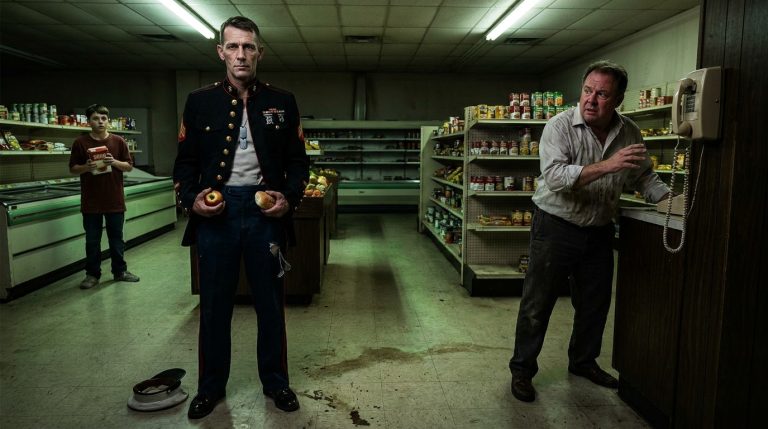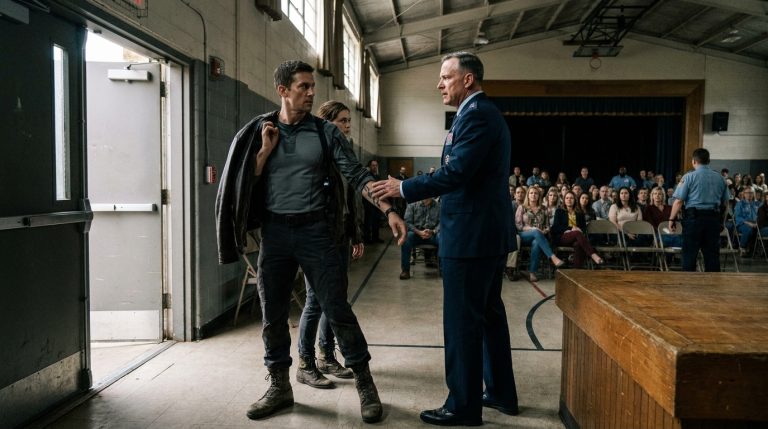
A Ghost in the Gears: Sergeant Major Elias Thorne Confronts the Architecture of Forgotten Wars
CHAPTER 1: THE WEIGHT OF IRON
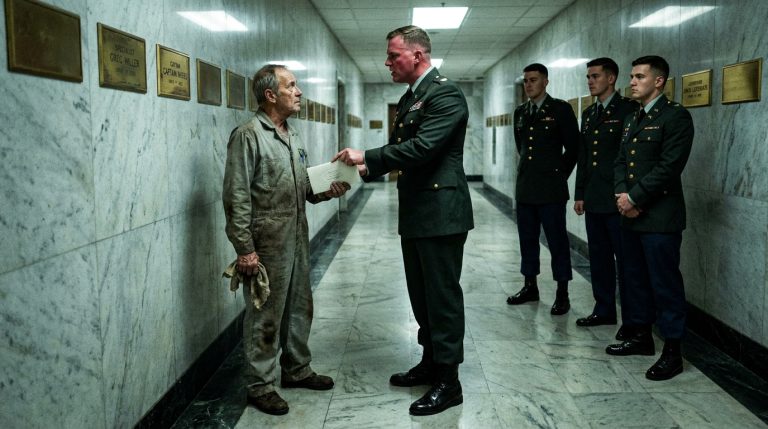
The air in the mess hall at Fort Benning did not move. It sat heavy, thick with the smell of scorched coffee and the sharp, antiseptic sting of floor wax. Captain Hayes remained a statue of frozen indignation, his hand hovering in the space where he had tried to strip away the old man’s dignity.
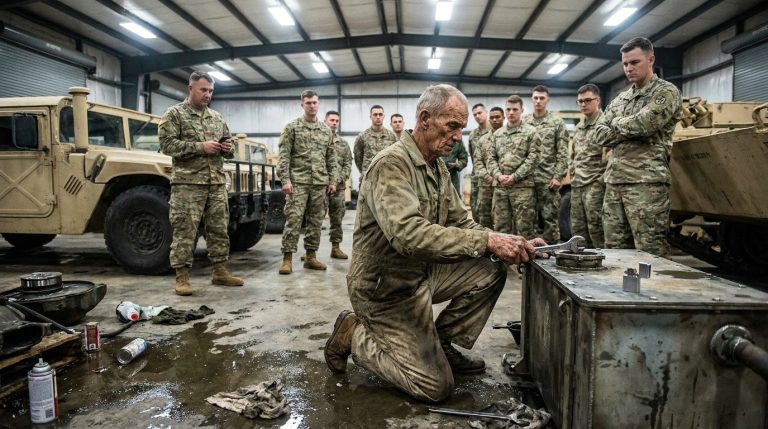
Elias Thorne stood. The movement was deceptively slow, the joints of his knees protesting with a soft, rhythmic clicking, but the intent was absolute. He looked at Hayes not with anger, but with the flat, deadened observation of a man who had watched entire civilizations crumble in the mud of forgotten frontiers.
The silence was a physical weight. Every private at the surrounding tables had gone rigid, their forks suspended mid-air. In the back of the room, the Master Sergeant—a man who had spent three decades learning to read the geometry of a room—was already shifting his weight, his eyes locked on Thorne’s worn field jacket. He saw the way the fabric hung over the shoulders. It wasn’t just age; it was the structural alignment of a man who had spent his life carrying things that would snap a lesser human in half.
Thorne didn’t look at the crowd. He kept his gaze locked on the pulse visible in the side of Hayes’s neck.
“You think you’re enforcing order, Captain,” Thorne said. The voice was a low, grinding sound, like gravel shifting under the tread of a heavy vehicle. “But you’re only rearranging the dust.”
Hayes’s face lost its flush of superiority, replaced by a pasty, mottled gray. He tried to reclaim his voice, to demand the protocol he lived by, but the room had already shifted its allegiance. The authority he had brought into the room with him had evaporated, leaving him exposed in the center of a space that was no longer his.
Then, the doors groaned open. The sound was distinct, a heavy hydraulic sigh that sliced through the suffocating quiet.
General Vance entered. He walked with a gait that suggested he was constantly correcting for a long-hidden injury. When he saw Thorne, the sharp, calculated mask he wore for his command simply fell away. He didn’t look at the room. He didn’t look at the protocol. He looked at the old man as one might look at an altar.
As Vance approached, the air in the room seemed to pull toward the two men, a vacuum created by the collision of two different centuries. Hayes took a reflexive, stumbling step back, his boot catching on the metal leg of a chair. The resulting screech was agonizingly loud, a jagged tear in the fabric of the scene.
General Vance didn’t turn to see what had made the noise. He stopped precisely three feet from Thorne, his posture softening into something that looked dangerously like exhaustion.
“Sergeant Major,” the General murmured. The title wasn’t an address; it was a plea.
Thorne’s eyes flickered, just for a heartbeat, toward the doorway. There, standing in the shadow of the frame, was a junior aide holding a manila folder with a bright red stripe—a clearance level that shouldn’t exist on a base of this configuration. The folder was held with white-knuckled precision, the corner catching the light and glinting like an exposed nerve.
Thorne saw it. He didn’t blink. He knew the weight of that color. He knew what kind of ghosts lived inside folders that were never meant to be opened.
“General,” Thorne replied, his voice steadying, regaining that sharp, metallic edge. “I believe we have business to discuss. And it isn’t about coffee.”
CHAPTER 2: THE GENERALS BURDEN
The mess hall was no longer a room; it was a pressurized chamber. The friction of the air, thick with the smell of floor wax and the metallic tang of unspent adrenaline, caught in Thorne’s throat. His gaze remained anchored to that folder. It was thin, unassuming, and held with the kind of reverence usually reserved for liturgical texts. The red stripe—a dash of arterial color against the manila—was a signal he hadn’t seen in four decades.
General Vance did not follow Thorne’s eyes immediately. He was focused on the Captain, Hayes, whose face had gone from a defensive, blotchy crimson to a sickly, translucent gray. The General’s hand, steady and broad, rested on Thorne’s shoulder. It wasn’t a supportive touch; it was an anchor, pinning Thorne to the present moment, keeping the old man from drifting back into the dark currents of the past.
“Captain,” Vance said, his voice dropping an octave, losing its warmth entirely. “Leave us.”
Hayes didn’t argue. He moved with a clumsy, disjointed gait, his polished boots scraping against the tile in a discordant rhythm. He passed Thorne without looking up, his eyes fixed on the floor as if searching for a place to hide. The room was silent, the kind of silence that has teeth.
Vance turned toward the doorway. “Major,” he called out to the aide. “Clear the room. Now.”
The soldiers—privates, NCOs, and technicians—moved with a sudden, coordinated urgency, their departure a ripple of fabric and heavy breathing. As the mess hall emptied, the sudden absence of noise felt like a drop in altitude. Thorne found himself standing in the center of the vast, hollow space, the General’s hand still on his shoulder.
“The folder, sir,” Thorne said, his voice a low gravel, unbothered by the command structure or the rank of the man beside him. “That is not something you carry into a mess hall.”
Vance exhaled, a ragged, weary sound. “It was the only way to reach you without triggering the audit systems. You know how they monitor the civilian database.”
Thorne felt the ghost of a twitch in his right hand—a tactical phantom memory of reaching for a sidearm that hadn’t been there for years. He suppressed it, closing his fingers into a tight, dry fist. The environment felt increasingly brittle; the fluorescent lights above buzzed with a frequency that set his teeth on edge. It was the sound of a system that was malfunctioning, a structure that was trying to keep its secrets in a world that was becoming far too transparent.
“You’re not here for a reunion, General,” Thorne stated, his eyes shifting from the folder to Vance’s face. The General looked older than his years, the skin around his eyes mapped with fine, nervous lines. He was a man holding back a collapse, and Thorne recognized that look. He had seen it in the faces of men sitting in muddy foxholes while the radio emitted nothing but static.
“No,” Vance admitted. He gestured toward the door, away from the prying eyes of the remaining staff. “We need to move. My office is a sterile environment. It’s the only place we can talk about… the anomaly.”
“The anomaly,” Thorne repeated, tasting the word. It was bureaucratic shorthand for a catastrophe they couldn’t explain.
“The sensor arrays in the northern sector,” Vance said, his voice dropping to a whisper as they began to walk. “They’re picking up signature patterns, Elias. Patterns that shouldn’t exist. They match the spectral analysis from your final extraction.”
Thorne felt a cold, metallic chill settle deep in his chest, a sensation that had nothing to do with the temperature of the room. The past wasn’t buried; it was simply rusting. And now, the rust was starting to flake away, exposing the jagged, dangerous iron beneath.
“You didn’t bring me here for an honor guard,” Thorne said, his pace steady, his shoulders squaring instinctively. “You brought me here because something is breaking the surface.”
Vance didn’t answer. He simply opened the heavy steel door that led into the administration wing. As they crossed the threshold, the lighting shifted from the harsh, clinical glare of the mess hall to the dim, amber glow of the hallway. The change in texture felt like passing from one reality into another.
Thorne glanced at his own reflection in the polished glass of the double doors. He looked frail, a worn-out husk of a man in a dated jacket. But behind his eyes, the man from the 75th Ranger Regiment—the man they called Phoenix—was waking up. He felt the weight of the moment, the way the air pressed against him, the way every decision from this point forward would have a cascading effect on a history that was supposed to have ended forty years ago.
He followed the General, his steps echoing with a hollow, rhythmic beat that sounded, to his own ears, like the counting of a fuse.
CHAPTER 3: THE ARCHITECTURE OF PARANOIA
The walk to the administration wing was a study in controlled obsolescence. Every step Thorne took felt like a deliberate act of friction against the sleek, polished linoleum. General Vance walked with a rigid, unnatural efficiency, his shoulders pinned back as if bracing for an impact that had been forty years in the making.
“The security protocols have changed, Elias,” Vance said, his voice bouncing off the sterile white walls. “They aren’t just locking doors anymore. They’re tracking intent. Algorithms, motion sensors, biometrics—the base is essentially a giant, sentient nervous system.”
Thorne didn’t respond. He was busy watching the way the overhead lights flickered—a sub-perceptual stutter that his eyes, trained on the movement of shadows in deep jungle, picked up immediately. To any other man, it was a failing bulb. To Thorne, it was a rhythmic pulse, a heartbeat. He wondered, with a flash of cynical clarity, if the building was watching him back.
He felt the age in his bones, a dull, heavy ache, but he channeled the discomfort. He turned it into a diagnostic tool. Every time he shifted his weight, he mapped the room’s blind spots. The habit was forty years old, a relic of a time when the only thing standing between him and a shallow grave was his ability to notice the way a branch moved against the wind.
They reached the General’s office. The door wasn’t just a door; it was a heavy slab of reinforced steel that groaned as it retracted. Inside, the space was windowless, dominated by a large, circular desk that looked like an operating table. The air here was drier, processed through high-end scrubbers, devoid of the scent of earth or rain. It smelled of ozone and cold, unfeeling machinery.
Vance bypassed the chair and went straight to a console built into the wall. He tapped a sequence of keys—not a keypad, but a haptic interface that glowed with a soft, pale blue light.
“I brought you here because the anomaly isn’t just a reading,” Vance said, his back to Thorne. “It’s a resonance. We’re detecting something buried in the northern sector that matches the exact structural density of the Phoenix mission’s final equipment cache.”
Thorne moved to the center of the room. He felt a sudden, sharp spike of vertigo. For a split second, the polished floor beneath him seemed to dissolve, replaced by the damp, rotting floor of an enemy bunker from decades ago. The memory was so visceral he could smell the cordite, hear the frantic, muffled shouts of men who were already ghosts. He gripped the edge of the desk, his knuckles turning white, the sensation of rusted iron digging into his palm.
Stay, he told himself, the internal command as sharp as a blade. You are here, not there.
“You’re not telling me the whole truth, General,” Thorne said, his voice raspy, a low growl that held no room for bureaucratic pleasantries. “You don’t need a retired Sergeant Major to identify a cache. You have satellites that can see through three meters of solid rock.”
Vance stopped typing. He stayed still for a long, heavy moment before turning around. His face was a mask of calculated uncertainty. “Satellites see shadows, Elias. They don’t see intent. We need you to tell us if what we’re seeing is a threat or a… a tomb.”
Thorne leaned forward, his eyes boring into the General’s. He noticed the way Vance’s hands were slightly curled, as if he were trying to hide a tremor in his fingers. It was a small detail, but in the context of a man who commanded three stars, it was a massive reveal. Vance wasn’t just anxious; he was terrified.
“You’re worried that the cache isn’t empty,” Thorne said. It wasn’t a question.
Vance walked back to the desk, his movements heavy. He pulled the manila folder with the red stripe from his pocket and laid it on the desk. He didn’t open it. He just placed his hand over it, a silent barrier between the past and the present.
“I’m worried that what’s in that cache is still active,” Vance whispered. “And if it is, the men who sent you on that mission—the ones who still hold seats on the Oversight Board—are going to do everything in their power to make sure it stays buried. Even if they have to bury us with it.”
Thorne stared at the folder. He could feel the weight of it, the gravity of a secret that had been nurtured in the dark for forty years. His perception shifted again, the room’s perfect, sterile order feeling like a thin sheet of ice over an abyss. He was the only person in this building who knew what that mission had truly cost, the only person who knew that the “official” version of events was a lie built on the bones of his team.
“You want me to be your scout,” Thorne said, a dry, humorless smile touching his lips. “You want me to walk back into the mouth of the beast so you can see if the teeth are still sharp.”
“I want you to help me fix this,” Vance countered, his voice gaining a sudden, desperate strength. “Before they decide that you’re a loose end that needs to be tied.”
Thorne looked away from the folder and toward the door. He could hear the faint, muffled hum of the base—the sound of thousands of people going about their lives, oblivious to the fact that their reality was anchored by a lie. He felt the cold pressure of the room closing in, a tactical trap of his own making. He had come here for a cup of coffee, and instead, he had walked into the middle of a war that had never actually ended.
He reached out and touched the corner of the folder. The paper was cold—unnaturally cold—as if it had been stored in a climate that defied the laws of the room. He didn’t open it. He didn’t need to. He already knew what was written inside. It was a list of names, and at the top of that list, written in the shaky, indelible ink of a man who was already dead, was his own.
He wasn’t a hero being welcomed home. He was a piece of evidence being recalled for destruction.
CHAPTER 4: THE SILENCE IN THE WIRE
The darkness was total, thick and absolute. It wasn’t the natural dark of a forest at night, but a synthetic, stifling absence of light that felt heavy against the skin. Thorne didn’t flinch. He didn’t gasp. His hand, still resting on the folder, remained perfectly still, his body settling into the stance he had perfected in the high-altitude winters of a war that had never been acknowledged.
“General?” he asked, his voice low and devoid of panic.
There was no reply. The hum of the computer consoles—the quiet, constant vibration of the base’s nervous system—had vanished. The silence that filled the space was porous, revealing the distant, muffled sound of a security alarm somewhere deep in the gut of the facility, though it sounded like it was being muffled by miles of concrete.
Thorne pulled his hand back from the folder. He felt the edge of the desk, his fingers tracing the cold, machined surface until he found the corner. He stood still, letting his eyes adjust to the absence of light. Slowly, shapes began to emerge from the black: the faint, ghostly outline of the General’s chair, the silhouette of the wall-mounted console, and a sliver of grey, ambient light bleeding in from under the heavy steel door.
“Vance,” Thorne said again, louder this time.
Nothing. Thorne moved, his feet making no sound on the floor. He didn’t trust the floor; he walked with the measured, cautious tread of a man navigating a minefield. He reached the console. The haptic interface, which had been glowing a soft blue, was dead. He ran his hand over the panel and felt something wet—a faint, oily slickness on the metal casing.
He didn’t need light to know what it was. He touched it to his thumb, bringing it close to his nose. It had the distinct, metallic tang of hydraulic fluid—or perhaps, given the age and the nature of the systems here, a cooling agent that had been forced to bleed out.
A sabotage, he thought. Or a cleanup.
He turned toward the door, his heart rate steady, his mind processing the environment as a series of tactical hazards. If the power had gone out, the electronic locks would be failing—or perhaps they were being overridden by a manual circuit. He pushed against the heavy steel of the door. It didn’t budge. It wasn’t locked electronically anymore; it was sealed.
Thorne didn’t waste energy pounding on the metal. Instead, he pulled a small, multi-tool from his jacket pocket—a relic from his own days in the field, something he had never thrown away. He located the manual override panel near the floor, his fingers working with the muscle memory of a man who had stripped and reassembled equipment in the blinding dark of a mountain pass.
As he worked, a low, rhythmic thudding began to vibrate through the floor. It wasn’t footsteps. It was the sound of heavy machinery being engaged—something massive, deep below the facility, waking up. It was a low-frequency pulse that he felt in his teeth, a vibration that grew steadily in intensity until the very walls of the office seemed to shiver.
“They’re coming,” Thorne muttered to himself, his tone not of fear, but of grim, professional acknowledgement.
The door’s manual release clicked. It was a small, sharp sound, like a bone snapping. Thorne eased the door open just an inch. The hallway outside was bathed in the red, strobing light of emergency beacons. The air was thick with the smell of ozone and burnt plastic—the scent of a system that had been pushed far beyond its threshold.
He didn’t rush out. He stayed in the shadows of the doorway, his eyes scanning the corridor. The hallway was empty, but he could see the marks of struggle: a heavy rolling cart tipped on its side, papers strewn across the floor, and a discarded communications headset lying in the middle of the hall, its wire torn clean through.
He stepped out into the red light, his body low, his movements fluid and efficient. He didn’t head for the mess hall or the exit. He headed for the only place that still mattered: the archives.
If the General was gone, and the systems were shutting down, then the physical evidence of what was happening—the true mandate of Operation Phoenix—would be sitting in the one room that didn’t rely on digital interfaces to maintain its contents. He walked with the silence of a shadow, his mind already calculating the path of least resistance. The base was a cage, and the walls were beginning to close in. But a cage, he knew, was only as strong as the man who held the key. And he had already decided that no one, not even the ghosts of the Oversight Board, was going to hold his fate for him.
He reached the end of the hallway and paused. At the junction ahead, the shadow of a man stretched across the wall—a man who wasn’t moving, a man who was waiting. Thorne stopped, his hand dropping to his side, his posture shifting into a defensive, grounded coil.
“I know you’re there,” Thorne said, his voice quiet, carrying through the red-lit silence. “You might as well step out. The lights aren’t coming back on.”
The shadow didn’t move. But from the darkness, a voice emerged—strained, young, and trembling with a cocktail of fear and rigid duty.
“Sergeant Major,” the voice said. “Please. Step back.”
It was Private Miller.
CHAPTER 5: THE ASHES OF THE ARCHIVE
Thorne didn’t move. He stood in the red strobing light, his silhouette casting a long, jagged shadow against the industrial-grey walls. Private Miller stood ten feet away, his service weapon drawn but held at a low-ready, his knuckles white against the grip. He was terrified—not of Thorne, but of the weight of the moment. He was a boy caught in a machine that was grinding itself to pieces.
“Private,” Thorne said, his voice quiet, steady, cutting through the hum of the cooling fans like a whetstone on steel. “That weapon is a tool. It is not an argument. Before you decide what to do with it, you need to understand that the people who gave you that order don’t know why they gave it.”
Miller’s breathing was ragged. “I was told… I was told there was a breach, sir. Unauthorized personnel in the restricted sectors.”
“Look at the lights, Miller,” Thorne said, gesturing to the flickering red beacons. “Does this look like a breach? Or does it look like a burial?”
The private hesitated. His gaze flickered toward the administration wing Thorne had just exited. The sound of heavy machinery continued to pulse beneath their feet, a rhythmic, mechanical thumping that seemed to grow more insistent, like a countdown.
Thorne took a step forward. Miller’s arms stiffened, but he didn’t raise the weapon. He couldn’t. The aura of the old man—the sheer, immovable weight of his history—was a wall Miller lacked the strength to climb.
“I’m going to the archives,” Thorne said, his tone authoritative, the kind of command that bypassed the brain and went straight to the instinct. “You can come with me, or you can stay here and wait for the people who are coming to scrub this floor. But if you stay, you are choosing to be part of the silence.”
Miller lowered the muzzle of his rifle an inch. “The archives are sealed, sir. They were purged ten minutes ago.”
Thorne stopped. The information hit him like a physical blow. A purge meant more than just deletion; it meant incineration. They were burning the paper trail. They were making sure that when the cache in the northern sector was unearthed, there would be no context—only the danger.
“Who gave the order?” Thorne asked.
“I don’t know, sir. It came through the priority terminal in the command center. Automated.”
Thorne walked past the private, his boots clicking rhythmically on the floor. Miller didn’t stop him. As they reached the archive junction, Thorne saw the smoke—a thin, acrid ribbon curling out from the heavy, fire-rated door. The purge was still in progress. The internal ventilation was struggling to cope, the smell of charred paper and melting plastic thick enough to taste.
Thorne reached the door. The electronic lock was dead, but the manual override had been welded shut. Someone hadn’t just deleted the files; they had turned the room into a furnace. He put his ear to the metal. He could hear the faint, crackling roar of fire on the other side.
He pulled back, his face a mask of cold, hard focus. He had been a ghost for forty years. He had learned how to exist in the spaces between the lines of history. But even a ghost couldn’t survive in a room that was being erased.
“They’re not just hiding the truth, Miller,” Thorne said, his voice devoid of emotion, a flat, metallic observation. “They’re erasing the fact that we were ever here at all. Every name, every coordinate, every soldier who died in that jungle.”
“Sir,” Miller whispered, his voice trembling. “What do we do?”
Thorne turned, looking at the young man. He saw the same uncertainty he had felt so long ago, standing on the edge of that continent, knowing that the only way to survive was to keep moving forward. He reached into his pocket and produced the small multi-tool, holding it up.
“We don’t go through the door,” Thorne said. “We go under.”
He pointed to the floor grate, a heavy, rusted access panel leading to the facility’s secondary cable conduit. It was a tight, claustrophobic crawlspace, filled with the guts of the base—thousands of miles of wire and fiber-optic cabling. It was the place where the base’s secrets lived, the veins and arteries of the machine.
Thorne dropped to his knees, his movements fluid despite the years. He pried the grate open, the metal screeching in protest. He looked back at Miller. The young man stood in the red light, his face a crossroads of doubt.
“If we go down there,” Miller said, “there’s no coming back.”
“If we stay here,” Thorne replied, his eyes reflecting the deep, hungry glow of the burning archive behind the steel door, “we were never here to begin with.”
He lowered himself into the dark. The air beneath the floor was cold, stagnant, and tasted of dust and copper. He began to crawl, the rough concrete scraping against his jacket, the weight of the world pressing down on his back. He didn’t look back to see if the private followed. He kept his eyes on the narrow, cable-choked tunnel ahead. He was the ghost of Operation Phoenix, and he was finally returning to the machine that had tried to kill him.
CHAPTER 6: THE ARCHITECTURE OF THE GHOST
The crawlspace ended in a shuddering heave as Thorne kicked the final maintenance panel outward. He tumbled into the archive sub-level, landing on his side on the cold, polished concrete. The air here was different—recycled, sharp, and pressurized. He didn’t wait for his vision to clear. He rolled to his feet, his hand instinctively checking for the weight of his sidearm, finding only the comforting cold of his multi-tool.
Private Miller scrambled out behind him, gasping, his uniform torn and blackened by the grime of the conduits. The vault was massive, a cathedral of steel shelving that stretched into the gloom. At the center of the room, isolated on a single elevated platform, sat a hardened storage unit—a tactical cache from the Cold War era, marked with a faded, hand-painted symbol that hadn’t been used in half a century.
It was not a tomb. It was an insurance policy.
Thorne walked toward the platform, his gait slow and deliberate. He could see the dust motes dancing in the sterile light, swirling in a silence that felt heavy with the weight of four thousand forgotten secrets. He approached the unit, his fingers hovering over the heavy latch.
“Is that it?” Miller whispered, his voice sounding small in the vast, tomb-like space.
Thorne didn’t answer. He threw the latch. The seal hissed—a pressurized sigh of escaping air that had been trapped since 1984. Inside, the cache was packed with physical media: ledgers, microfilm, and audio spools. He reached in and pulled out a single, leather-bound volume. He opened it, his eyes tracking the handwriting. It was his own.
The Rogue Mandate wasn’t a legend; it was a signed order, authorized by a man who now sat on the Oversight Board, instructing Phoenix 1 to conduct an extraction that was intended to fail. The mission was never about preventing a war; it was about covering up the theft of assets that the agency didn’t want the public—or the military command—to know existed.
“They didn’t just abandon us,” Thorne said, his voice a low, resonant growl that seemed to vibrate through the steel shelves. “They needed us to die so they could claim the mission was a total loss. It made the records easier to sanitize.”
The sound of an electronic chime echoed through the vault. The platform lights turned a harsh, clinical white. From the shadows of the doorway, General Vance stepped forward, flanked by two armed security officers. His face was devoid of the exhaustion Thorne had seen earlier. It was a mask of cold, bureaucratic iron.
“You were never supposed to find this, Elias,” Vance said, his voice devoid of the tremor it had held in the office. “I brought you here to help me solve the anomaly. I didn’t think you’d be foolish enough to find the source.”
“The anomaly is me, isn’t it?” Thorne said, holding the ledger up.
“The anomaly is a liability,” Vance replied. He signaled to the guards. “Secure the files. The Sergeant Major is… fatigued. He needs to be returned to his residence.”
The guards moved forward, but they stopped when Miller stepped in front of them, his rifle leveled—not at Thorne, but at the General. The room went dead silent. The sound of the base’s cooling system was the only thing filling the void.
“Private, stand down,” Vance ordered, his voice dropping to a dangerous whisper.
“Sir,” Miller said, his voice rock-steady now, “I see the ledger.”
Thorne took the moment. He didn’t fight the guards; he moved with the surgical precision of a man who had spent his life navigating collapse. He stepped toward the console at the base of the platform, the one used to index the vault. He slammed the ledger onto the scanner and initiated a remote broadcast—a failsafe he had programmed into the archive’s network decades ago, a signal that was now hitting every terminal on the base, including the mess hall and the training grounds.
“It’s out,” Thorne said, his voice quiet. “Every copy. Every log. It’s in the system.”
Vance’s face went white. The Poetic Justice was absolute; the system he had used to bury the truth was now broadcasting it to every terminal on the base. The security guards hesitated, their earpieces suddenly crackling with the influx of unauthorized data. They looked at the General, then at the ledger, then at the man they had been told was a ghost.
The cool down was immediate. The tension drained from the room, replaced by a sudden, hollow realization. Vance’s authority—the brittle, artificial structure he had used to maintain his legacy—collapsed in real-time as the data flowed.
Thorne turned to Miller and nodded, a quiet gesture of respect. He reached out to a workbench nearby, picking up a rusted, discarded piece of a structural brace—the very tool he had used to force the archive grate. He began to twist it, the metal groaning as he worked the fatigue out of the alloy, repairing the frame of his own past by simply choosing to let it go.
He looked at the General, who was now being surrounded by his own staff—not as a commander, but as a subject of an incoming investigation. The downfall was not a dramatic fire; it was the quiet, methodical arrival of the truth.
Thorne walked toward the exit, his shoulders finally square, the stoop of his age replaced by the solid, grounded bearing of a soldier who had finished his watch. He stopped next to Miller. “You’re a good soldier, Miller. But always remember: the uniform is for the country, not the people who wear the rank.”
He walked out into the cool, morning air of the base. The sun was beginning to break over the horizon, painting the sky in colors of pale, hopeful gray. He took a deep breath, the taste of air not filled with ozone or deceit, but with the quiet, indifferent promise of a new day. The legacy of Phoenix was finally at rest, and for the first time in forty years, he was just an old man, walking toward a cup of coffee that wasn’t an act of rebellion.