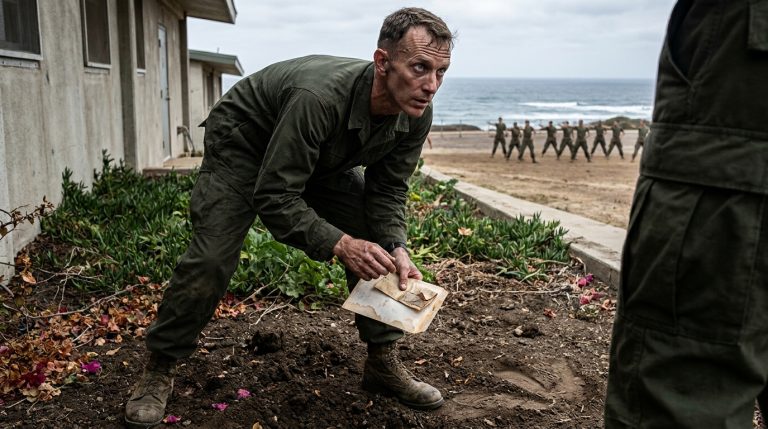
The Ghost of Seventy-Three: A Veteran’s Masterclass in Steel, Silence, and the Weight of Survival
CHAPTER 1: THE SILENT BEHEMOTH
The air in the Third Brigade motorpool was thick with the smell of diesel and the stagnant, heavy humidity of a morning that refused to break. Lieutenant Davenport didn’t look at the tank anymore; he looked at the scrolling blue lines of his diagnostic software, his jaw tight enough to grind teeth.
“Colonel, this is a civilian liability,” Davenport snapped, his voice hitting the damp air with sharp, brittle edges. He pointed a thumb toward the man in the grease-stained coveralls. “My team has logged thirty-six hours on this Honeywell turbine. We’ve traced every circuit, analyzed every flow rate. The data is unequivocal. The main power unit has suffered a catastrophic terminal failure.”
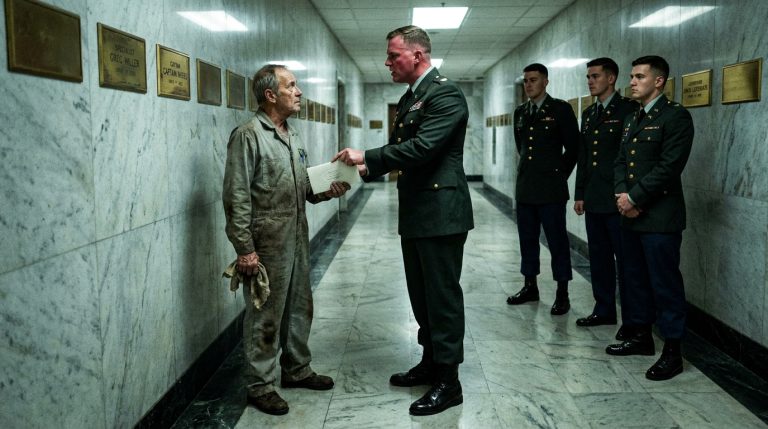
Thomas Wilson didn’t answer. He was seventy-eight years old, a man whose skin seemed to hold the texture of dried desert earth. He stood by the massive road wheels, ignoring the young officer entirely. His hand, gnarled and stained with layers of machine oil that no amount of scrubbing could fully remove, pressed flat against the composite armor of the hull. He wasn’t looking at the diagnostic ports or the open access panels. He was listening.
The tank was cold—a dead, silent mountain of depleted uranium and composite. It was supposed to be the lead vehicle for a readiness exercise, but right now, it was just a liability that threatened the brigade’s reputation.
“Sir,” Davenport pressed, his eyes flicking to Colonel Miller. “The computer doesn’t lie. We need a crane, a flatbed, and three weeks at the depot. This gentleman’s presence is interfering with protocol.”
Thomas shifted his weight. His old knees gave a faint, rhythmic protest—a dry, metallic sound that mirrored the rusted hinges of the engine grill. He ran his hand lower, tracing the line of a hydraulic conduit. The steel under his palm felt wrong. It lacked the subtle, humming resonance of a machine waiting to wake. It was dead weight.
“How did she sound?” Thomas asked. The voice was low, gravel ground against gravel.
Davenport blinked, the arrogance on his face wavering into sheer confusion. “Sound? The decibel readings were within standard parameters until the cutoff. The onboard computer logs every micro-oscillation.”
Thomas turned his head. His eyes were the pale, washed-out blue of a long-distance horizon, fixed somewhere past the lieutenant’s shoulder. “The computer only knows what you tell it to look for, boy. A machine doesn’t just die in binary. She tells you when she’s tired. She tells you when she’s choking.”
He took a step toward the rear of the behemoth, his boots grinding against the loose gravel. The silence that followed wasn’t empty; it was heavy with the gaze of a dozen young engineers who weren’t sure whether to laugh or hold their breath. Thomas reached out and gripped the edge of the engine housing, his fingers finding the seam of a valve he knew by heart.
Under his touch, the metal was scarred, pitted with the rust of neglected years. He felt the cold, unforgiving surface—an indifferent, dead thing. But then, his thumb brushed a specific pressure valve. There was no vibration. No tremor of stored potential. Just the hollow, flat thud of an obstruction.
Thomas pulled his hand back, his expression darkening. He didn’t look at the lieutenant. He looked at the tank, and in his mind, the gray sky of the motorpool suddenly fractured, revealing the blinding, sand-choked heat of a desert war, where the only thing keeping him from the shadow of an enemy turret was the small, rhythmic snap of a Zippo lighter, and the desperate, frantic hope that he could feel his way to the truth before the metal died beneath him.
“You’re chasing ghosts in the software,” Thomas said, his voice barely a whisper, “because you’re too afraid to touch the rust.”
He reached into his pocket. The sharp, metallic click-clack of his lighter echoed across the quiet concrete, and for a moment, the entire motorpool seemed to hold its breath, waiting for the spark.
CHAPTER 2: THE ANATOMY OF A GHOST
The snap of the Zippo was more than a sound; it was a rhythmic anchor. Thomas felt the weight of the silver-cased lighter in his palm, the familiar wear of the brass edges against his calloused thumb. The air around the M1 Abrams seemed to thicken, pressing in with the heat of a memory he hadn’t fully intended to exhume.
Davenport stared at the lighter, his face a mask of twitching annoyance and mounting confusion. The lieutenant’s team of young engineers stood frozen, their tablets forgotten at their sides. They were waiting for a grand gesture, perhaps a speech or a magical fix, but Thomas remained perfectly still, his focus locked on the cold, scarred flank of the tank.
“Something like that,” Thomas repeated softly, the words barely clearing his throat.
He stepped back, breaking the proximity he had held with the turret. His old knees creaked—a dry, protesting sound that seemed to mock the sleek silence of the modern military hardware. He didn’t look at Davenport again. He didn’t have to. The lieutenant’s posture, stiff and defensive, told him everything he needed to know about the man’s intellectual retreat. Davenport was already retreating into the safety of his own internal diagnostics, searching for a rebuttal, a technicality, or an exit.
Thomas turned and walked toward the rear deck of the tank. His gait was slow, deliberate, each footfall on the concrete measured. He felt the phantom vibration of 73 Easting in his bones—the memory of a burning, crippled machine and the desperate, bleeding work required to wake it. Here, the motorpool was quiet, but the absence of sound was a different kind of scream.
He didn’t reach for a diagnostic port. He reached for his wrench.
As his fingers closed around the cold steel tool, a sudden, sharp intrusive thought sliced through his focus. He saw himself, thirty years younger, standing in a line of soldiers being recognized for valor, but the officer in his memory wasn’t a general; it was a man he’d once called ‘Boss’—a crusty old NCO who had taught him that tools were the only language that didn’t lie. The weight of that wrench in his memory, perfectly balanced and heavy, hit him in the present. He felt the cold iron of the wrench he currently held. It was lighter than the one in his memory. Cheaper. The steel felt less dense, less tempered by the forge of necessity.
He shook the thought away, the grit of the motorpool dust grinding between his eyelids. He couldn’t afford the luxury of nostalgia.
Sergeant Price, standing a few paces away near the nose of a parked Humvee, watched him with wide, unblinking eyes. Price was a tanker, one of the men whose life depended on this machine. He wasn’t looking at the lieutenant; he was looking at Thomas’s hands. Price’s right hand was hovering near his pocket, clutching his phone with a white-knuckled grip. He was waiting.
Thomas knelt near the secondary hydraulic reservoir, his joints locking. The smell here was different—sharp, metallic, and tainted by the acrid, stale scent of burnt fluid. He ran his hand along the chassis, feeling for the slight, almost imperceptible temperature difference in the plating.
“You’re wasting your time, Mr. Wilson,” Davenport’s voice cut through the air, though it had lost its initial, condescending bite. It sounded thin, like a wire stretched too far. “The system is dead. The computer-controlled valves are locked shut. You aren’t going to find a simple leak here. It’s a system-wide catastrophic failure of the turbine starter circuit.”
Thomas ignored him. He was tracking a faint, discordant vibration coming from within the reservoir casing. He tapped the casing with the handle of his wrench.
Thud.
It was a flat, dead sound. No ring. No resonance.
He tapped it again, slightly higher up the casing.
Thud.
He closed his eyes for a split second. The mental image of the baffle—a simple, hinged plate—flickered in his mind. It should have been sitting at a forty-five-degree angle. Instead, it was lying flat, a horizontal wall blocking the flow of fluid to the starter. Every time the pump tried to force fluid through, it just hit a brick wall of iron. The computer, sensing the resistance, threw a ‘catastrophic failure’ error, not because the pump was dead, but because the path was choked.
It was so simple it felt like a cruelty.
Thomas felt the weight of his own age, the exhaustion of fighting a world that had forgotten how to look at the machines it relied on for survival. He felt the presence of the Lieutenant hovering behind him, a nervous, kinetic energy that threatened to derail the work. He took a slow breath, the air tasting of grease and damp asphalt.
“Sergeant Price,” Thomas said, his voice low and steady. “Step over here.”
Price moved instantly, his boots hitting the concrete with a rhythmic intensity. He looked at the old man, his face flushed with a mixture of reverence and anxiety.
“Yes, sir?”
“The bypass kit,” Thomas commanded, not looking up. “Don’t bother with the main diagnostic harness. I need the auxiliary lines. The ones hidden behind the rear engine access panel. You’ll find a manual release valve. It’s rusted shut, so you’re going to need more than just force. You’ll need a bit of patience.”
Thomas gripped the casing again, his knuckles white against the dark, oily surface. He didn’t need a tablet to tell him what was wrong. He didn’t need a screen to show him the truth. He could feel it in the cold iron—the history of a machine that had been pushed too hard, maintained too little, and finally, silently, died from the weight of its own neglect.
He felt the gaze of the young engineers on him, a heavy, expectant pressure. He knew what they were thinking: He’s crazy. He’s going to break it.
But Thomas didn’t care. He was already somewhere else, somewhere back in the desert, his hands slick with oil, his heart hammering in time with the roar of a turbine he’d coaxed back to life from the very brink of destruction. He felt the Zippo in his pocket, the sharp metal edges pressing against his thigh.
It was time to wake the machine.
CHAPTER 3: THE GHOST OF SEVENTYTHREE
Thomas didn’t pull away immediately. He let his hand rest against the reservoir casing, feeling the faint, cooling metal drain the warmth from his skin. The motorpool seemed to press in closer, a theater of observation where every pair of eyes was pinned to the back of his neck.
“Sergeant,” Thomas said, his voice cutting through the humid air with the precision of a scalpel. He didn’t look back. “I said, bring the auxiliary lines. Now.”
Sergeant Price moved with a sudden, sharp agility, his boots scuffing the concrete as he pivoted toward the supply rack. Lieutenant Davenport stepped forward, his face a complex map of indignation and fear. He opened his mouth, prepared to assert the authority that was rapidly slipping through his fingers, but the words seemed to die in his throat as he watched Thomas.
Thomas wasn’t performing. There was no theatrical flair to his movements. He was working.
He stood up, his knees popping with a sound like snapping twigs, and gestured to the sprawling tangle of hoses that Price laid out on the oil-stained ground. Thomas picked one up—a heavy-duty hydraulic line, stiff with age. He ran his thumb over the rubber. It was fraying at the edges, the steel braiding beneath the surface showing through like exposed nerve endings.
“This isn’t just a failure of the machine, Lieutenant,” Thomas said, his gaze shifting to the younger man. He didn’t raise his voice, but the quiet gravity of it carried the weight of the authority the lieutenant had so desperately tried to claim with his tablet. “This is a failure of what you’ve been feeding her. You rely on the data so much you’ve stopped looking at the anatomy.”
Davenport’s eyes flicked to the frayed hose in Thomas’s hand. The shame on the lieutenant’s face was a raw, red thing. He looked as though he wanted to bolt, but he was pinned by the silent, judging presence of his own junior engineers.
“I… we followed the maintenance protocols, Mr. Wilson,” Davenport stammered, his pride finally fracturing. “The system is scheduled for a full, fleet-wide service next quarter. The logs indicated no deviations.”
Thomas turned back to the reservoir, his movements rhythmic and efficient. He began loosening the primary coupling on the reservoir, the wrench biting into the rusted bolt with a satisfying, metallic groan.
“The logs,” Thomas muttered, as much to himself as to the man standing over him. “The logs are a map of where you’ve been, not where you’re going. If you only look at the map, you’ll never see the cliff until you’re halfway down.”
As the coupling gave way, a thin, viscous stream of hydraulic fluid trickled out, dark and thick as motor oil. It smelled of heavy, labored usage—burnt, sharp, and deeply wrong. Thomas caught the fluid in a rag. It was contaminated with tiny, microscopic flecks of metal.
The realization hit him like a physical blow. This wasn’t just a collapsed baffle. It was a failure of the entire maintenance chain. The metal shards meant the pump itself was beginning to disintegrate, choked by the very fluid it was supposed to cycle. The baffle was the symptom, but the starvation of the system was the disease. If they had followed the manual to the letter, as Davenport claimed, they were literally bleeding the tank dry.
He felt a flicker of the ‘Butterfly Detour’—a sudden, biting awareness that this wasn’t an isolated incident. If this tank was dying from the inside out due to systematic neglect, how many others in the Third Brigade were sitting on the line, humming with hidden, structural rot?
Thomas wiped his hands on his coveralls, the fabric stiff with the grime of a thousand past repairs. He looked at Price, who was watching with the intensity of a acolyte.
“Sergeant,” Thomas said, his tone shifting from instructive to urgent. “Get a sample of the main reservoir fluid. Check for sediment. If you see silver in the black, you tell the Master Gunner immediately.”
Price didn’t ask why. He simply nodded and grabbed a sample cup.
Thomas returned to the bypass, his movements growing faster, more calculated. He began stripping the old, frayed line. He wasn’t just fixing a broken tank; he was unravelling a tapestry of errors. Each turn of the wrench, each adjustment of the auxiliary line, felt like he was stitching a wound that the military’s own bureaucracy had been systematically reopening.
He glanced at Davenport. The lieutenant was still standing there, his tablet held loosely at his side. He looked small. The bravado, the sharp, condescending edge—it had all evaporated, leaving behind a young man who was finally, for the first time, seeing the machine as a living thing.
“You’re learning, son,” Thomas said, not unkindly. He fit the new line, his fingers working with the muscle memory that had been forged in a desert war. The connection clicked into place—a perfect, solid fit.
“I’m not doing it right, am I?” Davenport asked, his voice barely audible over the distant, low hum of the base.
Thomas tightened the bolt, the wrench pulling the metal into a flush, secure lock. He looked at the lieutenant, his pale blue eyes clear and steady.
“You’re doing exactly what you were taught,” Thomas said. “But you’re standing in the wrong place to see the truth. Come closer.”
Davenport hesitated, then stepped into the shadow of the tank’s hull. The air beneath the armor was cooler, smelling of dry dust and iron. Thomas pointed to the reservoir.
“Put your hand there. Right there on the casing.”
Davenport’s hand hovered, then touched the metal. He flinched slightly at the contact, the surface pitted and cold.
“Feel that?” Thomas asked. “That’s not just steel. That’s a history of choices. Someone chose to ignore the leak, someone chose to sign off on the log, and someone chose to believe that the computer knew more than the machine. When you touch it, you aren’t feeling a failure. You’re feeling the cost of silence.”
The silence that followed was absolute. For the first time, Davenport didn’t look for a screen or a data point. He just felt the cold, rusted weight of the tank, a machine that had been waiting for someone to listen to its slow, dying confession. Thomas stood back, his heart thumping a steady, rhythmic cadence in his chest, knowing that the real repair wasn’t the bypass line—it was the shift in the man standing beside him.
CHAPTER 4: THE THUNDER OF AUTHORITY
The ground beneath Thomas’s knees began to shudder, a low-frequency pulse that traveled through the concrete and into his marrow. It wasn’t the tank; the M1 Abrams was still cold, its turbine dormant. This was external—a rhythmic, industrial vibration that meant the world of the Third Brigade was about to be forcibly rearranged.
Lieutenant Davenport pulled his hand away from the reservoir casing as if burned. He looked toward the main gate, his face cycling from shame to a flash of renewed, albeit terrified, apprehension. The silence of the motorpool, which had only moments ago been the site of a quiet, transformative instruction, was now being devoured by the whine of high-end engines and the screech of tires on gravel.
“They shouldn’t be here,” Davenport whispered, his eyes wide. “I didn’t authorize a command inspection.”
Thomas didn’t look up. He stayed knelt by the hull, his fingers still tracing the line of the newly rigged bypass. He could feel the tension in Sergeant Price, who had stepped away from the Humvee, his posture rigid. Price’s hand was no longer on his phone; it was pressed against his thigh, his eyes tracking the convoy as it tore into the perimeter.
“It’s not an inspection, son,” Thomas said, his voice as dry as the desert air he kept tucked in his memories. “It’s a rescue.”
The convoy was a jagged, black-and-sand-colored line of force. Two command vehicles and a swarm of Humvees skidded to a halt in a perimeter formation, kicking up a wall of grit that blinded the younger engineers. Out stepped figures in crisp, starch-stiffened uniforms—men whose presence alone seemed to suck the oxygen out of the motorpool. Leading them was a two-star general, flanked by a Master Gunner whose face looked like it had been carved from granite and then set on fire.
Thomas felt a cold pit form in his stomach. He hadn’t wanted this. He had wanted the fix, the quiet satisfaction of a job earned through sweat and grease. He hadn’t wanted the theater of command.
“Mr. Wilson!”
The voice boomed across the tarmac, a baritone command that stopped the world in its tracks. General Peters was striding directly toward them, his gaze locked onto Thomas with an intensity that bordered on physical. Behind him, Master Gunner Davis looked like he was vibrating with barely suppressed fury, his eyes darting from the tank to the trembling Lieutenant Davenport.
Thomas slowly rose to his feet. His knees clicked, and he took a moment to wipe the fresh smear of hydraulic fluid from his hands. He felt, for a fleeting, disorienting second, like he was back on the line, being hauled in front of a tribunal for a mistake he hadn’t yet realized he’d made. He had to remind himself that he was an old man in coveralls, not a soldier in a war zone.
“General,” Thomas said, his voice steady. He didn’t salute—he didn’t have to—but he stood with a spine that hadn’t bent for anyone in decades.
“I’m told there’s been a situation,” Peters said, his eyes finally sliding toward Davenport. The lieutenant looked like a child caught in a thunderstorm. He tried to stand at attention, but his knees were shaking so violently it was a parody of discipline.
Davis didn’t wait for the General to finish. He marched past the command group, his boots slamming into the concrete with the sound of gunshots. He stopped inches from Davenport, his presence so heavy it felt like an physical weight forcing the younger man to wither.
“You,” Davis growled, his voice a low, lethal rumble. “You have the audacity to treat a legend like a trespasser? You have the gall to look at the man who wrote the book on armored survival and call him a liability?”
Davenport looked up, his face drained of all color. The arrogance that had fueled him hours ago was entirely gone, replaced by a hollow, brittle realization of his own obsolescence. “Master Gunner, I—”
“Save it,” Davis snapped. He shifted his gaze to the tank, then back to Thomas. His expression softened, but only by a fraction of a millimeter. It was the look of a man seeing a relic of a time when the stakes were life and death, not flowcharts and data logs. “We’re going to fix this, Willie. My team is ready. Stand aside.”
Thomas stood his ground. He felt a sudden, sharp, and entirely unexpected surge of defensiveness. This wasn’t Davis’s fix. This wasn’t a tactical maneuver for a general’s office. This was the work he had been doing in the dirt, the quiet labor of understanding the machine.
“The fix is already in, Master Gunner,” Thomas said, his voice flat.
Davis blinked, his brow furrowing. “What?”
“The bypass is rigged,” Thomas pointed to the line he and Price had installed. “The baffle is collapsed. The reservoir is starved. I’ve already done the diagnostic. All you’re doing is adding more noise to the motorpool.”
The air between the two men crackled. It was a clash of eras—the old guard who knew the iron, and the new guard who wielded the administrative power of the entire armor branch. Davis looked at the bypass, his eyes scanning the rig with the practiced, cynical eye of a man who had seen a thousand botched attempts at field repair. He knelt, leaning in close to the reservoir.
Thomas watched him, his own pulse quickening. He felt the familiar pull of the ‘Unreliable Perception’—the gnawing doubt that maybe, just maybe, the bypass wasn’t enough. What if the contamination had reached the pump’s interior seals? What if the bypass was just a temporary fix that would blow out the moment they hit the ignition, proving Davis right and himself a relic?
The Master Gunner ran a calloused finger over the new coupling. He stayed there for a long, agonizing minute, the only sound the distant, rhythmic idling of the command vehicles. When he finally looked up, his expression was unreadable.
“It’s not regulation,” Davis said, his voice tight.
“Neither is a war,” Thomas replied.
The General, who had been watching the exchange with the patience of a predator, stepped forward. “Sergeant Price,” he commanded. “Is this the fix the man provided?”
Price, standing at attention, sounded like he was about to burst with pride. “Yes, sir. He diagnosed it in ten minutes, sir. Without a laptop.”
Davis stood up, brushing the dirt from his knees. He looked at Thomas, then at the tank, and finally at Davenport, who seemed to be praying for the ground to open up and swallow him whole. The tension in the motorpool was no longer just about the machine; it was about the survival of the very ethos the Armor Corps was built on. Thomas felt the weight of it, the heavy, metallic tang of an era ending and another struggling to be born.
“Start it,” Davis ordered, his voice echoing in the hollow space under the turret.
Price didn’t hesitate. He climbed into the commander’s seat. Thomas felt the breath catch in his throat, a sharp, physical pain in his chest. This was it—the moment where the ghost of seventy-three met the cold, unyielding reality of the modern day. If the turbine didn’t scream, if the machine died on the first turn, he wasn’t just an old man with a wrench. He was a memory that had outlived its usefulness.
CHAPTER 5: THE SCREAM OF THE TURBINE
The ignition sequence began with a whine that felt like a needle scratching across the surface of a record. Sergeant Price had his hand on the master switch, his knuckles white, his eyes fixed on the engine deck. Thomas stood motionless, his heart hammering against his ribs like a trapped bird.
He didn’t need to see the gauges. He felt the vibration through his boots—a erratic, stuttering rhythm that didn’t belong in a 1,700-horsepower turbine. It was the sound of a heart beating with a murmur, a machine that was being strangled from within.
Whine. Cough. Silence.
Then, a sound that made the hair on the back of his neck stand up: a sharp, high-pitched ping, the metallic shriek of a seal being sheared under the pressure of the bypass he had installed.
“Cut it!” Thomas roared, his voice erupting with an authority that stunned the onlookers.
Price slammed the ignition off, but the damage was already done. A thin plume of acrid, white smoke curled up from the engine grills, smelling of ozone and scorched rubber. It wasn’t just the baffle anymore. The bypass had worked to give the starter juice, but it had revealed the deeper, more sinister rot—the pump was failing, its internal seals disintegrating and sending metallic sludge into the turbine’s veins.
Master Gunner Davis moved instantly, his hand grabbing the engine handle to force it open. He peered into the abyss of the turbine bay, his face twisting into a grimace. “Willie,” he growled, his voice stripped of its earlier bravado. “The pump seals are gone. She’s pumping metal.”
Thomas walked over, his legs feeling heavy, his mind racing through the physics of the disaster. He had been so focused on the obstruction—the Layer 1 decoy—that he had missed the secondary, more catastrophic reality: the system had been pushed past its breaking point long before he arrived. It wasn’t just a maintenance oversight; it was a systemic death sentence for every vehicle in the fleet that had been subjected to the same digital-first, tactile-last treatment.
Lieutenant Davenport was hovering nearby, his face ashen. He was watching the smoke with the expression of a man witnessing the total collapse of his own identity.
“I… we ran the diagnostic,” Davenport muttered, his voice barely audible. “The sensors… the sensors said the pump was fine.”
Thomas turned on him, his patience finally snapping. He didn’t yell; he spoke with the quiet, terrifying precision of a man who had seen too many tanks burn because of someone else’s arrogance. “The sensors measure what the machine tells them, Lieutenant. But the machine only speaks if you know how to listen to the silence in between the signals. You didn’t listen. You just checked the boxes.”
He turned back to the turbine bay. The smoke was thinning, revealing the charred, blackened remains of the seal. It was a ruin, a piece of industrial carnage that should have been preventable.
“We need to pull it,” Davis said, his voice flat. “The engine is compromised. There’s no field-fix for this. Not today. Not with these parts.”
The finality of the statement hit the motorpool like a physical weight. The dream of the ‘quick fix’ was dead. Thomas felt a hollow, aching emptiness in his chest. He had come here to prove that a man could still matter in an age of machines, but all he had succeeded in doing was pulling back the curtain on a rot that was deeper than he had imagined.
“It’s not just this one,” Thomas said, his voice barely a whisper. He looked at the line of silent, monolithic tanks sitting in the motorpool, their turrets lowered like heads in shame. “This was the lead vehicle. If the lead is failing this hard, what about the rest? You’ve been running them into the ground because your ‘data’ told you they were fine. You haven’t been maintaining a fleet. You’ve been maintaining a graveyard.”
Davis looked at the other tanks, his expression darkening. The Master Gunner, a man who had lived his life by the creed of the armored corps, was beginning to see the patterns. He looked at the General, who stood off to the side, his face a mask of cold, analytical observation. The General wasn’t looking at the broken tank anymore. He was looking at the entire brigade, his eyes scanning the rows of iron with a new, terrifying clarity.
“Mr. Wilson,” the General said, his voice quiet. “Are you telling me this isn’t an isolated failure?”
Thomas looked at the wreckage of the pump. He felt the weight of the Zippo in his pocket, the familiar, grounding friction of the brass against his thumb. He realized now that he hadn’t been brought here to fix a tank. He had been brought here to witness the end of an era. The truth wasn’t in the engine—it was in the entire culture of the Third Brigade.
“I’m telling you, General,” Thomas said, his voice gaining a hard, brittle strength, “that you’ve been trusting the wrong ghosts. You replaced the mechanics with algorithms, and the algorithms don’t know how to bleed.”
He turned away from the engine, his boots crunching on the grit of the motorpool. He didn’t look at Davenport, or Davis, or the General. He walked toward the edge of the tarmac, his posture stiff, his spirit exhausted. He had fought for the machine, and he had lost. The silence of the tank, now dead and smoking in the morning air, was the only answer he needed.
CHAPTER 6: THE WEIGHT OF THE WRENCH
The motorpool was silent, save for the low, rhythmic hum of a generator in the distance. Thomas stood near the perimeter fence, his boots pressing into the gravel. He didn’t look back at the tank; he didn’t need to. He could feel the stillness that had settled over the Third Brigade, a heavy, suffocating quiet that only occurs when the comfortable illusions of a command structure are stripped away by the harsh, unyielding truth of a failure.
Master Gunner Davis walked toward him, his heavy, rhythmic gait slower than usual. The anger that had fueled him an hour ago had been replaced by a grim, reflective sobriety. He stopped beside Thomas, looking out at the rows of tanks—the silent, metallic giants that were no longer just machines, but victims of a systemic rot.
“You were right, Willie,” Davis said, his voice a low, gravelly rumble that lacked its usual bite. “It’s not just one. It’s all of them. We’ve been running on hope and bad data for years.”
Thomas reached into his pocket and pulled out the Zippo. He didn’t light it; he simply held it, the worn brass cool against his palm. “Data doesn’t bleed, Master Gunner. And it doesn’t break. You can’t train a computer to care if the steel starts to scream.”
The General, Peters, approached them then. He walked with a measured, deliberate pace, his uniform no longer looking like a pristine display of power, but like the armor of a man who realized he’d been defending a crumbling wall. He stood with them, looking out at the tanks. There was no theatricality now—only the stark, pragmatic recognition of a command failure that reached from the motorpool to the halls of the pentagon.
“You’ve given me a problem that isn’t on any of my briefing slides, Mr. Wilson,” the General said, his voice quiet.
“I’ve given you the truth, General,” Thomas replied, looking at the man with eyes that had seen the cost of these ‘problems’ in blood and fire. “Whether you decide to fix it or just update the manual to hide it… that’s your choice.”
The General turned to look at Thomas, his expression unreadable. For a moment, it seemed as if he might launch into the standard, bureaucratic defense of the institution. Instead, he simply nodded, a slow, solemn acknowledgment. “The Wilson Method won’t be just a training module. It’s going to be the new baseline. Starting today, if you don’t know how to touch the machine, you don’t get to command it.”
Thomas felt a strange, quiet release in his chest. It wasn’t the catharsis of a victory; it was the settling of a debt. He had forced them to see, and now, the burden was no longer his to carry.
Lieutenant Davenport approached them, moving tentatively, his posture stripped of the brittle, artificial confidence he had worn like armor. He stopped a few feet away, clutching a heavy, standard-issue torque wrench in his hands—not his tablet, not his ledger, but a tool. He looked at Thomas, his eyes reddened, the mask of the rising star completely gone.
“I’m reporting for re-education at 0500, sir,” Davenport said. His voice was steady, purged of the arrogance that had been his defining trait. He held the wrench out to Thomas. “I don’t know if I can learn the silence, but I’m going to start by learning the weight.”
Thomas took the wrench from the lieutenant. It was heavy, balanced, and perfectly cold. He looked at the tool—a simple, elegant piece of necessity—and then back at Davenport. He saw the flicker of something new in the young man’s eyes: the first, painful spark of humility.
“It takes more than a shift,” Thomas said softly, handing the wrench back. “It takes a willingness to bleed for the work. If you’re ready for that, you’ll find the silence eventually.”
As the afternoon light began to fade, casting long, distorted shadows across the tarmac, the motorpool began to stir with the quiet, methodical activity of men who were finally doing the work. They weren’t rushing. They were tearing down the reservoirs, checking the baffles, and listening to the tanks—one by one, system by system.
Thomas walked to the gate, the Zippo still clutched in his hand. He stopped at the edge of the base, the familiar, dry earth of the exterior world welcoming him back. He felt the phantom pain in his knuckles—the old scars of a life spent in the service of steel—and realized that the damage was, in its own way, a form of peace.
He didn’t look back at the Third Brigade. He didn’t need to hear the turbines turn. He knew that somewhere, deep in the guts of those machines, the truth was being spoken in the language of metal and sweat.
He stopped near a small, rusted sign by the exit, a piece of industrial debris that had been neglected for years. He knelt, the familiar, creaking protest of his knees a comforting, grounding sensation. With the edge of his wrench, he scraped away the thick, hardened layer of mud and grime from the sign’s base, revealing the original, weathered steel beneath. It was a small, useless act in the face of a systemic collapse, but as the iron shone back at him, clean and exposed to the light, he felt a sudden, deep sense of resolution.
The tank was breathing. The men were listening. The ghost of seventy-three had finally found a place to rest. He turned, his step light, and walked into the lengthening shadows, leaving the weight of the motorpool behind him, satisfied with the quiet, invisible work that had finally begun.