The Weight of the Soil: A Guardian’s Final Stand Against the Creeping Shadow of Decay
CHAPTER 1: THE SEVERED WIRE
Arthur did not look for the culprit. He looked for the pattern.
He stood by the eastern fence line, where the land dipped into a shallow, shadowed gulch. The grass here was yellowed, brittle from a week without rain, and the chain-link fence—a relic of his father’s time—rattled in the wind like a dying breath. He knelt, his knees popping with a dull, familiar ache, and studied the base of the post.
The wire hadn’t been snapped by an animal or worn down by the shifting frost. It had been sliced. A clean, clinical incision that left a jagged silver edge catching the harsh afternoon light. Someone had walked this line with intent, measuring the resistance of the barrier, testing where the perimeter was softest.
Arthur stood slowly, wiping the dust from his palms onto his canvas trousers. He didn’t feel the surge of adrenaline the young men at the shop would have expected. Instead, he felt the heavy, dragging weight of responsibility. This was not a random act of vandalism. The neighbors had been hit at night, terrified into silence, but this—this was a survey.
He turned toward the house. The garden, Elaine’s garden, sat in the distance like a green island in a sea of encroaching brown. He thought of the empty rows, the zucchini waiting for room to spread, and the way the shadows were lengthening across the porch. He looked back at the fence. The silence of the rural road was absolute, yet he could feel eyes on his back—the phantom pressure of someone watching, waiting for him to report it, waiting for him to overreact.
He wouldn’t. He walked back toward the house, his boots making a rhythmic, grinding sound against the gravel. When he reached the porch, he didn’t head for the kitchen. He stopped at the heavy, locked box on the side table, his hand resting on the biometric sensor for a heartbeat, feeling the cool metal beneath his fingertips.
He didn’t open it. Not yet.
He caught a glimpse of his reflection in the windowpane: an old man with a thin mustache, a man who looked like he belonged to the landscape, worn and unremarkable. He noticed, just for a second, a dark sedan idling three hundred yards down the county road. It wasn’t moving. It was just sitting there, its nose pointed squarely at his driveway.
Arthur stepped inside and closed the door, sliding the deadbolt home. The click was final, echoing in the quiet hallway. He went to the kitchen, poured a cup of lukewarm water, and watched the sedan through the slats of the blinds. It was still there.
He picked up a notepad from the table, uncapped his pen, and began to write. He wasn’t tracking the intruder’s movements; he was cataloging the friction of the day, noting the precise timing of the sedan’s arrival, the exact texture of the silence that followed.
The phone on the wall didn’t ring, but the silence felt like a question he was being forced to answer. He knew the cost of what was coming. Every move he made to secure this place would require an equal measure of his own peace. He walked back to the kitchen window. The sedan was beginning to pull away, but it stopped, turned, and then slowly drifted toward his driveway.
Arthur set the pen down. He didn’t reach for the box. He stood in the center of the kitchen, waiting to see if they were brave enough to knock.
CHAPTER 2: THE THRESHOLD OF PERSISTENCE
Arthur stood in the kitchen, the linoleum cold beneath his socks, his eyes fixed on the gray sedan. It didn’t belong here. In a county where everyone knew the rhythm of their neighbor’s engines—the rattle of the delivery truck, the high-pitched whine of the mail carrier’s hybrid, the heavy roar of the farmer’s diesel—this car was a dissonance. It sat at the edge of his gravel with an unnatural stillness, like a predator holding its breath.
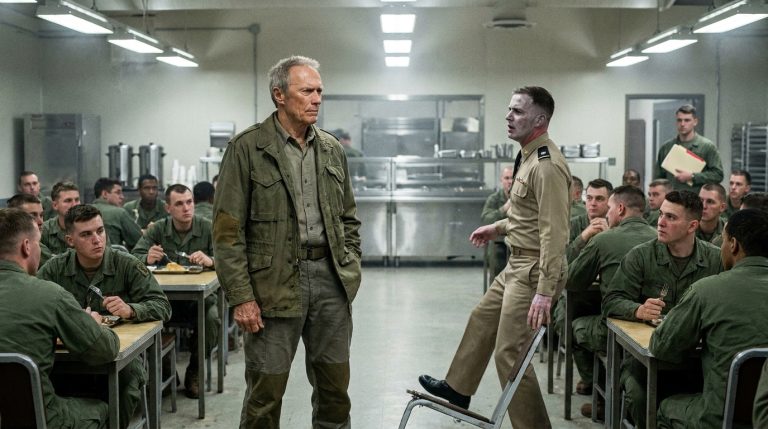
He didn’t move toward the safe. He stayed by the window, his fingers tracing the edge of the wooden blind. He wasn’t afraid, but the old, familiar weight began to settle into his marrow. It was the same sensation he’d felt in the mud of the Anbar province, twenty years ago—the air growing thin, the world narrowing down to the space between where he stood and the threat outside.
His mind flickered, unbidden. For a sharp, biting second, the linoleum beneath his feet transformed into the pulverized concrete of a rigged building in Fallujah. He could smell the acrid, biting scent of dust and high explosives, hear the frantic, rhythmic heartbeat of the men he’d been sent to pull from the ruin. The phantom echo of an order—Stay with me, Marine—shivered through his chest. He blinked, the vision receding back into the safety of his quiet kitchen, leaving only the reality of the Virginia afternoon and the encroaching gray of the sedan.
He breathed in, slow and deep. He wasn’t in the city of fire. He was on his own land. And he would not be pushed.
He walked to the mudroom, his movements deliberate and quiet. He pulled on his work boots, the leather worn soft as skin, and tied them with steady hands. He didn’t rush. Rushing was for those who hadn’t learned the cost of panic. Instead, he grabbed his heavy canvas jacket and the brimmed cap he kept on the rack.
When he pushed the front door open, the sound was loud in the stillness—a sharp, wooden crack against the frame. He stepped out onto the porch. The heat was dry, smelling of iron and baked earth. He didn’t look at the sedan yet. He walked down the porch steps, his gaze tracking the line of his garden. The rows of tomatoes were sturdy, their green leaves thick with resilience. He stopped at the watering can, a rusted, dented thing that had survived three decades of seasonal change. He picked it up. It was empty, a hollow weight in his calloused palm.
He walked toward the gravel drive, his pace measured, the rhythm of his steps slow and purposeful. He saw the sedan’s window roll down—a slow, mechanical descent. A man sat in the driver’s seat, sunglasses masking his eyes, his left arm draped casually over the frame of the door. He was young, clean-shaven, wearing a polo shirt that looked entirely too expensive for this patch of rural road.
Arthur didn’t call out. He kept walking until he was ten feet from the front bumper. He stopped, the empty watering can held loosely at his side. He didn’t assume the position of a threat, nor did he offer the posture of a victim. He simply stood, a man in a faded canvas jacket, looking at a stranger who had no reason to be on his property.
The driver leaned out, a thin, rehearsed smile touching his lips. “Excuse me, sir. Just checking the plat lines for the new utility easement. We might have encroached on your property by mistake.”
Arthur felt the texture of the lie. It was thin, brittle—the sort of fabric that tore under the slightest pressure. Utility easements were marked, surveyed, and cleared by the county with formal notice. There were no utilities coming through this section of the woods.
“You’re lost,” Arthur said. His voice was quiet, stripped of any ornamentation. It wasn’t a question.
The driver’s smile didn’t reach his eyes, which remained hidden behind the dark lenses. “Maybe so. Just doing the job, sir.”
“There’s no job to be done here,” Arthur replied. He didn’t reach for his phone. He didn’t look back toward the house. He simply held his ground, his gaze steady. He watched the driver’s hand—a nervous, micro-movement of his fingers against the steering wheel. A tic. The man was uncomfortable, but he was also waiting for a reaction. He wanted Arthur to flare up, to shout, to demonstrate the kind of instability that would justify whatever report he was filing.
Arthur gave him nothing but the silence of the landscape. He waited, letting the heat of the afternoon pull the tension out of the moment, until the driver’s confidence began to fray. The young man cleared his throat, his eyes flicking to the rearview mirror.
“Right,” the driver muttered, his bravado thinning. “My mistake. Have a good one.”
He rolled the window up before Arthur could respond. The sedan shifted into gear, the tires spinning slightly on the loose stone before it lurched forward, heading back the way it had come.
Arthur stayed still until the sound of the engine faded into the hum of the cicadas. He looked down at the watering can in his hand, then back toward his garden. He knew, with the cold clarity of a strategist, that they would be back. And the next time, they wouldn’t pretend to be lost. He walked back toward the house, the weight of the coming conflict heavy, yet entirely manageable. He had work to do.
CHAPTER 3: THE SOILS RESISTANCE
The dust kicked up by the sedan’s tires lingered in the stagnant air, a fine, gritty veil that coated Arthur’s lungs with the taste of dry earth and spent ambition. He turned his back on the county road and walked toward the house, but his destination wasn’t the safety of his living room. He veered left, toward the garden.
The rows were a testament to Elaine’s order. She had plotted the space with a geometry that Arthur had spent three years desperately trying to maintain. As he approached the far corner, where the soil was darkest and richest, he saw Devon standing by the shed. The boy—now young man—was shifting bags of mulch, his movements awkward but earnest.
Devon looked up as Arthur approached. His expression shifted from the preoccupation of labor to a respectful stillness. “Everything alright, Mr. Callaway? I saw a black car leaving the drive as I pulled in.”
Arthur didn’t answer immediately. He picked up his trowel from the edge of the planter bed, the metal cool and reassuringly heavy. “Surveyors,” Arthur said, the word feeling like a stone in his mouth. “Looking for easements that don’t exist.”
Devon’s brows furrowed. He was bright, observant in a way that reminded Arthur of the younger Marines he’d mentored—quick to catch the unspoken, slow to trust the surface. “Easements? Out here? That doesn’t make any sense.”
“It doesn’t,” Arthur agreed. He knelt by the corner plot, the one Elaine had earmarked for the zucchini. He dug the trowel into the dirt, feeling the resistance of the roots. “They’re testing the line, Devon. They aren’t looking for utilities. They’re looking for how much space they have to squeeze before something breaks.”
He began to clear the weeds, his hands moving with the practiced efficiency of a man who understood that work was the only honest antidote to chaos. Devon set down the mulch bag and stepped into the garden, moving to the adjacent row to help. They worked in silence for a long time, the only sounds the rhythmic scrape of metal on stone and the distant, dry rustle of the wind through the corn.
This was the “Inhale.” It was the time to prepare, to harden the perimeter, to turn the landscape into an asset. Arthur watched Devon’s hands. The boy was stronger now than when he had first come to the house, his grip firmer, his focus sharper. He was being molded by the work, by the quiet, by the responsibility of maintaining a place that others wanted to erase.
“If they come back,” Devon said, his voice low, his eyes fixed on the dirt, “what do I tell them?”
Arthur paused, his hand hovering over a sprouted seedling. He looked at the boy, really looked at him, and saw the flicker of something that could easily become fear if left untended. “You don’t talk to them,” Arthur said, his tone clinical. “You finish the planting. You observe. You note the plate, the make, the driver’s description, and you keep your distance. You are a guest on this land, and you are here to work the garden, nothing more.”
Devon nodded, but his jaw tightened. He understood the tactical implication. They were not fighting a war in the open; they were reinforcing a position.
“They’re after the land, aren’t they?” Devon asked, not looking up. It wasn’t a guess; it was an observation.
Arthur didn’t answer. Instead, he reached into his pocket and pulled out the small, leather-bound notebook. He opened it to a page filled with neat, dense handwriting—a record of the last month’s oddities: a fence wire cut, a drone hovering at dusk, a black sedan idling.
“They’re after the history of the land,” Arthur corrected. “They think if they remove the current occupant, the history becomes theirs to rewrite. It’s an old trick. They use fear to clear the brush, then move in with the bulldozers once the occupants are too tired to stand their ground.”
He looked toward the porch, where the heavy lockbox sat just inside the door, invisible from where they stood. He had prepared for this, not with the weapon itself, but with the documentation. He had been recording the incursions, logging the times and locations, building a paper wall that would prove far more resilient than a fence.
As the sun began to dip toward the treeline, casting long, fractured shadows across the property, the atmosphere shifted. The air grew cooler, sharper. Arthur realized that his preparation had to go beyond just watching. He needed to make it clear that the land was not merely property—it was a defended post.
He stood up, his joints stiff, and looked at the garden. It looked orderly, productive, and entirely occupied. It was, in its own small way, a declaration of intent. He turned to Devon. “Tomorrow, we finish the rest of the rows. We make it look like this house is the center of the world.”
Devon wiped his brow with the back of his wrist. “It is, isn’t it?”
Arthur looked toward the driveway, his gaze hardening. “For some of us, it has to be.”
He turned back to the dirt, the work continuing. The shadows lengthened, but for the first time in weeks, the silence didn’t feel like a vulnerability. It felt like a rampart.
CHAPTER 4: THE SURVEILLANCE SHIFT
The sun had begun to bleed into the horizon, casting the property in the bruised, violet light of twilight. Arthur stood near the edge of the cornfield, his breath hitching slightly in the cool evening air. The trowel felt heavy in his hand, a dull weight against the sudden, prickling awareness at the back of his neck.
He didn’t move. He stood perfectly still, letting the environment settle around him. He had spent his life listening to the texture of a landscape—the way the wind changed when something was moving through the tall grass, the way the cicadas stopped their drone when a predator was nearby. Now, he listened for the electronic pulse of a foreign object.
He moved toward the old oak tree at the edge of his property, the one that offered the best vantage point of the driveway. He reached into the crook of the branches, his fingers tracing the rough, ancient bark. There, tucked behind a knot of lichen, he felt it—a cool, synthetic texture that had no business being on a living tree. He pried it loose. It was a miniature camera, no larger than a thumb, secured with heavy-duty adhesive. It was professional grade, the kind of hardware that didn’t belong to a desperate local trespasser.
Arthur didn’t pull it off and crush it. If he did, they would know he knew. Instead, he simply left it, his mind pivoting instantly to the implications. This was not about vandalism. This was about mapping. They were building a profile of his daily habits, waiting for the gap, the moment when the rhythm of his routine faltered.
He walked back to the house, the camera still vibrating with a faint, undetectable frequency that he felt in his teeth. Devon was waiting on the porch, his shadow stretching long and thin across the peeling paint. The boy stood up as Arthur climbed the stairs, his eyes searching Arthur’s face for a sign.
“They’re watching, aren’t they?” Devon asked, his voice barely a whisper against the rising wind.
Arthur didn’t answer him directly. He walked past him into the kitchen and sat at the table. He pulled out his notebook, but he didn’t write. He stared at the blank page, his thoughts organizing into a tactical framework. “Devon, tonight we don’t turn on the porch lights. We leave the house as dark as it was when my wife was alive.”
Devon looked at him, confused. “But if it’s dark, they can see us better.”
“They’ll see what I want them to see,” Arthur replied. He reached into the drawer and pulled out a small, portable radio—the kind he’d kept in his go-bag for years. He turned the dial until it hit the static between stations, then placed it near the front window.
The strategy was simple: displacement. He wasn’t going to hide; he was going to manipulate their observation. By keeping the house dark and introducing a steady, low-frequency hum of white noise, he would force them to use their own equipment to filter out the interference, making it harder for them to track his actual movements.
He sat in the chair, the room around him growing darker as the last of the light died. He looked at the biometric safe on the side table. He hadn’t touched it since the shop, but the weight of it was a constant, pulsing pressure in the room. He didn’t need to open it to know what was inside. He needed to understand why they wanted him so badly that they were willing to risk this level of exposure.
“Mr. Callaway?” Devon sat down across from him. The boy was shaking, just slightly. “If we do this, if we start playing their game… we can’t stop. You know that.”
“I know,” Arthur said. “But we aren’t playing their game, Devon. We’re setting the board. The difference is, they think this is a land grab. They don’t realize they’ve walked onto a battlefield that’s been under siege for twenty years.”
Arthur closed his eyes. He could still hear the faint static of the radio, a sound that merged with the phantom echoes of his past—the radio chatter from Fallujah, the desperate voices of his men, the steady, cold cadence of command. He opened his eyes and looked at the boy. Devon was leaning forward, his fear beginning to curdle into the same resolve Arthur had seen in the faces of the young Marines he once led.
“You should go home, Devon,” Arthur said softly. “Tomorrow, we start the real work.”
“I’m not leaving,” Devon said. “Not now.”
Arthur nodded. He understood. He reached out and touched the cover of his notebook. The decoy secret—the surveyors, the easements, the petty harassment—was just the outer layer. The core truth, the reason they were so desperate to see him leave, was buried in the history of the house, in the records of the land itself.
He waited. Outside, the wind rattled the old windows, a sound like fingers tapping against the glass. He didn’t flinch. He sat in the dark, a guardian of a history that the modern world was trying to pave over. He knew the sedan would be back, likely before dawn. And when it was, he would be ready.
CHAPTER 5: THE DARKNESS OF INTENT
The house didn’t just go dark; it seemed to hold its breath. One moment, the soft, amber glow of the kitchen light was casting long, reassuring shadows across the floorboards, and the next, the world was plunged into a heavy, suffocating ink. The hum of the refrigerator ceased. The rhythmic click of the wall clock seemed to double in volume, a metronome counting down the seconds of an unraveling night.
Arthur didn’t panic. Panic was a waste of caloric energy, a luxury he hadn’t afforded himself in decades. He remained in his chair, his hands resting on the cool surface of the table, his eyes adjusting to the absolute absence of light. He could feel the house settling—the groan of the timber as the temperature dropped, the shifting weight of the night air against the siding.
He listened. Outside, the crickets had resumed their drone, but something else was missing. The road was too quiet. The usual, distant rumble of passing trucks was absent, as if a perimeter had been drawn around his acreage, isolating him in a bubble of artificial silence.
He stood up, his movements fluid and soundless. He navigated the room by memory, his fingers brushing the familiar grain of the cabinets until he reached the drawer where he kept his heavy-duty flashlight. He didn’t turn it on. Instead, he made his way to the back door, his boots barely making a whisper against the hardwood.
He felt the temperature difference before he saw the source. The air near the door was cooler, carrying the scent of damp soil and iron. Someone had cut the power, yes, but they hadn’t come to the front door. They were working the periphery, systematically degrading his defenses.
He moved into the mudroom and paused. The back door, which led out toward the edge of the garden and the utility junction, was slightly ajar—less than a fraction of an inch, but enough to register on his senses. He reached out and touched the frame. It was cold. Someone had been there.
He didn’t draw the weapon from the safe, not yet. He needed to know the nature of the adversary. If they were looking for a fight, they would have kicked the door in. If they were looking for intimidation, they would leave a calling card. He pushed the door open, the hinges silent under his careful, practiced hand, and stepped out into the night.
The moon was hidden behind a thick blanket of clouds, leaving the backyard in a state of absolute, oppressive shadow. Arthur moved toward the utility shed. His eyes were adjusted now, picking out the silhouette of the trees against the slightly lighter sky. He saw a shape—a human form—crouched near the junction box at the corner of the shed.
The intruder wasn’t a local kid, and he wasn’t a surveyor. The man was dressed in tactical gear, his movements efficient, jerky, professional. He was dismantling the connection, his hands moving with a practiced, singular focus that Arthur had seen a thousand times on a thousand different battlefields. It was the posture of a man who didn’t want to be noticed, but didn’t fear the consequences if he were.
Arthur stopped ten paces away. He didn’t speak. He simply stood, a shadow within a shadow, watching. The intruder finished his work and turned, his eyes sweeping the darkness. He held a device—a thermal scanner—that flickered with a faint, greenish glow.
Arthur held his breath, his heartbeat slow, controlled, and steady. He knew the limits of that device. At this range, in the damp, cool air of the Virginia countryside, his own body heat would be masked by the trees and the cooling temperature of the soil. He was a part of the landscape.
The intruder moved toward the fence line, his gait light, his presence barely a disruption in the natural rhythm of the night. He paused at the spot where the wire had been cut two days ago, checked his watch, and then disappeared into the treeline.
Arthur waited for a full minute after the man had vanished. He walked to the junction box. The power lines were neatly severed, the casing stripped with surgical precision. It was a message, a declaration that the “surveying” phase was over. Now, they were moving into active isolation.
He turned back toward the house. He saw a light flicker in the upstairs window—not his, but from across the fields, near the property line of the neighboring farm. They were signaling.
He didn’t feel rage. He felt the cold, sharp clarity of a problem being defined. He had been looking for a pattern, and he had found it. The isolation of his property was not an end goal; it was the mechanism of a larger, more sinister harvest. They weren’t just trying to drive him out; they were trying to prove he was no longer capable of holding the ground he stood on.
He reached the back door and looked back at the garden one last time. In the darkness, the rows of vegetables looked like scars upon the earth. He walked inside and closed the door, sliding the bolt home. He moved to the side table, his hand finding the biometric sensor of the lockbox.
This time, he didn’t hesitate. The mechanism whirred—a soft, mechanical sound in the stillness—and the lid clicked open. He reached in, his fingers closing around the cold, textured grip of the Sig Sauer. He checked the chamber, the slide cycling with a heavy, metallic authority that felt like an old, trusted friend coming home.
He wasn’t going to turn the lights back on. He was going to wait for them in the dark, where the ground was familiar and the shadows were his own.
CHAPTER 6: THE TACTICAL DEFENSE
Arthur sat in the velvet dark of the living room, the silence pressing against his eardrums like deep water. The house wasn’t just quiet; it was dormant, stripped of the hum of electricity, leaving only the sound of his own slow, controlled breathing. He remained motionless, a fixture within the shadows, his senses tuned to the subtle shifts in the air currents coming from the hallway.
He had expected the sedan to return. Instead, he heard the faint, rhythmic crunch of gravel under heavy, deliberate boots. Not the hurried, frantic pace of the kid from the garden, but the steady, measured gait of an operator. One. Maybe two. They weren’t hiding their presence anymore; they were testing his resolve.
He didn’t move toward the window. He leaned back, his eyes fixed on the sliver of moonlight bleeding through the gaps in the blinds. He tracked the sound—a soft scrape against the porch steps, the groan of the third board—the one he’d meant to fix for a year. The intruders were familiar with the house. That realization didn’t shock him; it merely confirmed the scope of the surveillance.
His mind felt sharp, though a strange, metallic fatigue began to seep into his limbs. He looked at the pistol on his lap, its silhouette barely visible in the gloom. The V-4 variance—the creeping suspicion that his own perception was being manipulated—played at the edges of his concentration. Had they been inside before? Was the house exactly as he remembered it, or had subtle, deliberate changes been made while he was out in the garden? The thought was a phantom, a whisper in the back of his mind, but he filed it away.
Friction, he reminded himself. Control the friction.
The front door didn’t click. Instead, there was a faint, high-pitched whine—a bypass tool, cutting through the tumblers of the deadbolt. Arthur felt the vibration through the floorboards. He rose, not with a burst of motion, but with the slow, fluid grace of a man who moved by the architecture of his surroundings. He positioned himself in the blind spot behind the coat rack, a position that offered cover and a clear line of sight to the entrance.
The door eased open, a thin, silver wedge of moonlight slicing across the floor. Two figures entered. They were dressed in dark, non-reflective material, their movements synchronized and efficient. They didn’t sweep the room with flashlights; they moved with the confidence of men who already had a map of the floor plan.
Arthur watched them, his pulse remaining steady. He could have ended it there—a warning shot, a shout, a tactical advantage—but he waited. He needed to know their objective. They moved toward his desk in the study, bypassing the living room furniture entirely. They weren’t there for the valuables; they were there for the information.
They reached the desk, the sound of drawers being opened and closed with practiced care. Arthur moved, his feet silent on the carpet. He reached the doorway of the study just as one of the figures pulled the small, leather-bound notebook from the desk surface. The sight of it—his private record of the intrusion—felt like a violation of his own skin.
“That doesn’t belong to you,” Arthur said.
His voice was a low, gravelly vibration that seemed to fill the room, devoid of anger but absolute in its weight. The two figures spun, their weapons coming up in a seamless, fluid motion. But Arthur was already a shadow in the corner, his own posture firm, the Sig Sauer held with a steadiness that owed nothing to luck.
The intruders froze. They didn’t speak. For a second, the room was suspended in a stalemate of pure, kinetic tension. The lead figure—the man who had held the notebook—tilted his head slightly, his tactical mask concealing his features, but his eyes were wide, calculating. He knew who he was looking at. He recognized the stance, the grip, the stillness.
“We were told you’d be sleeping, Colonel,” the man said, his voice modulated, stripped of any distinctive pitch.
“You were misinformed,” Arthur replied. He didn’t drop his guard. He shifted his weight, his eyes scanning for the secondary threat—the man behind the lead figure, whose finger was hovering on the trigger of his own firearm.
“This is a mistake,” the intruder said, his posture beginning to shift, a subtle shift in weight that spoke of a prepared exit. “We’re just contractors. We don’t want the property, we just want the records.”
“You have the records,” Arthur said. “And you have three seconds to leave them on that desk and exit this house, or you’ll find out why I’m still here.”
The lead intruder hesitated. He looked at the pistol in Arthur’s hand, then at the unwavering, stone-cold resolve in Arthur’s eyes. The man holding the notebook carefully set it back on the desk, his hands steady, his movements deliberate.
“We’ll be back,” the man said.
“I’ll be here,” Arthur responded.
They turned and retreated, their exit just as calculated as their entry. Arthur didn’t follow them. He didn’t fire. He watched them vanish into the dark, the sound of their boots retreating down the gravel drive.
He didn’t move for a long time. He stood in the doorway of the study, the house settling back into its oppressive, hollow silence. He looked at the notebook on the desk. They had wanted the information, but they had left it behind when the cost of taking it became too high.
Arthur walked over to the desk and picked up the book. His hands were beginning to shake, the adrenaline finally beginning to flush out of his system, leaving a hollow, echoing fatigue in its place. He realized then that the decoy—the survey project, the land development—was merely a shroud. These men weren’t here for the land. They were here to ensure the history stayed buried.
He turned toward the window, looking out into the night. The sedan was gone, but he knew the siege had only just begun. He had survived the first contact, but he had also revealed his hand. He wasn’t just a retired old man in a quiet house anymore; he was an obstacle. And he knew, with the cold, hard logic of a survivor, that the next move wouldn’t be a test.
It would be a final solution.
CHAPTER 7: THE TACTICAL FALLOUT
Arthur didn’t sleep. He spent the remainder of the night in the center of the study, the Sig Sauer resting on the desk beside the notebook. He watched the moonlight crawl across the floor, a slow, indifferent progression that marked the minutes until dawn. The house was quiet, but it was a different kind of quiet—the stillness of an old, rusted machine that had been pushed past its limits.
When the first gray light of morning bled through the blinds, Arthur finally stood. His joints were stiff, his body aching with the fatigue of a man who had been holding a position for too long. He walked to the window and peeled back the slats. The gravel drive was undisturbed, but the air felt heavy, charged with the static of the impending confrontation.
Devon arrived just as the sun began to clear the treeline. He walked up the drive, his posture hesitant, his gaze darting toward the darkened house. Arthur met him at the door, his face a mask of iron-gray resolve. He didn’t offer a greeting. He simply stepped aside and let the boy in.
“They came, didn’t they?” Devon asked, his voice tight. He had seen the broken lock on the back utility junction from the driveway.
“They did,” Arthur replied. He walked into the study and gestured to the desk. The room was exactly as he had left it, the papers still scattered, the air heavy with the scent of ozone and stale dust. “They wanted the records. They didn’t want the land, Devon. They wanted to make sure the history of this property remained unwritten.”
Devon stepped forward, his eyes scanning the desk. “Records? What kind of records?”
“Evidence,” Arthur said. He picked up the notebook. “For years, I kept track of the county filings, the land deeds, the way the corporate interests have been quietly acquiring the surrounding farms. I thought it was just bad business. I thought it was just the town dying. But this…” He gestured to the study, the evidence of the breach. “This is an active campaign. They aren’t waiting for the town to die. They’re accelerating the rot.”
Arthur felt the weight of the realization. It wasn’t just about his house. It was about the entire ridge. By isolating him, by breaking the neighboring spirits, they were devaluing the entire tract of land, creating a vacuum that they could fill with their industrial projects. The home invasions, the surveyors, the cutting of the power—it was a coordinated, top-down strategy of psychological attrition.
“What do we do?” Devon asked. The boy’s voice was steady, but there was a flicker of something in his eyes—a realization that the battle wasn’t against a shadow, but against a system.
Arthur turned to the desk and pulled out a thick envelope he had hidden beneath the floorboards weeks ago. “We don’t play their game, Devon. We don’t fight them in the dark. We pull them into the light.”
He handed the envelope to the boy. Inside were copies of the land deeds, the correspondence with the county planning board, and the meticulous logs he had kept of every encounter, every surveyor, every black sedan. It was a roadmap of their intent.
“Take this to the press,” Arthur said. “Not the local paper. The state desk. Find someone who cares about the history of this ridge more than the price of a bulldozer. Give them the evidence, and tell them who is behind the acquisition.”
“They’ll come for you, Mr. Callaway,” Devon said, his voice trembling. “Once they know we have this, they won’t hold back anymore.”
“They’re already here, Devon,” Arthur said, his voice quiet, almost gentle. “The difference is, now they’ll have to deal with more than just a house they think they can intimidate.”
He watched the boy tuck the envelope into his jacket. He felt a sudden, sharp pang of regret—that he was passing this weight onto someone so young. But he knew that if he kept it, if he held onto the burden of the past, the cycle would only continue until the land was nothing but iron and dust.
“Go,” Arthur said.
Devon turned and walked to the door. He paused, looking back at the man who had been the bedrock of his understanding of duty. “I’ll be back,” he said.
“Don’t worry about me,” Arthur said. “Just make sure the truth gets out.”
He watched the boy walk down the drive, a small, resolute figure against the vast, empty expanse of the ridge. Arthur turned back into the study. He walked to the window and looked out at the garden. The tomatoes were vibrant, the zucchini spreading out just as Elaine had planned. For a moment, he felt a flicker of the peace he had been trying to protect.
But it was only a moment. Outside, on the county road, he saw a car pull over. It wasn’t a black sedan this time; it was a heavy, industrial truck, its engine rumbling like a predator’s growl. It stopped, the driver’s door opening with a sharp, metallic clang.
Arthur didn’t reach for the safe. He didn’t pick up the pistol. He sat in his chair, his hands folded on the desk, and waited. He had done his part. He had moved the piece that would turn the tide. Now, all that remained was to hold the line, to stand as the immovable object against the force that had been trying to erase his life, his history, and the memory of the woman he had loved.
The door to the truck slammed shut. Footsteps crunched on the gravel, heavy and deliberate. Arthur closed his eyes, listening to the approach, and for the first time in twenty years, he didn’t feel the weight of the past. He felt only the cool, steady certainty of the present.
He was home. And he was not moving.
CHAPTER 8: THE FINAL HORIZON
The man who stepped onto the porch was broad-shouldered and wore a high-visibility vest over a charcoal suit, a jarring juxtaposition that signaled a total shift in tactics. He didn’t carry a weapon, but the way he moved—with the unhurried entitlement of a man who owned the future—was more intimidating than any firearm. He stopped at the door and knocked, the sound resonating through the house like a gavel.
Arthur opened the door. He didn’t look at the man; he looked past him to the industrial truck idling at the edge of the drive. The engine’s low thrum seemed to vibrate in the floorboards.
“Mr. Callaway,” the man said. His voice was smooth, polished by years of boardrooms and backroom deals. “I’m Julian Vane. I’m sure you’ve heard the name. My firm represents the interest in this ridge.”
Arthur didn’t invite him in. He stood in the doorway, a solid, immovable barrier. “I’ve heard the name,” he said, his voice level. “I’ve also read the records. The ones you tried to steal last night.”
Vane didn’t flinch. He smiled, a thin, clinical expression that never reached his eyes. “Records are just ink on paper, Arthur. History is written by those who occupy the space. You’re a man of the past. You understand that better than anyone. You commanded men in wars that don’t exist in the textbooks anymore. Why fight for a house that is already obsolete?”
“Because it’s mine,” Arthur replied. He didn’t raise his voice. He didn’t need to. “And because the history you’re trying to bury is the only thing that keeps this town from becoming a hollowed-out shell for your development.”
Vane took a step closer, his voice dropping to a conspiratorial whisper. “The state desk has the documents, Arthur. Devon made sure of that. But do you really think a few investigative reporters can stop a project that is already funded at the federal level? We aren’t just building houses. We’re building the infrastructure of the next fifty years. You’re standing in the way of progress.”
Arthur watched the man, observing the precise, arrogant twitch of his jaw. He realized then that Vane wasn’t just a developer; he was a manifestation of the very system Arthur had served for thirty-four years—a system that consumed its own history to feed its growth.
“Progress requires a foundation,” Arthur said. “You’re building on rot.”
Arthur reached into his pocket and pulled out his phone. He dialed a number, his thumb pressing against the screen with the weight of a final decision. “I’m not the only one with records, Vane. The Marine Corps archives have a very specific interest in land use on historically significant sites, especially when those sites have been intentionally sabotaged by entities with government contracts.”
Vane’s smile wavered. For the first time, he looked at Arthur not as an old man, but as a threat. “You’re bluffing.”
“Check your phone,” Arthur said.
Vane hesitated, then pulled a slim device from his pocket. He glanced at a notification, and his face went deathly pale. The silence that followed was heavy, the thrum of the truck engine suddenly sounding distant, inconsequential.
Arthur held his ground. He had anticipated the Vane firm’s involvement weeks ago and had used the time to reach out to his former command at Quantico. The “records” were not just local deeds; they were proof of systemic corruption that linked Vane’s firm directly to military procurement fraud.
“The paperwork is moving,” Arthur said. “The surveyors, the break-ins, the utility sabotage—it’s all being logged as evidence of federal malfeasance. The ridge isn’t going to be developed, Vane. It’s going to be an investigation site.”
Vane stared at him, the arrogance dissolving into a cold, visceral fear. He looked at the house, then back at Arthur, and for a long moment, the two men stood in a silence that encompassed everything. Vane turned on his heel, walked back to his truck, and climbed inside. The engine roared to life, and the vehicle peeled away, kicking up a cloud of dust that hung in the air like a final, fading phantom.
Arthur remained on the porch until the truck was nothing more than a speck on the horizon. He walked to the edge of the stairs and looked out at his land. The garden lay in the morning light, the soil dark and rich, the rows of tomatoes standing tall. He knelt and picked up the rusted watering can he had used for years.
He didn’t need to do anything else. The threat was receding, caught in the gears of the very system it had tried to manipulate. He walked to the garden, the cool, dry earth yielding beneath his boots. He found the row where he and Devon had planted the zucchini, and he began to pour water onto the thirsty soil.
The physical act—the weight of the water, the texture of the dirt, the rhythmic, calming motion—brought a quiet to his mind that he hadn’t felt since before Elaine had passed. The garden wasn’t just a place of labor; it was a living record of their life together, a patch of ground that had endured through seasons of storm and heat.
Devon appeared at the edge of the property, walking up the drive. He stopped when he saw Arthur, his face filled with a hesitant hope. Arthur didn’t stop working. He finished the row, set the can aside, and wiped his hands on his trousers.
“It’s over?” Devon asked.
Arthur looked at the house—the peeling paint, the worn steps, the windows that had seen the history of three generations. It wasn’t perfect, and it was certainly showing its age. But it was his.
“For now,” Arthur said. “The land is safe.”
He walked over to the old oak tree and looked up at the branch where the camera had been. It was gone, removed by the retreat of the people who had placed it there. He looked at his hands—calloused, weathered, the hands of a man who had fought a war on two fronts and held the ground.
“You did good, son,” Arthur said to Devon.
He reached out and placed a hand on the boy’s shoulder. They stood there for a long time, looking out over the ridge, the sun warming the air, the wind rustling the leaves of the oak tree. The silence that surrounded them was no longer the silence of a siege; it was the silence of a life reclaimed.
Arthur took a deep breath, the scent of the garden—green, living, and enduring—filling his lungs. He had fought his last battle, and he had won. He turned back toward the house, the porch beckoning him home. There was a gate to fix, a roof to patch, and a garden to tend. And for the first time in a very long time, that was more than enough.