The Weight of a Whisper: A Master of Quiet Valor Redeems a Broken Modern World
CHAPTER 1: THE WEIGHT OF HISTORY
The air inside the range was curated—climate-controlled, sterile, and pressurized with the scent of high-velocity brass. To Miller, it was the sound of a successful business model. To Roy Brooks, it was simply a place where the air felt too thin to hold the weight of memory.
Roy didn’t flinch as Kyle, the young man in the adjacent stall, let off another burst of rounds from his chrome-finished AR-15. The younger man’s laughter, jagged and sharp, cut through the ambient roar. Roy sat motionless, his 82-year-old hands wrapped around the walnut stock of the Springfield M21. It was a beautiful piece of equipment, its wood polished to a dark, deep mahogany by decades of sweat and oil.
“Hey, Miller!” Kyle shouted, his voice echoing off the concrete walls. “Are you charging by the target or by the paper? Because this guy’s got a free pass on gravity.”
Miller sighed, his boots squeaking rhythmically against the polished floor as he approached Roy’s stall. He was already drafting the reprimand in his head, a script of safety protocols and proficiency requirements designed to minimize liability. He arrived at Roy’s station and stared down the lane. The fifty-yard paper target hung pristine and ghostly white, untouched by the five rounds Roy had just fired.
“Sir,” Miller began, his tone a rehearsed masterpiece of condescension. “I’m going to have to ask you to pack it up. You’re a hazard.”
Roy turned slowly. His eyes were a pale, washed-out blue—the color of a storm that had long since passed. He didn’t blink. He simply looked at Miller, and in that gaze, the younger man felt a sudden, inexplicable urge to check his own pulse.
“I’m hitting it,” Roy said. The voice was a low, gravelly rasp that seemed to pull the oxygen out of the stall.
Miller glanced back at the target. “The paper is clean, sir. You’re not hitting the target. You’re barely hitting the backstop. It’s a safety violation.”
Roy didn’t argue. He didn’t defend himself with vanity or bluster. He simply reached into his pocket, retrieved his credentials, and then, with a reluctance that felt like a physical tearing of his own skin, held out the Springfield.
Miller reached out to take it. The moment his fingers closed around the stock, the sterility of the range fractured. The fluorescent lights flickered, not from a bad connection, but from a shift in his own perception.
His hand brushed a small, tarnished brass plate embedded in the wood. Suddenly, the concrete walls weren’t there anymore. The smell of gun oil was replaced by the cloying, damp rot of a jungle floor. Torrential rain hissed against broad, waxy leaves. A radio crackled in the near distance—frantic, terrified, and screaming about a shield of human life.
Miller saw a younger man—a version of the face in front of him—knuckles white, eyes fixed on a target that shouldn’t have been visible, a life that should have been lost. He felt the sickening kick of the rifle against a shoulder that was far younger than Roy’s, and the overwhelming, deafening roar of a world on fire.
Then, just as abruptly, the jungle evaporated. Miller was back in the fluorescent hum, shivering, the Springfield feeling unnaturally heavy and cold in his hands. He stared at the brass plate, his heart hammering against his ribs. He looked at Roy, who was waiting with the patient, terrifying stillness of a man who had already seen everything.
Miller tried to speak, but the words felt hollow, like dust in his throat. He set the rifle back on the bench, his hands shaking just enough for Roy to notice.
“Everything,” Miller whispered, his voice failing to hit the professional register he’d intended, “seems to be in order. But you’re still not hitting the target, sir.”
Roy didn’t move to take the gun back. He just looked down the lane, and for the first time, Miller noticed that the wire holding the target didn’t just hang—it shivered.
CHAPTER 2: THE ECHO IN THE BRASS
The fluorescent lights of the range hummed, a persistent, sterile drone that had always sounded like order to Miller. Now, it sounded like a dying radio frequency. The Springfield M21 sat on the scarred wooden bench between them, its presence suddenly massive, an artifact that didn’t belong in a room built for polymer and plastic.
Miller took a half-step back, his boots finding no purchase on the slick concrete. He looked at Roy Brooks—really looked at him—and saw not an old man, but a tectonic shift in the room’s atmosphere. The way Roy stood, heels grounded, shoulders perfectly squared, wasn’t the posture of a hobbyist; it was the stance of someone who had spent decades waiting for the next tremor.
“The lane is clear,” Roy said again. The voice was quiet, stripped of any demand. It was a statement of fact, as absolute as the law of gravity.
Miller’s hand, the one that had touched the brass plate, felt phantom vibrations of heat. He rubbed his thumb against his index finger, trying to scrub away the memory of the humidity, the smell of mud, and the terrifying, impossible clarity of that vision. He was a creature of the modern world—a world of calibrated sights, digital readouts, and clear liability waivers. He didn’t have a place for ghosts.
“I—I apologize, sir,” Miller stammered, the words tasting like copper. He wasn’t sure what he was apologizing for. Was it for the eviction, for the mockery, or for the fact that he had felt something he couldn’t explain? “I didn’t mean to imply… that is, the target mechanism…”
Roy didn’t help him. He simply reached out and picked up the rifle. The movement was effortless, a fluid extension of his own body. He didn’t look at the target downrange. Instead, he looked at Miller. There was no judgment in his washed-out blue eyes, only a weary, profound patience. It was the look of a man watching a child run toward a cliff edge without knowing it was there.
“You’re looking for holes in the paper, son,” Roy said. He began to wipe the stock with a soft, lint-free cloth, the movement rhythmic and slow, like a prayer. “But the world isn’t always made of paper. Sometimes, it’s made of wire. Sometimes, it’s made of things that shouldn’t be touched.”
The air in the range grew heavy. To the left, Kyle and his group were still chattering, but their voices seemed to be coming from miles away, muffled by a thick, invisible barrier. Miller felt a cold sweat break out across his brow. He tried to think of his duty, his supervisor, the liability protocols, but his mind kept looping back to that tiny, hand-etched plate on the stock.
He was supposed to clear the lane. He was supposed to tell this man to leave. Instead, Miller found himself leaning in, his own breathing syncing with the slow, methodical rhythm of Roy’s wiping cloth.
“What happened?” Miller asked, the question slipping out before he could filter it through his professional persona. “That plate… the coordinates…”
Roy paused. He looked down at the brass, his thumb tracing the worn metal. For a heartbeat, the range didn’t exist. There was only the sound of rain—not the climate-controlled whisper of the ventilation, but a heavy, tropical deluge that seemed to manifest inside the walls of the shooting range. Miller could almost smell the ozone and wet earth. He felt an intense, crushing sense of loss, as if he were mourning a person he had never met.
The sensory intrusion was so violent that Miller’s knees buckled slightly. He reached out, grabbing the edge of the firing bench to steady himself. When he looked up, the vision was gone. The range was just a range again. But Roy was watching him, a shadow of a smile—sad and knowing—tugging at the corner of his mouth.
“I didn’t come here to shoot,” Roy whispered, his voice barely audible over the hum of the range. “I came here to see if the world had forgotten how to listen to the silence.”
He set the rifle back into its padded case, locking the latches with a definitive, metallic click. The sound was like a gavel striking a block.
“I’m going to get some coffee,” Roy said, turning toward the double doors that led to the cafe. He didn’t walk like an old man; he moved with a predatory, quiet grace that made Miller feel clumsy and exposed in his own skin. “You should think about your next move, Miller. The wire is a long way off, and the target is just a target. Don’t mistake the two.”
Roy walked away, leaving Miller standing in the stall. He felt the vacuum left in the old man’s wake, a space that was now filled with a thousand unanswerable questions. Miller looked down at the firing line. The target still swayed, a tiny, rhythmic motion that shouldn’t have been there, as if the air itself were still vibrating from a shot fired a lifetime ago.
He turned to follow, not because he was the range safety officer, but because he was terrified of what would happen if he remained in the silence alone.
CHAPTER 3: THE DESERT AND THE JUNGLE
Miller followed the old man through the swinging double doors, the transition from the range’s aggressive, sterile atmosphere into the lobby’s slightly dustier light feeling like crossing a border. Roy didn’t look back. He moved with a rhythm that defied his age—a measured, purposeful stride that made Miller feel like he was constantly struggling to bridge the distance between them.
The lobby was mostly empty. A few tactical vests hung on a wall display, looking bloated and heavy compared to the lean, functional simplicity of the rifle Roy carried in its canvas-and-wood case. David, the man Miller had noticed in the stall near Kyle earlier, was standing by the glass front door. He was waiting, his arms folded, eyes tracking Roy’s progress with a gaze that wasn’t judgmental, but searching.
When Miller caught up to them, the air felt thick, charged with an unspoken frequency. David stepped away from the door, his movements sharp and efficient. He didn’t look at Miller; he looked at Roy, his chin dipping in a gesture that was almost entirely devoid of civilian pretense.
“You’re not from around here, sir,” David said. It wasn’t a question. It was a recognition.
Roy stopped, the case slung over his shoulder like a soldier’s kit. He turned, and Miller, still feeling the phantom vibration of that brass plate in his palm, stood a few feet back, breathing in the scent of stale coffee and industrial cleaner.
“I’m from everywhere, son,” Roy replied, his voice a low, gravelly hum. “And nowhere in particular.”
David nodded slowly, his eyes scanning Roy’s face. “I served in the deserts. Afghanistan. The silence there… it hits different. But the way you stand? I’ve seen that before, in men who fought in the green. You don’t just hold a rifle, Mr. Brooks. You curate it.”
Miller felt a sudden, sharp prickle of unease. He was the one who had tried to eject this man. He was the one who had called him a liability. The memory of Kyle’s laughter, the smug satisfaction of the range safety officer, now felt like a grotesque performance. David wasn’t laughing. He was standing at a kind of attention that was subtle, nearly invisible to the untrained eye, but perfectly clear to Miller now that he knew where to look.
“You’ve been watching,” Roy noted, his voice devoid of accusation.
“I’ve been looking,” David corrected. “I noticed the wire. Everyone else was busy looking at the target. I looked at the tension.”
Miller shifted, his weight moving from one foot to the other. The realization hit him with the force of a physical blow: he hadn’t seen because he hadn’t wanted to. He had been so obsessed with the rules, with the protection of his own small, orderly kingdom, that he had failed to see a master at work. He looked at Roy’s hands—gnarled, spotted with age, yet as steady as granite.
“Why?” Miller asked, his voice coming out thinner than he wanted. “Why hit the wire? Why not just show them? You could have ended the… the spectacle earlier.”
Roy looked at him, his pale blue eyes searching Miller’s face. “If I had shown them, it would have been a trick. A show. People like that,” he nodded toward the range doors behind them, “they don’t want the truth. They want a display. If you give a man a miracle, he’ll spend the rest of his life trying to replicate it with cheaper tools. If you give him a question, he might actually start looking for the answer.”
Miller felt a cold shiver run down his spine. The rifle case in Roy’s hand seemed to pulse. He thought of the brass plate, the coordinates, the jungle heat he had experienced through the metal. It wasn’t a weapon. It was a diary.
“I need to know,” Miller insisted, stepping closer, abandoning his professional distance. “What happened? I felt… when I touched it…”
Before Roy could answer, the front door rattled. A blue sedan pulled into the parking lot, followed by a heavy, unmarked SUV. David stiffened, his head snapping toward the glass. “You weren’t just passing through, were you?”
Roy’s expression didn’t change, but his posture shifted. It was an infinitesimal tightening of his shoulders, a slight shift in his weight that made him look ready for an impact. “I was looking for a place to sit for a while,” Roy said, his voice flat. “It seems my past has a habit of finding me, even when I’m looking for the shade.”
The SUV doors opened. Men in dark suits stepped out, their movements disciplined and scanning, the antithesis of the chaotic, loud arrogance of Kyle’s group. Miller looked at the gun case, then at Roy’s calm, weathered face. The decoy mystery—the idea that this was just a grumpy old man with an illegal weapon—was completely incinerated.
He didn’t know what was coming, but as he watched the men approach the entrance, Miller realized that for the first time in his career, the safety protocols he cherished were completely useless. He felt the phantom heat of the brass plate again, a warning, or perhaps a guidance. He took a step closer to Roy, not as an authority figure, but as an anchor in a storm he was only just beginning to perceive.
“They aren’t here for a range membership,” David said, his hand moving to the small of his back in an instinctual, protective gesture.
Roy sighed, a sound that carried the weariness of half a century. “No,” the old man murmured. “They’re here because they think I’ve forgotten. But I haven’t forgotten anything.”
CHAPTER 4: THE HONOR GUARDS REACH
The lobby’s silence was no longer empty; it was pressurized. The four men in charcoal-gray suits stopped three paces from Roy, their movements synchronized and devoid of individual affect. They were not security; they were something colder, something systemic. Miller felt a strange, protective impulse—a useless but burning desire to put himself between these suits and the old man with the rifle case.
“Mr. Brooks,” the lead man said. His voice was flat, a synthesized tone of professional courtesy. “We have orders to secure the item. There have been reports of unauthorized personnel handling sensitive assets.”
Roy didn’t move. He stood, his shoulders relaxed, his hands still hooked around the handle of the canvas case. He looked at the suit not with fear, but with the weary curiosity one might show a curious beetle. “Orders,” Roy repeated softly. “Whose orders?”
“Official channels, sir. You’re aware of the protocols.”
Miller watched, his heart hammering against his ribs. He felt the phantom heat of the brass plate once more, a searing, intuitive warning that these men were fundamentally wrong about the object in Roy’s hand. They saw a weapon; they saw a liability. They were blind to the anchor.
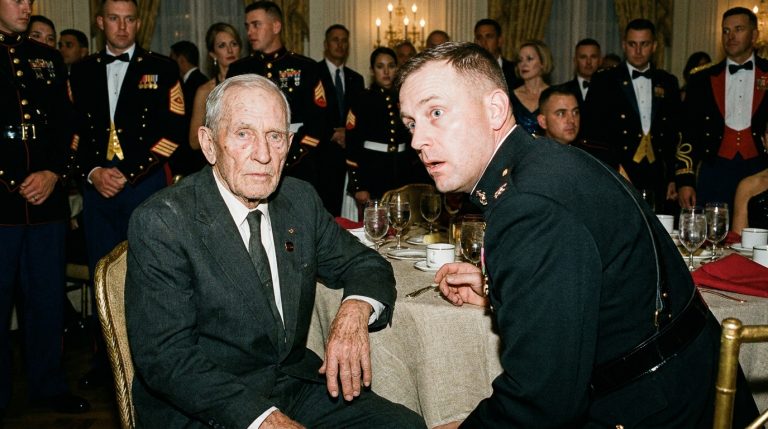
Before Roy could respond, the sound of rhythmic, polished leather against concrete echoed from the parking lot. A new, more commanding cadence—the sound of military precision. The doors pushed open, and the lobby space was suddenly flooded with the midnight-blue of dress blues. Colonel Ryman stepped through, his presence so absolute that the suits in gray instinctively pivoted.
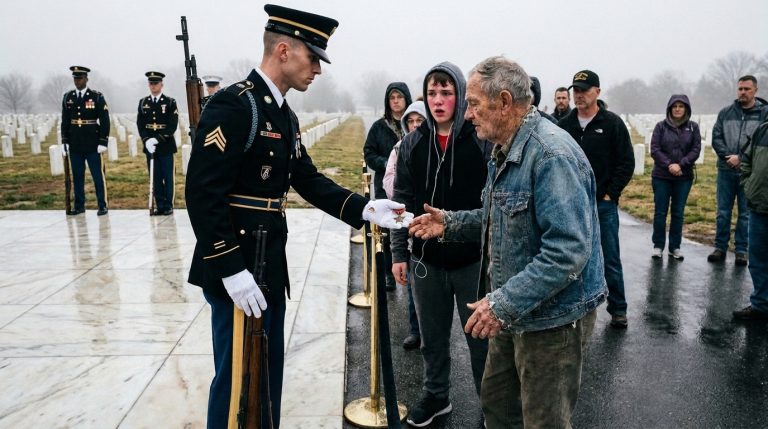
Ryman didn’t look at the suits. He marched straight to Roy, his face a mask of iron-clad respect that seemed to command the very air to thicken. He stopped, saluted, and held it—a gesture of such profound professional and personal weight that Miller found himself instinctively bracing his own shoulders.
“Sir,” Ryman said, his voice ringing with a resonance that drowned out the hum of the air conditioning. “We were alerted to a breach in protocol regarding your current location.”
The lead suit in gray shifted, his professional veneer cracking. “Colonel, this is a civilian facility. We are under instruction to contain—”
“You are under instruction to vacate,” Ryman interrupted, not even turning his head to look at the man. “You are currently interfering with a Congressional Medal of Honor recipient and a classified heritage asset. Any further interaction will be treated as an obstruction of official military business.”
The tension in the room spiked. It was a clash of worlds: the cold, invisible hands of bureaucratic containment versus the ancient, rigid tradition of honor. Miller watched as the gray suits hesitated, their eyes darting between Ryman’s steely gaze and the calm, unwavering presence of Roy.
Roy reached out and placed a hand on Ryman’s forearm. It was a small, quiet gesture, but it halted the Colonel’s rising fury. Roy turned his attention to the suits. “You want the item,” he said, his voice gravelly and low. “You think it’s about the metal. You think it’s about the wood.”
He unlatched the case.
Miller leaned forward, holding his breath. Inside, the M21 rested on its velvet bed. It looked small, almost fragile, but the way Roy touched the stock—his thumb grazing the tarnished brass plate—seemed to draw all the light in the lobby toward the center of the case.
“This isn’t an asset,” Roy said, looking directly at the lead man in gray. “This is a record. And if you think you can take a man’s record, you’ve never understood what it means to carry one.”
The lead suit reached out, his fingers twitching toward the rifle, his logic still trapped in the binary of containment. Ryman’s detail stepped in, their movements a blur of synchronized motion, forming a wall of dark blue between Roy and the intruders. The lobby became a crucible. Miller realized then that he was witnessing the end of the decoy mystery; these men weren’t here to protect the range, and they weren’t here to protect the public. They were here because they were terrified of what that brass plate represented: an accountability that they couldn’t control.
“Leave,” Roy said. It wasn’t a shout. It was an exhale.
The gray suits stood frozen, the weight of the moment pressing down on them. Finally, the lead man lowered his hand. He looked at Roy, then at the Colonel, and realized the math didn’t add up. There was no victory to be had here. They turned, their exit hurried and graceless, a sharp contrast to the silent, disciplined stillness of the Honor Guard.
As they left, the lobby seemed to deflate. The pressure vanished, replaced by a sudden, heavy exhaustion. Miller slumped against the wall, his hands finally stopping their trembling. He looked at Roy, who was calmly closing the case, his face etched with a look of profound, lingering sorrow.
“You didn’t show them,” Miller whispered.
Roy looked up, his pale blue eyes connecting with Miller’s. “Some things,” Roy said, “are too heavy to show. They are only meant to be carried.”
CHAPTER 5: THE WEIGHT OF A QUIET LIFE
The lobby felt larger now, emptier. The sharp, metallic tang of the Honor Guard’s presence had receded, leaving behind the dull, comforting scent of floor wax and the low, distant hum of the range’s ventilation. Roy stood alone in the center of the room. He didn’t rush to leave. He simply reached down and clicked the latches of his rifle case open one last time.
Miller took a hesitant step forward, his boots feeling heavy. The arrogance that had defined his morning—the need to categorize, to control, to eject—had evaporated. He looked at the rifle not as a piece of property, but as a map. He saw the scars on the walnut stock, the way the wood had darkened in places where a hand had gripped it for too long, in too many places, under too much duress.
“You’re not going to be able to stay here,” Miller said, his voice quiet. It wasn’t an order; it was a realization of the world they both lived in.
Roy looked up, his pale blue eyes clear and remarkably bright. He reached into the case and, with a slow, deliberate motion, traced the brass plate one final time. “No,” he agreed. “I never intended to. I just needed to see if the world was still capable of seeing anything beyond the surface.”
“I see it now,” Miller said, and he meant it. He looked at the rifle, and for a split second, he didn’t see a weapon. He saw the backpack buckle of a hostage, the impossible geometry of a shot taken fifty years ago in a monsoon, and the crushing, beautiful burden of a man who had chosen to be a ghost so that others could live as people. The truth wasn’t about the gun; it was about the man who had been defined by the lives he had spared, not the ones he had taken.
Roy smiled, a faint, weary expression that touched his eyes. “That is the first step, Miller. But seeing it is only the start. Carrying it… that’s where the work begins.”
He closed the lid, the soft clack of the latches resonating in the quiet room. He picked up the case. It looked lighter now, somehow. Or perhaps it was just that he was carrying it differently.
David, who had been watching from the doorway, stepped forward and held the door open. He didn’t salute, but the way he bowed his head was a gesture of deeper acknowledgment. Roy nodded in return, stepping out into the cool, late-afternoon air. The sun was dipping low, casting long, amber streaks across the parking lot.
Miller followed him to the edge of the pavement. He watched as Roy approached a modest, unassuming sedan. The old man paused, his hand resting on the roof of the car. He turned back, looking at Miller one last time. “Repair the things you break, son,” Roy said, his voice carrying clearly on the breeze. “Not because you have to, but because the world is fragile enough as it is.”
With a final, steady nod, Roy climbed into the car and drove away, his taillights fading into the orange haze of the sunset.
Miller stood in the parking lot for a long time. The range behind him felt alien, a relic of a frantic, insecure world that was rapidly losing its meaning. He turned back toward the building, his eyes catching sight of his own reflection in the glass door. He looked different—older, perhaps, but more grounded.
He walked back inside, past the rows of high-tech gear and the vacant, sterile shooting stalls. He reached the counter where Miller used to be so eager to enforce his small, rigid laws. He picked up a rag and began to wipe down the surface. He wasn’t doing it to keep the place tidy for a supervisor; he was doing it because he was responsible for the space he occupied.
The silence of the range was no longer heavy. It was just quiet. Miller looked at the bullet trap, at the wall where the concrete still held the mark of a master, and felt a strange, quiet peace. The mystery was gone, replaced by the simple, enduring reality of a man who had walked through the fire and chosen, every day since, to keep the memory of that heat contained within a small, brass-inlaid piece of wood.
He was the ghost’s keeper now, in his own way. And for the first time in his life, Miller felt that he was finally, truly, awake. He set the rag down, straightened his posture, and looked toward the entrance, ready to welcome whoever walked through the door with the patience, the respect, and the quiet dignity that he had been taught, in the span of a single, unforgettable afternoon, to value above all else.