A Quiet Weight: How an Unnoticed Veteran Reshaped the Soul of a Proud Marine Commander
CHAPTER 1: THE WEIGHT OF A PIN
The Marine Corps birthday ball was a symphony of polished brass and starched collars. The light in the ballroom didn’t merely illuminate the space; it caught on every surface, reflecting off glass and gold braid until the room felt like a furnace of perfection.
Colonel Matthews moved through the crowd as if he were part of the architecture itself, his stride synchronized with the rhythm of the evening. He was the host, the senior officer, the man who owned the atmosphere. But as he turned toward the perimeter of the room, his eyes caught a flicker of disharmony.
Tucked into a corner, away from the warmth of the main gathering, sat an old man. He was a portrait of obsolescence—a dark suit that bore the faint, polished sheen of a garment worn through decades of quiet Sunday afternoons. His hands rested on the white tablecloth, gnarled by time, yet unnervingly still. On his lapel sat a pin, a small dark shape that lacked the defiant glint of a ribbon or the prestige of a medal.
Matthews stopped. The silence at the table seemed to repel the festive roar of the room.
“Evening, old-timer,” Matthews said, his voice smooth, sharpened by the effortless condescension of a man who had never been forced to question his own status. “A bit lost, are we?”
The old man turned his head. His eyes, pale and steady as a winter sky, met the Colonel’s. There was no flicker of defensive fire, no attempt to justify his presence. There was only observation.
“This is a restricted event,” Matthews continued, leaning down as if he were explaining a complex maneuver to a recruit who had missed the briefing. “For active duty personnel, esteemed veterans, and their registered guests. Your name wasn’t on any list I saw.”
“I was invited,” the old man replied. His voice was a rasp, the sound of stone shifting against stone, holding a firmness that seemed to baffle the younger officers beginning to gather nearby.
Matthews let out a laugh that died quickly in the air. “Invited by who? The ghost of Chesty Puller?” The nearby officers chuckled, the sound brittle and eager to please. “Look, Grandpa, I’m sure you served your time. But this is a night for the modern Corps. Things have changed.”
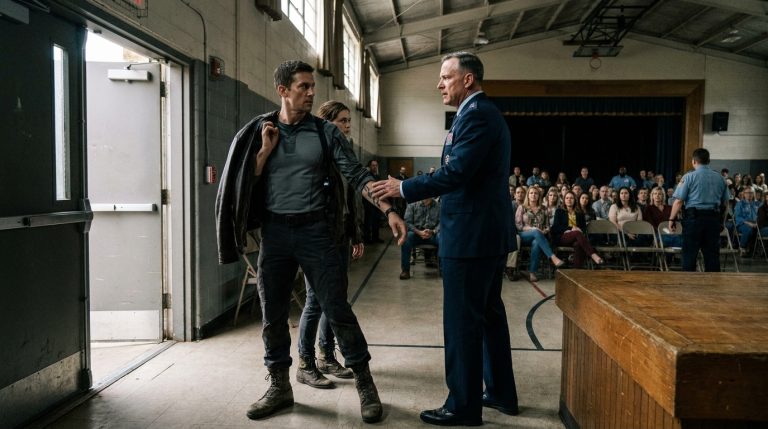
The Colonel reached down, his fingers firm as he sought to guide the old man toward the exit. But the moment his hand settled onto the shoulder of the old suit jacket, the air in the room didn’t just go cold—it shattered. The smell of perfume and floor wax evaporated, instantly replaced by the thick, copper tang of blood and the suffocating scent of cordite.
The room vanished. The old man wasn’t in a ballroom anymore. He was kneeling in red dust, the weight of his gear a familiar, biting ache, while the air around him screamed with the rhythm of machine gun fire. He keyed his radio, his heartrate steady as a metronome, preparing to lead his men into a flank maneuver that shouldn’t have been possible.
Back in the ballroom, the Colonel pulled his hand back, gasping, as if he had just touched a wire vibrating with a current far too old for him to understand. He didn’t know why, but the man before him was no longer just an intruder. He was an anomaly.
CHAPTER 2: THE ECHO OF THE RIDGE
The Colonel’s hand retracted as if he had been burned, his fingers twitching in the sudden, sanitized air of the ballroom. He looked at Arthur Vance, then at his own hand, then back at the old man. The silence was absolute. The string quartet had not stopped playing, but the music now sounded like a thin, discordant veil stretched over a void.
Arthur Vance remained in his seat. He did not lean back, nor did he shift. He was a stone in a stream, and the water—the panic, the confusion, the sheer social gravity of the room—was forced to flow around him. He felt the phantom weight of the ruck on his shoulders, the phantom grit of red dust between his teeth, but he chose to anchor himself here, in the present, where the floor was polished wax and the light was artificial, golden, and safe.
He looked up at Matthews. The Colonel was swaying, just slightly, a man trying to regain his equilibrium after a sudden fall. His face was pale, his eyes wide and unfocused. The arrogance that had defined his posture minutes ago had been eroded, replaced by a raw, naked bewilderment. He had felt the wire. He had touched the history he thought was merely a fairy tale.
“You should sit down, Colonel,” Arthur said. His voice was quiet, lacking the bite of a lecture. It was the voice of a man who had seen the end of many things and found them all to be fleeting.
Matthews didn’t move. He couldn’t. He was staring at the small, indistinct pin on Arthur’s lapel. It was so small, so unassuming, yet in his mind, it had just expanded to fill the room, blotting out the stars on his own collar. The junior officers, who had been laughing, had backed away, their faces masks of sudden, dawning comprehension. They felt the temperature drop. They felt the history.
Arthur focused on the texture of the tablecloth beneath his fingertips. It was coarse, heavy linen. He allowed the memory of the ridge line to recede, pushing it into the dark, well-ordered filing cabinets of his mind. Miller, he thought, the name a soft, recurring pulse in his chest. Miller is home.
“My rank,” Arthur said, breaking the Colonel’s paralysis. The words were not an attack; they were a quiet piece of information, delivered like a heavy, cold coin dropped onto a table. “Does not exist in the books you carry, Colonel. The records are sealed. The men who know… they are mostly gone. And the unit, as you call it, it never required a spotlight. It required results.”
Matthews finally found his voice, though it was a ragged, hollow thing. “I… I didn’t mean… I thought…”
“You thought you were protecting a tradition,” Arthur interrupted gently. “You thought the uniform was the shield. But the uniform is just the cloth, Colonel. It’s what you do when the cloth is torn, when the light fails, and when there is no one left to give you an order—that is where the truth resides.”
The ballroom began to feel smaller, tighter. Arthur saw the way Matthews’ gaze flicked to the surrounding officers. The Colonel was realizing that his stage had been pulled out from under him. The “modern Corps” he prided himself on protecting suddenly felt fragile, a thin, polished veneer stretched over the raw, jagged reality of what men like Arthur had actually forged.
Arthur saw a young lieutenant near the edge of the crowd, his face reflecting a profound, unspoken recognition. The boy was looking at the old man not as a curio, but as a mirror. Arthur felt a surge of something long-buried: not pride, but a heavy, echoing sorrow for the distance between them. The “decoy” of his age, his frail hands, his worn suit—it had served him well. It allowed him to observe, to stay in the shadows where the truth was clearest. But the secret was leaking now, a slow, inevitable seep.
He needed to keep the Layer 2 truth contained—the fact that he had not just “led” those men, but had been forced to carry the weight of their lives in a way no modern commander could fathom. He watched Matthews, whose eyes were searching for a way to save his own dignity.
“I’m going to finish my drink, Colonel,” Arthur said, reaching for the water glass that had sat untouched. The glass was cool, damp with condensation. He held it, feeling the texture of the cold moisture against his skin, using the sensation to ground himself once more. “And then I’m going to leave. You won’t have to worry about the list. I am already gone.”
Matthews looked like he wanted to apologize, but he lacked the internal vocabulary for it. He nodded, a sharp, jerky motion, and turned away. He didn’t walk; he stumbled, his polished blues looking suddenly like a costume that didn’t quite fit. The crowd parted, not out of respect for his rank, but out of a sudden, instinctive need to distance themselves from the shame that was radiating off him like heat from a cooling engine.
Arthur remained seated. He was alone at the table now. The room roared with a new sound—the sound of whispers, of secrets being traded in low, frantic tones. He knew they were talking about him, about the name, about the history. He knew the illusion of the “old man in the worn suit” had been shattered.
He didn’t look at the General, who he knew was approaching. He didn’t look at the officers who were gathering their courage to speak. He looked at the pin on his lapel, the dark, indistinct shape that held the weight of a generation. He took a sip of water, the liquid slow and steady, and waited for the next shift in the tide.
CHAPTER 3: THE GENERALS SALUTE
Arthur did not rise. His knees, protesting the damp chill of the evening, reminded him that he was no longer the operator who could spring from a crouching position to clear a room in two seconds flat. He remained anchored to the chair, his hands resting on the white tablecloth. The table, once an island of isolation, had become the focal point of the entire ballroom.
General Harding’s approach was not a walk; it was an arrival. He moved with the effortless, contained power of a man who had spent forty years commanding the movement of human lives. The crowd of officers parted for him, not in a polite ripple, but in a sudden, sharp divide, as if the air itself was compelled to give way to his momentum. He didn’t look at them. His eyes were locked on Arthur with the intensity of a heat-seeking missile.
The General stopped three paces from the table. The silence in the room had become a physical presence, a static charge that made the fine hairs on Arthur’s arms stand up. Harding brought his heels together with an audible, resonant click that seemed to ring out against the high, vaulted ceiling.
Then, he moved. His right hand snapped up, fingers straight and pressed together, thumb tucked, elbow creating a perfect, textbook angle. It was a salute of such profound, agonizing precision that it looked like a kinetic sculpture of respect. He held it there, perfectly still, his gaze drilling into Arthur’s eyes.
Arthur felt the weight of it. It wasn’t just a military courtesy; it was a public declaration. The General was staking his own authority on the presence of the man in the worn-out suit.
“Mr. Vance,” the General said, his voice booming with a timbre that resonated in the hollow of Arthur’s chest. “Sir.”
The “sir” was the anchor. It rippled through the room. The junior officers, who had been snickering mere minutes before, looked as though they had been frozen in mid-breath. The realization was sinking into the room like lead: they had been witnessing a moment of genuine, historical gravity and had mistaken it for a farce.
Arthur inclined his head, a gesture of quiet acknowledgement. “General.”
Harding held the salute for a full five seconds before dropping it with a sharp, crisp motion that signaled the end of the formal tension and the beginning of a much more uncomfortable reality for those watching. He ignored the shivering, pale-faced Colonel Matthews, who was standing a few feet away, caught in a state of suspended animation.
“I had no idea you would be here,” Harding continued, his tone dropping from an official command to a deeply personal register. “If I had known, I would have had a chair prepared at the head table. I would have had the entire staff briefing on your presence.”
“I prefer the view from here, General,” Arthur replied, his voice raspy but clear, carrying easily across the hushed room. “It provides a better perspective on the evolution of the species.”
A ripple of nervous, respectful laughter moved through the nearby officers, but it died quickly under the General’s stern gaze. Harding finally turned, his focus shifting to Colonel Matthews. The change in the General’s demeanor was visceral; the warmth he had offered Arthur vanished, replaced by a glacial, predatory stillness that made Matthews recoil a half-step.
“Colonel,” Harding said, the word dripping with an icy, controlled fury. “Are you familiar with the term ‘plank owner’?”
Matthews’ mouth opened and closed. He looked at the floor, then at the ceiling, desperately seeking an exit that didn’t exist. “I… I’m not… sir, I apologize. I was simply maintaining the… the protocols of the event…”
“You were maintaining the protocols of a careerist,” Harding interrupted, his voice dropping into that dangerous, low register that every Marine feared. “You were so busy polishing the brass on your own uniform that you failed to notice the foundation upon which this entire Corps is built. This man helped write the doctrine you spout to your subordinates. He forged the training cycles you think are so grueling.”
The General stepped closer, invading Matthews’ personal space until the Colonel’s shoulders slumped. “He doesn’t wear a uniform because the one he earned is woven into the very history of our national defense. You wanted to know his rank? His rank is Founder. His unit is History. And you, Colonel, have spent the last ten minutes trying to eject a titan because his suit didn’t meet your fashion criteria.”
Matthews stood there, his back rigid, but his entire posture screaming defeat. The “decoy” of the evening—the idea that this was just a simple case of a confused old man—had been utterly obliterated. The General’s words weren’t just a reprimand; they were a restructuring of the room’s hierarchy.
Arthur watched the scene with a detached, weary clarity. He saw the General’s intent. Harding wasn’t just protecting Arthur; he was using Arthur to reset the moral compass of the command staff. It was a tactical maneuver, as calculated and efficient as any Arthur had conducted in the field. But beneath the General’s righteous indignation, Arthur saw a flicker of something else—a shared, quiet burden of those who had carried the secrets of the “unit” and seen the things that didn’t appear in the history books.
The General gestured toward the head table. “Mr. Vance, if you would be so kind as to join us. I have a few things I would like to discuss, and I believe the audience here has had quite enough of a lesson for one evening.”
Arthur rose slowly, his joints stiff. He looked at Matthews, whose face was a mask of profound, life-altering shame. Arthur didn’t gloat. He didn’t feel the need to crush the man further. He merely nodded, a final, weary gesture, and began to walk. The crowd parted, silent and wide, their eyes following him with a mixture of terror and sudden, overwhelming reverence. He was leaving the shadows, but he knew the weight of what he left behind—the broken ego of a careerist and the sudden, uncomfortable realization of a new generation that their shiny world was built on foundations they barely understood.
CHAPTER 4: THE SILENT VIGIL
The head table was a world away from the friction of the ballroom floor. Here, the air was cooler, less charged with the chaotic energy of the gathered crowd. General Harding sat with an effortless authority, his posture relaxed, while Colonel Matthews remained anchored in his own private orbit, standing a few paces off, a man hollowed out by his own realization.
Arthur Vance settled into the chair offered to him. It was upholstered in deep, velvet-like fabric that held the residual warmth of the previous occupant. He didn’t look at the General immediately. Instead, he looked at his own hands. They were still gnarled, still showing the tremor of age, but they felt different now. The phantom memory of the ridge line had finally receded, tucked away into its proper place. The “actual” moment—the command—had been delivered, and the duty was satisfied.
“You didn’t have to do that,” Arthur said, his voice barely rising above the low, ambient hum of the distant conversations.
General Harding leaned in, his expression stripped of the public mask he wore for the troops. “It was long overdue, Arthur. You’ve been a ghost for thirty years. Some of us still remember what you built. Some of us still recognize the architecture of the foundation.”
“The foundation isn’t meant to be looked at, General,” Arthur said. “It’s meant to hold the weight. If people start looking at the foundation, it means the building above it is wobbling.”
He glanced at Matthews. The Colonel was staring at his own hands, his face still pale. He looked like a man who had been forced to look into a mirror and had found the reflection lacking.
“Colonel,” Arthur called out, his voice not harsh, but carrying a weight that forced Matthews to snap his head up. “Come here.”
Matthews approached, his movements stiff, lacking his earlier, practiced grace. He stopped at the edge of the table, his eyes fixed on the tablecloth.
“You asked me earlier what my rank was,” Arthur said, gesturing for Matthews to pull up a chair. The Colonel hesitated, then sat, perching on the very edge of the seat as if afraid the velvet might burn him. “You judged the man by the suit. You judged the history by the lack of brass.”
Arthur reached up and touched the small, dark pin on his lapel. He unclasped it—a slow, deliberate movement of his arthritic fingers. He placed the pin on the white tablecloth. It was nothing more than a scrap of metal, tarnished by time.
“This is not a hero’s badge, Colonel,” Arthur said. “It is a reminder. It represents the men who didn’t come home. It represents the tactical reality that sometimes, ‘actual’ means you have to make a choice that no one else can make, and you have to live with the arithmetic of that choice for the rest of your life. My rank is not the point. The point is the arithmetic.”
Matthews stared at the pin. The silence between them was not a void; it was a connection. He finally understood that the “actual” weight Arthur carried wasn’t power—it was the responsibility of having survived when others hadn’t.
“I see it now,” Matthews whispered. The words were a fragile, honest admission. “I saw the uniform. I didn’t see the man.”
“The uniform is just a tool,” Arthur said, his voice softening. “You are a leader, Colonel. But leadership is not about the shine on your shoes. It is about your capacity to perceive the value in the unseen. If you can see the person in the shadows, you will never lose your way.”
Arthur pushed the pin toward Matthews. “Keep it. Not as a trophy. As a weight. Every time you think about throwing someone out because they don’t fit your version of what a soldier should look like, look at that. Remind yourself that you don’t know the math.”
Matthews reached out, his hand shaking, and closed his fingers over the pin. He didn’t look up, but his posture changed. The rigidity, the forced, artificial pride, bled out of him, replaced by a grounded, somber resolve.
The Denouement of the evening began to settle over the table. The General and Arthur spoke of things that the rest of the ballroom would never hear—names of forgotten operators, the logistics of impossible missions, the quiet, mundane reality of life after the shadows. It wasn’t a hero’s recounting. It was the conversation of men who had shared the same burden.
Arthur noticed, for the first time, a small, frayed thread on the cuff of his own jacket. He began to twist it, a small, rhythmic motion of his thumb and forefinger. It was a simple, grounding act. He realized then that he had no more battles to fight. The lesson was delivered. The authority was respected. The quiet was reclaimed.
As the evening began to thin out, the guests departing in hushed tones, Arthur finally stood. He felt a profound, atmospheric peace. The ballroom was no longer a place of judgment; it was simply a room, a space defined by the people who inhabited it. He looked at the General and gave a small, almost imperceptible nod.
“Thank you, General,” Arthur said. “For the chair.”
“Thank you, Arthur,” Harding replied, his voice thick. “For the foundation.”
Arthur walked toward the exit, his gait slow and steady. He didn’t look back at the room, at the officers, or at the Colonel, who was still sitting at the table, staring at the small, dark pin in his hand. He stepped out of the ballroom and into the cool, quiet air of the night. The street was dark, the city lights distant and blurred. He felt the weight in his chest dissipate. The history was not forgotten; it was finally, for the first time in thirty years, shared. He walked into the dark, a quiet man who had finally let the silence speak for itself.