The Watchman of Route 19: A Quiet Testament to the Unbroken Bonds of Human Remembrance
CHAPTER 1: The Sunday Threshold
The air on Route 19 tasted of dry earth and impending rain, a sharp contrast to the stale, chemical scent of the high school hallways Ray spent his weeks scouring. He moved with the familiar, rhythmic limp, the hinges of his knee protesting the damp morning, but he didn’t slow. He reached the cemetery gate and pushed, the rusted iron protesting with a high, thin whine that vanished instantly into the stillness of the trees.
Ray moved through the headstones like a ghost visiting his own past, his boots brushing through weeds that hadn’t seen a scythe in months. He stopped at the leaning slab of granite, the one that everyone else ignored. A single, stubborn patch of moss clung to the name carved there—Lieutenant J. Moore.
He pulled a small, weathered leather notebook from his pocket, the spine cracked from years of handling. He didn’t open it. Instead, he knelt, his knees sinking into the mud with a wet, heavy thud. The physical discomfort was a grounding weight, a reminder that he was still here, still breathing, still able to perform the one duty that mattered.
He reached into his coat and withdrew the bouquet—dandelions and wild marigolds, their stems bruised and limp. As he tucked them against the base of the crumbling stone, his fingers traced the etched letters, feeling the texture of the erosion. The world outside the cemetery, with its clanging school bells and demanding vice principals, felt like a dream someone else was having.
“You’re not forgotten,” he whispered, the words small and hollow in the vast, quiet expanse of the graveyard. “Not this week.”
He sat back on his heels, watching the mist cling to the trees. He felt the phantom pressure of a hand on his shoulder, a weight that had never truly left him since the jungle. He leaned forward, squinting. A small, strange discrepancy caught his eye—a cigarette butt, brand new, lying in the grass just inches from his own boots.
He hadn’t been here yesterday. He hadn’t been here in a week. And he was certain, with the obsessive clarity of a man who lived in the margins, that he was the only one who ever visited this forgotten strip of earth. His heart gave a sudden, sharp flutter, not of fear, but of an unwelcome, impending shift in his carefully ordered solitude. The silence felt different now—thinner, as if someone else were listening from behind the veil of the trees.
CHAPTER 2: The Joggers Lens
Ray stared at the filter, its paper casing slightly yellowed and damp, sitting in the thick, wet grass like a blemish on a pristine canvas. He nudged it with the toe of his heavy work boot. It was fresh. The tobacco inside hadn’t even fully disintegrated into the soil.
His heart, usually a steady, predictable metronome, stuttered. He looked up, his gaze sweeping the perimeter of the cemetery. The iron gates were still closed, the chain looped loosely, but the air felt heavy, charged with the static of an unseen presence. He wasn’t just a ghost here anymore; the boundary he had maintained for a decade—the invisible wall between his life and the world—had been breached.
He turned back to the headstone. The wild marigolds he had placed moments ago suddenly looked inadequate, almost defiant against the intrusion. He wiped his hands on his trousers, the fabric rough against his skin, and felt the sudden, jarring flash of the jungle—not the green heat, but the stillness that came before an ambush. In the shadow of the headstone, for a fraction of a second, he didn’t see the mossy granite. He saw a squad huddled in the dirt, the smell of damp tobacco and unwashed skin rising to meet him. He blinked, and the hallucination dissolved into the gray, overcast light of a Sunday morning in America.
He needed to leave.
Ray stood, the effort wringing a groan from his bad knee. He reached down to grab his worn leather notebook, but his hand stopped mid-air. A soft, rhythmic clicking sound drifted over the top of the nearby hedgerow—the sound of soft-soled running shoes striking the paved path just outside the cemetery wall.
He didn’t run; that wasn’t in him. He walked, his pace slow and deliberate, moving toward the gate. As he rounded the line of overgrown yew trees, he saw him.
The jogger was young, dressed in neon-bright synthetic gear that looked alien against the muted, desaturated tones of the cemetery. He was mid-stride, his chest heaving, his fingers fumbling with a sleek, metallic device—a phone. He wasn’t looking at the road; he was looking at his screen, his thumbs moving in a frantic, tapping dance.
The young man didn’t see Ray until he was ten feet away. He pulled his headphones down around his neck, his expression shifting from focused exhaustion to mild, invasive curiosity.
“Sorry, man,” the jogger said, not stopping, just slowing to a jog-in-place. “Didn’t mean to intrude. Just passing through. Place is kind of… intense, right?”
Ray stopped. He felt the weight of his own existence, his khaki janitor’s uniform, the smear of mud on his pant leg. He looked like an artifact, a relic of a different time. “It’s a cemetery,” Ray said, his voice raspy from disuse.
“Yeah, I get that. It’s just…” The jogger gestured vaguely toward the direction of Moore’s grave. “I saw you back there. You come here every week, don’t you? My buddy, he lives over on Route 19. Said he sees the ‘cemetery guy’ all the time.”
Ray felt a coldness spread through his chest. The cemetery guy. Not Ray Navaro. Not a human being. A fixture. A piece of the scenery like a birdhouse or a broken fence.
“I have business here,” Ray said, his tone clipped, protective.
The jogger smiled, a friendly, unthinking expression that didn’t reach his eyes. He lifted his phone, the camera lens glinting in the pale light. “It’s cool, really. Kind of poetic. Guy like you, keeps the flame alive. Think people would love to see that, you know? A little bit of humanity in a world that’s forgotten how to care.”
“Don’t,” Ray said. It wasn’t a shout, but the sharpness of it caused the jogger to freeze. “Don’t take the picture.”
“Whoa, easy.” The jogger stepped back, his hands raised in surrender, but the phone remained clutched in his palm, the screen still active. “Just a candid shot, man. For, you know, the local community page. People like stories like this. It’s—”
Ray didn’t wait. He turned his back on the younger man, the indifference of the modern world striking him harder than any physical blow. He walked to the gate, pulled it shut, and heard the distinct, metallic click of the latch. Behind him, he heard the faint, rhythmic sound of the shutter—the sound of a digital ghost being captured, a piece of his secret life being ripped away and fed into the hungry, faceless maw of the internet.
He didn’t look back. He climbed into his truck, the engine turning over with a tired, shuddering cough. As he drove away, the rear-view mirror showed the jogger standing by the gate, his fingers moving again, uploading, sharing, spreading the silence. Ray gripped the steering wheel until his knuckles went white. He had protected Moore for ten years, keeping him safe in the shadows, and in less than ten seconds, a stranger had dragged the Lieutenant into the light.
The world was no longer quiet. And for the first time in his life, Ray Navaro realized that being seen was exactly the same as being lost.
CHAPTER 3: The Black Sedan
Ray stepped out of his truck, his boots crunching against the loose gravel of his driveway. The house stood before him—a small, modest structure that had been his refuge for decades. Its peeling white paint and the sagging porch steps were the only witnesses to the life he had carved out in the margins. He expected the usual comfort of the creaky floorboards and the stale, familiar air of his living room, but as he reached for the latch of his front door, his hand trembled.
The digital echo of the jogger’s shutter was still ringing in his ears. He walked inside, the interior dimly lit by the gray afternoon filtering through drawn curtains. He didn’t turn on the lights. He moved by habit, his hand brushing against the worn fabric of the armchair before settling onto the kitchen counter. He stood there in the quiet, the mug of coffee he’d poured before he left now sitting untouched, a dark, cooling pool of liquid.
He felt unanchored. The privacy he had guarded was a fragile thing, and he realized now that it hadn’t just been a wall; it had been a bubble. And bubbles were designed to burst.
He moved to the window, peering through a gap in the blinds. The street was quiet, typical for a Sunday in this forgotten part of the county. Then, he saw it. A car, black and polished to an unnatural, mirror-like sheen, glided slowly around the corner. It didn’t belong here. Its engine was a low, disciplined hum that sounded entirely too expensive for the neighborhood. It slowed, the tires whispering against the asphalt, and pulled to a stop directly in front of his driveway.
The car sat there for a long moment, idling like a predator scenting the air. Ray didn’t pull back. He watched, his breathing shallow, as the driver’s side door opened. A man stepped out, dressed in a suit that looked like it had been tailored for someone moving through the halls of power, not the dirt roads of a dying town. He moved with a stiff, practiced efficiency, his gaze sweeping the house with the same analytical precision Ray had learned to use on the battlefield.
A second man followed, this one older, his posture holding a distinct, military-grade rigidity. He didn’t look at the house; he looked at the ground, then up at the eaves, then back to the house, as if measuring the very space Ray occupied.
Ray felt the sudden, irrational urge to lock the door, to hide the leather-bound notebooks he had kept under the floorboards for years. But he knew, with the cold, resigned logic of a veteran, that hiding was no longer an option. They hadn’t come here by accident. The jogger’s post hadn’t just reached the locals; it had reached someone who knew how to look for what was hidden in plain sight.
He heard the heavy, deliberate thud of the car door shutting. Then, the rhythmic, metallic sound of footsteps on his porch—a sound that carried the authority of an order given.
Ray took a breath, the air filling his lungs with the scent of old dust and dry wood. He didn’t go to the door. He stayed at the counter, watching his own reflection in the darkened window, a man who had spent a lifetime trying to be invisible, now standing exposed in his own kitchen.
A knock came—three sharp, measured raps on the wood that didn’t sound like a plea for entry, but an announcement of arrival.
Ray looked down at his hands. They were calloused, stained with the gray dust of the school hallways, trembling slightly. He reached out and gripped the edge of the sink, his knuckles white, forcing himself to steady. He was a janitor. He was a ghost. He was the man who kept watch. And as he walked toward the door, every step feeling like an march into a different life, he knew that the silence of the last ten years was about to be broken into a thousand jagged pieces.
He didn’t know what they wanted, but he knew the weight of what he held in the records beneath his feet. He opened the door, and the light from the street spilled into the dim hallway, framing the two men in the doorway like silhouettes against a stark, unforgiving horizon.
“Mr. Navaro?” the older man asked. His voice was gravelly, refined, and carried the unmistakable weight of a man who dealt in truth and consequence. “We’d like to talk about Lieutenant Moore.”
The name hit Ray like a physical blow. He didn’t speak. He just stood there, the barrier between his sanctuary and the world finally, irrevocably, dissolved. He stepped aside, his movement slow and stiff, and motioned them into the house. The interior, usually a place of peace, suddenly felt small, cramped, and entirely inadequate for the history that was about to walk through his threshold.
The taller man entered first, his eyes scanning the room, taking in the small piles of books, the worn furniture, the quiet evidence of a solitary life. He didn’t look like a threat, but the way he moved suggested that he was a man who knew exactly how to dismantle the structures he encountered.
Ray watched them settle into his chairs, the leather creaking under their weight. The room grew silent, the ticking of the clock on the wall now the only sound, a relentless, rhythmic reminder that the time for hiding had officially run out.
CHAPTER 4: The Kitchen Table Negotiation
The silence in the kitchen wasn’t empty; it was pressurized. It settled between the three of them like a low-hanging fog, dense enough to choke the breath out of the room. The younger man, the one with the tailored suit, remained standing, his eyes moving over Ray’s modest, cluttered kitchen with a dispassionate, clinical interest. He looked for nothing in particular, yet he seemed to catalogue everything—the worn edges of the laminate table, the stack of unread mail, the single cup of coffee sitting like a dark, unblinking eye.
The older man, whose scar ran like a white river through his eyebrow, didn’t move. He kept his eyes locked on Ray, his gaze steady and devoid of the easy social cues Ray was used to from the school staff or the local post office clerks. He sat there as if he were waiting for a tactical shift, his hands folded neatly atop the leather-bound folder he had brought with him.
“You’ve been off the grid for a long time, Mr. Navaro,” the older man said. His voice was soft, devoid of accusation, yet it carried the weight of a stone dropped into a deep, dark well. “We’ve had to trace a paper trail that doesn’t officially exist for the better part of a decade.”
Ray didn’t offer a chair. He remained standing by the counter, his hands gripping the edge of the sink so tightly his knuckles turned a bloodless white. “I wasn’t hiding,” Ray replied, his voice barely rising above the low hum of the refrigerator. “I was just living.”
“Living implies a future,” the man in the suit murmured, his tone dry. “What you’ve been doing, Mr. Navaro, is curating a past. One that, until a few days ago, was remarkably well-hidden.”
The older man reached out and placed the folder on the table. With a slow, deliberate motion, he flipped the cover back. Inside lay the black-and-white photograph. It was the same image Ray had seen in his mind’s eye a thousand times—the squad in the jungle, the weary, dirt-streaked faces, the light hitting their eyes in a way that looked almost like hope. Moore stood in the center, his hand resting on Ray’s shoulder, his helmet tilted back, his grin defiant.
Ray stared at it. The sight of it felt like a violation. It felt like someone had reached into his memory and pulled out a piece of his own flesh.
“We saw the photo,” the older man continued, tapping the edge of the paper with a manicured fingernail. “The one of you kneeling in the mud. For a moment, we didn’t know who you were. But the facial recognition software, combined with the records we unearthed from the 1974 purge… well, you became very visible, very quickly.”
Ray felt a sudden, sharp clarity, a V-3 detour in his own perception. He remembered the folder he had kept tucked under his floorboards, the one he had spent ten years convincing himself was just a memento. He realized then that the records in this man’s possession weren’t just service histories; they were leverage.
“I don’t have anything to give you,” Ray said, his voice stronger now, colored by the defensive pride of the sovereign protector. “The grave is just a grave. The flowers are just flowers. If you’re looking for heroes, you’re in the wrong house.”
The younger man chuckled, a sound that lacked any real warmth. “We aren’t looking for heroes, Ray. We’re looking for the custodian of record. And according to the documents we’ve pulled from the archives—documents that, by the way, were marked with your specific classification code—you were designated to maintain the memory of this specific unit until such time as the official records could be consolidated.”
Ray felt the air go thin. He had never signed a document to that effect, never received a command. But he remembered the night in the bunker, the rain falling like lead, and the way Moore had shoved that envelope into his hands. Hold this, Ray. If I don’t make it, just don’t let them bury the truth.
He hadn’t been acting out of a simple, lonely whim. He had been performing an undocumented, unverified order—a mission that had defined his entire life since he had left the service.
“You don’t understand,” Ray said, his voice wavering, the psychological phantom of the jungle surfacing again—the fear, not of the enemy, but of the responsibility. “I wasn’t acting for the Corps. I was acting for him.”
The older man leaned forward, the light catching the scar on his face, making it stand out in stark, jagged relief. “It doesn’t matter who you thought you were acting for, Ray. It only matters that you were successful. The Corps, however, has a very specific way of handling unrecorded custodians. We can either make this official, complete with the honors and the ceremony that the Lieutenant—and you—rightfully earned, or we can continue to pretend that you’re just a janitor who enjoys the cemetery on his days off.”
The implication hung in the room, heavy and suffocating. It wasn’t a choice; it was a pivot. Ray looked at the photograph again, at the young man who had once leaned on him, and he realized the decoy secret he had built his life around—the idea that he was doing this in total, blissful independence—was collapsing. He was, and had always been, part of a system he had desperately tried to escape.
“Why now?” Ray asked, his voice raw.
“Because the memory is leaking,” the older man said, his eyes hard and unblinking. “And when memories leak, they tend to carry the truth with them. We want to be the ones to contain it.”
Ray didn’t answer. He watched as the men stood up, the chair legs scraping harshly against the floorboards. The older man picked up the folder and tucked it under his arm.
“There’s a ceremony, Ray. Hillcrest National. Sunrise. We expect you to be there. You’ve done your job for ten years. Now, let us do ours.”
They walked out, their footsteps echoing in the silence they left behind. Ray stood alone in his kitchen, the air still humming with their presence. He looked down at his hands, realizing that for the first time in a decade, he didn’t know what he was supposed to do next. The mission had been changed, the parameters shifted, and he was no longer the sole guardian of the secret. He was, as they had said, the custodian.
He moved to the window and watched their black sedan pull away, the taillights disappearing into the dusk like dying embers. He had wanted to stay invisible. Instead, he had been found.
CHAPTER 5: The Ceremony at Hillcrest
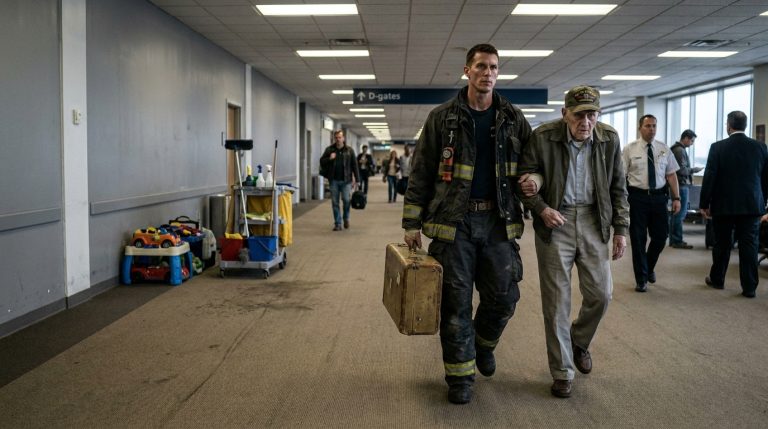
The transition from the intimacy of his kitchen to the sprawling, manicured grounds of Hillcrest National was not a journey; it was an erasure. Ray sat in the passenger seat of the black sedan—a quiet, velvet-lined tomb of a vehicle—watching the familiar landscape of his town blur past. The trees were no longer landmarks; they were scenery to be bypassed. He felt the heavy, tactile weight of the service jacket on his shoulders. He had patched the cuffs himself, the thread thick and mismatched, a testament to years of private maintenance. Now, it felt like a costume he had been forced to wear.
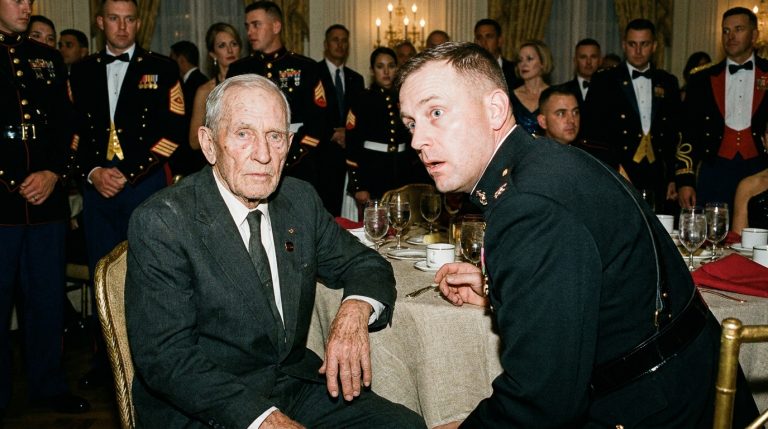
When the car finally slowed to a halt, the scale of the morning hit him. It wasn’t the modest, moss-choked corner of Route 19. It was a sea of blue uniforms, standing in rigid, calculated lines that seemed to stretch into the gray mist of the horizon.
He stepped out, his boots sinking into the wet turf. The cold hit him immediately, a razor-edged breeze that smelled of damp grass and fresh-cut granite. He saw them then—the sentinels. They stood with a motionless, statue-like precision, their gazes fixed on a point somewhere above the trees. There was no sound, only the distant, rhythmic flapping of a flag being raised nearby.
“This way, Mr. Navaro,” the taller man said, his voice stripped of the nuance he’d used in the kitchen. Here, he was just another cog in the machine of the ceremony.
They led him up a paved incline toward the new marker. The grave had been transformed. It no longer leaned; it stood straight, its surfaces polished to a mirror-like finish that caught the pale morning light and fractured it. Moore’s name was etched in deep, sharp letters, the gold leaf still bright and untarnished. But it was the detail beside it that made Ray’s breath hitch: a second inscription, smaller, recognizing his decade of service. It felt like a monument to his own loss of anonymity.
He noticed the discrepancy immediately. The layout was perfect—the rifle team, the folded flag, the polished stone—but there was no chaplain. No one to offer a prayer, no one to speak of grace or soul. It was a logistical operation, a tactical correction of an archival oversight.
He took his place as directed, his legs feeling heavy, his mind reeling. He was meant to be the centerpiece, the living witness, but he felt like an exhibit. He looked around for the young man from the high school, the one who had approached him at the school, but the crowd was composed entirely of strangers in uniform. The atmosphere wasn’t one of mourning; it was one of compliance.
“We are here to fulfill the obligation of remembrance,” the voice of the colonel boomed over the public address system, the sound vibrating against the gravestones. It was a speech, but it lacked the hum of human memory. It was precise, transactional, and utterly devoid of the quiet, Sunday-morning whispers Ray had shared with the Lieutenant for ten years.
Ray kept his gaze fixed on the ground. He remembered the specific, faded texture of the envelope Moore had shoved into his hand in the bunker—the way the paper had felt like thin, brittle skin. He remembered the smell of the damp earth on his own knees during his first visit to the grave. These things were real. They were the texture of a man’s life. The shiny, polished monument before him was just a frame, empty and cold.
As the bugler began to play—the notes of Taps rising, thin and lonely, into the sky—the realization finally settled in. He hadn’t saved the Lieutenant by being here today; he had saved him in the quiet, forgotten years, in the moments where no one was looking, and no one was taking pictures. The “honor” they were bestowing was a closing of the books, a way to finalize a record that had remained open and bleeding for too long.
He reached into his pocket and his fingers brushed against the small, folded photograph he had kept from the young man. It was the only thing here that wasn’t polished or authorized. It was a scrap of paper, fraying at the edges, capturing a moment of genuine, unmonitored human connection.
The rifle team fired their three volleys. The sharp, concussive cracks echoed off the trees, a violent punctuation to the silence. Ray flinched, the sound triggering a memory of gunfire that made his hands shake. He forced himself to stay upright, his body a pillar of forced endurance.
They handed him the flag—a triangle of perfectly folded cotton, crisp and smelling of cedar. It was heavy, a physical object that carried the weight of the entire ordeal. He took it, the fabric coarse against his palms. He didn’t look at the Colonel. He didn’t look at the stone. He looked down at the flag, tracing the sharp, geometric lines of its construction, and he finally understood.
This wasn’t about the Lieutenant. And it wasn’t about him. It was about the finish line.
He stood there as the order began to break down, the officers stepping back, the sentinels turning in unison. The machine was doing its work, and it was moving on to the next assignment. Ray felt a sudden, frantic need to get away, to escape the sterile, engineered perfection of the graveyard. He turned, the flag clutched to his chest, and began to walk away, his limp more pronounced now, his exhaustion absolute. He had fulfilled his mission. He had been the custodian. But as he looked back one last time at the polished, gold-leafed stone, he knew the silence he had kept was gone forever, and with it, the only version of the truth that had ever belonged entirely to him.
CHAPTER 6: The Windows Reflection
The drive back to his house was a mirror image of the morning, but the world outside the tinted glass had shifted. The fog had lifted, revealing a landscape that looked mundane, almost suspiciously ordinary. Ray sat with the flag pressed against his chest, its sharp corners digging into his forearms, a constant, physical reminder of the performance he had just endured. He didn’t speak to the driver. He didn’t look at the landscape. He just watched the way the light played off the dashboard, a simple, unadorned play of sun and shadow that felt infinitely more real than the gold-leafed stone he had left behind.
When the sedan pulled into his driveway, the house looked smaller than he remembered, as if it had been shrinking in his absence. The driver opened the door, a brief, mechanical courtesy, and Ray stepped out, his knees popping—a sound that felt like a quiet victory of his own organic reality over the sterile perfection of the cemetery.
“Will you be requiring anything else, Mr. Navaro?” the driver asked, his voice clipped and practiced.
“No,” Ray said. “I’m home.”
The sedan pulled away, the engine hum vanishing into the quiet hum of the neighborhood. Ray stood on his porch for a long moment, looking at the familiar, peeling white paint of the door frame. He walked inside, the floorboards greeting him with the same rhythmic creak they had offered for twenty years. He didn’t turn on the lights. He walked straight to his small, cluttered kitchen, the space where the men in suits had sat the night before, dismantling his life with their folders and their cold, analytical questions.
He laid the folded flag on the table. It looked alien here, a piece of formal, high-stakes history sitting on a table stained with coffee rings and covered in dust. He didn’t leave it there. He moved to the corner, where the loose floorboard waited—the one he had pried up a thousand times. He knelt, his movements slow and deliberate, and lifted the wood. Beneath it lay the leather-bound notebook he had carried for a decade.
He sat on the floor, the space around him quiet, the atmosphere settling into a deep, profound peace. He opened the notebook. The pages were yellowed, covered in his cramped, unsteady handwriting—notes from a thousand Sundays, observations of the weather, thoughts on the passage of time, and the quiet, unspoken promises he had made to a man who had never really left his side.
He reached into his pocket and pulled out the photo the young man had given him—the squad, the sandbags, the socks drying in the sun. He looked at it, really looked at it, and saw not the tragedy of the war, but the resilience of the men who had been there. The Lieutenant wasn’t a name on a stone. He was the hand on his shoulder. He was the reason Ray had walked with a limp for fifty years—not because he had been broken, but because he had been carried by the memory of someone who hadn’t made it.
He took his pen, the ink smooth and steady, and wrote the final entry in the notebook. The watch ends, but the memory stands.
He didn’t need to return to the grave on Route 19. The memory was no longer anchored to a patch of dirt. It had been passed on. He thought of the school children he had seen at the ceremony, their faces bright and curious, holding their wild flowers. They had seen the story. They had seen the man who remembered. And for the first time, Ray realized that his true mission hadn’t been to guard a grave, but to plant a seed.
He stood up and walked to the window. The sun was beginning to set, casting long, golden fingers of light across his small yard. He placed the notebook on the windowsill, open to the last page. Beside it, he carefully placed the photo of the squad. He didn’t need the flag. He didn’t need the honors. He had the weight of the story, and he had the quiet, enduring grace of a life lived for something greater than himself.
He turned toward the kitchen, the room no longer feeling cramped or inadequate. It felt like a cockpit, a sanctuary, a home. He reached for the coffee pot, his movements fluid, the simple act of brewing a cup of coffee feeling like a profound, sacred ritual. He was Raymond Navaro. He was a janitor. He was a man who had walked through the fire and had come out on the other side, not by forgetting, but by choosing to remember.
The house was silent, but it was a good silence—a warm, breathing, living thing. Outside, the wind moved through the trees, a soft, rhythmic rustle that sounded like a conversation being held between generations. Ray took a sip of his coffee, the warmth spreading through his chest, and he watched the light die out of the sky. The watch was over. The story would go on. He looked at the reflection in the window, not the tired, old man the others had seen, but a man who had stood his ground, a man who had kept his word, a man who, at the end of it all, was finally, truly, whole.