The math remains true even when corporate greed tries to turn human instinct into lines of code
CHAPTER 1: THE GRAVITY OF IRON
The red dust didn’t care about three-star generals or prototype tactical chassis. It simply drifted, fine as flour, settling into the lines of Saul’s face and the tracking gears of the advanced optics. The sun was an iron weight at the apex of the sky, baking the firing range until the horizon warped into a greasy mirage.
Saul lowered himself with an agonizing, multi-stage deceleration. His left knee joint gave off a dry, internal pop that he felt in his molars. To the three elite shooters lying prone on the canvas mats, he looked like a collapsing scaffold of old cedar and stained denim. They didn’t see the predator; they saw seventy-nine years of gravity pulling a man toward the gravel.
“Chamber is hot,” Saul whispered.
The voice didn’t belong to the man who had spent the last twenty years scraping burnt pork-chop residue from stainless steel vats. It was flat, dehydrated, and stripped of the rhythmic deference he used when asking the officers if they wanted ice in their water.
His right cheek hit the composite stock. The material was cold, an engineered synthetic that lacked the greasy warmth of the old walnut stocks he knew by heart. Through the lens, the world changed. The 2,500-meter target—a gray steel silhouette—was a speck suspended in the dancing heat lines.
The young snipers were breathing through their teeth, waiting for the recoil to break the old man’s collarbone. Captain Miller stood with his arms crossed, his shadow cutting across Saul’s boots like a blade.
Saul didn’t look at the wind flags. The flags were nylon; they had memory, and memory was slow. Instead, he watched the cheatgrass at the two-thousand-meter mark. It wasn’t waving; it was vibrating. It was a shivering, high-frequency distortion that meant the air wasn’t moving down the canyon—it was drilling into it.
Fourteen knots at the apex. One mill up for the heavy river air coming off the low bottom.
His thumb, calloused and yellowed by decades of kitchen bleach, didn’t squeeze. It anchored. He took up the three-pound slack of the match-grade trigger until his pulse settled between the beats. In the silence before the ignition, the skin of his forearm hitched. Deep beneath the star-shaped burn scar on his right arm, a microscopic fragment of mortar casing from the A Shau Valley shifted against the tendon. A small, iron knot of history that had never rusted out.
Boom.
The concussion didn’t crack; it thudded into the chest walls of the men standing behind him. A ring of red dust erupted three feet outward from the muzzle brake.
Saul didn’t follow the flight through the glass. He opened his left eye, watching a lone horsefly navigate the grease stains on his white apron.
Three seconds passed. The silence on the range became heavy, thick with the smell of unburned cordite and hot oil.
“Impact,” the spotter’s voice came through the electronic headset, dry and cracked like salt. “Center mass. The… the plate is down.”
Miller didn’t move. His hand remained hooked into his tactical vest, his fingers frozen against the nylon webbing. The snipers stayed down in their ghillie suits, their mouths slightly open, looking at the distant hillside as if the mountain itself had shifted two inches to the left.
Saul rolled his shoulder forward, disengaging his frame from the rifle with the same slow, creaking economy of motion. He didn’t check the monitor. He reached down, picked up the spent brass casing—it was blistering hot, but his thumb didn’t register the heat—and dropped it into the front pocket of his apron, right next to a small, bent cotter pin.
“The draw carries the lead,” Saul said to the gravel between Miller’s boots. “You’re reading the air where the money is. Not where the target is.”
He began the long, stiff climb back to his feet, his hands tracking along his thighs for leverage. As his sleeve slid down, the jagged, white tissue of the star-shaped scar caught the direct glare of the sun. It wasn’t a kitchen accident. Under the thin skin, the dark shape of old metal was still waiting.
General Sterling stepped forward, his boot heavy on the canvas mat. His eyes weren’t on the distant hillside. They were locked onto the white star on Saul’s arm.
“The valley of tears,” Sterling whispered.
Saul paused, his fingers wrapping around the hot, greasy handle of the water cart. The wheels gave an immediate, high-pitched squeak as he shifted his weight. “The meatloaf is going to turn to leather if I’m not back by five, General.”
“Operation Silent Thunder,” Sterling said, his voice dropping into a register that made Captain Miller turn around. “My father didn’t talk about the war, Sergeant Major. Except for the man who stayed behind the log.”
Saul didn’t turn his head. He looked down the long, dusty road toward the mess hall, where the exhaust fan was already humming against the heat. “Your father was a loud man, sir. Most officers are.”
He pushed. The cart groaned, the rusted axle resisting the first three inches of movement before settling into its familiar, scraping rhythm. He left the prototype rifle on the mat, its barrel still radiating a faint, blue heat into the dry air. Behind him, the silence of the elite division was louder than the shot.
CHAPTER 2: THE COLD IRON WEIGHT
The screech of the cart’s ungreased axle was the only thing that dared to occupy the space between Saul’s boots and the stunned formation behind him. It was a thin, scraping sound—metal grinding against iron dust—that cut through the mid-afternoon heat like a dull file. Saul didn’t look back to see if General Sterling’s salute had dropped. He kept his palms pressed against the worn tubular steel of the handle, his knuckles white under a thin layer of unwashed flour and dried pork fat. Every footstep down the gravel track felt like a calculated compromise with his lower back.
Behind him, the armory loomed as a low, corrugated steel box, its olive-drab paint blistering into gray flakes under the desert sun. Captain Miller’s shadow didn’t follow him, but the man’s breathing did—a sharp, ragged intake of air that spoke of career-ending humiliation disguised as tactical disbelief. Saul knew the type. He had seen fifty years of Millers come and go, men who believed the manual was written in ink rather than bone.
The journey from the active line to the secondary armory bunker was exactly four hundred yards of unshaded gravel. Saul didn’t shorten the distance with a summary; he counted every strike of his boot heels against the stones, feeling the vibration travel up through his stiffening knee. The air inside the secondary bay didn’t circulate; it sat, heavy with the sharp, chemical tang of solvent, cosmoline, and old canvas.
When the heavy steel door groaned shut behind him, the silence changed shape. It became enclosed, thick with the scent of rusted iron filings that had settled into the concrete cracks over forty seasons.
“You’re going to break that cart one of these days, Saul.”
The voice belonged to Orson, the chief ordnance clerk, a man whose skin had turned the same shade of gray as the ammunition crates he cataloged. Orson didn’t look up from his clipboard. He was running a thick, oil-stained thumb down a column of digital serial numbers, his modern tablet looking entirely out of place against the backdrop of wooden packing boxes from the Vietnam era.
Saul didn’t answer immediately. He rolled the cart into its designated corner next to the fire bucket, the metal frame rattling a final, hollow protest against the corrugated wall. He reached into his apron pocket, his fingers immediately finding the small, bent cotter pin he had kept there since morning. He didn’t pull it out. He just turned it over, feeling the rough, pitted surface where the zinc plating had failed years ago.
“The axle’s fine,” Saul said, his voice returning to its low, dry rasp. “It just don’t like the sand.”
The door behind them didn’t click; it struck the frame with the flat, heavy thud of military-grade hydraulic seals. Captain Miller stepped into the bay, his cap tucked under his left arm, his face no longer flushed but a pale, tight mask of bureaucratic fury. He didn’t look at Saul. He walked straight to the long steel counter where the prototype chassis lay under the fluorescent tubes, its barrel still faintly ticking as the alloy cooled.
“Leave us, Orson,” Miller said. The command wasn’t loud, but it had the sharp edge of an officer trying to salvage a perimeter that had already been breached.
Orson didn’t argue. He picked up his tablet, slid his stool under the zinc counter with a dry scrape, and retreated into the dark rows of the cage, the chain-link gate clicking behind him like a latch on a trap.
Miller stood before the counter, his fingers hovering an inch above the electronic receiver of the rifle Saul had just fired. “The general wants you on the line tomorrow at dawn. He thinks you’re a miracle. He thinks because you remembered a wind trace from forty years ago, you can teach boys who grew up with digital wind-scrubbers how to breathe.”
Saul wiped his palms on his apron, leaving two fresh, dark smears against the grease-stained fabric. “The math don’t care about the general, Captain. And it don’t care about your electronics. Your boys are aiming three inches low because the glass is telling them the air is flat.”
Miller’s hand dropped onto the counter, his knuckles striking the zinc with a sharp clack. “That glass is integrated with the base’s ballistic network, Saul. It doesn’t lie. It takes real-time telemetry from three separate sensory towers across the ridge.”
Saul took two steps forward, his boots dragging slightly against the grit on the concrete. He didn’t look at Miller’s eyes; he looked at the rifle’s elevation turret. There was a tiny smear of red dust jammed into the thread of the locking collar—not from the range, but from someone who had used a non-standard spanner to tighten it. It was a physical discrepancy so small it wouldn’t register on a digital diagnostic, but to a man who had spent three days in a ditch with nothing but a cleaning rod, it looked like a trench.
“Your network is reading the ridge,” Saul said softly, his thumb tracing the worn edge of his pocket. “But the bullet has to cross the gully first. Whoever set the baseline on this glass didn’t account for the iron in the dirt. The magnetic drift is pulling the internal reticle two tenths to the left before you even take up the slack.”
Miller frowned, his eyes narrowing as he finally looked down at the turret where Saul’s finger hovered. He didn’t touch it. The arrogance was still there, but it had turned into something defensive, a calculated retreat behind technical manuals. “That’s proprietary hardware, old man. Logistics verified the calibration before the unit arrived from the testing facility.”
“Logistics doesn’t shoot,” Saul muttered. He reached into his secondary pocket, his hand passing over the old cotter pin to pull out a small, flat-head jeweler’s screwdriver with a chipped handle—an old tool he used for clearing jammed valves on the kitchen’s steam kettles. He didn’t ask for permission. He stepped into Miller’s space, his shoulder brushing the captain’s tactical vest as he leaned over the chassis. “They just sign the receipts.”
The tiny steel blade met the set screw on the optic’s mounting base with a hard, metallic click. The metal was stiff, resisting the pressure until Saul applied the weight of his palm, the dry friction of his old bones forcing the screw to give way with a sharp, resonant snap that echoed off the armory walls.
Miller reached out to grab Saul’s wrist, his grip tightening against the old man’s sleeve, but he stopped when the fabric pulled back an inch, exposing the lower edge of the star-shaped tissue. “Saul—”
“Look at the indexing mark,” Saul said, his voice entirely devoid of rhythm, cold as the iron floor. “It ain’t centered. Someone didn’t slip the scale. They locked it down off-axis on purpose.”
Miller’s hand stayed on Saul’s sleeve, but the pressure died. His eyes went down to the tiny brass indicator beneath the digital housing. It was off by less than half a millimeter—a physical deviation that no software could patch because the software assumed the physical base was true. The decoy was simple, crude, and perfectly hidden within the machinery.
“Tomorrow,” Saul whispered, pulling his arm back until the sleeve fell over the scar again, “we take the glass off entirely. Let’s see how many of your boys can see the grass shake without a battery.”
CHAPTER 3: THE UNREDACTED LINE
The jeweler’s screwdriver went back into the lower pocket of Saul’s apron with a small, dry scratch against the heavy cotton canvas. Captain Miller didn’t instantly drop his fingers from Saul’s sleeve; his touch lingered for a half-second, his palm registering the hard, knotted contour of the shrapnel scar beneath the fabric before his arm fell back to his side. The dim fluorescent light overhead gave off a high-frequency hum that vibrated inside the small concrete bay, mixing with the distant, rhythmic thump of the mess hall exhaust fans bleeding through the secondary ventilation shaft.
“The scale is locked,” Miller muttered. His eyes remained fixed on the half-millimeter alignment gap beneath the optic housing. He didn’t look at Saul. He looked at the micro-metric screws as if trying to re-read his own career trajectory through the cold steel. “If that’s a mechanical defect from the facility, the entire shipment is compromised.”
“It ain’t a defect,” Saul said, his rasp flat, unbothered by the administrative weight that was currently pressing the air out of the captain’s chest. He turned his body toward the door, his spine popping with a dull, wet sound that echoed against the zinc table. “Defects happen in pairs or batches. This one was done by a hand that knew exactly how much variance the digital compensator would try to correct before the shooter took up the trigger slack. It’s clean work.”
He didn’t wait for Miller to adjust his posture. Saul walked toward the heavy hydraulic entrance, his boots dragging through the fine gray dust that accumulated near the threshold. The transition from the armory back to the gravel path was an exercise in pure resistance; the desert air had cooled by three degrees, but it felt thicker now, saturated with the first oily indicators of the evening generators kicking over across the compound.
The four hundred yards back to the mess hall were longer in the dusk. Saul pushed his rusted water cart with a steady, rhythmic lean, his hip bone taking the brunt of the frame’s counter-force. The wheels didn’t squeak as loudly now that the sand had packed into the dry axle sleeve, but the sound was still there—a low, mechanical rattle that tracked his path through the darkening rows of corrugated equipment sheds.
By the time he reached the rear entrance of the kitchen, the smell of scorched starch and yellow onions had completely replaced the clean, sharp bite of the armory’s solvents. The heavy stainless-steel door was already propped open with a rusted ten-pound weight from an old scale. Inside, the steam from the main boiling vats clung to the low ceiling, dripping in slow, greasy beads down the green tile walls.
Saul rolled the cart through the doorway, letting the handle drop against the grease-traps with a hollow iron thud. He didn’t take off his apron. He walked straight to the large industrial convection oven, his fingers wrapping around the thick latch handle. The metal was hot, but the calluses on his palms absorbed the thermal sting without a flinch. He threw the heavy door open, exposing the gray, dense blocks of meatloaf that had begun to crust over around the edges.
“You’re late, Sergeant Major.”
The rank didn’t come from the kitchen staff. Saul didn’t turn around immediately. He picked up a long, flat steel spatula from the prep table, using his left hand to check the resistance of the meat before he acknowledged the presence near the dry-storage racks.
General Sterling was sitting on a low wooden crate normally reserved for sacks of russet potatoes. He didn’t have his service cap on; it sat on his knee, the three silver stars catching the yellow glare of the exposed bulb above the sink. Between his thick fingers, he held a single manila folder, its edges frayed and darkened by grease stains that looked decades old.
“The onions are burning,” Saul said, his back still turned as he slid the tray two inches to the left to catch the lower heating element.
“My father died in ninety-eight,” Sterling said. The voice was quiet, stripped of the range command that had flattened Captain Miller three hours ago. “He left a trunk in the basement. It had four separate logbooks from the sixty-seventh logistics group. Most of the pages were scrubbed with black ink—names, coordinates, supply drops. But he kept one list hidden behind the lining of the lid. A list of personnel who never crossed the tarmac at Tan Son Nhut.”
Saul laid the spatula down on the zinc counter. The metal gave off a sharp, ringing vibrato that died slowly against the steam-heavy air. He turned around, his hands resting on the lip of the sink behind him, his palms finding the cold, greasy edge where the stainless steel had begun to pull away from the wall.
“Your father was a supply clerk, General. He saw paper, not people.”
“He saw you,” Sterling countered. He rose from the potato crate, his frame filling the narrow aisle between the boiling vats and the prep table. He laid the folder down next to Saul’s spatula. The paper was thin, translucent with age, and through the cover, the purple ink of an old mimeograph stamp was still visible. “He’s the one who signed the transfer that put you in this apron twenty-four years ago. He didn’t use your real social. He used a dead private’s number from a training accident in Fort Bragg.”
Saul looked down at the folder. He didn’t touch it. A single drop of condensation fell from the copper pipe above, striking the top edge of the paper with a dull, wet bloom that immediately began to dissolve the faded purple line of the registration stamp. His mind didn’t drift to the jungle; it stayed locked on the physical fact of the water destroying the ink.
“The meatloaf needs twenty minutes,” Saul said, his eyes remaining on the dissolving mark. “Then the boys from the third platoon will be through that door. They don’t care about logbooks, sir. They care about salt.”
“Miller’s unit isn’t deploying to Europe, Saul,” Sterling said, stepping closer until the smell of his starch-stiffened utility uniform mixed with the grease of the kitchen. “They’re going into the same valley your old team left behind. And the hardware they’ve been given is throwing errors that my data network can’t find. Someone is grooming them to miss.”
Saul’s thumb moved down to his pocket, his skin finding the cold, bent edge of the cotter pin again. He didn’t pull it out, but he squeezed it until the iron point bit into the soft meat of his index finger. “They aren’t missing because of the network, General. They’re missing because they believe the machine is smarter than the dirt.”
He reached out, his hand surprisingly quick for a man who had spent the last two minutes creaking like an old door, and picked up the folder. The paper felt brittle, almost ready to turn to ash under the pressure of his calloused fingers. He didn’t open it. He slid it directly into the deep charcoal-stained pocket of his apron, right behind the jeweler’s screwdriver.
“Tomorrow at five-thirty,” Saul said, his voice dropping into that rhythmic, predator stillness he had used on the shooting mat. “Tell the captain to leave the batteries in his barracks. We’re going to use the iron.”
CHAPTER 4: THE STRIPPED CHASSIS
The folder sat heavy against Saul’s hip, the old, brittle paper crackling softly beneath the grease-stiffened canvas of his apron as he shifted away from the steel sink. General Sterling didn’t move out of the narrow aisle immediately; his gaze remained fixed on the pocket where the 1972 manifest now rested, hidden behind a lifetime of scorched tomato paste and commercial detergent. The steam between them was thick, carrying the flat, metallic scent of iron-heavy water boiling down to dry scaling on the sides of the industrial cookers.
“Five-thirty,” Sterling said. It wasn’t an agreement; it was an acknowledgment of a boundary he hadn’t planned on encountering on a secondary training range. He stepped back, his starched uniform collar scraping slightly against the low-hanging copper intake pipe as he moved toward the propped-open rear exit. “The range will be cleared of all technical support staff by five. Only Miller and his three shooters.”
Saul didn’t watch the general leave. He reached down and picked up the heavy steel spatula again, sliding it under the corner of the nearest meatloaf pan to check the firmness of the center. The iron door at the back didn’t slam—it swung shut on its rusted counterweight, the flat thud of the ten-pound weight hitting the floorboards sending a small vibration through the damp green floor tiles.
The next twelve hours didn’t exist in paragraphs; they existed in the greasy, physical labor of clearing three hundred metal trays, scrubbing the black carbon off the boiler elements with a wire brush that smelled of stale fat, and watching the desert moon pass over the high clerestory windows of the kitchen. Saul didn’t sleep in the barracks. He spent the three hours before dawn sitting on an overturned milk crate near the dry-storage bay, his thumb slowly smoothing out the bent edge of the old zinc cotter pin in his pocket until his skin felt grey and leaden from the friction.
At exactly five-fifteen, the first gray light of dawn broke over the eastern ridge, turning the red dust of the compound into a flat, desaturated violet. Saul walked the four hundred yards back to the firing range on foot. He didn’t bring the water cart this time; he carried only a weathered canvas tool-roll under his arm, its heavy webbing stained with old lubricant from when the base still serviced manual hydraulic jacks.
The range was exactly as Sterling had promised—empty of the logistics vans and the flat-screen telemetry monitors that usually littered the area behind the firing mats. Captain Miller was already there, his jaw tight, standing beside three prone figures who looked small and thin inside their unwashed ghillie suits. The prototype tactical chassis sat on the middle mat, its high-magnification digital optic housing catching the cold, blue glare of the morning sky.
“The general said you wanted the batteries out,” Miller said as Saul approached. The captain’s voice had lost its bureaucratic sharpness from the night before; it sounded dry, worn down by an all-night session with the logistics logs that had clearly yielded no answers. “The network integration is completely disabled. The scopes are dead glass right now.”
Saul didn’t answer him. He dropped his canvas roll onto the edge of the mat, the heavy tools inside clinking together with a dull, leaden rattle. He knelt—his right knee giving off that same dry, internal crack that traveled straight to his jaw—and reached for the prototype rifle.
“Hey,” one of the snipers whispered from his mat, his face masked by green and brown jute twine. “That’s a sixty-thousand-dollar optical suite. You can’t just—”
Saul didn’t look at the shooter. His fingers, wide and scarred from fifty years of kitchen knives and hot oil, wrapped around the quick-release collar of the digital housing. He didn’t use a special tool; he used the flat edge of an old, modified iron spanner from his roll, wedging it into the seam where the electronic bus met the receiver rail.
He applied pressure. The synthetic composite housing gave off a sharp, agonizing screech as the locking pins—designed for a laboratory, not a dust storm—sheared off inside their slots. A tiny fragment of blue plastic popped out, tumbling into the red dirt between Miller’s boots.
“Now it’s glass,” Saul said, his rasp slicing through the cold morning air. He lifted the heavy electronic box off the rail, exposing the bare, notched iron mounting points underneath. He didn’t hand the expensive optic to Miller; he dropped it into the dirt beside his tool-roll like a cracked mixing bowl. “And glass don’t look at satellites.”
Miller took half a step forward, his hand twitching toward his belt before he forced his fingers to stay flat. “You just bricked the primary guidance logic for the black ops validation, Saul. If they can’t qualify on the baseline system, the deployment is scratched.”
“They’re missing because the system is telling them where the target ought to be if the world was clean,” Saul said. He reached into his tool-roll and pulled out a pair of matte-black, purely mechanical iron target sights—machined from solid stock, pitted with old cosmoline stains, and completely devoid of wiring. He slid the front post onto the barrel rail, his thumb forcing the locking detent into place with a heavy, metallic thunk that sounded like an old gate closing. “The world ain’t clean, Captain. The dirt out here is full of iron ore. It heats up unevenly. The digital sensor reads the air temperature at the tower, but it don’t feel the cold pocket sitting over the old creek bed at twelve hundred meters.”
He turned his leathered face toward the middle sniper, his eyes startlingly clear beneath his gray brows. “Get up. Get behind the metal.”
The soldier hesitated, looking up at Miller for a split second before the captain’s silent, rigid nod forced him to shift his weight. The sniper crawled over to the modified chassis, his fingers hesitant as they touched the bare steel rail where the multi-thousand-dollar display had sat five minutes ago. His cheek met the synthetic stock, but without the high-definition screen to guide his eye, his head looked tilted, unmoored from the automated safety parameters he had been trained to trust.
“The post is your truth,” Saul told him, leaning over the shooter until the smell of old onions from his apron settled over the mat. “Don’t look at the silhouette. Look at the glare on the left side of the blade. The wind is coming off the rocks at sixteen knots now—it’s picking up because the sun is hitting the shale. If you see the grass blur, you hold half a blade left. Don’t touch the dials. Use your bones.”
The range went completely still. The sun had just cleared the top of the eastern ridge, and the red dust on the valley floor began to shimmer, creating that deceptive, watery illusion that had mocked Miller’s shooters for three days.
“Take the slack,” Saul whispered.
The sniper’s finger tightened on the match trigger. Without the digital interface to calculate the humidity, the elevation, and the rotational variance of the earth, the silence between the mats felt raw—stripped down to the basic physics of copper, lead, and the black iron post pointing into the light.
CHAPTER 5: THE LOG EXCLUSION
The trigger broke. The raw ignition didn’t register as a clean report down the draw; it hit the gravel with a flat, concussive slap that blew the violet dust away from the edges of the shooter’s canvas mat. Without the dampening weight of the digital optic housing, the bare metal chassis jumped three inches to the rear, its steel buttplate driving straight into the sniper’s shoulder with unbuffered mechanical force. The boy didn’t curse; his jaw clamped tight enough for his teeth to click against his lip, his eyes locked onto the black iron post pointing through the shimmering heat.
Three seconds passed as the heavy sixty-two-grain projectile cut through the shifting river air.
“Impact,” the spotter rasped, his hand twitching over his disabled digital console. He didn’t look at the screen; he kept his bare eye glued to the rubber cup of the old optical spotting tube. “Lower left quadrant. The plate spun three inches.”
Captain Miller took a long, slow breath through his nose, his chest expanding against the rigid nylon webbing of his harness. He didn’t praise the boy. He turned his eyes down toward the discarded sixty-thousand-dollar electronic housing sitting in the red dirt by Saul’s tool-roll. A thin line of blue plastic flakes had settled onto the lens cover, looking like cheap glitter against the professional grade coating.
“They aren’t missing because they can’t shoot,” Saul said, his voice a low, dry scraping that didn’t rise above the wind whistling through the valley. He didn’t wait to see the second round chambered. He bent down, his joints giving off a dull, grunting pop as he gathered his canvas roll. “They’re missing because someone built a box that thinks for ’em, and that box has an anchor in its gears.”
He turned his back on the line before the sniper could reset the bolt. Saul didn’t skip the journey; he tracked his footsteps along the edge of the gravel lane, the distance from the range to the main maintenance terminal house exactly eight hundred yards of hard, packed clay. The sun was fully up now, casting long, sharp shadows behind the rows of standard water towers and rusted diesel storage cylinders that skirted the base’s northern perimeter.
The terminal house was a gray concrete block, its double steel doors protected by an automated keypad that gave off a weak, green light. Saul didn’t use a keycard; he waited as Captain Miller, whose boots had been striking the gravel with an agitated, hurried pace behind him, stepped past his shoulder to press his thumb against the biometric reader. The lock disengaged with a heavy, pressurized clack of pneumatic pins.
Inside, the cool, air-conditioned draft smelled of fried circuits and stale ozone. A row of four automated diagnostic terminals lined the zinc wall, their digital screens cycling through the logistical tracking for every rifle assignment on the base.
“If there’s an anchor in the system, it has to be on the master server,” Miller said, his teeth showing slightly as he pulled a high-speed data lead from his vest pocket. He didn’t look at Saul; he was already interfacing with the secondary technician’s terminal, his fingers moving across the plastic keys with the aggressive, practiced velocity of a man whose career depended on locating a discrepancy before the next shift rotation.
Saul didn’t touch the keyboard. He walked to the terminal at the far end of the bench—the old analog maintenance ledger station that the digital teams had stopped using three cycles ago. The screen was dark, covered in a thin, greasy film of diesel soot that had drifted in through the low intake vent near the floor. Saul reached out, his thick, calloused index finger tracing a slow line through the dust on the lower edge of the monitor housing.
He didn’t need the software to find it. Beneath the screen, where the physical diagnostic cables fed into the terminal’s sub-panel, a single manual jumper wire had been routed through the grounding bus. It wasn’t standard military issue; it was a rough, hand-crimped length of copper wire wrapped in old, yellowed cloth tape—the kind of scrap wire the base electricians used for repairing the old kitchen refrigeration units in the nineties.
“Miller,” Saul muttered.
The captain didn’t stop his hands. “Not now, Saul. I’m running a diagnostic check on the facility’s satellite link. If the calibration error came from the factory, it will be logged in the primary shipment manifests.”
“The manifests are clean,” Saul said, his voice flat, his finger remaining on the cloth-wrapped wire. He didn’t pull it. He just pressed it until the copper core groaned against the steel terminal screw. “Look at the ground.”
Miller stopped his hands on the keys, the sudden silence inside the room making the hum of the air conditioning sound twice as loud. He stepped away from his console, his boots making a dry, sliding sound against the concrete as he walked over to Saul’s station. He leaned down, his eyes tracking the yellowed cloth tape until they hit the manual bridge on the grounding plate.
The discrepancy was physical, crude, and entirely invisible to an automated system check. The jumper wire didn’t alter the data; it simply delayed the diagnostic signal by four milliseconds every time the rifle’s optic requested an internal calibration check. To the server, the rifle looked true; to the glass on the range, the world was permanently shifted four mills to the left.
“That’s a maintenance bypass,” Miller whispered, his face going a shade paler as the realization hit his chest. His fingers went down toward the wire, but he stopped himself before touching the cloth tape. “Only three people have access to this terminal panel during the night shift. This wasn’t done at the factory, Saul. This was done here. Six days ago.”
Saul reached into his apron pocket, his hand moving past the manila folder to roll the small jeweler’s screwdriver between his fingers. He didn’t unscrew the wire. He left it exactly as it was, its rough, grease-stained surface a quiet monument to a deliberate failure.
“They didn’t want your boys to fail the war, Captain,” Saul said, his rasp dropping into a cold, transactional rhythm that made the air inside the air-conditioned room feel even thinner. “They wanted them to fail the qualification. Someone wanted this unit kept on the ground.”
CHAPTER 6: THE PERIMETER SHADOW
“Someone wanted this unit kept on the ground,” Saul repeated, his voice dropping an octave until it was just a dead rasp against the mechanical hum of the server stack. Captain Miller didn’t yank his eyes from the yellowed cloth tape. His jaw muscles clenched, the skin around his temples tightening as he realized the manual ground wire had been fixed with the precise knowledge of a contractor who cleared five-figure logistics invoices every month.
“We leave it,” Miller whispered. He stepped back from the panel, his knuckles catching the zinc edge of the workbench with a sharp, dry scrape. He didn’t look at Saul’s face; his eyes drifted down toward the old canvas tool-roll cradled under the old man’s arm. “If I report this through standard data channels, base security locks down the division before the shooters can even draw their secondary brass. The deployment gets scrubbed from the top.”
“The top is where the ink comes from,” Saul said.
He moved first. His boots didn’t bounce on the concrete floor; they dragged with a deliberate, multi-staged weight that carried him back toward the heavy pneumatic doors. Miller followed two inches behind his left shoulder, his breath coming in shallow, hot intervals that spoke of an officer walking the narrow edge of a structural collapse. When the heavy door broke its seal, the cool, artificial ozone of the terminal was instantly torn away by a hot, grit-laden gale that had begun to roll off the western flats.
The four hundred yards between the terminal house and the secondary perimeter fence were a long exercise in physical friction. The sky had turned a desaturated, zinc-colored yellow, and the fine red dust was no longer sitting—it was running across the packed clay in long, shivering lines like rust-colored water. Saul kept his head down, his chin tucked into the greasy collar of his apron, his thumb mechanically tracking the edge of the flat jeweler’s screwdriver through the fabric of his pocket.
They didn’t take the road. Miller steered them along the low baseline of the wire, where the chain-link fabric was encrusted with dried tumbleweeds and old iron shavings from the motor-pool lathe yards. At the secondary security gate—a weathered structure of rusted pipe and hand-wound padlocks—the captain stopped. He didn’t use the automated intercom box; he reached into his vest, pulled a heavy, stamped iron key from his utility pouch, and rammed it into the lock cylinder with a hard, unlubricated clack.
“The deployment orders came from a secondary division inside the Defense Logistics Agency,” Miller said, his voice straining against the low rumble of the wind hitting the corrugated sheds twenty yards out. He threw the gate open, the iron hinges giving off a sharp, high-pitched shriek that was swallowed by the storm. He stepped through, into the unmonitored dirt road that ran parallel to the outer fuel lines. “They didn’t give us a specific sector. Just a set of coordinates in the old southern sector. The same grids your unit cleared in seventy-two.”
Saul stopped on the threshold of the wire. His boots were buried an inch deep in the soft, shifting drift of red shale that accumulated against the bottom rail of the fence. He looked out into the desaturated gray of the flats, where the horizon had entirely vanished behind the wall of wind-blown dust.
“The grids are dead, Captain. Nothing out there but old tin roofs and copper wire.”
“Then why did someone clear a three-million-dollar tech voucher to ensure my men couldn’t hit a house at two miles?” Miller stepped into Saul’s line of sight, his utility uniform already graying with the fine dust settling into the seams. He held out his right hand, not to grab the old man, but to show him a small, crumpled piece of yellow carbon paper he had pulled from his breast pocket. It was an internal transfer manifest, the type used for shipping scrap metal buttons and discarded engine blocks off the base. “Look at the authorization line, Saul. It wasn’t signed by base logistics. It was signed by a logistics liaison named Burkowitz. In eighty-four.”
Saul didn’t reach for the paper. He didn’t need to see the name. The wind caught the carbon leaf, folding it over Miller’s thumb with a dry, snapping sound. A sudden, violent gust hit the wire behind them, making the entire chain-link length rattle like an old chain being dragged through an iron tub.
“My brother died in eighty-two,” Saul said, his rasp completely flat, stripped of everything but the mechanical reality of the dust in his throat. “He didn’t work for logistics. He was buried in a dry well outside of Da Nang because his radio didn’t have a grounding wire.”
Miller’s hand stayed up, the yellow paper vibrating between his fingers like a dry leaf. The arrogance that had defined him on the active line was completely gone, replaced by the grim, pragmatic realization that he was standing outside the wire with an old man who knew more about the base’s operational deception than the master server did.
“The general doesn’t know about this wire,” Miller said, his eyes tracking a long, slow circle around Saul’s face, searching for a break in the leathered skin. “He thinks his father was just saving a legend. He doesn’t know his father was covering a supply leak that’s been running since the treaty was signed.”
Saul reached down, his fingers finding the brittle edge of the manila folder inside his deep apron pocket. He didn’t pull it out to show the captain. He just pressed his thumb against the old mimeograph ink through the cloth, feeling the texture of the paper give way slightly under his calloused print.
“The general knows what his father wanted him to know,” Saul said, his body already turning back toward the gate, his spine resisting the lateral pull of the wind. “A story about a ghost keeps people from looking at the floorboards. You want your boys to live through the month, Captain? You tell ’em to forget the name on the manifest. You tell ’em to look at the glare on the blade.”
He didn’t wait for Miller to lock the gate behind them. Saul stepped back through the rusted gap, his old boots grinding the red shale into the concrete baseline as the first heavy drops of a mud-thick rain began to spot his white apron.
CHAPTER 7: THE RED GALE LULL
The first drop of mud hit the white cotton of Saul’s apron with a heavy, wet thunk, expanding instantly into a grey, marble-sized smear over the laundered fabric. The wind rolling off the western salt flats didn’t just howl through the secondary fence; it arrived in erratic, violent hammer-blows that rattled the rusted pipe-rails of the gate until the ancient padlock chain danced against the latch. Saul didn’t look back to see if Captain Miller had secured the iron key. He kept his head tucked low into his collar, his boots sliding half an inch through the loose, shifting red shale that washed down the gravel embankment like dry water.
The journey back to the primary firing mats was exactly six hundred yards of unshaded, wind-scoured clay. The air had taken on a thick, oxidized smell—iron ore heating beneath a heavy sky just before the pressure dropped. Saul walked with a deliberate, side-slanted lean to offset the lateral force of the gale, his left hand shoved deep into his apron pocket to shield the old jeweler’s screwdriver and the manila folder from the wet grit. Every step carried the dull, mechanical crunch of aggregate grinding beneath his heels, a raw friction that traveled straight through his stiffening knee into the baseline of his spine.
When he reached the center lane, the three snipers were still prone on their canvas mats, their green and brown jute twine ghillie suits plastered flat against their backs like wet moss. Miller was already there, his utility cap gone, his hair dark and matted with the rust-colored drizzle that had begun to coat the entire line. The prototype tactical chassis lay on the middle mat, its bare iron rail slick with water, the mechanical aperture sights Saul had installed two hours ago catching the flat, violet glare of the western ridge.
“The thermal trace is completely gone,” Miller shouted over the rumble of the wind hitting the metal supply sheds behind them. He didn’t use his radio; the storm had turned the local frequency into a wall of flat, electric static. He pointed a grey, grit-streaked finger toward the distant hill. “You can’t see the silhouette through the glass anymore, Saul. The dust density is crossing thirty percent. It’s an unrated corridor.”
Saul didn’t answer him. He lowered his frame onto the edge of the mat, his joints giving off a wet, cracking sound that was instantly buried by the roar of the gale. He reached out and touched the receiver plate of the rifle. The steel was cold now, stripped of its digital calibration cycle, completely dependent on the physical relationship between the lug and the bed.
“The glass is dead because the glass needs a reflection,” Saul rasped, his voice cutting through the wind like a dull saw through dry pine. He leaned over the middle shooter, his chest inches from the boy’s shoulder harness. “The metal don’t need a reflection. The metal just needs the line.”
The sniper’s fingers were shivering inside his fingerless wool gloves, his knuckles grey from the damp drop in temperature. Through the small iron rear ring of the sight, the 2,500-meter target was no longer a speck; it was a ghost, a fleeting shape that vanished every time a fresh wave of red shale was lifted off the gully floor.
“The wind ain’t blowing straight across the draw no more,” Saul told him, his hand reaching up to touch the front sight post, his calloused thumb wiping away a bead of muddy water that had settled inside the protective hood. “It’s dropping into the bottom. It hits the old creek bed and it bounces up three feet. If you shoot where the air is moving right now, the tail of that bullet is gonna catch the lip of the ridge and skip into the dirt.”
“We need to call a technical hold,” Miller said, stepping onto the mat, his boots sinking into the wet mud that was already forming over the canvas. “The validation parameters don’t cover a zero-visibility red gale. The software logs will flag this as an uncertified attempt.”
Saul didn’t look up at the captain. He kept his eyes on the shooter’s trigger finger. The boy had taken up the preliminary weight of the trigger, but his pulse was jumping—Saul could see the tiny, erratic twitch of the tendon beneath the wet nylon of his cuff.
“The war don’t give you a technical hold, Captain,” Saul muttered. He reached down and rolled the old zinc cotter pin between his fingers inside his pocket, using the sharp, familiar scrape of the metal to center his own internal rhythm. “Your software is sitting in a dry room in Virginia. The bullet is out here in the wet.”
He tapped the shooter’s shoulder with two fingers—hard, wooden strikes that forced the boy’s frame to settle into the mat. “Look at the glare on the right side of the post now. The storm is shifting the light behind the cloud line. When the ridge goes dark, the wind is gonna pause for two seconds while the air fills the draw. That’s your pocket. Don’t think about the miles. Just think about the blade.”
The boy took a long, ragged breath, his chest lifting the wet canvas of his suit. The range around them seemed to shrink, the horizon closing down until there was nothing left but the iron chassis, the smell of wet sulfur, and the low, rhythmic thumping of the storm hitting the wire.
Saul stayed down beside him, his face inches from the mud, his old eyes wide and fixed on the shivering line of the cheatgrass twenty yards out. He was waiting for the lull—the precise mechanical space where the pressure equalized before the rain turned into a floor.
CHAPTER 8: THE RUSTED RECEIVER
The pocket of stillness lasted exactly two seconds. The shiver in the cheatgrass died, the red shale hanging suspended in the iron-heavy air before the sky seemed to drop another inch, releasing the full weight of the mud-thick downpour. Saul didn’t shift his weight from the edge of the canvas mat; his leathered cheek remained inches from the wet canvas, his eyes tracking the sudden, dark saturation of the ground where the puddle began to lake around the rifle’s mechanical front post.
“Fire,” Saul muttered.
The sniper didn’t hesitate. The ignition was a wet, flat thud that didn’t roll down the draw so much as it cracked against the low-hanging cloud line. The mechanical recoil hammered the boy’s frame backward, his boots skidding two inches through the thickening red clay as the spent brass casing ejected with a sharp, burning hiss into the mud.
“Impact,” the spotter called out, his bare eye pressed so hard against the old optical spotting tube that his brow was rimmed with grey grease. His voice lacked the cautious hesitation of the previous hour; it was flat, certain, stripped of technical doubt. “Center mass. The lead mark is right on the spine.”
Captain Miller let out a breath that sounded like tearing paper, his shoulders dropping from their rigid posture as he looked from the hill back to the old tool-roll sitting in the slush. “That’s three consecutive steel strikes without a satellite link. The qualification baseline is met.”
“The qualification is just a line on a ledger, Captain,” Saul said, his rasp low and steady as he began the multi-staged effort of bringing his frame back to its feet. His left knee ground internally, a dry friction that felt like sand sliding through an old pipe. He didn’t look at the plate. He turned his face toward the long gravel path that led back to the secondary maintenance bays, his boots heavy with four pounds of accumulated red clay. “The war don’t check the ledger.”
He didn’t skip the journey. Saul walked the four hundred yards back to the mess hall storage yard with a slow, rhythmic shuffle, his head down against the vertical weight of the rain. Miller followed three paces behind his left hip, his boots making a heavy, sloshing cadence through the pooling water. By the time they reached the wooden loading dock behind the kitchen, the violet light of the morning had turned into a flat, industrial grey that made the corrugated steel roofs look like old pewter.
Saul’s rusted metal water cart sat exactly where he had left it, its iron handle slick with a film of cold grease and rainwater. He didn’t pick up a towel. He reached into his deep apron pocket, his fingers passing over the brittle manila folder to wrap around the handle of the old flat-head jeweler’s screwdriver.
He didn’t look at Miller. He leaned over the secondary shelf of the cart—the low, sheet-iron tray where the spare paper cups and the aluminum water pitchers were stacked. Beneath the lip of the middle runner, where the zinc welding had begun to flake away into yellow scales, a small, oblong box was tucked behind the axle housing. It wasn’t an official kitchen modification; it was a compact, grey-molded plastic terminal, its seam sealed with a strip of high-density black adhesive that had begun to accumulate fine red dust along its edges.
“Saul,” Miller said, his boots coming to a dead stop on the wet wood of the dock. He leaned down, his eyes tracking the thin, insulated wire that ran from the plastic box up into the tubular steel frame of the cart’s pushing handle. The wire was hidden inside the rusted piping, completely invisible unless a man was looking for the precise entry hole where the metal had been drilled out with a five-millimeter bit. “What is that?”
“It ain’t a water heater,” Saul muttered.
He didn’t use a delicate touch. He jammed the flat blade of the jeweler’s screwdriver into the plastic housing’s seam, his palm striking the butt of the tool with a hard, wooden thud. The plastic gave way with a sharp, wet snap, exposing a circuit board that was entirely different from the heavy, automated modules inside the base’s main server room. This board was small, hand-soldered, its capacitor banks marked with the three-digit alphanumeric stamps used by defense contractors in the late nineties.
A tiny, red diode was pulsing beneath the silicone coating—one short blink every four seconds, a rhythmic indication that the unit was drawing micro-power directly from the battery loop inside the cart’s old electronic temperature monitor.
The discrepancy was complete. The cart hadn’t been just a cart; it was a passive relay, a mobile terminal that had been tracking every micro-adjustment Saul made to the range equipment for three cycles, broadcasting the technical corrections back to the secondary communications tower before the data could hit General Sterling’s secure network.
“They weren’t just watching the shooters, Saul,” Miller whispered, his hand going down to his utility belt, his fingers hovering an inch above his sidearm holster as his eyes scanned the empty kitchen yard. The rain was hitting the tin roof above them with a deafening, metallic roar that drowned out the sound of the base generators. “They were tracking you. Every time you touched a chassis, this thing was logging the mechanical variance.”
Saul reached down and pulled the circuit board out by its copper leads, the wire tearing away from the axle housing with a dry, metallic ping. He didn’t drop it into the mud. He held it between his thick, flour-stained fingers, his thumb tracing the small, stamped serial number on the base plate. The number began with the letters S-T—the old code for Operation Silent Thunder.
“They knew the ghost was still in the kitchen,” Saul said, his voice dropping into that cold, predator stillness that made the rain sound distant. He slid the broken board into his apron pocket, right beside the 1972 manifest. “And they’re using my numbers to build a machine that don’t miss.”
CHAPTER 9: THE VERIFIED INTEL
The wire ends on the torn circuit board didn’t scratch through the heavy cotton canvas of Saul’s pocket; they sat blunt against his hip, pressing the brittle layers of the manila folder flat against his ribs as he turned away from the water cart. Captain Miller stayed frozen on the loading dock, his boots submerged an inch deep in the grey runoff swirling over the planks, his right hand still hovering over the plastic flap of his sidearm holster. The downpour on the tin roof above had settled into a steady, vibrating roar that sounded like a dry hopper unloading gravel into an iron pit.
“We go to Sterling,” Miller said. The command lacked the sharp, tactical velocity he had used outside the wire; it was low, heavy with the sweat of a man realizing his entire command structure was built on top of a dry well. He didn’t look at Saul. He stepped down off the loading platform, his boots striking the mud with a thick, sucking splash that didn’t rise above the wind.
Saul didn’t shorten the distance. He walked behind Miller’s left shoulder, his boots tracking the long, gravel alignment road that cut between the industrial refrigeration units and the primary administrative sector. The distance was exactly five hundred yards of unshaded gravel, and the rain didn’t wash the dust away—it turned the red shale on the lane into a thick, greasy paste that coated the eyelets of Saul’s boots until every step required a conscious pull from his lower back.
The entrance to General Sterling’s command suite was a single steel hatch protected by a standard mechanical deadbolt and a security cameras box that was currently dripping a steady stream of orange-tinted water from its iron mounting bracket. Miller didn’t knock. He hit the thumb-latch with his palm, the lock giving way with a hard, unlubricated clack that cut through the thunder rolling off the western ridge.
The air inside the main office was hot, smelling of damp wool, cold tobacco, and the dry grease of the large analog maps hanging from the cork tracking boards. General Sterling was standing behind his zinc desk, his starched utility shirt unbuttoned at the throat, his grey eyes locked onto a secondary data printout that had been flagged with a red ink stamp across the header.
“The shooters qualified,” Sterling said without looking up from the paper. His thick fingers were pinned against the desk, his knuckles white under the glare of the low-hanging fluorescent tubes. “Miller, your boys cleared the baseline with zero assistance from the telemetry network. The Pentagon just approved the primary staging order.”
“The staging order is a trap, sir,” Miller said. He didn’t take off his wet cap. He stepped straight to the edge of the desk, his hand coming out of his vest pocket to drop the yellow carbon paper manifest—now damp and streaked with red clay—directly onto the general’s printout. “We found a manual bypass wire inside the terminal house server panel. And we found this inside Saul’s water cart.”
Saul reached into his apron pocket, his calloused fingers wrapping around the hand-soldered circuit board he had pulled from the axle housing. He laid it next to Miller’s manifest. The tiny red diode had stopped pulsing—the internal capacitor had finally run dry—but the alphanumeric S-T stamp on the base plate was still fully visible beneath the greasy thumbprint Saul had left on the silicone.
Sterling didn’t touch the board. His eyes went from the copper leads to the faded purple line on the manila folder still visible inside Saul’s open pocket. The general’s face didn’t go pale; it turned into a hard, rigid stone mask, the lines around his jaw tightening until the skin looked like old boot leather that had dried out in the sun.
“Operation Silent Thunder,” Sterling whispered, his voice dropping into that low, flat register that belonged to the logistics offices of eighty-four. He looked up at Saul, his gaze passing over the star-shaped burn scar on the old man’s arm. “My father didn’t just sign your transfer to keep you out of the stockade, Sergeant Major. He signed it because the inventory you cleared in seventy-two wasn’t listed on the final evacuation manifest. Three hundred units of manual optical gear went missing from the Da Nang depot before the wires were cut.”
“The depot was empty when we left it, General,” Saul said, his rasp dry and unbothered by the three silver stars on the man’s collar. He didn’t step closer to the desk; he stayed near the door, his palms resting flat against the cold iron frame behind him, his frame absorbing the low vibration of the building’s drainage pipes. “Your father knew the math. If you leave three hundred units of iron sights on a ledger, someone has to pay for the shipping. If you lose ’em in a ditch, the government writes a new voucher.”
“The new vouchers are what bought the prototype chassis,” Miller said, his teeth showing slightly as he looked between the two older men. The realization was striking his chest like a blunt tool. “The calibration errors weren’t a logistics mistake from base operations. The contractor who built the digital suite is the same subsidiary that bought the scrap metal from the Da Nang purge. They’re using the old mechanical profiles to verify their software metrics, and they needed my unit to fail so they could justify a fourth-phase development grant.”
The room went completely quiet, the silence inside the concrete suite so absolute that the scraping of the rain against the steel shutter plates sounded like a handful of iron nails being thrown against an empty tub.
Saul reached back into his pocket, his thumb finding the small, bent cotter pin he had rolled between his fingers for twenty years. He didn’t reveal it. He kept it in the dark, a small, unrusted remnant of a time when a man’s competence was measured by the grease on his hands rather than the satellites in the sky.
“The contractor don’t care who wins the war, Captain,” Saul muttered, his face turned toward the dark window where the storm was turning the base roads into red rivers. “They just want to keep building the box.”
CHAPTER 10: THE UNLINKED TRANSMITTER
“They just want to keep building the box,” Saul repeated, his rasp dropping into a dry whisper that barely carried over the mechanical dripping of the water pooling near the general’s door. Captain Miller didn’t move his hand away from his utility vest; his fingers remained locked near his buckle, his knuckles dark with the grey grease of the range clay. General Sterling stayed pinned behind the zinc desk, his palms flat against the wet carbon paper of the manifest, his eyes anchored to the hand-soldered circuit board like a man watching an old landmine emerge from the mud.
“If the relay is routing through the secondary communications tower, it isn’t hitting the primary base logs,” Miller said, his teeth catching the low glare of the fluorescent tube above. He turned his torso toward the heavy door, his wet boots leaving a dark, double crescent of red mud on the grey linoleum floor. “The secondary tower is isolated. It runs on the old nineteen-eighties trunk line that handles the automated perimeter alarms. It’s a closed loop.”
“Nothing is closed if the wire has a tail,” Saul muttered.
He moved first. His boots didn’t bounce against the threshold; they dragged with a deliberate, stiff leverage that pulled his frame out into the corridor. Miller stepped instantly into his wake, his wet shoulder tracking two inches behind Saul’s right sleeve as they exited the administrative building into the courtyard. The rain hadn’t stopped; it had turned the gravel alleyways into a series of shallow, rust-colored channels that rippled every time a fresh gust of wind cleared the corrugated roofs of the logistics bays.
The journey to the base’s secondary communications relay station was exactly seven hundred yards of unbroken walking along the northern fence line. Saul didn’t use a shortcut; he counted the iron fence posts as they passed through the violet-grey dusk, his palms buried inside the pockets of his apron, his fingers rolling the chipped jeweler’s screwdriver against the edge of the manila folder. The air outside was saturated with the smell of wet soot and heated copper from the auxiliary power transformers humming behind the motor-pool yard.
The relay station was a low, windowless brick box tucked behind three decommissioned fuel tanks, its iron roof rusted into deep, orange craters that were currently filled with muddy water. The door was a solid leaf of boilerplate steel, its keyway blocked by a heavy, mechanical deadbolt that didn’t have a digital terminal or a biometric reader.
Miller stepped past Saul’s shoulder, his breath coming in short, rhythmic gasps against the chill of the rain. He didn’t use a key; he pulled a heavy, three-inch steel pry-bar from his tactical kit and jammed the wedge directly into the rusted seam above the latch mechanism.
He threw his weight against the iron bar. The boilerplate leaf gave off a sharp, unlubricated screech as the internal retention pin sheared off with a heavy, metallic ping that bounced off the brick walls. The door swung inward, exposing a narrow, concrete chamber that smelled of old sulfur batteries and wet rot.
Inside, three racks of vintage analog switching gear stood in the dark, their copper terminal plates covered in a thick, green layer of oxidation that looked like dried moss. A single, modern fiber-optic cable had been spliced into the old terminal block—not with a standard military junction box, but with a crude, hand-wrapped bundle of electrical tape and clear silicone sealant.
“Look at the routing block,” Miller whispered, pointing his flashlight into the throat of the rack. The beam of light caught the clear silicone, revealing a cluster of four hand-soldered copper leads that ran down from the main array into a secondary, unlisted terminal box hidden beneath the iron floor plates. “This isn’t part of the base upgrade. This line runs straight to the contractor’s data compound outside the western perimeter fence.”
Saul knelt by the edge of the floor plate, his left knee popping with a hard, dry sound that echoed in the small room. He reached out with his bare hand, his thick fingers tracing the seam where the modern fiber had been forced into the old iron conduit.
Beneath the clear sealant, a tiny physical discrepancy caught his eye—a small, stamped brass inventory tag that had been riveted to the grounding plate. The tag didn’t have a modern logistics barcode; it featured a five-digit number stamped with a manual punch, the first two characters reading ST. It was the exact same inventory batch that had been listed on the third page of the manila folder inside his pocket.
The trap was physical. The modern black-ops division hadn’t been sabotaged by a remote hacker or an external agent; they had been routed through a legacy terminal that had been planted inside the base’s infrastructure forty years ago during the original drawdown of Operation Silent Thunder. The contractor hadn’t invented a new system; they had simply turned Saul’s old tactical footprint into a data-mining loop.
“They didn’t just want your boys to qualify, Captain,” Saul said, his voice dropping into that dead, predator rasp as his thumb cleared the green crust from the brass tag. He didn’t pull the wire. He left his fingers flat against the cold copper, his old skin registering the faint, high-frequency vibration of a live transmission running through the iron. “They needed ’em to shoot with the iron first. They needed to see how a man hits a target when the computer is dead, so they could patch the software hole.”
CHAPTER 11: THE TERMINAL MATRIX
The high-frequency hum running through the fiber casing did not alter its rhythm beneath Saul’s thumb. He kept his calloused print pressed flat against the clear silicone patch, feeling the microscopic, mechanical pulse of the live data stream drilling into the floor plates. Beside him, Captain Miller lowered his tactical light until the beam was just a pale puddle on the wet green crust of the legacy terminal blocks.
“If the link is live, they’re logging this room right now,” Miller whispered. His fingers stayed two inches above the aluminum latch of his sidearm, his knuckles grey from the damp draft whistling under the broken door leaf. He didn’t check his wrist watch; his gaze remained fixed on the small brass inventory tag marked ST that Saul had cleared with his thumb. “The compound fence line is less than nine hundred yards from this wall, Saul. If we don’t sever the link from the distribution box, the server across the wire automatically wipes the validation trail.”
“You don’t cut a snake by its tail,” Saul said, his voice a flat, dry rasp that rattled against the empty battery racks.
He rose from the wet concrete, his spine giving off three distinct, wooden pops that he felt in the roots of his molars. He didn’t use a multi-tool. He reached into his deep apron pocket, his hand passing over the brittle manila folder to wrap around the heavy, iron-handled spanner he had left inside the canvas roll. He didn’t turn back toward the safety of the main administrative loop. He pointed the iron tool toward the low utility tunnel that ran beneath the decommissioned fuel tanks toward the western perimeter fence.
The transition from the relay house to the concrete access crawlway was an unbroken stretch of damp, high-friction geometry. Saul led the way through the narrow, four-foot conduit, his shoulders scraping the lime-crusted ceiling, his boots dragging through two inches of stagnant water that smelled of old kerosene and rusted pipe-scale. Miller moved directly behind his left boot heel, the heavy canvas of his uniform catching the rough edges of the wall bolts with a continuous, dry tear. They didn’t speak; the only sound was the rhythmic, hollow slosh of their boots advancing through the dark, zero-skip corridor.
After ninety yards of manual crawling, the tunnel terminated at the base of the secondary command bunker—a three-level underground concrete cellar built during the initial testing phase of seventy-two. The air inside the bottom tier was cold, thick with the scent of unwashed canvas and old generator grease. A single yellow utility bulb hung from a frayed cloth cord, illuminating a massive, zinc-plated junction terminal where forty separate legacy cables converged into a single master trunk line.
“This is the line,” Miller said, his boots striking the concrete floor with a hard, flat echo. He stepped to the terminal box, his flashlight beam revealing a heavy, industrial-grade switching mechanism that had been mounted directly over the 1972 distribution array.
The mechanism wasn’t automated. It was controlled by a massive, dual-handled iron knife switch, its contacts coated in a thick layer of grey petroleum grease to prevent the desert moisture from fusing the copper blades. A thick cable led out from the top of the assembly, passing through a newly drilled hole in the six-inch concrete ceiling—straight into the primary communications console of the validation suite.
Saul stepped into the circle of light. He didn’t look at the copper switches; his eyes went straight to the small, hand-painted stencil on the concrete wall behind the junction. The stencil featured a faded white star and three lines of text that had been blacked out with old grease-pencil marks.
He reached out, his calloused thumb tracing the contour of the hidden letters until the grease flaked away into dry, dark scales. Beneath the black ink, the name Sterling emerged—not the general’s initials, but the distinctive, wide hand of Colonel Thomas Sterling, the logistics chief who had managed the 1972 drawdown.
“The colonel didn’t build this loop to steal copper, Captain,” Saul said, his rasp dropping into that cold, predator stillness that made the hum of the transformer sound distant. He reached into his pocket and pulled out the manila folder, throwing its brittle, water-streaked pages onto the flat top of the junction box. “He built it to keep the ledger from closing. If the team stayed listed as missing in the valley, the division could keep drawing the operational maintenance grants every winter. He didn’t hide me to save my skin. He hid me to keep the voucher alive.”
Miller froze, his hand dropping away from the switching lever as the physical reality of Layer 2 struck his chest. The folder lay between them under the yellow light, its translucent pages revealing forty years of internal financial transfers that matched the serial numbers on Saul’s rusted water cart down to the final digit.
The ultimate final reality was locked on the paper. The general’s father wasn’t a protector; he was the primary architect of the legacy leak, and General Sterling’s arrival on the base wasn’t a coincidence—it was the final phase of a fifty-year administrative cleanup designed to bury the original manifest before the modern black-ops division deployed into the same valley.
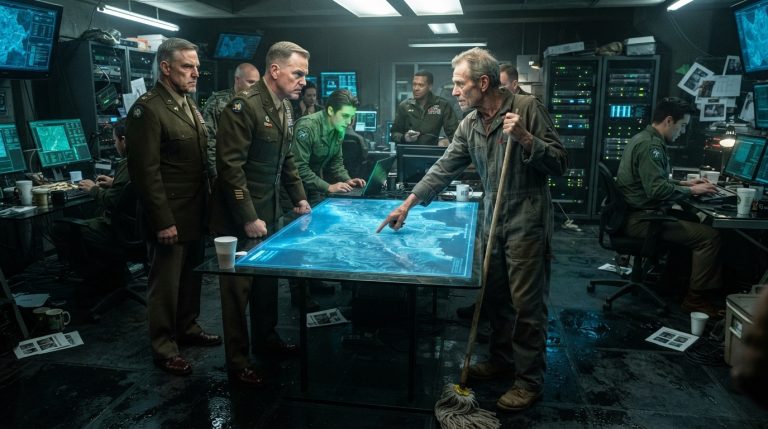
“He knows,” Miller whispered, his face turning the color of wet ash as he looked toward the stairs leading up to the main command deck. “The general isn’t looking for an error, Saul. He’s looking for the ledger.”
The steel hatch at the top of the concrete stairs didn’t click; it struck the frame with the heavy, hydraulic thud of an operational lock being forced from the inside. General Sterling stood on the upper platform, his starched utility shirt dark with rain, his right hand resting flat against the steel railing as his grey eyes took in the uncoiled folder on the terminal.
“The ledger is already closed, Sergeant Major,” Sterling said, his voice dropping down the stairs like a heavy iron weight.
CHAPTER 12: THE LAST CALIBRATION
“The ledger is already closed, Sergeant Major,” General Sterling repeated. The steel boots of his utility frame didn’t echo as he descended the final three concrete steps; they made a heavy, flat thud against the damp lime crust of the cellar floor. He didn’t look at Captain Miller’s sidearm. His eyes remained locked on the frayed edges of the manila folder that sat on the zinc-plated junction box, its translucent pages vibrating slightly under the dull hum of the trunk line transformer.
“It was never a rescue, was it?” Miller asked, his hand dropping completely away from his tactical belt. The structural realization hit his chest like a blunt instrument, his shoulders slumping under the wet nylon weight of his harness. “Your father didn’t hide Saul to protect a ghost. He hid him to keep the forty-year procurement cycle from hitting a dead end.”
“The division needed a benchmark,” Sterling said. He stopped two feet from the edge of the terminal, his hand coming down onto the iron casing of the knife switch. His tone wasn’t defensive; it was the cold, institutional prose of an officer reading an unredacted audit report. “The software models we use for the modern chassis are built on physical data points. We couldn’t design an automated system that accounts for the iron drift in the southern sector without the raw tracking profiles from the men who shot it manually in seventy-two. Saul wasn’t an employee, Captain. He was the last live calibrator on the ledger.”
Saul didn’t reach for his tools. He stayed near the dark tunnel opening, his calloused palms flat against the cold concrete wall behind him, his frame registering the precise vibration of the rain drainage running through the foundation. He looked at the massive iron handle of the knife switch, then at the grease-pencil marks he had scraped away to expose the colonel’s name.
“The math don’t care about your procurement, General,” Saul said, his rasp low and steady, cutting through the damp air like a rusted blade. “You built a box that counts every leaf that falls in the valley, but you forgot that a boy behind the trigger still has to breathe between the gusts. Your software didn’t fail because of a manual bypass wire. It failed because you tried to turn a man’s bones into a code line.”
Sterling’s fingers tightened on the grease-coated iron handle of the knife switch. For a fraction of a second, the predator posture that had defined his family for two generations flared through his chest—a visceral, defensive calculation to throw the heavy lever, isolate the bunker’s power array, and let the master server outside the fence initiate an automated system purge that would overwrite the manifest files forever.
But his hand stayed fixed. He didn’t drop the lever because Captain Miller had already stepped between the junction box and the exit ladder, his bare thumb pressed firmly against the physical reset pin of the analog tracking ledger—a simple, spring-loaded brass detent that Saul had cleared with his jeweler’s screwdriver three hours ago. If Miller slammed that pin, the mechanical counter would lock the current data profile into the base’s un-scrubbable hard storage, rendering any remote digital wipe entirely useless.
The counter-move was clean, manual, and unbuffered by software logic. The elements seeded on the range had converged on the floor.
“If you throw that switch,” Miller said, his teeth showing slightly in the yellow glare of the utility bulb, “the analog registration locks the manifest to the staging order. The Pentagon gets the raw numbers without the contractor’s patch. The loop stays open, sir.”
Sterling looked from the brass pin to Saul’s leathered face. The silence inside the three-level cellar became absolute, stripped of institutional rank, reduced down to the hard friction of three men standing over a grey iron table. Slowly, his fingers opened, his palm sliding off the grease-coated handle with a faint, sticky scrape.
“You can’t keep flipping burgers forever, Saul,” Sterling said softly, his frame stepping back into the shadow of the stairwell.
“The onions don’t write vouchers, General,” Saul muttered.
He didn’t wait for the officers to clear the ledger. Saul turned his frame toward the concrete access tunnel, his boots dragging through the two inches of stagnant water with a slow, rhythmic economy of motion. Every step through the nine-hundred-yard crawlway was a calculation against gravity, his old knee joint giving off that familiar, dry pop that tracked his progress back toward the daylight.
By the time he emerged from the secondary perimeter gate, the red gale had fully broken, the violent wind dissolving into a quiet, mist-heavy drizzle that turned the red shale of the compound into an atmospheric, desaturated peace. The sun was setting behind the western ridge, throwing a long, warm-sunset orange light across the empty firing mats.
Saul walked back to the kitchen yard alone. He didn’t go to the administrative block; he stepped onto the wooden planks of the loading platform, his eyes finding his rusted metal water cart sitting in the quiet aftermath of the storm. The pulled circuit board was gone from the frame, leaving only a tiny, clean hole where the five-millimeter drill bit had cut through the tubular steel.
He reached into his apron pocket, pulled out the old, bent zinc cotter pin, and laid it on the zinc prep table inside the kitchen door. He picked up a soft cotton cloth and a small can of manual machine oil. With slow, rhythmic strokes, he began to wipe the rust off the pin’s barrel, his fingers moving with the precise, deliberate labor of a man who had nothing left to verify to a satellite.
Through the open door, the sound of the third platoon’s mess hall trucks could be heard grinding up the gravel alignment lane, their gears shifting down as they reached the perimeter. Saul laid the clean pin back into his deep pocket, right next to his flat-head screwdriver. He picked up his long steel spatula, threw open the heavy door of the convection oven, and let the warm, savory smell of the onions fill the quiet kitchen.
The ghost was back in the apron. The math was true.