The Iron in the Thread: A Novel of Retribution, Rust, and the Unyielding Price of Valor
CHAPTER 1: THE FRICTION OF THE AISLES
The plastic seat creaked, a thin, cheap protest against eighty-two years of settled bone and unyielding muscle. Douglas Ramsay kept his palms flat over the scarred wood of his cane, feeling the deep, longitudinal grooves where his fingers had worn the varnish down to the raw grain over three decades of walking. The auditorium smelled of high-end synthetic wax, expensive cologne, and the sharp, chemical ozone of over-cranked air conditioning. Below the chatter of the gathering crowd, the building itself hummed a low, bass note that vibrated directly into the soles of his boots.
“Is this some kind of joke?”
The voice was thin, sharpened by the frantic pressure of a deadline. A young man in a tailored tuxedo loomed over the row, a silver clipboard pressed against his chest like light armor. His knuckles were white against the aluminum edge, his face flushed an aggressive, smooth pink that had never known a winter in a jungle canopy. His name tag read Julian Thorne, Senior Event Coordinator.
Douglas didn’t turn his neck immediately. The vertebrae were stiff, fused by the violent deceleration of a rotor failure fifty years back in a clearing that didn’t exist on any map. When he did move, it was a single, heavy rotation of the torso. He looked at the young man’s polished shoes, then up to the silk lapels, and finally into the small, twitching pupils.
“I am sitting exactly where I was told to sit,” Douglas said. His voice carried the grating friction of iron tires rolling over dry river gravel. It stayed low, beneath the level of the stage microphones, but it didn’t shake.
Julian let out a short, dry bark of a laugh, his eyes darting to a pale assistant who stood three paces back, her fingers frozen over a glowing tablet screen. “Did you hear that, Sarah? He was told. Sir, this row is center-line. It’s reserved for dignitaries, foreign attachés, and the keynote speakers. Look at yourself.”
Douglas looked down. His fingers remained locked on the cane. He wasn’t wearing the midnight-blue wool of the dress uniform, nor the stiff, starched collars of the administrative staff. He wore a faded crimson windbreaker. The nylon was coarse, aged into a desaturated, brick-like hue, its surface scored by old grease stains and the faint, unmistakable smell of spent oil and dry earth. The cuffs were frayed into gray spiderwebs of loose thread, and the metal zipper was missing three teeth near the throat, leaving an open gap like an unhealed wound.
“I know what I’m wearing, son,” Douglas said softly.
“It’s offensive,” Julian hissed, leaning down until the scent of his mint mouthwash cut through the heavy air. “We have senators arriving in ten minutes. Generals. People who actually gave something to the service. You look like you crawled out from under a chassis to get out of the downpour. Move. Now. Before I have the guards handle it.”
Douglas shifted his weight, the movement telegraphing nothing but the immense, rooted mass of an old tree. On the left breast of the jacket, a small patch—stitched in gold and black thread that had long since rotted into a dull charcoal gray—caught the glare of the overhead stage lights. To a civilian, it was an unrecognizable shape, a smudge of ancient fabric. To Douglas, every stitch was a marker.
“I’m not moving,” Douglas said, turning his eyes back to the empty wooden podium on the stage.
The air between them turned cold, the friction of the young man’s breath hitching as the first heavy boots of the security detail began their rhythmic, metallic march down the concrete ramp behind the curtains.
CHAPTER 2: THE ANATOMY OF OVERWATCH
The silence didn’t just hang; it settled like grit over an ungreased axle. Julian Thorne’s chin remained tucked down, his breath hitching against the rigid wool of his collar as Douglas’s refusal remained suspended between them. The silver clipboard in the young man’s hands gave a tiny, metallic creak—the subtle deflection of thin aluminum under a tightening palm. Douglas didn’t blink. He kept his eyes leveled at the empty stage, but his peripheral vision, trained in valleys where survival depended on the slight displacement of a single fern leaf, registered a sudden flicker forty feet above the floor.
High up on the mezzanine railing, where the shadows of the secondary spotlights pooled into pools of absolute black, a second figure leaned over the iron bar. It wasn’t one of the tech crew. The silhouette was too still, its focus anchored entirely on Row A center. A small, green indicator light from a handheld radio blinked once against the stranger’s lapel before being covered by a palm.
“Sarah,” Julian said, his voice dropping into a register that was far too thin to be steady. “Get them now. The South Entrance team. Tell Miller to bring the heavy zip-ties. This is an active obstruction.”
The assistant didn’t move for three full seconds. Her fingers remained hovering over the glass of her tablet, the blue light casting a cold, square glow across her pale cheeks. She looked at Douglas’s profile—the deep, calcified lines around his jaw that looked less like skin and more like old cedar bark hardened by river salt. There was an absolute absence of panic in the old man’s posture, a density of weight that made the vast auditorium feel fragile by comparison. Then, with a frantic clack of her heels against the brass threshold of the aisle runner, she turned and bolted up the incline toward the double doors.
Douglas felt the vibration of her departure through the soles of his boots. He reached up with his left hand—the skin knobby and scarred with pale white tracks from old mortar fragments—and slowly touched the throat of his crimson jacket. The zipper was cold, the iron teeth rough against his thumb where the three missing pieces had been sheared away by a piece of shrapnel in the spring of ’72. Underneath the frayed nylon lining, tucked flat against his ribs, the stiff edges of the canvas logs rasped against his undershirt with every breath. They were heavy. They had always been heavy, a physical weight he had carried across five decades of timber-cruising and cabin-isolation, waiting for the day the names written in fading purple ink would finally be read into the light.
“You think because you’re old, people are going to care,” Julian muttered, stepping into the narrow gap between the seats to cut off Douglas’s view of the stage. He was sweating now; a bead of moisture ran down the side of his temple, leaving a pale track through the dusting of theatrical powder on his skin. “You think this place is a museum where you can just display your trash. This is an operation. We have three networks broadcasting live from the back riser. We have five hundred plates of prime rib sitting in the holding kitchen that need to be served at exactly twenty minutes past the hour. You are a variable, sir. And my job is to eliminate variables.”
“A variable,” Douglas repeated. The word came out dry, catching on the gravel in his throat. He looked at the coordinator’s polished leather shoes, noting the slight scuff on the left toe where Julian had tripped over his own pride during the initial approach. “Son, a variable is what happens when the weather turns over the ridge and your slick-line drops twenty feet into the brush because the pilot’s eyes are full of hydraulic oil. What you’ve got here is just an old man sitting in a chair he paid for fifty years back. That’s a constant. You can’t budget for a constant.”
“We’ll see about that,” Julian said. He checked his watch—a gold-plated piece that clicked with a sterile, microscopic precision. “Two minutes. The motorcade is clearing the security gate at the north gate right now. When General Vance steps through those doors, this front row will be clear. Even if I have to have the crew roll you out in a laundry bin.”
Douglas didn’t answer. He let his hand drop back to the head of his cane, the dry grain of the hickory wood reassuring against his palm. He could hear them now—the heavy, rhythmic thud of corporate security contractors moving through the service corridors behind the stage curtain. They weren’t soldiers; their stride was wide, heavy-heeled, the gait of men who relied on bulk and body armor rather than the low, fluid stealth of a mountain patrol. The iron hinges of the stage-left door groaned, a thin screech of metal that lacked oil, signaling the arrival of the guards.
Up on the mezzanine, the dark silhouette moved again, the small green light of the radio flashing three times in quick succession. Douglas watched the shadow shift, its posture changing from observational to alert. The friction in the room was rising, the air thickening with the smell of wet wool and the heavy, electric heat of the stage-lights turning on one by one, painting the empty aisles in long, sweeping bars of white gold.
CHAPTER 3: THE VICE GRIP
The low screech of the stage-left hinge died out, leaving a raw, metallic vibration that seemed to hang in the stale air of the aisle. Julian Thorne took a half-step forward, his polished oxfords scuffing against the brass trim of the carpet runner. The scent of his mint lozenges and frantic sweat sharpened as he reached down, his arm extended with a rigid, administrative entitlement. His fingers flicked the collar of the faded red windbreaker a second time, the sharp snap of his nail against the aged nylon sounding like a twig breaking underfoot in a dead forest.
“It’s an eyesore, old man,” Julian whispered, his lips barely moving as he kept his eyes sweeping the lower tier for the first sign of the senator’s advanced staff. “It’s probably covered in decades of dust and fleas. You don’t have the paperwork for this seat. You don’t have the uniform for this room. You’re a trespasser in a zone that was built for people who actually left something on the field.”
Douglas’s hand didn’t rise in a defensive arc; it simply traveled. The motion was a blind, heavy instinct, a sudden calcified burst of speed that defied the deep aches in his knuckles and the slow rust of his joints. Before Julian’s hand could retreat back toward the safety of his silver clipboard, Douglas’s fingers intercepted the young man’s wrist.
The contact was loud in the small space between the rows—the heavy, dry smack of weathered skin meeting starched cuff links. Douglas didn’t squeeze with the explosive force of a young man; he locked his grip with the slow, hydraulic pressure of a logging winch. His thumb, thick and flattened by a lifetime of hard labor and the heavy kick of iron levers, drove deep into the soft valley between Julian’s radius and ulna, pinning the major nerve against the bone.
“Don’t touch the jacket,” Douglas said.
The volume of his voice hadn’t changed by a single decibel, but the dry gravel in his throat seemed to harden into chips of flint. The air within the immediate five feet of Row A center went completely dead, the background murmur of the entering dignitaries dropping away as Julian’s breath caught in a sharp, wet gasp.
The young coordinator tried to yank his arm back, his shoulder jerking upward in an instinctive, panicked reflex. He didn’t budge. Douglas sat completely still, his left hand frozen on the head of his cane, his right arm acting as a solid, rusted bar of iron connecting him to the trembling clerk. Julian’s smooth, pink face went white around the jawline, his eyes widening as he looked down at the liver-spotted hand that held him. The skin of Douglas’s knuckles was cross-hatched with small, white scars—the permanent ink of engine grease, old wire rope, and the sharp bite of mountain shale.
“Let go,” Julian squeaked, his voice cracking into an uncharacteristic, high register that caused a pair of retired colonels three rows back to stop their conversation mid-sentence. “You’re… you’re assaulting an official event officer. Let go of me.”
Douglas looked into the young man’s eyes, watching the arrogant certainty dissolve into the pure, survivalist panic of a small animal caught in a spring-trap. He felt the rapid, fluttering pulse of Julian’s artery beneath his thumb—a frantic, rhythmic tapping that reminded him of the fuel pumps on the old Sikorsky switch-lines when the lines were choked with air.
“You speak real loud about what this room was built for, son,” Douglas said, his gaze remaining locked on Julian’s twitching eyelid. “But you look at a piece of cloth and you only see the tear in the hem. You don’t see the grease under the stitching. You don’t see the miles it carried. You think a tuxedo makes a man a part of the masonry. It just makes him part of the furniture.”
Behind Julian’s heels, the heavy footsteps of the two security contractors finally cleared the stage curtain. They were big men, built out of the heavy, synthetic bulk of modern gyms, their black tactical shirts tight across their shoulders. The leader—a man with a shaved head and a neck that showed the thick, pale scar of an old industrial accident—stopped at the edge of the riser, his eyes tracking from Julian’s twisted posture down to the old man’s static, iron grip.
“Problem, Mr. Thorne?” the guard rumbled, his hand dropping naturally to the heavy leather utility belt at his hip.
Julian didn’t look back at them. He couldn’t. The pressure on his wrist joint was increasing by small, imperceptible increments as Douglas tilted his wrist just three degrees to the left, taking up the slack in the coordinator’s silk sleeve. “He’s… he’s non-compliant,” Julian managed to choke out, his chest heaving against his tailored waistcoat. “Get him out of the chair. He’s trespassing.”
Douglas held the grip for one more long, unhurried second, letting the cold density of his weight sink fully into the young man’s marrow. Then, without a single jerk or sudden release, his fingers uncoiled. The transition was immediate; the tension vanished from the air, and Julian stumbled two steps backward into the row behind him, his silver clipboard slipping from his numb fingers and hitting the polished wood floor with a sharp, echoing clatter that traveled all the way to the back mezzanine.
Julian stood there, his right hand tucked against his ribs, his fingers working frantically to restore circulation to his white skin. His face had rushed from white back to a deep, dangerous purple as he glared down at the old man in the red windbreaker.
“You’re done,” Julian whispered, his teeth grinding together as he gestured to the two guards on the riser. “Miller, take him through the service exit. If he doesn’t walk, you drag him by the cuffs. I don’t care if his family is watching.”
Douglas didn’t move an inch. He slowly reached down, picked up his cane, and reset his palms over the worn wood, his eyes returning to the red velvet curtains of the main VIP entrance across the floor. He could hear it now, beneath the heavy breathing of the guards—the distant, authoritative air-horn of a command escort clearing the intersection three blocks away. The time was up. The high-start was rolling, and the first heavy tread of iron was already at the door.
CHAPTER 4: BREACHING THE PERIMETER
The metallic clatter of the silver clipboard hitting the parquet floor had barely finished vibrating through Douglas’s boots when the heavy double doors at the VIP entrance didn’t just swing—they struck the magnetic wall stops with the flat, structural crack of an iron gate splitting under a ram. The plush velvet curtains buckled inward, sucked forward by a sudden displacement of air that carried the sharp, familiar scent of motor-pool diesel, ozone, and cold rain.
Julian Thorne didn’t drop his hands from his ribs. He froze, his boots sliding back an inch until they caught on the edge of the open clipboard. On the white sheet clamped to the aluminum board, a thick, black permanent-marker line had been dragged through the name RAMSAY, D., its edge dry and jagged where the ink had run thin over the recycled paper texture. It lay right between them, an unhidden erasure. But neither Julian nor the two muscular security guards could look down.
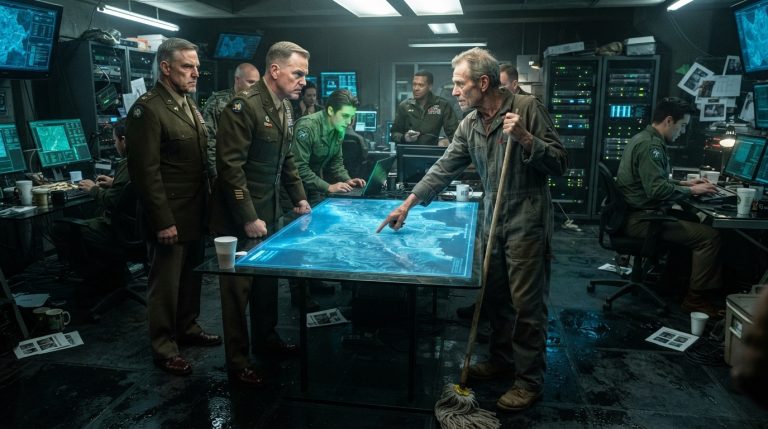
A phalanx of eight uniformed soldiers cleared the threshold in a synchronized, fluid wedge. They weren’t dressed for the chandeliers or the champagne flutes on the high tables. They wore dust-scoured combat webbing, low-profile ballistic helmets, and the heavy leather sidearm holsters of a field command detail on active transit. The iron buckles on their straps gave off a flat, dull clink-clink as they fanned out into the row, their boots moving with a fast, zero-skip precision that instinctively occupied every foot of high-ground flanking Row A center. They didn’t speak. They didn’t issue commands to the civilians. They simply planted their heels into the plush ballroom carpet and turned their backs to Douglas, creating a wall of unyielding olive-drab canvas and iron-plated gear.
Through the center of the broken line strode General Marcus Vance.
Six feet, four inches of hardened, sun-baked iron. His four silver shoulder stars caught the sharp overhead gallery lights, but there was no polish on his combat boots; they were coated in the dry, gray alkali dust of the high country maneuvers he had left less than three hours ago. His face was a map of deep, angular shadows, his jaw set so tightly that the tendons along his neck looked like braided wire rope under tension.
Julian Thorne swallowed, his throat making a dry, clicking sound as his administrative composure attempted to reassert itself. He took a half-step forward, his right hand still twitching against his vest, his mouth opening to deliver the pre-arranged greeting he had rehearsed for three weeks. “General Vance… sir… thank God. We have a logistical… a seating discrepancy in the primary center line—”
Vance didn’t turn his head. He didn’t drop his stride by a fraction of an inch to acknowledge the coordinator’s existence. He simply moved through the space Julian occupied. It wasn’t a violent shove; it was the raw, physical momentum of a heavy transport clearing a blocked lane. The sheer displacement of the general’s bulk forced Julian to stumble sideways, his shoe heel catching the edge of the dropped clipboard. The aluminum plate skittered three feet away across the wood floor as Julian hit the carpet hard on his hip, his tailored tuxedo trousers bunching up around his shins.
The lead security guard, Miller, felt his shaved head drop three inches into his shoulders as Vance’s eyes swept over him. The hand that had been resting on the heavy utility belt snapped back to his side, his fingers flattening against his seams as if the leather holster had suddenly become white-hot.
Vance stopped exactly three feet from the faded crimson windbreaker. The air conditioning hummed its low, steady bass note, but within the perimeter of the soldiers, the temperature felt like it had dropped straight to the iron-point. The general looked down at the frayed cuffs, the gray webs of loose nylon thread, and the gold-and-black patch that had long since rotted into an unrecognizable smudge of charcoal stitch-work.
Then, slowly, with the heavy, unhurried precision of an engine dropping into its cradle, the four-star general went down on one knee.
The collective gasp from the second and third rows behind them was a wet, sudden rustle of silk and wool—the sound of five hundred wealthy donors realizing the ground beneath their tables had just shifted three feet into the gray. The highest-ranking officer in the hemisphere sat on the dusty hotel carpet at the feet of an old man whose windbreaker zipper was missing its teeth.
“Sergeant Major,” Vance said. His voice was a heavy, resonant growl that didn’t need the house speakers to fill the room; it carried the unpolished density of a field telephone line.
Douglas looked down over the head of his hickory cane, his watery blue eyes narrowing as he traced the familiar, hard set of the younger man’s jaw. A small, dry crease appeared at the corner of his mouth, the leather of his cheek tightening against the collar of his jacket.
“You’re late, Marcus,” Douglas said. The gravel in his throat sounded older now, but it didn’t give an inch to the uniform kneeling before him.
“I got held up at the logistics depot over the ridge, Doug,” Vance replied, his hand reaching out, his glove leather raspy against the frayed nylon of Douglas’s sleeve. “I didn’t think you’d leave the cabin for this.”
“I heard they were giving you the fourth star,” Douglas murmured, his palm remaining flat on the worn wood of his cane. “Figured somebody had to be down here in the low country to make sure your head didn’t get too wide for the olive-drab.”
Vance gave a short, wet bark of a laugh that stayed in his chest, his fingers tightening on the red sleeve until the coarse fabric bunched under his grip, revealing the faint, oil-darkened circle of an old grease stain from an extraction bay forty years cold.
CHAPTER 5: THE GENERALS KNEE
The general’s leather glove remained rigid against the rough fabric of the windbreaker sleeve, his weight settled completely onto the hotel floor. The thick, alkaline dust coating his combat trousers began to trace gray lines into the pristine burgundy weave of the ballroom carpet, a slow bleeding of the rough elements into a space meant for polished brass and silent service.
Julian Thorne lay exactly where he had fallen three feet away, his elbow braced against a brass floor riser. The cold metal bit through his silk shirt as he stared up at the four silver stars on Vance’s shoulder. His tongue felt thick, tasting of dry theatrical powder and the metallic tang of sudden adrenaline. The two private security contractors behind him had completely abandoned their stance; Miller’s large hands were hooked loosely by his sides, his fingers twitching in small, irregular patterns as he subtly shifted his weight toward the shadow of the velvet exit curtain.
“Stand up, Marcus,” Douglas said softly. His left hand didn’t move from the hickory cane, but his fingers tightened until the dry grain groaned against his knuckles. “A ballroom floor ain’t the place to drop a anchor. These people didn’t pay five hundred dollars a plate to watch an army commander scrape his shins on a rental rug.”
Vance didn’t obey immediately. He remained on his knee, his head tilted downward just enough that the shadow of his stiff cap bill completely obscured his eyes. The smell of the motor-pool diesel hanging off his olive-drab webbing seemed to expand, triggering a sudden, sharp memory in Douglas’s throat—the suffocating heat of an extraction bay where the floorboards were slick with aviation fuel and the dark, wet leaves of the Ashau canopy were plastered to the Plexiglas by the rotor wash.
“They paid to see an awards ceremony, Sergeant Major,” Vance said, his low growl slicing through the stagnant, over-cooled air of Row A. He slowly rose to his feet, his joints making a dry, mechanical click that sounded identical to the lock on a heavy equipment crate. He stood at his full height, his massive shoulders blocking out the brilliant glare of the stage spotlights behind him, throwing Julian and the security detail into absolute shadow. “But they don’t know what the medals are cast from. They think they’re stamped out of a press in Virginia.”
Vance turned his torso three degrees, his eyes tracking downward until they locked onto the silver clipboard lying upside down near Julian’s hip. The white manifest page was crinkled where Julian’s heel had skated across the edge, the jagged black line through Douglas’s name fully exposed to the stage-light.
“You dropped your ledger, son,” Vance said. The volume of his voice didn’t rise, but the structural density of the tone made the crystal wall-sconces twenty feet above them give off a faint, sympathetic ring.
Julian scrambled to his knees, his hands sliding through the dust on the floor as he reached for the aluminum plate. His fingers were shaking so violently the board made a rhythmic clatter-clatter against the parquet before he could pin it down. “General… the administrative board… the committee manifest was revised at noon. The seating arrangement for Row A center was restricted to active-duty attaches and representatives of the current logistics command. The 77th… the 77th isn’t listed in the active registry. The unit designation was retired on paper twenty years ago. I was… I was simply adhering to the protocol file provided by the bureau.”
Douglas watched the young man’s fingers white-knuckle the metal edge of the clipboard. The protocol file. It was always the file. Even forty years ago in the timber country, the people who came with the erasures always carried a clean manila folder with a steel clip. They never had mud on their boots, and their ink was always fresh.
“The registry,” Vance repeated, his voice dropping into a cold, transactional register that made Miller take another half-step deeper into the shadow of the curtain. The four soldiers behind the general didn’t move their eyes from the crowd, their heels pinned to the carpet like iron stakes. “You crossed his name out because the computer told you the desk was empty. You thought because the ink was old, the man was gone.”
“No, sir,” Julian stammered, his teeth hitting each other as he tried to pull himself up using the back of a second-row chair. The wealthy woman dripping in diamonds in Row B shrank back into her cushions, her fur wrap rustling as she drew her skirts away from the dust on Julian’s trousers. “The dress code… the protocol explicitly states formal black-tie or service dress blues. The windbreaker… it’s a code violation. It reflects poorly on the dignity of the platform. We have diplomats from the joint command arriving in five minutes—”
“This jacket,” Vance interrupted, his arm moving in a short, sudden arc until his thumb was pointing directly at Douglas’s left breast, “is the only item in this building that didn’t come out of a catalog. Look at the stitching on that line, Thorne. That’s heavy nylon cord from a survival harness. It was sewn together with a pair of pliers in a ditch while the fuel tank of a downed slick was burning fifteen yards away.”
Douglas reached up, his weathered fingers covering the missing teeth of his zipper, his thumb feeling the thick, irregular knots under the collar. He didn’t want the boy to look too close at the lining. The canvas logs were still there, stiff against his lower ribs, the sharp corners of the old waterproof paper digging into his skin with every short, rasping breath. If Vance kept talking, if he cracked the history open too wide before the microphones were live, the people in the back booth would turn the feed off before the true names could be spoken.
“Marcus,” Douglas said, his voice a low gravel brake. “Let it lie. The boy was just following the hand he was dealt. He don’t know the difference between a grease spot and an award ribbon.”
Vance’s face hardened further, the skin around his temples turning a dark, dangerous gray as he stared down at the coordinator. “He’s about to find out the difference, Doug. Because if this windbreaker leaves this row, I’m taking the flags off the stage and the four stars off my shoulders, and we can let the senators spend the evening listening to the air conditioning.”
CHAPTER 6: THE ANATOMY OF NYLON
The absolute silence that followed General Vance’s threat was broken not by a human voice, but by the physical limits of the venue itself. Directly above Row A center, the heavy, high-output house microphone mounted to the lighting truss caught the resonant, cannon-shot frequency of Vance’s voice and produced a sudden, sharp spike of audio feedback. The low, structural whine skreeled across the acoustic tiling of the ceiling, a brief, mechanical scream that made the diamond-dripping woman in the second row flinch back into her velvet cushions with a dry rustle of silk.
The noise broke the lock on Julian Thorne’s lungs. He pulled himself up fully, using the cold, gilded iron armrest of seat two to anchor his weight. His tailored trousers were gray with the dust from the carpet, and his right hand remained tucked tightly into his waistcoat, his skin still showing the dull, white imprint of Douglas’s old grip. He looked from Vance’s rigid, towering frame down to the open manifest on the floor. The panic in his eyes hadn’t vanished, but it had shifted, hardening into the cold, calculated desperation of an administrator who realizes the ledger is being burned in front of him.
“You can’t change the manifest on the floor, General,” Julian said. His voice was thin, but it carried a sharp, desperate velocity that cut through the dying echo of the feedback. He didn’t look at Douglas; he kept his eyes pinned to the fourth star on Vance’s shoulder strap. “The Department of Defense protocol file for this evening is logged in the federal network. The 77th Air Rescue is legally designated as inactive. The cross-border logs from seventy-two are classified under a grandfathered executive seal. If you alter the protocol without an administrative waiver from the secretariat, the live broadcast risers behind us will go black in three minutes. The network carries a mandatory compliance clause.”
Douglas let his eyes drop to the coarse fabric of his own sleeve. Underneath the frayed edge where the gold-and-black stitching had rotted away, his thumb felt the hard, rectangular density of the canvas logs sewn flat against his ribs. The waterproof paper was cold, unchanged by the heavy heat of the stage lights. Julian was right about the file, but he was looking at the wrong ledger. The boy thought the deletion was a matter of black tie and seating charts; he didn’t know the erasure had been executed thirty years ago to keep the names in the lining from ever hitting the congressional record.
“The compliance clause,” Vance said. He took a single, deliberate step closer to Julian, his heavy field boots grinding the aluminum clipboard further into the parquet. The metal gave off a loud, structural crunch as the plate buckled under his heel, splitting the paper manifest down the center-line. “You’re talking to me about an ink-line on a digital server, son. You think that machine has a memory?”
“It has the force of law, sir,” Julian replied, his teeth clicking together as he forced his spine straight against the back of the row. “The bureau doesn’t recognize variables that aren’t on the roster. If the Sergeant Major remains in this row without the authorized service dress or a validated credential, the command detail is technically in violation of federal event security. The MPs at the south entrance are bound by the same gate-log I am.”
The four soldiers in the perimeter didn’t turn their heads, but Douglas heard the subtle, rhythmic click-clack of their tactical webbing as they shifted their balance, their backs forming an unyielding line of canvas and brass between the stage and the lower tier. The friction in the room was rising, the air thickening with the smell of wet wool, old dust, and the heavy electric heat of the risers.
“Let the boy speak, Marcus,” Douglas said. He raised his right hand from the cane, his thumb dragging across the missing metal teeth of his windbreaker zipper. The iron was rough, catching on the scarred skin of his palm. “He’s just reading the print on the back of the card. He don’t know that the machine that printed it was paid for with the grease we scraped off the rotor hubs in the valley.”
“He knows exactly what he’s doing, Doug,” Vance said, his voice dropping into a dangerous, transactional whisper that didn’t travel past the third seat. He reached down and touched the frayed crimson nylon of Douglas’s collar, his leather glove raspy against the weathered fibers. “He thinks because the command registry is clean, the blood on this lining doesn’t have a voice. He thinks if he keeps the red jacket out of the camera line, the story stays under the chassis.”
Vance turned back to Julian, his jaw set so tightly the skin over his cheekbones looked like old timber. “The 1972 logs aren’t missing, Thorne. They’re sitting right here in Row A. And if your network risers go black because this windbreaker is in the center seat, you can tell the secretariat that the commander of the hemisphere’s forces is currently standing guard over the only piece of history in this room that didn’t require an appropriation vote.”
Beyond the perimeter, the low, steady thud of the VIP motorcade’s heavy air-horns finally vibrated through the outer concrete walls of the ballroom. The doors at the far end of the gallery began to groan, the iron hinges protesting as the advanced diplomatic staff started their transition into the main hall. The escalation was locked; the high-start had cleared the gate, and the unpolished grit of the old valley was about to meet the clean ink of the capital.
CHAPTER 7: CLEAR THE FLOOR
The structural groan of the gallery doors faded into the high-set acoustic tiles, leaving the sharp, heavy scent of tarmac rain and unwashed service uniforms pooled at the back of Row A. General Vance didn’t shift his boots from the crumpled remains of the aluminum clipboard. He kept his weight balanced forward, his large, scarred hand resting near the brass rivets of his belt as he watched the first three officers of the diplomatic advance detail clear the lower curtain line. They were young captains from the administrative bureau, their dress whites pristine, completely free of the dry country dust that coated Vance’s tactical webbing.
Julian Thorne stood rigid against the back of seat two, his knuckles working against the brass trim of the armrest until his skin turned a flat, bloodless white. His breath came in shallow, irregular rasps that smelled faintly of the stale peppermint lozenges he had swallowed before the house lights came up. “The gate-log is automated, General,” he whispered, his eyes darting toward the approaching captains. “The network doesn’t accept a physical override from a field command detail. If the registry isn’t cleared by the time the secretariat reaches the floor riser, the system tags the entire front row as an unverified security perimeter. They’ll divert the motorcade to the south annex.”
“Let them divert it,” Vance said. The volume of his growl stayed below the reach of the upper gallery microphones, but the sheer mass of his voice made the thin plastic of the seating row vibrate against Douglas’s spine. “They’ve spent thirty years diverting every file that had the number seventy-seven stamped on the spine. They can spend an evening walking through the loading dock to see if the concrete matches their ledger.”
The lead captain of the advance detail stopped four paces from the olive-drab perimeter line. His eyes took in the synchronized, outward-facing posture of the eight tactical soldiers, then dropped to Julian’s dust-streaked trousers and the skittered remains of the seating manifest under Vance’s heel. A small crease appeared between his starched collar tabs. “General Vance, sir. The secretariat’s car has cleared the lower checkpoint. The foreign attachés are forty seconds out from the main riser. We need the center lane cleared for the camera angles.”
“The lane is clear, Captain,” Vance said without turning his torso. “The Sergeant Major is in his seat. The rest of this furniture belongs to the staff.”
Julian took a half-step forward, his right arm still twitching against his vest where Douglas’s fingers had left their dull mark. “Captain, the occupant of seat one is non-compliant. He has no credential logged in the current bureau file. He’s… he’s wearing an unverified garment that violates the formal security directive for live broadcast. I’ve ordered the contract guards to execute a removal under the trespass ordinance.”
The captain looked at Douglas. He looked at the faded brick-red nylon of the windbreaker, the gray spiderwebs of frayed thread hanging from the cuffs, and the three missing teeth on the oxidized iron zipper. His gaze lingered on the gold-and-black patch on the left breast—the rotted thread so thin it looked like an old grease stain left behind by an unwashed tool. Unlike Julian, the captain had spent three months at the logistics depot in Virginia; his eyes narrowed as he recognized the irregular, heavy-gauge stitching of the survival harness line that bound the collar together.
“The trespass ordinance doesn’t apply to a command-directed invitation, Mr. Thorne,” the captain said softly, his hand dropping away from his leather folder. He looked at Vance, his jaw tightening into a brief, unpolished sign of recognition that didn’t quite reach a formal salute. “The system log hasn’t updated because the secretariat’s server is on a fifteen-minute delay from the main house detail. But the name is on the manifest at the outer gate.”
“It was crossed out,” Julian hissed, his voice cracking as he reached down to point at the split paper beneath Vance’s boot. “I saw the deletion myself. The line was blacked out by the internal committee at noon.”
“The committee doesn’t own the ink-supply, son,” Douglas murmured from his chair. He didn’t lift his chin from his palms, but his thumb moved slowly against the worn hickory of his cane, the dry wood rasping against his old skin. He could feel the hard edges of the canvas logs beneath his ribs, the waterproof paper growing warm against his chest as the heat from the stage risers intensified. “They just own the eraser. They think if they drag a marker through a set of initials, the valley goes flat. But the trees are still there, and the iron we left in the brush don’t rust out just because you turned the machine off.”
Vance turned his head then, his eyes locking onto Julian with an expression that carried the absolute lack of pity found in an engine room after a failure. “Captain, take Mr. Thorne out through the service ramp. He’s finished with his checklist for the evening. He seems to have a problem understanding the difference between a variable and a constant.”
“General, the ceremony—” Julian began, his boots sliding back another inch as two of Vance’s tactical soldiers stepped inward from the perimeter, their heavy canvas shoulder straps brushing against his silk lapels.
“The ceremony is about what’s left in the dirt after the ink dries, Thorne,” Vance said, his hand dropping flat onto Douglas’s shoulder, his fingers pinning the red nylon against the old man’s bone. “And you don’t have the gear for it. Get out.”
The two soldiers didn’t use their hands; they simply occupied the space until Julian was forced to turn toward the narrow iron door behind the curtain line. His silver clipboard remained where it lay, crushed and split on the parquet, its white page showing only the jagged black line where Douglas’s name had been tried and erased in the dark.
CHAPTER 8: THE IGNITION OF THE TRUCK
The narrow iron door behind the curtain clicked shut, swallowing the last frantic scrape of Julian Thorne’s shoes. With the coordinator gone, the vast hall seemed to drop its formal pretense, the remaining crowd settling into their seats with a heavy, collective rustle like dead leaves shifting before a storm. General Marcus Vance did not take the podium. He did not step into the brilliant white cone of the center stage spotlight. Instead, with a single, deliberate movement, he pulled out seat two—the chair directly beside Douglas—and lowered his massive frame into it, shoulder-to-shoulder with the faded crimson windbreaker.
“Let the speakers have the microphones, Doug,” Vance growled softly, his field boots flat against the floorboards, pinning the shattered fragments of the silver clipboard beneath his heel. “We’ve done our time on the wire.”
Douglas didn’t look at the stage as the first administrative officer cleared his throat at the podium. He reached inside the frayed line of his jacket collar, his stiff, oil-stained fingers sliding past the missing iron teeth of the zipper to touch the thick canvas lining against his lower ribs. The double-layer mystery was over. The administrative deletion Julian had tried to enforce was nothing more than the final, clumsy layer of ink meant to obscure the truth. For thirty years, the official registry had listed the 77th as a retired designation, an empty ledger. But under the rough fabric, hidden within the unauthorized shroud he had sewn together with a pair of pliers, the actual cross-border logs remained intact. The names of the twelve men left in the burning grass of the Ashau Valley weren’t lost; they were printed in water-fast ink on the canvas backing, a permanent physical record that the high command had tried to scrub from the servers to hide their own failure.
“They wanted a clean broadcast, Marcus,” Douglas murmured, his voice like river stones grinding together in a dry creek bed. “They wanted the stars to look bright on the screen without the grease from the extraction bay showing on the linen.”
“The grease is what holds the airframe together, Doug,” Vance replied, his hand resting on the armrest between them, the leather of his glove showing the dark, salt-stained cracks of thirty years in the field. “The network can broadcast whatever they want. The logs are staying right here.”
The ceremony rolled on above them like a distant machine, a sequence of starched uniforms and rehearsed testimonies that lacked the raw friction of the high country. Douglas sat through it with the immense, rooted weight of an old cedar tree, his palms steady on the hickory wood of his cane. He felt the gradual cooling of the room as the hours stretched, the sharp chemical ozone of the air conditioning slowly giving way to the simpler, heavier scent of the rain outside the reinforced gallery windows.
When the last chandelier dimmed and the politicians began their slow, rhythmic march toward the limousine lines at the front entrance, Douglas didn’t wait for the escort. He pulled himself up, his fused vertebrae popping with a dry, mechanical crack that sounded identical to the iron levers on his old winch. He didn’t use the cane for balance now; his spine was straight, his chin lifted until the frayed collar of the windbreaker cleared his throat line.
Vance walked beside him, his combat boots pacing the old man’s slow, deliberate stride through the service exit and out into the cool, dark air of the alley. The downpour had stopped, leaving the asphalt slick and black, reflecting the desaturated amber glare of the streetlights.
“My detail can have you back at the ridge cabin in two hours, Doug,” Vance said, stopping at the edge of the curb where his command vehicle sat idling, its diesel exhaust rising in gray plumes against the damp brick wall.
Douglas shook his head, his watery blue eyes tracking the slow movement of the mist through the power lines overhead. “No thank you, General. I’ve got the three-quarter ton parked around the corner behind the freight dock. She’s got a leak in the steering box, but the iron’s thick enough to get me over the pass.”
He turned, his boots raspy against the wet gravel of the side lot as he reached the old truck. The body panels were a faded, desaturated primer gray, the wheel wells encrusted with the red clay of the timber trails. He pulled the heavy iron handle of the driver’s door; it gave off a loud, dry clack-groan that had never known synthetic oil.
Douglas climbed into the cab, the springs in the horsehair bench seat settling under his mass with a familiar, metallic groan. The interior smelled of old burlap, spent oil, and the sharp, iron tang of dry earth. On the dashboard, a small, brass-backed pocket knife—its casing scarred by three decades of carving timber-lines—lay inside the ash tray. He picked it up with his right hand, his thumb working the rusted hinge until the blade clicked open with a flat, certain snap.
Slowly, deliberately, he reached inside his windbreaker. He didn’t rush the blade. He ran the steel point along the coarse, irregular knots of the survival-harness thread that bound the inner nylon lining together. One by one, the five-decade-old stitches popped, releasing the stiff, rectangular sheets of canvas logs that had been pinned against his ribs since the spring of ’72. He laid the waterproof pages flat on the rusted steel floorboard beneath the heater core, letting the true names settle into the oil-stained iron of the truck.
He reached for the ignition switch. The key was cold, the brass worn smooth by forty years of friction against his pocket coins. He twisted it.
The starter gave a heavy, mechanical grunt—a slow, hydraulic struggle against the cold oil in the block—before the cylinders caught with a sudden, concussive roar that shook the primer-gray fenders. The engine idle was rough, a loud, unpolished tractor cadence that completely drowned out the distant hum of the capital’s traffic blocks away.
Through the salt-filmed glass of the windshield, Douglas looked back toward the alley entrance. General Marcus Vance was still standing on the curb, his frame rigid, his hand raised in a sharp, slow salute that stayed locked against the bill of his cap. He didn’t lower it as the truck began to roll. He stood guard over the empty asphalt, his four stars catching the amber light as the red windbreaker faded into the gray shadows of the mountain road.