The Cold Weight of Freedom: A Pragmatic Tale of Unspoken Boundaries and Hard-Earned Sovereignty
CHAPTER 1: THE KITCHEN THRESHOLD
Thirty pairs of polished shoes filled my parents’ living room, but all I could focus on was the greasy film of gravy on my thumbs.
I stood by the double-basin sink in the kitchen of the white colonial, scraping scorched stuffing off a copper pan with a blunt butter knife. Through the doorway, laughter bubbled over the sound of soft jazz. My sister Megan’s voice rose above the rest, bright and sharp, recounting Derek’s latest court victory while my mother chimed in with precise, practiced pride.
I twisted the cap of the steel fountain pen in my apron pocket, feeling the cold threads click against my thumb.
“Wendy,” my mother said, stepping through the doorway with three empty wine glasses balanced between her fingers. She didn’t look at my face; her eyes swept down to my faded black jeans. “The crab cakes are lukewarm. Warm the second tray, and make sure Derek’s glass doesn’t sit empty. His partners are watching how we host.”
“I’m on the last pan, Mom,” I said, my voice flat, unhurried. “The caterer left two hours ago.”
“We all make sacrifices for family,” she replied automatically, setting the glasses down with a sharp clink against the granite. “Derek brought the Lexus. Move your Civic off the driveway before the neighbors leave.”
She turned back toward the dining room without waiting for an answer. I didn’t move my car. I wiped my hands on a damp towel, pulled the fresh tray of appetizers from the oven, and carried it into the light.
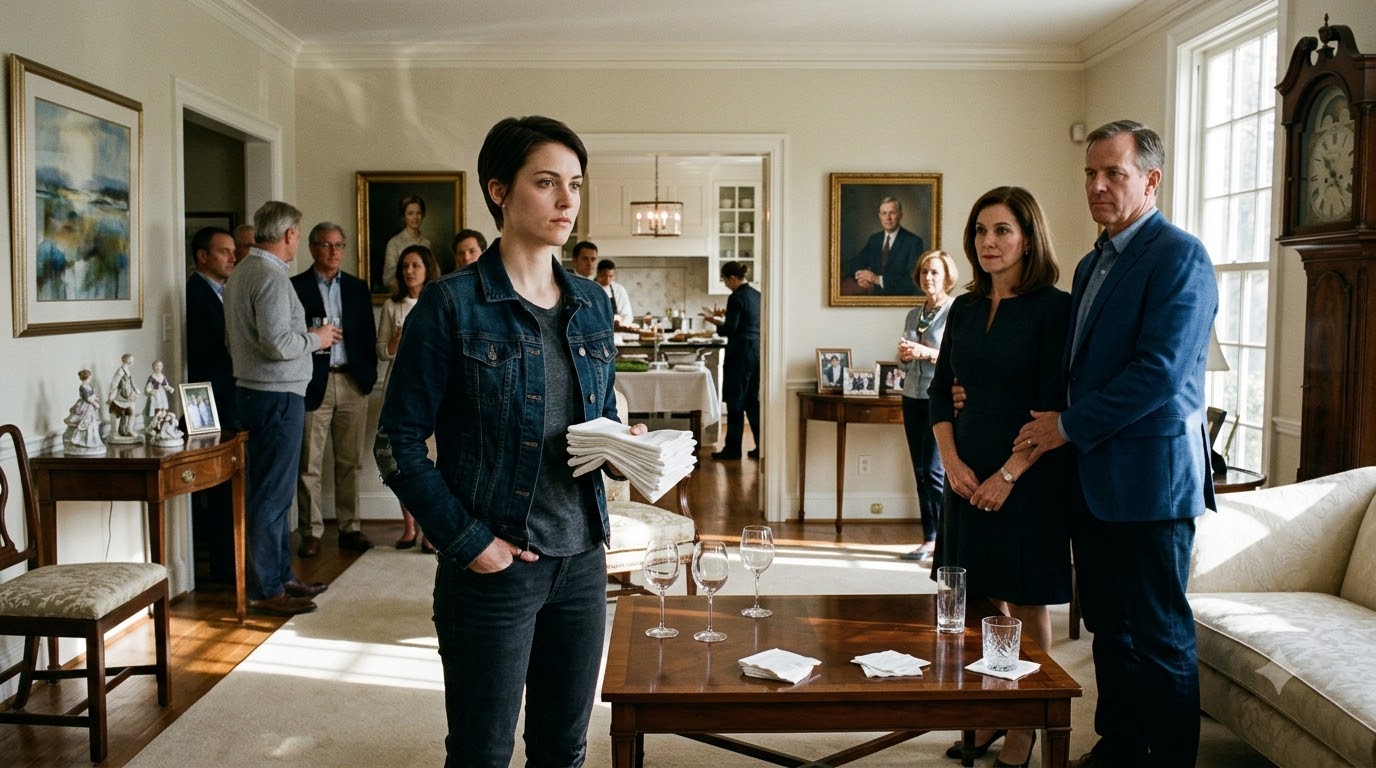
At nine o’clock, my father tapped his fork against his crystal water glass. The ring was rhythmic, commanding the room to settle.
“Forty years,” Harold Dixon announced, his chest expanding beneath his blue blazer. He put his arm around my mother’s waist, drawing a quiet murmur of approval from the neighbors lined along the rug. “Four decades of building a home, a career, and a legacy with these incredible women.”
Megan beamed from the sofa, leaning her head against Derek’s shoulder. I stayed near the doorframe, holding a stack of cloth napkins.
“To mark this milestone,” my father continued, his eyes sweeping the audience, “Patricia and I are taking the whole family to Maui next week. Seven days at the Four Seasons.”
Megan squealed, clapping her hands together. The room broke into a warm wave of applause.
I let out a slow breath, stepping forward half an inch. “What time is the flight, Dad?”
My father’s chin dropped slightly. The warmth drained from his eyes, replaced by the cool, administrative stare he used to give junior tellers at the bank branch.
“You don’t need the flight time, Wendy,” he said, his voice dropping into a low, deliberate register that cut through the remaining claps.
The room went still. A neighbor near the piano lowered his glass.
“I don’t understand,” I said.
“Someone needs to stay behind and manage the house,” my mother added smoothly, smoothing her skirt as if she were explaining a weather report. “Megan and Derek need a real break. Oliver’s ear has been playing up, and Sophie needs her routine. You’ll stay at their house.”
“You’re not coming, Wendy,” my father said, flat and final. “It’s handled.”
Thirty people stood in the space between us. Nobody spoke. Derek looked down at his watch, adjusting his cufflink. Megan picked a piece of lint off her wool dress.
I didn’t drop the napkins. I didn’t raise my voice. I felt the cold barrel of the fountain pen inside my pocket, pressing against my hip as I tightened my grip inside the cloth.
“I see,” I said.
I turned back into the kitchen, the silence of the living room heavy on my shoulders, and set the napkins down beside the cold sink.
CHAPTER 2: COLD ENGINES AND QUIET EXITS
Cold gravel crunched under my boots as I dragged the third heavy suitcase toward the trunk of the Civic.
The streetlamp at the end of the driveway hummed, casting a yellow, sickly light across the hood. At 1:14 AM, the neighborhood was completely dead, every white colonial on the block locked tight against the humid Boston air.
I set the suitcase down, the metal handle snapping back against the hard plastic with a sharp clatter. I froze for a second, my thumb brushing the worn steel fountain pen tucked into my pocket. No lights came on in my parents’ bedroom window upstairs. No curtains twitched.
I lifted the trunk lid, shoved the bag inside alongside my wooden camera box—wrapped safely in a cashmere scarf—and slammed it shut.
My hand rested on the cold steel of the trunk latch for three full seconds. Thirty-two years of being the reliable cushion, the extra set of hands, the person who made sure the china was washed and the toddlers didn’t run into traffic. Gone in three heavy bags and a ten-year-old Japanese sedan.
I climbed into the driver’s seat, pulled the door shut till it clicked, and turned the key.
The engine turned over with a rough, metallic rattle that sounded like a saw hitting plywood in the dead quiet of the street. I didn’t wait for the heater to kick in. I shifted into reverse, backed down the concrete apron, and pulled onto the road without tapping the brakes once.
My phone buzzed against the passenger seat around 3:00 AM somewhere near the New York border.
I didn’t pick it up, but the screen glowed brightly in the dark cabin. Patricia Dixon.
A minute later, the screen lit up again. Megan.
I let the screen go black. I didn’t need to read a text to know what it said. It was always the same vocabulary: unreasonable, selfish, ruining the family plans. They didn’t need Wendy the daughter or Wendy the sister. They needed the unpaid nanny to handle the car seats while they drank mimosas in Maui.
I drove through the night, stopping only for cheap diesel-scented coffee and gas station apples. By the third day, the flat fields of Nebraska gave way to the dry, sun-baked gray of the Southwest. The air coming through the cracked window changed from damp highway exhaust to hot, pine-scented dust.
My back throbbed from forty hours in a saggy vinyl seat. My shoulders felt like two solid blocks of river stone. But every hundred miles the odometer clicked over, a heavy, suffocating weight loosened in my chest.
On the fifth evening, I turned off Highway 1 into Carmel-by-the-Sea.
The coastal fog was rolling in thick over the cypress trees, smelling of wet salt, pine needles, and cold ocean rocks. I pulled the Civic up to the curb outside a two-story shingled building with a hand-lettered wooden sign swaying in the breeze: The Ceramic Cup.
The front porch light flickered on. The screen door creaked open, and Aunt Ruth stepped out into the damp mist wearing a mud-stained denim apron and holding a heavy stoneware mug.
She didn’t ask why my car was caked in three states worth of road grime. She didn’t ask why I looked like I hadn’t slept since Tuesday.
“You’re late,” Ruth said, her voice dry as sandstone, though a small smile tugged at the corner of her mouth. “The room upstairs has a draft, and the coffee machine needs a heavy hand at five in the morning.”
I got out of the car, my knees popping as I stood straight in the cool salt air. “I can handle a coffee machine, Aunt Ruth.”
“Good,” she said, turning back toward the warm light of the shop. “Because tomorrow you meet Marcus Coleman, and he doesn’t hire people who look like they’re still carrying their mother’s laundry.”
CHAPTER 3: THE PRICE OF CLAY AND GLASS
Marcus Coleman adjusted his wire-rimmed glasses, turning the eleventh black-and-white print under the harsh glare of his desk lamp without making a sound.
The back office of Coastal Light Gallery smelled of fresh matting board, solvent, and strong espresso. Outside the frosted glass door, Carmel’s afternoon crowd moved along Ocean Avenue, but inside, the only noise was the crisp drag of heavy paper across felt.
I stood on the worn rug, my portfolio case resting against my shins, my thumb tracing the cold clip of the steel pen in my jacket pocket.
Marcus stopped at a portrait of an elderly janitor sitting on a overturned bucket in a Boston subway station, his hands gray with dust, his eyes fixed on the concrete floor.
“You’re not chasing dramatic lighting,” Marcus said, his voice a low, gravelly baritone that didn’t invite flattery. He didn’t look up from the print. “Most people try to make poverty look heroic or tragic. You just show the weight.”
“He was twenty minutes from finishing an eleven-hour shift,” I said. “Heroic doesn’t pay for bus fare.”
Marcus flipped the print over, setting it on the stack. He leaned back in his leather chair, the springs groaning under his weight, and tapped his knuckles against the desk.
“Ruth says you’re working her espresso machine at dawn and editing these until midnight.”
“It’s a roof and a living,” I replied. “I don’t mind the hours.”
“Good. Because a solo show isn’t a victory lap, Wendy. It’s fifteen finished, framed pieces in six weeks. Production costs come out of my pocket upfront, which means if you choke or miss the deadline, I take the hit.” He reached into his desk drawer and pulled out a two-page agreement, sliding it across the wood along with a heavy brass pen. “Sixty percent to you, forty to the house. You handle the darkroom work; I handle the frame shop and the press.”
I picked up the agreement. My hands didn’t shake, but the print on the page blurred for half a second as I read my name near the top line: Artist: Wendy Dixon.
I signed the bottom line, the black ink soaking into the parchment. No fanfare. No applause. Just a business arrangement signed in a back room that smelled of frame glue.
“Six weeks,” Marcus said, taking the paper back and stamping it with an official gallery seal. “Don’t let your family drama drag into my gallery space.”
“They don’t know where I am,” I said, capping my pen with a clean click. “And even if they did, they don’t care enough to look.”
I walked back to The Ceramic Cup through the ocean mist, my portfolio case significantly lighter.
At five the next morning, I was wiping down the granite steam wand on Ruth’s espresso machine when the back-office printer began to whir. Ruth stepped out from behind the curtain, holding a mug of dark tea, her clay-stained thumb resting against the rim.
“Your mother called the shop line yesterday while you were at the framer’s,” Ruth said plainly, taking a sip.
I didn’t stop wiping the stainless steel. “How did she get this number?”
“She has Google, Wendy. And she knows I’m still alive out here.” Ruth set the mug on the counter with a soft thud. “She told me you were throwing your life away, ruining Megan’s family dynamic, and acting like an ungrateful child.”
“What did you tell her?”
“I told her the coffee was five dollars and the phone line was for paying customers,” Ruth said, a cold, dry flicker of amusement in her eyes. “Then I hung up.”
I looked at the condensation pooling around the base of the grinder. The morning light was just hitting the blue shutters outside, cold and clean.
“She’s going to track it down,” I said quietly.
“Let her,” Ruth replied, turning back toward her pottery wheel. “A woman with that much unearned pride always travels far enough to make a fool of herself in public.”
CHAPTER 4: UNWELCOME SHADOWS IN WHITE SPACE
Standing near the wine bar in the middle of Coastal Light Gallery at 7:40 PM, wearing a plain navy dress while sixty patrons move through the room.
The string quartet in the corner played a low, measured arrangement as laughter drifted across the polished hardwood floors. A small red sticker glowed on the white wall placard next to my bus stop print—Mrs. Peton had bought it twenty minutes into the opening for three thousand dollars cash.
I held my glass of mineral water, feeling the cool condensation pool against my fingers, when the heavy glass front door swung open with a muffled thud against the brass stopper.
Megan came through first in a bright crimson dress that clapped loudly against her heels, her hair freshly blown out. Right behind her was Derek, his charcoal suit jacket unbuttoned, his phone clamped between his ear and shoulder as he barked a quick instruction before snapping it shut.
My mother entered last, wearing her beige Burberry trench coat draped over her arms like an armor plate. My father followed two paces back, adjusting his tie, his gaze sweeping the track lighting with dull disapproval.
Megan spotted me instantly by the centerpiece print. She marched straight through the cluster of local buyers, her face twisted into a practiced expression of urgent relief.
“Wendy!” Megan called out, her voice slicing right through the cellos. “My God, we’ve been looking everywhere for you!”
Several patrons turned, their champagne glasses pausing mid-air. Marcus Coleman glided out from his office doorway, his eyebrows drawn tight as his eyes measured the intrusion.
“Megan,” I said, my voice staying flat and low as she reached me. “This is a private event.”
“Private event?” my mother interjected, stepping into my personal space, her breath smelling faintly of peppermint and airport coffee. “You packed your bags in the dead of night, abandoned your sister with two toddlers, and ran three thousand miles away to play photographer?”
“I live here now, Mom,” I said smoothly, rolling the steel pen in my pocket between my thumb and forefinger.
“You’re coming home, Wendy,” Derek said, stepping forward with his hands planted on his hips, using the exact courtroom posture he used on uncooperative witnesses. “Megan is pregnant with number three. My firm is… we have a tight schedule this quarter. We don’t have time for this childish stunt. You’re needed back in Boston.”
“I am not a household appliance you left running in the kitchen, Derek,” I said, looking him dead in the eye.
“Don’t speak to my husband like that!” Megan snapped, her voice tightening as she noticed Mrs. Peton watching from three feet away. “We offered you a roof! We let you stay in the family circle! And you run off because you didn’t get a resort ticket?”
“I was never on your resort ticket, Megan,” I said calmly. “And I don’t work for your household.”
My father cleared his throat, taking a slow step toward me, his hand reaching out not to touch my shoulder, but to make an authoritative gesture in the air. “Wendy, let’s stop making a scene in front of these people. Put your things together. We have a rental car outside.”
“I have sold four prints tonight, Dad,” I replied, gesturing toward the red dots lining the gallery wall. “I have a contract with this gallery. I am not leaving.”
“Four prints?” my mother scoffed, her lip curling into a bitter smile as she glanced at the wall tags. “Who pays for pictures of old janitors and bus stops? This isn’t real work, Wendy. You’re an accountant who does freelance taxes on the side when we let you!”
“I paid three thousand dollars for that photograph, madam,” Mrs. Peton’s voice cut through the air like a cold blade.
My mother froze mid-breath, her head snapping toward the older woman standing by the wine bar.
CHAPTER 5: THE TRAP OF BLOOD AND LEVERAGE
Mrs. Peton set her champagne glass onto the nearest oak pedestal with a deliberate, metallic click that carried clear across the gallery floor.
My mother’s chin twitched upward, her hands gripping her Burberry trench coat like a shield. She looked at Mrs. Peton’s tailored silk blazer, then down at the three red dots gleaming under the track lights.
“This is a private family matter,” my father interjected, stepping between my mother and the room. He squared his shoulders, using the smooth, low tone he’d used for thirty years to calm angry bank customers. “My daughter has… misconstrued a standard family arrangement. We came here to resolve it like adults.”
“By demanding she quit her job and pack her bags into your car?” Marcus Coleman asked, taking two slow steps forward from his office doorway. He folded his arms across his linen shirt, his eyes locking onto Derek. “You walked in here talking about partners, counselor. I happen to know three senior equity partners at Whitmore and Associates. I wonder what they’d think of a junior attorney spending a Thursday night harassing a represented gallery artist in front of five major West Coast collectors.”
Derek’s face flushed dark red, a knot flexing along his jawline. “We aren’t harassing anyone! My wife is pregnant. We came to ask her sister for support—”
“—You didn’t ask,” I interrupted, stepping directly into the center of the floor, right under the main overhead spotlight. “You didn’t call to ask how my show was going. You didn’t buy a ticket. You showed up because you ran out of free labor.”
“Wendy, that’s enough!” Megan cried out, a loud tear finally spilling over her mascara. “You’re embarrassing Dad! You’re making us look like monsters!”
“You did that yourself the moment you told thirty dinner guests I was staying behind to sweep your porch while you flew to Hawaii,” I said, my voice steady, completely unhurried.
I pulled the steel fountain pen from my pocket, held it between my fingers, and unscrewed the cap with two slow, calculated twists.
“Dad,” I said, looking straight at my father. “You told everyone at the anniversary dinner that family comes first. But when I asked for my flight time, you told me I wasn’t part of the trip. You told me someone had to stay behind.”
My mother’s chest heaved. She looked around the gallery—at the journalist from Carmel Magazine taking notes on a yellow pad, at the silver-haired local collectors whispering behind their programs, at Aunt Ruth standing by the door with her arms crossed.
“You were always so dramatic!” my mother spat, her voice dropping all pretense of maternal warmth, sharpening into raw, exposed desperation. “You think you’re above this family because you hung some pictures on a white wall? Who covered your rent when your little client business stalled three years ago? Who kept a place for you at our table?”
“I paid my own rent, Mom,” I said flatly. “And I did your personal and business accounting for four years without charging you a single dime.”
Derek stepped forward, his eyes darting toward the gallery patrons before settling back on me with desperate malice. “You want to talk accounting, Wendy? Fine. Let’s talk about loyalty. You think this little art hobby makes you independent? You’re nothing without the Dixon name. You leave us stranded with the kids now, and you are cut off completely. No family visits. No safety net. Nothing.”
He thought that was the checkmate. He thought threatening to banish me from a house where I had been invisible would bring me to my knees.
I tightened my grip on the steel pen, feeling the cold metal press hard against my palm.
“Keep the net, Derek,” I said softly. “I’m already standing on my own two feet.”
CHAPTER 6: A LINE DRAWN IN GRANITE
Standing in the silent gallery after the front door clicks shut, holding the unscrewed fountain pen while Marcus and Aunt Ruth look on.
The heavy glass door swung shut on its hydraulic arm, sealing out the hum of Ocean Avenue. Outside, the headlights of my father’s rental car cut through the thick coastal fog as he pulled away from the curb, leaving a trail of gray exhaust hanging over the asphalt.
My mother hadn’t said goodbye. Megan had covered her face as Derek shoved her into the back seat, his jaw locked tight against the stares of the four local buyers who still stood near the wine bar.
Marcus screwed the cap back onto his brass pen and set the sales ledger onto his desk. “Four prints sold,” he said quietly, his voice cutting through the remaining tension. “Eight thousand four hundred dollars total. Your check will be ready on Tuesday.”
“Thank you, Marcus,” I said, carefully aligning the steel cap onto my fountain pen until the thread locked with a solid, metallic snap.
I didn’t feel a rush of wild triumph. I didn’t feel like celebrating with champagne. What I felt was a deep, cool stillness, like a long-dormant engine finally turning off after days of grinding gears.
Aunt Ruth stepped beside me, resting a hand lightly on my shoulder. Her palm was rough, smelling faintly of damp clay and lavender soap. “They won’t come back, Wendy,” she said softly. “People like your mother only go where they can command the room. They don’t visit places where they have to listen.”
“I know,” I said. “That’s why I’m staying.”
We locked the front doors at nine. The string quartet packed their cello cases, the bartender cleared the last of the crystal flutes, and the lights went down to low showcase spots shining directly on the dark-framed prints along the white plaster walls.
I didn’t drive back to Boston. I didn’t send a long text explaining my feelings or looking for an apology that would never come. I knew how the math worked now: some accounts stay permanently unadjusted, and the healthiest choice is to close the book.
At 5:30 the next morning, the coastal sun was barely breaking through the Monterey pines, casting long blue shadows across the damp pavement of Ocean Avenue.
I tied a plain canvas apron around my waist—the blue one embroidered with The Ceramic Cup—and turned the brass valve on the espresso machine. The boiler hummed to life, filling the small front shop with the rich, bitter scent of dark roast and fresh steam.
Outside the window, my ten-year-old Honda Civic sat parked along the curb under a sprawling cypress tree, its hood covered in a fine layer of ocean salt.
It wasn’t parked in a prime driveway. It wasn’t driving through Maui. But it was paid for, the keys were in my pocket, and nobody was standing at the door telling me to move it.
I picked up a warm porcelain mug, poured a double shot of espresso, and sat down at the small wooden table by the front window to watch the town wake up.