The Weight of Iron and Stars: Colonel Keane’s Final Defense of a Forgotten Legacy
CHAPTER 1: THE LEDGER OF DUST
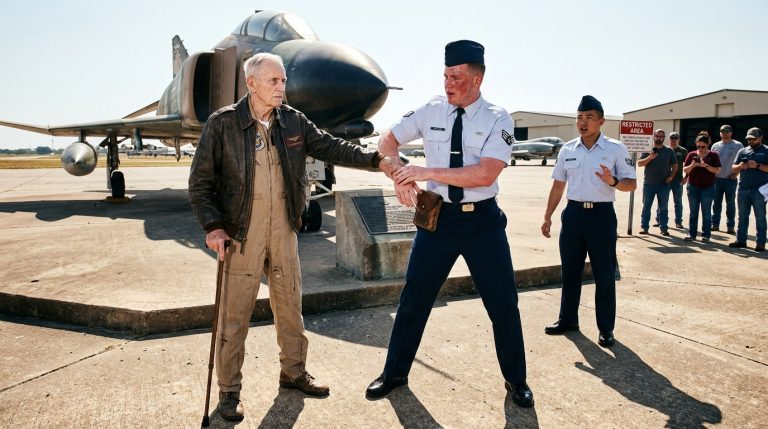
The air in the Summit Ridge National Bank tasted of stale ozone and floor wax, a scent that had no business being in a place built on top of a command center. Bobby Keane stood at the counter, his knuckles white against the dark wood. He didn’t look like a soldier; he looked like a man made of old parchment and granite, holding his breath as the girl behind the glass tapped a rhythm into her keyboard that felt entirely too fast.
“Sir, this record is showing as inactive,” the teller said. Her voice was flat, practiced, lacking the friction of human concern. She flicked her eyes toward the manager’s office, where Kaden was currently hovering like a bird of prey. “These systems don’t just stay open for… for what you’re describing.”
Bobby kept his gaze fixed on the brass challenge coin sitting in his palm. It was heavy, the Thunderbird emblem worn smooth by his thumb over decades of cold, sleepless nights. “The account was tied to a land-use trust,” he said, his voice low, gravelly, and steady. “Infrastructure maintenance for the Summit Ridge site. It doesn’t expire unless the land is repurposed or the foundation is compromised.”
Kaden arrived then, his loafers silent on the carpet. He didn’t bother with a greeting. He looked at the screen, then at the faded discharge papers Bobby had laid out, and let out a huff of air that suggested he was wasting time.
“Sir, we’ve moved past the era of paper trust funds,” Kaden said, his fingers drumming on the counter. “Whatever this was, it’s been archived. You’re trying to withdraw from a ghost file.”
“It’s not a ghost,” Bobby replied. He didn’t raise his voice. He didn’t need to. He slid the brass coin across the surface of the counter. It hit the wood with a hollow, metallic clack that seemed to vibrate through the entire teller line. “Check the internal registry under ‘Bishop Clearance.’ That will bridge the gap.”
Kaden glanced at the coin as if it were a common plastic toy found in a cereal box. He didn’t touch it. “Cute. You want me to call security because you’re having trouble letting go of the past?”
Bobby looked past Kaden, toward the plaque on the wall—the one with his name engraved in steel that refused to rust. He felt the phantom ache in his shoulder, the one that only flared when the humidity dropped, and he knew something was wrong. The air in the bank wasn’t just cold; it was thin, as if the oxygen were being pulled out to feed the machines humming behind the walls.
“I’m not looking for trouble,” Bobby said, his eyes locking onto Kaden’s, a look that stopped the manager mid-sneer. “I’m looking for the ledger. The original one.”
Kaden blinked. For a split second, the professional mask slipped, revealing a flicker of genuine, startled confusion. “What ledger?”
Bobby felt the chill run up his spine. The man didn’t know. Or worse, he knew exactly what had been erased, and he was counting on Bobby not knowing that it was gone.
CHAPTER 2: THE GENERALS SHADOW
The silence in the bank didn’t just linger; it solidified, settling over the lobby like a fine layer of gray dust. Kaden had turned his back, his stride brisk and dismissive, but the air remained charged, buzzing with the latent, low-frequency hum of the building’s heavy HVAC system. Bobby didn’t look at the manager’s retreating heels. He kept his eyes on the coin, the Thunderbird engraving catching a shaft of fluorescent light that felt too clinical, too bright.
His fingers, slightly stiff from the sudden drop in temperature, hovered over the brass surface. He hadn’t expected the ledger to be sitting out, but he hadn’t expected it to be purged, either. When the bank went civilian, the promise had been clear: infrastructure records were to be held in perpetuity, a baseline for the land’s stability. To claim they were “archived” was a lie of the highest order.
A soft, rhythmic thud echoed from the front entrance. It wasn’t the tentative shuffle of a customer or the aggressive snap of a guard’s boot. It was measured. Deliberate. The heavy glass doors didn’t swing; they groaned against the resistance of the pressure differential, then surrendered.
Bobby didn’t turn around, but he felt the atmosphere shift. The humidity in the room dropped, replaced by the sterile, crisp scent of starch and pressed wool. The humming of the overhead vents suddenly cut out, as if the building itself had been shocked into silence by the arrival.
“Colonel.”
The voice was like a gavel strike. Bobby slowly straightened, his spine clicking in protest, and turned. General Everett Kain stood ten feet away. He was a monument of rigid geometry in his dress uniform, every ribbon a stark, colorful smear against the charcoal-gray lobby. Behind him, an aide trailed like a silent shadow, clutching a briefcase that looked as if it contained the weight of the entire regional command.
Bobby stood his ground. He didn’t offer a salute—not yet. He simply tilted his head, acknowledging the gravity of the man’s presence. “General. You’re a long way from the district office.”
Kain walked forward, his eyes scanning the space with the predatory efficiency of a man who counted terrain, resources, and liabilities in his sleep. When his gaze landed on the teller counter, his lip curled almost imperceptibly. “I heard a whisper that someone had lost their way inside this building. I came to see if they needed a map.”
“They don’t want a map,” Bobby said, his voice a low grind of iron on stone. “They want the foundation gone. They’re scrubbing the records, Everett. They’re claiming the site trust is a ghost.”
Kain’s expression remained a mask of practiced neutrality, but his eyes flickered toward Kaden’s retreating figure. “This isn’t just about a bank account, is it? You’re looking for the structural blueprints.”
“I’m looking for the ledger,” Bobby corrected. “The one that marks the chemical drainage zones.”
The bank’s lights flickered once, twice, and then hummed back to life with a sudden, violent intensity. The cooling system roared back on, blowing a frigid current of air across the room. Bobby watched a small, loose thread on his coat sleeve whip in the artificial gale. He was being watched. Not just by the General, but by the cameras tucked into the corners of the ceiling, their red apertures blinking with mechanical indifference.
“They won’t let you near the basement records, Colonel,” Kain said, his voice dropping to a near-whisper that didn’t travel past the reach of their shadows. “Not without a level of clearance that doesn’t exist on their civilian servers. If you force the issue, you make yourself a target for the board.”
“I’ve been a target since the day I signed the commission,” Bobby replied. He reached out and tucked the brass coin into his pocket, his movements deliberate. “You didn’t come here to offer me a ride home, General. Why are you here?”
Kain looked at the wall, at the plaque that had been his own anchor for so many years. “Because,” he said, his tone turning colder, sharper, “if that ledger is unearthed, it won’t just be the bank’s reputation that collapses. It will be the entire jurisdiction of this district. And I am not going to let this region fall because some mid-level manager decided to delete history to save a few pennies on the quarterly audit.”
Bobby studied the General. There was a frantic edge to the man’s precision—a desperate need to maintain order that bordered on obsession. “You’re not here to help me, are you? You’re here to secure the perimeter.”
“I’m here to ensure the truth stays buried until we can manage the fallout,” Kain countered. “Don’t mistake my presence for an alliance.”
Bobby felt the cold of the floor seeping through his soles. He was alone in this room, standing between a man who wanted the truth erased and a man who wanted it silenced. And for the first time in years, the old ache in his shoulder felt like a warning.
CHAPTER 3: THE LEDGER OF DUST
The chime of the bank’s automatic doors announced another customer—a distracted businessman clutching a briefcase—but Bobby didn’t turn. He remained rooted in the spot where the General had stood, the lingering ozone of the HVAC system’s discharge still stinging his nostrils. The General was gone, vanished into the humid afternoon with the same calculated efficiency that had brought him in, leaving behind a wake of professional silence that felt entirely too curated.
Bobby walked slowly toward the self-service terminal near the lobby’s eastern wall, a sleek, touch-sensitive pillar of glass and steel that looked utterly alien against the building’s original, heavy-set stone columns. His hands, though steady, felt the tremor of age that he usually managed to suppress. He needed to verify the status of the trust fund before the systems could be cycled for the evening. If the lien records were being scrubbed, there would be a digital footprint, a trace of access logs that no manager could entirely wipe.
He tapped the screen. It blinked with a soft, inviting blue light. He entered the authorization code—an old, alphanumeric string that had remained unchanged for forty years, a relic of a time when security was built on trust rather than encryption.
Access Denied.
He tried again, his finger hovering over the glass. He keyed in the secondary protocol—the “Bishop” sequence that had unlocked the supply lines in the late eighties. The screen hung for a moment, the interface stuttering as if struggling to reconcile the archaic command with its modern, sanitized software. Then, the blue light bled into a harsh, warning red.
Account Not Found.
Bobby pulled his hand back as if the screen had scorched him. He looked around the lobby. The teller who had laughed at him earlier was now focused intensely on her own terminal, her posture rigid, shoulders hunched forward. She wasn’t processing deposits; she was deleting something. He could see the rhythm of her keystrokes—too fast, too rhythmic. She was clearing caches.
He moved toward the back office, his boots making no sound on the heavy carpet. He didn’t have the clearance to enter the sanctum of the management wing, but he didn’t need to. Through the narrow glass slit in the door, he saw Kaden. The manager wasn’t sitting at his desk. He was hunched over a server cabinet, his tie slung over his shoulder, his hands busy with a series of hard drives. He was pulling them, one by one, and sliding them into a shielded transport case.
The realization settled in Bobby’s gut, cold and absolute. This wasn’t a bureaucratic error. It was a structural dismantling. The bank was undergoing a physical migration of data, and they were taking the physical evidence of the land’s original survey—the drainage maps, the chemical site markers, the entire history of the command base—and moving it to a location that would never appear on a public server.
Bobby turned away, forcing himself to walk with the same steady, measured pace he had used to enter the building. He didn’t want to alert the guard stationed near the exit, who was now watching him with renewed suspicion, hand hovering near the radio on his belt.
As he reached the exit, a floor tile near the lobby’s information kiosk caught his eye. It was shifted, the mortar around it crumbling into a fine, reddish powder. He knelt, pretending to adjust his cane, and pressed his fingers against the stone. It felt loose. Below it, there was a hollow, echoing vibration—the signature of an older, deeper cavity that predated the bank’s foundation.
He glanced up. The security camera above the kiosk was pivoting toward him, its lens clicking as it struggled to auto-focus on the old man crouching on the floor. Bobby stood, his knees cracking, and felt the weight of the brass coin in his pocket. It wasn’t just a symbol of rank anymore; it was the only key left to a vault that hadn’t been touched in forty years.
He pushed through the front doors, stepping out into the blinding, unfiltered light of the street. The air outside was thick with the scent of hot asphalt and dry earth. He didn’t head for his car. He stopped at the edge of the sidewalk, watching the reflection of the bank in the glass of a neighboring storefront. The building looked solid, immovable, but from this angle, he could see the slight lean in its western facade—the subtle, structural fatigue of a foundation that was being poisoned from within.
He had expected to find a ledger. Instead, he had found a crime in progress. And the more he watched, the more he realized that the General hadn’t left because he was finished; he had left to ensure that when the bank finally collapsed, the evidence of what lay beneath it would be buried with the debris.
CHAPTER 4: THE MEETING IN THE RAIN
The rain began as a thin, gray mist, turning the dry asphalt into a slick, obsidian mirror. Bobby didn’t reach for an umbrella. He tucked his hands into the pockets of his coat, the fabric heavy and damp, and turned away from the bank’s storefront. The General had left, but the weight of his presence remained. Bobby felt it in the way the street seemed to clear of pedestrians, in the way the black sedan idling at the intersection kept its headlights dimmed, watchful.
He walked toward the older district, where the architecture shifted from the sanitized glass of corporate finance to the brick and iron of the city’s industrial roots. His destination was a small, sheltered transit hub, a relic of the old command infrastructure that sat half-forgotten behind a derelict warehouse.
As he turned the corner into the alley, the scent of stagnant water and cold rust flooded his senses. He didn’t look behind him, but he heard the distinct, rhythmic click of heels on wet pavement—too precise to be a passerby, too measured to be a threat. He stopped near a support pillar covered in layers of weathered, peeling paint.
“You’re putting yourself in the crosshairs, Colonel.”
The voice didn’t come from behind him. It came from the shadows of the transit hub. General Everett Kain stepped out, his dress uniform covered by a heavy, civilian-grade trench coat that looked completely out of place on his rigid frame. He held a small, black umbrella, but he didn’t open it.
Bobby turned, his movements slow, his joints aching in the damp air. “The bank isn’t just erasing records, Everett. They’re tearing out the foundation. You know what’s buried under that slab.”
Kain’s expression tightened. He looked away, his gaze tracking the progress of a rain-heavy cloud passing over the city skyline. “I know that if those records surface, the entire regional pact dissolves. The civilian stakeholders who bought that land… they didn’t know the soil was compromised. And if they find out, they won’t just sue. They’ll burn the history books to hide their own negligence.”
“And you’re the one holding the match,” Bobby said.
The General took a step forward, his boots squelching in the mud. “I am the one trying to prevent a mass panic. You think you’re fighting for truth? You’re fighting for a ghost that doesn’t want to be found.”
A flash of memory hit Bobby with the force of a physical blow—the original survey of the Summit Ridge site, the orange flags marking the containment zones, the way the earth had tasted like copper and burning salt. It was a phantom scent, sharp and intrusive, pulling him back to a time when his orders were absolute and his conscience was clear. He suppressed it, focusing on the cold iron of the pillar against his palm.
“I’m fighting for the integrity of the ground we stand on,” Bobby said. “If the bank goes through with this, they aren’t just erasing me. They’re erasing the cost of everything we did to build this city.”
Kain sighed, a sound of profound, weary exhaustion. He reached into his pocket and produced a small, encrypted data drive, pressing it into Bobby’s hand. “This is the shadow server access. It’s not the ledger, but it contains the original land-use manifests. Kaden doesn’t know it exists; he thinks he’s only moving the digital copies. Take it, and leave the city before the auditors get here.”
Bobby looked at the drive. It was cold, metallic, and heavy. “Why?”
“Because,” the General said, his voice dropping until it was barely audible over the patter of the rain, “I’m tired of lying to the families who still live on that land. But if you try to make this public, I won’t be able to protect you. I’ll have to categorize you as an unstable element.”
Bobby looked at the man he had once trained, noting the deep lines around his eyes, the hollow look of a leader who had traded his soul for the stability of his district. They were both ghosts, lingering in a world that had moved on, trying to secure a legacy that was already crumbling into dust.
“I didn’t come here for protection,” Bobby said.
“I know,” Kain replied. “That’s what makes you so dangerous.”
The General turned and walked back into the darkness of the transit hub, leaving Bobby alone in the alley. The rain continued to fall, washing away the grit of the city, but the cold remained, a permanent fixture in the marrow of his bones. He slipped the drive into his pocket, his mind already mapping the path back to the bank’s maintenance entrance. He knew now that the battle wasn’t against the bank manager; it was against the infrastructure itself, and he only had until dawn to pull the truth out of the dark before it was erased forever.
CHAPTER 5: THE ARCHITECTURAL VULNERABILITY
Bobby lingered in the dark of the alley for several moments after the General had vanished, the silence only punctuated by the rhythmic dripping of rain from a rusted fire escape. The data drive in his pocket was a quiet, compact promise of leverage, but it was useless if he couldn’t interface it with the bank’s internal network. The terminal in the lobby was a decoy, a glass-and-steel facade designed to keep the curious at arm’s length. The real gateway to the building’s infrastructure lay in the service tunnel—a relic from when the bank was the command center’s primary logistics hub.
He moved with a quiet, practiced deliberation, keeping his back against the damp brickwork of the warehouse. His shoulder throbbed with every step, a dull, insistent reminder of the years that had passed since he last moved through such narrow, unlit spaces. The air here was thicker, stagnant, smelling of wet earth and the sharp, chemical tang of the old remediation efforts.
He reached the heavy steel door of the service entrance. It was locked, of course, but the locking mechanism was a mechanical deadlock, not an electronic one. It was a holdover from the era of heavy infrastructure, designed to withstand physical force rather than digital bypass. Bobby knelt, his fingers finding the seam between the door and the frame. He didn’t have the tools a younger man might carry, but he didn’t need them. He knew where the rust had eaten into the internal bolts.
He applied steady, rhythmic pressure to the lower corner of the door, listening for the faint, hollow groan of protesting metal. He wasn’t forcing the lock; he was testing the structural decay. With a soft, metallic snap, the internal bolt gave way, the door swinging inward just enough for him to slip through.
The space inside was a labyrinth of concrete pipes and heavy-gauge cables. The light here was non-existent, save for the faint, filtered amber glow of emergency markers flickering far above. Bobby stood still, his heart rate steady, his eyes adjusting to the gloom. The hum of the bank’s central climate control was louder here, a deep, rhythmic vibration that resonated through the concrete floor.
He pulled a small, pen-sized flashlight from his coat, the beam cutting through the dust-choked air. He followed the path he remembered—the crawlspace beneath the central teller line. As he navigated the tight, claustrophobic tunnel, the memories of the site’s original construction flooded back: the way the foundation had been poured, the reinforced barriers meant to contain the chemical waste from the command’s early testing, and the fact that the entire bank was built atop a literal burial ground of hazardous material.
His flashlight beam settled on a junction box mounted to the damp concrete wall. This was it—the master interface for the building’s security and internal data network. It was here that Kaden’s team would be rerouting the archives before permanently deleting them.
Bobby took out the data drive the General had given him. He carefully opened the junction box, exposing a cluster of old-world copper wiring interwoven with modern fiber-optic cabling. The integration was clumsy, a messy testament to the bank’s rapid, careless modernization. As he prepared to interface the drive, a sharp, metallic screech echoed through the tunnel—the sound of a heavy door opening far above.
He froze. The footsteps that followed were not the casual pace of a night guard; they were hurried, heavy, and directed. Someone was coming down the service stairwell.
Bobby didn’t panic. He tucked himself into the shadow of a support column, the data drive gripped tightly in his palm. His breathing slowed to a rhythmic, almost meditative pace. He wasn’t just a trespasser; he was an architect of this space, and he knew every blind spot, every acoustic trap. As the light from a tactical flashlight swept over the concrete floor, Bobby watched the reflection, tracking the movement of his adversary. He realized then that the decoy secret of the liens was only the tip of the spear; the bank wasn’t just hiding paperwork, they were preparing to trigger a structural collapse of the service tunnels to ensure that the chemical contamination beneath would never be excavated. The bank was a grave, and Kaden was the undertaker.
CHAPTER 6: THE DIGITAL SIEGE
Bobby didn’t move. He kept his gaze fixed on the shadow of the support column, his muscles coiled, ready to surge into the dark if the light flickered any closer. The footsteps—heavy, rhythmic—stopped just ten feet away. He could hear the low, mechanical whine of a handheld drive-wiper, a sound that grated against the silence of the service tunnel. Kaden was here.
“I know you’re in here, Keane,” Kaden’s voice wasn’t loud, but it bounced off the concrete walls with a jagged, nervous energy. “The security protocols didn’t just throw an error; they flagged a manual override. You’re playing a game that ended forty years ago.”
Bobby stayed in the dark. He watched as the beam of Kaden’s light cut through the dust, searching the nooks of the maintenance crawlspace. He could see the manager’s profile now—he looked frazzled, his tie undone, his eyes wide and darting, fueled by a frantic, sweating desperation. He wasn’t just clearing data; he was trying to hide a massive, systematic theft of property liens that would collapse the bank’s standing in the upcoming regional audit.
Bobby shifted his weight, his boot sliding across the concrete with a tiny, sharp rasp.
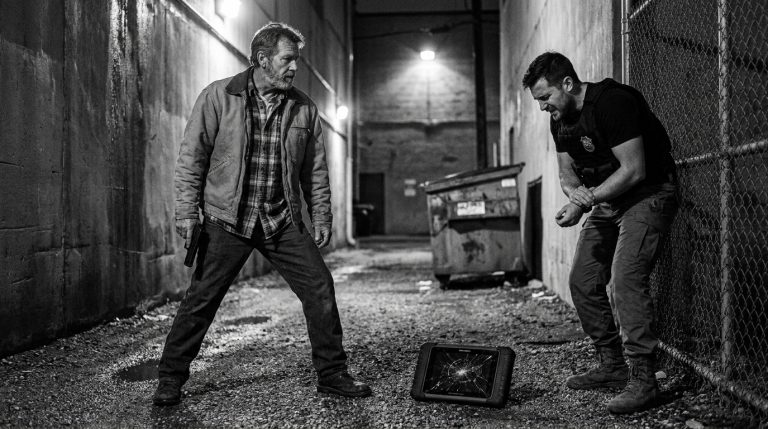
Kaden pivoted instantly, the light snapping toward the column. Bobby didn’t flinch. He stayed low, watching through the gap in the pipes. He saw the manager reach into his jacket—not for a weapon, but for a tablet that was tethered to the main server hub above. Kaden wasn’t looking for an intruder; he was looking to initiate a remote lockdown of the entire tunnel system. If he hit the switch, the bank would seal off the maintenance access, trapping Bobby in a tomb of his own history.
Bobby didn’t wait. He moved.
He lunged from the shadow of the column, not toward Kaden, but toward the exposed wiring of the server junction box he had been prepping. He jammed the General’s data drive into the copper interface, the metal teeth of the connector biting into the aging hardware.
“Don’t!” Kaden screamed, lunging forward.
Bobby didn’t try to fight. He let his momentum carry him into the side of the junction box, bracing his shoulder against the conduit. The drive clicked into place. A series of green lights, dim and flickering, flared into life on the panel. Data began to stream, the rapid-fire thrum of the drive sounding like a heartbeat in the confined space.
Kaden crashed into him, the impact driving the air from Bobby’s lungs. They tumbled across the concrete, a tangle of limbs and desperate, gasping breath. Kaden’s flashlight rolled away, its beam spinning wildly across the ceiling, illuminating the rusted pipes and the thick, black cables that carried the lifeblood of the building’s network.
Bobby shoved Kaden away, his movements economical, calculated. He didn’t use force; he used the environment, tripping Kaden against a low-hanging steam pipe. The manager grunted, sliding down to the floor, his hands scrambling for the tablet he had dropped.
“You don’t understand,” Kaden spat, his voice cracking. “The ground here is unstable. It’s not just a business. We’re trying to prevent a total containment failure. If the regulators find out what’s actually buried under the concrete, the whole block goes black.”
Bobby paused, the data drive still pulsing with amber light behind him. “You’re not saving the bank, Kaden. You’re trying to dump the liability on the next owner.”
“There is no next owner!” Kaden shouted, struggling to his feet. “The site is flagged for total demolition. That’s why the records are being scrubbed. We’re just the ones cleaning up the mess.”
Bobby looked at the junction box. The amber light turned a steady, solid green. The upload was complete. The General’s drive had just mapped the entire chemical site, linking it directly to the bank’s current financial assets. It was no longer a ghost file; it was an active, undeniable liability.
Kaden lunged for the server cabinet, but the alarm had already tripped. A deep, low-frequency siren began to wail, vibrating through the very walls of the building. The digital siege wasn’t just a battle for records anymore—it was a beacon, and the entire city’s audit team was about to have its eyes opened to the truth hidden beneath the floor.
CHAPTER 7: THE UNEARTHING
The sound of the alarm was a physical presence, a vibrating pressure that pressed against Bobby’s eardrums. He didn’t waste time watching the data transfer complete; he snatched the drive from the junction box and bolted for the service tunnel’s main conduit. Above him, he heard the frantic shouting of the bank’s security team. Kaden was howling orders, his voice distant but rising in a panicked crescendo.
Bobby ran, his lungs burning with the sharp, acrid scent of ozone and old, undisturbed dust. The tunnels were a maze of claustrophobic concrete and tangled pipes, but he moved with the memory of a man who had mapped this terrain before the first stone was laid. He ducked under a hanging bundle of high-voltage cables, his coat snagging on a rusted bracket, the fabric tearing with a sound like a gunshot in the confined space. He didn’t stop.
The tunnel began to shake. It wasn’t the sirens—it was the building. Kaden had triggered the site’s self-contained containment protocol, an archaic safety measure meant to seal the basement in the event of a chemical leak. The massive, hydraulic-driven blast doors at the end of the corridor were grinding closed, sparks showering from the tracks as iron fought iron.
Bobby threw himself forward, sliding across the slick, grease-stained concrete as the gap narrowed. He felt the cold iron of the door brush against his heel, the sound of metal shearing vibrating through his bones. He rolled out into the secondary maintenance sub-level, his breath coming in ragged, painful gasps. He was behind the seal now, in the guts of the bank where the real foundation sat.
The air here was different—heavy, metallic, and deathly still. He pushed himself to his feet, his cane clattering against the floor. He didn’t need a flashlight anymore. A faint, bioluminescent glow seeped from the fissures in the wall, a residue of the very contamination they had tried to bury.
He moved toward the center of the chamber, where the structural load-bearing pillar was anchored. It was a massive, cylindrical monolith of poured concrete, scarred by time and the encroaching rust of the tunnel’s iron skeleton. He traced the surface, his fingers finding the seam he remembered—the access panel that contained the final, unedited surveys of the site’s original chemical footprint.
He felt a sudden, dizzying wave of vertigo. A memory, unbidden and sharp: he was back in the uniform, the smell of burnt salt in his nose, watching the men in white suits frantically pouring concrete over the cracked earth. It hadn’t been a leak; it was a disposal. The bank wasn’t just built on a foundation; it was built on a crime.
A voice cut through the dark—not Kaden’s, but colder, more precise.
“I told you it was a ghost, Colonel.”
Bobby turned. General Kain stood near the entrance of the sub-level, his dress uniform pristine, his eyes reflecting the dull, sickly light of the containment chamber. He held a handgun, his stance professional, balanced, and utterly devoid of malice. He looked like a man performing an unpleasant, but necessary, duty.
“You weren’t supposed to find the internal survey,” Kain said. “The digital drive you uploaded? It was a decoy. A secondary ping that triggered the lockdown, not the revelation.”
Bobby looked at the drive in his hand, then back at the General. The truth snapped into focus. The General wasn’t here to protect the region; he was here to finish the job that began forty years ago.
“The bank isn’t the liability,” Bobby said, his voice steady despite the adrenaline surging through him. “You are.”
“We all are,” Kain replied. He stepped forward, his boots quiet on the concrete. “But some of us know how to keep the peace. Now, set the drive on the floor and step away from the pillar. We can end this quietly, Bobby. Like soldiers.”
Bobby stood his ground. He looked at the pillar, the cracked concrete, and the light leaking out of the fissures. He was tired. His shoulder burned, and his lungs felt heavy with the dust of a dead war. But he had come here to keep a promise, and he wasn’t about to break it for a man who had long since traded his honor for a title.
He felt the cold, hard weight of the brass coin in his pocket. It was time to settle the debt.
CHAPTER 8: THE SILENT EQUILIBRIUM
Bobby didn’t flinch. He looked at the General—not as a superior officer, not as an antagonist, but as a man who had spent forty years running from the same shadow that now filled the room. Bobby’s hand moved, not toward his cane, but toward his coat pocket. He pulled out the brass coin, the Thunderbird emblem glinting in the sickly bioluminescent light of the fissures.
“You think this is about orders,” Bobby said, his voice steady, carrying the weight of a lifetime spent keeping faith with the dead. “You think you’re containing a leak. But you’re just burying the evidence of your own failure, Everett. The contamination didn’t happen because of a lapse in protocol. It happened because you authorized the shortcut to keep the project on budget.”
Kain’s face went rigid. The pistol wavered, just a fraction of an inch. “I did what was necessary for the sector’s survival. If the truth had come out, the entire base would have been shuttered. Hundreds of families would have lost their livelihoods.”
“And instead, you poisoned the ground they walked on,” Bobby replied. He stepped forward, his boots crunching on the loose gravel of the chamber floor. “The survey didn’t disappear. I kept the original blueprints. I’ve had them for years, waiting for the moment when someone would try to sell this land for parts.”
Kain blinked. The realization shattered his composure. He hadn’t been fighting a desperate man; he had been fighting a witness who had been prepared for this outcome since the day the base closed. The General’s eyes darted toward the server panel, where the amber light had finally stabilized into a steady, pulsing glow. The network was streaming; the truth was being broadcast to every terminal the General had tried to insulate.
The sounds of the building shifted—the heavy thud of tactical teams breaching the lobby doors above, the sharp, authoritative commands of state auditors. The leverage had shifted. The bank was no longer a fortress; it was a crime scene.
Kain lowered the pistol. His shoulders slumped, the weight of his rank and his secret suddenly too heavy to carry. He looked around the chamber, at the damp, weeping walls, and the raw, exposed earth of the site he had spent decades trying to forget. The arrogance of the man had vanished, replaced by the hollow realization that his reputation was gone, and the ground he had protected was no longer his to command.
“You’ve destroyed everything,” Kain whispered.
“I’ve restored the balance,” Bobby said.
The General dropped the pistol. It landed with a dull, heavy thud in the dust. He didn’t wait for the auditors. He turned and walked into the darkness of the maintenance tunnel, a ghost retreating into the shadows of the history he had tried so hard to delete. Bobby let him go. The General wasn’t the target; the truth was.
Minutes later, the emergency doors were forced open from the other side. Men in protective gear and dark suits swarmed the sub-level, their lights blinding, their voices clipped and urgent. Bobby stood still, the brass coin still held tight in his hand. He watched as they took the server panels, the drives, and the mapped data—the evidence of a long-buried wrong that was now, finally, coming to light.
He walked out into the cool night air. The rain had stopped, leaving the city shimmering under the streetlights. He returned to the lobby, where the bank’s staff were being ushered out by the authorities. Kaden was being led away in handcuffs, his expensive suit rumpled, his face a portrait of complete, uncomprehending shock. Bobby walked past him, a quiet, forgotten figure, and headed toward his truck parked down the street.
The next morning, the bank remained closed. The plaque on the wall—the one that had borne his name—had been removed, leaving a square of clean, unblemished stone. Bobby stopped at the site one last time. He reached into his pocket, took out the velvet box General Kain had given him earlier, and placed it atop the pedestal where the bank’s commemorative monument had once stood. It was a simple, silent act of restitution.
He sat on the bench by the window, the same one where he had waited for the world to notice him, and watched the dawn break over the skyline. His shoulder felt better. The air was clear. He had kept his word to the men he served with, and he had finally closed the door on a past that had never truly stopped haunting the living.
He didn’t wait for the city to recognize him. He started his truck, the engine turning over with a steady, reliable rhythm, and drove away from the site of his final defense. He was just an old man going home, but as he pulled out into the morning traffic, the silence in the cab was no longer heavy. It was clean. It was the silence of a man who had finally earned his rest.