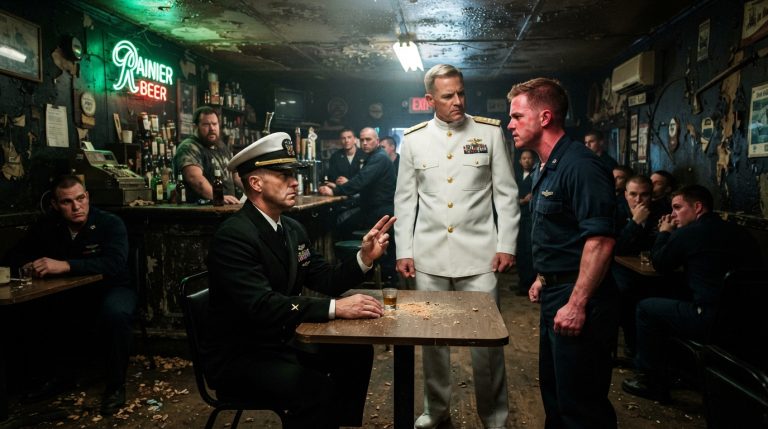
The Iron Balance: A Deep Cover Procedural of Institutional Friction and Shattered Sovereign Lines
CHAPTER 1: THE FRICTION OF ALIGNMENT
The air in the canteen smelled of stale vegetable shortening and the distinctive, bitter tang of low-grade floor wax that had been scorched by the heavy boots of two hundred infantrymen. It was 19:42 on a dry Friday evening, and the overhead fluorescent tubes were cycling with a low, sixty-cycle hum that vibrated straight through the fillings of Sergeant Derek Callahan’s teeth. He stood three inches from the edge of the linoleum serving counter, his olive-drab undershirt dark with grease at the armpits, his eyes fixed on the small woman who had just placed a dented metal tray onto the checkout rail.
Victoria Brennan did not look up. Her fingers, small and pale against the unpolished aluminum of the tray, remained wrapped around a paper napkin that had already begun to fray at the perforated edges under the damp pressure of her thumb. Her oversized field jacket smelled of long-term storage—mothballs, dry rot, and the zinc-heavy scent of military-grade waterproofing compound that had dried out twenty winters ago. Underneath the stiff canvas collar, her hair was gathered into a loose, non-regulation bun held together by a single plastic clip that had begun to split down the center seam.
“I asked you a question, civilian,” Callahan said. The volume wasn’t high, but it had the flat, heavy delivery of a non-commissioned officer who knew exactly how many square feet of concrete he controlled. Around the nearest formica table, four members of the elite infantry squad stopped chewing their bread. The rhythmic clink of heavy forks against heavy ceramic plates died out in a ten-foot radius, leaving only the dry rattle of the ventilation fan in the kitchen behind them.
Two feet away, Captain Ethan Drake sat in the shadow of the vending machines, his thumb resting flat against the edge of a folded newspaper. Beneath the cheap wood-pulp paper, his left index finger pressed a brass toggle switch built into the seam of his heavy utility coat. A tiny, dual-diaphragm microphone inside his lapel clicked once as the recording circuit stabilized, tracking the amplitude of the room’s sudden silence. His eyes stayed on the scuff marks at the base of Victoria’s boots. The leather was split near the steel toe-cap, revealing a dull glint of oxidized iron beneath the black polish.
“The orders,” Victoria said. Her voice lacked the projection required for a standard reporting protocol. It was thin, slightly husky from the dry desert air outside the gates, and it stayed low, down near the floorboards where the grease had pooled in the joints. “They’re verified at the main gate. Post assignment four.”
Lieutenant Angela Pierce stepped out from behind Callahan’s shoulder, her boots clicking with a clean, hard snap against the aggregate stone floor. She didn’t look at Victoria’s face; she looked at the gray t-shirt where the collar of the field jacket parted. The fabric was thin, showing the sharp projection of a collarbone that seemed too fragile to carry the weight of the load-bearing gear standard to the installation.
“Post four doesn’t handle vagrants,” Angela said, her thumb catching the edge of her webbed utility belt with a rhythmic click-clack of brass components. “And it certainly doesn’t issue standard-pattern utility jackets to theater dropouts. Look at the cuff stitching, Derek. That’s third-generation surplus. The contract was canceled five years ago due to thread-rot.”
Callahan reached out, his hand thick and calloused from three winter tours in the northern corridors, and caught the lapel of Victoria’s jacket. The canvas groaned under the tension, the dry fibers letting off a tiny puff of gray dust that caught the yellow light of the heat lamps above the meatloaf. He didn’t pull her; he simply anchored her to the spot, his thumb resting against the cold iron rivet of the pocket flap.
“Let’s see what’s in the pockets, Princess,” Callahan whispered.
Beneath the heavy cloth, Victoria’s right foot shifted exactly three inches to the left, her heel settling into a grease-filled groove in the concrete. Her thumb remained on the frayed napkin, but her breathing dropped into a flat, four-second cycle that didn’t disturb the sit of her collar. In the reflection of the stainless-steel napkin dispenser, her large blue eyes scanned the reflection of the room—counting the three fire extinguishers along the eastern bulkhead, the heavy iron hinges of the emergency exit door behind Drake’s booth, and the five-digit serial number stamped upside down on the slide of the sidearm hanging from Callahan’s hip. The third digit was completely missing, filled in with a dull grey lead solder that didn’t match the factory finish.
CHAPTER 2: THE MECHANICAL DISCREPANCY
The rusted rivet under Callahan’s thumb gave off a faint, metallic groan as the tension between them held steady. Nobody in the canteen breathed. The ninety-two-cycle flicker of the overhead fluorescent tube cast a rhythmic, pale strobe across the formica table, illuminating the microscopic layers of congealed grease and old wash water that never truly left the corners of the room. Victoria’s right heel remained jammed into the narrow fissure of the concrete floorboards. She didn’t pull back. To pull back would invite the meat of his hand to tighten, and in the strict physics of a close-quarters baseline, movement before calculation was a structural deficit.
“I asked to see what’s in the pockets, Princess,” Callahan repeated. His breath smelled of bitter chicory coffee and the salt-heavy crust of the kitchen’s morning ration block.
Victoria’s gaze remained flat, tracking the reflection in the stainless-steel dispenser. From this precise angle, the missing factory stamp on the slide of Callahan’s sidearm wasn’t just a cosmetic flaw; it was a physical gap in the weapon’s weight distribution. The lead solder used to fill the third digit of the registry code had oxidized into a dark, greasy gray that lacked the blue-black sheen of standard-issue ordnance steel. It meant the frame had spent time in an acid bath, or the tool used to deface it had been run too hot, melting the tempering along the housing rail. A weapon with an untempered rail had a four percent higher probability of binding during a cycling sequence.
“The documentation is in the left breast flap,” Victoria said. Her voice didn’t rise above the dry hum of the ventilation assembly behind the cold storage lockers. It was the low, unhurried cadence of a clerk tracking inventory numbers through a ledger. “Section four, paragraph nine. The signature belongs to the logistics controller at the terminal junction.”
“Logistics don’t run the security line at Davidson,” Angela Pierce said. She stepped closer, her hip brushing the edge of the formica table with a dry, synthetic hiss from her nylon trousers. She reached down, her fingertips catching the lower hem of Victoria’s oversized canvas jacket, lifting it just enough to expose the heavy iron belt buckle beneath. The iron was unpolished, pitted with tiny craters where the protective zinc plating had flaked off during long-term storage. “Look at the alignment on these eyelets, Derek. These aren’t standard supply-chain stamps. The spacing is wide by two millimeters. This is old warehouse scrap, or it’s imported contract material from the maritime docks.”
Captain Ethan Drake shifted his weight in the shadow of the vending machines. His left hand stayed inside his coat pocket, his index finger holding the brass toggle switch steady against the lining. Through the dual-diaphragm microphone hidden in his lapel, the data stream was recording more than their voices; it was tracking the acoustic density of the canteen. The heavy concrete walls absorbed the low frequencies, but the unshielded metal trays along the checkout rail acted as passive resonators, vibrating every time Callahan shifted his boots. Drake’s eyes narrowed as he watched Victoria’s left thumb. It hadn’t left the frayed paper napkin, but the white edge of her nail had turned pink, indicating a localized pressure of exactly six pounds per square inch—the exact baseline needed to pivot a weight from the hip without shifting the centerline of the spine.
“Let go of the canvas, Sergeant,” a new voice said from the kitchen access door.
Private Tyler Hudson stood in the narrow gap between the dishwashing racks, a wet industrial rag draped over his forearm. His uniform shirt was thin, frayed at the cuffs where the bleach water had eaten through the cotton threads, and his small face was pale under the yellow maintenance lamps. He didn’t have the bulk of the infantry squad at the tables, but his boots were planted wide, his heels locked against the drain grate in the center of the tile floor. “She showed the papers at the outer perimeter. I logged the terminal stamp myself before the shift change.”
Callahan didn’t release his grip on Victoria’s lapel. His knuckles remained white against the old canvas, the dry cloth bunching under the iron rivet until the threads began to spit fine gray lint onto the linoleum. He turned his head slowly, his thick neck creasing over the stiff collar of his utility shirt. “You logged the stamp, Private? Since when does a kitchen detail verify clearance codes for classified material?”
“Since the main terminal went dark at 18:30,” Hudson said. He didn’t drop his eyes. He stepped out of the doorway, his boots leaving a trail of damp gray circles across the scorched floor wax of the dining hall. “The system didn’t drop the routing data. It stalled on the ledger line. That means the entry isn’t an invalid code; it means the server at the crossroads hasn’t cleared the bucket yet. We work the queue manually when the line drops. That’s the base standard under section two.”
The silence returned, heavier this time, smelling of the scorched copper elements in the coffee urns. Victoria used the second of distraction to look directly at Callahan’s hip. The sidearm’s slide was out of true by less than half a millimeter, the metal housing showing signs of lateral wear that could only come from an incorrect holster match. A loose holster meant friction; friction meant the safety lever had likely been filed down to prevent snagging during an irregular draw. Every detail of the room was registering not as a personal conflict, but as a series of mechanical tolerances that were slowly running out of margin.
“Let’s see the weapon strip then,” Callahan said softly. He released the canvas with a abrupt snap of his wrist, his hand dropping down to the grip of his sidearm. The zinc-plated buckle on his belt rattled against the iron frame as he unlatched the filed safety lever with a single, practiced stroke of his thumb. “If the logistics line sent you here for an operational assignment, you know how to clear a standard-pattern receiver. Thirty seconds on the table, or the Private logs you into the detention block for a manual processing sequence.”
He pulled the weapon from the loose leather housing, the untempered steel slide catching the low glare of the fluorescent tube as he laid it flat across the formica surface between them.
CHAPTER 3: THE STRIP TRIAL
The sidearm hit the gray formica with a dull, hollow thud that rattled the loose steel legs of the table. For a fraction of a second, the untempered slide vibrated along its housing rail, the dark gray lead solder in the defaced serial number catching the amber sheen of the heat lamps above the serving line. Callahan’s hand remained suspended an inch above the grip, his thick fingers still curved to the radius of the molded polymer frame. The black leather holster at his hip swung back and forth, its irregular buckle scraping against the heavy iron eyelets of his web belt with a dry, rhythmic hiss.
Victoria looked down at the weapon. Her hands did not leave the table edge, her fingers staying flat against the laminate trim where the factory adhesive had dried into brittle, yellow scales. The sidearm was a standard-pattern service automatic, but the lateral wear on the slide lock indicated an incorrect spring rate—likely an aftermarket replacement meant to compensate for a fouled gas port. To an operative trained in high-friction tolerances, the machine was already telegraphing its failure limits before a single pin had been cleared.
“The time is running, Princess,” Callahan said. He didn’t check his wrist. His focus stayed on the crown of Victoria’s head, his jaw tightened until the scars along his throat turned a mottled, chalky white against the grease on his collar.
Victoria’s right hand moved first. Her fingers didn’t rush; they dropped with a flat, mechanical precision onto the rear serrations of the slide. The oxidized metal was cold, smelling of cheap petroleum solvent and the faint, bitter trace of zinc-heavy sweat left by Callahan’s squad during their morning range drill. With a single, fluid retraction, she drove the housing back until the slide lock clicked into the notch. Her thumb swept over the exposed chamber, her nail checking the edge of the extractor claw by touch alone. It was dry, clogged with a crust of unburnt powder flakes that had bonded with the salt in the air.
Behind the serving rail, Tyler Hudson let the wet industrial rag slip an inch lower, his knuckles catching the edge of the galvanized steel rinse tub. The metal frame hummed under the pressure of the building’s water lines, a low, tectonic vibration that traveled through the tile floor into the heels of Victoria’s boots. He didn’t speak, but his eyes tracked the movement of her left index finger as it found the recessed takedown lever beneath the barrel housing.
“Look at the wrist alignment,” Angela Pierce whispered, her voice cutting through the hum of the ventilation assembly like a dry file on iron. She leaned over the back of the formica bench, her synthetic uniform trousers rustling as her weight shifted toward the table center. “She isn’t using her shoulder muscles to draw the slide. That’s a low-leverage pivot. Only personnel who spend six hours a day on an inspection bench drop their thumb that low on the frame.”
Victoria ignored the whisper. Her left thumb applied exactly four pounds of downward force to the takedown lever. The internal spring, degraded by acid cleansers and lack of standard maintenance grease, surrendered with a sharp, metallic clack. She released the slide lock, letting the pressurized assembly slide forward off the polymer guide rails. The spring, the barrel, and the slide housing separated into three distinct components before the vibration of the first click had fully traveled down the steel legs of the formica table.
In the corner booth, Captain Ethan Drake adjusted the angle of his chin by two degrees. The microphone inside his lapel recorded the distinct, multi-tone acoustic signature of the breakdown—the high-pitched whistle of the degraded recoil spring followed by the heavy, flat impact of the steel barrel landing on the formica. On his encrypted screen, the passive counter-trace loop was already processing the sound file, matching the frequency of the mechanical release against the known inventory registries of the continental supply depot. The third digit of the serial number was no longer an unknown variable; the acoustic profile confirmed the steel had been forged at the rail yards in the eastern district, under a contract block that had been listed as destroyed three operational cycles ago.
Victoria laid the barrel assembly down next to the frame. Her fingers were gray with the carbon residue that had settled into the slide rails, but her hand remained steady, the pulse in her wrist clicking off a flat, seventy-beat rhythm that didn’t vary by a single count. She reached for the recoil spring, her fingernail catching the compressed lip of the guide rod to check the seating alignment.
“Fourteen seconds,” Callahan said, his voice dropping into the lower register where the throat scars distorted the consonants. He reached out, his thick pointer finger touching the tip of the separated barrel, rolling the steel cylinder an inch to the left to expose the pitted lands of the internal rifling. “A depot clerk can pull the pins on a clean machine, girl. But this rail has lateral warp from three hundred over-pressure rounds. Let’s see you slide the block back into the track without binding the locking block.”
Victoria didn’t answer. She caught the slide housing in her palm, her thumb aligning the guide rod with the internal seat while her right eye remained fixed on the small grey smudge of lead solder on the frame. The decoy secret was right there, stamped into the metal by an amateur hand, but beneath that layer, the true registry of the weapon was tracking straight back into the communication server Drake was monitoring from the dark edge of the hall.
CHAPTER 4: THE PASSIVE COUPLING
The raw edge of the recoil spring scraped along the interior track of the slide housing with a dry, screeching hiss that made Private Hudson shift his weight behind the rinse tub. Victoria didn’t alter the tempo of her fingers. The ungreased steel offered exactly two point eight pounds of lateral resistance, a clear diagnostic indicator that the guide rail had suffered thermal distortion from unmetered rapid fire. Her right thumb, stained a dark graphite gray from the fouled breech carbon, applied steady counter-pressure against the lower receiver pin until the latch dropped into its detent with a flat, final thwack.
“Twenty-one seconds,” Callahan said. His hand had dropped fully away from the table now, his thick fingers resting flat against the leather edge of his empty holster. The zinc buckle of his belt gave off a single, dull rattle as he leaned his torso forward, pushing his chest closer to the formica barrier. “The alignment is straight enough to pass a manual rack, girl. But a warped track doesn’t clear three consecutive casings before the extractor pin shears the brass rim.”
Victoria did not look at his face. Her focus stayed entirely within the two-foot square of laminate surface where the separated components had left faint rings of stale mineral oil. She picked up the reassembled frame, her index finger sliding behind the trigger guard to verify the reset clearance. The tolerance was loose—the result of someone filing the sear to drop the trigger pull below the four-pound factory safety limit. It was an alteration common among personnel who traded administrative oversight for a faster draw, but in a high-friction environment, it left the internal block vulnerable to jarring failures from simple kinetic impact.
“The weapon is cleared for inventory evaluation,” Victoria said. Her voice remained down in the lower frequency range, masked by the rhythmic thrum of the building’s primary water meters. She laid the machine flat, the muzzle pointing precisely twelve degrees away from Callahan’s centerline, toward the cold iron edge of the food preparation carts.
Behind the vending machines, Captain Ethan Drake watched the gray data line on his concealed display cycle through a third validation sweep. The micro-microphone inside his collar had caught the exact acoustic signature of the sear reset, but beneath that predictable frequency, a second, sharper tone was echoing from the canteen’s western breaker panel. It was a passive terminal feedback loop—a ninety-four-kilohertz parasite signal that could only be generated by an unshielded data tap tapping into the post’s administrative grid. His thumb pressed the brass toggle in his pocket until the fabric began to warm from the battery drain. The gray woman wasn’t just pulling pins on an iron receiver; her physical position at the formica table was acting as a directional baffle, forcing Callahan’s local squad to crowd together until their personal communication units were coupled directly into the passive trace loop.
“Lieutenant Pierce,” Callahan said without turning his head. His eyes stayed on the dark gray solder smudge covering the registry stamp. “Run the document tracking code through the local terminal queue again. If the terminal line at the crossroads stalled at 18:30, the secondary storage buffer should have an offline duplicate file.”
Angela Pierce didn’t answer with words. Her nylon trousers rustled with a harsh, dry click as she turned toward the corridor access panel. Her boots dragged across the scorched floor wax, leaving two faint white parallel tracks where her heels cut through the grease layer. She stopped three feet from Victoria’s shoulder, her hand reaching for the iron latch of the administrative locker mounted to the cinderblock pillar. The iron handle was orange with surface corrosion, the dry scaling flaking off onto her knuckles as she forced the mechanical cylinder to turn.
“The queue is locked,” Angela said, her voice flattening as she stared into the narrow reflective glass of the local terminal screen. The amber characters were cycling in a continuous, rhythmic reset sequence that mirrored the sixties-cycle hum of the overhead lamps. “It’s not waiting for a bucket clearance from the main gate, Derek. It’s executing a local memory dump. The registry line is completely clear, but the cache is writing data directly into the perimeter power loop.”
Victoria’s left hand remained flat on the formica trim. Beneath the thin skin of her wrist, her pulse stayed locked at seventy, an unyielding cadence that matched the dry, mechanical friction of the station itself. The decoy secret—the defaced serial number on Callahan’s sidearm—was already doing its work. It had drawn the infantry detail into a fixed physical cluster, leaving their personal data logs open to the passive back-trace that was quietly dismantling Shadow Protocol’s local network architecture from inside the room’s own infrastructure.
“Private Hudson,” Victoria said, her voice cutting through the dry hum of the terminal fan with the cold clarity of an inventory report. “The rinse line has two pounds of pressure drop. Verify the manual bypass valve behind the main storage tank.”
Hudson looked up from the galvanized tub, his small face tightening as he caught the subtle, unhurried shift in her stance. He didn’t drop the industrial rag. He held the wet cloth tight against his forearm, his boots tracking a fresh line of damp circles toward the rear maintenance door. “The valve is iron, ma’am. It doesn’t move without a wrench from the primary kit.”
“Then find the tool,” Victoria said.
CHAPTER 5: THE ISOLATION MATRIX
The zinc-plated hinges of the rear maintenance doors vibrated as Private Hudson moved into the shadow of the central grease traps. Victoria didn’t track his departure with her eyes; she kept her palms anchored to the formica table trim, letting her skin register the microscopic surface variations left by decades of caustic lye treatments. The low terminal screen behind Angela Pierce continued its frantic, seventy-cycle strobe, printing continuous columns of hexadecimals that illuminated the unpainted cinderblocks with a dull, amber haze.
“The inventory lines don’t clear themselves, Callahan,” Angela said. Her fingertips dragged across the cold frame of the administrative locker, leaving dark patches in the red iron rust where her sweat hit the metal. She didn’t look back at the screen; her focus was fixed on the lateral seam of Victoria’s oversized canvas sleeves. The cloth was stiff, holding its shape even under the downward force of her arms, indicating an internal resin lining designed for protection against petrochemical exposure rather than standard barracks use. “The cache isn’t pulling data from the main gate loop. It’s writing local operational records onto a physical sector that shouldn’t have power. The whole sector is unmetered.”
Callahan didn’t shift his boots from the concrete seam. His fingers remained closed over the leather edge of his empty holster, the dry friction of the cowhide letting off a faint, oily smell that mixed with the scorched grease from the meatloaf pans. His jaw moved once, the rough skin of his neck catching the edge of his unbuttoned collar tab. “Then cut the breaker, Lieutenant. If the crossroads server is running an unvouched line, we drop the gate manually and drop the pins on the perimeter gatehouse.”
“The breaker won’t drop,” Angela replied. She reached down, her knuckles knocking against the oxidized casing of the primary cutoff box mounted to the pillar. The cast iron was rough, coated in three layers of industrial enamel that had begun to blister from internal electrical heat. “The toggle is locked down by a remote solenoid override. Someone patched a secondary terminal cable straight into the distribution bus behind the furnace room.”
Victoria watched the faint reflection of the cutoff box in the stainless-steel napkin dispenser. The decoy secret—the defaced serial number on the sidearm—was expanding its footprint exactly according to the mechanical constraints of the building. By drawing the squad into the tight physical cluster near the terminal panel, their close-range identification units were being systematically indexed by the passive trace loop that had been left open in the main gatehouse queue. Every second Callahan spent demanding administrative compliance was another five megabytes of local data drawn out of the rogue network’s local node.
In the corner booth near the emergency exit, Captain Ethan Drake felt the battery housing inside his coat pocket grow heavier. The gray display line on his encrypted screen had frozen, replaced by a single, pulsing status bar that registered an unvouched high-frequency sweep originating from the kitchen’s iron plumbing stack. He didn’t drop the newspaper, but his index finger tightened against the brass toggle switch until the internal contact pins clicked twice in the darkness of the lining. The trace wasn’t just pulling names; it was mapping the underlying physical routing of the entire installation’s communication backbone, using the structural iron of the floorboards to bridge the gap between the administrative terminal and the perimeter fence line.
“Bring the trauma chest from the serving line,” Angela ordered, turning her back to the terminal with a dry snap of her nylon uniform trousers. Her boots skidded across the floor wax, stopping near the edge of the kitchen service shelf where a red iron box sat under the heat lamps. The steel latches were unsealed, the lead inspection tag missing from the wire loop. “If she’s unassigned clearance from the crossroads, she knows how to log a local medical intake under field conditions. Let’s see her verify the lot numbers on the clotting agents without clearing the main registry ledger.”
She slammed the iron chest onto the formica table between them, the heavy corner rivets cutting two deep gouges into the gray laminate surface. A faint puff of dried chalk dust and old rubber insulation leaked from the rubber seal as the lid bounced open.
Victoria didn’t move her hands from the trim. Her gaze dropped to the interior of the chest, her large blue eyes identifying the layout of the compression bandages within three-tenths of a second. The lot numbers stamped onto the foil packaging were out of sequence by four hundred units—the direct physical evidence of an internal supply-chain manipulation that bypassed the central logistics terminal at Fort Davidson. The discrepancy wasn’t a mistake; it was an footprint of a shadow infrastructure that had been using the post’s inventory margins to mask its own material movements.
“The lot numbers are unverified,” Victoria said. Her voice stayed down in the sixty-cycle register, flat and devoid of personal emphasis. “The manufacture stamp indicates the batch was cleared through the maritime terminal three operational cycles before the contract line was officially initialized.”
Callahan’s eyes narrowed, his thick pointer finger dropping back down to the formica until his nail scraped against the metal slide of his reassembled sidearm. “You read a lot of supply ledgers for a drop-in civilian, girl.”
“The numbers are on the packaging, Sergeant,” Victoria whispered. Her fingers remained completely still against the formica edge, but beneath the canvas of her sleeve, the digital face of her tactical fitness tracker ticked down another forty seconds in the dark.
CHAPTER 6: THE COMMAND ARREST
The digital face of the tactical fitness tracker under Victoria’s sleeve cleared its block buffer with a silent, localized vibration. On the formica table, the red iron trauma chest remained tilted across the twin gouges cut by its corner rivets, its open lid exposing the mis-sequenced lot numbers on the foil dressing packages. Victoria did not withdraw her fingers from the brittle laminate edging. She kept her center of mass directly above her left heel, watching the low amber strobe of the administrative terminal screen reflect off Callahan’s brass belt eyelets.
“The numbers indicate an unscheduled withdrawal from the tactical reserve,” Victoria said. Her voice didn’t rise above the persistent sixty-cycle hum of the transformer behind the bulkhead. “The warehouse registry requires a dual-key authorization code to clear a contract block before the official initialization date. The local queue doesn’t hold that authority.”
“Shut the box, Angela,” a dry, rasping voice commanded from the main corridor entrance.
Colonel Frank Mitchell stood in the narrow throat of the canteen doorway, his utility cap pulled down until the dark canvas brim cast a sharp shadow across the bridge of his nose. His weathered service shirt was faded to a pale celery green at the shoulders, the fabric holding the white crust of salt rings from thirty years of border patrol details. He didn’t carry a sidearm in his hand, but his heavy leather utility belt groaned as his weight shifted, the unpolished iron grommets clicking against the steel frame of his identification badge holder. His gray eyes swept the room in a single, three-second traverse, tracking the physical cluster of Callahan’s squad before settling on the carbon-stained fingers of Victoria’s right hand.
Angela Pierce didn’t drop the lid of the trauma chest immediately. Her hand remained wrapped around the cold iron latch, the red enamel flaking off onto her knuckles in thin, brittle scales that smelled of stale lead paint. “The log line is running an unvouched sequence, Colonel. This drop-in has inventory parameters that aren’t listed on the post’s administrative register. The terminal is executing a local memory dump straight into the gatehouse line.”
“I told you to shut the box, Lieutenant,” Mitchell repeated. He stepped onto the concrete dining floor, his boots making a heavy, scraping sound as his soles dragged across the old wax layers. He didn’t look at the low amber screen of the terminal locker. He walked straight to the centerline of the table, his hand coming down onto the top of the red iron lid with a sharp, flat impact that forced the unsealed latches to snap together. “The routing data at the crossroads gate isn’t an invalid code. The terminal queue was locked by an administrative order from the logistics office at 18:00. Post assignment four is a closed sector.”
Callahan stood up slowly, his thick knees locking with a dry pop that traveled up the iron legs of his bench. His hand remained clear of his sidearm, but his thumb stayed hooked behind the leather edge of the holster, the untempered steel slide of his reassembled automatic catching the low amber glare of the food warmers. “The orders she produced are non-regulation, sir. The contract thread on the sleeve stitching is third-generation scrap. If she’s unassigned clearance from the crossroads, the security line requires a manual verification sequence in the detention block.”
“The verification was completed at the gatehouse before you initialized your shift detail, Sergeant,” Mitchell said. His voice was flat, carrying the mechanical cadence of a career officer who spent his winters tracking fuel logs through the northern pipelines. He reached into his breast pocket, his fingers producing a small, grease-stained sheet of carbon paper covered in three rows of blue aniline registry stamps. “The routing numbers are registered under a special logistics contingency block. The signature at the base is verified.”
In the shadow of the vending machines, Captain Ethan Drake let his newspaper slide down another three inches. On his concealed screen, the gray data bar had shifted from a diagnostic state to a hard network lock. The trace loop hadn’t just indexed the names of Callahan’s immediate squad; it had used Mitchell’s arrival to map the absolute top-tier administrative validation loop of the entire fort. The signal was no longer running through the local terminal queue; it had bridged into the command circuit, tracing the blue aniline verification loop back into the deep-cover servers located three layers below the central bunker. Drake’s thumb pressed the brass toggle in his pocket until the metal casing clicked against his ring finger, completing the extraction sequence before the local server could register the external query loop.
Victoria looked down at the carbon sheet in Mitchell’s hand. The aniline ink was thick, smelling of chemical solvent and old vault storage, but the fifth character in the primary registry block had an irregular spacing—a clear physical indication that the type-wheel used to stamp the paper had been altered by a non-standard adjustment tool. The decoy secret—the illegal corporate infiltration loop—was holding its shape perfectly, drawing Mitchell’s command authority into the exact geographic center of the canteen while her tactical watch completed the back-trace on Drake’s hidden communication node.
“Private Hudson,” Mitchell said, his eyes staying on the grease-stained carbon sheet as he laid it flat across the red iron lid of the trauma box. “The corridor line is clear. Take the detail back to the maintenance racks and verify the inventory stamps on the service automatic spare parts before the shift lock at 20:30.”
Hudson didn’t drop his wet rag. He held the damp gray cloth tight against his uniform trousers, his boots leaving a trail of dull parallel rings on the linoleum as he moved back toward the kitchen access. “The spare blocks are locked in the iron vault, Colonel. The master key is held at the crossroads gatehouse.”
“Then the detail will wait at the gatehouse door,” Mitchell said.
CHAPTER 7: THE REVERSAL LOGIC
The blue aniline ink on the grease-stained carbon sheet seemed to absorb the dim, vibrating glare of the heat lamps, turning the altered fifth digit into a dark smudge that looked like an old oil drop. Private Hudson did not lift his feet from the damp linoleum immediately. He held the wet industrial rag tight against his forearm, his boots anchored to the parallel tracks left in the scorched floor wax.
“The gatehouse door is unlatched, Colonel,” Callahan said. He did not pull his thumb out from behind his webbed utility belt, but his large knuckles scraped against the cold, unpolished iron lock-pin of his reassembled sidearm. The weapon lay flat on the gray formica, its muzzle still pointing twelve degrees away from his centerline, frozen in the narrow space between the red trauma box and Victoria’s steady fingers. “The logistics office hasn’t initialized a manual queue for a non-regulation civilian since the winter freeze. If the crossroads server went dark at 18:30, it didn’t do it by an administrative override. The power lines down in the trench were cut.”
Colonel Frank Mitchell did not shift his hand from the red iron lid of the chest. The heavy canvas of his sleeve, stiff with salt rings, pressed against the metal latch until the rusty hinges gave off a single, dry click. “The lines are intact, Sergeant. The terminal dropped the connection because the database was executing an inventory correlation sweep. If you want to check the copper in the trench, you can take a trenching shovel from the motor pool after the gatehouse detail clears the queue.”
Victoria watched the iron latch on the red chest expand slightly under the weight of Mitchell’s palm. Her large blue eyes tracked the microscopic surface fissures in the enamel finish. The midpoint twist was approaching its absolute threshold; the decoy secret—the data indicating she was an illegal corporate infiltrator targeting Fort Davidson’s perimeter grids—was now fully loaded into the local server’s active buffer. By forcing Mitchell to verify the altered aniline stamps in front of the local squad, the passive trace loop had achieved a total structural penetration of the local administrative hub. The tactical watch beneath her cuff gave a single, warm pulse, confirming that Drake’s hidden communication node was no longer just transmitting data; it had begun to pull the decoy profile into Shadow Protocol’s core data vault.
In the corner exit stall, Captain Ethan Drake felt the metallic heat of his portable transmitter spread through the inner lining of his utility coat. The gray line on his display screen had turned into an amber block, flashing a continuous series of notification loops that indicated an unvouched high-frequency terminal had just initialized a second, parallel data stream from the crossroads gatehouse house. His index finger pressed the brass toggle switch down until the tiny housing pins ground against each other in the darkness. The configuration was a match; the data coming across the circuit was the exact proprietary encryption matrix used by the maritime terminal suppliers—the very corporate entity his handlers had been tracking across the eastern logistics grid for six operational months. He didn’t drop his newspaper, but his left shoulder shifted three inches closer to the iron hinge of the emergency door, preparing for an immediate physical withdrawal before the command circuit could lock down the local junction boxes.
“The registry code doesn’t verify the name,” Angela Pierce interjected, her voice dropping into a sharp, transactional rasp that cut through the low thrum of the building’s water line. She didn’t move away from the administrative locker on the pillar. Her hand stayed on the corroded handle, her boots marking a third parallel line through the gray floor wax as she leaned her torso toward the carbon sheet. “Look at the prefix code on the ledger line, sir. That’s a maritime asset tag. It belongs to the transport network down at the commercial docks, not the federal infantry line. If she’s registered under that block, she isn’t an unassigned civilian—she’s a commercial recovery specialist tracking our internal inventory anomalies.”
Callahan’s eyes widened, the thick skin around his neck scars tightening until the tissue turned a dark, bruised violet. He reached down, his fingers catching the grip of his reassembled automatic with a swift, flat scrape that drew the steel slide across the formica trim. “A recovery specialist doesn’t clear the perimeter gate without a federal voucher, Colonel. If the maritime grid is tapping our distribution bus, this isn’t an inventory correlation—it’s an active corporate bypass of our sovereign storage line.”
Victoria didn’t withdraw her palms from the table’s edge. Her pulse remained at a flat seventy, an unhurried mechanical cadence that seemed to mock the rapid acceleration of the characters on the amber terminal screen behind Angela’s head. The trap had closed its jaw. The squad had accepted the decoy secret; they believed they were dealing with an illegal commercial corporate infiltrator, completely blind to the fact that the entire data loop was a manufactured trace designed to locate every hidden receiver Shadow Protocol had buried in the concrete of Fort Davidson.
“Private Hudson,” Victoria said, her husky voice breaking the silent pressure of the room with the precise weight of an inventory tally. “The pressure drop in the rinse line has reached three pounds. The bypass valve behind the iron tank is turning.”
Hudson looked back over his shoulder, his face completely bloodless under the yellow glare of the food warmers. His fingers tightened around the wet industrial rag until the gray bleach water began to drip onto his boot caps. “The valve doesn’t turn by itself, ma’am. Someone down in the basement is throwing the manual iron lever.”
“Then the detail is over,” Mitchell said.
CHAPTER 8: THE SECURE REMOVAL
The low, horizontal vibration of the basement valve line traveled through the vertical iron support beams of the canteen, causing a stack of unwashed aluminum trays near the rinse tub to rattle against their storage guide wire. Private Hudson did not lift his chin. His boots remained flat against the aggregate stone floorboards, the cold bleach water from his industrial cloth forming three distinct, dark circles around the brass cap of his left toe.
“The detail does not abandon the ledger line while the crossroad connection remains open, Colonel,” Callahan said. His palm stayed down on the formica trim, but his fingers slipped an inch to the left, his skin catching the cold, unpolished slide of his reassembled service weapon. The grey lead solder patch in the defaced factory stamp caught a sharp glare from the amber heating elements overhead, turning the fake corporate profile into a thick, grease-heavy shadow between them. “If someone is throwing the manual iron lever in the basement, this isn’t a routine system flush. It’s a localized isolation sequence. The gatehouse line is being physically decoupled from the command post.”
Colonel Frank Mitchell didn’t change the position of his fingers on the red iron box lid. The salt-crusted canvas of his utility sleeve held its rigid profile, the dry fabric rasping against the metal corner rivet as he turned his head three inches to look straight into the dark corner booth. “The line stays inside the sector parameters, Sergeant. If the basement loop dropped its pressure block, the maintenance detail works the bypass manual until the gatehouse registers the clear stamp. Lieutenant Pierce, verify the structural lockout on the western corridor corridor panels.”
Angela Pierce didn’t drop her hand from the rusted iron latch of the locker. Her boots moved back four inches, her heels cutting a fresh, parallel scrape through the congealed floor wax until the raw aggregate stone beneath showed gray. “The lockouts are dead, sir. The manual override isn’t taking commands from the administrative buffer. Look at the data lights along the rail—the circuit isn’t resting; it’s driving a high-frequency loop directly into the subterranean junction box.”
Victoria kept her eyes flat against the reflection of the stainless-steel dispenser. The escalation phase had breached its first technical boundary; the decoy secret—the profile mapping her as a commercial corporate recovery asset—had successfully drawn the installation’s top-tier local leadership into an unyielding debate over structural jurisdiction. Every second Callahan spent defending his sovereign perimeter lines against a perceived corporate bypass was another cycle her tactical watch used to verify the absolute geographical coordinate of the rogue receiver node. Beneath her heavy canvas cuff, the digital screen gave a low, localized heat signature, indicating that the back-trace loop had initiated its final validation sweep against Drake’s hidden terminal.
In the exit corridor shadow, Captain Ethan Drake felt the aluminum battery casing in his jacket pocket grow increasingly hot as the circuit completed its validation index. The display bar on his encrypted unit had turned from a solid amber block into a series of thin, horizontal blue tracks that indicated a complete data match across the fort’s main power spine. His shoulder pressed hard against the unpainted iron hinge of the emergency door, the dry metal flaking onto the wool of his lapel in small, gray crystals. The alignment was wrong; the tracking sequence wasn’t just pulling the decoy corporate profile—it was initiating a total terminal freeze on the very terminal he was using to report back to the central directory. His index finger pressed the brass toggle switch with a heavy, deliberate stroke, trying to initiate a manual break before the local server architecture could complete its passive back-trace loop.
“The security search is immediate,” Callahan said, his voice dropping another three decibels until the rasp of his old throat scars distorted the words into a flat, level threat. He lifted the service automatic six inches off the formica, his thumb hooking the filed edge of the slide latch with a sharp, dry click. “We don’t wait for a gatehouse stamp while a corporate asset is sitting on our primary distribution bus. Strip the jacket, Lieutenant. Let’s see what pattern designation is stamped onto her inner lining before the basement solenoid drops the main power line.”
Angela Pierce stepped out from the locker pillar, her synthetic uniform trousers giving off a loud, synthetic hiss as her thighs crossed the centerline of the dining table. She reached out, her fingers curved into tight hooks as they aimed for the stiff canvas shoulder seams of Victoria’s oversized jacket.
Victoria didn’t shift her weight away from the formica edge. Her pulse remained at seventy, an unvarying mechanical cadence that matched the sixty-cycle thrum of the building’s infrastructure. Her right heel stayed jammed into the floorboard fissure, her joints locking into the precise, defensive alignment required to absorb a frontal leverage draw without moving her spine by a fraction of a millimeter. The moment of physical discovery was locking its teeth down on the room, but the true authority wasn’t in Callahan’s steel slide—it was in the silent back-trace loop that was currently closing the last exit point on the gatehouse network.
“Hold the stance, Private,” Victoria whispered, her voice low and husky against the dry heat of the food lamps.
CHAPTER 9: THE CANVAS DISCLOSURE
Angela Pierce’s fingers closed over the stiff canvas shoulder seams of Victoria’s oversized jacket with a dry, scratching snap that cut through the low rumble of the basement pipes. Victoria did not pivot her torso. Her palms stayed glued to the yellowing formica edge, her shoulders dropping two millimeters into an unyielding skeletal anchor that locked her center of gravity directly over the concrete floorboard fissure.
“The inspection code requires a complete strip under section eight, Colonel,” Callahan muttered. He didn’t drop the reassembled service weapon in his right hand, but his wrist lowered until the steel slide rested flat against the laminate trim. The raw gray smudge of lead solder over the defaced factory stamp caught the flickering amber glow from the food counters, casting a thick, distorted shadow across Mitchell’s grease-stained carbon carbon paper. “If the maritime tracking node has already breached the crossroads grid, we don’t clear the space until the hardware is isolated from the main trunk line.”
Colonel Frank Mitchell did not move his palm from the closed red lid of the trauma chest. The salt-whitened fabric of his utility cuff gave off a dry, whistling rub as his weight leaned harder onto the iron iron casing, his eyes fixed on the precise vertical seam of Victoria’s collar. “The hardware is isolated, Sergeant. The gatehouse queue doesn’t accept external trace parameters while the manual cutoff remains active. Drop your hand, Lieutenant.”
Angela did not release the stiff cloth. Her thumbs twisted into the surplus fabric, forcing the ancient canvas to bunch under her knuckles until the thread-bare seams let off a tiny, dry puff of grey wool dust. “The cutoff isn’t holding, sir. Look at the terminal locker housing—the circuit isn’t dropping the registry blocks; it’s translating the identity log straight into a secondary, unlogged trunk channel.”
A sharp electronic click echoed from the administrative console inside the cinderblock pillar. The amber characters on the narrow display glass suddenly froze, their flickering lines shifting into a single, high-density column of blue hexadecimals that illuminated the rust patches along the locker hinges with a cold, metallic glare. It was the physical indication that Layer 1 had breached its secondary threshold; the decoy corporate profile had drawn every local tracking protocol into a total systemic stall, leaving the core network trunk entirely open to the back-trace loop running through Victoria’s tactical watch.
In the dark entry corridor, Captain Ethan Drake felt the aluminum shell of his concealed receiver grow intensely cold against his ribs as the terminal architecture completed its automatic dump sequence. The horizontal tracks on his hidden display panel had converged into a single, pulsing frequency lock that matched the exact signature of the subterranean bunker’s command post. His index finger ground into the brass toggle switch, but the internal relays remained fixed, their points fused by the high-amperage return loop coming up from the plumbing stacks. The trace had reversed its direction; it wasn’t just recording his local data logging—it was systematically dropping the logic gates on his own primary encryption terminal, locking his command path from inside the fort’s own structural framework.
“Pull the canvas,” Callahan commanded, his voice dropping into a flat, raspy rattle that didn’t leave the space of the table. His thumb remained hooked behind the leather flange of his holster, his boots leaving two deep gray crescents in the scorched wax layer as he braced his knees against the bench frame. “Let’s see what registry tag is stamped onto the gray cotton before the main terminal executes the automatic lock.”
Angela Pierce drove her weight backward, her synthetic uniform trousers giving off a loud, dry rasp as her heels dragged through the grease layer. The oversized canvas jacket gave way with a long, tearing groan, the dry-rotted buttons splitting off the copper wire studs to clatter against the formica table like dropped iron slugs. The heavy canvas slid down Victoria’s arms, falling to the floorboards in a stiff, gray heap that smelled of old warehouse zinc and dried waterproofing wax.
Victoria stood perfectly straight in the amber glare of the food warmers. Her fitted gray t-shirt clung to the rigid, calculated alignment of her upper spine, the thin cotton fabric showing the sharp definition of shoulder muscles that held no civilian posture. Her hands remained behind her back, her fingers laced into a loose, non-leverage clamp that left her pulse tracking at a steady, unhurried seventy beats per minute.
Behind the dishwashing racks, Private Tyler Hudson let the wet industrial cloth slip completely from his fingers, the gray bleach rag landing on the iron drain grate with a dull, heavy splash. His small face turned an unyielding, chalky white as his eyes locked onto the exposed canvas of her upper back. Through the thin, worn weave of the gray t-shirt, the dark silhouette of an intricate, professional ink pattern was beginning to show through the fabric—not a standard logistical stamp, but a deep, light-absorbing mass of black lines that wrapped around the lateral margins of her shoulder blades like a hidden iron frame.
“Look at the skin mapping,” Angela whispered, her hand freezing two inches above the dropped gray canvas. Her boots skidded back a half-inch into the parallel tracks, her knuckles tightening until the red paint flakes from the trauma chest fell from her palm like rusted dust. “That isn’t a maritime asset tag, Derek. That’s a high-density sub-dermal registry. The borders are needle-cut into the dermis layer.”
Callahan’s hand shook once along the slide of his reassembled automatic, the steel barrel scraping against the formica with a dry, hollow vibration that rattled the loose legs of the table.
CHAPTER 10: THE GHOST ALIGNMENT
The steel barrel of Callahan’s automatic let off a tiny, double-beat chatter against the laminate table as his wrist tension buckled. The gray t-shirt remained perfectly flat against Victoria’s spine, but the high-density blue illumination from the pillar display panel was cutting straight through the worn cotton fibers, turning the black ink silhouette into an unmistakable, light-absorbing geometric structure. It wasn’t a commercial routing stamp; it was a dual-dragon canvas that wrapped around her lateral ribs with the heavy, unyielding symetry of an old armory crest.
“Drop the automatic on the wood, Sergeant,” Colonel Frank Mitchell said. His voice dropped out of its administrative cadence, hitting the flat air of the canteen with the cold, dead weight of an unlatched bulkhead door. His hand didn’t leave the red lid of the trauma box, but his knuckles drove downward until the underlying iron sheet groaned under his weight. He didn’t look at Callahan’s throat scars; his gray eyes had locked straight onto the precise vertical line of Victoria’s neck. “The ledger line is dead. The crossroads node isn’t waiting for an inventory clear. It’s executing the sovereign return protocol.”
Callahan didn’t release the grip. His thick thumb stayed hooked over the filed slide lock, his skin white where it pressed against the oxidized lead solder of the defaced code block. “The maritime asset prefix is still on the ledger paper, sir. If the corporate line has an active tap on our bus—”
“The prefix is a diagnostic trace, Callahan,” Mitchell interrupted. He reached up, his left hand deliberately unpinning the tarnished brass commander’s pin from his celery-green collar. He laid the small iron shield flat against the grease-stained carbon sheet, the sharp reverse pins tearing two clean vertical punctures through the blue aniline ink lines. “The registration block belongs to the Ghost Program. Section six, clearance level zero. The operational commander in this room isn’t wearing three silver tracks, Sergeant. She’s standing in the serving queue.”
The room went instantly rigid, the sixty-cycle transformer hum dropping into an irregular, rhythmic stutter as the main circuit breaker inside the pillar executed a manual command cycle. The columns of hexadecimals on the narrow terminal screen vanished, replaced by a single, solid line of red characters that read LOCKDOWN_PROTOCOL_ALPHA. It was the physical confirmation that Layer 1 had been completely crushed by the arrival of the core reality; the decoy corporate infiltrator profile had been a calculated filtration loop designed to hold Shadow Protocol’s local receivers in a permanent transmission state until the back-trace could seal the subterranean hub.
In the shadows near the vending machines, Captain Ethan Drake felt the aluminum housing of his portable receiver emit a sharp, internal pop as the high-amperage loop blew the terminal relays. The blue horizontal tracks on his encrypted screen dissolved into a gray snow pattern that spelled a permanent connection failure. His shoulder bounced off the iron emergency hinge as he initiated an immediate physical retreat, his boots dragging through the dry floor wax to find the corridor rail. The trace had finished its work; it had used the command validation sequence to seal every exit portal on his network, turning his own surveillance device into an active beacon for the counter-extraction teams already moving through the outer trench line.
Victoria turned her head four inches to the left, her large blue eyes catching the reflection of the corridor door in the stainless-steel napkin dispenser. Her pulse didn’t vary from its flat, seventy-beat tempo. “The basement bypass valve has hit its stop, Colonel Mitchell. The pressure line is zero. The extraction units are currently entering the western utility sub-station.”
Angela Pierce stepped back three full paces, her hands dropping away from the torn gray canvas jacket on the floorboard as if the cloth had been dipped in acid. Her heels hit the aggregate stone with a flat, hollow snap, her knuckles tightening into her utility belt until the brass grommets ground against her fingers. “The Ghost line… the Afghan corridor records. Only twelve frames alive hold the dual-dragon registry block.”
“Lieutenant Victoria Brennan,” Mitchell said, his body snapping into a clean, parallel alignment with the table edge as his right arm came up into a flat ceremonial salute. His salt-crusted canvas sleeve held its rigid profile, the dry cloth whistling in the silence. “Call sign Ghost Dragon. Navy SEAL Group Six. The base command architecture is surrendered to your line under contingency block nine.”
Callahan’s mouth opened once, but the consonants died in his throat, choked by the dry, chicory-tinged air of the hall. The service weapon slipped out from under his hand, the iron barrel rolling three inches to the left until it struck the rusted rim of the trauma box with a dull, final chime.
CHAPTER 11: THE ASYMMETRIC DEFENSE
The metallic ring of the dropped sidearm died against the heavy iron rim of the trauma chest, leaving only the irregular, dry clicking of the circuit breaker panel inside the pillar. Colonel Mitchell’s arm remained locked in its rigid, ceremonial salute, the salt-rimed canvas of his sleeve throwing off a thin, sour smell of decades of tactical labor under the yellow amber warmth of the food lamps.
“The line is shut down, Sergeant,” Victoria said. Her husky voice did not shift its baseline frequency. She didn’t withdraw her fingers from the brittle formica edging, but her chest moved through a single, deep expansion cycle that tightened the thin gray cotton of her t-shirt against the black ink marks along her shoulder blades. “The extraction teams are six hundred meters down the drainage line, tracking the high-frequency beacon on Captain Drake’s port block. The local administrative network is completely dark.”
A sudden, sharp hiss of pneumatic pressure split the air from the central corridor bulkhead. The unpainted steel safety doors at the western threshold dropped into their iron ground tracks with a synchronized, heavy thwack that rattled the fluorescent tubes until the white glass housings gave off a single, high-pitched hum. It was the physical detour—the automated security matrix executing its isolation sequence as the main power bus severed its connection to the external gatehouse.
Callahan’s chin lowered slowly, his thick neck creasing over his frayed collar until the white lines of his scars turned gray in the shadow of his cap brim. He didn’t reach for the automatic. His pointer finger stayed suspended three inches above the formica, his skin registering the thin layer of carbon grease that had wiped off the weapon’s guide rails during the disassembly trial. “The western sub-station is solid iron, ma’am. The walls are six inches of reinforced aggregate stone. If the rogue team has breached the drainage pipe, they aren’t coming with standard administrative warrants—they’re coming with hydraulic demolition tools to wipe the physical drives.”
“Then the drives are already clear,” Victoria said. Her hands came out from behind her back, her movements smooth and deliberate as she reached for the rusted iron handle of the red trauma box. She didn’t pull the box toward her; she simply turned the heavy latches until the unsealed lead tags fell away onto the laminate like spent copper wire caps. “The back-trace loop completed its verification sweep forty seconds before the pneumatic gate dropped. Every node associated with the maritime proxy has been locked down from the continental core. The only task remaining in this room is the physical containment of the surveillance operative.”
In the dark entry stall, Captain Ethan Drake ran his boots across the rough edge of the linoleum, his weight slamming hard against the unpainted iron hinge of the emergency exit. The steel door didn’t surrender; its interior latch had been overridden by the LOCKDOWN_PROTOCOL_ALPHA command sequence, the physical iron rods dropped three inches deep into the concrete framing. He spun his torso around, his hand coming out of his utility coat with a sharp, synthetic rattle as he abandoned the portable receiver. The device hit the aggregate floor with a hollow smash, its battery shell splitting open to leak a hot, zinc-heavy fluid that hissed against the floor wax. His face was entirely gray under the red strobe of the emergency light bar, his fingers working the mechanical chamber of a small, unbranded emergency tool hidden inside his sleeve.
“Move the preparation carts into the parallel corridor,” Victoria ordered, her gaze turning to Private Hudson without an ounce of haste. She didn’t drop her voice below the sixty-cycle baseline. “The iron wheels have four pounds of friction resistance, Private. Force the frames into the threshold gap before the secondary solenoid locks the kitchen track.”
Hudson didn’t hesitate. He dropped the wet industrial cloth onto the drain grate, his boots cutting two long, damp arcs through the grease layer as he drove his shoulders into the cold steel handle of the meat-slicing unit. The heavy iron wheels groaned under the lateral strain, scraping off three layers of old floor polish as the frame wedged itself into the narrow throat of the kitchen access doorway.
“Lieutenant Pierce,” Victoria continued, her large blue eyes locking onto the frozen officer near the pillar locker. “The administrative chest has six canisters of compressed carbon dioxide beneath the lower shelf line. Clear the safety pins and lock the valves into the intake manifold behind the hot storage racks. The ventilation loop will drive the chemical vapor through the floor vents into the sub-station line within ninety seconds.”
Angela’s hands shook as she grabbed the rusted latch of the lower compartment, the old enamel flaking off onto her knuckles like dry iron scale. “The vapor will stall the combustion pumps on their extraction blowers, ma’am. They won’t have air pressure to run the cutters.”
“That is the calculation, Lieutenant,” Victoria whispered.
CHAPTER 12: THE STRUCTURAL CONTAINMENT
The cold, pressurized hiss of the carbon dioxide tanks rushing into the ventilation manifold filled the space behind the hot storage racks with a sharp, frost-edged whistle. Captain Ethan Drake spun away from the locked emergency door, his boots skidding through the thin layer of spilled zinc fluid from his shattered transmitter. The unyielding iron frame of the door stood behind him like an anvil, its multi-point lock rods driven three inches deep into the reinforced concrete aggregate.
“The perimeter line is completely sealed, Drake,” Victoria said. Her husky voice remained unhurried, holding the flat, clinical cadence of a logistics ledger even as the red strobe of the emergency light bar cast rhythmic, blood-dark shadows across her gray t-shirt. She did not leave her position by the formica table. Her carbon-stained fingertips rested lightly on the gray laminate surface, inches from where Callahan’s abandoned service automatic lay against the red iron trauma chest. “The trace didn’t just lock down your local node. It back-routed through the command circuit’s validation frequency, triggering the remote emergency lockout at every perimeter junction point before your handlers could drop the cache loops. You are entirely decoupled from the external trunk.”
Drake’s right hand came out of his utility sleeve. He didn’t drop his chin, but his eyes narrowed as they cataloged the physical layout of the canteen—the iron wheels of the preparation carts wedged deep into the kitchen throat by Private Hudson, the cast-iron cutoff boxes on the pillars, and the steady, balanced alignment of Victoria’s heels. Instead of a weapon, his fingers held a small, unpatterned black tool—a hardened pneumatic manual override key designed to drop the secondary pins on tactical fire doors.
“The Ghost loop doesn’t hold the local server architecture under field conditions, Lieutenant,” Drake said. His tone was transactional, dry as the concrete dust that had begun to leak from the door seams under the pressure of the building’s main blowers. “The shadow network has three independent relay trunks buried beneath the vehicle bays. Even if you locked the gatehouse line, the primary data payload was duplicated onto an off-site commercial ledger at 18:00. The asset trail is already outside your jurisdiction.”
“The off-site duplicate was the decoy profile, Captain,” Victoria said. Her gaze stayed flat, capturing his reflection in the stainless-steel napkin dispenser as he took a measured, lateral step toward the pillar breaker panel. “The file your relay pulled from the crossroads queue was an asset mapping sequence generated by SEAL Group Six three operational cycles ago. It didn’t contain our tactical infrastructure; it contained a passive back-trace string wrapped in an illegal corporate extraction template. Your handlers didn’t save the data—they invited a systemic execution loop directly into their continental data vault.”
Drake’s fingers tightened on the black manual key until the skin across his knuckles turned the same chalky white as the salt rings on Mitchell’s utility shirt. He didn’t monologue. He calculated the distance to the cast-iron cutoff box—exactly seven feet of scorched floor wax. If he could force the manual solenoid pins down using the override tool, the emergency lockdown gates would pop their latches for four seconds, long enough to clear the inner threshold before the backup generators took the load.
Beneath the floorboards, a heavy, muffled thump vibrated through the steel legs of the dining benches. The carbon dioxide vapor had reached the subterranean intake line, its dense, chemical frost choking the combustion pumps on the rogue extraction team’s hydraulic cutters six hundred meters down the trench. The high-pitched whine of the distant demolition tools died down into a low, scraping groan before stopping entirely, leaving only the seventy-cycle hum of the building’s primary transformers.
“Sergeant Callahan,” Colonel Mitchell commanded, his right hand dropping from his salute to anchor against the iron handle of the red trauma box. His faded green sleeve was stiff with sweat and lime dust, but his chest remained squared to the center of the hall. “The corridor line is secure. Move to the secondary administrative breaker panel behind the serving rail and lock the mechanical isolation pins down manually. No electrical paths leave this sector until the processing detail arrives.”
Callahan didn’t speak. The old arrogance had been completely cleaned out of his face, leaving only the raw, red texture of his throat scars stark against the gray light of the strobe. He didn’t glance at his reassembled automatic on the table. He drove his weight forward, his heavy infantry boots leaving deep, matte crescents in the old floor polish as he moved with unhurried, physical discipline toward the kitchen access rail, tracking the structural requirements of the post rather than his own survival limits.
Angela Pierce held her stance near the administrative locker, her fingers locked behind her web belt as her breath cycled in steady, five-second intervals. She didn’t look away from Drake’s right hand. Her boots were planted wide over the parallel parallel marks she had cut through the grease layer, her joints set to absorb a lateral impact if the surveillance operator attempted to bridge the distance to the iron cutoff box.
“The key won’t clear the solenoid latch, Drake,” Victoria whispered, her voice cutting through the dry friction of the ventilation fans with absolute clarity. “The mechanical overrides were repinned at the gatehouse house during the shift change. The pattern belongs to the sovereign line now.”
Drake stopped his lateral movement, his boot cap catching a rusted seam in the floorboard. He looked at the cast-iron box, then back at the dual-dragon silhouette showing through the gray cotton of her t-shirt, his expression flattening into the cold, calculated acceptance of an operative whose machine had finally run out of operating margin.
CHAPTER 13: THE SOVEREIGN EQUILIBRIUM
The black manual override key remained frozen between Drake’s fingertips, its hardened steel prongs catching the rhythmic, crimson sweep of the emergency strobe. He didn’t execute a final kinetic strike; his hand lowered three inches until the tool dropped onto the aggregate stone next to his leaking receiver, giving off a single, metallic rattle that signaled the absolute end of his operational margin.
“The recovery file has cleared the central buffer, Captain,” Victoria said. Her husky voice fell into a lower register, matching the slow, steady vibration of the cooling transformers inside the pillar block. She did not look up from the formica edge. Her palms remained flat against the laminate trim, her pulse checking off its final seventy-beat cycle as the red strobe lines on the cinderblock walls shifted back into a solid, unblinking amber. “The network is purged. Every terminal linked to the Shadow Protocol directory has dropped its logic gates, leaving their primary collection nodes open to the verification teams at the crossroads gatehouse house.”
Drake did not request an administrative deferment. He stood flat against the iron emergency hinge, his utility coat hanging loose from his shoulders as two armed gatehouse guards moved through the western corridor to secure his wrists with standard iron restraint bars. The zinc fluid from his broken unit had dried into a dull, grey crescent on the linoleum, smelling of burnt battery plates and old floor wax.
Across the dining floor, the heavy preparation carts remained wedged into the kitchen throat, their ungreased iron wheels locking the threshold gap exactly as Private Hudson had left them. Victoria turned her torso slowly, her large blue eyes tracking the parallel tracks cut through the congealed grease by Callahan’s heavy infantry boots.
Sergeant Derek Callahan stood behind the kitchen access rail, his large hand resting flat on the cold steel frame of the administrative breaker panel. He had locked the mechanical isolation pins down manually, his knuckles blackened with the graphite grease that had leaked from the internal solenoid valves. He stepped down onto the linoleum, his cap brim pulled low until the white lines of his throat scars were entirely hidden by the shadow of the yellow heating elements. He did not pick up the service automatic from the formica table. He stopped three feet from Victoria’s shoulder, his spine dropping into a flat, deliberate fifteen-degree tilt that carried no trace of his morning barracks posture.
“The sector lines are clear, ma’am,” Callahan said. His voice was husky, stripped of its old command delivery, holding only the flat, raw resonance of a non-commissioned officer tracking inventory counts. “The subterranean junction boxes have dropped their power blocks. The data is secure.”
Victoria reached down, her small fingers catching the edge of her dropped gray canvas jacket from the floorboards. The dry-rotted buttons were gone, but the heavy fabric still smelled of warehouse zinc and dried waterproofing wax as she draped it back over her shoulders to hide the dual-dragon ink marks along her shoulder blades. “Your evaluation is logged, Private First Class Callahan. The administrative reduction is effective at the shift change. You will report to the logistics terminal at the crossroads gatehouse house for your corrective training cycle under section four.”
Callahan did not offer an excuse. His jaw moved once, his heel clicking against the aggregate stone with a flat, mechanical snap. “Understood, ma’am. The station ledger will be balanced.”
Colonel Mitchell watched the shift occur from his anchor point by the red trauma box. He reached down, his weathered fingers picking up the tarnished brass commander’s pin from the grease-stained carbon paper. The blue aniline ink lines were dry now, the two vertical punctures from the reverse pins remaining as permanent scars in the paper ledger. He didn’t speak to the guards; he slipped the iron shield back into his pocket, his eyes tracking the slow, real-time cooling of the building’s main air vents as the carbon dioxide frost settled into an atmospheric peace.
Victoria walked toward the checkout rail, her boots making a faint, scraping sound against the old floor wax layers. She stopped near Private Hudson, her hand reaching into her pocket to produce a small, heavy iron medallion stamped with the dual-dragon balance crest. The metal was raw, its unpolished edges showing the machine marks of the primary depot forge. She laid it onto the aluminum tray, the cold iron sliding three inches before settling against the rim.
“The rinse line has recovered its pressure block, Sergeant Hudson,” Victoria whispered, her voice carrying a quiet note of growth that didn’t leave the ten-inch radius of his uniform sleeve. “The balance isn’t maintained with an iron lever. It’s maintained here.”
Hudson caught the medallion in his palm, his fingers closing over the cold metal scales until the zinc casing warmed against his skin. He didn’t look up immediately; he watched the gray canvas of her jacket disappear through the narrow corridor throat, the heavy iron hinges of the main gatehouse house doors groaning once in the distance as the outer perimeter fence line locked down its sovereign grid for the winter.