The Blueprint of Retribution: Dismantling an Empire Behind a Suburban Desk
CHAPTER 1: THE YELLOW CLUE
The yellow alloy teeth bit deep into the sidewall of the 1978 Goodyear radial.
Mark Reynolds knelt on the cold concrete. His thumb traced the fresh score line in the custom powder-coated rim. The metal was still cold from the morning air trapped inside his sealed garage. Outside, the Florida humidity boiled against the steel panel door, but inside, the air smelled exclusively of 30-weight engine oil and dried pine sawdust.
He rolled a brass challenge coin—worn smooth across its raised Army Corps logo—over his knuckles. Clack. Clack. Clack.
The phone against his ear crackled with digital static.
“That’ll be five hundred dollars for removal plus the two hundred dollar violation fee, Mr. Reynolds,” the phone voice said. The tone was smooth, synthetic, conditioned by a thousand customer complaints. “Cash or credit card. Your choice. But that device stays locked until our account shows cleared funds.”
Mark did not raise his voice. Anger was thermal waste; engineering demanded efficiency.
“The garage door was down,” Mark said. His voice dropped into the flat, gravelly cadence he used when evaluating structural failures on bridge abutments. “You entered a locked private residence.”
“Article Nine grants Prestige Community Management the right of entry to abate covenants,” the voice droned. “Your garage door was observed open earlier this week. The vehicle was visible. It is categorized as unapproved commercial storage.”
“It’s a classic personal restoration,” Mark said.
“It has a boot on it, Mr. Reynolds. Seven hundred dollars clears it. Have a pleasant day.”
The line went dead.
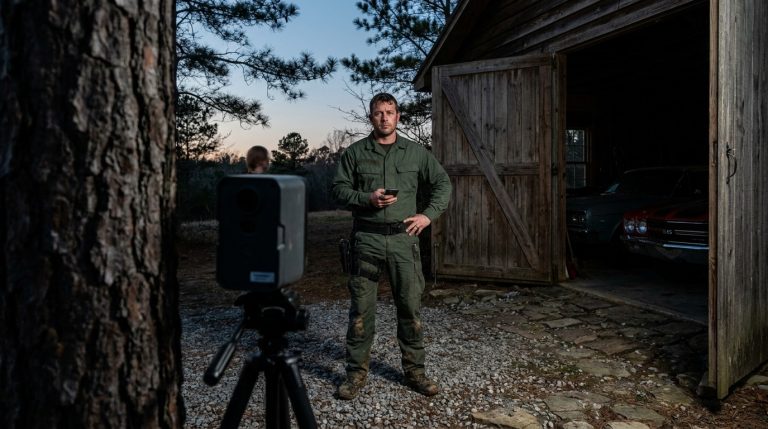
Mark lowered the phone. He didn’t swear. He stood up, the joints in his left knee popping—a souvenir from a mortar pit in Jalalabad. He slid the brass coin into his pocket, drew his digital camera from his work bench, and began taking photographs.
Frame one: the heavy steel deadbolt on the side door, unlatched from the inside.
Frame two: the yellow immobilization clamp, serial number scratched off near the keyway.
Frame three: the bright orange adhesive notice plastered across the windshield of his Ford F-150.
He zoomed in on the signature block at the bottom of the notice. Printed in shaky, aggressive cursive: Karen Miller, HOA President. Beneath her name, printed in formal serif type: Authorized via Vanguard Capital Enforcement Protocol.
Mark stopped. He adjusted the manual focus. Vanguard Capital. That name wasn’t in the three-ring binder of bylaws he’d signed six months ago during closing.
He stepped back, scanning the garage floor. A single dark smudge of grease lay near the left rear bumper—fresh, petroleum-based, not from his truck. The intruder had stepped in something outside before sliding through the side access hatch.
Mark reached down, scooped a smudge onto his index finger, and rubbed it against his thumb. Gravel dust. High-grade crushed granite, the exact stone Karen Miller had installed along her driveway two doors down.
He walked to his workbench, pulled out a fresh legal pad, and uncapped a black ink pen. He didn’t call a lawyer. He didn’t call the police. He drew a straight line down the center of the paper, dividing it into two columns: Stated Authority and Physical Evidence.
The battle lines were drawn inside four concrete walls.
He tapped the pen against the pad once, then started writing the first line of the counter-operation.
CHAPTER 2: COLD PAPER
The tip of the black rollerball pen dug into the fibrous legal paper, leaving a tiny crater of wet ink.
I didn’t lift the point. I kept it pressed into the pad while my left hand reached into my pocket, pulling out the brass challenge coin. I set the coin on the corner of the workbench—a solid anchor on top of the fresh grease smudge I’d lifted off the rear bumper.
Seven hundred dollars. That was the price they put on my privacy, slapped onto my windshield with an industrial adhesive meant for highway road signs.
Under the Stated Authority column, I wrote: Article 9, Section 1 — Right of Entry.
Under Physical Evidence, I listed three distinct points:
Garage side deadbolt intact; zero physical signs of forced entry prior to hatch unlatching.
Granite dust on bumper matches 4209 Oak Drive (Karen Miller).
Notice cites ‘Vanguard Capital’—an entity entirely absent from the 184-page master CC&Rs.
I capped the pen. The click echoed off the exposed rafters of the garage.
I didn’t paced. I didn’t pour another cup of coffee. I pulled a pair of clean cotton inspection gloves from my tool drawer, slid them over my fingers, and stepped over to the front driver’s side tire.
The yellow immobilization boot wasn’t high-grade municipal equipment. Up close, the welds along the tubular steel frame were uneven, pitted with slag—the work of a budget shop running cheap flux-core wire. The lock cylinder was an off-brand tubular model, showing slight brass shavings around the keyway. Someone had forced it or used a worn master key to set the tumblers.
I leaned down until my nose was six inches from the lock housing. There was no city inspection stamp. No county registrar badge.
If a legitimate municipal authority boots a vehicle, state statute requires a stamped registry number traced to a licensed operator. This thing was a blank piece of scrap iron painted canary yellow to look terrifying to someone who didn’t know how metal was put together.
I stood, walked to the side door, and stepped out into the blinding Florida heat.
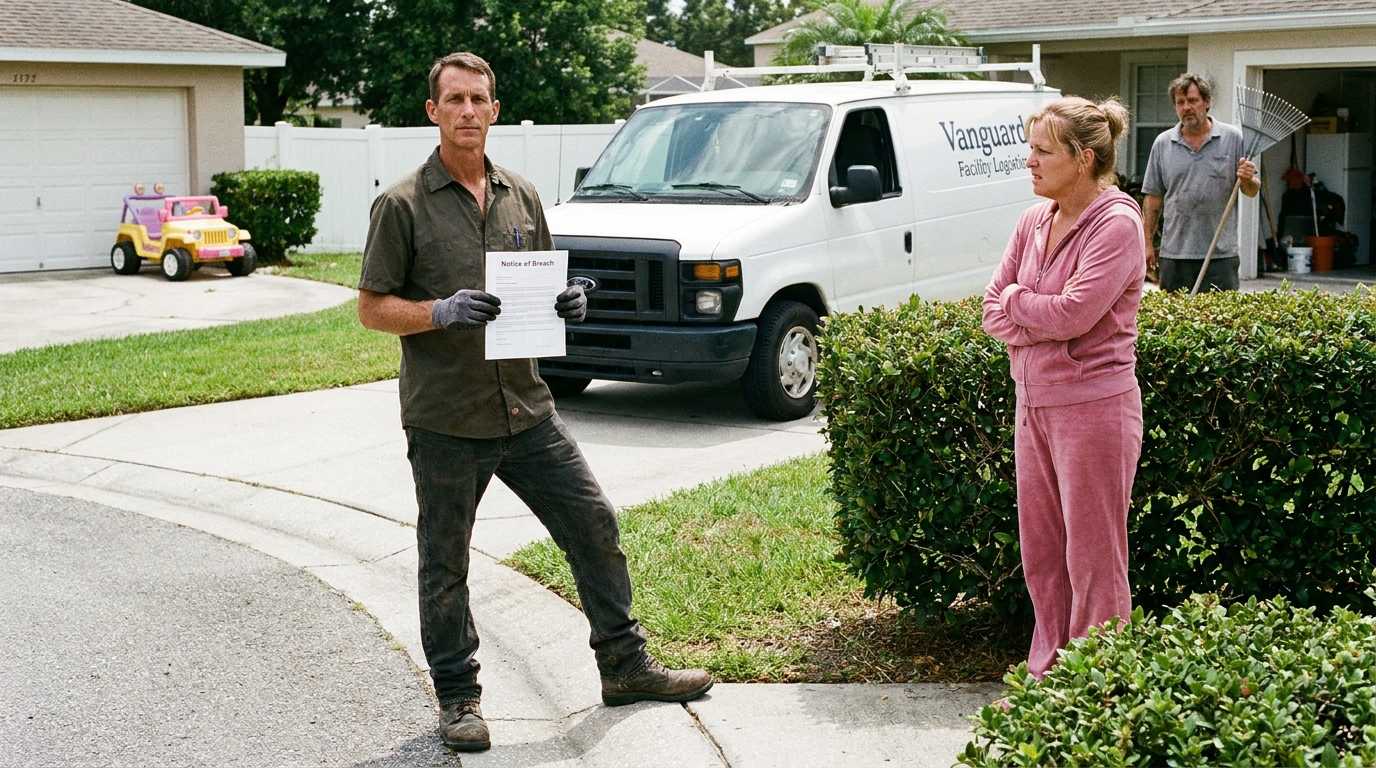
The air outside tasted like damp turf and exhaust. Two houses down, Karen Miller’s lawn was pristine, the Bermuda grass clipped to an absolute, uniform two inches. A white utility van was idling near her curb. On the driver’s door, painted in faded navy lettering, were the words: Vanguard Facility Logistics. Beneath it, in smaller block text: Docket 407 Registered Operator.
My eyes narrowed. The second Seed Noun. Docket 407.
A man in a gray polo shirt stepped out of Karen’s front entry. He carried a clipboard under his arm and a heavy steel ring of keys hooked to his belt. Karen stood on her porch, her arms crossed over a bright pink velour tracksuit, nodding as he spoke. She pointed toward my driveway.
The man didn’t look back at her. He turned, tossed the clipboard onto the dashboard of the van, and climbed into the driver’s seat.
I didn’t run. I walked at an even, deliberate pace down my driveway, taking the sidewalk toward her lot. I stopped at the boundary line—the exact edge where my property met the shared easement.
Karen saw me coming. She didn’t retreat inside. She adjusted the collar of her tracksuit, stepped down the concrete walkway, and stood three feet behind her manicured hedge line.
“Mr. Reynolds,” she said, her tone pitched with a high, practice-honed authority. “I assume you’re heading to the bank. The removal crew won’t return until Prestige confirms the electronic transfer.”
I pulled the folded sheet of legal paper from my back pocket. I didn’t hand it over. I held it at chest height, perfectly still.
“You trespassed,” I said. My voice was low, flat, carrying zero emotional amplitude. “You opened my side hatch, stepped over my threshold, and attached an unlicensed device to a private asset stored inside an enclosed structure.”
Karen’s upper lip twitched—a micro-spasm she tried to mask by taking a quick, sharp breath through her nose. Her right hand tightened on the strap of her visor.
“The garage door was up at 0800 on Tuesday,” she said, her voice rising half an octave. “The vehicle was visible from the common roadway. It is an eyesore. It violates the aesthetic harmony of Creekwood Estates.”
“Article Seven, Section Three-B,” I quoted, reading the exact line I had memorized during my midnight audit. “‘…unless fully enclosed within a garage.’ The rule governs state of storage, not visibility during maintenance. The door was closed when your agent entered.”
“Prestige handles enforcement!” she snapped, her knuckles turning white against her visor strap. “I simply sign the authorization log! You are in violation, Mr. Reynolds, and every day you delay adds a fifty-dollar administrative penalty!”
“You signed the orange slip,” I said. “Your handwriting. Your signature over the line marked Authorized Officer. Prestige is a management proxy. The liability lands on the hand holding the pen.”
I stepped forward, crossing the half-inch gap between the sidewalk and her turf, and held out the paper.
“This is a formal Notice of Breach,” I said. “You have twenty-four hours to produce the county immobilization license for ‘Vanguard Facility Logistics’ and remove the device from my property. If the boot is still on my wheel at 0900 tomorrow, I initiate formal proceedings.”
Karen didn’t take the paper. She let it hang in the air between us.
“You think you’re the first military man to move in here and cite rules at me?” she whispered, her eyes turning cold, tight, and venomous. “You think a three-star review on an engineering board makes you immune to community standards? Pay the seven hundred, Mark. Or Vanguard files the lien on Monday, and Docket 407 takes the house.”
She turned on her heel and walked toward her front door, the rubber soles of her shoes squeaking loudly against the pristine concrete.
I stood on the property line. I didn’t call after her. I didn’t raise my voice.
I looked down at the folded paper in my gloved hand, then across the street to the quiet, closed front doors of my neighbors’ houses. The threat wasn’t a fine. It was a template.
I unfolded the paper, smoothed out the crease against my thigh, and walked back toward my garage. The twenty-four-hour clock wasn’t just ticking for her. It was ticking for me.
CHAPTER 3: THE RETALIATION FEE
The heat radiating off the asphalt stung through the thin rubber soles of my boots as I crossed my property line.
I didn’t head back inside the garage right away. I stood at the corner of my driveway, smoothed out the creased notice, and slid it into a heavy Manila folder I’d brought out from the workbench.
Across the cul-de-sac, a screen door slapped shut.
Brian Henderson stepped onto his front porch. He was holding an aluminum rake, his head bowed against the glaring noon sun. He looked up, caught my eye, and immediately looked away, dropping his gaze to a plastic Barbie Jeep parked beside his garage door. A bright yellow sticker—the exact shade as the boot on my truck—was slapped across the toy’s tiny plastic windshield.
I adjusted the folder under my arm and walked across the asphalt.
“Brian,” I said.
He flinched slightly, tightening his grip on the rake handle until his knuckles showed white under his tan.
“Mark,” he muttered, keeping his voice below a carrying whisper. He glanced toward Karen’s picture window two doors down. “Look, man, I saw you over there talking to her. You shouldn’t have gone over there.”
“She trespassed,” I said.
“She runs the board,” Brian said. He rested his hands on the top of the rake, leaning his weight forward. His eyes were bloodshot, surrounded by dark, bruised-looking circles. “They hit me with twenty-five bucks last month for the kid’s jeep being on the grass for two hours while I was washing the driveway. Then fifty for ‘unauthorized yard storage.’ I paid it. My wife wanted to fight it, but… you fight them, they find something else. A weed in the pavement. The shade of your mailbox.”
“They don’t have the legal authority to boot vehicles,” I said. “Not in a private enclosure. Not without a county operator license.”
Brian let out a short, dry laugh that sounded like dry leaves scraping over concrete. “They don’t need a license, Mark. They have Prestige. Prestige files the paperwork with the county clerk. You don’t pay, they slap a lien on the deed under Docket 407. You ever try to refinance a mortgage with a cloud on the title?”
He reached into his back pocket, pulled out a folded white envelope, and pressed it into my hand. It was an official notice from Prestige Community Management, printed on thick, linen-textured stock.
“Read it,” Brian said. “That came yesterday. They call it a ‘Special Legal Compliance Assessment.’ Every house on the block got one.”
I unfolded the letter. My eyes scanned the text, stopping at the bolded section midway down the page:
Pursuant to Board Resolution 2024-B, a non-compliance administrative fee of $100.00 has been assessed against Lot 114 due to ongoing legal friction and unauthorized resident interference with contractual enforcement agents. Failure to remit within 14 business days will trigger automatic escalation under the Sovereign Ledger Protocol.
My thumb pressed into the paper. The third Seed Noun. Sovereign Ledger.
“They’re charging you for my dispute,” I said.
“They’re charging everybody,” Brian corrected. “They make it look like your fault so the whole street turns on you. It’s how she keeps everyone quiet. You pay the fine, or your neighbors pay for your noise.”
He took the paper back, folded it meticulously along its original creases, and shoved it back into his pocket.
“Pay the seven hundred, Mark,” he said softly. “Cut your losses. You can’t fight a company that owns the paper your house is printed on.”
He turned and dragged the rake toward his side yard without waiting for an answer.
I walked back across the street, my heels striking the pavement in a steady, measured rhythm. I didn’t go back into the house. I walked down the side path to my rear patio, pulled out my mobile phone, and dialed a local number I’d pulled from the state bar registry an hour before sunrise.
The phone rang three times before a deep, gravelly voice answered.
“Sterling.”
“Dave Sterling?” I asked. “My name is Mark Reynolds. I live on Oak Drive.”
A brief pause on the line. “The guy with the booted F-150?”
“Word moves fast,” I said.
“In a neighborhood this tight, a yellow boot is headline news,” Sterling said. “I’m sitting on my back porch three streets over. You sound like a man who’s reading the bylaws instead of throwing a lawn tantrum. You got five minutes?”
“I’ve got twenty-four hours,” I said. “And a ledger entry I need translated.”
“Bring your documents,” Sterling said. “And bring your own coffee. Mine’s cold.”
Ten minutes later, I was sitting at a glass-topped patio table in Dave Sterling’s backyard. Sterling was lean, built like a fence post, with short silver hair and eyes that didn’t blink when he looked at you. He wore a faded olive-drab t-shirt and had a thick yellow legal pad resting on a pile of leather-bound state statute books.
I laid my file on the table: the photographs, the orange notice, my handwritten timeline, and the notice Brian had shown me.
Sterling didn’t touch the photos. He reached straight for the notice from Prestige, running his thumbnail along the embossed header at the top.
“Vanguard Capital,” he read aloud. “Docket 407. Sovereign Ledger.” He set the paper down and looked up at me. “You know what these are?”
“Names,” I said. “Corporate proxies.”
“They’re shell markers,” Sterling said, leaning back. “I spent twenty-two years in the Army JAG Corps prosecuting contract fraud in procurement. Prestige isn’t just a property management company, Mark. They’re an extraction pipeline.”
He tapped the paper with his index finger.
“They don’t make their real money on the monthly forty-dollar maintenance dues,” Sterling continued. “They make it on the friction. They invent violations, hire unlicensed sub-contractors like Vanguard to execute the physical seizures, and then process the fines through a secondary ledger that bypasses the HOA’s public bank account. The HOA board sees a clean audit because the money never touches their official books. It goes straight to the corporate parent.”
“And Karen?” I asked.
“Karen gets prestige,” Sterling said, dryly emphasizing the word. “She gets to feel like the mayor of a four-hundred-home city. And I’d bet a month’s pension she gets a kickback on every cleared boot under the table.”
“I gave her twenty-four hours,” I said.
Sterling let out a low, rumbling laugh. “She won’t remove it. She can’t. If she backs down to you, the whole intimidation structure collapses. She has to double down. By tomorrow morning, you’ll have an escalation notice taped to your door.”
“Good,” I said.
Sterling’s eyes sharpened. He leaned forward, resting his forearms on the table. “Why good?”
“Because a threat isn’t a crime until they execute it,” I said. “Right now, I’m a homeowner with a civil dispute. The moment they accept payment for an illegal service or file a paper lien based on a fraudulent fee, the jurisdiction shifts from civil covenant to financial extortion.”
Sterling stared at me for three seconds in complete silence. A slow, thin smile spread across his face, cold and completely devoid of warmth.
“You aren’t trying to get the boot off,” Sterling said.
“I’m going to take their license,” I replied.
I reached into my pocket, pulled out my credit card, and laid it flat on top of the file.
“Tell me how we trap the transfer,” I said.
CHAPTER 4: THE FINANCIAL TRAP
The plastic edge of my credit card snapped against the glass patio table with a sharp, dry crack.
Sterling didn’t pick it up immediately. He slid two fingers over the raised numbers, rotating the card until the magnetic strip faced him.
“You execute this online,” Sterling said, his voice dropping into the quiet, rhythmic precision of a deposition. “Not over the phone. Not in person. We want every byte of metadata routed through Prestige’s payment gateway. If they route this through Vanguard Capital under the Sovereign Ledger umbrella, we have them on wire fraud.”
“What about the physical boot?” I asked.
“The second the authorization code clears, you call their dispatch,” Sterling said, pulling a legal pad toward him and uncapping a black gel pen. “You demand immediate key dispatch. You record the audio. You film the operator unlocking the wheel. If he scratches the rim, you document the damage. That turns simple extortion into a property destruction claim against Vanguard.”
I picked up my mobile phone, opened the browser, and navigated to the URL printed on the orange windshield slip: prestigepayments-gateway.com/docket407.
The screen loaded a bare-bones payment portal. There was no corporate address. No state tax registration ID. Just a simple input mask demanding the violation notice number, a seven-hundred-dollar base fee, and an automatically checked box labeled Administrative Compliance Surcharge: $100.00.
Total: Eight hundred dollars.
My thumb hovered over the submit button. Eight hundred dollars was three weeks of pension pay. It was a month of high-grade paint and replacement gaskets for the F-150. Paying it felt like swallowing glass.
“Do it,” Sterling said softly. “You’re not losing eight hundred bucks, Mark. You’re buying a smoking gun.”
I tapped the screen. The authorization ring spun once, twice, three times. The screen flashed green: Transaction Approved. Reference ID: VC-8809-LEDGER.
A PDF receipt generated automatically. I zoomed in on the fine print at the bottom of the digital document.
Merchant of Record: Vanguard Capital Holdings LLC. Settlement Account: Sovereign Ledger Escrow B.
Midway through the complete arc, the physical decoy was staring right at me. Prestige wasn’t even processing the fees directly. They were running a front system—using Vanguard as an unlicensed enforcement arm to collect off-the-books cash while sheltering Prestige behind corporate indemnification clauses.
“Got it,” I said, handing the phone screen over to Sterling.
Sterling leaned in, his eyes tracking across the merchant block. “Unlicensed collection. Unregistered operator executing physical seizure inside a private residence. They took the bait.”
I stood up from the glass table, sliding the credit card back into my wallet. “I’m calling dispatch.”
Forty-five minutes later, I stood in my open garage door. The sun was directly overhead now, casting short, dark shadows beneath the F-150.
A rusted white pickup truck with no door logos pulled into my driveway. The driver got out—a burly man in greasy denim overalls, his face flushed red from the heat. He didn’t look at me. He walked straight to the front tire of my truck, pulled a heavy steel key from his pocket, and shoved it into the tubular lock of the yellow boot.
I stood three feet away, my phone held at chest height, recording every movement in high-definition video.
“You’re filming?” the man grunted, twisting the key with a harsh metallic clack.
“I’m documenting,” I said. “What’s your operator license number with the county?”
He stopped, his hand freezing on the steel frame. He looked up, his small, dark eyes narrowing behind grime-streaked safety glasses.
“I just pick up the hardware, chief,” he spat. He yanked the yellow device free, letting the heavy steel jaw drop onto the concrete floor. CLANG.
The impact gouged a deep, half-inch scratch straight through the fresh silver powder-coat on my custom rim.
“You scratched the finish,” I said, keeping my voice utterly level.
“Take it up with Prestige,” he muttered, hoisting the heavy yellow device by its chain and tossing it violently into the bed of his pickup. “They own the gear. I just clear the ticket.”
He slammed his truck door, threw the engine into reverse, and backed out down my driveway, leaving a dark streak of burnt transmission fluid on the hot asphalt.
I walked over to the tire, knelt on the concrete, and touched the fresh metal scratch on the wheel. The rim was ruined, but the paper trail was complete.
I stood up, walked back to my workbench, and opened my laptop. I attached the PDF receipt, the video file of the boot removal, the photos of the rim damage, and the notarized affidavit Sterling had prepared.
I routed the entire package to two specific email addresses: the State Department of Business and Professional Regulation Enforcement Division, and the County Sheriff’s Economic Crimes Unit.
My finger hit Send.
The fan on my laptop whined loudly in the hot garage air. The first shot had been fired. Now, I needed the rest of the block to pull their triggers.
CHAPTER 5: THE DIGITAL INSURGENCY
The blue confirmation bar on the screen turned green, then vanished.
The email client logged the transmission timestamps: 12:04 PM for the State Department of Business and Professional Regulation, 12:05 PM for the County Sheriff’s Economic Crimes Division. Eight hundred dollars sent; one ruined rim documented; three statutory violations formally logged.
I didn’t shut the laptop lid. I pulled up a plain-text editor, opened a second browser window, and registered a domain name I’d spent forty-eight hours drafting in my notebook: creekwoodhoatruth.com.
Outside, a sudden squall line blew over the ridge, the sky darkening from harsh white glare to slate gray in less than ten minutes. The wind hit the steel garage door, rattling the panels in their tracks. Rain began to strike the driveway in heavy, fat drops, washing away the dark oil streak the tow truck driver had left behind.
I ignored the weather. I spent five hours writing pure, unadorned facts into the site’s basic framework.
No insults. No inflammatory adjective usage. Just three clean tabs across the top navigation bar:
Governing Documents vs. Florida Property Code.
The Vanguard Capital / Sovereign Ledger Docket 407 Audit Trail.
How to File a DBPR Complaint (Step-by-Step).
Under tab two, I embedded a PDF viewer displaying the transaction receipt from my credit card, masking my account number while leaving the merchant block fully visible: Vanguard Capital Holdings LLC / Sovereign Ledger Escrow B. Below it, I uploaded high-resolution scans of the orange windshield slip, the county clerk’s registry showing Vanguard had zero operator permits, and the $100 retaliatory assessment notice sent to Brian Henderson.
At 01:00 AM, the storm passed, leaving the night air thick, cool, and smelling of wet asphalt and crushed oak leaves.
I pulled two hundred printed flyers from my office printer. Each contained a single high-contrast photo of the yellow boot clamped on my wheel inside my closed garage, accompanied by two short lines of text:
Tired of illegal fines and paper liens? Know what your dues are actually funding.
Scan to read the state regulatory filings: creekwoodhoatruth.com
I slipped on a dark canvas jacket, pocketed a stack of flyers, and stepped out into the damp street.
The cul-de-sac was pitch black, save for the pale amber glow of streetlights reflecting off puddle surfaces. I moved street by street—Oak Drive, Pine Ridge, Willow Court—placing a folded flyer under every welcome mat. I didn’t knock. I didn’t leave them in mailboxes, which would violate federal postal regulations. I placed them flat on concrete doorsteps, anchored under rubber mats.
When I reached 4209 Oak Drive, I stopped.
Karen Miller’s house was completely dark. Her manicured lawn was littered with small oak twigs torn down by the afternoon squall. I stood at the edge of her driveway, pulled a flyer from my pocket, and slid it flat under her front door mat.
As I straightened up, a shadow shifted inside her front window. The vertical blinds parted by a quarter inch. A single pale eye caught the amber streetlamp light.
I didn’t run. I didn’t smile. I met her gaze for two full seconds, adjusted my jacket collar, and walked back down her driveway into the quiet dark.
By 07:00 AM, the server dashboard on my phone started vibrating every forty seconds.
Thirty visits. One hundred. Four hundred.
By noon, my secure contact form had received eighteen separate entries from homeowners across four streets. Mrs. Gable sent a scanned violation notice for her rose bushes with a handwritten note: They threatened my pension check. The Sanchez family uploaded a certified letter demanding $450 for non-approved swing set stain shades, signed under Docket 407.
Every story matched the exact same template: arbitrary violations, immediate monetary penalties, and threats of property encumbrance under the Sovereign Ledger umbrella if anyone questioned the board.
At 02:30 PM, an unmarked dark blue sedan pulled into my driveway.
Two men in charcoal suits stepped out. The driver wore a brass shield pinned to his belt loop—Economic Crimes Division. He didn’t carry a clipboard. He carried a heavy leather briefcase.
“Mark Reynolds?” the detective asked, stopping at the edge of my garage threshold.
“I’m Reynolds,” I said, stepping back to let them inside out of the afternoon heat.
“I’m Detective Vance,” he said, showing his credentials. “We reviewed your electronic filing and the county permit registry. We also spent two hours this morning speaking with the state investigator assigned to Case 2023-04771.”
He set his briefcase on my workbench, right beside my brass Army challenge coin.
“Vanguard Capital isn’t a licensed towing company, Mr. Reynolds,” Vance said flatly. “And QuickBoot Recovery has been operating without an economic authorization permit in this jurisdiction for fourteen months. We served a search warrant on their local yard forty minutes ago. We seized twenty-two unauthorized immobilization devices and four sets of merchant ledgers.”
I looked at the briefcase. “And Prestige?”
“The DBPR issued an emergency suspension order three hours ago,” Vance replied, unlatching his case and pulling out a formal blue-backed document. “They froze Prestige’s escrow accounts under the Sovereign Ledger flag. But we need you at the annual association meeting tonight to authenticate the physical evidence on the record.”
I picked up the brass coin from the bench, feeling its cool weight settle into the palm of my hand.
“I’ll be there,” I said. “And so will two hundred of my neighbors.”
CHAPTER 6: CHECKMATE AT THE CLUBHOUSE
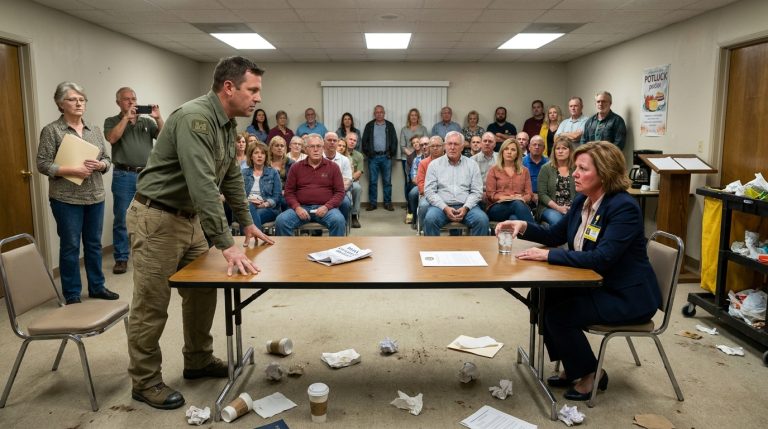
The hum of buzzing fluorescent tubes echoed off the polished linoleum floor of the Creekwood Estates clubhouse.
Every metal folding chair was occupied. Over two hundred homeowners packed the room, spilling out into the foyer and past the open double glass doors into the humid night. The air smelled of floor wax, stale coffee, and tight, simmering friction.
I sat in the front row beside Dave Sterling. On my knee rested the heavy leather briefcase Detective Vance had left with us, its brass latches cold against my palm. Across my knuckles, I rolled my Army Corps challenge coin in a silent, steady rotation. Clack. Clack. Clack.
At the head folding table sat Karen Miller.
She wore a navy blazer over her pink tracksuit, her posture rigid, her chin tilted up at an aggressive angle. To her right sat two mute board members. To her left sat a tall man in a tailored charcoal suit—Barry, the regional director of Prestige Community Management. A leather-bound binder lay open before him, stamped in gold foil with the words Sovereign Ledger Holdings.
Karen struck a wooden gavel against a wooden block. BANG.
“The annual general meeting of Creekwood Estates will come to order,” Karen announced into the small desk microphone. Her voice was thin, pitched high to cut over the room’s low roar. “Due to ongoing administrative disputes, the open forum is suspended tonight. We will proceed directly to the ratification of the emergency legal assessment.”
A wave of shouts erupted from the back rows. Brian Henderson stood up, holding his flyer high above his head.
“Read the room, Karen!” Brian shouted. “We want answers on Vanguard Capital!”
Karen banged the gavel three times in violent succession. BANG. BANG. BANG.
“You are out of order, Mr. Henderson!” she hissed. “Security will escort anyone disrupting this board!”
“There is no security,” Sterling said, standing up smoothly from the front row. His voice didn’t rise; it carried with the dry, terrifying resonance of a military courtroom prosecutor. “The county sheriff’s department dissolved your private detail two hours ago, Mrs. Miller.”
Karen’s hands tightened on the gavel until her manicured nails turned yellow against the wood.
Barry leaned over to the microphone, pulling it toward his face. He adjusted his silk tie, offering a tight, practiced corporate smile to the crowd.
“Good evening, residents,” Barry said, his tone slick, dismissive, and completely calm. “I am Barry Higgins, Regional Vice President for Prestige. Let me assure you that the internet rumors regarding Vanguard Capital and Docket 407 are based on a fundamental misunderstanding of master-planned community finance. Vanguard is an administrative trust created under Vanguard Capital to manage specialized asset preservation under the Sovereign Ledger framework. All fees collected are held in escrow for community enhancement.”
He paused, resting both palms flat on his leather binder, looking directly at me.
“Mr. Reynolds has engaged in a coordinated campaign of harassment,” Barry continued, his voice dropping into a razor-sharp threat. “If this illegal website is not taken down by midnight, Prestige will exercise its right under Article 12 to file immediate foreclosures against any property owner participating in this wildcat disruption.”
He thought he was sealing the trap. He thought the word foreclosure would clear the room.
I stood up. I didn’t reach for the microphone. I picked up the leather briefcase, walked up the three steps to the platform, and set it flat on the folding table right between Karen and Barry.
The latches clicked open in the dead silence of the hall.
“Article Twelve doesn’t apply to fraud, Barry,” I said.
I pulled out the first document: a blue-backed official order stamped by the Florida Department of Business and Professional Regulation.
“At 1400 hours today,” I said, reading the bold black text at the top of page one, “the DBPR issued an Emergency Order of License Suspension against Prestige Community Management. Case Number 2023-04771.”
Barry’s smile didn’t fade; it froze. His left eye twitched once, a tiny muscle spasm beside his temple.
“That’s a preliminary administrative inquiry—” Barry began.
“It’s a full license revocation,” I interrupted, setting down the second document—a certified bank audit ledger provided by the County Sheriff’s Economic Crimes Division. “And this is the paper trail for Sovereign Ledger Escrow B.”
I looked down at Karen. Her face had lost all its color. Her lower lip was trembling violently, her eyes darting between the papers and the front row where two hundred neighbors were watching her disintegrate in real time.
“For three years,” I said, my voice echoing off the concrete walls, “Prestige ran a kickback engine. Every yellow boot placed by Vanguard Capital generated a seven-hundred-dollar transaction. Five hundred went straight to an unlisted account controlled by Vanguard Capital Holdings. Two hundred went to an administrative fund that paid a monthly ten-percent ‘consulting fee’ directly to Karen Miller’s personal account under Docket 407.”
A collective, deafening roar went through the room. Neighbors stood on their chairs. Brian Henderson surged toward the aisle, pointing a finger at the board table.
“You took kickbacks on my kid’s toy?!” Brian yelled.
Karen slammed both hands flat on the table, pushing herself out of her chair. Her face turned a dark, mottled purple, her composure shattering completely into cornered desperation.
“It was for the community!” she shrieked into the microphone, her voice breaking into a ragged, desperate scream. “You don’t know what it takes to keep this place from turning into a slum! You think house values stay up on their own? You think people care about their lawns without a fist over them? I saved this neighborhood! I built it!”
“You robbed it,” I said flatly.
Barry shoved his leather binder into his coat, pushed his chair back, and made a quick, desperate stride toward the side exit door.
He didn’t make it two steps.
The side door opened. Detective Vance stepped through the threshold, flanked by two uniformed county deputies. Vance pulled a folded paper from his jacket, stepped into Barry’s path, and placed a heavy hand on the executive’s shoulder.
“Barry Higgins?” Vance said quietly. “We have an arrest warrant for organized scheme to defraud under State Statute 817.034. Hands behind your back.”
The metallic click of handcuffs snapping shut against Barry’s wrists carried across the quiet room like a gunshot.
Karen sank back into her folding chair. She didn’t speak again. She didn’t look at the crowd. She stared blankly at the scratched wooden block on her desk as Detective Vance placed a second paper in front of her.
Sterling stepped up to the desk, pulled the wooden gavel from her limp hand, and struck the block once. BANG.
“Under Bylaw Section 4-A,” Sterling announced to the room, “a petition signed by forty-two percent of voting owners has been submitted. By unanimous voice vote of those present, the board is dissolved, and all outstanding non-compliance assessments are declared null, void, and erased from the record.”
The applause didn’t start with a roar; it started with a single hand clap from Mrs. Gable in the second row, followed by Brian Henderson, then the Sanchez family, until the room vibrated with the thunder of two hundred people regaining their homes.
Two days later, the Florida heat had backed off into a cool, late-afternoon breeze.
My garage door was wide open to the sun. The air inside smelled of clean aluminum polish and fresh floor sealant.
I sat on a low wooden stool beside the driver’s side front tire of my 1978 F-150. In my lap was a pad of fine 0000 steel wool, a tin of metal restoration compound, and a high-speed polishing wheel attached to my cordless drill.
I applied a pea-sized dab of polish to the deep scratch on the custom powder-coated rim—the mark left by the unlicensed boot three weeks ago.
I pulled the drill trigger. The foam wheel spun in a tight, steady circle, working the abrasive paste into the gouged metal. Slowly, methodically, the jagged edge smooths out. The bright silver underlying aluminum began to catch the sunlight, blending the ruined edge back into a uniform, brilliant shine.
Step by step. Layer by layer. Removing the friction until the structure was sound again.
A shadow crossed the concrete floor.
I stopped the drill and looked up. Mrs. Gable stood at the edge of my driveway, wearing a wide-brimmed straw sunhat and garden gloves. In her hands, she carried a small ceramic gnome with a bright red painted hat.
“Thought you might like to see him,” she said, her eyes crinkling with a quiet, warm smile. “He’s sitting right next to my prize roses now. Right where the sun hits best.”
“He looks good, Mrs. Gable,” I said, wiping my hands on a shop rag and standing up.
“The new board meeting is on Tuesday,” she said gently. “Sterling said we’re voting on a motion to plant oak saplings along the common median.”
“I’ll be there,” I said.
She nodded, turned, and walked slowly back down the sidewalk toward her yard, her footsteps light against the clean concrete.
I turned back to the truck. I ran my bare thumb over the polished rim. The gouge was gone. The metal was smooth, cold, and solid under my touch.
I reached into my pocket, pulled out my brass Army Corps coin, and set it squarely in the center of my workbench beside my clean tools.
I stepped out of the garage, left the heavy steel door completely unlatched, and walked out into the open sun.