The Sanctuary at Heritage Hills: How an Ex-Military Engineer Built a Shield for His Community
CHAPTER 1: THE LINE IN THE DUST
The metal stake didn’t belong in my turf.
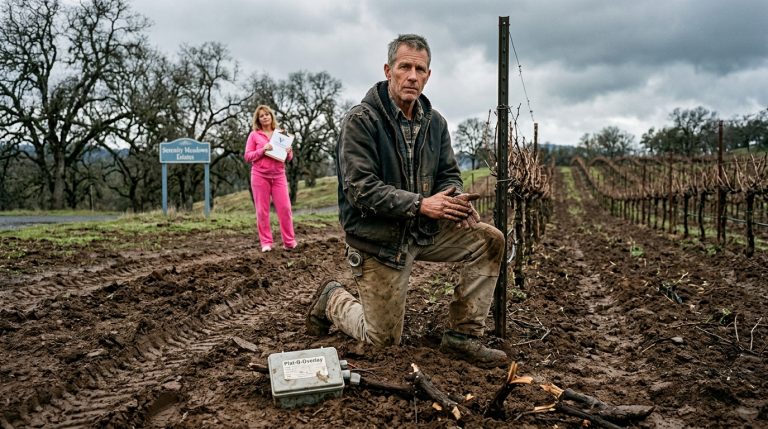
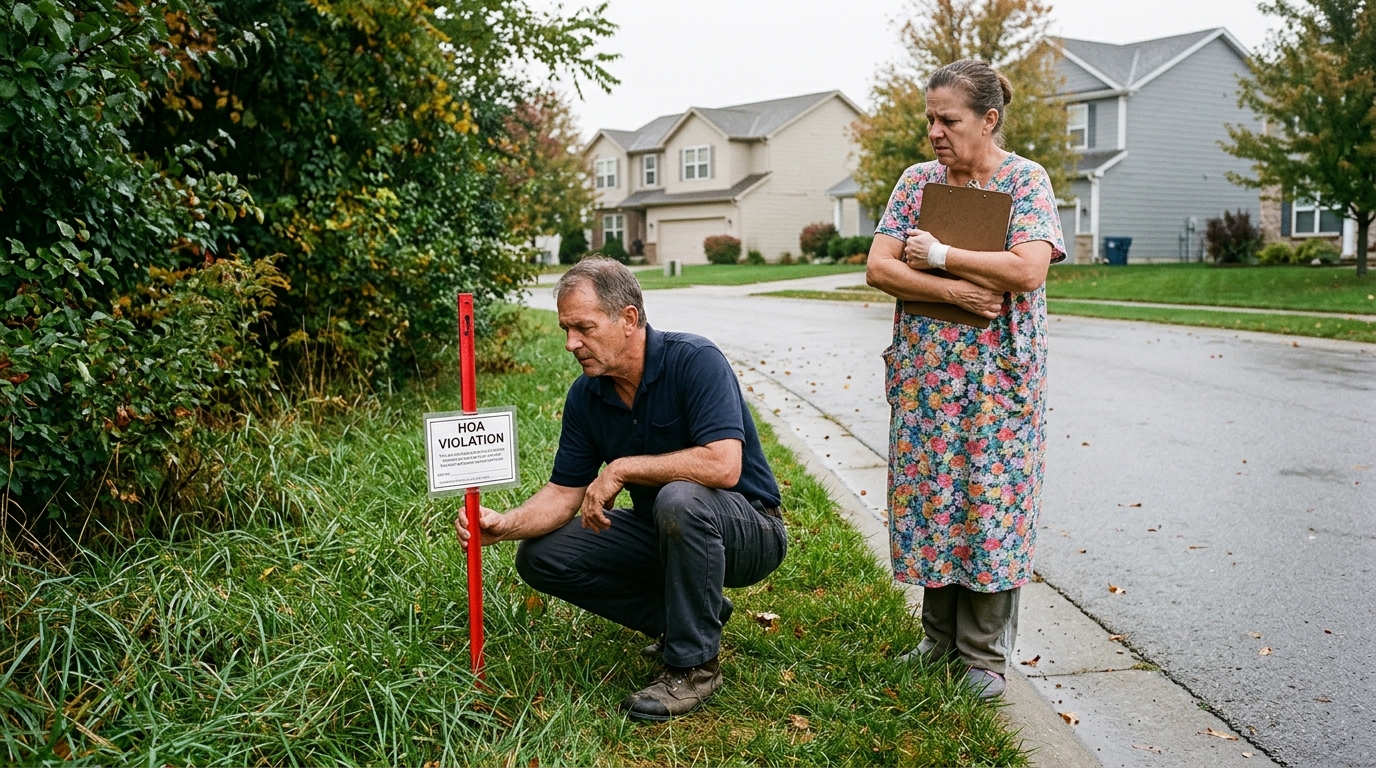
It sat three inches inside the property line, biting through two years of cultivated creeping fescue. Bright red paint coated the angle iron. The powder-coat was fresh. It smelled of industrial solvent and hot asphalt, sharp enough to cut through the damp autumn air.
Above the steel, a plastic sleeve held a sign. Bold black letters screamed across the white vinyl: NOTICE OF VIOLATION — HERITAGE HILLS HOMEOWNERS ASSOCIATION.
“This is a residential community, Mr. Garrison, not some backwoods industrial park.”
The voice came from behind the hedges. Karen didn’t step onto my grass. She stayed on the asphalt curb, floral mumu stretched taut across her shoulders, holding a clipboard against her chest like a riot shield. Her knuckles were white against the plastic clamp.
Behind me, inside the open bay of my three-thousand-square-foot workshop, the industrial planer spun down. The rhythmic hum of reclaimed oak smoothing under carbide blades died into a low, metallic whine. The silence that filled the driveway felt heavier than the noise.
“You’re standing on county land, Karen,” I said. My voice didn’t rise. Twenty years in the Army Corps of Engineers teaches you to keep your pitch flat when the terrain turns soft.
“The constant whining of your machinery is a direct violation of our community’s noise ordinance and aesthetic harmony,” she declared. She didn’t look at my eyes. She looked at the sign post she’d just driven into my dirt. “Therefore, the Heritage Hills Homeowners Association is issuing you an initial fine of five hundred dollars, plus a recurring penalty of eight hundred dollars per week until this noise pollution ceases entirely.”
Eight hundred dollars a week.
I turned the small brass thickness gauge in my pocket. My thumb rubbed the scarred metal face, feeling the microscopic ridges carved into the steel from decades of checking structural tolerances.
“My shop runs on Lot 7B,” I said. “This parcel isn’t in your subdivision.”
“Article Four, Section Two-B,” she read directly off her clipboard, her voice dripping with the practice of a bureaucrat who had never been answered back. “Any activity creating an annoyance or nuisance to adjacent residents falls under board jurisdiction. You have forty-eight hours to clear this site.”
She turned on her heel, rubber soles squeaking against the wet asphalt as she marched toward her golf cart parked at the cul-de-sac.
I didn’t yell. I didn’t follow her. I stepped over the property line, crouched by the red metal stake, and took a breath. Beneath the solvent smell of the fresh paint, the damp earth gave off the heavy scent of crushed roots.
She thought she was fining a handyman. She had no idea the homes in her neighborhood—the ones giving her precious HOA its property value—were engineered on the drafting table inside that very shop.
I stood up, pulling the brass gauge from my pocket. My thumb pressed into its cold edge until the brass left an indent in my skin.
The sign stayed in the ground for now. But the clock was running.
CHAPTER 2: RECONNAISSANCE IN THE SUBURBS
The electric whine of Karen’s golf cart faded past the cypress hedges, replaced by the damp drip of autumn mist falling through the pines.
I didn’t lower my hand. The cold edge of the brass thickness gauge remained pressed against my thumb, leaving a pale, sharp line in the callus. On the grass, three inches inside my property line, the red angle iron of the HOA violation sign sat planted like a rusty bayonet.
My workshop stood quiet behind me, but the silence wasn’t peace anymore. It was an interlude.
I turned from the property line, stepped into the bay, and laid the thickness gauge beside the master ledger on my drafting table. Beside the blueprint of Lot 7B sat a yellowing copy of the original county plat—a document clearly defining this five-acre plot as unincorporated land. She knew it, or she was too arrogant to check. Either way, a frontal assault against a bureaucrat with a clipboard was bad strategy. Bullies don’t back down when you yell; they back down when you undermine their footing.
I changed out of my sawdust-caked work shirt, pulled on a dark navy polo, and walked out toward the curving asphalt of Heritage Hills.
The subdivision was quiet at four in the afternoon. Curbside lawns were clipped to uniform three-inch height, edges squared off with geometric precision. Pristine, beige-and-gray facade houses lined the cul-de-sacs like painted cardboard cutouts. But clean lines don’t mean sound structures.
As I walked the sidewalk, my eyes instinctually tracked the details twenty years in the Corps had trained me to notice. Drainage grates choked with decaying pine needles. A settlement crack running through the concrete apron of the community clubhouse. And near the park, an green electrical transformer box bearing a freshly stenciled code that didn’t match the county utility sequence.
“You’re walking fast, neighbor.”
An older man in a faded canvas jacket was kneeling by a bed of hybrid tea roses near the curb of Lot 14. His hands were gloved, a pair of hand pruners resting on a burlap sack.
I slowed my pace, coming to a halt on the sidewalk. “Just taking the air. Jack Garrison.”
“Arthur Jensen,” he said, pushing himself up with a soft grunt. He looked at my hands, taking in the faint trace of wood stain under my fingernails, then glanced back toward the direction of my workshop. “Heard your machinery stop a few minutes ago. Then I saw the president’s cart heading back to her driveway like she’d just captured a hill.”
“She planted a sign,” I said flatly.
Arthur let out a dry, short laugh that held no humor. He adjusted his grip on the pruners, his gloved thumb repeatedly flicking the safety catch open and closed. Click. Click.
“She does that,” Arthur muttered, lowering his voice as a white crossover SUV crawled past us down the street. He didn’t look at the driver until the taillights cleared the corner. “She fined me two hundred dollars last month. Said my garden hose wasn’t coiled in a continuous clockwise circle behind the garage. Two hundred dollars, Jack. I’m on a fixed pension.”
“Why pay it?”
“Because if you don’t,” Arthur said, the pruner catch clicking faster, “she adds fifty dollars a day in non-compliance penalties. After thirty days, she threatens a lien. My wife has heart trouble. She can’t take the stress of legal letters arriving in certified envelopes. So I wrote the check.”
He looked away, his jaw working silently under his weather-beaten skin. The humiliation was an open wound, kept raw by the quiet efficiency of the HOA’s paper machine.
“Has anyone asked to see where that money goes?” I asked.
Arthur’s eyes snapped back to mine, sharp and wary. “She doesn’t publish the itemized books. Just a one-page summary at the annual meeting. Says detailed ledgers are confidential under ‘board discretion.’ Anyone who asks questions gets their lawn inspected the next morning.”
I absorbed the detail silently. Lack of transparency. Selective enforcement. Escalation tactics. It was the classic blueprint of an unchecked fiefdom.
I bade Arthur good evening and continued down Oakridge Lane toward the community playground. The damp cold was setting in, bringing the scent of chimney smoke down from the ridge.
Near the swing sets, a young mother was packing a canvas diaper bag while a toddler struggled with the zipper of a red coat. On the perimeter fence hung a bright blue plastic sign listing equipment rules. Beside the play structure, a brand-new wooden swing set sat unfinished in the gravel, its cedar posts unvarnished and raw.
I stopped by the bench. “Looks like half a job.”
The woman looked up, startled. Her eyes flicked instinctively toward the street before settling on me. “The installers stopped yesterday,” she said softly. Her voice had the tight, exhausted strain of someone who had spent the afternoon fighting a losing battle. “I’m Maria.”
“Jack,” I replied. “Why’d they stop?”
Maria pulled the strap of the bag over her shoulder, her fingers knotting into the fabric. “Karen stopped by. Said cedar isn’t an approved material under the architectural guidelines. She told us we have to dismantle it and purchase the pre-approved recycled plastic model from a catalog she left on our porch.”
“How much is the catalog model?”
“Three times what we paid for this one,” Maria said, her lips trembling slightly before she compressed them into a pale, thin line. “We saved for six months to build this for Leo. My husband spent three weekends setting those footings in concrete. Now we have to pay a removal fee or face daily fines.”
She looked down at the toddler, who was patting the rough cedar post with a mitten.
“Who distributes the catalog model?” I asked softly.
“Some commercial outfit out of the county seat,” she murmured, looking down. “Vanguard Supply. Karen said they’re the only vendor that meets the neighborhood’s aesthetic code.”
Vanguard Supply. I lodged the name into memory alongside the mismatched stencil on the utility box and the uncollected fines on Arthur’s hose.
“Don’t tear it down yet, Maria,” I said.
She looked at me, confusion mixing with a flicker of desperate hope. “We can’t afford a lien on our mortgage, Mr. Garrison.”
“She won’t file a lien this week,” I said, my voice steady as stone. “She’s busy with me.”
I turned and walked back toward Lot 7B as the streetlights hummed to life along the curbs. The suburban houses sat dark against the dusk, behind pristine lawns and uniform windows. But under the quiet surface, the friction was building. Karen hadn’t just built a system of rules; she had built a pressure cooker.
When I reached my property line, the red sign post still stood three inches inside my dirt, catching the long beam of my driveway light.
I walked past it into the shop, flipped on the overhead fluorescents, and walked straight to my desk. I pulled out a fresh notepad, uncapped a pen, and wrote three headings at the top of the page:
Jurisdiction (Parcel 7B)
Vanguard Supply
Article 11
I sat down, picked up the brass thickness gauge, and set it beside the pen. The time for passive defense was over. It was time to map the terrain.
CHAPTER 3: THE SHADOW ALLIANCE
The ballpoint ink seeped into the yellow legal pad, forming three thick black lines beneath the headings.
Outside the high windows of the shop, night settled hard over Lot 7B. Rain began to tap against the tin roof, a hollow, metallic rhythm that matched the ticking cooling fins of the table saw. Beside the pad, my brass thickness gauge reflected the stark overhead light, its cold face resting over the stamped edge of the county survey map.
I picked up my mug of lukewarm coffee, taking a slow sip. The silence was absolute, but it wasn’t empty anymore. It was filled with names. Arthur Jensen. Maria and David Chen. Vanguard Supply.
I picked up the desk phone, dialed Marcus Thorne’s direct line at his downtown office, and set the receiver against my ear. It rang twice before a sharp, measured voice answered.
“Thorne.”
“Marcus,” I said, keeping my tone level. “It’s Jack.”
“Jack,” he said, the rustle of case files audible over the wire. “I received your fax of the initial fine notice this morning. Standard municipal posturing. Have they pushed further?”
“She drove a steel sign three inches into my turf yesterday,” I said, looking out the bay window toward the driveway lamp. “And she threatened Arthur Jensen with a daily penalty until his pension gives out. She’s also shutting down a young family’s swing set build unless they buy through a firm called Vanguard Supply.”
Marcus paused on the line. The sound of paper shifting stopped dead. “Vanguard? Did you get a business registration number?”
“Working on it,” I replied. “Right now I need the legal mechanism to force an open floor. If we hit her from the outside with a property boundary lawsuit, she turns it into a protracted insurance defense fight using neighborhood funds. I want to hit her from inside her own room.”
“Article 11,” Marcus said immediately. The speed of his response showed why he’d made partner in six years. “Every residential covenant in the state has a special assembly clause. If ten percent of the registered titleholders sign a formal petition, the board is legally bound to call an extraordinary meeting within thirty days. No exceptions. If she refuses, it’s a breach of fiduciary duty that strips her of director’s immunity.”
“Ten percent of Heritage Hills is twenty-five homes,” I said, calculating.
“Twenty-five signatures,” Marcus confirmed. “Clean, verified deeds. No proxies. You get those twenty-five, Jack, and I’ll draft a petition that will turn her sweet little community forum into an evidentiary hearing. But you can’t be the face on the petition. You’re on Lot 7B—outside their fence line. It has to come from a resident inside the subdivision.”
“I have the right man,” I said.
I hung up, pulled a fresh sheet of heavy bond paper from my drafting drawer, and wrote out the petition framework in clean block lettering. WE THE UNDERSIGNED RESIDENTS OF HERITAGE HILLS HEREBY DEMAND AN EXTRAORDINARY SPECIAL ASSEMBLY PURSUANT TO ARTICLE 11…
Twenty minutes later, I walked through the light rain across the perimeter line onto Rosewood Lane.
Arthur’s garage door was half-open. A single yellow bulb illuminated a small workbench where he was wiping down his garden tools with an oiled rag. The smell of 3-In-One oil and damp soil filled the small space.
I stepped into the light, pulling the folded paper from inside my coat.
Arthur looked up, his hand freezing on the metal blade of his hedge shears. He didn’t ask what I was doing there. He just looked at the paper in my hand.
“She won’t stop with the hose fine, Arthur,” I said quietly, setting the petition on the edge of his workbench beside a stack of clay pots. “In two weeks, she’ll find something else. Your gutters. Your paint tone. Your trees.”
Arthur set the rag down. His gloved hands were stained with dark earth, the knuckles thick with arthritis. He picked up the paper, his eyes scanning the block text under the hanging bulb.
“Twenty-five signatures,” he whispered, his thumb rubbing the rough edge of the bond paper. “Jack… people are terrified. She’s got three cronies on the board who vote whatever way she points. If she catches anyone signing this, she’ll double their assessments.”
“She’s counting on that,” I said, leaning closer so my voice stayed under the rustle of the rain outside. “Fear is efficient when people think they’re standing alone in their driveway. But when twenty-five people step into the same room at the same time, holding the same document, the math changes. I’ve got Marcus Thorne handling the legal framework pro bono.”
Arthur’s head snapped up. “The corporate litigator?”
“He’s drafting the formal demand,” I said. “All we need is the threshold. You know the neighbors who’ve been squeezed. You know who paid the bogus fines just to keep the peace.”
Arthur looked at the paper for a long, silent moment. Outside, the wind rattled the metal rain gutter along his roofline. His thumb pressed into the paper, leaving a small, dark smudge of potting soil near the top margin.
“David Chen was at my porch this morning,” Arthur said softly, his voice raspy. “He was crying, Jack. A thirty-two-year-old structural engineer, sitting on my steps, telling me he didn’t know how to explain to his four-year-old why the playground set had to be torn down. Because he couldn’t afford six thousand dollars for the catalog model.”
Arthur reached into his shirt pocket, pulled out an old stainless-steel ballpoint pen, and clicked the top.
Without another word, he laid the paper flat against the wooden workbench and signed his name on Line 1: Arthur Jensen — 124 Rosewood Lane.
The ink was dark, thick, and steady.
“Line two is David,” Arthur said, capping the pen and handing it back to me. His eyes weren’t wary anymore. The tired, stooped posture of a man waiting for his next violation notice was gone, replaced by the quiet, hard posture of someone who had finally chosen his ground. “I’ll take the lower cul-de-sac tonight. We won’t use email. We won’t use the neighborhood app. We walk door to door after dark.”
“Quietly,” I added.
“Quietly,” Arthur agreed, his hand settling firmly over mine as he took the clipboard. “Let her drive her golf cart around tomorrow morning thinking she owns the air we breathe. We’ll have twenty-five by Thursday.”
I stepped back out into the rain, watching Arthur pull his garage door down until the latch clicked into place. The street sat dark and silent under the wet trees, but the first stone in her foundation had just been kicked loose.
I walked back toward Lot 7B, the damp chill cutting through my navy shirt. As I crossed my driveway, I saw a white envelope tucked under the windshield wiper of my pickup truck.
I pulled it out. The paper was heavy, cream-colored stock, embossed with the gold shield of the Heritage Hills Homeowners Association. Inside was a second notice, typed in stiff, formal font: FINAL WARNING BEFORE LIEN FILING — IMMEDIATE CEASE AND DESIST ORDER.
I folded the letter once, slipped it into my back pocket without reading the fine print, and walked into the shop. The clock on the wall read 9:15 PM.
Line 1 was signed. The clock was running on both sides now.
CHAPTER 4: THE PAPER SIEGE
The cream envelope sat heavy in my back pocket, the stiff paper creasing against my denim as I stepped under the fluorescent bay lights.
It was 9:15 PM. Outside, the rain continued its dull, rhythmic thud against the workshop’s corrugated roof. The notice was a standard escalation play—a thirty-day countdown to a property lien, signed in Karen’s sharp, slanted hand. She was trying to force a defensive reaction before the special assembly petition could make it onto the ledger.
I didn’t open the envelope again. Instead, I walked straight to the steel filing cabinet behind my band saw, unlatched the heavy brass padlock, and pulled the fat, black canvas binder marked Garrison Custom Homes — Historical Archive.
I cleared the drafting table, pushing my thickness gauge aside, and spread the documents under the halogen lamp.
The binder contained every permit, survey, and contractual rider from the original build of Heritage Hills eight years ago. Bob Sterling, the developer who had financed the five flagship estates on the ridge, had been a meticulous man. Every page bore his purple ink stamp: APPROVED FOR RECORD.
I flipped past the material specs for Lot 1’s mahogany library and Lot 3’s Douglas fir trusses until my hand hit a yellowed parchment insert tucked between the municipal drainage maps.
It was a master filing abstract. Stamped near the bottom margin in faded black ink was a reference note: SUBJECT TO STERLING COVENANT — PARCEL 7B ARCHITECTURAL RIDER.
My thumb halted over the text.
Sterling Covenant.
I pulled out my phone and dialed Marcus Thorne’s cell. It picked up on the third ring, the background silent except for the low hum of a highway commute.
“Jack,” Marcus said. “It’s late. Did Arthur get the signatures?”
“Arthur’s stepping off his porch right now with Line One signed,” I said, my eyes tracking the faded purple ink on the parchment. “I’m looking at an old master filing abstract from Bob Sterling. There’s a rider attached to the original master development agreement. It references an architectural arbiter clause.”
A short pause on the line. “Read me the exact wording.”
“Section Four, Paragraph C,” I said, holding the paper under the halogen beam. “‘For the preservation of craftsmanship and structural integrity across the designated flagship parcels, sole authority regarding external modification, material standard, and fabrication methods remains vested with the Master Builder, Jack Garrison, or his designated successor. This right runs with the land and supersedes subsequent residential association rules.'”
Marcus let out a slow, quiet breath over the speaker. “The developer built an umbrella over you, Jack. Before the HOA was incorporated, he assigned the architectural authority for those core properties directly to you.”
“Does it hold?”
“It doesn’t just hold,” Marcus said, his voice dropping into the hard, calculated rhythm of a courtroom opening. “It cuts their legs out. If Karen issued violation notices or attempted to dictate materials on those flagship properties—or tried to enforce jurisdiction on Lot 7B—she wasn’t just overreaching. She was acting completely outside the corporate power granted by the county deed filing. It renders every fine she levied against those structures legally void.”
“What about Vanguard Supply?” I asked, my thumb tracing the edge of the filing code.
“I pulled the corporate registration thirty minutes ago,” Marcus said. “Vanguard Supply LLC was incorporated two years ago. Registered agent is a local holding group. But the principal manager listed on the tax schedule? Gary Miller.”
“Her brother-in-law,” I said flatly.
“Her brother-in-law,” Marcus confirmed. “She denied Maria’s swing set, forced her to buy through Vanguard, and directed HOA funds into vendor contracts where her own family held a direct financial interest. That’s Layer One, Jack. It’s self-dealing, breach of duty, and mail fraud. But we need to keep the Sterling Covenant hidden until we step onto the floor at the clubhouse.”
“Why wait?”
“Because bullies fight dirty when they see the trap early,” Marcus said. “Let her think she’s walking into a standard noise complaint meeting. Let her file her fake lien notice. The moment she puts her signature on a fraudulent county filing, she seals her own liability.”
I looked down at the parchment. The ink was faded, but the line was unbroken.
“Arthur will have twenty-five signatures by midnight,” I said. “Where do we deliver?”
“Deliver the certified petition to her doorstep at 8:00 AM tomorrow,” Marcus instructed. “Send a copy to the board secretary by registered courier. By state law, she’ll have twenty-one days to schedule the special assembly. Do not stop your planer, Jack. Run the machines every day. Let her hear the sound of the shop while she looks at that petition on her kitchen table.”
I hung up, laid the parchment carefully inside my leather portfolio, and snapped the brass latch shut.
I walked to the front of the shop, opened the side access door, and looked out into the rain. Down at the end of Oakridge Lane, a single porch light flickered on at Lot 22, then another at Lot 28. Arthur was moving house to house through the dark, carrying the clipboard under his coat.
I picked up the white HOA letter from my back pocket, walked over to the shop’s cast-iron wood stove, and dropped it onto the red embers.
The cream paper curled, blackened, and caught fire, lighting up the cold steel of the stove for a brief, blinding second before turning to ash.
The thirty-day clock was burning down. But the trap was set.
CHAPTER 5: THE TRIBUNAL AT THE CLUBHOUSE
The ash inside the cast-iron stove was cold, but the momentum hadn’t stopped for three weeks.
When the heavy oak double doors of the Heritage Hills clubhouse swung open at 6:50 PM, the room was already packed. One hundred and fifty folding chairs lined the vinyl floor in tight, parallel rows, and every seat was filled. Latecomers stood along the paneled back walls, shoulder to shoulder, their hushed voices creating a low, restless hum under the fluorescent lights.
At the front of the hall sat a long folding table. Karen occupied the center seat behind an wooden gavel, her floral jacket pressed, her clipboard clamped tight in her hands. To her left sat Gary Miller; to her right, two other board members who stared strictly at their lap pads.
I walked down the side aisle carrying my black leather portfolio. Beside me walked Marcus Thorne, his dark wool coat unbuttoned, a thick leather briefcase in his right hand. Arthur Jensen, David Chen, and Maria sat in the front row. When Arthur saw me, he offered a single, firm nod.
Crack.
Karen slammed the gavel onto the folding table. The sharp wooden strike cut through the hum, echoing off the high drywall ceiling.
“Order,” Karen announced, her voice pitched high and tight. She didn’t look at the crowd; she kept her eyes fixed on her agenda sheet. “This special assembly is called to order under Article Eleven. I will remind all residents that this is a administrative forum, not an open debate. Disruptions will result in immediate removal by local security.”
She cleared her throat, adjusting her glasses with a quick, sharp flick of her finger. “First item. The petition submitted by Mr. Jensen references unresolved assessment disputes. The board’s legal counsel has reviewed the filings and determined that the fines levied against Parcel 7B and associated non-compliant properties remain fully valid under Section Four. Mr. Garrison, as a non-member, you have no standing to address this board.”
She picked up the gavel again, raising it two inches off the pad to dismiss the floor.
“He doesn’t need standing, Mrs. Miller,” Marcus said.
His voice wasn’t loud, but it carried the flat, penetrating clarity of a man who owned the air in the room. He stepped into the center aisle, unlatching his briefcase with two crisp metallic snaps.
“My name is Marcus Thorne, representing forty-two verified deeded homeowners in Heritage Hills,” Marcus said, placing a certified packet flat on her table. “Pursuant to Article 11, this assembly was called by petition of seventeen percent of the voting power. The agenda is set by the petitioners, not the director.”
“This is an outrage,” Karen snapped, her cheeks flushing a dark, mottled red. She slammed the gavel down again. Crack. “You are out of order! Security—”
“There is no security officer in this room, Mrs. Miller,” Marcus replied calmly. “And if you attempt to adjourn without taking floor motions, you commit an immediate, personal breach of corporate governance. Item One on the petitioners’ agenda: Jurisdiction and Architectural Authority.”
Marcus turned to me. I stepped forward, unlatching my portfolio, and laid two large laminated documents onto the display easel beside the speaker’s podium.
The room went deathly silent.
“This is the registered county plat map for the development,” I said, pointing to the red outline on the map. “Parcel 7B is an independent, unincorporated five-acre plot. It is not part of your subdivision. But more importantly, let’s look at the houses inside your subdivision.”
I swapped the plat map for a copy of the master development abstract, the purple ink stamp glowing under the overhead lights.
“Eight years ago, developer Bob Sterling filed the master charter,” I continued, looking directly at the residents in the front rows. “Under the Sterling Covenant, sole architectural authority for the flagship homes on lots one through five was permanently vested in Garrison Custom Homes. Mrs. Miller had zero legal right to issue material notices, halt construction, or fine those homeowners for custom features.”
A sudden wave of whispers erupted through the back rows. David Chen stood up from his seat, his hands resting on the back of his chair.
“Is that why you rejected our swing set, Karen?” David called out, his voice shaking with restrained anger. “Because we didn’t buy from Vanguard Supply?”
“Sit down, Mr. Chen!” Karen shrieked, her knuckles turning chalk-white around the gavel handle. “Vanguard is an approved vendor! They meet the neighborhood aesthetic!”
“Vanguard Supply LLC,” Marcus interrupted, pulling a stapled state tax document from his folder and holding it up for the room to see, “is a private firm managed directly by Gary Miller. Gary Miller is your brother-in-law, Mrs. Miller.”
The room didn’t just whisper; it exploded. Chairs scraped against the linoleum as people stood up.
“She funneled the playground contract!” someone yelled from the third row.
“What about my hose fine?” Arthur called out, standing beside David. “Where did that two hundred dollars go?”
Karen stood up so fast her folding chair tipped backward, crashing against the wall behind her. Her face was pale, her mouth opening and closing as she looked across a sea of seventy angry faces, all standing, all demanding answers she couldn’t give.
“This meeting is adjourned!” she screamed, swinging the gavel wildly.
“It isn’t adjourned, Karen,” I said, my voice cutting through the noise like a blade. “Article 11 gives the floor to the assembly. And Arthur Jensen has the floor.”
Arthur stepped to the center aisle, holding a white sheet of paper. “I move for an immediate, independent forensic audit of all HOA bank accounts for the past three years, to be conducted by a certified public accounting firm!”
“Seconded!” fifty voices shouted in unison.
“All in favor, say aye!” Arthur called out.
A deafening roar of “AYE!” rattled the clubhouse windows.
“The motion carries,” Arthur announced over the cheers. He didn’t pause. “I make a second motion: an immediate vote of no confidence and the removal of Karen Miller, Gary Miller, and the current board from their positions!”
“Seconded!” the room thundered back.
Karen grabbed her purse, shoved her clipboard into Gary’s chest, and fled toward the side exit door, her heels clicking violently against the floor as the crowd parted to let her pass. She didn’t look back. She didn’t say a word.
The heavy door slammed shut behind her, the latch clicking into place.
The room stayed loud, but the anger was gone, replaced by the collective relief of a community that had just taken its air back. Arthur turned to me, his eyes bright under the fluorescent lights, and extended his hand.
I shook it, feeling the hard, tired callus of a man who had finally cleared his garden of weeds.
CHAPTER 6: THE BUILDERS PEACE
The grip of Arthur’s hand was solid, the rough calluses of a man who worked his own soil locking around mine in the center aisle of the clubhouse. Behind us, the hum of lingering neighbors slowly dissolved into the cool autumn air outside as people walked back to their homes under unthreatened porch lights.
The legal fallout was swift and absolute. Within forty-eight hours, Marcus Thorne delivered the formal audit demand backed by the Article 11 vote. When the independent accounting firm unsealed the association’s general ledger, Layer 1 collapsed completely. The paper trail linked every inflated vendor invoice directly to Vanguard Supply, exposing two years of systematic kickbacks and unrecorded fines. Confronted with the county prosecutor’s initial inquiry, Karen signed a total surrender: resigning her post, agreeing to full restitution of mismanaged funds, and putting her house up for sale before the first frost hit the ridge.
Three weeks later, the morning sun broke over Lot 7B in long, golden shafts through the pines.
The red steel violation sign was gone, its turf hole filled and leveled with topsoil. Inside my workshop, the overhead fluorescents reflected off the clean concrete floor. The three-thousand-square-foot sanctuary was quiet, save for the soft, rhythmic rasp of my hand plane smoothing a eight-foot slab of reclaimed white oak.
A shadow fell across the bay door threshold.
I paused, setting the wooden plane on its side, and wiped a fine layer of oak dust from my forearm.
Arthur stood in the doorway. He wasn’t wearing his gardening gloves or carrying a clipped ledger. He wore a simple flannel jacket and carried two steaming porcelain mugs, the aroma of fresh dark roast drifting into the shop.
“Mind if I step across the line, Jack?” he asked, a quiet smile creasing the corners of his eyes.
“The line’s gone, Arthur,” I said, gesturing toward the workbench. “Come on in.”
He walked inside, his boots making a soft crunch on the scattered shavings. He set one mug down on the edge of the assembly table, right beside my old brass thickness gauge. He looked around the high ceilings, taking in the heavy timber trusses, the neatly racked clamps, and the organized stacks of kiln-dried timber.
“It’s quiet in here,” Arthur noted, taking a slow sip from his mug. “I used to think that planer was just noise when I heard it from down the block. Now I realize it’s the sound of someone who actually knows how to put things together.”
“Destruction is fast,” I said, picking up the thickness gauge and running my thumb over its smooth, worn brass edge. “Building takes time. You have to check the tolerances.”
Arthur nodded, looking out the open bay toward the curving streets of Heritage Hills. “The new board had its first budget meeting last night. David Chen took over the architectural review committee. First thing he did was approve his own swing set build. He’s using cedar.”
“Good timber,” I said. “It holds up in the rain if you set the footings right.”
“We also voted to formally recognize the Sterling Covenant,” Arthur added, turning back to me. “The board entered the master abstract into our permanent public record. Parcel 7B and the flagship estates are officially documented as autonomous. No future board can ever question your jurisdiction or try to squeeze this shop again.”
He paused, reaching into his coat pocket and pulling out a folded blue-lined blueprint. He laid it flat on the workbench between our coffee mugs.
“We need a new pavilion for the park,” Arthur said, pointing to the structural outline. “And the playground needs a covered shelter before winter sets in. The board wants to hire Garrison Custom Homes as our chief structural consultant. We want it built right, Jack. By hand.”
I looked down at the blueprint, then at the brass gauge resting on the oak slab. For twenty years in the Corps, my work had been about securing perimeters, fortifying positions, and keeping threats at bay. But standing here in the morning light, surrounded by the scent of freshly planed wood and the quiet respect of a neighbor who had fought beside me, I realized the perimeter didn’t need fortifying anymore.
“I won’t charge you for the consultation, Arthur,” I said softly, picking up my mug. “Consider it a neighborly gesture.”
Arthur smiled, raising his cup in a silent toast. “To good neighbors.”
“To solid foundations,” I replied, clinking my mug against his.
After Arthur left, his footsteps fading down the gravel drive toward Oakridge Lane, I stood alone in the doorway of the shop. The morning air was crisp and clear. Down the street, I could hear the distant, faint sound of a hammer striking nails as David Chen set the final rafters on his son’s swing set. Children were laughing near the cul-de-sac.
I turned back to the workbench, picked up my hand plane, and adjusted the brass thumbnut until the blade depth was calibrated to a fraction of a millimeter.
I set the sole flat against the oak slab and pushed. A long, continuous ribbon of wood curled smoothly through the top throat, falling softly to the floor like a golden ribbon. The sound was steady, clean, and rhythmic.
It was no longer the sound of a tactical defense. It was the sound of a man at peace in his sanctuary, building something that would last.