The Iron Boundary: A Hardboiled Neo-Western Tale of Legacy, Retribution, and Land
CHAPTER 1: THE BLUEPRINT AND THE BRASS
The brass plumb bob weighed three pounds. Its point rested directly over a hand-drawn notch on the 1978 survey, perfectly aligned with the limestone marker at the eastern creek.
It was off by six feet.
I didn’t blink. I didn’t reach for my coffee. I just adjusted the knurled brass screw on the weight, watching the shadow cast by the overhead lamp. Six feet across a thousand yards of fence line wasn’t a clerical error. It was an annexation.
The front door clicked open. Emily stood in the threshold, her boots caked in fresh barn mud. Her knuckles were white around the leather lead rope.
“Karen’s golf cart is parked at the end of the driveway,” Emily said. Her voice didn’t shake, but her jaw was locked tight. “She’s taking pictures of the barn.”
“Let her take them,” I said.
“She told Mr. Henderson on the road that Patches would be gone by Friday.”
I unscrewed the top of the plumb bob, feeling the heavy thread yield beneath my thumb. “Patches isn’t going anywhere.”
“Dad—”
“Go water the horses, Em.”
She stood there for two seconds, searching my face for panic. She didn’t find any. She turned and let the screen door slam.
I looked back down at the yellowed parchment. My grandfather’s ink had faded to a dull sepia, but the bedrock coordinates were stamped into the county clerk’s records in 1946. Whispering Pines built their ornamental brick gate on what their board called “Easement A.”
According to my map, “Easement A” didn’t exist.
My phone on the oak table buzzed against the wood. An unknown number from a local exchange. I let it vibrate four times before picking it up.
“Miller,” I said.
“Mr. Miller, this is Arthur Vance from Vance & Associates,” a smooth, dry voice came through the receiver. “I represent the Whispering Pines Homeowners Association.”
“I know who you are, Vance.”
“We received confirmation that you were served with the formal notice of non-compliance regarding livestock harboring. My client is willing to waive fifty percent of the accrued fine if you sign the voluntary easement boundary agreement by noon tomorrow.”
I rolled the brass plumb bob across the blueprint, feeling the cold metal press against the heel of my palm.
“What agreement?” I asked.
“A minor administrative adjustment to the eastern boundary, Mr. Miller. It cleans up the legal descriptions for the entire sector. A formality.”
“Send it to my mail slot,” I said. “Not my fence line.”
“Mr. Miller, I strongly advise—”
I hung up.
I walked to the kitchen window and pulled back the screen. The hot Texas wind hit my face, smelling of dry dust, bruised live oak, and the faint metallic tang of diesel exhaust from the development expanding two miles east. Across the stone wall, Karen sat in her white golf cart, clipboard rested against the steering wheel, watching my porch through dark sunglasses.
She thought she was measuring my tolerance for pain.
She didn’t know I was measuring her perimeter.
CHAPTER 2: THE LINE IN THE SCRUB
The exhaust from Karen’s golf cart hung low in the stagnant heat, smelling of sulfur and burnt battery acid. She didn’t drive off. She sat behind the plastic windshield, tapping her manicured nails against the plastic frame, waiting for me to break eye contact.
I didn’t. I held the heavy brass plumb bob against my thigh, feeling the sharp point pin the crease of my jeans.
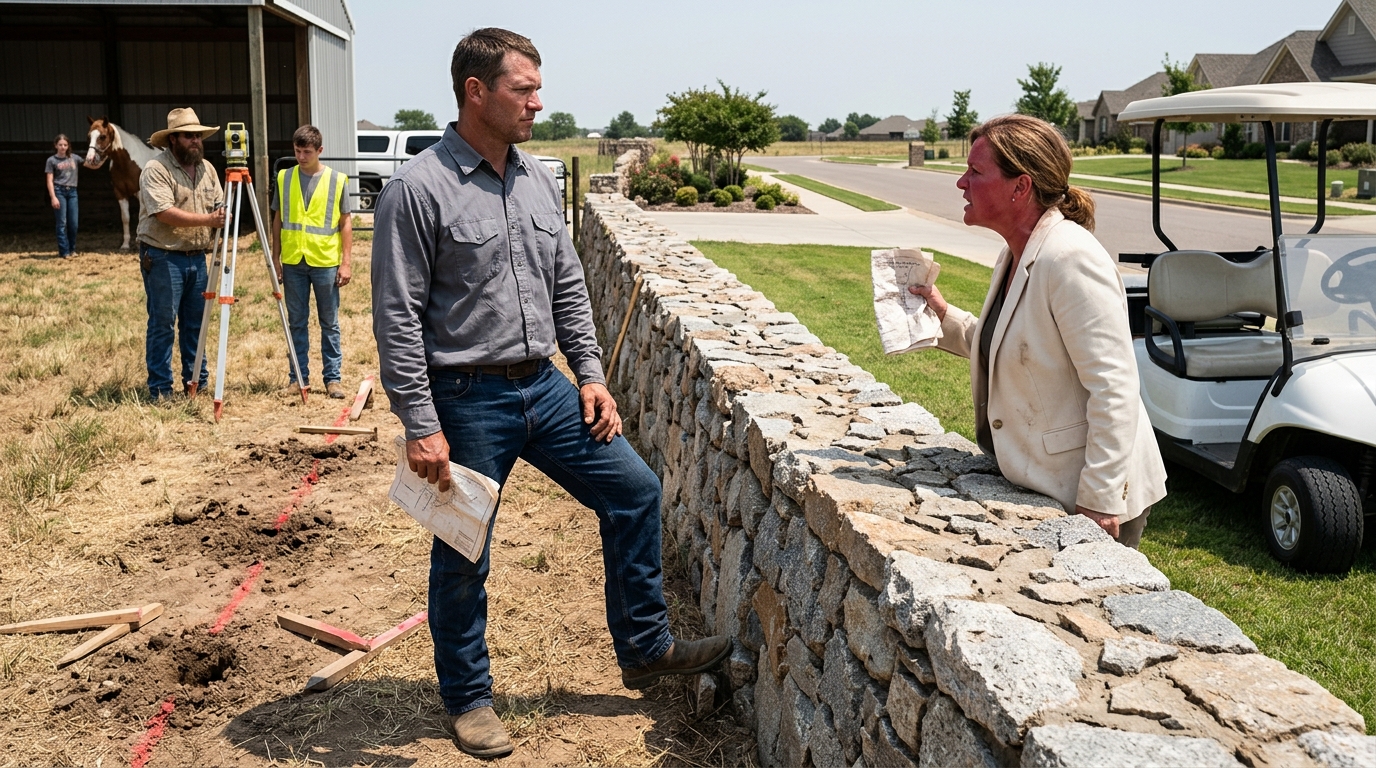
A silver Ford F-150 turned off the main asphalt of Whispering Pines Drive, its tires kicking up a cloud of white limestone dust along the perimeter road. It slowed to a crawl as it reached Karen’s cart. Two men in neon-yellow high-visibility vests sat in the cab. On the truck’s passenger door, faded black magnetic lettering read Tri-County Surveying & Engineering. Beneath it, in smaller block print, was a secondary contractor code: Tract 40-B Infrastructure.
My jaw tightened. Tract 40-B was the historical designation for the scrub parcel east of the creek—land my father leased to the county for flood drainage back in ’88, a lease that expired when the city incorporated the ward.
The driver killed the truck’s engine. A burly man with a thick beard and a battered straw hat stepped out, hoisting a heavy aluminum tripod over his shoulder. Behind him, the younger crewman grabbed a box of wooden hub stakes and a spool of fluorescent red chalk line.
Karen stepped down from her golf cart, her sandals crunching on the loose gravel. She gestured toward the ancient stone wall—the dry-stacked granite my grandfather had laid with a mule and a sledgehammer after the war.
“Right along the inner ridge, Hank,” Karen said, her voice carrying clearly across the dry pasture. “Clear the brush if you have to. The HOA board approved the setback line up to the oak line.”
The oak line sat forty feet inside my property.
I let the screen door click shut behind me as I stepped off the porch. The heat hit my chest like a wet wool blanket. I didn’t rush. I didn’t shout. I walked with a measured, heavy tread, my work boots cutting quiet paths through the dry yellow grass.
Emily watched from the shade of the barn overhang, her hand rested flat on Patches’ shoulder. The horse blew a soft puff of air through his nostrils, sensing the sudden drop in atmospheric pressure that always comes before a storm.
By the time I reached the stone fence, the surveyor was unfolding the legs of his total-station tripod, jamming the metal spikes into the soft soil three feet on my side of the granite.
“Take those spikes out of the dirt, Hank,” I said. My voice was low, flat, and dry as the brush.
The surveyor froze. He looked up, squinting against the glare of the noon sun. “Mr. Miller?”
“You know who I am,” I said. “And you know where the county corner monument sits. It’s sixty yards south, sunk into the limestone under that live oak. You’re setting up on private deeded acreage.”
Karen marched right up to the opposite side of the low wall, her face flushed dark red under her visor. “This is HOA common area buffer zone, Arthur! The board signed off on the re-alignment survey this morning. You received the legal notice from Mr. Vance.”
“Vance is an attorney, not a surveyor,” I said, staring directly at Hank. “And if you drop that plumb line on this side of the stone, Hank, you’re trespassing under Texas Natural Resources Code Chapter 21. You’re operating without a signed access warrant.”
Hank pulled his hands back from the tripod as if the aluminum were hot. He looked at Karen, then at the wooden stakes in his assistant’s hands. “Ma’am, you said the access easement was cleared with the landowner.”
“It is cleared!” Karen snapped, her voice rising an octave. “He is in non-compliance! The easement reverted to the master development plan when the covenants were recorded!”
“Show me the county clerk’s stamp,” I said smoothly. I reached into my back pocket, pulled out the folded 1946 Bedrock Survey copy, and laid it flat across the top stone of the wall. “Show me where my grandfather surrendered the mineral or surface rights for Tract 40-B.”
Hank leaned over, his eyes scanning the faded ink lines and the distinct, hand-lettered metes-and-bounds description. His thumb hovered over the red wax seal of the 1946 registrar.
“This is the original bedrock plat,” Hank muttered, rubbing his beard. “This isn’t in the digital regional database.”
“Because your employer didn’t file the digital update,” I said, keeping my gaze locked on Karen’s trembling chin. “They dropped the Whispering Pines master plan right over the top of the old county survey and prayed nobody would cross-reference the physical markers.”
Karen grabbed the paper off the stone, crumpling the edge in her fist. “This is obsolete trash! A seventy-year-old scrap of paper doesn’t override a gated community’s master deed! We will have the sheriff remove you from this line by noon tomorrow!”
“Call him,” I said, stepping right up to the edge of the stone fence, the toe of my boot touching the granite. “Tell Sheriff Ross to bring his tape measure. And tell him to bring the county clerk’s land-fraud investigator while he’s at it.”
Karen stared at me, the air trapped in her lungs. For a fraction of a second, the self-righteous arrogance flickered out of her eyes, replaced by a cold, calculating flicker of genuine panic. She didn’t look at the land. She looked down at the crumpled corner of the 1946 survey in her hand, specifically at the line marked Blackwood Infrastructure Corp Right-of-Way (Expired).
“Pack it up, Tim,” Hank told his assistant, pulling the tripod out of the dirt.
“Hank, you finish this survey or your contract is terminated!” Karen yelled, but the crew was already tossing the wooden stakes back into the bed of the F-150.
I didn’t say another word. I picked up my folded map, smoothed the crumpled edge against my thigh, and watched the silver truck execute a sharp, dust-swirling U-turn back toward the paved gates of Whispering Pines.
Karen turned on her heel and marched back to her golf cart, her engine whining as she floored the pedal.
I stood by the ancient stone wall, feeling the fierce heat radiating off the granite. The surveyors were gone, but the fresh puncture holes their tripod had left in my dirt remained—three small, dark wounds in the earth, exactly six feet inside my grandfather’s boundary.
CHAPTER 3: COLD FRICTION
The three small puncture wounds in the dirt outside my fence line stayed in my mind all afternoon.
By seven o’clock, the Texas heat had settled into a dense, humid twilight. I wore my clean dark denim, a ironed gray button-down, and work boots wiped free of mud. In my right hand, I carried a single Manila folder containing the three survey sheets and a five-page extract of municipal property code. In my left pocket, the brass plumb bob clicked softly against my keys with every stride.
The Whispering Pines Estates Clubhouse looked like a Tuscan villa dropped onto a scraped prairie. Recessed spotlighting illuminated the manicured lawn, highlighting two dozen manicured boxwoods that had never known a drop of unfiltered groundwater.
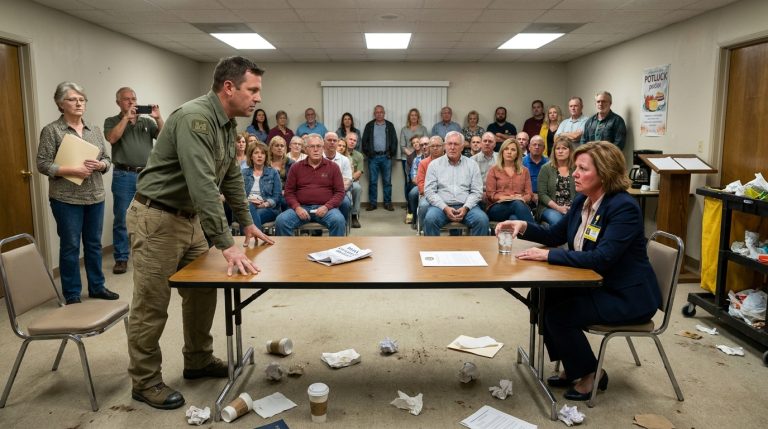
Inside, the air conditioning hit like a freezer door opening. Forty homeowners sat in rows of padded folding chairs. At the front, behind a long folding table draped in dark blue cloth, sat the four members of the HOA Executive Board.
Karen held the gavel in the center. To her right sat Arthur Vance, his silver hair combed back with grease, a leather briefcase sitting open at his feet.
Karen raised the wooden gavel and struck the sound block twice. The sharp crack echoed through the vaulted drywall ceiling.
“Item four on the executive agenda,” Karen announced, her voice projected through a small portable microphone. “Continued non-compliance and easement trespass at Parcel 12-A, commonly known as Miller Ranch.”
A quiet rustle rippled through the room. A few eyes turned toward the back row where I stood near the double doors, my back straight, my arms folded across my chest.
“As many of you know,” Karen continued, smoothing the lapel of her tailored cream blazer, “the board voted last quarter to enforce uniform boundary setbacks across the eastern perimeter. Mr. Arthur Miller has consistently refused access to authorized contractors, racked up over five thousand dollars in unpaid fines, and today physically obstructed a certified surveying team.”
Arthur Vance leaned toward his microphone, his voice smooth and measured. “For the benefit of the community, the board is preparing an expedited petition for a court-ordered injunction and a tax-lien filing to protect the neighborhood’s property valuations.”
A man three rows ahead of me muttered something to his wife and nodded in agreement.
I didn’t call out from the back. I didn’t raise my hand. I walked down the center carpet aisle, my boots making deliberate, quiet thuds against the floorboards beneath the synthetic rug.
Karen’s knuckles turned white around her gavel. “Mr. Miller, this floor is not open for public comment until section seven.”
I reached the front table and laid the Manila folder flat on the blue cloth, right over Vance’s open notepad.
“Section seven is for general grievances,” I said. My voice was clear, low, and carried without a microphone. “This isn’t a grievance, Karen. It’s a notice of statutory violation.”
Vance didn’t look flustered. He slid the folder toward himself with one finger, opening it with practiced indifference. “Mr. Miller, if this is another copy of your grandfather’s deed, we have already reviewed—”
“Read page three, paragraph two,” I cut in. “The highlighted text.”
Vance’s eyes flicked down. The smug smile on his face faltered for a fraction of a second—a micro-stutter in his eyelid that lasted less than a beat, but I caught it.
“This board passed Resolution 4-B last year,” I said, turning slightly to face the forty residents seated behind me. “You told the homeowners it was a routine zoning adjustment to allow for underground storm-drain maintenance.”
“It was a routine adjustment,” Karen snapped, her microphone screeching with feedback as she leaned forward. “Passed unanimously by a quorum of this board!”
“You didn’t have a legal quorum,” I said. “Under Texas Property Code Chapter 209, any covenant modification affecting adjacent un-covenanted deed lines requires a sixty-seven percent affirmative vote of the entire membership, not just four people sitting at a folding table.”
Vance closed the folder with a sharp snap. “That code applies to residential subdivisions, Mr. Miller. Whispering Pines operates under a master developer exemption granted under the 2012 infrastructure charter.”
“Granted to Blackwood Infrastructure Corp,” I said.
The room went completely still. Karen’s hand froze mid-air above her gavel.
“Blackwood surrendered its development charter to the county three years ago,” I continued, leaning both hands flat on the table, bringing my face six inches from Vance’s. “Which means your ‘master developer exemption’ expired thirty-six months ago. Every fine you’ve issued under Resolution 4-B is legally void. And every dollar you’ve collected for ‘perimeter maintenance’ on Tract 40-B is an illegal assessment.”
A woman in the third row leaned forward. “Wait—what perimeter maintenance? We paid a two-hundred-dollar special assessment for that in March!”
Karen struck the gavel three times in rapid, desperate succession. “Order! This meeting is not a public forum for unverified legal claims! Mr. Miller, you are out of order!”
“I’m not asking for the floor, Karen,” I said, picking up my folder and tucking it neatly under my arm. “I’m giving you notice. If another contractor sets foot across the granite wall at Tract 40-B without a county judge’s signature, I won’t call a surveyor. I’ll file an immediate injunction against this board individually, not as an association.”
I looked Vance straight in the eye. “Individually means the HOA’s liability insurance doesn’t cover your legal defense. You pay out of pocket.”
Vance’s mouth snapped shut into a thin, tight line. He didn’t offer a rebuttal. He didn’t look at Karen. He picked up his pen and began rapidly crossing out lines on his legal pad.
I turned on my heel and walked back up the aisle. Nobody spoke. The silence in the room wasn’t polite; it was the cold, heavy quiet of forty people realizing the ground beneath their feet wasn’t as solid as they had been sold.
As I pushed through the heavy glass exit doors into the humid night, I heard Karen’s gavel strike the wood one more time, but the sound was hollow, thin, and entirely stripped of authority.
CHAPTER 4: THE UNBURIED UTILITY
The humid night air outside the clubhouse clung to my skin like greasy wool. I didn’t drive straight home. I pulled my F-250 onto the gravel shoulder of County Road 404, killed the headlights, and sat in the dark cab with the engine ticking as it cooled.
From the high bench seat, I looked across the ravine toward the eastern line of my property. Two hundred yards off, past the granite wall, a yellow mini-excavator sat silent under the security floods of the Whispering Pines maintenance yard. It wasn’t an HOA lawn tractor. It was a twelve-ton track hoe with a narrow trenching bucket.
They weren’t planning to survey the boundary. They were getting ready to dig it.
By five thirty the next morning, the sun hadn’t cleared the live oaks, but the sky had turned the color of bruised slate. I walked down to the creekbed carrying a heavy steel pry bar, an entrenching shovel, and my grandfather’s surveyor bob in my canvas tool bag. My boots sank three inches into the soft silt along the bank where the 1946 line met the granite wall.
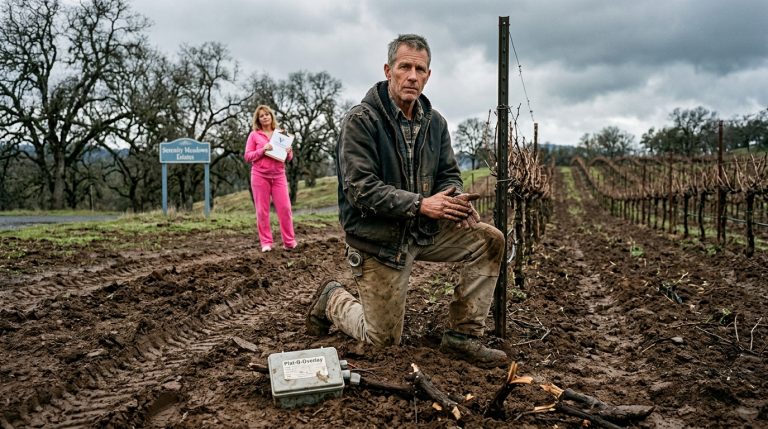
The eastern acre was choked with wild cedar and greenbrier, but ten feet inside my property line—right where Hank’s tripod spikes had bitten the dirt yesterday—the grass looked wrong. The native bluestem was yellowing in a straight, six-foot-wide swath that stretched eighty yards parallel to the creek.
I dropped to one knee. The soil under the dead thatch wasn’t compact limestone clay. It was loose, pale fill, full of crushed aggregate that didn’t belong in this valley.
I drove the steel tip of the pry bar into the ground. It went down six inches, then struck something solid with a dull, heavy thunk. Not stone. High-density plastic.
I scraped back four inches of loose dirt with the entrenching blade. Beneath the topsoil lay a strip of bright orange warning tape buried two feet above a six-inch PVC conduit line. The printed block text on the tape was coated in red mud, but the capital letters were legible: CAUTION: HIGH VOLTAGE / WATER MAIN ROUTE – PROPERTY OF BLACKWOOD INFRASTRUCTURE CORP.
My thumb dragged across the raised lettering on the tape.
They hadn’t just altered the map in 2015. They had laid a primary utility corridor directly through my grandfather’s land during the initial phase of Whispering Pines construction. The HOA board didn’t want my horses gone because of smell or bylaws; they wanted the land because a multi-million-dollar municipal utility trunk ran six feet inside my boundary line without an easement.
If I proved the boundary was mine, the county would force Whispering Pines to either tear up three hundred yards of paved road to re-route the trunk or pay inverse-condemnation damages that would bankrupt their development fund.
A dry branch snapped behind me in the cedar brake.
I didn’t leap up. I wiped the red clay off my entrenching blade onto my sleeve, stood up slowly, and turned around, keeping the heavy steel pry bar rested lightly against my right thigh.
Arthur Vance stood twenty feet back, his expensive leather dress shoes ruined by the wet creek silt. He wore a damp poplin shirt without a tie, his hair uncombed. He looked less like a corporate attorney and more like a man who hadn’t slept since the meeting ended.
Behind him stood two men in gray work shirts, holding steel fence posts and a sledgehammer.
“You’re digging on a designated drainage corridor, Mr. Miller,” Vance said. His voice lacked the smooth, rehearsed cadence it had inside the clubhouse. It was thin, rasping against the humid morning air.
“This isn’t a drainage corridor, Vance,” I said, pointing the tip of the pry bar at the exposed orange tape in the mud. “It’s an un-permitted utility trespass. Blackwood laid this main in 2012 when they cleared Tract 40-B.”
Vance’s eyes dropped to the orange plastic. His left hand twitched, his thumb digging hard into his palm—an involuntary micro-action that betrayed the icy composure he tried to project.
“The original developer had authorization—”
“The original developer forged the registrar’s stamp on the 2015 plat,” I said, stepping across the exposed trench line. “Karen didn’t sign that enforcement order to protect property values. She signed it because Blackwood’s parent company still holds forty percent of the unsold lots in Whispering Pines, and if this pipe gets exposed, the city revokes their occupancy permits.”
Vance looked at the two men with the sledgehammer. Neither of them moved. They were local laborers, paid by the hour, and they knew the difference between a fence job and a boundary war.
“We can negotiate a retro-active easement,” Vance said quietly, his eyes darting toward the stone wall where my truck sat idling on the ridge. “A lump-sum settlement. One hundred thousand dollars. Paid directly to you, out of the master maintenance reserve.”
I looked at the mud on my boots, then at the orange tape sticking out of my earth.
“My grandfather bought this dirt for eighteen hundred dollars when he came back from Europe,” I said, my voice low and hard as the granite bedrock beneath us. “You couldn’t buy six inches of it for every dime in your association’s bank account.”
“Mr. Miller,” Vance’s voice hardened, the desperation surfacing as a cold threat. “If you block the utility access, the board will file an emergency health-and-safety injunction by noon. A judge will grant us temporary possession of the corridor before you can get a court date.”
“Let him try,” I said, jamming the pry bar deep into the fill right alongside the pipe. “Tell your judge to bring his own shovel.”
CHAPTER 5: THE SIEGE OF COVENANTS
The tip of the pry bar stayed sunk two inches into the dirt right against the PVC conduit. Neither Vance nor the two men in gray shirts moved a muscle.
“You have five minutes to get off my land,” I said.
Vance pulled a handkerchief from his pocket, wiped his forehead, and carefully folded the cloth into a small square. “This isn’t over, Arthur. You can’t hold a municipal utility hostage.”
“It’s not a municipal utility,” I replied, my voice steady over the patter of rain hitting the cedar leaves. “It’s an unrecorded commercial encroachment. Tell Karen if she wants to discuss terms, she can meet me at the county recorder’s office.”
Vance turned without another word and walked back through the brush, his wet shoes squelching in the silt. The two laborers followed him, leaving their sledgehammer leaning against a fence post.
By ten o’clock, the rain had turned into a steady, gray downpour. I stood on the back porch, wiping down the brass plumb bob with an oiled rag before tucking it into my pocket.
Emily came out through the kitchen doorway, holding two mugs of black coffee. She handed one to me and leaned against the porch railing, looking out toward the driveway.
“Deputies?” she asked softly.
“They won’t send deputies yet,” I said, taking a sip of the bitter coffee. “Sheriff Ross knows the difference between a criminal trespass and a civil boundary dispute. Vance has to go through a judge first.”
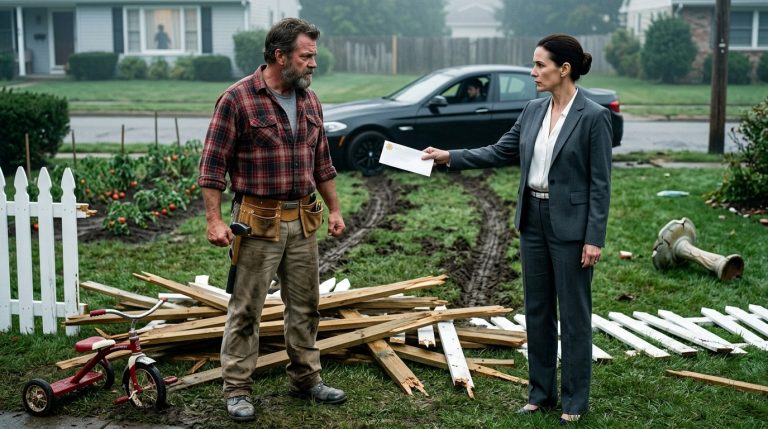
A yellow county maintenance truck pulled up to the gate, followed closely by Karen’s white golf cart, covered now by a plastic rain canopy. A man in a brown rain slicker stepped out of the county truck and unlatched my entry gate.
I walked down the steps, meeting him halfway on the gravel driveway.
“Art,” the man said, pulling off his hat. It was Jim Miller—no relation, just a county road supervisor who’d known my father for thirty years. “I got a formal notice from the Whispering Pines board claiming an emergency drainage obstruction on the county right-of-way.”
Karen leaned out from under her golf cart canopy, her raincoat pulled tight around her neck. “Tell him, Jim! Tell him he’s obstructing a public drainage easement!”
Jim looked at me, then looked past my shoulder toward the creekbed. He pulled a yellow carbon copy from his clipboard. “They filed an administrative stop-work order against your property, Art. Claims you’re interfering with sub-surface municipal flow.”
I reached into my pocket, pulled out a laminated copy of the 1946 Bedrock Survey, and handed it to Jim.
“Look at the section corner mark on page two, Jim,” I said. “And check the county charter for Tract 40-B.”
Jim squinted at the paper in the dim rain light. He ran a calloused finger over the red ink seal. “Tract 40-B… that’s the old county lease parcel from eighty-eight.”
“The lease expired in 2008,” I said. “Whispering Pines never renewed it. They buried a commercial trunk line inside my deeded boundary line without an easement, and now they’re trying to use an HOA covenant to cover up a municipal code failure.”
Jim looked from the map to Karen. His expression hardened into a dry, flat scowl. “Karen, is this an unrecorded main?”
“It’s a board-approved infrastructure corridor!” Karen yelled over the sound of the rain against her plastic roof. “We have an injunction hearing scheduled for two o’clock!”
“You don’t have an emergency order,” Jim said, folding my map carefully and handing it back to me. “And as far as county road maintenance goes, this isn’t our pipe. If you want to dig on Art’s deeded line, you bring a signed warrant from Judge Harlan, not an HOA notice.”
Jim turned back to his truck, climbed in, and slammed the door.
Karen’s hands gripped the plastic steering wheel of her cart until her knuckles turned white. “You think you’ve won something, Arthur?” she spat, her voice trembling with cold rage. “By two o’clock today, Judge Harlan will sign the temporary access order. And when he does, I am bringing a commercial excavation crew to tear up every foot of that creekbed.”
I stepped up to the side of her cart, looking down at her through the rain-streaked plastic window.
“Bring them,” I said quietly. “And make sure Vance brings his personal checkbook.”
She floored the electric accelerator, the cart’s tires spraying wet gravel as she sped back toward the paved roads of Whispering Pines.
I stood in the rain, watching the red taillights disappear into the mist. I reached into my pocket, feeling the cold weight of the brass plumb bob against my palm. The court hearing was four hours away, but the trap was already set.
CHAPTER 6: CHECKMATE AT THE BEDROCK
The rain had eased to a fine, cold mist by the time I pulled the F-250 into the concrete parking lot behind the county courthouse.
I didn’t carry a briefcase. Under my arm, I held a thick cardboard cylinder sealed with tin end-caps. In my jacket pocket, my fingers rested on the knurled brass body of the 1946 plumb bob.
District Courtroom 3 smelled of floor wax, damp wool, and old varnish. Judge Harlan sat behind the elevated mahogany bench, his wire-rimmed spectacles resting on the tip of his nose as he scanned a stack of freshly collated papers.
Arthur Vance sat at the plaintiff’s table, his leather briefcase standing open beside him. Karen sat next to him, her fingers laced so tightly together on the oak veneer that her knuckles showed yellow under the overhead fluorescent tubes.
“Mr. Miller,” Judge Harlan said, his voice deep and gravelly, echoing off the high plaster walls. “The board of Whispering Pines has filed an emergency motion for a temporary restraining order and access authorization regarding an alleged utility obstruction on Tract 40-B. You’re representing yourself today?”
“I am, Your Honor,” I said, walking up to the defense table and standing behind the wooden chair. I didn’t sit down.
Vance stood up immediately, adjusting his tie. “Your Honor, the board has submitted sworn affidavits from certified utility inspectors. The trunk line passing along the eastern perimeter services forty-two homes in Sector Four. Mr. Miller’s active physical interference poses an immediate public health and infrastructure risk.”
Judge Harlan turned a page. “Mr. Miller, do you deny that a secondary water and power conduit runs along that boundary?”
“I don’t deny the conduit is there, Your Honor,” I said smoothly. I popped the tin cap off the cardboard cylinder and slid two large rolled documents onto the table. “I deny that the HOA or its umbrella corporation ever possessed the legal authority to lay it.”
Karen leaned toward Vance, her lips moving in a sharp, hurried whisper, but Vance kept his eyes fixed on the rolled maps in my hands.
“I am placing two certified records into evidence,” I said, unrolling the first map flat across the oak table and weighting the corners with the metal end-caps. “Exhibit A is the original 1946 Bedrock Survey, filed with the county registrar under Volume 14, Page 88. It defines the exact metes and bounds of the Miller Ranch, anchored to the granite bed of Indian Creek.”
I unrolled the second document right alongside it. “Exhibit B is the 2012 plat modification submitted by Blackwood Infrastructure Corp during the construction of Whispering Pines Phase One.”
Judge Harlan leaned forward over his bench, peering down. “What is the discrepancy, Mr. Miller?”
“Exhibit B shows a six-foot public utility setback,” I said, tapping the paper with the brass point of the plumb bob. “Supposedly dedicated by the county in 1988 under the temporary lease for Tract 40-B. But if you examine the registrar’s seal on Exhibit B, you’ll find the corporate entity listed isn’t the municipality.”
I looked directly at Karen. Her face had gone completely gray.
“It’s a shell entity registered under Karen’s maiden name,” I said, my voice cutting through the silent courtroom like a cold blade. “Blackwood Infrastructure Corp didn’t surrender its development charter to the city in 2012. It transferred its liabilities to a private holding company. Karen used her position as HOA president to authorize an un-permitted private utility line over my grandfather’s deeded acreage, then billed the homeowners two hundred thousand dollars in special assessments for ‘municipal drainage upgrades’ that were never filed with the county clerk.”
Vance’s hand dropped to his legal pad. He didn’t offer an objection. He didn’t look at the judge. He slowly turned his head to look at Karen, his expression turning into a cold mask of professional horror.
“Your Honor,” Vance said, his voice dropping an octave as he carefully closed his briefcase latch with a sharp click. “My firm was retained to represent the homeowners association in a standard boundary dispute. We were not advised of any undisclosed corporate cross-ownership regarding Blackwood Infrastructure Corp.”
“Mr. Vance,” Judge Harlan said, his voice dangerously soft. “Are you withdrawing this motion?”
“I am withdrawing the motion immediately, Your Honor,” Vance said, stepping two feet back from the table, completely isolating Karen where she sat. “And I am advising my client to seek independent legal counsel.”
Karen opened her mouth, but no sound came out. The absolute conviction, the arrogant certainty that had carried her to my fence line two days ago, had collapsed into a hollow, terrifying void.
Judge Harlan brought his wooden gavel down with a sharp, echoing CRACK.
“The petition for emergency access is denied with prejudice,” Harlan ruled. “This court orders an immediate freeze on all association enforcement actions against Parcel 12-A. Furthermore, the county clerk is directed to refer the survey filings for Tract 40-B to the District Attorney’s fraud division for formal investigation.”
The rain had stopped completely by the time I drove back through the wooden gates of Miller Ranch. The sun was breaking through the western clouds, casting long, golden light across the wet pastures and turning the stone wall into a ridge of dark granite and silver moss.
I parked the F-250 by the barn. Emily stepped out onto the porch, holding a leather halter in her hand. She didn’t ask about the court or the judge. She looked at my face, saw the quiet stillness there, and gave me a small, slow nod.
I walked down to the eastern fence line alone.
The air smelled of clean rain, wet cedar, and overturned earth. The three small puncture holes where the surveyor’s tripod had bitten into my dirt yesterday were already smoothing over, filled with fresh silt washed down from the ridge.
I reached into my pocket, pulled out the 1946 brass plumb bob, and sat down on the flat top stone of my grandfather’s granite wall. I pulled a small piece of fine emery cloth from my pocket and began gently rubbing away a spot of tarnish on the knurled brass cap, restoring the bright, clean metal beneath.
The stone beneath me was solid, grounded deep in the limestone bedrock, unmovable and unbothered by the quiet, fading world beyond the line.