The Rusted Steel and the Quiet Garden: How One Outcast Engineer Rewrote the Rules of War
CHAPTER 1: THE COLD WATER TANK
The water in the zinc tub was slate-gray under the March twilight.
Barnes Wallis knelt on the damp grass, his knees pressing hard into the mud through a frayed piece of canvas. His wire-rimmed glasses slipped down the bridge of a nose pinched by the chill, but he did not reach up to push them back. His thumb rested against the smooth, cold curve of a glass marble, feeling the tiny imperfections left by a factory mold in Ripley.
Across the kitchen window, a faint yellow light flickered where Molly was scraping dried porridge from an iron pot. She did not look out anymore. For three months, the rhythmic clack-ping of glass hitting zinc had become the dull metronome of a household living on short rations and quieter terror.
Wallis flicked his wrist.
The marble skimmed the surface, bouncing once, twice, biting into the water with a sharp hiss before sinking into the murky depths. He did not watch it sink. He watched the concentric ripples colliding against the rusted sides of the tub, transferring energy outward with brutal, silent efficiency.
“It isn’t about breaking the surface,” he muttered to the empty garden, his voice raspy from a day spent inhaling coal smoke and damp air. “It’s what the medium does when you stop fighting it.”
The gate latch at the side of the house clicked—a dry, metallic snap that cut through the low rumble of a distant freight train on the London line. Wallis did not turn his head. He reached into his coat pocket, his fingers brushing past a grease-stained notebook filled with calculations scribbled in the margins of old grocery bills.
The war was six months old, and the newspapers on the sideboard spoke only of U-boat wolf packs chewing through merchant convoys in the Atlantic. Every headline was a reminder of steel roofs twenty feet thick that laughed at the largest blockbusters the Royal Air Force could haul.
He pulled another marble from his pocket, his knuckles stiff with the damp arthritic ache that came from too many hours bent over a workshop bench at Vickers.
“They want bigger hammers,” Wallis whispered, his thumb pressing the glass until the skin turned white. “They’re building mountains of iron to smash against mountains of concrete.”
He drew his arm back, his eyes locked on the dark water, waiting for the cold to settle deep into his bones before he made the next throw.
CHAPTER 2: THE BUREAUCRATIC WALL
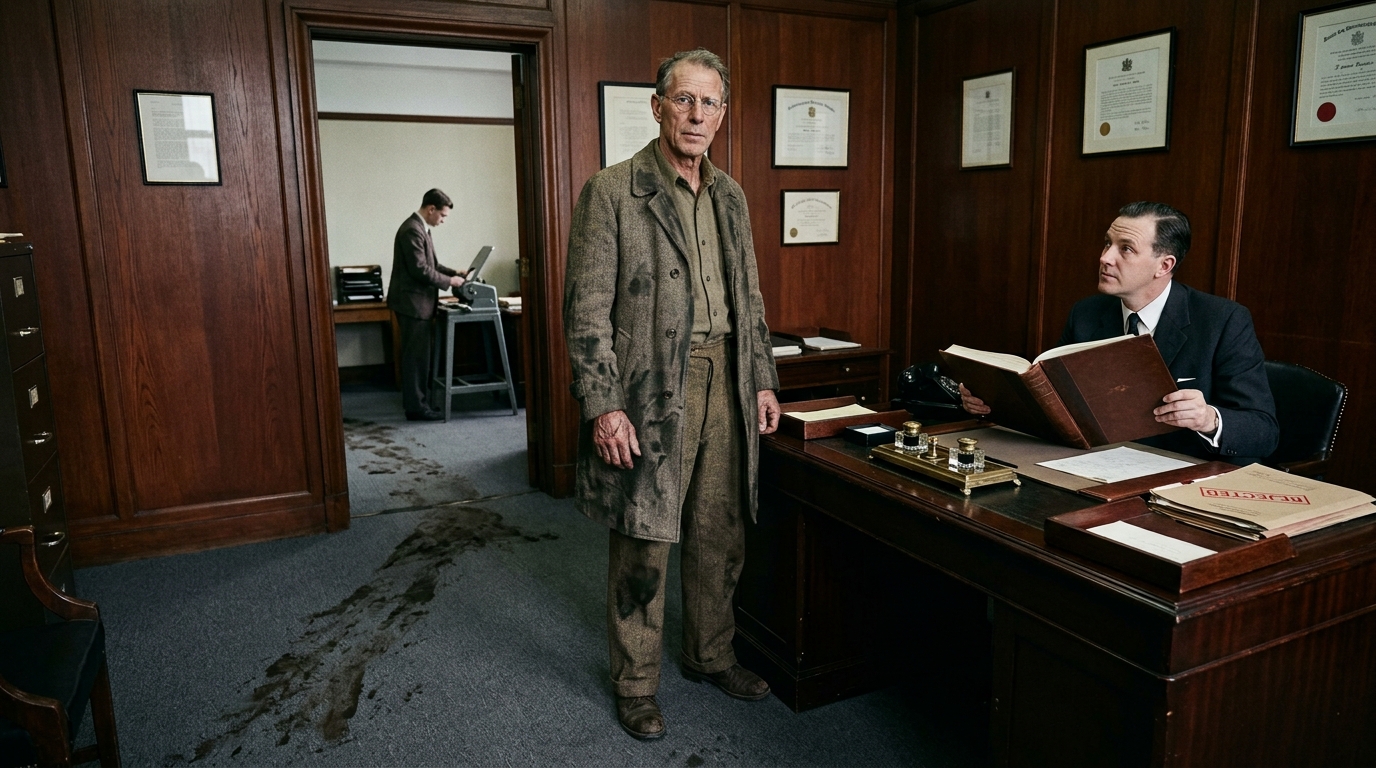
Barnes Wallis did not wipe his boots before stepping onto the heavy wool runner. The mud from the Surrey lane was caked deep into the treads of his leather shoes, leaving a dark, stubborn smear across gray institutional carpeting that had never seen a working man’s garden.
Across the mahogany barrier, a junior undersecretary named Pringle kept his eyes fixed on a ledger, refusing to look up until the silence became a physical weight.
“The Air Ministry has reviewed your preliminary notes, Mr. Wallis,” Pringle said, his voice flat and dry as old parchment. “And the conclusion of the scientific committee is quite definitive.”
Wallis adjusted his wire-rimmed glasses, feeling the sharp edge of a wooden block in his coat pocket where he had carved a scale model of his steel penetrator during the train ride up from Weybridge.
“They haven’t seen the drop tests at Harmondsworth,” Wallis said.
“They have seen enough to know that dropping heavy objects into municipal water tanks does not constitute aerodynamic research,” Pringle replied, finally lifting his gaze. “We are fighting a total war, Mr. Wallis. We are not conducting parlor tricks for village children.”
A rhythmic, metallic tapping echoed from the outer office—someone dropping a hole-punch through thick card stock with metronomic regularity.
Wallis didn’t blink. He reached into his pocket, his thumb brushing the cool, worn edge of his pocketknife. “The U-boat pens at Saint-Nazaire are covered by twenty feet of reinforced concrete. Your blockbusters are bouncing off them like lead shot off a church door.”
“And our engineers have calculated that no aircraft in existence can carry a projectile heavy enough to crack that mass from altitude,” Pringle snapped, leaning back and letting the leather chair groan in protest. “You have no university degree in ordnance design, Mr. Wallis. You have no commission. You are an assistant chief designer of airships. Stay in your hangar.”
The air in the room smelled faintly of stale carpet adhesive and damp wool, oppressive and heavy with the absolute certainty of men who had never turned a lathe in their lives.
Wallis did not raise his voice. “The concrete doesn’t care about a university degree, Mr. Pringle. When a sphere hits water at the correct velocity, the energy doesn’t dissipate into the air. It travels through the medium.”
“Enough,” Pringle said, slamming his ledger shut with a crack that made the inkwell rattle against the glass tray. “The file is closed. No further state funds will be allocated to your backyard experiments.”
Wallis stood up slowly, his knees stiff from the damp ride, and left the damp smudge of Surrey mud right where the undersecretary’s polished shoes would have to cross it.
CHAPTER 3: THE WORKSHOP OF REJECTION
The unheated storeroom smelled of stagnant machine oil and damp cardboard left behind by departed clerks.
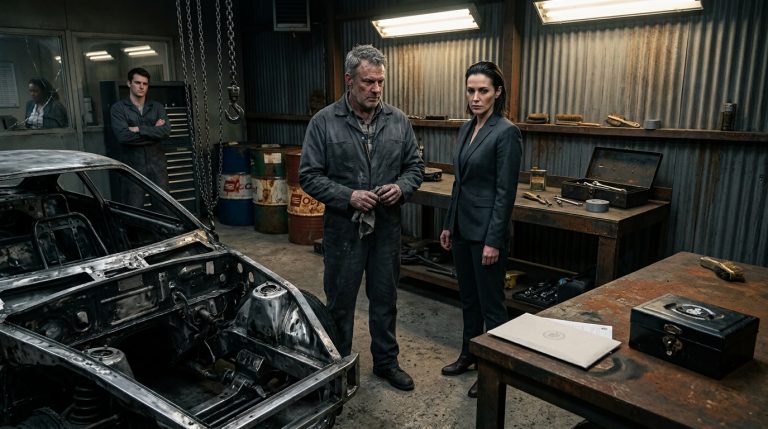
Barnes dragged a wooden crate across the splintered floorboards, his breath pluming white in the freezing March air as he arranged a row of crude metal cylinders along the bench. Without state funding or official blueprints, every millimeter of progress had to be carved, weighed, and tested by hand using scavenged scrap from the factory scrap-heap.
The door creaked open an inch, letting in a thin ribbon of gray draft from the hallway.
“They won’t even clear the test range at Harmondsworth for your scale models, Barnes,” Molly said, her coat pulled tight around her shoulders as she set a dented tin mug of lukewarm tea on the edge of the workbench.
Barnes didn’t stop filing down the nose cone of a lead-weighted cylinder; the rasp of metal against steel filled the small room with a steady, biting friction.
“The Ministry thinks a closed door stops physics, Molly,” he muttered, his fingers gray with graphite dust and cold sweat. “They can lock the front gate, but they can’t stop the ground from carrying a shockwave.”
He picked up a heavy iron marble, turning it over in his calloused palms to test its balance against gravity.
The blueprint rolls on the back shelf remained untouched, stamped with bright red rejection notices signed by committees that had never built a bridge or cast a hull in their lives.
“If the directors find out you’re using Vickers equipment after hours for unauthorized ordinance, they’ll strip your badge,” Molly warned, her eyes scanning the dark, drafty corners of the improvised laboratory.
“Let them look,” Barnes said, setting the iron ball down with a heavy thud that rattled the tea tin. “The concrete across the Channel isn’t waiting for committee approval.”
He grabbed a wrench, his knuckles white against the iron handle as he tightened the vise on his next prototype.
CHAPTER 4: THE UNSEEN LEAK
The heavy iron key turned with a dry groan in the lock, the cold night air rushing in to mix with the smell of damp coal dust and machine grease.
Barnes didn’t step inside immediately. His eyes locked on the fresh mud trail smeared across the gray concrete floor—a footprint distinct from his own worn soles or Molly’s sensible heels. Someone had lingered in the dark alleyway between the railway wall and the Vickers annex, watching the window where his scaled-down steel penetrators sat drying on a plank.
A shadow detached itself from the brickwork behind him, slipping into the dim circle of yellow light cast by the gas lamp.
“The committee didn’t just reject your proposals, Wallis,” a quiet voice murmured from the damp gloom.
Barnes turned slowly, his hand closing around the cold handle of a heavy steel file in his coat pocket. It was a junior clerk from the procurement department, his collar turned up against the drizzle, clutching a damp manila folder like a shield.
“They’re scrubbing the requisition logs,” the clerk whispered, casting a nervous glance toward the main factory gates. “Pringle didn’t file your blueprints away for safekeeping. He ordered the security team to classify your backyard test records under industrial sabotage.”
Barnes didn’t flinch. His jaw tightened as the cold air bit into his skin. “Sabotage? For testing how an iron ball sinks in water?”
“They are terrified of what happens if you’re right,” the clerk said, stepping closer into the light. “If an uncredentialed designer proves the Air Ministry has wasted four years throwing tin cans at twenty-foot concrete, the entire command structure takes the blame. They aren’t just ignoring you anymore, Wallis. They’re trying to prove you’re losing your mind.”
The clerk shoved the damp folder onto the edge of the coal bin and vanished back into the shadows before Barnes could ask another question.
Barnes picked up the papers, his thumb tracing the official red ink stamp declaring his calculations null and void.
CHAPTER 5: THE DESPERATE GAMBLE
The damp clay of the testing embankment gave off a heavy, sour smell of stagnant ditch water.
Barnes knelt in the mud, carefully balancing a scaled steel cylinder on a wooden tripod while the wind whipped through the abandoned gravel works. Without official clearance or ministry transport, he had hauled the ballast down here on the back of a rattling farm lorry before dawn.
A sharp crunch of gravel behind him cut through the whistling wind.
“You’re operating outside the defense procurement act, Wallis,” an icy voice barked from the darkness near the rusted crane.
Barnes didn’t look up from the triggering mechanism. His thumb tested the tension of a steel wire, feeling the cold bite of rusted iron.
It was Pringle, standing with two armed security guards whose heavy woolen coats stood out against the desolate landscape like crows on a fence.
“The Ministry warned you that unauthorized ordnance testing on private Crown land is an indictable offense under wartime emergency regulations,” Pringle said, stepping forward with his polished shoes sinking ankle-deep into the wet clay. “Step away from the rig, Wallis.”
Barnes stood up slowly, wiping grease from his palms onto an old rag. “The concrete at Saint-Nazaire isn’t waiting for an indictment, Pringle.”
“You are destroying state-allocated scrap iron for a delusion,” Pringle snapped, gesturing for the guards to close in. “Confiscate the detonators and secure the notes. We are putting an end to this charade right now.”
Barnes did not run. He reached into his coat, his fingers closing around a smooth glass marble.
“You can confiscate the scrap,” Barnes said, his voice hard as iron. “You can lock away every notebook in Weybridge. But you can’t stop the physics when the drop hits the bedrock.”
He flicked the heavy wooden release lever with his boot before the guards could reach him.
CHAPTER 6: THE MIDNIGHT SUMMONS
The desk lamp cast a harsh, yellow circle over stacks of grease-stained test logs and crumpled drafting sheets.
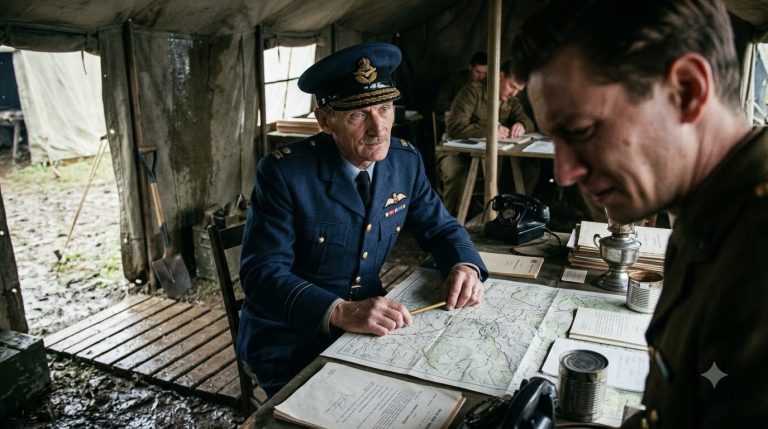
Barnes stood frozen in the quiet chill of the Vickers office, his thumb pressed against the cold metal casing of the phone. The line crackled with static, but the voice on the other end brook no argument—Air Marshal Arthur Harris did not call at three in the morning to debate committee rules.
Pringle stood near the doorway, his face mottled with furious disbelief, clutching a sheaf of confiscated requisition orders that suddenly meant nothing.
“The unauthorized drop tests at the gravel pit cleared sixty feet of simulated bedrock,” Barnes said into the mouthpiece, his voice steady despite the exhaustion tearing at his muscles. “The shockwave travels through the medium itself, sir. You don’t need a mountain of explosive when the earth carries the weight.”
A heavy sigh drifted across the wire from London.
“The Prime Minister has read the field reports, Mr. Wallis,” Harris said flatly, the sound of papers rustling in the background cutting through the hum of the line. “The Air Ministry committee is dissolved. You have your prototype approval for the six-ton penetrator.”
Pringle took a sharp step forward, his mouth opening to protest, to cite protocol, to demand an administrative review.
Barnes didn’t even look at him. He lowered the receiver back onto its brass cradle with a solid, definitive clack that swallowed the undersecretary’s words before they could leave his throat.
The battle against institutional arrogance was over, but the real work—the heavy, unyielding grind of turning physics into survival—was just beginning in the cold dawn outside.