The Dusty Silence of Anzio: A Coal Miner’s War Against the Unseen Watchers of the Italian Ridge
CHAPTER 1: THE FIRST SILENCE
The mud in the Anzio drainage ditch tasted like rusted iron and stagnant river water, but Tommy Reeves didn’t spit it out.
Every drop of moisture gave away position if you weren’t careful.
His fingers curled inside his pocket, rubbing the hard, smooth edge of a black lump of Harlan County coal he’d carried across the Atlantic.
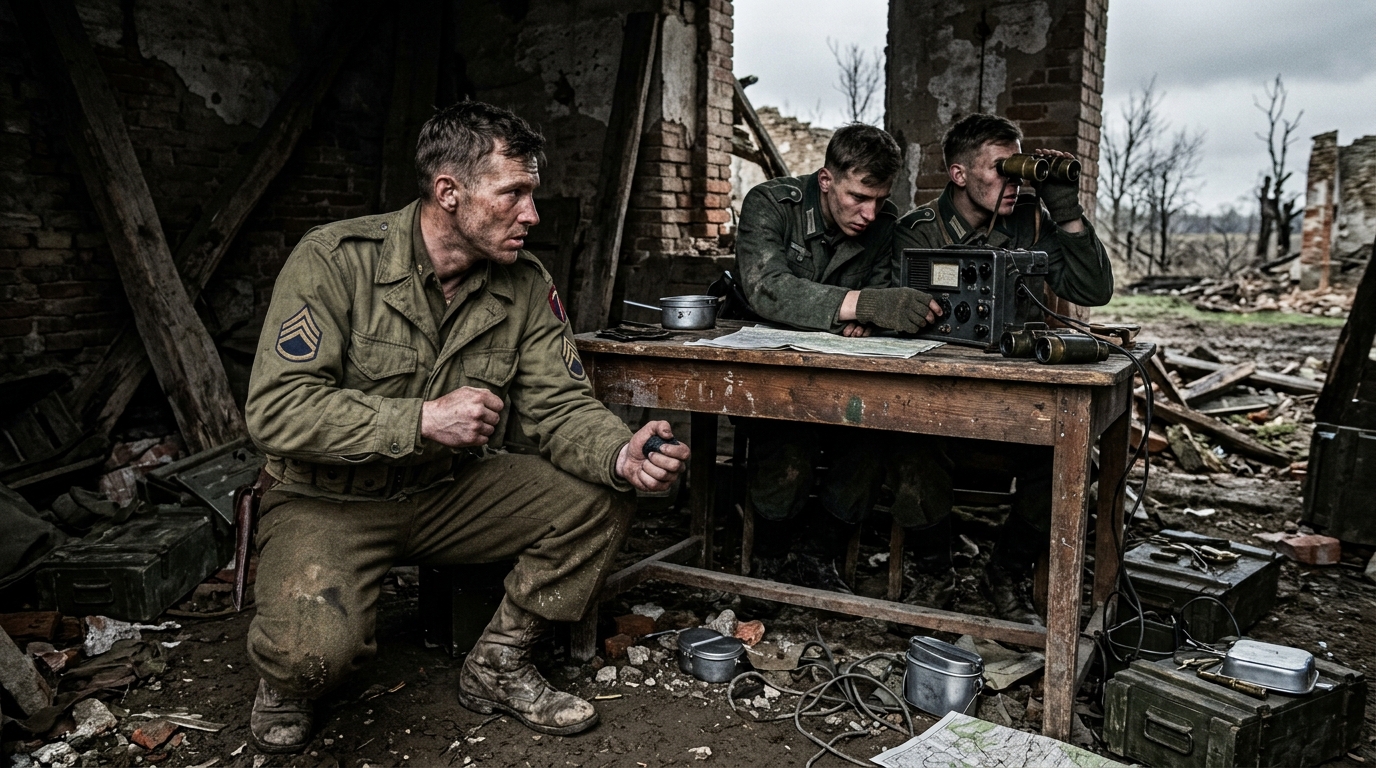
Two hundred yards north, the German observation post in the collapsed barn was shifting its weight.
Tommy didn’t need to look up to know what they were doing.
He could hear the faint, metallic scrape of a radio dial turning through the damp morning air.
Fourteen minutes between frequency adjustments.
It was the same rhythm he used to track roof pressure back in the Kentucky mines when the timber started to groan before a cave-in.
Men called it instinct. Tommy called it listening.
A platoon from Baker Company had dissolved into red mist on this very slope three days ago because nobody took the time to listen to the gaps.
His sergeant’s boots felt heavy, soaked through with freezing Italian rain that had turned the valley into a grey swamp.
Thirty inches of filthy water filled the trench, soaking through his wool trousers and chilling his knees to the bone.
He kept his head low, pressing his face into the wet earth just as a distant mortar tube let out a flat, heavy cough from the Alban Hills.
Ninety seconds.
That was how long it took for the shells to drop once the spotters in the barn locked their coordinates on an Allied patrol.
He didn’t check his watch. He felt the time pass in the tightening of his shoulder muscles and the slow crawl of the mist over the barbed wire.
The radio in the barn crackled with a burst of static, sharp enough to cut through the hum of the artillery motor idling miles behind the lines.
The spotter inside cleared his throat, complaining in muffled German about the morning frost on his boots.
Tommy rolled his shoulder, shifting his weight off a jagged stone that was pressing into his right hip.
The gap was coming.
The two men inside were trading shifts, their eyes locked on the heavy brass binoculars instead of the open ground.
He drew his trench knife an inch out of its leather sheath, feeling the cold steel respond to the damp air.
He didn’t think about glory, and he didn’t think about the lieutenant’s direct orders waiting back at camp.
He just watched the grey smoke drift from the barn’s shattered roof and waited for the silence to break.
CHAPTER 2: ORDERS FROM HEADQUARTERS
The canvas flap of the command tent lifted with a sharp snap against the freezing wind coming down from the Alban Hills.
Lieutenant Ambrose didn’t look up from his maps when Tommy stepped inside, his boots leaving dark stains of heavy mud across the duckboards.
A small paraffin lamp flickered on the crate table, throwing long, jittery shadows across charts of the Anzio perimeter that were already out of date before the ink dried.
—You missed the morning briefing, Sergeant.
Ambrose’s voice was thin, tired, edged with the brittle patience of a man who slept in his uniform and shaved out of a steel helmet.
Tommy didn’t answer right away.
His fingers stayed locked around the dark piece of Harlan County coal in his coat pocket, rubbing the smooth, cold surface until his skin warmed it.
The air inside reeked of damp wool, stale tobacco, and the chemical bite of kerosene.
—I wasn’t at a briefing, Lieutenant. I was checking the drainage lines on the western ridge.
Ambrose finally raised his head, his eyes bloodshot behind wire-rimmed glasses that caught the yellow lamp glare.
—The ones where Baker Company got shredded yesterday? That’s not your sector, and spotter control isn’t your concern.
The lieutenant dropped a red grease pencil onto the table, letting it roll across a grid coordinate marked with a crosshatch of pencil lead.
—Doctrine is clear, Sergeant. Sniper teams handle observation posts. We observe and report. We don’t creep around in the dark playing executioner.
Tommy took half a step forward, the floorboards groaning under his weight.
—The snipers from Minnesota are scattered across forty feet of mud because the spotters in the church tower had a better angle.
The silence in the tent grew heavy, broken only by the steady drip of condensation running down the canvas roof.
Ambrose stood up, his jaw tightening until the skin stretched white over his cheekbones.
—And if you go out there trying your shadow-linking nonsense and get yourself captured, we lose the best scout in the Third Division for nothing.
—Men are dying while we wait for artillery that never arrives on time, Tommy said, his voice flat and low.
—Consider this a direct order, Ambrose snapped, jabbing a finger toward the map. You are forbidden from closing within a hundred yards of an enemy position. Is that understood?
Tommy looked down at the red crosshatch on the table, feeling the cold weight of the coal in his pocket.
—Understood, sir.
CHAPTER 3: CROSSING NO MANS LAND
The pre-dawn mist hung low over the Anzio valley like a wet wool blanket, swallowing the sound of boots moving through the churned mud.
Tommy adjusted the strap of his pack, his fingers brushing the cold iron of the trench knife tucked against his belt.
Behind him, the camp was silent except for the dull clank of a mess kit and the low mutter of sentries changing watch.
He didn’t look back toward Ambrose’s tent.
The orders were clear on paper, but the heavy artillery shells dropping on Baker Company were written in blood on the hillsides.
He slipped past the outer perimeter wire, his movements guided by thirty inches of freezing water and the familiar rhythm of drainage ditches.
Every yard forward meant leaving behind the safety of official doctrine and the comfort of standard reconnaissance rules.
A sudden gust of wind swept down from the Alban Hills, carrying the sharp, chemical stench of cordite and wet ash across the open field.
He dropped flat into a shallow crater, pressing his chest into the damp earth as a searchlight beam swept across the grey horizon.
The light grazed the ridge twenty yards ahead, bathing the ruined skeleton of the barn in a pale, spectral glow.
Tommy waited out the sweep, his breathing slow and measured, matching the steady drip of moisture from a shattered wooden beam above.
The first target was three hundred yards ahead, resting in the dead space between Allied lines and German artillery nests.
He pulled the small piece of Harlan coal from his pocket, rolling it once between his thumb and forefinger before tucking it back away.
There was no radio to call for help if things went sideways, and no backup platoon waiting in the wings.
Just the mud, the cold steel, and the silent discipline of the mining tunnels learned years ago in the dark.
He pushed himself up onto his elbows and began to crawl toward the ridge.
CHAPTER 4: THE BARN CLEARED
The rhythmic crackle of the radio inside the ruined stone walls provided a steady, irritating pulse against the morning cold.
Tommy held his breath, pressing his cheek flat into the freezing slush while the German spotters traded shifts near the shattered window frame.
Fourteen minutes between frequency checks.
The exact gap had opened up just as the radio operator reached for his tin cup of ersatz coffee.
Tommy lunged through the jagged opening in the masonry, his boots making no sound against the rotted floorboards.
The first spotter twisted around, his mouth opening in sudden, sharp alarm before the trench knife caught him cleanly beneath the jawline.
—Quiet—
The second man clawed frantically for his rifle leaning against the crate table, but his sleeve caught on the cord of the radio headset, dragging the whole unit down with a sharp clatter.
Tommy drove his weight forward, pinning the man against the damp stone wall until the struggle went limp.
He didn’t waste a second looking down at the silence settling over the cellar floor.
His fingers reached out, smashing the dials of the German radio into useless scrap metal with the butt of his knife.
On the cold dirt beside the rubble, a single cigarette butt still smounldered, releasing a thin blue wisp of smoke into the damp air.
He kicked dirt over the ash, slung his pack higher onto his shoulder, and checked his map for the next ridge.
CHAPTER 5: THE COMMAND CONFRONTATION
The duckboards outside Lieutenant Ambrose’s tent groaned beneath the weight of soaked leather boots as Tommy pushed through the canvas flap.
The paraffin lamp flickered in the draft, casting harsh yellow light over the same out-of-date maps that had governed a failing campaign.
Ambrose looked up from his red grease pencil, his jaw tightening into a hard, defensive knot.
—You were ordered to stay away from the perimeter, Sergeant.
Tommy didn’t blink.
He unbuttoned the flap of his heavy wool coat and dropped a bloodstained map onto the center of the wooden crate table.
Five red crosses stood out starkly against the grid lines, each one marking a neutralized observation post that had been calling down death for weeks.
—The positions are cleared, Lieutenant. Twelve spotters gone. No shots fired.
Ambrose stared down at the map, his hands gripping the edge of the wood until his knuckles turned bone-white.
—This is a court-martial offense. You violated a direct order, and you bypassed every protocol in the field manual.
—The manual left Baker Company out in the open to rot, Tommy said, his voice flat, low, and entirely devoid of fear.
—And if you think I’m going to cover for an insubordinate scout who thinks he can run his own private war, you’re entirely mistaken.
The lieutenant reached for the field telephone, his hand trembling slightly with a mixture of bureaucratic rage and stubborn pride.
—I’m calling division command right now to have you stripped of your stripes and locked in the stockade.
Tommy didn’t move an inch, his fingers resting quietly inside his pocket over the smooth piece of Harlan coal.
—Call them, sir. Tell them why the artillery stopped firing this morning.
CHAPTER 6: THE NEW DOCTRINE
Lieutenant Ambrose stared at the dangling black receiver, his jaw working soundlessly as the weight of the silent ridge settled over the command tent.
The heavy division staff car crunched to a halt outside three minutes later, its tires spraying wet gravel against the canvas walls.
Colonel Sherman stepped through the flap, brushing cold rain from his woolen shoulders before dropping a thick dossier onto the map table.
—Your radio silence report reached headquarters twenty minutes ago, Sergeant, Sherman said, his eyes fixed on the red crosses marking the dead observation posts.
Ambrose stiffened, his fingers curling into tight fists at his sides.
—He violated direct orders, Colonel. Insubordination of the highest order.
Sherman didn’t even look at the lieutenant, keeping his gaze locked on Tommy’s weary, mud-caked face.
—Insubordination usually gets a man a court-martial and a cold cell, Sherman murmured, picking up the bloodstained map. But German artillery effectiveness just dropped sixty-three percent across this sector before dawn.
The division intelligence officer let out a slow, heavy sigh, sliding the map back toward the center of the crate.
—You’re suspended from standard reconnaissance, Reeves, effective immediately.
Ambrose’s face flushed with a sharp, vindictive triumph that vanished the second Sherman turned his head.
—You aren’t going to the stockade, Sergeant, because the general wants you building a special unit to teach this shadow-linking nonsense to every scout in the Fifth Army.
Tommy stood motionless, his thumb still rubbing the smooth piece of Harlan coal in his pocket.
—Probation with extreme prejudice, Sherman added, turning toward the tent exit. Report to Captain Williams at zero-six-hundred tomorrow to start the training program.
The tent flap dropped shut, leaving the smell of wet wool and kerosene hanging thick in the dim light.
Ambrose turned away in bitter silence, his boots scraping sharply against the duckboards as he walked out into the gray Italian morning.
Tommy stepped outside into the cold drizzle, his shoulders aching with the deep, settling fatigue of a man who had finally stopped the bleeding.
He looked down past the perimeter wire toward the dark hills where the ridge waited, his fingers slowly relaxing around the warm stone in his coat.