The Iron Tread of Common Sense: How a Forgotten Armor Crew Defied London’s Brass in the Norman Hedgerows
CHAPTER 1: THE WEIGHT OF BRASS
The diesel exhaust sat thick in the humid Norman drizzle, smelling of scorched oil and turned earth.
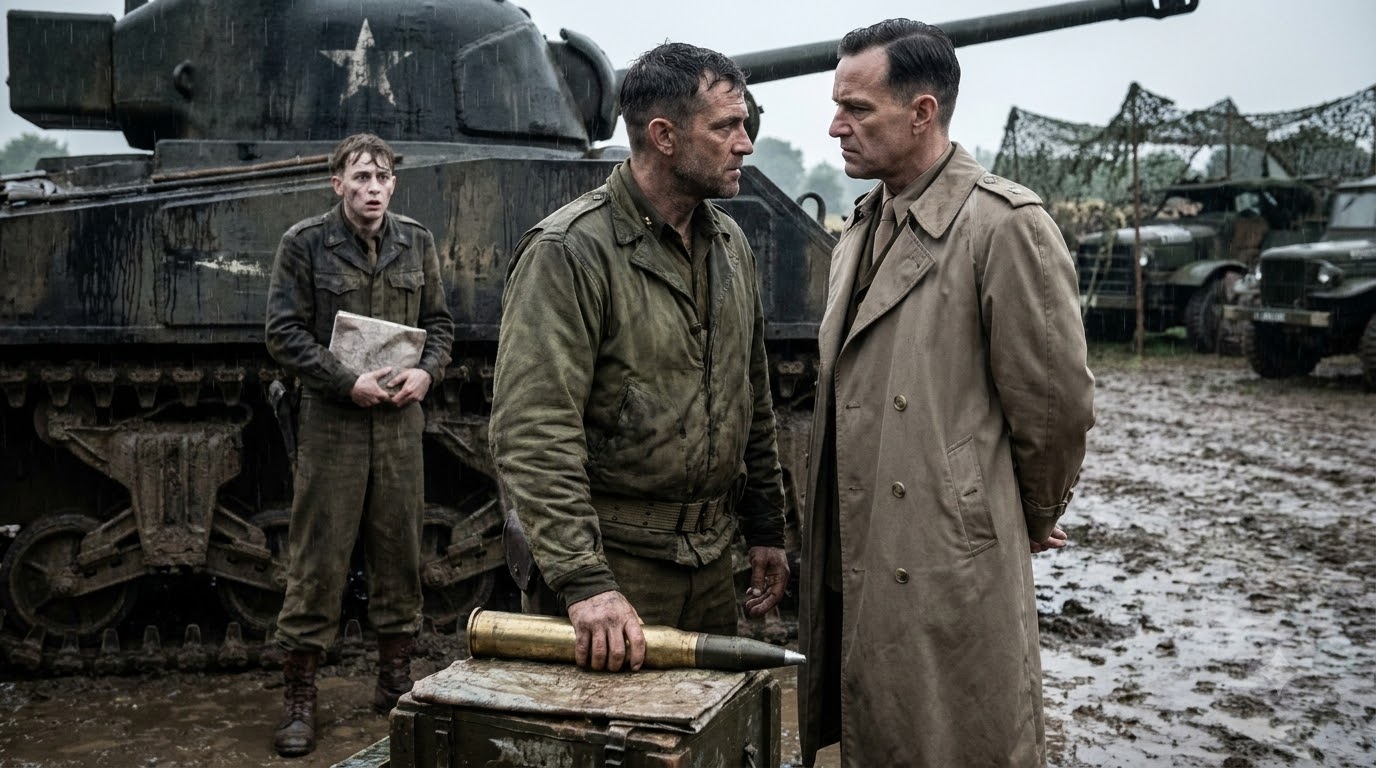
I picked up the dented brass casing of a 75mm shell—empty, heavy, smooth from weeks of my calloused hands rolling it across the engine deck—and set it down on the motor pool clipboard to keep the wet wind from stealing my supply receipts.
Major Sterling didn’t look at the dirt on my knuckles. He didn’t look at the three Sherman tanks sitting under the camouflage netting behind me, their short 75mm barrels dripping rainwater onto the churned mud. He just adjusted his spotless leather gloves and tapped the official order pinned to his map case.
“Fourteen days in the bocage, Sergeant Miller, and you’re still running standard 75s,” Sterling said, his voice clipped and smooth, completely untouched by the artillery rumbling six miles south near Tilly. “London spent millions developing the 17-pounder Firefly to puncture Tiger armor. Yet your troop is actively refusing the upgrades.”
“The 17-pounder punches through eight inches of steel, sir,” I said, keeping my voice flat while my fingers traced the cold rim of the spent brass casing. “And every time it fires, the muzzle blast lights up the hedgerow like a blowtorch, blinding the gunner for five seconds and setting the dry brush on fire.”
Sterling chuckled, a dry, thin sound that had never heard the crack of a German Pak 40 anti-tank gun hiding in an ancient earthen bank. “The Ordnance Board does not concern itself with brush fires, Sergeant. It concerns itself with defeating enemy armor.”
“We haven’t seen a German tank in eleven days, Major,” I replied, stepping around a puddle of black grease to face him head-on. “We see machine gun dugouts every fifty yards. We see concrete bunkers, mortar teams, and dug-in infantry behind six-foot dirt mounds. A 17-pounder high-explosive shell has thin walls and barely an ounce of blast. My 75mm high-explosive round collapses those dugouts in one hit.”
“You will take the Fireflies,” Sterling said, his eyes narrowing as he stepped closer, his polished boots sinking an inch into the Norman mud. “The division needs high-velocity anti-armor capacity, not your personal opinions on infantry support. You’ll sign the transfer log now.”
I didn’t reach for the pen. I just rested my palm on the heavy brass casing on the table, feeling the cold weight of the metal.
“My men are supporting the 1st Hampshire Regiment at dawn,” I said quietly, leaning in just enough so he could hear the grit in my teeth. “If I take those long-barreled Fireflies into the sunken lanes, the infantry dies in the wire because I can’t suppress the machine guns. You want to tell their captain why his boys didn’t come back?”
Sterling’s hand twitched toward his map case, his jaw tightening as he realized the grease-monkeys in the staging area weren’t backing down.
“You’re dangerously close to insubordination, Miller,” he muttered, his gloved fingers snatching the top paper from his board. “You’ll take one Firefly as a troop trial on tomorrow’s patrol. That is a direct order. If you fail to demonstrate its utility, I’ll have you relieved by noon.”
He turned on his heel, striding back toward his staff car without looking back.
I picked up the 75mm brass casing, rolled it slowly over my knuckles, and stared at the long, awkward silhouette of the single Firefly sitting at the far edge of the depot.
CHAPTER 2: THE BLINDING FLASH
The long barrel of the Firefly snagged on an overhanging oak branch, showering the crew hatch with wet leaves and clattering off the turret roof like small arms fire.
I wiped my hand on my oil-stained trousers and stepped up to the commander’s cupola, watching young Miller—no relation, just a green kid from Leeds—wrestle with the oversized breech inside the dark turret. The massive 17-pounder casing was so long in that cramped space that he had to angle it sideways just to clear the radio rack.
“We’re entering the sunken lane south of St. Aignan,” Corporal Evans called up from the driver’s seat of my lead 75mm Sherman. His voice was pinched, tight with the kind of fear that only comes from knowing the hedgerows on either side were higher than our hull. “If there’s a Pak 40 sitting in that orchard, boss, we won’t see it till we’re ten yards off its muzzle.”
“Keep your speed down to five knots, Evans,” I said through the throat mic, my eyes sweeping the dense, thorny tangle atop the six-foot earthen banks framing our narrow track. “Firefly stays in the three-spot. If anything twitches in the brush, I’m putting a 75mm high-explosive round right into the roots before anybody tries to aim that long pipe.”
Major Sterling had forced this trial on us, sending one of his staff observers—a immaculate lieutenant named Vance—to sit in the Firefly’s jump seat with a notepad. Vance popped his head out of the hatch, his uniform spotless, holding a leather-bound logbook against his chest like a shield.
“Sergeant Miller,” Vance shouted over the clatter of the tracks, his pencil hovering. “Major Sterling expects a full gunnery demonstration at the tree line. We need to log the exact time-to-target engagement of the 17-pounder against hardened obstacles.”
“Tell Major Sterling that if he wants a demonstration, he can come stand on this deck,” I muttered, my left hand instinctively coming down to pat the cool brass rim of the spent 75mm casing I had jammed into my cargo pocket.
A sharp, violent thump cracked through the damp air three hundred yards ahead, followed instantly by the wet tearing sound of high-velocity iron cutting the air directly over our heads.
The shell smashed into the stone boundary wall to our right, showering the lead tank in granite splinters and grey dust.
“Anti-tank gun! Sunken orchard, twelve o’clock!” Evans yelled, slamming the brakes so hard the Sherman’s nose dipped into the mud.
“Vance, get down!” I roared, grabbing the lieutenant’s shoulder and shoving him bodily into the Firefly’s turret well just as a second solid shot whipped through the leaves above us.
“Firefly team, engage target!” Vance scrammed from inside the steel box, his voice high and echoing off the armored walls. “Use the long gun! Show them the range!”
“Negative!” I barked into the radio net. “Firefly, hold your fire! That brush is bone-dry under the canopy!”
It was too late. Young Miller inside the Firefly panicked, pulling the firing solenoid on the 17-pounder to clear the threat.
The explosion wasn’t a standard gun report; it was a physical blow that slammed against my chest, blowing the air right out of my lungs.
A sheet of white-hot flame spewed fifteen feet out of the Firefly’s muzzle brake, instantly scorching the dense thorn hedges on both sides of the narrow track. The flash was so brilliant, so absolute, that even with my eyes squeezed shut, the orange glare burned through my eyelids, leaving me stone blind in the middle of a killing zone.
When I forced my eyes open three seconds later, green and purple spots danced across my vision, masking everything in front of my face. Worse, the dry gorse and dead thorn leaves lining the sunken lane were roaring with bright red flames, sending a thick column of black smoke straight into the grey sky.
“I can’t see!” young Miller screamed over the intercom, his voice cracking into full panic inside the Firefly. “I’m blind! Commander, I can’t see the orchard!”
“Reverse! Firefly, reverse back into the hollow!” I yelled, my ears ringing so hard the sound was like a drill hitting bone.
Through the rising black smoke, I saw the true terror of the mistake. That massive plume of fire and black soot was a giant signpost in the middle of the bocage. Across the valley, two more German gun positions, previously hidden in the deep shadows of the orchard, immediately tracked their long barrels toward the burning hedge. They didn’t even need to aim at the tank; they just aimed at the fire.
A high-velocity round slammed into the dirt three feet from the Firefly’s left track, showering the suspension in red clay.
“They’ve got us zeroed!” Evans shouted. “Sergeant, that long gun just gave away the whole troop!”
I didn’t wait for Lieutenant Vance or Major Sterling’s doctrine manual. I reached down into the turret of my standard Sherman, grabbed the cold leather lanyard of our short 75mm gun, and jammed my heel against the manual traverse.
“High explosive! Load M48!” I screamed to my loader, Knox, who was already shoving a heavy, thick-walled round into the breech with the smooth precision of a man who liked living. “Target the base of the smoke! Three rounds rapid!”
Our 75mm barked—a sharp, solid thump that barely shook the hull, leaving no blinding flash, no lingering flame on the wet brush.
The high-explosive round tore across the open gap and detonated with a deep, bone-shaking CRACK right at the roots of the enemy emplacement, throwing a massive cloud of dirt, wooden beams, and shattered vegetation sixty feet into the air. The heavy blast wave collapsed the earthen roof of the Pak 40 dugout instantly, smothering the crew before they could lay their gun for a second shot.
“Round two, fire!” I yelled.
Another 75mm shell whistled low over the hedge, exploding directly in front of the second position, suppressing the German gunners under a wall of flying mud and shrapnel, forcing them to drop their hand-wheels and dive for the trench floor.
“Firefly, move back now while they’re eating dirt!” I ordered, grabbing the rear deck handles of the retreating tank as it clattered backward through the smoke.
We pulled back into the safety of the hollow, the engine idling in a rough, heavy thrum while the smoke from the Firefly’s self-inflicted fire drifted lazily over our heads.
Lieutenant Vance crawled out of the Firefly’s turret, his face pale, his immaculate tunic covered in grey soot from the muzzle back-blast. His hands were shaking so violently he dropped his silver pencil into the mud at my feet.
“It… the blast filled the entire crew compartment,” Vance whispered, rubbing his eyes frantically with his gloved knuckles. “I couldn’t see the target. I couldn’t see my own hands.”
I reached down, picked up his pencil from the muck, and wiped the wet dirt off on my sleeve before pressing it back into his trembling palm.
“That’s what happens in the hedges, Lieutenant,” I said, my voice low and hard as granite. “Now, where’s that official casualty report Major Sterling received from Cheux yesterday? The one he forgot to attach to our transfer orders?”
Vance froze, his eyes widening through the soot surrounding his goggles as he looked at me in pure shock.
CHAPTER 3: THE UNSIGNED LEDGER
Lieutenant Vance didn’t answer right away. He pressed his back against the wet track of the idling Firefly, his chest heaving while rain washed grey rivulets of soot down his clean collar.
“There is no Cheux report in my file, Sergeant,” Vance said, his voice straining for authority but cracking on the last word. “Major Sterling’s orders are absolute. We are upgrading the armored division to heavy anti-tank specifications.”
I stepped forward, my heavy boots sinking into the red clay, and reached out with one grease-stained hand.
I didn’t grab him. I just rested my thumb on the brass latch of his map case—the cold metal slick with rainwater—and held it down so he couldn’t pull the flap shut.
“You dropped three pages out of that case when you scrambled out of the hatch, Vance,” I said softly, my voice barely carrying over the idling diesel engine. “One of them was a casualty list signed by the troop leader at Cheux. Three Fireflies lost in four minutes. All three burned out because their first shot ignited the hedge line and marked them for the German gunners.”
Vance swallowed hard, his jaw twitching as he tried to pull the case away, but my weight on the latch didn’t budge.
“That… that was an isolated incident,” Vance stammered, his eyes darting toward the open road where Major Sterling’s staff car was already kicking up mud as it returned from the rear command post. “Operational casualties are expected when introducing new weapons platform doctrine.”
“Is that why the ledger in your bottom pocket has a big red zero written across the 75mm high-explosive allocation column for the next three weeks?” I asked.
The lieutenant went completely rigid. The color drained out of his face, leaving the black soot around his mouth looking like a bruise.
“You weren’t supposed to see that,” he whispered.
“Major Sterling isn’t pushing these long guns because he cares about Tigers,” I said, setting my spent 75mm brass casing on top of his map case like an iron paperweight. “He missed the supply convoy at Bayeux. He let four thousand rounds of standard high-explosive shells sit on a dock in England while he booked priority rail transport for his shiny 17-pounders. We’re running out of 75mm ammo, and instead of admitting he starved the infantry, he’s forcing us to take guns that can’t clear a machine gun nest.”
A horn blared from the edge of the hollow. Major Sterling’s staff car skidded to a halt in the rutted lane, throwing a curtain of brown water over the rear deck of my Sherman.
Sterling stepped out, his leather trench coat spotless despite the downpour, his cane clicking against the gravel as he strode straight toward us.
“Lieutenant Vance! Report!” Sterling demanded, his voice ringing with high-ranking arrogance. “I heard heavy gun fire from two miles out. Did the Firefly neutralize the enemy position as dictated by doctrine?”
Vance opened his mouth, his tongue catching on his lips as he looked between the major’s glaring eyes and the heavy brass casing resting on his map case.
“The… the trial encountered tactical friction, sir,” Vance managed to say, his voice barely audible over the rain.
“Friction?” Sterling sneered, turning his gaze on me, his eyes cold and brimming with petty authority. “Sergeant Miller, you will hand over the logbooks for your remaining tanks immediately. Your troop is being reorganized under my direct command effective at fourteen-hundred hours. You’ll take the Fireflies, or you’ll face a court-martial for refusing equipment in a combat zone.”
I didn’t flinch. I picked up the heavy brass casing, let its cold weight settle in my palm, and looked Sterling dead in the eye.
“You can take my stripe, Major,” I said, my voice steady as an engine block. “But tomorrow morning, the 1st Hampshire Regiment goes over that ridge into a wall of German machine guns. If they go without my 75s throwing high-explosive cover, your name is going on every casualty letter sent back to England.”
Sterling stepped directly into my space, his chest almost touching mine, his mouth twisting into a dark, vicious sneer. “You think a handful of foot soldiers gives you leverage over Headquarters, Sergeant? I am ordering the swap now.”
CHAPTER 4: THE MUDDY TRAP
“Sergeant Miller!” the runner gasped, dropping to one knee in the thick mud, his Enfield rifle slung loose over his shoulder. “Captain Vance from the 1st Hampshires sent me up the lane! Two dug-in machine gun positions just pinned B Company against the sunken bank north of the orchard. We can’t move! We need high explosives on those bunkers right now!”
Major Sterling stepped directly into the runner’s path, waving his leather crop toward the long, sleek barrel of the Firefly.
“Runner, inform your captain that armor support is engaging under high-velocity anti-tank protocols!” Sterling snapped, his jaw tight. “The Firefly will deploy to the ridge immediately!”
“No, sir!” the runner yelled back, wiping rain and red grit out of his bloodshot eyes. “There are no German tanks out there! It’s heavy machine guns behind stone walls! A long-shot solid round won’t do anything—we need high-explosive blast to blow out the earthworks!”
Sterling turned on me, his eyes wide, stepping forward to snatch the clipboard out of my hand.
“You will comply with division orders, Sergeant!” Sterling screamed, his composure finally shattering into an unhinged, high-pitched demand. “I am ordering this entire troop forward under my operational command! If you fire a single standard 75mm shell without my authorization, I will personally strip your rank on the spot!”
I looked at Sterling. I looked at Lieutenant Vance, who stood frozen in the rain, staring down at the mud with his mouth slightly open. Then I looked at the young runner, shivering in his soaked wool tunic, waiting for an answer that meant life or death for his mates in the ditch.
I didn’t argue. I didn’t yell back.
I turned my back on the major, grabbed the steel handrail of my short-barreled Sherman, and pulled myself up onto the engine deck in one smooth movement.
“Evans! Crank the motor!” I shouted down the hatch. “Knox, load M48 high-explosive! Fill the racks with every 75mm shell we’ve got left!”
“Miller!” Sterling shrieked from the ground, waving his crop furiously at my boots as the radial engine roared to life, blowing a cloud of warm blue exhaust across his clean uniform. “This is mutiny! You are disobeying a direct order from a field officer!”
“I’m obeying the infantry’s order, Major!” I called down through the smoke. “You want to stand in front of thirty tons of moving iron to stop me, you’re welcome to try!”
Sterling scrambled backward as Evans slammed the left clutch, turning the Sherman’s heavy steel tracks and churning up two giant waves of black mud that splashed right across the major’s spotless leather coat.
We surged out of the hollow into the narrow, rain-drenched lane, my short 75mm barrel pointed straight down the track.
Two hundred yards ahead, through the mist and torrential rain, I saw the stone wall framing the farm track. Muzzle flashes flickered steadily behind a low earthen bank, pinning forty British infantrymen flat against the wet ditch.
“Driver, stop short of the crest!” I barked through the throat mic. “Keep our hull low behind the bank! We don’t need distance—we need volume!”
“Target spotted! Base of the stone wall!” Knox called up from the dark turret well.
“Fire!”
Our short 75mm gun thumped sharply. There was no giant, blinding flame. There was no dry hedge catching fire. Just a fast, clean recoil, followed two seconds later by a thunderous explosion right inside the German bunker. Stone blocks, timber, and dirt erupted into the sky, instantly smothering the first machine gun nest.
“Next round in! Loaded!” Knox shouted.
“Fire!”
We pumped five rounds of high explosive into that orchard in under forty seconds. The 75mm shells tore through the brush, collapsing the second dugout, shattering the stone perimeter, and scattering the surviving defenders into the open where the infantry could handle them.
Through my commander’s periscope, I saw Captain Vance’s infantrymen rise out of the mud, cheering through the smoke as they surged forward to secure the ridge without losing a single man.
When we backed the Sherman back into the motor pool half an hour later, the rain had stopped, leaving a quiet, cool dampness hanging over the engine decks.
Major Sterling was waiting beside his staff car. But he wasn’t alone.
Standing next to him was Colonel Arbuthnot from 7th Armoured Division Headquarters, holding the unsigned logistics ledger Lieutenant Vance had dropped in the mud.
“Major Sterling,” Colonel Arbuthnot’s voice was dry as bone, completely cutting through the hum of the cooling tank engines. “Sergeant Miller’s tactical report just came through from the Hampshire commander. His troop cleared the approach using standard 75mm high-explosive fire while your designated Firefly trial sat blind in the hollow.”
“Colonel, the sergeant actively defied my direct authority—” Sterling started, his voice high, his fingers twitching against his side.
“The sergeant saved a company of infantry because he used the right tool for the job,” Arbuthnot interrupted, slapping the wet ledger against his palm. “And according to this supply audit I just received from Bayeux, you diverted four thousand rounds of 75mm high-explosive ammunition to cover up a shipping delay on your own requisition docket.”
Sterling’s jaw worked silently, his face turning the color of chalk as he looked from the colonel to the grease-stained crew sitting on my tank deck.
“You’re relieved of field oversight, Sterling,” Arbuthnot said flatly. “Report to the rear echelon staging area at Caen. They need someone to organize laundry transport.”
Sterling stood frozen for three seconds, his polished boots caked in thick, heavy Norman clay. He tried to adjust his gloves, found them stained with black engine grease from my tank deck, and walked toward his staff car without saying another word.
I sat down on the front fender of my Sherman, pulled the dented brass 75mm casing out of my pocket, and set it down on the clean engine deck beside my spanner.
Knox leaned out of the loader’s hatch, handing me a metal mug of hot, strong tea.
“We got five 75mm high-explosive crates coming up from the beach depot tonight, Sarge,” Knox said, wiping his oily brow with his sleeve.
“Good,” I said, taking a slow sip of the hot tea and watching the sun break through the clouds over the cleared orchard. “Keep the short guns clean. We’ve got work to do tomorrow.”