The Heavy Price of Glory: How General Eisenhower Defended the Forgotten Heroes of the Falaise Pocket
CHAPTER 1: THE WEIGHT OF PAPER
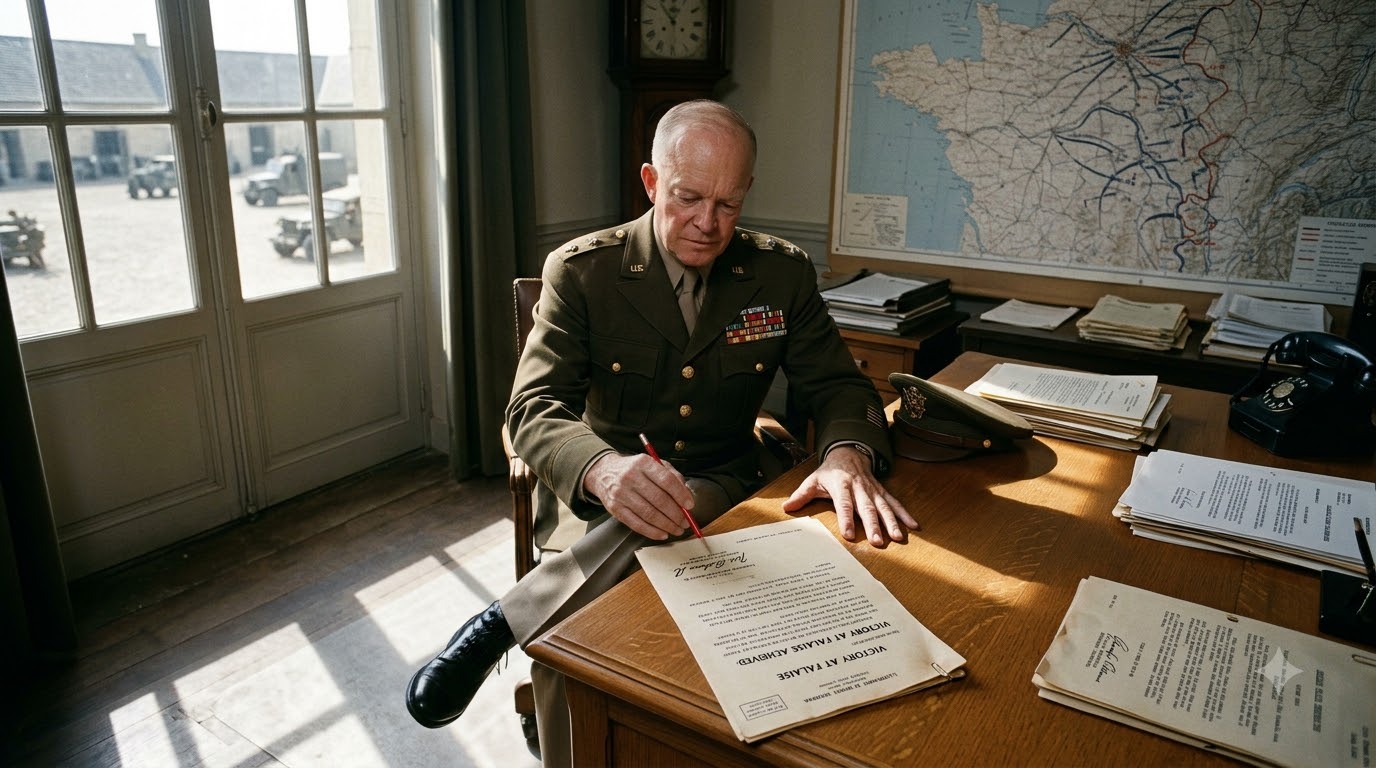
General Dwight D. Eisenhower pressed his thumb against the edge of the heavy brass map-weight on his desk. The metal was cold, smelling faintly of tarnished copper and stale August air.
Across the room, the grandfather clock ticked with a slow, heavy rhythm that matched the grinding ache behind his eyes.
He didn’t look up when the aide set the fresh batch of field dispatches down on the corner of the oak wood.
The paper resting right on top bore the signature of Lieutenant General George S. Patton Jr., dated August 20th, 1944.
Eisenhower pulled the document closer, his fingers dragging across the coarse, military-issue fiber.
Patton’s typewritten words marched across the page with an aggressive, flawless certainty. The Third Army commander claimed the entire victory of the Falaise pocket, wrapping the destruction of the German 7th Army neatly into an American triumph.
Eisenhower’s jaw tightened, a dull muscle ticking beneath his ear as he read the calculated omission of every Commonwealth unit north of the line.
He set the report down, let out a long, quiet breath through his nose, and turned his gaze toward the tall window looking out over the gravel courtyard in Granville.
Out there, the war was measured in miles of shattered asphalt and the relentless hum of truck engines.
He knew what Patton was hoping he wouldn’t check. Just forty miles to the north, Canadian and Polish divisions had spent ten brutal, unbroken days clawing through dust and fire against the fanatical remnants of the Hitler Youth.
They had paid for every single foot of that ridge with young lives, while Patton’s tanks sat parked at Argentan under strict orders to hold.
Eisenhower rolled the brass weight between his palm and the desk surface, feeling the sharp edge bite into his skin.
The silence in the headquarters office felt heavier than the dispatches.
He picked up a red wax pencil, hovering the tip just above Patton’s signature, knowing that whatever mark he made next would either shatter the fragile coalition or permanently bury the truth.
CHAPTER 2: SMOKE OVER THE VALLEY
The map board in the second-echelon command post shuddered as a heavy transport truck rumbled past the canvas walls outside.
Fine white dust drifted through the tent flap, settling instantly over the grease-penciled lines marking the Falaise pocket.
Lieutenant General Guy Simmonds didn’t bother brushing it off his sleeve.
His eyes were bloodshot from four days of unbroken focus, his boots caked in the dried mud of the Norman wheat fields where his Second Canadian Corps had just clawed through hell.
Reports from Operation Tractable lay scattered across the drafting table like broken slate.
Every single yard of that advance had been bought with a heavy, unyielding price, measured in smoking hulls and rows of temporary wooden crosses near the hedgerows.
Yet, looking at the wire transcripts forwarded from the south, you would think the Third Army had fought the entire war alone.
Simmonds picked up a stub of a blue pencil, snapping it clean in half between his fingers with a dry, splintering crack that made his aide flinch.
The silence inside the tent was thick, broken only by the distant, rhythmic thud of artillery clearing out pockets of desperate resistance near Chambois.
He didn’t need a loudspeaker to tell his men what was happening; the frustration was a living thing vibrating in the marrow of every exhausted soldier holding the northern shoulder.
They had closed the trap, and now someone else was writing the headline.
CHAPTER 3: THE BRASS DESK
The coffee inside the mug had long since gone cold, forming a dull, dark skin across the surface that reflected the harsh glare of the desk lamp.
Eisenhower did not touch it.
His fingers stayed flat against the polished grain of the wood, feeling the faint vibrations of a staff car pulling up to the headquarters entrance downstairs.
He knew the political cost of moving against Patton’s version of events, but the alternative was far worse.
A general who steals the credit of better men breaks the spine of the entire alliance.
His chief of staff hovered near the door, holding a fresh batch of intelligence summaries that detailed the exact positions of the Polish defenders holding Hill 262.
— They’re asking if the official dispatch from the northern pincer is going out tonight, — the aide murmured, his voice tight with suppressed anxiety.
Eisenhower picked up the porcelain mug, felt the dead chill of the ceramic against his skin, and set it back down without taking a sip.
— It goes out tonight, — he said, his tone flat, immovable, and entirely devoid of hesitation.
The machinery of command had to grind forward, and the myth built in the south was about to meet the gritty, bleeding truth of the north.
CHAPTER 4: INK AND ECHOES
A junior staff officer stepped inside, clutching a freshly decrypted teletype message from the southern sector.
His boots squeaked against the clean floor, the sound grating sharply against Eisenhower’s frayed nerves.
— General, the wire service inquiries are doubling by the hour, — the officer said, holding out the single slip of paper like a live wire.
— They want confirmation on Third Army’s advance through the gap.
Eisenhower stared at the paper without taking it, his eyes locked on the faint, missing timestamp in the header margin where the initial dispatch had been logged.
Something had been scrubbed from the carbon copy before it ever reached his desk, a deliberate omission designed to leave the Commonwealth out of the history books.
— Tell them the official release goes through Supreme Headquarters first, — Eisenhower replied, his voice dropping an octave into a low, rumbling warning.
— And make sure the casualty reports from the northern ridge are attached to every single copy we distribute.
The officer swallowed hard, nodded once, and backed out of the room, leaving the heavy door to click shut on a truth that refused to stay buried.
CHAPTER 5: THE SILENT CORRIDOR
Patton didn’t flinch, his jaw set in a hard, stubborn line as he stood across the table from Eisenhower.
The air in the room was stale, charged with the rigid tension of two men who viewed the war through entirely different lenses.
— I took Argentan just like you asked, Ike, and my boys cleared the road, — Patton snapped, his voice sharp enough to cut glass.
— Those dispatches state the facts as my staff recorded them on the ground.
Eisenhower didn’t raise his voice, his silence acting like a dead weight against the other general’s explosive defense.
He reached down, sliding a thin packet of casualty reports and northern logistics logs across the polished wood until it stopped right against Patton’s polished belt buckle.
— Your staff forgot to count the five thousand Canadians and Poles who bled to close that three-mile gap from the north, George, — Eisenhower said, his tone flat, cold, and entirely immovable.
— I need your next report to reflect what actually happened in the pocket, not what looks good in the Sunday papers back home.
Patton’s face flushed dark with suppressed rage, his fingers twitching instantly toward the ivory handles of his sidearms before he caught himself with a sharp jerk.
— This is politics, pure and simple, — Patton growled, his eyes narrowing into cold slits as he refused to yield an inch.
— History will look at who reached the line first, not who was bogged down in the mud.
Eisenhower kept his gaze locked dead on the Third Army commander, knowing the trap had closed and the stubborn general had nowhere left to run.
CHAPTER 6: DUST ON THE HEADSTONES
Eisenhower lifted the ruler, his thumb tracing the newly printed line that explicitly credited the Canadian and Polish forces with sealing the northern shoulder of the pocket.
The public wires were already ticking, carrying the undeniable truth across the Atlantic and into newspapers from coast to coast.
Patton’s grand myth had collided with hard reality, forcing the arrogant dispatches to bend beneath the weight of actual sacrifice.
Outside the headquarters window, the late August wind stirred the dust across the gravel courtyard, carrying no sound of battle, only the steady hum of transport trucks rolling south toward Paris.
Eisenhower leaned back in his leather chair, the wooden springs groaning under his weight as he let out a long, slow breath that emptied the tension from his chest.
The political storm would pass, but the names of the men who held Hill 262 would remain carved into the historical record where no general’s ego could ever reach them again.
He closed the leather portfolio with a soft, final click, leaving the desk clean and the truth completely restored.