The Rusted Iron Bird That Proved an Empire Built on Sand Cannot Outlast the Assembly Line
CHAPTER 1: First Touch of Iron
Hans Leiser tightened his grip on the brass technical calipers, feeling the cold metal bite into his palm.
Around him, the hangar at Recklin Experimental Airfield remained dead silent, save for the rhythmic dripping of water from a cracked overhead pipe into a rusted bucket.
The giant American bomber sat parked on the concrete floor, its dark crosses painted clumsily over the original star markings like a bad scar.
Without manuals, blueprints, or factory support, every inspection required raw physical persistence against an unfamiliar machine.
He stepped closer to the port wing, running a gloved thumb along a flush-mounted rivet line that showed no signs of hand-fitting or weld corrections.
“The fuel tanks are topped off, Herr Leiser,” a mechanic muttered from the shadows, his voice dry and raspy.
Leiser did not answer immediately, instead clicking the caliper shut with a sharp metallic snap that echoed off the damp concrete walls.
CHAPTER 2: Cold Measurement in Silence
The interior of the flight deck smelled overwhelmingly of damp canvas, unrefined American fuel, and copper dust.
Hans Leiser pulled himself through the narrow hatch, his boots scraping against the aluminum ribs of the fuselage floor without the soft cushioning of standard German wool lining.
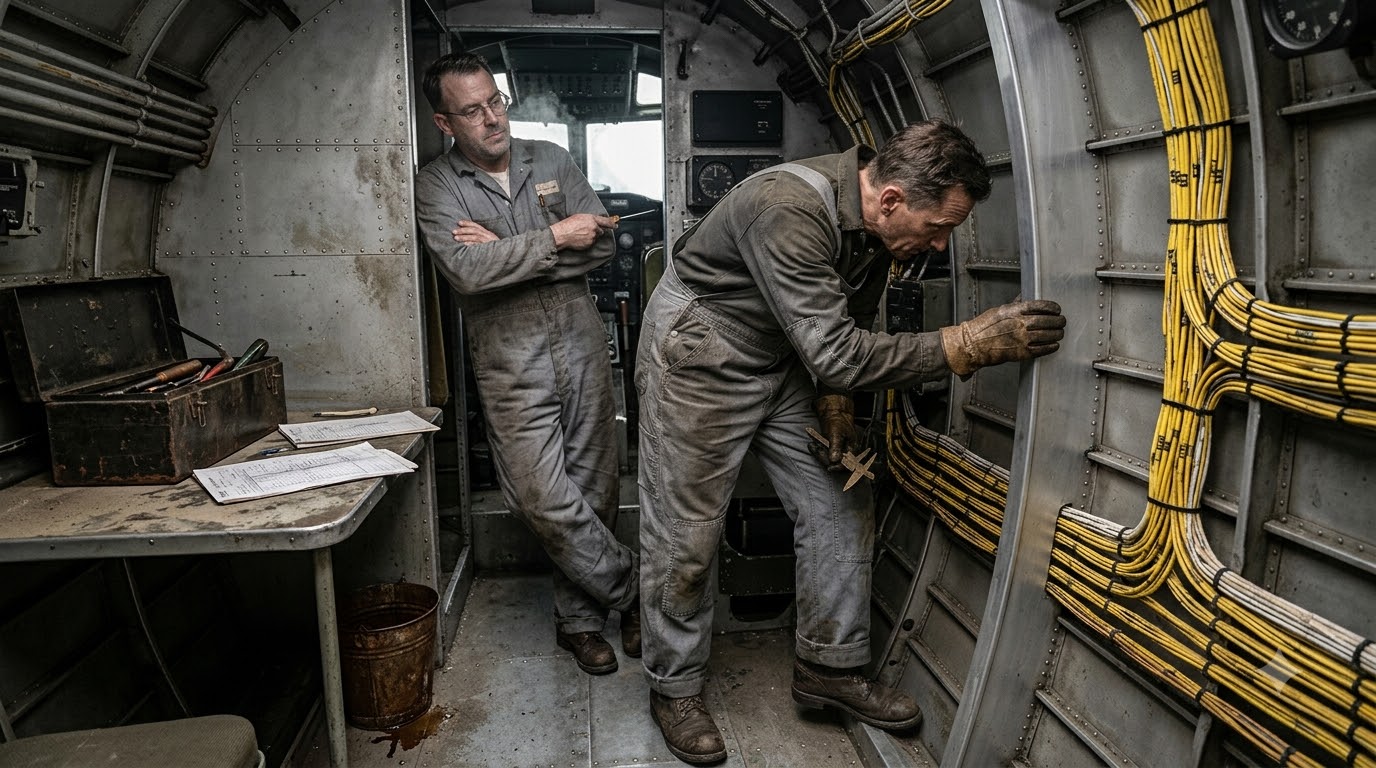
Behind him, Senior Technician Miller adjusted his spectacles in the dim light, holding a flathead screwdriver like a weapon against the silence.
“Look at the junction boxes, Herr Leiser,” Miller murmured, his breath pluming in the freezing air of the unheated hangar. “There are no soldered joints here. Everything is crimped and standardized.”
Leiser reached out, brushing his fingertips over a neatly bundled loom of yellow-coded wires that ran along the sidewall.
The precision was infuriatingly consistent, mocking the hand-soldered chaos of domestic assembly lines back in Berlin.
He pulled the brass calipers from his coat pocket, pressing the jaws against the thickness of an aluminum stringer.
The measurement revealed a tolerance so exact it required zero hand-filing or custom shims.
“They aren’t building these things by hand,” Leiser said, his voice dropping into a flat, exhausted register. “They are stamping them out like bullets.”
Miller pointed the handle of his screwdriver toward a small data plate riveted near the instrument console.
A microscopic stamp on a nearby fastener caught the pale morning light filtering through the high clerestory windows—a tiny lot number indicating mass production.
No artisan signature, no maker’s mark of pride, just an unyielding administrative number designed for a machine that never stopped moving.
Leiser let out a long breath, watching it turn to mist against the instrument glass before his eyes drifted to the empty fuel gauges.
CHAPTER 3: The Heavy Riddle of Steel
Senior Technician Miller dropped a stack of requisition forms onto the navigation table with a sharp slap that kicked up a thin cloud of dust.
“Berlin wants a complete inventory of the wing spar alloys by tomorrow noon,” Miller said, his jaw tightening into a hard line. “They think we can melt these frames down and recast them in our own foundries.”
Leiser did not look up from the instrument panel, his thumb sliding along the cold vernier scale of the tool.
“They don’t understand the metallurgy,” Leiser muttered, his voice carrying the dry rasp of a man who had spent too many hours breathing stale air. “This isn’t recycled scrap melted in a backyard crucible. It’s high-purity stock stamped under thousands of pounds of hydraulic pressure.”
Miller crossed his arms, leaning his shoulder against the armor-plated bulkhead.
“Try telling that to the inspectors waiting outside the hangar gates,” Miller replied, his eyes narrowing as he gestured toward the frosty glass of the hangar doors. “They are looking at this machine like it’s a golden goose, while we are sitting here with empty fuel drums and half-broken tools.”
Leiser squeezed the brass tool tighter until the metal bit deep into his skin, suppressing the sudden surge of exhaustion rising in his chest.
“A goose that requires an entire continent’s worth of factories to keep alive,” Leiser said, sliding the caliper into his pocket with a definitive click.
Miller let out a short, humorless breath that echoed off the bare aluminum ribs overhead.
“Then let’s give them their numbers before they decide to pull our funding and send us both to the eastern front,” Miller said, turning sharply toward the aft hatch.
Leiser stood in silence, his eyes fixed on the empty fuel gauge as the distant rumble of a truck engine signaled the arrival of the morning inspection team.
CHAPTER 4: Silent Run on the Tarmac
Hans Leiser climbed back up into the flight deck, his fingers grazing the overhead circuit breaker panel in the dim light.
“The inspectors are bringing the district director,” Miller warned from the lower hatch, his breath frosting in the unheated cabin. “They want a engine start demonstration before sunset.”
Leiser did not turn around, instead gripping the heavy aluminum throttle quadrant.
The levers operated with a reversed logic compared to domestic designs, pushing forward to increase power rather than pulling back.
He slid his palm over the smooth plastic knobs, feeling the absolute absence of wear or custom adjustment.
“They want a show without fuel or spare parts,” Leiser muttered, his knuckles whitening as he tested the resistance of the magneto switches.
Miller wiped a grease-stained rag across his forehead, his jaw clenching in tight frustration.
“Try telling them that when they start screaming about production quotas,” Miller shot back, his boots shifting heavily against the metal ribs. “They expect miracles out of a dry tank.”
Leiser pulled his hand away from the controls, wiping a speck of dry oil from his index finger.
“Miracles require an assembly line, Miller,” Leiser said, his voice dropping into a flat, exhausted whisper as the heavy hangar doors began to groan open against the frozen ground.
CHAPTER 5: The First Airborne Pulse
Daylight flooded the damp interior of the fuselage, illuminating the floating dust motes and casting long shadows across the control pedestal.
Senior Technician Miller stood by the starboard wheel well, wiping his grease-stained fingers on a rag while watching the district director march across the tarmac.
“They expect a miracle on twenty gallons of low-grade fuel, Herr Leiser,” Miller muttered, his voice tightening as he tossed the rag onto a packing crate.
Leiser pulled himself into the pilot’s seat, his boots clicking sharply against the reinforced metal flooring.
He gripped the dual yoke, feeling the solid, unyielding weight of the American flight controls respond to his grip without a single millimeter of slack.
“They aren’t looking for a miracle,” Leiser replied, his eyes scanning the unfamiliar gauges across the instrument panel. “They are looking for someone to blame when the engines cough.”
Outside, the district director stopped twenty paces away, crossing his arms and shouting up through the open hatch.
“Start the starboard engines, Leiser! Berlin wants data, not excuses!”
Leiser did not blink; instead, his thumb pressed the starter toggle while his left hand eased the throttle forward just an inch.
The radial engine coughed once, spat a thick cloud of dark blue smoke across the concrete, and then caught with a deafening roar that shook the entire airframe.
The vibration rattled through the floorboards straight into Leiser’s boots, a raw, mechanical pulse of four thousand horsepower straining against the chocks.
He kept his gaze fixed on cylinder head temperatures, knowing that every second the engine ran on domestic fuel was burning away their only proof.
CHAPTER 6: Firing Arc Realities
Senior Technician Miller wiped a layer of frost from the exterior lens of an observation camera, his breath catching in the freezing air.
“They want every angle of the tail guns documented for the fighter pilots,” Miller called out over the idling rumble of the outboard engines.
Hans Leiser locked the control column in place and climbed out of the cockpit hatch, his boots crunching hard into the frozen mud.
He walked around to the rear empennage, staring up at the Plexiglass dome of the Cheyenne tail turret.
The dual heavy barrels pointed backward with an unblinking, mechanical menace that left zero blind spots along the six o’clock axis.
“Tell them the blind spots don’t matter,” Leiser said, his voice flat as he pointed toward the intersecting fields of fire. “If a fighter approaches from the rear, he flies straight into a wall of overlapping lead.”
Miller lowered his clipboard, his expression darkening as he reviewed the telemetry data from the morning run.
“The tactical command won’t listen to that,” Miller muttered, tapping his pencil against the paper. “They believe a skilled pilot can thread the needle through the tail sweep.”
Leiser reached out and gripped the cold steel barrel of a machine gun mount, feeling the absolute rigidity of the linkage.
“Then the tactical command is planning for a math problem they’ve already lost,” Leiser replied, releasing the metal with a sharp metallic clink.
CHAPTER 7: The Decoy Secret Revealed
Senior Technician Miller dropped a replacement manifold valve onto the work table with a dull metallic thud.
“The replacement part from the salvage depot fits without a single stroke of a file,” Miller said, his eyes wide with a mixture of awe and disbelief. “It dropped straight into the assembly housing on the first try.”
Hans Leiser stepped closer, his hand hovering over the interchangeable flange.
The modular precision confirmed the worst fears of the technical command.
This was Layer 1 laid bare before them—not a machine built by master craftsmen, but a product of an industrialized system that required zero custom fitting.
“They aren’t hand-crafting these bombers,” Leiser muttered, his voice dropping into a flat, heavy register. “A worker with ten minutes of training can pull a broken part and drop a new one right in its place.”
Miller wiped his palms frantically on his trousers, leaving dark streaks of grease across the fabric.
“If every factory across the Atlantic operates like this, our repair schedules are completely meaningless,” Miller whispered, staring at the flawless seam of the valve housing.
Leiser picked up the brass caliper, clicking it shut with a sharp snap that cut through the background hum of the base.
“We’ve been measuring rivets while they’ve been measuring output in tens of thousands,” Leiser said, turning his back on the workbench as the distant sirens grew louder.
CHAPTER 8: The Weight of Scarcity
Senior Technician Miller dropped a half-empty fuel drum onto the hangar floor with a hollow, echoing clang that rattled the adjacent tool chests.
“That’s the last allocation for the week,” Miller said, his breathing shallow in the freezing air as he kicked the rusted metal rim. “If we run the starboard engines again tomorrow, the test schedule stops dead.”
Hans Leiser slid the caliper back into his heavy wool coat pocket, his expression hardening against the bitter chill of the unheated space.
“The command doesn’t care about our fuel reserves,” Leiser replied, stepping over a stray length of wiring harness. “They want performance metrics on one-quarter capacity while our own supply lines burn out across three fronts.”
Miller wiped a grease-stained forearm across his forehead, leaving a dark smudge across his skin.
“We’re burning high-octane fuel we can’t replace just to figure out why an enemy assembly line works better than our entire industrial ministry,” Miller muttered, crossing his arms tightly against the cold.
Leiser stared at the massive aluminum wing towering above them, its smooth flush-riveted skin absorbing the dim interior light.
“They aren’t just building planes, Miller,” Leiser said quietly, his voice dropping into a flat, exhausted register. “They’re building an endless mathematical inevitability.”
CHAPTER 9: Whispers from the Front
Senior Technician Miller tossed the damp courier pouch onto the metal workbench with a sharp slap that scattered a handful of loose iron rivets.
“The frontline squadrons are getting chewed to pieces over the Ruhr valley,” Miller said, his voice dropping into a tense, strained whisper. “They say the enemy formations are throwing up an impenetrable wall of heavy fire.”
Hans Leiser picked up the top intelligence report, his eyes scanning the typewritten casualty figures without expression.
The numbers confirmed what the mechanical teardown had predicted months ago.
Every bomber shot down was immediately replaced by three more rolling off assembly lines across the Atlantic, rendering tactical victories entirely meaningless on a strategic scale.
“They aren’t just fighting back,” Leiser muttered, his thumb tracing the jagged edge of the paper. “They’re simply replacing the math faster than our squadrons can survive it.”
Miller slammed his hand down flat against the table, kicking up a small cloud of dried dust.
“Then what are we doing here freezing in this hangar burning fuel we don’t have just to document a machine that keeps multiplying?” Miller demanded, his chest heaving under his heavy wool coat.
Leiser did not answer immediately, staring down at the cold rivets scattered across the steel surface.
“We are documenting the exact shape of an inevitable defeat,” Leiser replied, folding the dispatch neatly in half before tossing it aside.
CHAPTER 10: The Unseen Machinery Breaks
Senior Technician Miller dropped a rusted wrench onto the concrete floor with a sharp, echoing clang that signaled the final exhaustion of their repair tools.
“The spare hydraulic pump is cracked beyond welding,” Miller said, his breathing shallow in the freezing air as he stared at the fractured casting. “Without a replacement from the central depot, this machine stays grounded permanently.”
Hans Leiser slipped the folded paper into his coat pocket, turning slowly to face the darkened wheel well.
The administrative pressure from Berlin had been building for weeks, demanding immediate flight tests that their shrinking fuel reserves and broken equipment could no longer support.
“The central depot has nothing left to send us,” Leiser replied, his voice dropping into a flat, level tone of absolute pragmatism. “Every ounce of metal and fuel is already tied up trying to patch holes in a sinking ship.”
Miller rubbed his tired eyes with the back of a greasy hand, a dry cough escaping his chest.
“They won’t accept that explanation when the inspection commission arrives tomorrow morning,” Miller muttered, his shoulders sagging under the weight of the looming confrontation.
Leiser reached out, resting his palm against the cold, unyielding aluminum skin of the fuselage.
“Let them come and look at the empty fuel drums themselves,” Leiser said, his jaw tightening into a hard, immovable line.
CHAPTER 11: The Cornered Blueprint Trap
District Director Vogel marched through the side doors, his polished leather boots clicking sharply against the concrete before stopping just short of the bomb bay doors.
“Berlin demands an immediate operational flight status report, Leiser,” Vogel barked, his face flushed with bureaucratic fury as he slapped a directive against his leather glove. “No more delays, no more administrative excuses about spare parts.”
Hans Leiser did not turn around immediately, keeping his palm pressed flat against the cold metal ribbing of the fuselage to steady his breathing.
He slowly pulled his hand away, turning to face the official with a cold, unyielding stare that ignored the proffered paperwork entirely.
“The fuel drums are empty, Director,” Leiser said, his voice dropping into a flat, level register that cut through the cavernous hangar. “And the hydraulic pumps are fractured beyond any local foundry’s ability to recast.”
Vogel’s jaw tightened into a rigid knot of angry denial as he stepped closer, raising his voice to override the plain reality.
“You will improvise! That is an order from the ministry—find a way to make it fly by morning or answer to the high command!”
Leiser let out a slow, heavy breath, his eyes locking onto the frantic pulse in the director’s temple.
“You can order a miracle on paper, Director, but you cannot manufacture high-octane fuel out of empty air,” Leiser replied, his voice remaining terrifyingly steady.
CHAPTER 12: The Dusty Horizon Collapses
Senior Technician Miller walked slowly out from the shadow of the wing, his boots scraping softly against the littered concrete floor.
“He’s gone to file his reprimand with Berlin,” Miller said, his voice completely flat, stripped of all previous tension. “They’ll strip our clearance by morning.”
Hans Leiser did not move, his hand resting quietly against the rough, unpainted metal of a spare bulkhead plate.
The grand illusion of tactical brilliance had finally burned away into the cold gray dawn, leaving behind only the stark arithmetic of survival.
No amount of political posturing or administrative threats could alter the absolute reality of empty fuel drums and broken logistics.
“Let them strip it,” Leiser replied, his words carrying the quiet weight of finality. “The numbers were settled long before we ever touched this machine.”
Outside the open hangar doors, the distant roar of an ordinary work train rumbled across the desolate German landscape, moving supplies toward a front that was already collapsing inward.
The giant American fortress sat silent under the pale light, an inanimate monument to an industrial titan that could never be stopped by willpower alone.
Leiser unbuttoned his heavy coat, pulled off his oil-stained work gloves, and laid them flat across the workbench next to the brass calipers.
There were no more reports to write, no more impossible engine runs to fake, and no more bureaucratic demands to deflect.
He picked up a dry rag, wiped a final speck of grease from his thumb, and walked slowly toward the exit without looking back.