The Quiet Daughter They Thought Was a Failure Stood Alone at the Estate—Until the Law Arrived
CHAPTER 1: THE ALUMINUM CHAIR
The iron gates of the Grant estate swung open with a dull screech that echoed against the wet gravel.
I kept my hands steady on the steering wheel, easing the station wagon past the manicured lavender hedges and the pristine white columns of the main house.
A young valet in a stiff black vest pulled open my door, his eyes sweeping over my faded rain coat without a flicker of recognition.
“Welcome, Ms. Drew,” he said, his voice flat and impersonal, treating me like a guest who had wandered into the wrong reservation.
Inside the grand dining room, the air smelled of beeswax polish, expensive linen, and roasted meats.
My mother, Isolda, was moving around the long oak table, whispering something to my teenage niece, Laya, who glanced up at me once before looking down at her phone.
I walked toward the far end of the room where the name cards were placed.
Every card featured gold calligraphy printed on heavy cream cardstock, except for mine.
My card was a piece of plain index paper with my name written in blue ballpoint pen, resting beside a cold aluminum folding chair that clanged against the hardwood as I pulled it out.
I sat down, smoothed the fabric of my skirt, and let my hands rest on the table.
Mis was standing near the marble fireplace, swirling a glass of white wine while three family members stood in a tight circle around her.
“When you’re managing eight-figure portfolios, there simply isn’t room for sentimentality,” Mis said, her voice carrying easily across the room as she tapped her manicured nail against the crystal glass.
I reached into my coat pocket and pulled out my father’s old brass fountain pen, placing it parallel to the edge of the table.
Isolda walked over to the side sideboard, picked up a folded paper, and cleared her throat loudly to gain the room’s attention.
“Everyone, before dinner is served, I want to show you something special,” Isolda announced, holding up a faded event flyer. “Anelise brought some of her work tonight—you remember her little street exhibit years ago, where she painted on Amazon shipping boxes?”
A wave of soft, polite laughter trickled down the table as my sister smiled down at her plate.
“We called it the cardboard Madonna,” Isolda added, her voice dripping with artificial affection. “Bless her heart, she still tries.”
I didn’t blink or reach for my lukewarm tea; I simply rotated the brass pen ninety degrees until it lined up perfectly with the grain of the oak table.
My niece Laya leaned across the table, her brow furrowed in genuine confusion. “Aunt Anelise, why does your place card say ‘Hobbyist’ under your name when everyone else has their job title?”
The laughter died down instantly, replaced by a sudden, heavy silence as Isolda’s smile froze.
Before I could speak, the heavy double doors opened, and Devon Lang, the family’s senior legal counsel, stepped into the room clutching a leather briefcase.
He offered a confident, practiced smile to Isolda, but as his eyes passed over my corner of the table, his steps hitched.
His right hand twitched violently at his side, dropping his pen onto the floor as his complexion drained to a pale, waxy gray.
“Ms. Drew,” Devon whispered, his throat working hard to swallow as he remained rooted to the rug.
“Counselor,” I replied softly, my thumb resting over the worn cap of the brass pen. “It’s been a long time since Georgetown.”
CHAPTER 2: THE PAPER TRAP
“Ms. Drew,” Devon repeated, his voice dropping an octave as he fumbled with the clasp of his leather briefcase. “I didn’t realization you’d be… attending.”
“Required attendance,” I said, my voice smooth and level. I picked up the brass fountain pen, uncapped it with a soft click, and let the polished nib rest against the edge of my paper place card. “My mother insisted.”
Isolda smoothed her silk scarf, shooting Devon a sharp, warning glare before turning her gaze back to the head of the table. “Devon, please. Sit down. We have family business to conduct, and we don’t need to waste time on formal introductions.”
Devon pulled out a mahogany chair three seats down from Mis, his movements stiff, his eyes darting toward me every time the metal nib of my pen lightly tapped the table.
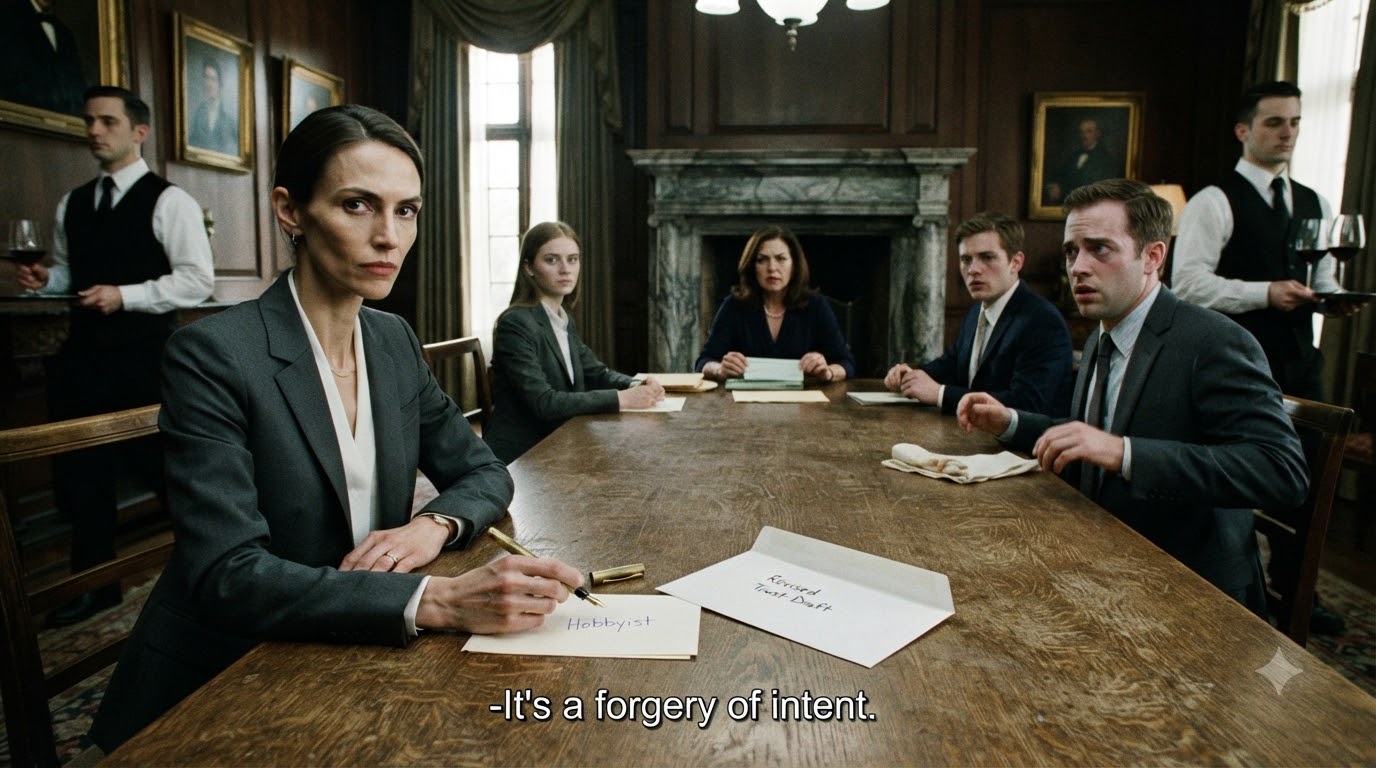
Mis tapped her fork against her water glass, the sharp ringing cutting through the murmur of the room. She reached into a thin folder beside her plate and pulled out a fresh, crisp white envelope, holding it between two fingers like a winning card.
“Since we’re all here,” Mis said, her voice dripping with artificial sweetness as she slid the envelope across the polished oak toward my folding chair, “Mom thought you should see the updated draft tonight. It’s only fair.”
The paper slid to a halt right next to my lukewarm tea.
I didn’t open it immediately. I looked at Mis, whose smile remained fixed, unbothered, and entirely confident in her unearned leverage.
“Go on, open it,” Isolda urged from the head of the table, cutting a piece of roast duck with deliberate precision. “We had Devon clean up the language. It’s much more… practical this way.”
I unfolded the thick sheet inside. Bold, underlined serif text stared back at me: Non-Financial Beneficiary. Anelise Drew may receive personal memorabilia and studio materials as agreed upon by the primary executors.
No equity. No land. No voice in the family trust. Just permission to keep my own old sketches if my sister felt generous enough to hand them over.
“Art isn’t really an asset, Anelise,” Mis leaned in, her voice low enough so only the lower half of the table could hear. “You understand, don’t you? Real responsibility requires real capital.”
I didn’t flinch, nor did I lower my eyes. Instead, I turned my attention to Devon, who was rapidly taking small sips from his wine glass, refusing to meet my gaze.
“Devon,” I said quietly, the brass pen balance perfectly across my fingers. “Section 4 of the state probate code regarding trustee self-dealing. Did you draft this revision before or after my mother opened the Nevada filing?”
Devon choked slightly on his wine, setting the glass down so hard red liquid sloshed over the rim and stained the white tablecloth.
“I—that’s standard language for non-contributing heirs,” Devon stammered, his fingers twitching against his napkin. “It’s entirely within legal bounds.”
“It’s a forgery of intent,” I said, keeping my tone perfectly conversational. “And you know exactly whose signature is missing from page three.”
Mis’s smile faltered for a fraction of a second, her posture stiffening as she looked between me and the visibly sweating lawyer. “Don’t mind her, Devon. She’s just being dramatic. It’s what artists do.”
She thought she was insulating herself behind polite protocol and legal jargon, completely blind to the fact that every word Devon failed to say was locking the door behind them.
I slid the paper back into the envelope, picked up my brass pen, and capped it with a firm, final click.
CHAPTER 3: THE ROUTING NUMBER
Isolda pulled out a heavy burgundy leather checkbook with gold initials stamped across the corner.
She flipped open the cover with a deliberate flourish, taking her time to smooth the paper against the mahogany table so everyone around us could see the thick gold-bordered checks.
“Since we are resolving family matters tonight,” Isolda announced, her voice projected toward the center of the room, “I am issuing the annual donation to the Grant Foundation directly.”
She tore a check from the book with a sharp, dry rip that echoed through the quiet dining room, handing it directly to the waiter standing behind her chair.
I leaned forward on my aluminum folding chair, resting one elbow casually on the table edge as the waiter stepped back into the ambient light.
My eyes locked onto the carbon paper stub remaining inside the open checkbook.
Four numbers printed in dark red ink on the bottom margin caught the dim chandelier light: 4182.
The room was silent except for the low murmur of small talk near the fireplace, but for me, those four digits turned the entire room into glass.
“A shell entity registered under a Nevada filing,” I said, my voice low and conversational, directed straight across the table.
Mis was in the middle of taking a sip from her wine glass, but her movement stalled. “What are you talking about?”
“The account you just transferred those trust funds into,” I said, tapping the brass cap of my pen once against the tablecloth. “The routing sequence ends in 4182. It belongs to a defunct corporation that lost its tax-exempt status three years ago.”
Isolda’s hand froze over her open checkbook, her fingers stiffening around the leather binding.
“Anelise, that is quite enough,” Isolda snapped, her fake warmth dissolving into cold, defensive sharpness. “You know nothing about the foundation’s finances.”
“I know the routing number,” I said, looking Mis dead in the eye. “And I know whose name is listed on the Nevada articles of incorporation alongside Devon’s firm.”
Mis set her glass down with enough force that wine splashed onto her knuckles, her face pale as she looked toward our mother for support.
Devon didn’t say a word; he simply pushed his chair back six inches and stared at his hands.
CHAPTER 4: THE TERRACE TOAST
The terrace string lights cast a warm yellow glow across the polished stone balustrades, framing the gathered relatives as they sipped champagne and offered performative laughs.
Mis tapped a silver spoon against the side of her glass, three sharp pings cutting through the outdoor chatter to command the garden’s attention.
“To legacies,” Mis began, her voice smooth, poised, and projected with practiced confidence. “To the fortunes we inherit, and to the creative little side projects some choose when real responsibility is too heavy.”
Polite ripples of laughter spread through the group, a few aunts and uncles nodding along with indulgent smiles.
I stepped out from behind the stone archway, my coat unbuttoned, the brass fountain pen tucked firmly into my palm alongside the folded estate papers.
“To legacies,” I said, my voice cutting cleanly through the ambient noise without raising its pitch. “And to knowing which signatures are admissible in probate court—and which belong to a defunct Nevada shell company.”
The laughter died instantly, replaced by a sudden, heavy drop in atmospheric pressure across the patio.
I unfolded the two sheets of paper, holding them up so the dim terrace lights illuminated the typed text and signatures for everyone on the upper steps to see.
“One of these is my father’s original estate directive,” I said, looking straight past Mis to where Isolda stood near the doorframe. “The other is a draft Devon Lang prepared three days ago, routing primary foundation assets through account sequence 4182.”
Near the cocktail table, a glass slipped from a cousin’s hand, shattering against the blue flagstones. Nobody moved to clean it up.
Mis didn’t drop her smile, but her jaw clenched, a tiny muscle near her ear twitching violently as she stepped toward me. “You think you can come into my house and manufacture a scene out of pure jealousy?”
“It’s not a scene, Mis,” I said, stepping closer until only a pace separated us on the stone steps. “It’s a paper trail.”
Isolda rushed forward, her silk scarf trailing behind her as she grabbed Mis’s arm. “Anelise, stop this nonsense right now! You are ruining a family gathering over your own petty grudges!”
“You used Dad’s name on those filings,” I said softly, the words carrying straight to the relatives hovering on the grass below. “You took his life’s work and dragged it through an illegal laundering scheme, thinking I’d stay quiet because you gave me a folding chair.”
Mis took a sharp, jagged breath, her eyes blazing with pure defiance as she sneered directly into my face. “You have nothing, Anelise. You’re a failed painter on a folding chair. No court will ever take your word over ours!”
She didn’t surrender; she doubled down, narrowing her eyes and lifting her chin in absolute, arrogant refusal to yield an inch.
CHAPTER 5: THE FINAL AUDIT
“This is ridiculous!” Mis screamed, her voice cracking across the patio as two state forensic accountants in plain suits stepped past the iron gates. “She’s trespassing! She’s mentally unstable—she draws on trash boxes!”
Isolda lunged forward, grabbing my coat sleeve with trembling, manicured hands. “Anelise, tell them it’s a mistake! Tell them you made a mistake before this ruins our family standing!”
I stood my ground, my posture firm as I peeled Isolda’s fingers off my sleeve one by one.
“I didn’t call them, Mother,” I said, my voice steady, carrying cleanly through the damp night air. “The banking compliance system flagged routing number 4182 the moment Devon submitted those altered probate drafts.”
Mis spun toward Devon, but the family lawyer was already backing away down the terrace steps, his face white, frantically tapping on his phone as he tried to secure his own defense.
“You ruined everything!” Mis shrieked, taking a furious step toward me, her wine glass shattering against the flagstones as her fingers buckled. “We built this family’s name! You’re nothing without us!”
“You didn’t build a name,” I said, holding out my hand to receive my father’s original handwritten estate ledger from the lead auditor. “You built a cage, and you used Dad’s memory to lock the door.”
The lead auditor reviewed the original draft, compared it with the paper trail I had meticulously documented over months of silent observation, and signed the asset freeze injunction right on the stone railing.
Isolda sank down onto the outdoor bench, her silk scarf slipping into the dirt as her regal composure completely dissolved into quiet, helpless disbelief.
I turned my back on the terrace, walking down the long gravel driveway as the blue utility lights swept across the white columns of the estate.
In my downtown loft, the morning rain tapped softly against the high window panes.
I sat at my oak worktable, surrounded by damp brushes and jars of ochre and navy pigment.
Across the wood lay my father’s leather ID wallet and his original ledger, completely cleared of fraud, returned to its rightful owner.
I picked up a fine-tip brush, dipped it into fresh black ink, and began to sketch on a fresh, clean canvas—no longer hiding behind silence, no longer defined by their frame.