The Surveyor’s Silence: A Tale of Rusted Iron, Broken Deeds, and the Long Game of Suburban Justice
CHAPTER 1: THE RADIUS OF FRICTION
The diesel exhaust didn’t just hang in the air; it clung to the damp morning frost like a film of oil on a gray pond. Garrett felt the vibration in the porch boards before he actually saw her—a low, rhythmic thrumming that lived in the soles of his work boots. He didn’t move. He just gripped the ceramic handle of his mug, watching the steam vanish into the sharp November chill.
The Sovereign crested the slight rise of the eastern slope, its blades shrieking as they hit a patch of overgrown fescue. Winifred Holst sat atop the machine like a statue carved from salt and spite, her silver hair lacquered into a helmet that didn’t so much as quiver against the wind. She didn’t look at him. She looked at the horizon, her jaw set with the practiced indifference of a queen surveying a border she’d already decided didn’t exist.
Then came the sound.
It wasn’t the grass. It was the dry, plastic snap of the survey stake—the one Garrett had driven in six inches deep with a three-pound sledge just forty-eight hours ago. The orange ribbon, bright as a flare against the dead lawn, was sucked into the deck. For a second, a flurry of neon plastic confetti sprayed out the discharge chute, peppering the gray grass like a confetti of warnings ignored.
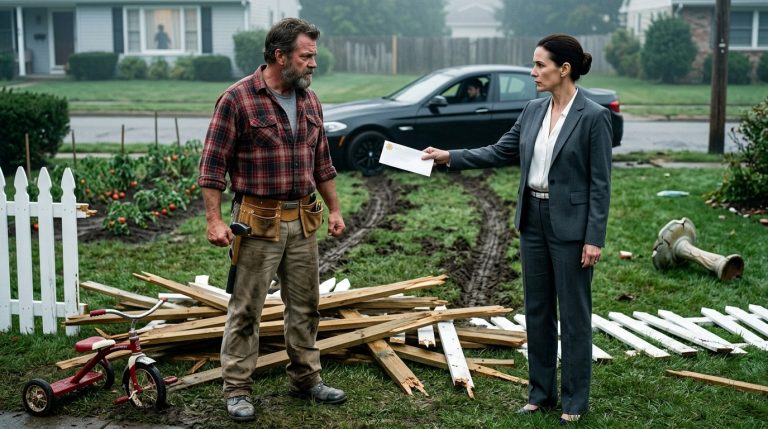
Winifred’s left tire wasn’t just over the line. She was three feet deep into his dirt, her path carving a raw, dark scar through the hand-laid gravel of the walkway he’d spent three weekends leveling.
“Boundary’s right there, Winifred,” Garrett called out. His voice was flat, sandpaper-dry, stripped of the anger that usually made his knee ache.
She didn’t stop. She didn’t even slow down. She reached the end of the pass, yanked the steering lever with a gloved hand, and pivoted the mower in a tight, aggressive circle. Only then did she kill the blades, though she kept the engine idling—a heavy, mechanical heartbeat between them.
“Common area, Garrett,” she said, pitching her voice just loud enough to carry over the diesel rattle. She offered a smile that was all teeth and no warmth, the kind of expression a landlord gives a tenant they’re about to evict. “The board reviewed the plot last night. You’re encroaching on the community’s visual corridor. Those stakes are a liability. A tripping hazard.”
“The deed says different,” Garrett replied, stepping off the porch. The friction of the gravel under his boots felt personal. He stopped at the edge of the fresh tire tracks. “My survey pins are registered with the county. Pulling them is a fifth-degree felony in this state, Winifred. You know that.”
She Adjusted her clipboard, clicking her pen with a sharp, rhythmic clack-clack-clack. “This isn’t the county, Garrett. This is Crestfield. We have our own standards. Our own reality. If you want to contest the fine, the hearing is the third Tuesday of next month. I’ll be presiding.”
She engaged the blades again—a metallic scream that cut off any further conversation—and drove the Sovereign straight back across his property, the rear tires spitting bits of his gravel into the air.
Garrett watched the blue smoke of her exit. He looked down at the remains of the orange ribbon, now just a shredded plastic ghost in the mud. His knee throbbed, a dull iron pulse, but his hands were steady. He reached into his pocket and pulled out his phone, scrolling past the HOA notices and the threatening emails until he hit a contact he’d saved a week ago.
Clifton Marsh answered on the second ring.
“Marsh,” the voice crackled, sounding like two stones grinding together.
“It’s Foss. 14 Sycamore,” Garrett said, his eyes fixed on the fresh rut in his lawn. “I need the iron pins re-established. And I need the certified plat stamped by the recorder’s office. Whatever the rush fee is, I’ll have the cash in an envelope.”
“I’m three weeks out, Foss.”
“I don’t have three weeks,” Garrett said, watching Winifred’s garage door rumble shut. “She just mowed over the state-certified marker while looking me in the eye. I’m not looking for a neighborly chat anymore. I’m looking for a funeral for her career.”
There was a long silence on the other end, the sound of a man weighing the cost of precision.
“Thursday morning,” Marsh finally said. “0800. Don’t be late with that envelope.”
Garrett hung up and looked at the dwarf apple tree. A single, shriveled fruit hung from a low branch, stubborn and bitter. He reached out and touched the bark, feeling the rough, rusted texture of the wood. The line had been crossed for the last time.
He went inside to find his highlighter.
CHAPTER 2: THE PRECISION OF IRON
The truck that pulled into 14 Sycamore Lane at exactly 0758 didn’t rumble; it rattled with the sound of a thousand unorganized bolts. It was a white Ford that had seen enough salt to scour a coastline, the magnetic sign on the door—Marsh Survey Services—peeling at the corners like a sunburnt lip. Clifton Marsh climbed out, his joints making a sound not unlike the truck’s suspension. He didn’t offer a handshake. He just spat a stream of tobacco juice into the dead leaves and looked at Garrett’s yard as if he were inspecting a crime scene.
“Pins or boundaries?” Marsh asked. His voice was a low-frequency hum that seemed to vibrate in Garrett’s bad knee.
“Both,” Garrett said, handing over the envelope. It was heavy, thick with the kind of crisp bills that meant a man had spent years saving for something better than a legal battle. “I want them deep, Clifton. And I want the ribbon bright enough to see from space.”
Marsh pocketed the envelope without counting it. He moved to the back of his truck, pulling out a transit and a tripod that looked older than Garrett. The brass was tarnished, the leveling screws pitted with age, but when Marsh set it up, he did so with a terrifying, surgical focus. He didn’t care about the neighbors. He didn’t care about the silver-haired woman currently peering through the blinds of number 16. He cared about the truth buried under six inches of Ohio clay.
Garrett watched as Marsh paced. The surveyor wasn’t looking at the grass or the encroaching boxwoods. He was looking for the ghosts of iron. He used a magnetic locator, the device chirping like a dying bird whenever it passed over a scrap of buried metal.
“She’s been busy,” Marsh muttered, pausing near the east fence. He kicked at a patch of dirt where the Sovereign’s tracks had turned the earth into a muddy slurry. “Found your original pin. Or what’s left of it. It’s bent forty-five degrees to the north. That didn’t happen from a mower deck hitting it. That’s a pry bar job.”
Garrett felt a flare of heat in his chest—a sharp, dry spark. “Can you prove it was moved?”
“Doesn’t matter if I can prove who did it,” Marsh said, his eyes pressed to the transit’s lens. “I’m here to tell you where it’s supposed to be. The earth doesn’t lie, even if the people on top of it do.”
For the next three hours, Garrett became the laborer. He carried the heavy iron rods. He held the prism pole steady while the wind tried to whip it out of his grip. Every time Marsh signaled him to move, Garrett felt the weight of the task. It was the “Weight of Labor,” the slow, grinding reality of protecting what was yours. The air smelled of iron and the metallic tang of the surveyor’s equipment, mixed with the dry, papery scent of a neighborhood that was slowly rotting from the inside out.
Midway through the morning, the garage door at number 16 groaned open. Winifred didn’t come out on the Sovereign this time. She came out on foot, carrying a clipboard like a shield. She stopped at the very edge of the contested line, her eyes scanning Marsh’s equipment with a look of profound, calculated distaste.
“Mr. Marsh, I assume?” she called out. Her voice was curated—polite enough to sound reasonable to a passerby, but thin as a razor.
Marsh didn’t look up from his transit. “Working, Winifred. Unless you’re holding a prism, stay clear of the line.”
“I hope you’re aware that the Crestfield Architectural Review Committee requires a permit for any ground-disturbing activity,” she said, her pen poised over the clipboard. “Including the installation of unapproved metal markers. I’d hate to have to issue another citation before the ink is even dry on your report.”
Garrett stepped forward, his boots crunching on the gravel walkway. He felt the grit under his heels, the physical friction of his presence. “It’s a boundary survey, Winifred. Not a gazebo. State law trumps your committee’s ‘standards’ every day of the week.”
Winifred’s gaze shifted to Garrett. For a split second, the mask of suburban civility slipped. He saw the predator behind the silver curls—a woman who viewed her neighbors as assets to be managed or liabilities to be liquidated. She looked at his yard, at the dwarf apple tree he’d planted for his daughter, and he realized she didn’t just want the land. She wanted the control. She wanted to prove that his labor, his hand-laid stones, and his hand-planted trees only existed by her grace.
“We’ll see what the board says about ‘state law’ when your assessments come due, Garrett,” she said softly. She made a sharp, aggressive note on her clipboard and retreated into the shadows of her garage.
Marsh waited until the door clicked shut before he spoke. “She’s a piece of work. Reminds me of a developer I knew in Licking County. Used to move the stakes every time the moon went dark. Ended up in a cell after his foundations started sliding into the creek.”
He moved to the south corner, near the row of HOA-branded planters that sat along the Marchetti fence. The planters were heavy, cast-iron things, rusted to a deep, burnt orange. Marsh stopped, his magnetic locator let out a long, continuous scream.
“That’s odd,” Marsh said. He knelt in the dry dirt, brushing away a layer of dead mulch. He found a heavy iron padlock, rusted shut, securing a maintenance hatch at the base of the planter. He poked at it with his screwdriver. “These planters aren’t on the community plat. They’re sitting right on the line, but they aren’t registered as common area improvements.”
“Then who put them there?” Garrett asked, kneeling beside him. The smell of rusted iron was thick here, a sharp, coppery scent that felt like a warning.
“Someone who wanted to hide a boundary,” Marsh said, his voice dropping an octave. He pointed his transit back toward Winifred’s house. “If I pull the line from the street, those planters are four feet inside the Marchetti lot. And if they aren’t in the minutes…”
He trailed off, but the implication hung in the air like wood smoke. Garrett looked at the rusted padlock. It wasn’t just a marker; it was a seal.
Marsh spent the final hour driving the new pins. He used a heavy sledge, the clack-clack-clack of iron hitting iron echoing through the quiet cul-de-sac. He tied the orange ribbons tight, double-knotting them. When he was done, he handed Garrett a certified plat drawing. The paper was crisp, the ink dark and absolute.
“Your line is there,” Marsh said, pointing to a spot sixteen feet inside what Winifred’s hedge implied. “She’s not just over the line, Foss. She’s living in your kitchen, legally speaking. You have enough here to bury her.”
Garrett took the drawing. The paper felt heavy, like a weapon he hadn’t yet learned how to aim. He looked at the orange ribbons fluttering in the wind. They were the only color in a landscape of gray and brown.
As Marsh loaded his truck, a black sedan slowed down at the end of the driveway. Desmond Price, the ex-contractor from two doors down, rolled down his window. He looked at the orange ribbons, then at Garrett, then back at number 16.
“Heard the hammer,” Desmond said. He looked tired, the kind of tired that comes from decades of fighting the same battles. “You get the pins in?”
“In and certified,” Garrett said.
Desmond nodded, his eyes fixed on the rusted planters at the edge of the yard. “Good. Because I did some digging in the county archives this morning, Garrett. You aren’t the first one she’s done this to. But you might be the first one with a receipt she can’t burn.”
He reached over into the passenger seat and held out a manila folder, his knuckles scarred and thick from years of framing houses. “Take a look at this when you get inside. Look at the signature on the 2017 consent agreement. Then tell me if you think she’s just ‘confused’ about where her yard ends.”
Garrett reached for the folder, his fingers brushing the gritty surface of the paper. As he pulled it toward him, he caught sight of the silver curls in the window of number 16. Winifred wasn’t writing anymore. She was just watching.
The wind picked up, a cold, sharp gust that rattled the rusted padlock on the planter. It sounded like a key turning in a lock that hadn’t been opened in a very, very long time.
CHAPTER 3: THE ABSENCE IN THE ARCHIVE
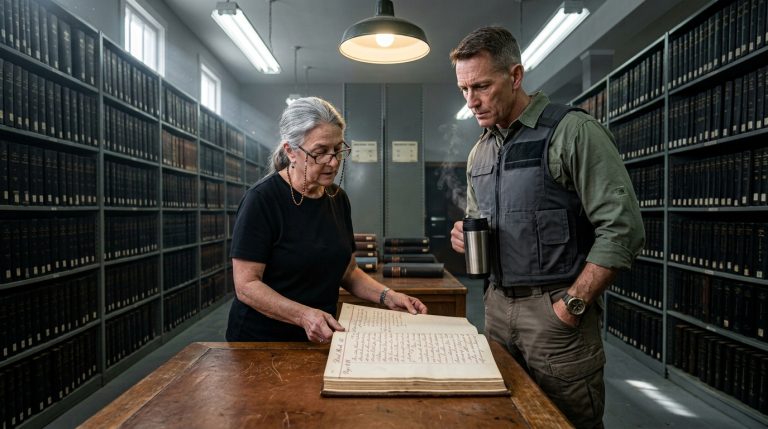
The kitchen light flickered once, a sharp, fluorescent hum that mirrored the buzzing behind Garrett’s eyes. Before him, the table was no longer a place for meals; it was a battlefield of paper. Forty-seven pages of meeting minutes, printed on high-grain HOA letterhead that felt like cold, expensive linen, were fanned out like a losing hand of poker.
Garrett took a sip of coffee. It was lukewarm and tasted of burnt beans, but it kept the fog at bay. He picked up the yellow highlighter. He wasn’t looking for what Winifred had written; he was looking for what she had failed to say.
The manila folder Desmond had handed him sat at the corner of the table, the 2017 Quiet Title Consent Agreement staring back at him. Winifred’s signature on the final page was a work of art—loops and swirls that looked more like a barbed wire fence than a name. She had acknowledged the boundary seven years ago. She knew exactly where the iron pins were supposed to be.
“Every inch was a choice,” Garrett whispered to the empty kitchen.
He began the grind. One month at a time. January 2016. February 2016. He read through the mundane tyranny of suburban governance: complaints about mailbox rust, debates over the specific shade of “Heritage Sand” permitted for shingles, and the perpetual, grinding war against the height of neighborhood hedges.
Winifred’s voice was all over the pages. She moved motions with the efficiency of a shark, seconded them before anyone else could breathe, and tabled discussions that didn’t suit her with a chilling procedural grace. But as Garrett reached the 2018 records, he began to notice a pattern—a “Rusted Truth” emerging from the bureaucratic sludge.
Whenever a property line was mentioned, the minutes became curiously vague. Phrases like “administrative adjustment” and “community beautification alignment” began to appear. There were no recorded votes. No mention of a quorum. Just Winifred “taking the lead on a minor boundary clarification.”
He flipped to June 2018. The Kellerman property.
His eyes locked onto a line item buried at the very bottom of the Treasurer’s Report, tucked under “Miscellaneous Maintenance.”
Settlement Payment: 18 Sycamore (Kellerman) – $1,200.00. Source: HOA Maintenance Reserve Fund.
Garrett sat back, the chair creaking under his weight. The air in the kitchen felt heavy, thick with the smell of the dry ink and the cooling coffee. He reached for his legal pad.
The Maintenance Reserve Fund was sacred. It was the pool of money every homeowner paid into for new roofs on the community center or resurfacing the pool. Using it to settle a boundary dispute was like using a fire extinguisher to water a houseplant—it was a misuse of the emergency system.
He highlighted the $1,200 in a neon yellow that seemed to scream against the page.
The door to the garage rattled. Garrett didn’t jump; he just turned his head as Desmond Price stepped inside, bringing a gust of cold, November air with him. Desmond looked at the table, his eyes immediately finding the highlighter and the highlighted line.
“Found the bleed,” Desmond said. He didn’t ask; he knew. He pulled out a chair, his heavy work boots dragging across the linoleum with a dry, papery scrape.
“She paid them off,” Garrett said, his voice flat. “The Kellermans. She pushed them until they fought, then she reached into everyone’s pocket to buy their silence.”
Desmond leaned in, his scarred knuckles resting on the edge of the table. “I talked to Howard Briggs an hour ago. The Treasurer. He’s starting to get twitchy, Garrett. He remembers that payment. He said Winifred told the board it was for ’emergency drainage remediation’ near the north lot. He never saw a receipt.”
“Because there isn’t one,” Garrett said. He tapped the 2017 Quiet Title agreement. “She was already under a court-ordered covenant here at 16 Sycamore. She knew she couldn’t afford a second survey. So she used the community’s money to bury her tracks.”
He felt the friction of the situation building—a slow, grinding heat. This wasn’t just about a riding mower anymore. This was about a Sovereign who had treated the neighborhood’s treasury like her personal war chest.
“What’s the next move?” Desmond asked.
Garrett looked out the window. In the darkness, the orange ribbons on the new survey pins were invisible, but he knew they were there. He knew the iron was deep.
“The bylaws,” Garrett said, flipping to the back of the HOA handbook. “Section 4, Paragraph 11. A Special General Membership Meeting can be called by any fifteen homeowners. If we get the signatures, she has to face the quorum. Not just the board she has in her pocket, but the whole street.”
“Fifteen,” Desmond mused. “I can get you ten by breakfast. People are tired, Garrett. They’re tired of the fines, and they’re tired of the way she looks at them like they’re dirt under the Sovereign’s tires.”
“Make sure they understand the stakes,” Garrett warned. “This isn’t a grievance about grass. This is about the money. Our money.”
He stood up, his knee giving a sharp, familiar protest. He walked to the kitchen counter and picked up the small, rusted padlock he’d taken from the planter earlier. He turned it over in his hand, feeling the grit of the corrosion.
“I’m going to call a surveyor’s attorney tomorrow. A woman named Augusta Wren,” Garrett said. “And then I’m going to the garage. I need to build something.”
Desmond frowned. “Build what?”
Garrett didn’t answer immediately. He looked at the padlock, then back at the map of his property. He thought about the Sovereign’s tire tracks, the way they moved in inches, patient and predatory.
“A physical consequence,” Garrett said. “Winifred doesn’t believe in lines she can’t see. So I’m going to make sure the next time she crosses one, the whole neighborhood sees it.”
He felt a strange, cold calm. He was an electrician; he understood circuits. He understood that when a load became too great, the breaker had to trip. Winifred had been overloading the system for eight years.
“Get the signatures, Desmond,” Garrett said.
After Desmond left, Garrett stayed in the kitchen for a long time, staring at the absence in the records. Every blank space in the minutes was a secret. Every unrecorded vote was a trespass.
He picked up the phone to call the Gmail account he’d set up: SycamoreEvidence. He began to scan the highlighted pages, the flash of the camera illuminating the room in sharp, rhythmic bursts.
As he worked, he heard the faint, distant sound of a garage door closing next door.
He didn’t look up. He didn’t have to. The “Rusted Truth” was already on the table, and for the first time in three years, Garrett Foss wasn’t the one being hunted. He was the one laying the cable.
CHAPTER 4: THE DEPTH CHARGE
The envelope waiting in Garrett’s mailbox wasn’t the standard white utility bill. It was a heavy, cream-colored cardstock that felt like a threat before he even broke the seal. He didn’t open it on the porch. He took it to the garage, where the smell of solder and cold oil provided a familiar sanctuary.
Notice of Enhanced Compliance Review.
The words were printed in a font so sharp they felt like they could draw blood. Winifred wasn’t just fining him anymore; she was mobilizing. The letter granted “board representatives” the right to enter the exterior of his lot twice weekly to inspect for code violations. It was a legal trespassing permit, signed by a board that hadn’t met in public for three months.
Garrett set the letter on his workbench, right next to the two commercial color powder charges he’d stripped of their “Gender Reveal” labels. The powder inside was a fine, dehydrated mineral—safety orange, the exact color of the surveyor’s ribbon. He began wiring the low-voltage triggers, his fingers moving with the rhythmic precision of a man who spent his days troubleshooting frayed circuits.
The garage door rattled. It wasn’t the wind. It was a rhythmic, authoritative knock.
Garrett didn’t hide the charges. He draped a shop rag over the detonators and pulled the chain to raise the door.
Winifred Holst stood on his driveway, her silver curls damp from the misting rain. She wasn’t alone. Terrance Flood from Birchwood Court stood a few paces behind her, looking like a man who had been drafted into a war he didn’t understand. He clutched a clipboard with a white-knuckled grip.
“Garrett,” Winifred said. She didn’t smile this time. Her face was a mask of administrative iron. “I assume you received the notice. We’re here for the initial walkthrough.”
“You’re here for a trespass, Winifred,” Garrett said, his voice level. He stepped out of the garage, the concrete cold through his socks. “I’ve talked to Augusta Wren. She’s filing the demand letter tomorrow. You might want to hold off on the clipboard until you see the CC list.”
Winifred’s eyes flickered toward the garage, trying to peer past him into the shadows where his workbench sat. “Threats of litigation won’t excuse property neglect, Mr. Foss. Your east perimeter is in a state of ‘aesthetic disharmony.’ Those iron spikes you’ve driven into the common area are a safety hazard.”
“They’re survey pins, Winifred. And they’re sixteen feet inside my line.”
“That is a matter of interpretation,” she replied. She stepped forward, her expensive leather shoe crossing the threshold of his driveway. “One the board has already adjudicated.”
“Interpretation?” Garrett reached into his back pocket and pulled out a folded photocopy of the document Desmond had found. He didn’t hand it to her. He held it up, the damp air making the paper go limp. “This is a Quiet Title Consent Agreement from 2017. It has your signature on page four, notarized by the county. It acknowledges the exact boundary line you’re currently standing on.”
The silence that followed was heavy, broken only by the distant hiss of tires on wet asphalt. Terrance Flood shifted his weight, looking from the document to Winifred’s back.
Winifred didn’t flinch. She didn’t even look at the paper. “Documents can be taken out of context, Garrett. Ancient history doesn’t override current community standards.”
“It’s seven years old, Winifred. That’s not ancient history. That’s a recorded covenant,” Garrett said. He felt the friction of her denial—a cold, hard wall of ego. “You didn’t forget where the line was. You just thought I wouldn’t check.”
“I have work to do,” she said, her voice dropping to a whisper that didn’t reach Terrance. She stepped around him, her shoulder brushing his as she marched toward the east fence. “Terrance, document the unsanctioned ground markers. Fifty dollars per occurrence, retroactive to Monday.”
Garrett didn’t stop her. He watched her walk toward the dwarf apple tree. He watched her gardening gloves reach out to touch the orange ribbon, her fingers twitching with the urge to rip it away.
“She knows,” Terrance whispered as he shuffled past Garrett. He looked terrified. “She told us the survey was a fraud. She said you were trying to steal the common area to build a workshop.”
“She’s lying to you, Terrance. Check the treasury records. Ask her about the Kellerman settlement,” Garrett said.
Terrance stopped, his foot hovering over the edge of Garrett’s hand-laid gravel path. “The what?”
“Ask her why the neighborhood’s reserve fund is short twelve hundred dollars from 2018. Ask her why the board didn’t vote on it.”
Terrance looked at Winifred, who was currently pointing her pen at the survey pin like it was a cursed object. He didn’t make a note. He just stood there, the rain beginning to soak into his Crestfield Civic League jacket.
Garrett turned and walked back into the garage. He didn’t need to argue anymore. The “Layer 1” truth was out—she had signed the line away years ago. The decoy was her claim of “community beautification.” But as he looked at the wiring on his workbench, he realized the deeper rot. If she was willing to ignore a notarized covenant, she was willing to do much worse to maintain the illusion of her authority.
He picked up a pair of needle-nose pliers and crimped the final connection. The trigger wires were thin, nearly invisible monofilament. He’d set them four inches off the ground, right in the tire path the Sovereign always took.
He wasn’t just building a trap. He was building a circuit that required her agency to complete. She had to choose to cross the line. She had to choose to ignore the pins.
“Garrett!” Winifred called out from the yard. Her voice was shrill now, the iron mask cracking. “These markers are being removed by the landscaping crew on Saturday. Any interference will be met with a police presence.”
Garrett didn’t look up from his work. “See you Saturday, Winifred. Bring your clipboard.”
He waited until he heard her car door slam next door. Then he sat on his stool and listened to the rain hit the metal roof of the garage. It was a hollow, rhythmic sound.
He pulled the shop rag off the color charges. They sat there, twin canisters of orange dust, waiting for a spark. He thought about the Kellermans. He thought about the twelve hundred dollars. He thought about the way Winifred had looked at his apple tree—not as a living thing, but as an obstacle to her geometry.
The setback hit him an hour later. A text from Desmond: Howard Briggs just called. Winifred’s calling an ‘Emergency Executive Session’ tonight. No residents allowed. She’s trying to move the reserve funds into a legal retainer before the special meeting petition can be processed.
Garrett gripped the pliers until his knuckles went white. She was trying to drain the evidence before he could show it to the room. If she moved the money now, it would look like a proactive legal defense, not a cover-up.
The “Rusted Truth” was getting heavier. He wasn’t just fighting for his yard anymore. He was fighting to stop a thief from burning the bank on her way out.
He checked the camera batteries one last time. Everything was green.
“Saturday,” he whispered. The word tasted like ozone and dry earth. “One way or another, Winifred, the orange is coming out.”
CHAPTER 5: THE SOVEREIGNS STAIN
The diesel growl didn’t just vibrate in the air; it chewed through the silence of the gray November morning like a dull saw through bone. Garrett stood behind the thin veil of his kitchen curtains, his fingers ghosting over the screen of his phone. The trail cam feed was a crisp, digital window onto the frost-covered grass of the east yard.
Winifred was early. She wasn’t dressed for a walkthrough; she was dressed for a conquest. A yellow windbreaker, bright as a warning sign, and those same heavy gardening gloves. She sat atop the Sovereign with a posture that suggested she was riding into battle rather than merely grooming a suburban lot.
Garrett watched the screen. The mower nosed into the frame, its wide deck hovering inches above the frozen blades of grass. He saw the iron pin. He saw the orange ribbon, stiff with frost, fluttering a frantic greeting.
Winifred didn’t hesitate. She didn’t even tap the brakes.
The front left tire of the Sovereign crushed the ribbon into the mud. The mower traveled a foot. Two feet. Garrett’s heart beat a slow, heavy rhythm against his ribs—the pulse of a man who had waited three years for the circuit to close.
Then, the world turned orange.
The discharge wasn’t a bang; it was a pressurized thwip-hiss, the sound of four pounds of fine mineral pigment deciding it no longer wanted to be contained. A twin eruption of safety-orange dust geysered upward, catching the Sovereign in a crossfire of neon grit. The cloud rose in a perfect, suffocating cone, engulfing the machine, the yellow jacket, and the silver helmet of hair in a sudden, blinding fog.
The Sovereign’s engine didn’t just stall; it choked. A wet, metallic sputter followed by a dying gasp of diesel smoke.
Silence rushed back into the yard, heavier than before.
Garrett was out the back door before the cloud had even settled. The air smelled like a dry-erase board and cold soil—a chalky, mineral scent that coated the back of his throat. He didn’t run. He walked with the measured gait of a man who had already won the argument.
Winifred was a statue. She sat on the dead mower, her arms still locked on the steering levers. The orange powder had found every crease, every seam. Her face was a mask of vibrant, glowing dust, except for the pale circles around her eyes where her gardening gloves had instinctively flown to cover her nose. She looked less like a neighbor and more like a terracotta relic unearthed from a forgotten war.
“Mrs. Holst,” Garrett said. He stopped ten feet away, exactly at the edge of the orange-dusted grass. He held his phone up, the lens steady. “Are you hurt?”
Her head turned slowly. A small puff of orange dust fell from her shoulder. Her eyes were wide, darting between the survey pin she’d just flattened and the man standing on the pristine side of the line.
“You,” she wheezed. Each word sent a small cloud of pigment into the air. “You… booby-trapped… common area.”
“I protected my property,” Garrett corrected. His voice was a calm, low friction. “You crossed the iron pin. You crossed the ribbon. You are four feet inside my deeded acreage, Winifred. My cameras have the GPS coordinates and the timestamp.”
“This is assault,” she hissed, though there was a tremor in the silver-orange curls that hadn’t been there before. “I am the president of this association. I have the authority—”
“You have a signature on a Quiet Title agreement from 2017 that says this land isn’t yours,” Garrett cut her off. He didn’t raise his voice. He let the weight of the evidence do the heavy lifting. “And you have a neighborhood full of people who just found out about the Kellerman settlement. I’ve seen the minutes, Winifred. Or rather, I’ve seen the lack of them.”
She tried to climb down from the Sovereign, but her foot slipped on the orange-slicked metal of the deck. She stumbled, her gardening gloves leaving bright orange handprints on the white vinyl siding of her own gate as she steadied herself. The Sovereign sat behind her, a rusted, orange-stained monument to a bad decision.
She didn’t look back. She walked toward her house, her orange footprints marking the frost like a trail of blood.
Garrett didn’t gloat. He didn’t even smile. He turned the camera toward the Sovereign, capturing the way the orange powder highlighted the exact point of trespass. It looked like a crime scene because it was one.
His phone buzzed in his pocket. A text from Desmond: Petition just cleared 20 names. Howard Briggs is calling the special meeting for tonight. 7:00 PM. Community Center. He said he’s bringing the bank statements.
Garrett looked at the orange handprints on Winifred’s gate. The decoy was dead. The “community standards” and the “architectural review” had been stripped away by four pounds of powder, leaving only the raw, ugly truth of the land grab.
But as he looked at the Sovereign, he noticed something Marsh had mentioned. The mower was angled toward the south fence—toward those rusted, locked planters. Even in her panic, Winifred had been steering toward them.
He walked over to the edge of the orange radius. The pigment had settled over the rusted padlock on the south-side planter, highlighting the jagged lines of the keyhole. It wasn’t just a decoration. It was a lid.
The “Rusted Truth” wasn’t finished. The orange powder was just the primer. The real rot was still under the lid, and tonight, at 7:00 PM, Garrett was going to pry it open.
He went back inside to download the footage. He didn’t make fresh coffee. He didn’t need it. The adrenaline was a clean, cold circuit, and for the first time in three years, the Sovereign was silent.
CHAPTER 6: THE QUORUM OF TRUTH
The fluorescent lights of the community center didn’t just hum; they vibrated with the collective tension of eighty-three people packed into a room designed for forty. The air was a thick soup of stale coffee and damp coats, but under it all, Garrett could smell the lingering mineral ghost of orange pigment on his own skin. He sat at the front folding table, his back straight, his eyes fixed on the empty seat at the head of the board.
Desmond sat to his right, a manila folder resting under his heavy, calloused hand like a buried stone. To his left, Augusta Wren adjusted her glasses, her presence a cool, sharp contrast to the restless energy of the room.
When Winifred Holst walked in, the room went so quiet Garrett could hear the dry papery scrape of a single dead leaf skittering across the parking lot outside. She had showered, scrubbed, and changed, but as she moved into the light of the projector, Garrett saw it—a thin, vibrant line of safety orange caught in the crease of her ear, a stubborn stain of trespass she couldn’t wash away.
She took her seat and gripped the gavel. It didn’t look like a tool of order anymore; it looked like a rusted weight.
“This meeting is called to order,” she said. Her voice was thin, a frayed wire holding back a surge. “We are here to address a petition regarding community concerns. I will begin with a statement on—”
“Motion to suspend the chair’s statement,” Augusta Wren stood, her voice cutting through the room with the precision of a surveyor’s laser. “We are here under Section 4, Paragraph 11 of the bylaws. The membership has a right to prioritize the agenda. We start with the audit.”
A murmur rippled through the standing-room-only crowd. Winifred’s knuckles went white against the wood of the gavel. “That is a procedural violation, Counsel—”
“The membership is the procedure, Winifred,” Howard Briggs spoke up from the middle of the crowd. The treasurer wasn’t at the board table. He was standing with the people. He held up a stack of bank statements, the paper fluttering like a flag of surrender. “I’ve spent the last four hours at the branch office. I think everyone should see what ‘Boundary Maintenance’ actually costs this neighborhood.”
Garrett watched as Augusta stepped to the laptop. The projector whirred to life, throwing a beam of light across the room that caught the dust motes in a shimmering dance. The first image wasn’t a spreadsheet. It was the video.
The room watched in a silence so profound it felt heavy. On the screen, the Sovereign nosed into the frame. They saw the orange ribbon. They saw the iron pin. And then, they saw the eruption. The collective gasp that followed was a physical thing, a sudden intake of breath that seemed to pull the oxygen out of the room. The sight of their president, the woman who fined them for mailbox colors and hedge heights, coated in a neon cloud of her own ego, was a truth no one could argue with.
“That,” Augusta said, her voice echoing in the stillness, “is a documented trespass. But here is the reason for it.”
She clicked the remote. The Quiet Title Consent Agreement filled the screen. Winifred’s signature, looped and arrogant, glowed in the dark.
“Seven years ago, Mrs. Holst legally acknowledged that she did not own the land she mowed today,” Augusta explained. “She knew the line. But more importantly, the audit of the Maintenance Reserve Fund reveals three separate payments—totaling four thousand dollars—made to private residents between 2018 and 2022. These weren’t for community drainage. These were settlements paid to homeowners whose property Mrs. Holst had encroached upon, bought with your dues to prevent them from filing the same survey Garrett Foss filed last week.”
The explosion wasn’t orange this time; it was vocal. The room erupted. Rosalyn Thacker stood up, her voice trembling with two years of suppressed fury. “You used our emergency funds to hide your land grabs while you told me there was ‘no budget’ to review the variance for my mother’s wheelchair ramp?”
Winifred slammed the gavel, but the sound was hollow, a dry tap against a rising tide. “This is a coordinated character assassination! The funds were utilized for—”
“They were utilized for you, Winifred,” Garrett stood up. He didn’t yell. He didn’t have to. He looked her directly in the eye, seeing the predator finally cornered by the very lines she thought she could move. “You thought if you moved slow enough, no one would notice the friction. You thought if you acted official enough, the truth would get tired and go away. But iron doesn’t get tired. The dirt doesn’t forget where the line is.”
The vote wasn’t even close. 61 to 9. The motion to remove her as president and freeze all board expenditures pending a full forensic audit passed like a landslide.
Winifred didn’t wait for the formal adjournment. She gathered her clipboard—that rusted shield of administrative tyranny—and walked out. She moved through the crowd like a ghost, her silver hair bowed, the orange stain in the crease of her ear the only color left on her.
Garrett stayed until the room emptied, until the smell of stale coffee was replaced by the cold, clean air coming through the propped-open doors. Howard Briggs approached him, shaking his hand with a grip that felt like a new beginning.
“The variance for the ramp is on the agenda for Monday,” Howard said. “First item. It’ll take five minutes.”
“Good,” Garrett said.
He walked out into the parking lot with Desmond. The November wind was sharp, smelling of woodsmoke and the hard, honest scent of coming winter.
“You did it, Garrett,” Desmond said, leaning against his truck. “You held the line.”
“No,” Garrett said, looking toward the dark silhouette of Sycamore Lane. “The line held me. I just made sure people could see it.”
A month later, Garrett stood at the edge of his property. The dwarf apple tree was bare, its branches black lace against a pale sky. The boxwoods were gone, replaced by a clean, straight run of hand-laid gravel that followed the exact path Clifton Marsh had marked.
He knelt in the cold dirt and touched the iron pin. It was solid, unmoving, a rusted truth anchored in the heart of the world. He looked over at number 16. A ‘For Sale’ sign stood in the front yard, its white post straight and true. The Sovereign was gone, loaded onto a truck three days ago, leaving only a fading orange stain on the driveway to mark where it had been.
Garrett stood up, his knee giving its usual, pragmatic protest. He didn’t mind the pain. It was the price of labor, and today, the labor was done. He walked back toward his porch, his boots crunching on the gravel, the sound a steady, rhythmic cadence of a man who finally knew exactly where he stood.