The Iron Boundary: How a Retired Master Sergeant Weaponized a Century-Old Deed to Demolish a Suburban Empire
CHAPTER 1: THE WALL AND THE WARNING
The mortar in the joints was still pale grey, wet enough to leave a white smear on a fingernail. Six feet of cinder block, laid dead-straight across red clay.
I turned the brass compass in my right palm, feeling the cold, scratched metal bite into my thumb. North sat twelve degrees off the wall’s orientation. The dirt track I’d driven my Ram 3500 down for twenty years was gone, smothered under a hundred yards of fresh masonry.
“That road is HOA property now, Mr. Davidson.”
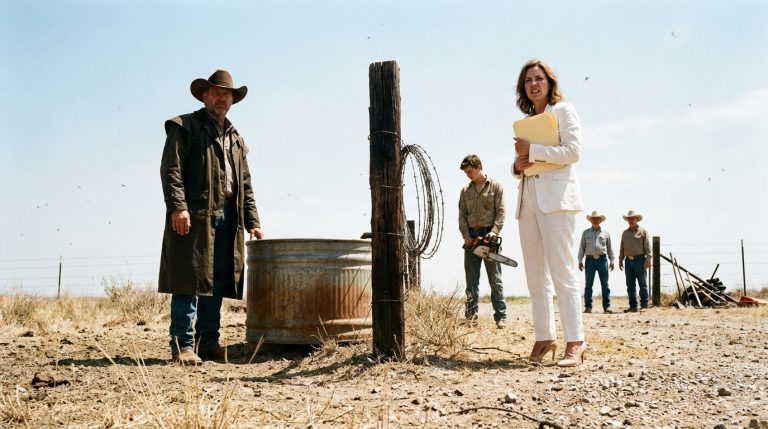
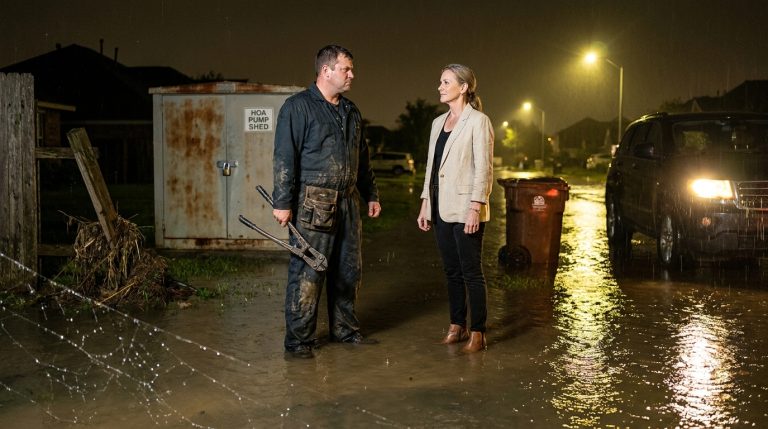
Karen Miller didn’t step onto the dirt. Her floral mumu hung taut across her frame, bright orange hibiscus patterns shimmering in the ninety-degree heat. She stayed on the concrete apron of the new subdivision road, arms folded over her ribs, hair stiffened into a blonde helmet that didn’t move in the humid breeze.
“Your back forty is officially landlocked,” she said. “You should have thought of that before you parked your unsightly truck in your own driveway.”
I didn’t answer right away. Anger is raw fuel; you don’t let it flare in the open. You compress it until it turns into leverage.
“That’s a county-recorded easement, Karen,” I said. My voice stayed in the low register I used when briefing fire-teams. “It’s been my legal access since I bought this fifty acres.”
“The developer’s new plat was approved by the county commissioner last month,” she replied, her chin tilting up. Her teeth were too white, capped and straight. “It supersedes your dusty old papers. This is HOA common area now. Next spring, we’re putting a butterfly garden right here.”
A butterfly garden. On top of thirty thousand dollars worth of oak timber I had contracted to move in three weeks. My log splitter, tractor, and skidder were locked on the wrong side of six feet of concrete.
“I have a commercial logging contract, Karen.”
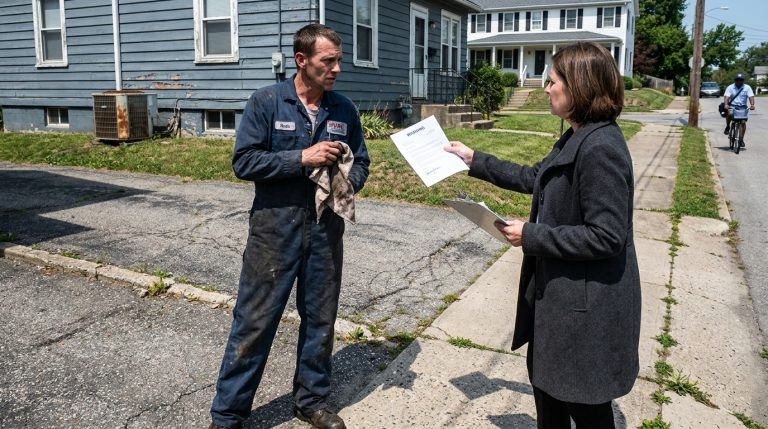
“Not anymore.” She pulled a pink carbon-copy slip from her clipboard and held it out. She didn’t walk toward me to hand it over; she let it drop onto the red clay between us. “Bylaw 7.4. Commercial vehicles exceeding one ton are prohibited from overnight parking. That’s a three-hundred-dollar fine. Welcome to Whispering Pines.”
She turned on her heel, her sandals clicking against the fresh asphalt.
I didn’t pick up the paper. I stood on my side of the property line, thumb tracing the scratched glass of the compass face until the needle stopped swinging.
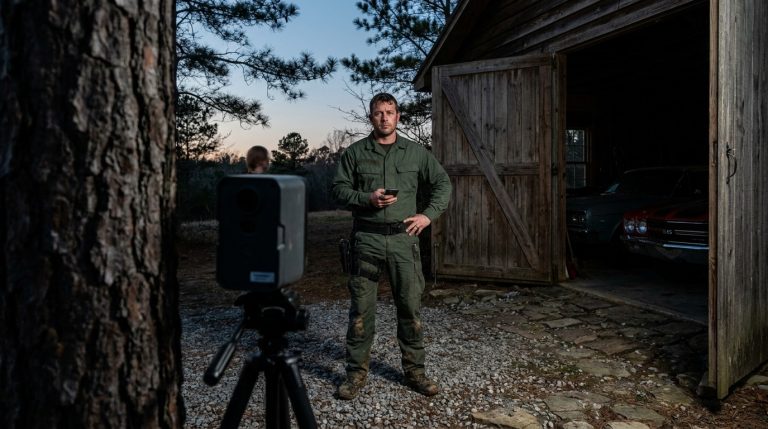
Behind me, the front ten acres were quiet. The modest ranch house, the workshop, the timber rig idling in the gravel driveway—everything I’d built after twenty-four years in the Corps. Beyond the cinder blocks lay the back forty, dense with mature pine and hardwoods. Completely cut off.
I reached down, picked up a chip of dried mortar from the base of the wall, and crushed it between two fingers. It crumbled into dust.
“Mark,” I called out toward the workshop.
My son stepped around the corner of the garage, a crescent wrench in his grease-stained hand. He had the same flat eyes I’d seen in the mirror during our first tour in Anbar.
“She put up the wall, Dad?”
“She put up the wall,” I said, putting the compass back in my pocket. “Get the truck in the garage. We’re going to the county courthouse.”
“We taking the sledgehammers?”
“No,” I said, looking at the grey line of blocks choking off my timber. “We’re going to find the paper that breaks it.”
I walked back to the house, the heat rising off the driveway in waves. On the kitchen counter, my wife Sarah had left a thermos of black coffee and my original property file. I picked up the yellowed folder. The top deed was dated twenty years ago, referencing an access route recorded in the county vault.
Karen thought she was enforcing a neighborhood rulebook. She didn’t know she’d just declared war on a Master Gunnery Sergeant who spent two decades studying terrain maps and supply lines under fire.
My phone buzzed on the counter. A text from an unknown number: Notice of Cease and Desist regarding commercial operation on parcel 04-B will be served tomorrow morning.
I cleared the message, screwed the cap onto the thermos, and looked at Mark.
“Let’s go.”
CHAPTER 2: THE ARCHIVES OF DEED BOOK 12
The heavy oak door rattled as the brass deadbolt retracted from the inside.
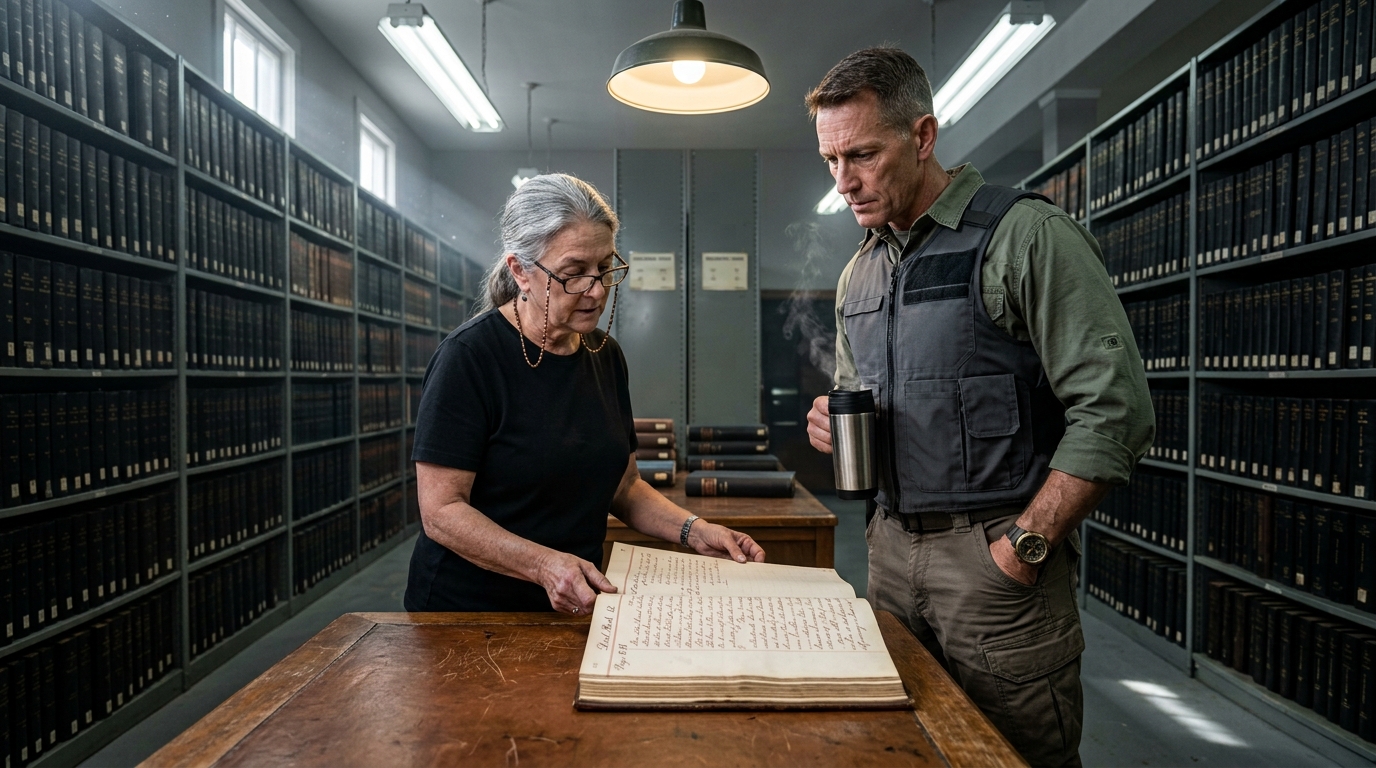
It was 8:00 AM sharp. The smell of ninety-year-old paper, dry leather bindings, and floor wax drifted through the opening before the door even swung wide.
A woman in her late sixties with iron-grey hair and reading glasses hanging from a beaded chain looked me over. Her eyes dropped to the heavy thermos in my hand, then to Mark standing half a step behind me with his arms crossed over his chest.
“You’re early, Marcus,” Agnes said. She held the door back with her hip. “Or you’re hiding from someone.”
“A little of both,” I said.
“It’s about that new development up on the north ridge, isn’t it?” She stepped aside, letting us into the cavernous hall of the records room. Tall steel shelving units stretched thirty feet up, packed with bound volumes that held every square inch of this county’s history. “I saw the plat filed last month. Whispering Pines Estates. Looks like a lot of taupe paint and trouble.”
“They put a cinder-block wall across my access road yesterday,” I said, setting the yellowed folder from my house on the oak counter. “Karen Miller says my easement doesn’t exist anymore.”
Agnes snorted, pulling a heavy brass key ring from her apron pocket. “Karen Miller thinks her HOA charter overrides the Ten Commandments. Wait here.”
I stood at the high counter, my thumb resting on the scratched casing of the brass compass in my pocket. Mark leaned against the doorframe, his gaze fixed on the street outside through the frosted glass. He was keeping watch out of pure muscle memory.
Agnes returned carrying a volume so thick it required both hands. She set it on the scarred leather pad with a heavy, dull thud that kicked up a micro-cloud of white paper dust.
Deed Book 45.
“This is your original purchase reference from twenty years ago,” she said, tapping the cracked black spine.
I opened the cover. The pages were yellowed at the edges, stiff as birch bark. My fingers traced the typed lines from two decades prior. There it was—a explicit reference to a thirty-foot right-of-way for ingress and egress, granting perpetual access to parcel 04-B.
“It’s right here,” Mark said, leaning over my shoulder. “Page 212. Plain English.”
“Plain English to a human,” Agnes corrected, pulling a fresh magnifying glass from under the counter. “To a developer’s corporate lawyer, it’s just something to bury under a new subdivision map. Look at the margin note, Marcus.”
I adjusted the angle of the overhead lamp. Written in tiny, faded fountain-pen script along the left margin was a cross-reference: Derived from prior reservation, Deed Book 12, Page 88.
Deed Book 12.
“That’s the parent tract,” I murmured.
“That’s the 1923 partition,” Agnes said softly. “Before the old ranch was sliced up. If the right-of-way was established there, it runs with the dirt, not the owner. A hundred new HOA plats can’t burn a recorded reservation unless you signed a release.”
“I didn’t sign anything,” I said.
“Then go back to the source.” She turned toward the dark, narrow aisle at the back of the archives where the pre-Depression volumes were kept in climate-controlled steel stacks. “Wait here. The 1920s books are delicate.”
While she walked back into the stacks, I unstrapped my thermos and poured black coffee into the plastic cap. The bitter steam rose into the cool air of the basement room. I handed the cup to Mark. He took a slow sip, his eyes never leaving the front window.
“She’s going to fine us three hundred dollars a day for the Ram,” Mark said quietly. “Plus the cease-and-desist on the tractor.”
“Let her write the paper,” I said. “Paper doesn’t cut wood. And it doesn’t hold up a wall if the foundation is built on a lie.”
Agnes returned carrying a book wrapped in faded green cloth. She placed it down like a surgeon handling a glass organ. The binding flaked small specks of dried glue onto the counter.
She turned the brittle pages with the tips of her fingers until she reached page 88.
The handwriting was copperplate script, executed with an ink that had faded to a rich, dark sepia over a century. Dated April 17, 1923. Jedidiah Miller—no relation to Karen, according to county records—selling three hundred acres to a buyer named Thomas Anderson.
“Read section three,” Agnes said.
I leaned in. The words were precise, unforgiving, written by a surveyor who didn’t deal in vague approximations:
…Reserving unto the grantee, his heirs, and assigns forever, a perpetual and non-exclusive easement thirty (30) feet in width for the purpose of ingress, egress, and all manner of conveyance. The center line of which is described as follows: Beginning at an iron pin on the northern boundary line of Parcel 4, thence South 0 degrees 15 minutes West, a distance of 858 feet…
“The 1923 Meets-and-Bounds,” I said out loud.
“That’s not a general dirt track description,” Mark said, his finger hovering an inch above the old ink. “That’s a locked surveyor’s line.”
“That’s right,” Agnes said, a thin, sharp smile touching her lips. “It means your right-of-way isn’t just ‘where the road happens to be.’ It’s a mathematically fixed strip of earth recorded ninety-nine years before Whispering Pines laid its first pipe.”
I pulled out my phone and took four high-resolution photos of the page, ensuring the county seal stamped in the corner was clearly visible in the frame.
“Agnes,” I said, putting my phone away. “Who’s the best surveyor left in this county who knows how to read 1920s marks?”
“George Peterson,” she answered without hesitation. “He’s seventy, retired, lives down by the creek, and he hates HOAs more than he hates rotten fence posts. Tell him I sent you.” She scribbled a number on a yellow sticky note and slapped it on my folder. “And Marcus?”
“Yeah?”
“When you take that wall down,” she said, “make sure you save me a piece of the concrete.”
I closed Deed Book 12, the heavy cover snapping shut with a flat, final sound that echoed in the quiet basement.
“Let’s go find George,” I told Mark.
CHAPTER 3: THE TROJAN McMANSION
The door of the courthouse swung shut behind us with a heavy latch-click that cut off the smell of old parchment.
Morning traffic on Main Street was already churning up gravel and diesel exhaust. I led Mark down the steps toward the Ram, my hand resting inside my coat pocket, fingers curled around the rough brass casing of my compass.
“Call him,” Mark said, unlocking the passenger side.
I pulled out the sticky note Agnes had given me and dialed the number. The line rang four times before a gravelly, rasping voice cut through the static.
“Speak.”
“George Peterson?”
“Who’s asking?”
“Marcus Davidson. Agnes down at the county vault gave me your name.”
A short pause on the line, followed by the dry click of a lighter opening and catching. “Agnes doesn’t hand my number out unless somebody’s trying to steal dirt or fix a bad fence. Which one is it?”
“An HOA built a cinder-block wall across my access road,” I said. “I’ve got the 1923 partition deed in my hand.”
George let out a low, hacking cough that sounded like two bricks rubbing together. “The greasy spoon on Highway 9. Corner booth. Bring cash for pie and whatever papers you pulled.”
The line dropped dead.
Twenty minutes later, the tires of the Ram crunched onto the cracked asphalt of the diner lot. The place smelled of burnt lard, stale coffee, and exhaust fumes. Inside, the fluorescent light tubes hummed at a frequency that vibrated right behind my teeth.
George Peterson sat in the back booth, a faded flannel shirt tucked into jeans held up by broad leather suspenders. His hair was a wild, uncombed mane of silver, and his eyes—small, sharp, and pale blue—sat behind smudged wire-rimmed glasses. On the Formica table sat an old Panasonic laptop, a heavy digitizer puck, and two mugs of black coffee.
He didn’t offer a handshake. He just pointed a thick, calloused finger at the empty vinyl seat.
“Sit,” he grunted. “Where’s the text?”
I placed the printouts of Deed Book 12, Page 88 on the table next to his coffee mug.
George didn’t rush. He pulled a pair of jeweler’s loupes down over his glasses, leaned over the copperplate handwriting, and traced every single line with the blunt edge of a lead pencil. His thumb had a thick, white scar running across the knuckle—a surveyor’s mark from a rusty chain tape, most likely.
For three solid minutes, the only sound in the booth was the hum of the diner fridge and the scratch of his pencil lead against my paper.
“South zero degrees, fifteen minutes West, eight hundred fifty-eight feet,” he muttered, his lips barely moving. He stopped at the bottom of the second page, leaning back so fast the vinyl seat squeaked in protest. He pushed his loupes up.
“Well, I’ll be a son of a gun,” he breathed. “They don’t write them like this anymore. Tighter than a drum.”
“Is it valid?” Mark asked, leaning over the table.
“Valid?” George snorted, spitting a fleck of tobacco onto his napkin. “Son, this thing is a steel cable anchored in bedrock. It runs with the dirt. Doesn’t matter if a developer filed ten thousand colorful CAD maps with the county last week. You can’t file away a recorded fee interest without a signed release from the holder. That’s property law 101.”
“They’re claiming the new plat supersedes it,” I said. “Karen Miller—the board president—issued three fines already.”
“Karen Miller is an idiot,” George said flatly. “And her developer’s surveyor was either blind, drunk, or lazy. Probably all three. Most of these soft-handed kids coming out of school just shoot GPS points and trust whatever vector file the developer hands them. They don’t dig through the basement books.”
He spun his laptop around. On the screen was a high-resolution GIS satellite overlay of Whispering Pines Estates. The slick, curving asphalt cul-de-sacs and beige roofs looked like a mold outbreak spread across the green forest canopy.
“Watch this,” George said.
He keyed in a set of coordinates, importing the precise meets-and-bounds data from the 1923 deed into his mapping software. A bright, razor-thin red line appeared on the screen, cutting across the satellite image.
“Now,” George said, tapping the trackpad. “Here’s the dirt track you’ve been driving on for twenty years.”
A blue dashed line appeared. It ran parallel to the red line for about fifty yards, then veered roughly forty feet south, skirting a low marshy draw before cutting back toward my workshop.
“See that discrepancy?” George asked, looking up at me. “The old dirt road shifted decades ago. People drove where the mud was dry, not where the deed was written. Your actual, legal thirty-foot right-of-way isn’t the dirt road the HOA walled off.”
I stared at the red line on the screen. My chest tightened, a cold, focused clarity settling over my ribs.
“Where does the red line go, George?”
George grinned, revealing a row of crooked, coffee-stained teeth. He clicked his mouse, zooming in on the northern perimeter of the subdivision.
The red corridor—thirty feet wide, perfectly straight, unyielding—didn’t touch the cinder-block wall. It cut straight through the pristine front lawn of the development’s flagship property.
It sliced through a multi-car garage, passed directly through a vaulted foyer, cut through a luxury kitchen, and exited through a brick patio before striking straight toward my back forty acres.
I didn’t need to read the tiny text above the parcel boundary to know what it said.
“Lot One,” Mark whispered, his jaw dropping.
“The showcase house,” George cackled, slapping his knee with a sound like a pistol shot. “The four-hundred-thousand-dollar McMansion with the fake Tuscan columns. The one owned by Ms. Karen Miller herself.”
The diner background noise seemed to drop away entirely.
I looked at the bright red line cutting through the floor plan of Karen’s living room. A year of threats, three hundred dollar fines, blocked timber trucks, and condescending lectures about ‘unsightly vehicles’—and the entire time, my legal highway ran straight through her front door.
“The developer built her house squarely across a recorded, perpetual easement,” I said softly.
“Square in the middle,” George corrected, his eyes gleaming behind his thick lenses. “If you enforce this deed to the exact inch, Marcus… she doesn’t just have to take down a cinder-block wall. She’s got a three-ton legal wrecking ball sitting in her master bedroom.”
Mark looked at me, a dangerous, slow smile spreading across his face. “Dad. What’s the move?”
I reached out, closed the laptop lid halfway to dim the glare, and picked up my coffee cup.
“We don’t say a word to her,” I said, my voice cold and level. “We let her lawyer file his response under oath first. We let her swear on the record that no easement exists on her land.”
“The perjury trap,” George chuckled.
“The perjury trap,” I agreed. “Then we bring in the stakes.”
CHAPTER 4: THE INSURGENCY AND THE DEPOSITION
I slid my coffee cup across the Formica table and stood up from the diner booth.
“George,” I said, looking down at the screen where the red line sliced through Lot One. “Keep that file locked on a thumb drive. We’ll need it certified when the court order goes through.”
“It’s already encrypted, son,” George grunted, closing his Panasonic laptop with a snap. “Just make sure your lawyer doesn’t flinch when he pulls the trigger.”
Two hours later, Mark and I pulled up to a small, single-story brick office building three miles off the interstate. The sign out front read Carter Legal Services. No glass high-rise, no marble fountain—just a clean brass plate on a solid door.
Ben Carter met us in the lobby. He was thirty-five, built like a lightweight boxer, wearing a gray suit with sleeves rolled up to his elbows. A former Marine JAG officer, his handshake was quick, bone-dry, and hard.
“Master Guns,” Ben said, gesturing toward his inner office. “I read the documents you scanned over from the courthouse. Let’s talk strategy.”
We sat around a scarred mahogany table. I didn’t waste time on small talk. I laid George’s printed satellite overlay flat between us.
Ben leaned over the paper, his eyes scanning the bright red trajectory of The 1923 Meets-and-Bounds. He didn’t speak for twenty seconds. Then a slow, dangerous smile spread across his face, his thumb flicking against the corner of a yellow legal pad.
“She built her house right in the center of the right-of-way,” Ben said, his voice dropping an octave. “The developer never checked the prior encumbrances in Deed Book 12.”
“She thinks the new subdivision plat gives her total immunity,” I said. “She’s already filed three fines against my Ram and issued a cease-and-desist on the logging tractor.”
“Good,” Ben said, pulling a pen from his breast pocket. “Let her keep digging. If we reveal the exact location of the easement now, her firm will file an emergency motion for equitable modification or claim laches. But if we force her to commit under oath first—if we get her to swear that Lot One is clean and unencumbered—we lock her into a corner she can’t litigate her way out of.”
“The perjury trap,” Mark said.
“The perjury trap,” Ben confirmed. “We file a broad petition for injunctive relief regarding the wall. We demand her deposition as board president. We don’t mention the survey overlay until she’s locked on the court reporter’s record.”
While Ben prepared the court filings, I spent the next three days building the ground force inside Whispering Pines.
I didn’t knock on front doors in uniform, and I didn’t make speeches. I walked the perimeter fence line at 0600 every morning, stepping along the public shoulder where the red clay met the new asphalt.
First came Dave, the young father I found taking down his daughter’s swing set in his backyard.
“Two hundred dollar fine,” Dave told me, tossing a rusted galvanized bolt into a plastic bucket. His knuckles were raw. “Karen said it violated the architectural review guidelines. A temporary structure left out past sundown.”
“She doesn’t have the authority,” I said, leaning my elbow on his wooden fence rail. “She’s operating off an unrecorded enforcement schedule. Show me the notice.”
Within forty-eight hours, Dave had introduced me to four more neighbors. There was Mrs. Gable, an eighty-year-old widow fined for hanging a copper wind chime on her rear patio, and an Air Force captain ordered to take down a blue-star service flag.
We held a meeting in my workshop on Thursday night. Twenty-two homeowners sat on folding chairs between my timber rig and the workbench, the air thick with the smell of pine shavings and gear oil. I didn’t ask them to fight my war. I laid out the certified copies from Deed Book 12 on an oak worktable and let them read the law for themselves.
“She’s using fear because she assumes you’re isolated,” I told them, my voice carrying over the low hum of the shop fan. “An HOA board isn’t a sovereign government. It’s a corporation bound by state statute. We pool a legal fund, we file a consolidated joinder, and we stop paying arbitrary fines into her common account.”
By Friday morning, we had nineteen signed affidavits documenting arbitrary fines and financial non-disclosure.
The deposition took place two weeks later in a glass-walled conference room in downtown.
Karen Miller sat across the long table from Ben and me. She wore a dark blue blazer with silver buttons, her rigid blonde hair shining under the recessed LED lights. Her attorney, Preston Vance IV, sat beside her—a tall man in a three-piece suit who spent the first ten minutes adjusting his gold cuff links and smirking at my plain canvas jacket.
“Let the record reflect,” the court reporter droned, her fingers dancing over the keys of her machine, “this is the deposition of Karen Miller, President of the Whispering Pines Estates Homeowners Association.”
Ben leaned back in his chair, holding a single sheet of paper.
“Mrs. Miller,” Ben began, his tone almost conversational. “You authorized the construction of the cinder-block wall across the northern dirt track, correct?”
“The board authorized it,” Karen corrected, her chin raised. “To secure HOA common property from unauthorized commercial vehicles.”
“And you are familiar with parcel boundaries within Whispering Pines?”
“Intimately,” she said, folding her hands over her leather notebook. “I reviewed every plat filed with the county.”
Ben pulled a manila folder from his briefcase and slid a single document across the polished table. It was the preliminary title declaration for Lot One.
“Mrs. Miller, I want to direct your attention to your personal residence,” Ben said softly. “Lot One. You purchased this parcel directly from the developer, correct?”
“I did,” she said, not bothering to look down at the paper.
“And to your knowledge, as both the property owner and the HOA president, is Lot One encumbered by any prior recorded easements, rights-of-way, or structural reservations?”
Preston Vance tapped his pen against his legal pad. “Object to form. The public records speak for themselves.”
“She can answer if she knows,” Ben said calmly. His eyes didn’t leave Karen’s face.
Karen let out a sharp, dismissive breath. “There are no easements on my property. My title is clear, my plat is approved by the county, and Mr. Davidson’s claims are nothing more than a disgruntled trespasser’s fantasy.”
“So it is your sworn testimony today,” Ben continued, his voice dropping into a razor-thin quiet, “that no thirty-foot right-of-way exists across Lot One?”
“It does not exist,” Karen said, looking straight into my eyes with absolute, unwavering conviction. “Not on my lawn, not on my driveway, and not on my land. Period.”
Ben didn’t smile. He didn’t raise his voice. He simply clicked his pen twice and looked at the court reporter.
“Mark that as Exhibit C,” Ben said. “No further questions for this witness.”
Karen blinked, a faint flicker of confusion crossing her eyes as Ben casually stacked his papers and closed his briefcase. She had expected an argument. She had expected a shouting match over bylaws.
She didn’t know she had just signed her own execution order under penalty of perjury.
“We’re done here,” Ben whispered to me as we stood up from the mahogany table. “Call George. Tell him to pack his transit and his wooden stakes.”
CHAPTER 5: PINK RIBBONS ON THE WHITE TILE
Ben didn’t even wait for the elevator doors to close before pulling his cell phone from his breast pocket.
“Judge Henderson’s clerk is holding the docket for us,” Ben said, his thumb scrolling fast across the screen as we stepped into the glass elevator shaft. “We file the certified deposition transcript alongside the court-ordered survey petition within twenty minutes. Mrs. Miller just swore under oath that no encumbrance exists on Lot One. The court will grant an immediate order for an on-site meets-and-bounds verification.”
“George is waiting at the gas station off the turnout,” I said, feeling the steady, familiar pulse in my throat. I pulled my brass compass from my jacket pocket, turning the heavy casing once against my palm. “He brought two assistants and a total station.”
By 0845 the following morning, the sun was cutting through the morning haze, baking the asphalt of Whispering Pines Estates.
I stood beside the Ram at the curb of the cul-de-sac. Beside me, a county sheriff’s deputy leaned against the door of his patrol car, arms crossed over his chest, watching the street with a flat, bored expression. Ben had secured a civil standby order to ensure no interference with court officers.
At 0855, George Peterson’s white Ford pickup pulled up to the curb. Two young rodmen in orange vests jumped out of the bed, unloading tripods, brass prism poles, and a heavy wooden crate filled with square oak stakes and rolls of neon-pink surveyor’s ribbon.
Across the manicured turf, the front door of Lot One flew open.
Karen Miller marched down her stone walkway. She wore a bright pink tracksuit, her rigid blonde hair unyielding against the morning wind, her phone clamped tightly to her ear. Preston Vance hurried two steps behind her, his tie untied at the collar, frantically waving a stapled legal motion.
“This is an illegal entry!” Karen shouted, stopping three feet from the deputy. Her face was flushed dark crimson. “This is private property! I am the president of this HOA, and I demand you cite these men for criminal trespass immediately!”
The deputy didn’t move. He reached into his pocket, pulled out a tri-folded paper with a blue court seal, and handed it to her without a word.
“Superior Court order,” the deputy said calmly. “Signed an hour ago. You obstruct these surveyors, ma’am, and I put you in cuffs for contempt. Step back.”
Karen snatched the paper, her eyes darting across the judge’s signature. Preston Vance grabbed her arm, whispering frantically into her ear, but she shoved his hand away, her chest heaving as she glared at me.
“You think this old piece of paper frightens me, Davidson?” she spat, her voice shaking with rage. “You think you can bully this community?”
I didn’t answer. I stood on the public shoulder, hands folded behind my back, watching George set up his total station over the benchmark iron pin at the corner of the property line.
“Point of beginning locked!” George called out, his voice rasping over the hum of the transit. He peered through the optical eyepiece, dialing in the azimuth from Deed Book 12. “South zero degrees, fifteen minutes West!”
“Lock it!” one of the rodmen yelled, driving a steel pin into the turf with a small sledgehammer. He tied a fluttering strip of pink ribbon to the top.
George adjusted the brass dial. “Eight hundred and fifty-eight feet! Proceed along centerline!”
The rodman stepped off the asphalt, holding the prism pole straight up. He didn’t turn toward the dirt road or the cinder-block wall. He walked dead straight across Karen’s manicured Bermuda grass.
Thump.
The sledgehammer struck the first wooden stake into the center of her prize-winning rosebed. Pink ribbon fluttered against the cut flowers.
Thump.
The second stake went into the middle of her stone walkway, thirty inches from her decorative mailbox.
Karen took a frantic step backward, her eyes wide as the line of pink stakes advanced like a marching squad across her yard. “What are you doing? The road is over there!”
“The dirt road shifted forty years ago,” Ben said, stepping forward with his arms crossed. “Your developer never checked the original reservation in Deed Book 12. This is The 1923 Meets-and-Bounds, Mrs. Miller. The exact legal centerline of Mr. Davidson’s perpetual right-of-way.”
The rodman didn’t stop. He walked up the three flagstone steps of her front porch.
The pole touched the brass kickplate of her mahogany front door.
“Target locked!” George yelled from the transit. “Path continues straight through the primary structure!”
The deputy pushed off his car frame and walked up the steps beside the rodman. He looked at Karen.
“Open the door, ma’am,” the deputy said. “The order covers the entire width of the recorded easement.”
Karen stood frozen on her porch, her fingers clutching her phone so hard her knuckles turned chalk-white. She looked down the street. Dave, Mrs. Gable, the Air Force captain, and a dozen other neighbors were standing along the sidewalk in quiet, total silence, watching the line of pink ribbons cut across her kingdom.
Her mouth opened, but no sound came out. Slowly, her hand dropped. She pulled her house key from her pocket with trembling fingers and unlocked the heavy door.
George’s rodman stepped inside, his mud-caked work boots leaving dark, wet impressions on the pristine white tile of her foyer.
Through the large picture window, everyone on the street watched the rodman extend the prism pole across her living room floor, past her glass dining table, straight toward the rear patio doors.
George walked up the steps, holding two small square wood blocks equipped with adhesive bottoms. He walked into her foyer, knelt on her polished floor, and slapped the first stake directly in the center of her entry tile.
He drove the second block into the floorboards just beneath her living room archway.
When George walked back out onto the porch, he wiped his dusty hands on his jeans and looked down at Karen, who was slumped against her doorframe.
“Thirty feet wide, ma’am,” George said, his voice carrying clearly to every neighbor standing on the curb. “Fifteen feet on either side of those pink lines. Your kitchen, your foyer, and half your garage sit directly in the middle of a legal county highway.”
I stepped up to the bottom of her porch steps. I reached into my pocket, felt the weight of the brass compass one last time, and looked her in the eyes.
“You have thirty days to clear the obstruction from my road, Karen,” I said quietly. “Or my trucks will do it for you.”
CHAPTER 6: THE FINAL CLEARING
The thirty-day deadline expired at 0900.
I stood beside the Ram at the entrance of Whispering Pines Estates, watching the minute hand on my watch sweep past twelve. Beside me, a massive Caterpillar D9 bulldozer sat idling on a flatbed trailer, its twin exhaust stacks breathing pale gray diesel smoke into the crisp morning air.
Mark sat in the high cab, his hands resting on the hydraulic levers, his face set in a calm, flat line.
Two news vans from the county affiliate were parked along the grassy shoulder. Dave, Mrs. Gable, and fifteen other homeowners stood in a quiet semicircle behind Ben and George Peterson. No shouting. No signs. Just twenty people who had suffered under an illegal regime, waiting for the final enforcement of the law.
The sheriff’s cruiser pulled up first, followed by a second unit. The deputy stepped out, pulled a rolled copy of the writ of assistance from his belt, and walked straight over to Ben.
“Order is active, counsel,” the deputy said, looking toward the end of the cul-de-sac. “She hasn’t vacated, but her lawyer signed the consent decree at midnight.”
“Let’s move,” I told Mark.
The ramps slammed down onto the pavement with a deafening metallic clang. The steel tracks of the D9 clattered as Mark walked the seventy-ton machine off the trailer, its massive yellow blade gleaming under the bright southern sun.
We didn’t head toward Lot One.
Mark steered the bulldozer down the asphalt access lane, stopping ten feet from the cinder-block wall that had blocked my timber trucks six weeks ago.
Preston Vance stood on the other side of the blockade alongside Karen Miller. Karen didn’t wear her pink tracksuit today. She wore a wrinkled raincoat, her stiff hair uncombed, her eyes hollowed by thirty days of relentless court losses and personal liability claims. Her HOA board had dissolved forty-eight hours prior under the weight of class-action litigation from the homeowners fund we seeded.
Preston raised a hand, his voice trembling over the roar of the diesel engine. “Mr. Davidson! The HOA receiver has signed the surrender of the easement area! The contractor is on his way to remove the blocks manually!”
I walked up to the edge of the property line, pulling my brass compass from my coat pocket. I let the metal sit flat in my palm, feeling the steady weight of it.
“Your thirty days ran out at nine o’clock, Preston,” I said. “My son is clearing my road.”
Mark pulled the right hydraulic lever. The D9 surged forward, its massive steel blade dropping six inches into the red soil.
The impact wasn’t a sudden explosion; it was a slow, crushing grinding of physics. The six-foot cinder-block wall—built on arrogance and fresh mortar—buckled in the center. The hollow concrete blocks cracked like eggshells, crumbling into grey powder and rubble under seventy tons of tracks.
Within ninety seconds, a forty-foot gap opened across the dirt track.
The path to my back forty acres was clear.
Mark didn’t push into Karen’s yard. He lowered the blade, backed the D9 over the broken masonry, and ground the cinder blocks into fine gravel, creating a solid, crushed-stone base over the red clay where her wall had stood.
Karen watched the concrete turn to dust beneath the tracks. She didn’t scream. She didn’t pull out her phone. She simply turned her back and walked slowly up her driveway toward Lot One, where a high-end realtor’s For Sale sign had been hammered into her front lawn an hour earlier. Under the court decree, the proceeds from the sale of Lot One were already encumbered to repay every arbitrary fine she had levied against the neighborhood.
Dave stepped up beside me as the D9 engine settled into a low idle.
“We held the reorganization meeting last night, Marcus,” Dave said, handing me a thin sheet of paper. “No covenants. No color restrictions on mailboxes. Just a three-line charter: Pay for the road paving, keep your trees trimmed, and be a good neighbor.”
I looked down at the simple sheet of paper, then handed it back to him with a quiet nod. “Sounds like a place worth living.”
By four o’clock that afternoon, the news vans were gone. The noise of heavy machinery had faded into the quiet whisper of the pine canopy.
Mark and I drove the Ram 3500 down the restored dirt road, pulling a trailer loaded with ten cords of seasoned oak. The tires crunched over the crushed concrete of the destroyed wall, smooth and unbroken, passing right into the dense, cool shadow of my back forty acres.
I stopped the truck beside the old timber barn.
I got out, walked over to the wooden workbench, and picked up a piece of fine sandpaper. The brass casing of my compass was scratched from six weeks of riding in my pocket against keys and concrete dust. I spent ten minutes rubbing the brass in slow, circular motions until the dull metal gleamed again under the setting sun.
The needle swung freely inside the glass, settling true North.
Sarah walked out from the house, carrying two glass jars of iced tea. She set one on the workbench beside the polished compass and leaned her shoulder against mine, looking out toward the tall pines stretching toward the horizon.
“Is it over, Master Guns?” she asked softly.
I picked up the cold glass, feeling the ice bite into my fingers, and looked down the long, open dirt path that belonged to my family forever.
“It’s over,” I said. “The road is ours.”