The Weight of the Grid: A Story of Survival, Silicon, and Subdivisions
CHAPTER 1: RUSTED EDGES
The heat in Bakersfield didn’t just sit in the air; it baked into the concrete until the ground radiated like an open kiln long after sundown. Marcus Caldwell adjusted his grip on the fiberglass ladder, the calloused skin of his palms catching on the rough, weathered grain of the frame. Above him, the twelve monocrystalline solar panels caught the late afternoon sun, casting sharp, angular shadows across the uniform gray tiles of his roof. They looked like slate mirrors reflecting a sky too bright to look at directly. Every line was straight, every bracket torqued down to the exact foot-pound specified by the county code.
He didn’t need to look down to know she was standing there. The rhythmic, aggressive strike of designer heels on his concrete driveway was a sound he’d learned to identify over the last three weeks. It had the same sharp, metallic cadence as a loose line tapping against a transformer casing in high winds.
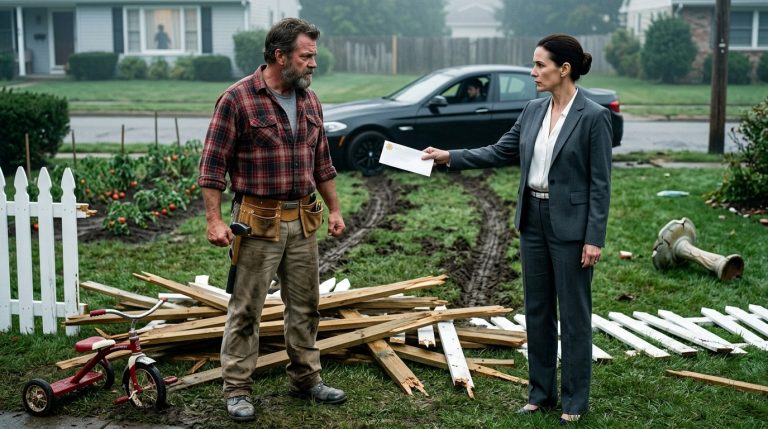
“Mr. Caldwell,” Vivian Blackwell said, her voice cutting through the dry drone of a dozen distant air conditioning units. She didn’t offer a greeting. She didn’t look at the small, neatly edged patch of lawn or the meticulous weather-stripping along his garage door. She held a thick manila envelope against her chest like a shield. “We are past the point of casual reminders.”
Marcus descended slowly, one deliberate rung at a time. His fifty-eight-year-old knees gave a faint, familiar click with the shift of his weight. He wore his old Pacific Gas and Electric blue work shirt, the fabric faded to the color of a winter sky, the hem stiff with salt stains from an afternoon of labor. When his boots hit the pavement, he didn’t step toward her. He simply stood beside the ladder, picked up a grease-stained rag from his workbench, and began wiping the aluminum dust from his fingers.
“The city inspector signed off on the grid-tie at two o’clock, Vivian,” Marcus said. His voice was level, carrying the flat, unhurried cadence of a man who had spent thirty years talking over the roar of diesel generators and snapping high-voltage lines. “The net meter is already running backward. I’m putting clean power back into the Riverside Oaks circuit.”
“The city doesn’t manage the visual harmony of this subdivision, Mr. Caldwell. The board does.” Vivian stepped forward, the white leather of her premium SUV gleaming behind her in the cul-de-sac like a polished tooth. She thrust the envelope toward him. “Section Four, Paragraph Two of the covenants. Non-standard exterior reflective surfaces are strictly prohibited without prior architectural committee approval. You have seventy-two hours to return this roof to compliance.”
Marcus looked down at the envelope. The paper was crisp, untouched by the valley dust. He didn’t take it. Instead, his gaze drifted past her shoulder toward the end of the street, where the green metal box of the neighborhood’s primary electrical transformer sat behind a manicured hedge. He knew the thickness of the copper inside that box. He knew the exact capacity of the oil cooling the core. He’d helped lay the primary conduit for this entire sector back when the soil was nothing but dry dirt and tumbleweeds.
“Sarah wanted these panels,” Marcus said softly, his thumb tracing a rough scar near his knuckle where an old inductive arc had bitten into the skin twenty years ago. “She wanted the house to pull its own weight. To stop relying on an old, dirty infrastructure that breaks every time the thermometer hits one hundred and five.”
“Sarah isn’t paying the community assessment fines, Marcus,” Vivian replied, her eyes narrowing as she dropped the envelope onto the hood of his truck. The metal gave a faint, hollow thunk. “And neither will this neighborhood. Remove them, or we’ll have the legal authority to ensure your connection to this block becomes very expensive.”
She turned on her heel, the sharp click of her shoes echoing off the retaining wall as she walked back to her vehicle. Marcus didn’t watch her pull away. He looked up at the roof, where the blue-black silicon plates drank the remaining light, silent and steady against the gray. Beneath his boots, the ground felt solid, but he knew exactly how much current was moving through the dark earth beneath the concrete, waiting for the right switch to flip.
CHAPTER 2: THE GRAVITAS OF LAW
“The defendant’s actions do not merely represent a aesthetic non-compliance, Your Honor,” the attorney said, his voice carrying the smooth, polished resonance of someone whose words were bought by the billable hour. He wore a charcoal suit that looked too pristine for the valley heat, a sharp contrast to the desaturated oak paneling of the Kern County Superior Court. “They represent a calculated disregard for the contractually binding framework that holds our community together.”
Marcus sat behind the defense table, his large, calloused hands resting flat on the scuffed wood surface. The grain under his fingers was worn smooth by decades of nervous litigants, the varnish long stripped away by sweat and friction. He didn’t look at the lawyer. His eyes were fixed on Judge Martinez, noting the way her thumb rhythmically tapped the side of her fountain pen—a steady, mechanical pulse that reminded him of a pressure gauge on a failing line.
To his right, Vivian Blackwell sat perfectly rigid, her hands clasped tightly over a black leather portfolio. The gold hardware on her purse caught the harsh overhead fluorescent lighting, casting tiny, aggressive glints across the table. She didn’t look at Marcus, but her jaw was set so tightly that the skin around her mouth looked white and bloodless, like paper stretched over wire.
“Let’s strip away the adjectives, Counselor,” Judge Martinez said, her voice dry as the Bakersfield dust. She shifted her gaze from the attorney’s glossy exhibits down to the sparse folder Marcus had submitted. “The plaintiff is seeking a temporary restraining order based on allegations of intimidation and systemic harassment. Yet, looking through these logs, the only documented interactions consist of the defendant saying good morning while your client was photographing his garage.”
“Context is everything in an intentional harassment campaign, Your Honor,” the lawyer counteracted, stepping closer to the bench. He laid down three high-resolution photographs. The images showed Marcus’s roof, the blue-black silicon panels reflecting the sharp valley sun like shards of obsidian. “The defendant is utilizing industrial-grade utility equipment to alter the structural infrastructure of the Riverside Oaks subdivision. My client, as the elected executive of the homeowner association, is legally obligated to document these violations for the safety of the public.”
Marcus leaned forward slightly, the fabric of his faded blue work shirt straining against his shoulders. “Those panels aren’t industrial, Your Honor,” he said. His voice was quiet but heavy, carrying the flat, unhurried weight of a man who spent thirty years speaking over the roar of high-voltage transformers. “They’re standard residential three-hundred-watt monocrystalline modules. The city utility inspector verified the grid-tie connection at two o’clock last Tuesday. The system is fully compliant with the California Solar Rights Act.”
“The Solar Rights Act contains explicit exemptions for legitimate safety concerns, Mr. Caldwell,” Vivian’s lawyer snapped, turning his head just enough to direct his words toward Marcus without fully facing him. “The association is currently initiating an independent engineering audit of the entire circuit due to unexplained voltage fluctuations observed near your property.”
The word fluctuations hung in the air, stiff and false. Marcus knew the exact layout of the neighborhood circuit. He knew the resistance of the lines, the capacity of the step-down transformers, and the structural limits of the aluminum conductors buried beneath the asphalt. The idea of twelve residential panels causing a measurable fluctuation on a standard three-phase system was technically absurd—a finger-painted explanation designed for people who viewed electricity as magic rather than physics.
Judge Martinez picked up one of the photographs, her fingernail clicking against the glossy paper. “And these alleged safety concerns require a restraining order because…?”
“Because the defendant’s presence during my client’s compliance documentation is inherently adversarial,” the lawyer asserted. “He is attempting to leverage his former employment with the utility provider to bypass community standards and intimidate the board.”
Marcus watched the judge’s eyebrows rise slightly, a slow, skeptical movement that told him everything he need to know about the trajectory of the hearing. He reached into his pocket and pulled out a small, faded pocket notebook—the kind linemen used to record line numbers and transformer specs. The edges were black with old cable grease, the pages yellowed by the valley sun. He opened it to a page marked with a single metal paperclip.
“On May fourteenth,” Marcus read, his voice steady, “Mrs. Blackwell’s vehicle was logged at the cul-de-sac entrance at six-fifteen AM. On May fifteenth, six-twelve AM. On May sixteenth, six-twenty AM. Every photo in that exhibit was taken from the interior of a white BMW parked on a public easement. If there’s a pattern of observation here, Your Honor, I’m not the one holding the camera.”
Vivian’s pen clicked—a sharp, nervous sound that echoed in the quiet courtroom like a geiger counter detecting a leak. Her lawyer opened his mouth to object, but Judge Martinez held up a single, pale hand, stopping the motion before it could form.
“This court is not a mechanism for enforcing neighborhood aesthetic preferences under the guise of an emergency safety crisis,” Judge Martinez said, her tone dropping into a final, heavy cadence that signaled the end of the argument. “The request for a temporary restraining order is denied. If the association has legitimate infrastructure concerns, you will address them through the appropriate municipal code enforcement channels, not through the misuse of injunctive relief.”
The gavel didn’t slam; it met the wood block with a short, dull thud that signified the absolute boundary of the law.
Marcus stood up slowly, his knees making that familiar, dry click. He began gathering his notebook and his single folder, his thick fingers moving with deliberate care. Across the aisle, Vivian Blackwell didn’t move immediately. She remained seated, her fingers buried so deeply into the leather of her portfolio that the material groaned under the strain. When she finally looked up, her eyes didn’t hold the heat of anger; they held the cold, calculating weight of an operator who had simply encountered a temporary check on a long board.
As Marcus walked down the center aisle of the courtroom, the heavy oak doors swinging shut behind him, his phone vibrated against his hip. It was a single text from an unlisted number—a short string of text that made him halt on the marble steps outside the courthouse, the midday heat striking his face like a physical blow.
Elena here. Found something in the 2018 registry maps. The main feed line isn’t where the city records say it is. We need to look at the ground beneath your garage tonight.
Marcus deleted the message, his thumb pressing hard against the glass screen until the surface smeared with oil. He looked out over the desaturated expanse of the parking lot, where the heat waves made the distant utility poles look twisted and fluid, like iron bars melting in the sun. The law had given him a reprieve, but out here on the asphalt, the real friction was just beginning to warm up.
CHAPTER 3: THE MIDNIGHT LINE
The fluorescent tubes overhead buzzed with a low, sixty-cycle hum that vibrated directly against Marcus’s temples. It was the exact frequency of an overloaded substation, a sound he had spent thirty years tracking through rainstorms and midnight emergencies. Here inside the twenty-four-hour diner, the noise simply curdled the smell of burnt coffee and old frying oil.
Elena Rodriguez slid a laminated municipal plat map across the sticky formica table. Her fingers were smudged with graphite, the cuffs of her jacket frayed where they had rubbed against the edges of drafting tables in the city planning basement.
“Look at the pink boundary lines, Marcus,” Elena said, her voice dropping below the rattle of the kitchen’s exhaust fan. “The city records show the primary distribution loop for Riverside Oaks follows the southern utility corridor along the main road. But that’s the public ledger. The infrastructure field notes tell a different story.”
Marcus leaned forward, resting his heavy elbows on the table. The skin of his forearms was rough, weathered by decades of line work and scarred by minor inductive arcs that had left white, hairless track marks across his wrists. He adjusted his reading glasses, squinting through the glare of the overhead lights at the desaturated technical drawings.
His eyes followed the tiny, crisp ink lines representing the underground conduits. They didn’t run along the perimeter of the subdivision. Instead, they took a sharp, ninety-degree turn at the southern boundary, cutting straight across the parcel marker for Lot 14—the exact plot where his house stood, passing directly beneath the concrete slab of his detached garage before feeding into the green transformer box at the corner of the cul-de-sac.
“The developer rushed the phase-two filing in late 2018,” Marcus observed, his thumb tracing the path of the high-voltage lines. He could feel the gritty texture of dried coffee on the map’s edge. “They didn’t want to pay for the trenching around the bedrock near the main road. It was cheaper to cut straight across the raw acreage before the homes went up.”
“Exactly,” Elena said, tapping a specific notation near the margin. It was a faded municipal stamp, the purple ink rusted to a dull brown over the last eight years. “They granted a temporary construction easement to the city to operate that primary loop while the subdivision was being finalized. Standard procedure. But look at the expiration clause tucked into the addendum.”
Marcus read the tiny, dense legal typeface. His heart gave a slow, deliberate thud against his ribs—the exact physical sensation he felt when verifying an ungrounded line before stepping into a bucket crane.
This easement shall terminate automatically upon the transfer of the final parcel title or forty-eight months from the date of execution, whichever occurs first, unless formally renewed by the municipal authority.
“Forty-eight months from November 2018,” Marcus murmured, calculating the cause-and-effect with the cold speed of a diagnostic computer. “That puts the drop date in November 2022. It’s 2026, Elena. That means for over three years, the main power feed for this entire block has been running through my private property without a valid easement.”
“Worse than that,” Elena whispered, leaning closer until her glasses caught the yellow reflection of the diner’s exterior neon sign. “The city planning department assumed the homeowner association assumed the responsibility during the 2019 transition. Nobody filed the permanent dedication. The infrastructure is physically trespassing on your land. If you file a formal notice of violation, the city has precisely forty-eight hours to either negotiate a new easement on your terms or disconnect the transformer to clear the encroachment.”
Marcus took his glasses off, letting them dangle from his calloused fingers. He didn’t look excited; he felt the cold, heavy weight of a sovereign protector who had just been handed a loaded weapon in a dark room. He looked out the window at the desaturated gray ribbon of the highway, where the distant streetlights flickered against the valley haze.
The green metal transformer box down the street from his house wasn’t just a municipal utility anymore. It was a physical anchor that tied Vivian Blackwell’s entire kingdom directly to the dirt beneath his garage. Every air conditioner, every security camera, and every matching mailbox in Riverside Oaks depended on a loop of copper that had no legal right to be there.
“But that’s only half of it,” Elena continued, pulling a second document from her leather bag—a copy of a corporate registration from the Secretary of State’s online portal. The paper was crisp, the fresh ink sharp against the desaturated background of the diner’s interior. “I started looking into why Vivian is pushing these twenty-five-hundred-dollar ‘electrical safety audits’ through the board. Take a look at the corporate officers for Sunblock Roofing Company.”
Marcus took the page. His eyes scanned the names listed under the executive board. Brad Blackwell was listed as the principal owner, but tucked down in the third tier of ownership was a limited liability company registered out of Delaware.
“The LLC is a holding shell,” Marcus said, his voice flat, noting the technical layout of the corporate structure. “Who holds the signature authority?”
“Vivian does,” Elena said. “The association isn’t trying to fix a safety issue, Marcus. The safety audits are designed to be a financial funnel. The board issues a non-compliance notice based on ‘voltage instability’ from independent solar setups like yours. Then they offer a choice: pay a recurring fifty-dollar daily fine or accept a mandatory remediation safety audit through Sunblock Roofing. If a homeowner can’t afford the upfront audit fee, Brad offers them a corporate buyout—they sign a twenty-five-year solar lease program that locks them into a fixed monthly utility payment higher than their original bill, and the title of the solar equipment transfers directly back to the holding company.”
The pieces clicked together with the heavy, metallic finality of a closing breaker switch. The war over his twelve panels wasn’t about aesthetics or community harmony. It was a predatory manufacturing loop designed to systematically strip independent property owners of their energy choices, using the HOA bylaws as a legal vise to force them into long-term financial contracts that Vivian and her husband directly controlled.
“They’re using the association to run a corporate acquisition scheme,” Marcus said, his thumb pressing into the paper until it wrinkled.
“They’ve already converted four houses on the lower loop,” Elena said, her fingers tightening around her coffee mug. “My old property was one of them before I had to sell. She used the board to bleed me dry until I couldn’t afford the legal fees to fight her. She took my investment, Marcus. She took my husband’s deposit money for our own solar project and locked it in an escrow account that we couldn’t touch without a court order.”
Marcus looked at the smudge of graphite on Elena’s fingers, then down at the expired easement map. The physical reality of the situation was absolute. Vivian Blackwell thought she was playing a game of administrative attrition against a grieving widower who would eventually run out of stamina or money. She didn’t know that she had built her entire extortion machine on land that didn’t belong to the grid.
He stood up, sliding his notebook into his shirt pocket. The metal paperclip caught on the faded denim, a tiny scratch of friction that felt remarkably clear in the cool air of the diner.
“We don’t file the easement violation with the city planning clerk, Elena,” Marcus said, his voice carrying the quiet, gritty determination of a mechanic about to pull a primary fuse. “We file it directly with the city attorney’s office tomorrow morning, timed exactly three hours before Vivian’s safety town hall. If she wants to talk to the neighborhood about who controls the power on this block, I want to ensure we have the deed to the circuit.”
He turned and walked toward the cash register, his boots leaving faint, dusty prints on the linoleum floor. Behind him, the map lay on the formica table, its pink lines glowing under the hum of the fluorescent lights like a fuse that had already been lit in the dark.
CHAPTER 4: THE TACTICAL FAULT
“Look at the figures on the screen, neighbors,” Vivian Blackwell announced, her voice projected through two portable PA speakers that rattled against the drywall of the subdivision clubhouse. The air inside the room was thick, smelling of synthetic carpet cleaner, industrial floor wax, and the damp heat of forty worried residents tightly packed into folding chairs. “These are engineering metrics. Unregulated feedback from unauthorized micro-generation systems is bleeding into our common-area infrastructure. It is a fire risk, and it is a liability that threatens the property value of every parcel title in Riverside Oaks.”
Marcus sat in the back row, his wide shoulders slightly unaligned with the narrow plastic backing of his chair. He had his heavy leather work boots anchored flat against the linoleum floor. In his lap, he held a single printed copy of the financial handout Vivian’s committee had distributed at the door. His thumb pressed against the margin, feeling the cheap, rough texture of the paper. His technical focus wasn’t on the presentation slides; it was on the tiny municipal seal reproduced at the bottom of the sheet. The date code on the stamp had been altered—scraped or double-printed to turn an eight into a zero.
“The board has a fiduciary responsibility to secure this grid,” Vivian continued, her hand tracing a steep, red line graph that appeared to show an exponential surge in neighborhood voltage anomalies. Brad Blackwell stood just behind her right shoulder, wearing a spotless white hard hat and an orange high-visibility vest that looked like it had never encountered grease or cable soot. “Therefore, effective immediately under the emergency safety provisions of Section Nine, the association is mandating a comprehensive circuit inspection for any home operating non-standard external modifications. The standard assessment fee is twenty-five hundred dollars.”
A sharp murmur rippled through the front rows. A retired man in a faded bowling shirt leaned forward, his hands gripping his knees. “Twenty-five hundred? Vivian, most of us are on fixed drawdowns. That’s more than two months of grocery money. What happens if the audit finds something we didn’t know about?”
“Sunblock Roofing has agreed to provide a structured compliance remedy for families facing immediate hardship,” Brad Blackwell spoke up, stepping forward with a smooth, practiced smile that didn’t reach his eyes. His voice had the slick, rehearsed rhythm of a door-to-door solicitor. “We can convert your independent array into an approved master-lease program. Zero dollars upfront. We assume the maintenance liability, we standardize the grid tie-in, and you lock in a stable, predictable utility tier for the next twenty-five years.”
Marcus watched the room. He saw the subtle shift in posture among the older residents—the slight lowering of the shoulders, the sigh of exhaustion from people who didn’t understand the physics of an inductive loop but understood the weight of a legal threat. They were being offered an escape hatch from a trap that had been custom-built to catch them.
Marcus stood up. The metal legs of his folding chair scraped against the linoleum with a dry, screeching friction that cut straight through the hum of the PA system. The room went silent, the collective gaze of the subdivision swiveling toward the back wall.
“The line graph is false, Vivian,” Marcus said. His voice didn’t have the amplified volume of the speakers, but it carried the heavy, unhurried resonance of an iron pipe striking an anvil. “You’re showing a three-phase power factor deviation and calling it a residential voltage surge. A twelve-panel array operates on a single-phase synchronous inverter. It physically can’t produce the harmonic distortion you’ve got listed on that slide.”
Vivian’s posture stiffened, her fingers tightening around the plastic body of her laser pointer until the casing groaned. “Mr. Caldwell, this meeting is for registered members to discuss community safety, not for non-compliant litigants to give unverified technical opinions.”
“It’s not an opinion; it’s a diagnostic standard,” Marcus said, walking down the center aisle. His boots made a rhythmic, heavy strike against the floor. He laid his copy of the handout directly on the presentation table, his calloused thumb pointing at the brown, distorted municipal stamp at the bottom. “And this document contains a fraudulent public record notation. You took the 2018 construction easement file number from the city planning ledger and tried to re-date it as a 2020 permanent dedication code. You did it because you know the city loop running through this block doesn’t have a valid property agreement.”
Brad Blackwell stepped into the gap between the table and Marcus, his chest expanding under the orange vest. “Caldwell, you’re out of line. You don’t know anything about the association’s infrastructure contracts.”
“I know the main feed line runs directly beneath my garage slab, Brad,” Marcus said, looking down at the younger man until Brad stepped back an inch, his boot heel catching on a speaker cable. “And I know the temporary easement expired forty-eight months after November 2018. I filed the formal notice of encroachment with the city attorney’s office at noon today. The municipal utility department has already logged the violation.”
Vivian let out a sharp, breathless laugh that sounded like dry twigs snapping underfoot. “You think filing a bureaucratic complaint protects your unauthorized panels, Marcus? The city attorney doesn’t manage our internal architectural enforcement. The board has the legal authority to place a structural lien on your parcel by Friday morning for non-compliance.”
“They won’t be placing any liens, Mrs. Blackwell,” a voice called out from the side entrance.
Elena Rodriguez walked into the clubhouse, followed by two men in dark gray utility shirts bearing the embroidered emblem of the municipal power authority. One of them carried a yellow industrial clipboard; the other held a heavy leather tool belt loaded with lock-out tags and insulated high-voltage shears.
The lead technician looked at Vivian, then down at his digital readouts. “We have a structural safety order issued by the city legal department, ma’am. A formal encroachment notice means we are operating public infrastructure on private land without a valid property easement. Under state utility code five-one-two, we are required to isolate and tag out the transformer at Lot 14 pending immediate circuit relocation or a formal property settlement.”
The color left Vivian’s face so quickly her skin took on the desaturated gray tint of old drywall. “You can’t touch that transformer. If you pull that circuit, the power to the entire northern loop goes dead.”
“We have to clear the encroachment within forty-eight hours of the notice, or the city faces a ten-thousand-dollar daily structural penalty,” the technician explained, his voice flat and transactional. He turned back toward the door. “We’re pulling the primary fuse at the junction box now to isolate the line.”
“Wait—” Vivian shouted, stepping out from behind the podium, her portfolio slipping from her hand and spilling loose, white contract templates across the floor. “Marcus, stop this. If the loop goes down, forty homes lose their climate control in one-hundred-and-five-degree heat. You’re going to endanger your own neighbors just to settle a dispute over twelve pieces of glass?”
Marcus didn’t answer. He watched her run toward the door, her high heels sliding on the scattered papers. The trap had sprung, but as Marcus looked at the technicians walking toward the corner of the cul-de-sac, a cold knot formed in his chest. He had wanted leverage, but he hadn’t calculated the speed of the municipal response. The utility wasn’t going to negotiate; they were going to drop the loop to protect themselves from liability, and when the lights went out across the block, the blame wouldn’t hit the expired ledger in the city basement. It would hit the only house with working solar panels.
CHAPTER 5: THE ABSOLUTE BOUNDARY
The green metal casing of the transformer hummed against the dry heat, its rusted surface vibrating under the strain of the peak afternoon load. The padlock hanging from the primary latch was pitted with corrosion, its iron shackle stiff from years of exposure to alkali dust.
Marcus stood on the edge of the concrete pad, his heavy leather boots kicking up a small cloud of powder as he planted his weight. Behind him, the sound of the subdivision clubhouse was a distant rattle of panic, but here at the corner plot, the world had narrowed down to the metallic clink of tools and the heavy breathing of a woman who had run out of administrative options.
“Get away from the enclosure, Vivian,” Marcus said. His voice was raw, scraped by the dry wind, but it carried the flat, immoveable density of an unyielding bedrock structure.
Vivian Blackwell stood with her hands clamped around the rubber grips of a pair of thirty-six-inch bolt cutters. The red paint on the jaws of the tool was chipped, revealing the dark, hardened tool steel beneath. Her designer heels sank into the soft dirt beside the concrete pad, tilting her posture forward, making her movements look erratic and jagged.
“I am pulling the main disconnect switch, Marcus,” she gasped, her chest heaving under her silk blouse, the fabric stained with grease from her vehicle’s trunk lid. “If the city is going to shut down this loop because of your filing, I will ensure it happens under my authority. I will protect this neighborhood from your interference.”
“You’re not protecting anything but your husband’s balance sheet,” Marcus said, stepping closer. The air near the transformer smelled of scorched transformer oil and hot copper—a scent he could read like an instrumentation gauge. “The city technicians aren’t cutting the loop because of a filing. They’re dropping it because you built your entire lease-acquisition scheme on a fraudulent easement code. If those jaws touch that lock, you’re not enforcing a covenant. You’re destroying public infrastructure on private land.”
“It’s my grid!” Vivian screamed, her jaw locking as she brought the blades of the cutters down against the rusted padlock. The metal met metal with a sharp, sickening clank that echoed off the brick retaining wall of Marcus’s garage.
The hardened steel of the shackle didn’t snap on the first squeeze. The mechanical advantage of the long handles strained against her weight, the friction producing a microscopic puff of iron dust that smelled of sulfur.
Marcus didn’t run. He shifted his weight, his calloused hand reaching out to grip the cold, rough shaft of the tool’s handle before she could cycle the leverage. The skin of his palm pressed against the steel, feeling the heat generated by the impact.
“The loop stays live until the backup system balances the load, Vivian,” Marcus said, his thumb forcing the handle upward, reversing the torque. “If you drop three hundred and forty-seven homes offline while the circuit is pulling peak voltage, the inductive kickback will blow the internal fuses in every residential inverter on this street. You’ll destroy the electronics in forty houses just to clear your track.”
“Let go of the handles!” Brad Blackwell’s voice cut through the drone of the transformer. He had reached the edge of the lot, his white hard hat tilted back, his hands empty but twitching near his sides. “Caldwell, you touch her and that’s an immediate battery charge. We’ve got the board records to prove you’ve been planning this obstruction for months.”
“The city attorney has the records now, Brad,” Elena Rodriguez said, stepping onto the concrete pad from behind Marcus’s truck. She held a digital printout bearing the official blue stamp of the county recorder’s office. The edges of the paper were crisp, unwrinkled by the wind. “The municipal utilities director signed the emergency bypass agreement ten minutes ago. Marcus didn’t file to kill the power. He filed to transfer the loop’s liability to an independent local provider.”
Vivian froze, her fingers slipping against the rubber grips of the cutters. The tool hung slack between her and Marcus, its iron jaws still biting into the scarred shackle of the lock. “What independent provider?”
“The Sarah Caldwell Foundation,” Marcus stated, his voice dropping into a final, low register that carried the absolute finality of an uncoupled breaker. He reached down and took the bolt cutters from her unresisting hands, dropping them onto the dry earth with a heavy, muted thud. “The new easement agreement gives the city twenty-four months to relocate the conduit. In the meantime, the surplus generation from my twelve panels—and every independent array you tried to audit out of existence—is being rerouted into a community-managed microgrid. The city didn’t send those men to disconnect my house. They sent them to isolate your loop from the commercial supply.”
A heavy, metallic click sounded from the primary line pole at the edge of the cul-de-sac.
It wasn’t the sound of an explosion; it was the dry, definitive operation of an automated vacuum circuit breaker. Across the subdivision, forty air conditioning units stuttered, their fans dropping three octaves as the voltage shifted. But the lights didn’t go dark. The digital meters along the driveways didn’t halt. The numbers simply rolled over, the indicators changing from a commercial utility prefix to a local, closed-loop designation.
The white BMW sat idling near the curb, its personalized license plates covered in a thin, gray layer of Bakersfield dust. Vivian looked down at her hands, where the rust from the transformer padlock had left a dark, orange smudge across her palms—a permanent stain of friction that wouldn’t wash out with administrative appeals or corporate legal filings.
Marcus turned his back on the green metal enclosure, his boots step-matching the rhythm of the newly balanced grid humming beneath the concrete. The panels on his roof caught the last of the light, steady and functional, pulling the remaining energy from a sky that had finally run out of heat.