A Freight of Steel and Silence: The Long Road to Redemption Under the Gray Virginia Sky
CHAPTER 1: THE DUSTY GRIT OF THE RUSTY SKILLET
The rain didn’t wash the world clean; it just turned the Virginia dust into a slick, unforgiving paste. I sat in the corner booth of the Rusty Skillet, the vinyl seat cracked under my weight, nursing a cup of coffee that had gone lukewarm twenty minutes ago. Outside, the Peterbuilt sat in the back row, a monolithic presence in the dark, but inside, the air felt small, claustrophobic.
Then they walked in.
The old man moved as if his bones were bolted together with rusted iron, stiff and hesitant. Beside him, the girl—Sarah—worried at her fingernails, her eyes darting around the diner as if searching for a exit that didn’t exist. The man, Elias, wore a suit from a decade the fashion industry had forgotten, pressed into a blade-sharp edge that betrayed the poverty of the fraying cuffs. He clutched a battered wooden box to his chest like a child guarding a heartbeat.
“Sit here, Dad,” she urged, her voice thin, brittle with the kind of anxiety that doesn’t sleep. “Just eat something. The senator’s office, they’ll understand if we’re ten minutes late.”
“I don’t belong on that wall, Sarah,” he rumbled. The sound was like gravel shifting in a landslide, deep and discordant in the quiet diner. “I filed papers. That’s all I did. I don’t belong next to the names of men who actually did the work.”
I watched them over the rim of my cup. It was a practiced performance—the humble clerk, the worried daughter. But I’ve spent enough time hauling steel across the country to recognize the look of a man carrying a corpse, not in a box, but behind his eyes. It wasn’t modesty. It was a suffocating layer of survivor’s guilt, polished and maintained for fifty years.
Then the door shrieked open, admitting a gust of wind and four men who smelled of expensive scotch and the kind of untouchable entitlement that makes a man want to drive off a cliff. The leader, a guy with a haircut that cost more than a set of new tires, scanned the room with a predator’s apathy.
He didn’t look at the empty tables. He looked at the girl.
“Table for four,” the leader snapped, his finger hovering near the waitress’s face. “Center booth. The lighting is better.”
“That table is taken, sir,” the waitress whispered, her eyes flickering toward Elias.
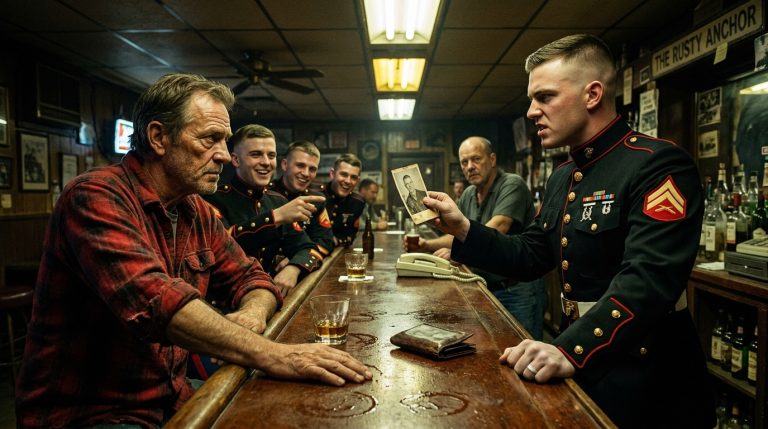
The leader ignored her, his boots clicking with a hollow, rhythmic authority across the linoleum. He reached the booth in three long strides, his shark-like grin never wavering as he stared down the old man. “Hey, Pops. You done yet? I’m bored of looking at the back of your head.”
Elias tightened his grip on the box. His knuckles were pale, the skin tight against the bone.
“Don’t,” Sarah whispered, her hand trembling as she reached for his arm.
The leader laughed—a sharp, cutting sound that echoed off the grease-stained walls. He reached out, his manicured fingernail tapping the side of the wooden box with a mocking, rhythmic clack. “What’s in here? Stolen pensions? You look like you’re holding onto a ghost.”
The leader shoved his finger against the latch. Elias’s hands were old, slow, and caught off guard. The box slid. It hit the floor with a sound like a gunshot, the latch snapping open to spill the contents into the mud tracked in by the front door.
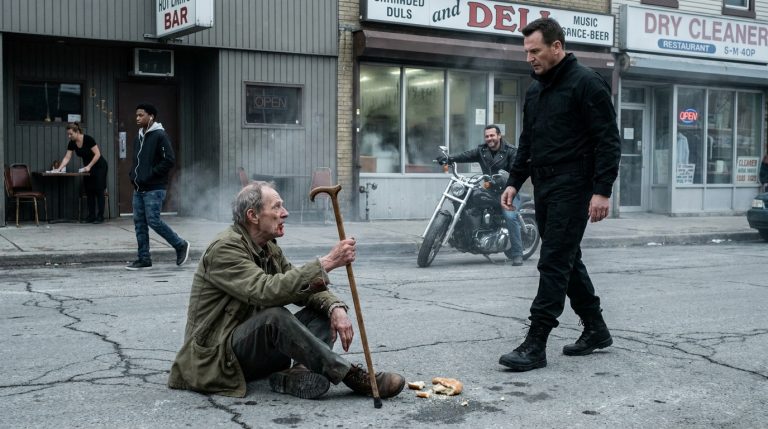
A silver star medal spun on the floor, settling in the dirt near the leader’s polished loafer. The diner went dead silent. The leader looked down, his lip curling in a sneer that didn’t reach his eyes. He flicked the medal with the toe of his shoe, sliding it under the table like it was gum wrapper. “Stolen valor, Pops? Pretty sad for a janitor.”
I felt the coffee cup vibrate in my hand. I didn’t stand up out of anger; I stood up because the mechanics of the room had shifted, and I was the only gear left to turn.
“Leave the box,” I said, my voice dropping into the low, vibrating register of an idling engine.
The leader turned. He looked at my flannel shirt, the grease-stained jeans, the trucker cap, and he saw a zero. He didn’t see the six-foot-four frame, and he definitely didn’t see the way the old man’s hands had stopped shaking the moment the medal hit the dirt.
“Go back to your feed trough, big man,” the leader said, turning his back to me. “This doesn’t concern the help.”
He reached for the girl’s arm, his fingers tightening with a sudden, predatory cruelty. Behind the leader’s back, Elias looked up. The air in the booth shifted. The exhaustion vanished, leaving behind a terrifying, still, and lethal clarity. He didn’t look like a clerk anymore. He looked like a man who was calculating the trajectory of a bullet.
I took a step forward, the floorboards groaning under my boots. I wasn’t just walking; I was closing the gap.
CHAPTER 2: THE PHYSICS OF CONSEQUENCE
I closed the distance. The floorboards under the heavy-duty soles of my boots didn’t creak; they gave way with a dull, settled thud. The leader, Brad, didn’t pivot quickly enough. He was still caught in the momentum of his own arrogance, his hand tight around Sarah’s arm, his head tilted back in a mocking laugh directed at the old man.
I didn’t speak. Words were for people who had time to waste, and the air in the Rusty Skillet had curdled into something that demanded immediate, kinetic resolution. I reached out, not with a fist, but with a flat palm, and pressed it against the small of Brad’s back. It wasn’t a shove; it was a redirection of energy. I pushed him off-balance, forcing him to release his grip on Sarah to catch himself on the edge of the laminate table.
He stumbled, his polished loafers sliding on the slick linoleum. He spun around, his face blooming from a sneer into a mask of indignant rage. “You really want to lose your license over a decrepit old man, trucker?”
“I’m not looking to lose anything,” I said, my voice as level as a spirit level. I stepped between him and the booth, putting my body between the threat and the target. “I’m looking to finish my coffee. And you’re making the room noisy.”
Brad’s three friends shifted, the air around them humming with a cocktail of cheap scotch and bravado. The one closest to me—a thick-necked guy in a blazer—took a step forward, his jaw tight. “You’re making a mistake, pal. We don’t take orders from guys who sleep in cabs.”
I didn’t look at the blazer guy. I kept my eyes on Brad. I noticed the way his weight shifted to his right leg—a classic tell. He was setting up for a swing, a wild, ego-driven roundhouse that lacked any real anatomical leverage. It was the movement of a man who had never been hit, someone who assumed the world would always move out of his way.
“Get out,” I repeated, my tone devoid of threat. It was a statement of fact, an inevitability.
Brad’s eyes widened, his nostrils flaring. He swung.
The air displaced by his fist felt slow, almost sluggish. I didn’t need to dodge; I just stepped inside his arc, the proximity neutralizing the power of his punch. I moved with the efficiency of a piston, my left hand snapping up to catch his wrist before it could gain momentum, and my right hand finding the nerve cluster just beneath his collarbone. I didn’t strike; I pressed.
Brad let out a sound—half-gasp, half-whimper—as his knees buckled. It was a clean, mechanical collapse. He was down, his face inches from the mud-caked medal that still lay near the booth. His friends froze, the suddenness of his fall stripping the confidence from their posture.
“Outside,” I said, looking at the door.
“You’re dead,” the blazer guy muttered, but he didn’t move. He looked at Brad, who was struggling to pull air into his lungs, his hand shaking as he reached for his phone.
Elias was behind me now. I could hear his breathing—a steady, rhythmic cadence that was impossible for a man with the “rust-caked” joints he had been pretending to have just seconds ago. He moved to Sarah, his hand firm on her shoulder. He wasn’t comforting her; he was steadying her, guiding her toward the exit with a tactical grace that was entirely foreign to the role of a frail janitor.
“Jack,” Elias said. His voice had lost the gravel rumble. It was clear, sharp, and commanded the space like a radio broadcast from a command center. “The back exit. Now.”
I didn’t look back. I kept my gaze locked on the group of men. “Sarah, get him to the truck. Don’t stop for keys. Don’t look back. Just get in.”
“What about you?” Sarah’s voice was high, trembling, but she was already moving, her hand clamped tight over her father’s arm.
“I’m just finishing my coffee,” I said, though my hands were already set, ready to absorb whatever recoil the room was about to throw at me.
As they slipped through the shadows toward the rear, the rain hammered against the diner’s plate glass, a violent, rhythmic drumming that masked the sound of the front door being shoved open again. A gust of cold, wet air roared into the diner, swirling the scent of bacon grease into a chaotic mist. The environment was shifting. The diner, once a place of refuge, had become a cage.
I didn’t wait for them to recover. I turned and walked toward the back, my boots heavy on the floorboards, my senses tuned to the sound of the front door hitting the frame. Brad was back on his feet, his face a mottled, ugly purple. He wasn’t looking at me anymore; he was looking at his friends, his finger pointing toward the rear door.
“Get him!” Brad screamed, his voice cracking. “I don’t care about the girl. I want the trucker.”
I reached the door, pushed it open into the freezing, rain-swept night, and stepped out into the mud of the parking lot. The Peterbuilt loomed in the dark, a silent, iron fortress. I knew exactly where Elias was heading, and I knew exactly how long we had before the formation of SUVs behind us turned this rainy night into a tactical nightmare. I didn’t rush. I moved with the deliberate, heavy-duty rhythm of a man who knew that in a game of steel, the biggest, hardest object usually wins.
CHAPTER 3: THE HIGHWAY GAMBIT
The air brakes hissed—a long, drawn-out sigh of compressed air that felt like a release of tension I hadn’t realized I was holding. I slammed the transmission into gear, the shift knob cold and vibrating against my palm. Beside me, Elias was already a different man. The hunched, shuffling janitor had vanished the moment we cleared the diner door, replaced by a stillness that was, in its own way, more dangerous than the violence I’d just left behind.
He didn’t look at me, and he didn’t look back at the diner. His eyes were fixed on the side mirror, or rather, the empty mounting bracket where the mirror should have been.
“They’re moving,” Elias said. His voice was steady, void of the tremor he’d displayed earlier. “The SUV is already in the turn lane. They aren’t going to call for backup. They’re going to try to finish this themselves.”
I didn’t answer. I pulled the Peterbuilt out of the lot, the massive tires crunching over the gravel. The rain was coming down in sheets, a gray, liquid wall that obscured the world beyond the reach of my headlights. I needed to build speed, and I needed to get this rig onto the highway before the black SUV could close the distance.
“Sarah,” I barked, glancing into the rearview mirror. She was huddled in the sleeper berth, her face pale, her hands gripped so tight around her purse that her knuckles were white. “Stay down. Get below the window line.”
She nodded, too terrified to speak. I shifted up, the 600-horsepower engine growling as it labored under the weight of the flatbed load. We weren’t fast, not in the way these modern, computerized SUVs were, but we were heavy. Momentum was my only ally.
As we hit the on-ramp, the world narrowed to the flickering orange glow of the dashboard lights and the rhythmic, hypnotic slap of the windshield wipers. Then, the first set of high beams erupted behind us. They didn’t just turn on; they flared, a blinding white strobe that flooded the cab.
“Formation,” Elias noted, his head tilted slightly, listening to the roar of engines approaching from the rear. “One on the left, one on the right. They’re going to box you in. They want to force you onto the shoulder.”
I felt the truck shudder as the first gust of wind from an overtaking vehicle rocked the trailer. My grip on the steering wheel tightened until my forearms burned. I didn’t accelerate away; instead, I held the lane, forcing them to make the first move. If I let them bully me, I was finished.
“Watch your left,” Elias warned, his eyes tracking movement I could only perceive as shadows in the dark.
I glanced at the side window. The black SUV was there, prowling alongside my driver’s side door. I could see the silhouette of Brad in the passenger seat, his arm hanging out the window, his expression contorted into a mask of pure, unadulterated malice. He wasn’t just trying to pass; he was drifting closer, his fender inching toward my front tire.
It was a game of chicken, played in the dark, at seventy miles an hour, in a downpour.
“He’s going to hit you,” Sarah screamed from the back.
I didn’t swerve. I did the opposite. I nudged the wheel to the left, closing the gap, forcing the SUV driver to either collide with the heavy-duty lug nuts of my steer axle or retreat into the median. It was a calculated risk. I felt the sickening crunch of metal—the sound of steel against aluminum, the high-pitched shriek of bodywork being torn away like tissue paper.
The SUV swerved, its tires catching the wet grass of the median. For a heartbeat, it fishtailed, a chaotic dance of headlights and sparks in the darkness, before it corrected and fell back.
“That was close,” I grunted, my heart hammering against my ribs.
“It’s not enough,” Elias said, his gaze fixed forward. “They aren’t done. And neither are you. Look at the road, Jack. You’re losing your focus on the terrain.”
He was right. I was staring at the rearview, obsessing over the last skirmish, while the highway was throwing new threats at us. The road ahead was dark, winding through a stretch of thick, claustrophobic forest where the canopy kept the rain from washing the road clean. I was driving into a tunnel of shadows.
I felt a sudden, sharp discrepancy—a vibration in the steering column that hadn’t been there a minute ago. It was subtle, a rhythmic thumping that suggested my front tire was taking the brunt of that collision. I ignored the instinct to check the air pressure; I didn’t have time.
“Why are they doing this?” I asked, the question slipping out before I could check it. “Over a medal? Over a box of photos? This isn’t just entitlement, Elias. This is personal.”
Elias turned then, and for the first time, he looked at me, not as a driver, but as an equal. The ambient light from the instrument panel caught his face, revealing a map of scars and hardened lines that told a story far deeper than any janitor’s record.
“Some people,” he said, his voice as cold as the rain hitting the windshield, “spend their whole lives building a legacy out of paper and air. When someone comes along with something real—a history, a truth, a medal—it reminds them that their world is hollow. They don’t want to steal it, Jack. They want to destroy it.”
He didn’t explain more. He didn’t have to. The road ahead began to narrow as the bridge markers appeared, their reflective yellow paint glowing like malevolent eyes in the dark. We were heading into the chokepoint, the bridge that would decide whether we made it to the state line or ended up as a pile of wreckage in the Virginia mud.
My knuckles throbbed, a dull ache that synchronized with the thumping in the steering wheel. Every mile was costing me. I checked the mirror again. The headlights were still there, hanging back just enough to stay in my blind spot. They were waiting for a mistake. They were waiting for me to get tired.
“They’re signaling,” Elias said, pointing toward the two pickups now flanking the rear of the trailer. “See the flashes? They’re coordinating. When we hit the bridge, they’re going to try to cut your airlines.”
I looked at the road, the engine roar filling the cab, the smell of damp flannel and nervous sweat thickening the air. We were running out of road, and the nightmare was only just beginning to tighten its grip.
CHAPTER 4: THE BRIDGE CHOKEPOINT
The bridge spanned the dark gorge like a serrated blade cutting through the gloom, its concrete railing a continuous blur of white concrete that seemed to rush toward us. I kept my foot steady on the throttle, the engine’s roar echoing off the girders—a deep, resonant sound that felt like it was rattling the marrow in my bones.
“Three hundred yards to the narrow,” I said, my voice steady, though my hands felt like they were fused to the steering wheel.
Elias was leaning forward, his eyes tracking the side mirrors with an intensity that made the cab feel small, charged with a sudden, sharp pressure. He didn’t flinch as the pickup on our right surged forward, its high-beam lamps flickering in the spray thrown by my tires. He was silent, but it wasn’t the silence of a passenger; it was the silence of a man calculating windage and distance.
Then, the phantom came.
A sharp, metallic clatter of a girder vibrating beneath the bridge’s weight hit my ears, and for a split second, the sound didn’t belong to the highway. It transformed into the terrifying, high-pitched scream of a mortar strike hitting a dirt-packed bunker. I jerked the wheel, a reflex born of muscle memory, my heart leaping into my throat. The Peterbuilt veered, the massive trailer swaying on its kingpin, and for a terrifying second, we leaned precariously toward the concrete barrier.
Elias’s hand shot out, steadying the wheel. His grip was like a vice—unyielding, corrective, and devoid of panic. He pulled the rig back into the center of the lane without a word, his face a stone-cold mask. The hallucination of the battlefield evaporated, replaced by the relentless reality of the wet asphalt and the encroaching pickups.
“Keep your head, Jack,” he muttered, his voice barely audible over the wind. “The bridge is solid concrete. It won’t give. They want you to think it’s a trap.”
“They’re not just trying to push me,” I replied, the adrenaline still coursing through me. “They’re trying to time the squeeze.”
The pickup on the left accelerated, its engine whine rising to a fever pitch. I saw the driver’s face—a young, cocky kid with a headset, his hands dancing over the wheel as he tried to pinch the gap between my driver’s side and the bridge railing. He was playing for keeps.
I glanced at the instrument panel. The needles were steady, but the vibration in the steering column was intensifying. I was losing the steering precision I needed for this maneuver. Every inch of the bridge was a potential catastrophe, but I couldn’t slow down—stopping meant being a stationary target for whatever they had planned behind the blockade.
“Sarah, stay down!” I yelled, glancing in the rearview. She was curled into the sleeper, her eyes wide, clutching a blanket like a shield. She looked so small against the backdrop of the massive, steel-framed trailer.
“Jack, look ahead!” Elias warned.
The gap was closing. The pickup on the left had drifted within inches of my side panel, its brush guard scraping against the reflective tape on my door. The sound was a harsh, screeching grind that cut through the engine noise. I felt the rig pull to the right, a violent tug as their vehicle dragged against mine.
I didn’t try to outrun them. Instead, I did the only thing a driver with eighty thousand pounds of momentum could do: I tapped the trailer brakes.
The air hissed. The massive trailer groaned as the brakes locked momentarily, the weight of the steel beams surging forward and shoving the tractor sideways. It was a violent, jarring motion that sent a ripple of force through the entire vehicle.
The pickup driver, caught off guard by the sudden lateral shift of my trailer, overcorrected. His truck skidded, the rear tires catching the edge of the bridge’s seam. He fought the wheel, his vehicle wobbling like a top, and for a terrifying second, I thought he was going to flip into the path of the SUV behind us. He slammed into the concrete railing instead, a shower of sparks and shredded metal erupting into the night as his truck bounced off the concrete, the impact sending him spinning toward the rear.
“That’s one,” Elias said, his voice as flat as a ledger entry. “But the SUV is moving up the middle.”
I looked forward. The black SUV, battered but relentless, was surging forward from the rear, aiming for the narrow corridor we were creating. They weren’t going to pull alongside anymore; they were going to ram the back of the trailer to trigger a jackknife.
“They’re going for the pin,” I said, a cold resolve settling in my gut. “If they hit the kingpin, this trailer is going to wrap around the cab.”
“Then don’t let them hit the pin,” Elias said, shifting his weight. “Increase speed. Gain the distance. We need to reach the construction site before they can commit to the ram.”
“I can’t push it any harder, Elias! The engine’s redlined!”
“Then find another gear,” he retorted, his eyes locking onto mine with a terrifying, absolute certainty. “You have the mass, Jack. Use it.”
I looked at the road, the rain-drenched tarmac stretching out like a black ribbon into the darkness. We were a thousand feet from the construction barrels, and the SUV was closing. The roar of the engine was a screaming, mechanical protest, but I reached for the stick, grinding through the gears, feeling the vibration of the entire chassis as we accelerated toward the unknown, toward the construction site that promised either our salvation or our end.
CHAPTER 5: THE STAGING AREA
The world skewed sideways. The transition from the wet asphalt of the highway to the loose, unstable gravel of the construction staging area felt less like a turn and more like a controlled crash. The Peterbuilt groaned—a deep, metallic protest—as the trailer’s massive tires bit into the soft earth, fishtailing the entire rig in a wide, sliding arc that ended with the truck jackknifed against a pile of rusted iron rebar.
I didn’t give myself a second to catch my breath. The engine was still roaring, the turbo whining as it spooled down.
“Stay here,” I barked, my voice barely piercing the chaotic roar of the rain and the grinding gears. I reached beneath the seat, my fingers brushing the cool, heavy steel of the tire thumper. It was a tool of the trade, but tonight, it felt like the only thing tethering me to reality.
“Jack, wait,” Elias called out. His voice was no longer the gravelly mumble of a clerk. It was sharp, authoritative, and calm. I glanced back and saw him reaching into his inner coat pocket—not for a weapon, but for something else. He pulled out a small, metallic object, something that glinted with a dull, matte finish under the cab’s flickering overhead light. It wasn’t a gun. It looked like a communicator, or perhaps a master key. “If they breach the perimeter, don’t face them in the open. Use the excavator as a pivot point. Their momentum is their weakness. If they hit the equipment, they’re trapped.”
I didn’t argue. I didn’t have the time to ask how a retired clerk knew the tactical vulnerabilities of a construction site. I pushed the door open and stepped out.
The cold hit me like a physical blow. The rain was freezing now, a sleet that turned the mud into a treacherous, sucking swamp. Beyond the reach of the truck’s remaining headlight, the staging area was a landscape of hulking, dark silhouettes—the crane, the bulldozer, the towering stacks of rebar. And then, the headlights of the black SUV crested the highway barrier.
It arrived with a screech of tires and a blast of spray, skidding into the construction yard with the reckless abandon of a predator that had finally cornered its prey. It skidded to a stop twenty feet away, the driver’s door flying open before the engine had even cut out.
Brad stepped out. He was a mess. His expensive suit was shredded, his face streaked with a mixture of grease and rainwater, and in his right hand, he held a pistol. He didn’t look like a senator’s son anymore; he looked like a man who had lost everything and was desperate to burn down whatever remained.
“You think you’re so smart, don’t you?” Brad screamed, his voice swallowed by the thunder. “You think you can just drive away? You humiliated me. You and that old man!”
I stood by the front fender of my truck, the rain plastering my shirt to my skin. My heartbeat was a steady, rhythmic thud in my ears—a countdown. I felt the phantom vibrations of the bridge still echoing in my legs, the sensory overload of the chase blurring the edges of the yard. I looked at the shadow of the crane, the dark metal looming over the yard like a gallows. Was it moving? For a moment, the iron seemed to shift, but I blinked, and it was just a trick of the flickering light.
“Put it down, Brad,” I said, my voice low, cutting through the wind. “You’re done. You’re already a felon. Don’t add a body to the list.”
“A body?” Brad laughed, a high, manic sound. “Nobody cares about a trucker and a janitor!”
Behind him, the two pickups skidded into the yard, their engines cutting out with a rhythmic, pulsing sound that felt like a dying heart. Five more men spilled out. They were armed with tire irons, bats, and chains—their faces illuminated by the harsh, yellow glare of the construction floodlights that had just flickered to life.
I checked the distance. Twenty feet. Too far to rush, too close to retreat. I scanned the yard—the bulldozer, the rebar, the mud. I needed to force them into the trap Elias mentioned. I took a step back, feigning a retreat toward the cab of the truck.
“Get him!” Brad shrieked, waving the gun toward the staging area. “I don’t care if he’s breathing or not!”
The five men surged forward. They didn’t coordinate; they moved with the desperate, mindless energy of a pack. I waited until the lead man, a massive guy with a rusted chain, was within striking distance. I didn’t swing for the head; I swung for the knees.
The tire thumper connected with a wet, heavy thud. The guy went down, a garbled cry erupting from his throat, but the others didn’t stop. They swarmed over him, desperate to reach me. I pivoted, swinging the hickory stick in a wide, defensive arc, but the weight of them was overwhelming.
I was knocked backward into the mud. The cold hit my skin instantly, shocking and sharp. A hand grabbed my hair, yanking my head back, while another fist slammed into my ribs. The world went dark for a second, a flicker of gray static clouding my vision.
I fought, my limbs moving with a frantic, desperate energy, but I was pinned. I felt the cold barrel of a gun press against my forehead.
“You’re trash,” Brad whispered, standing over me, his breath smelling of expensive scotch and sewage. “You’re just a nobody in a loud truck. And that’s all you’ll ever be.”
I glared up at him, my vision blurring, the rain washing the mud from my eyes. I felt a surge of cold, hard clarity. This wasn’t the end. This was the moment where the rules of the road—the rules of the fight—changed forever. I prepared to kick, to twist, to do whatever it took, but before I could move, the driver’s side door of the Peterbuilt slammed open.
“I said,” Elias’s voice roared, a sound that held the weight of a thunderclap, “drop the weapon!”
I looked past Brad. Elias was standing on the steps of the rig. He wasn’t hunched. He was standing perfectly straight, his eyes burning with an ancient, terrifying intensity, and in his hand, he held the tire iron as if it were a weapon of war.
CHAPTER 6: THE TURNING POINT
The world seemed to sharpen, the chaotic noise of the storm and the shouting men falling away into a high-frequency hum. The tire iron, a heavy, grease-coated piece of forged steel, was still spinning in the mud, clattering once before it settled near Brad’s twitching fingers. Brad didn’t scream at first. He just stared at his hand, which was angled in a way that defied nature, his jaw hanging open as the shock finally bypassed the adrenaline.
The goons who had pinned me to the mud were paralyzed. They looked at Elias, then at Brad, and their collective momentum evaporated. They didn’t see a janitor. They saw a man who had ended a threat with the casual, terrifying precision of a machine.
I took the opening. I surged upward, my legs driving me out of the muck, and slammed my shoulder into the man holding my left arm. He didn’t even try to hold on; he stumbled back, tripping over the guy I’d gut-punched earlier. I was on my feet, hickory stick in hand, my chest heaving, every muscle screaming for release.
“Back!” I roared. The goons didn’t need further persuasion. They backed off, their faces pale, their eyes darting toward the darkness beyond the floodlights as if they were already calculating their own exit routes.
Elias walked forward. He didn’t rush. He moved with a terrifying economy of motion, his footsteps heavy and purposeful in the sludge. He reached the center of the yard, the rain washing the grease from his hands. He didn’t look at me, and he didn’t look at the thugs. He looked at Brad.
“You have no idea what you’ve disturbed,” Elias said, his voice quiet, lacking any of the tremor or the stutter that had characterized his performance at the diner. It was a voice that belonged in a bunker, a voice that had likely directed artillery strikes and held perimeters long before the senator or his son were even born.
Brad scrambled backward, his broken wrist cradled against his chest. “You… you’re not…”
“I’m a man who is tired of being patient,” Elias interrupted. He gestured toward the gun lying in the mud, half-submerged in the gray water. He didn’t pick it up. He simply stepped on it, grinding it deeper into the earth with the heel of his shoe. “I spent fifty years trying to bury the things I did, the things I saw, so that children like you could play at being powerful. I gave you that peace. And you chose to weaponize your ignorance against me.”
I watched, mesmerized. The “clerk” was gone. The man standing before me was a relic of a darker era, someone who viewed the current conflict not as a life-or-death struggle, but as a minor tactical correction. He wasn’t acting out of anger; he was acting out of necessity.
One of the goons—the one who had tried to tackle me—made a mistake. He tried to circle around, his hand reaching into his jacket, presumably for another weapon.
Elias didn’t look over, but he moved. He pivoted on his heel, his left hand snapping out to catch the goon’s wrist, and he executed a move so fast that my eyes could barely track it. He used the goon’s own weight to flip him, pinning the man’s face into the mud with a single, firm hand on the back of his neck.
“Stay down,” Elias said, the command echoing across the yard. The man didn’t move. He went limp, his breath hitching in a stifled sob.
The rest of the attackers didn’t wait. They turned and sprinted toward their vehicles, leaving their companion in the mud. Brad, left entirely alone, looked around, his eyes wild with a sudden, dawning terror. He tried to stand, but his legs gave out, and he collapsed back into the muck, sobbing—not out of pain, but out of the sheer, crushing weight of his own insignificance.
I walked over to them, my boots sinking into the gravel. I felt the exhaustion settle into my bones, a deep, weary ache. The fight was over, but the reality of what had just happened was beginning to settle.
“Elias,” I said, my voice barely audible over the relentless drumming of the rain. “Who are you?”
Elias looked at me, and for a fleeting second, the mask of the humble janitor threatened to return, but it faltered. He looked toward the highway, where the faint, rhythmic pulse of sirens was beginning to color the distant sky with blue and red.
“I’m just a man who didn’t want to be remembered, Jack,” he said softly, turning to walk back toward the Peterbuilt. “But the road has a way of reminding you who you are, whether you want to know it or not.”
He climbed back into the cab, his movements fluid and efficient, showing no sign of the age or the injury he’d been faking for the last hundred miles. I watched him go, then turned my gaze to Brad, who was still huddled in the mud, his world dismantled.
The sirens were getting louder. The state troopers were minutes away. The chase was coming to its inevitable, ugly conclusion. I took a deep breath, the damp air stinging my lungs, and started toward the truck. It was time to finish the run, but as I walked, I realized the man sitting in my passenger seat was no longer the man who had climbed into the cab back at the Rusty Skillet. The story was changing, and for the first time, I wasn’t entirely sure I knew how it would end.
CHAPTER 7: THE BLUE LIGHT ESCORT
The engine fired on the first turn of the key, a massive, deep-throated roar that seemed to vibrate the very ground beneath us. The mud around the wheels churned as I shifted into low gear, the Peterbuilt clawing its way back toward the highway pavement. Behind us, the construction yard was already crawling with activity—the red and blue strobes of the state police cruisers lighting up the rain-slicked piles of rebar and the dark, looming skeletons of the machinery.
“They’re secured,” Elias said, his voice quiet as he watched the rearview mirror. His posture was perfectly upright, his hands resting on his knees. There was no trace of the trembling, confused old man who had walked into the Rusty Skillet three hours ago. He was watching the police move toward the SUV, watching them haul Brad toward the patrol cars.
“You think they’ll hold him?” I asked, keeping my eyes on the road. The highway ahead was still dark, but now, a wedge of cruisers was peeling off the ramps to meet us. They formed a V-formation, their sirens cutting through the night with a sterile, rhythmic urgency.
“His father is a district attorney,” Elias replied, his gaze shifting to the horizon. “In that world, they don’t look for truth. They look for leverage. But the dashcam footage… that’s the one thing they can’t spin. You did well, Jack. You gave them a narrative they can’t destroy.”
I glanced at him. The “clerk” facade was completely dismantled. The way he held his shoulders, the way his eyes tracked the movement of the escort vehicles—it was all wrong for a man who claimed to have spent fifty years filing paperwork. I felt a chill that had nothing to do with the freezing rain.
“You weren’t a clerk, were you?” I asked.
Elias didn’t answer immediately. He stared out the windshield, the strobe of the police lights washing over his face in rhythmic pulses of blue and white. “I was a specialist. In a place where you didn’t have time to be a clerk. You were either a soldier, or you were a memory.”
I didn’t press. I couldn’t. The road ahead demanded my full attention. The state police escort cleared the traffic ahead of us with a ruthless, surgical efficiency. We were moving at a steady seventy-five, a convoy of light and purpose cutting through the Virginia darkness. I found myself driving differently, my movements more fluid, more focused, as if the urgency of the escort forced me into a higher state of awareness.
In the sleeper berth behind me, Sarah had finally fallen into a fitful, exhausted sleep. I could hear her breathing—a soft, uneven sound that contrasted sharply with the mechanical drone of the truck.
“We’re twenty miles out,” I noted, watching the highway signs zip past, illuminated by the cruisers’ light. “They’re going to be waiting for you, aren’t they?”
“The senator’s office,” Elias said, a faint, almost melancholy smile touching his lips. “They want the ceremony. They want the photograph of the forgotten hero standing at the wall. They think they’re giving me something. They don’t understand that for fifty years, I’ve been the one giving them their peace.”
He looked down at the wooden box still resting on his lap. He hadn’t opened it again, but his hand hovered over the latch, his thumb tracing the wood with a reverence that was almost painful to watch. “My daughter thinks this is a story about a janitor who did a good thing. She needs it to be that way, Jack. Do not change that for her.”
“I’m just a trucker,” I said, the words feeling heavy in the quiet cab. “I don’t have a say in the history books.”
“The history books are written by the people who win,” Elias said, looking toward the distant, glowing silhouette of the Washington DC skyline. “But the truth? The truth is written by the people who survive. We’re arriving soon. Keep your distance from the dignitaries. Let them have their ceremony. I just need to touch the granite, and then we leave.”
The escort began to slow as we approached the district line. The massive, looming structures of the capital appeared, bathed in a floodlit, artificial light that made the city look like a sprawling, white-marble mausoleum. My hands were aching, my ribs were a solid block of pain, and the truck felt like a pile of scrap metal held together by sheer willpower. But we were close.
The lead cruiser signaled a turn, the blue strobes reflecting off the polished marble of the monuments as we entered the memorial grounds. It was quiet here, a profound, heavy silence that seemed to swallow the noise of the city. I felt the weight of the truck slow, the gears shifting down with a mechanical sigh, until we finally came to a stop near the entrance to the wall.
The police escort didn’t just stop; they formed a perimeter. It was all so clean, so official. I watched as the doors of the cruisers opened and men in sharp, charcoal-gray coats stepped out, their faces obscured by the shadows and the dim streetlights. They were waiting.
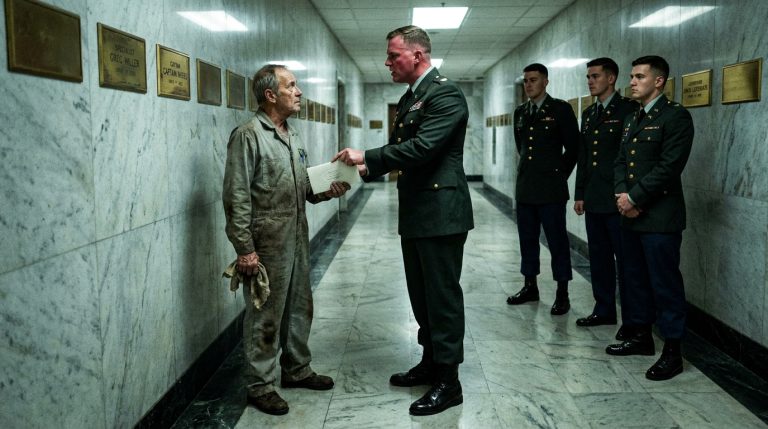
“This is the end of the line, Jack,” Elias said, his voice barely a whisper. He straightened his tie, his movements slow and deliberate. He picked up the box, stood up, and looked at me one last time. For a moment, the mask of the fragile old man was gone entirely, replaced by something ancient and steel-hard.
“You did a good job today,” he said. It wasn’t a compliment; it was a verdict.
I watched him step down from the cab, his boots hitting the pavement with a firm, solid sound. He looked toward the wall, the black granite slab reflecting the lights of the capital, and he started to walk. I stayed in the cab, the engine idling low, the vibration of the truck the only thing keeping me in the present moment. I knew then that whatever happened next, I had been part of something that wouldn’t be found in any news report or press release. I had been part of a truth that was finally coming home.
CHAPTER 8: THE FINAL UNVEILING
The silence of the memorial was not empty; it was heavy, pressing against the skin like the weight of a deep-sea dive. I stood by the front bumper of the Peterbuilt, the chrome still scarred from our collision on the bridge, and watched as Elias approached the wall. He didn’t walk with the shuffle of the man who had ordered a sandwich in the Rusty Skillet; he walked with the measured, rhythmic cadence of a man returning to his post.
The dignitaries—a collection of gray-suited men with practiced expressions of solemnity—parted for him, their chatter dying away as if his presence alone acted as a vacuum for sound. Sarah was two steps behind him, her eyes wide, her hands pressed to her chest as if she were afraid that if she let go, the truth would evaporate.
The senator stood at the podium, a sheet of paper fluttering in his hand. He looked at Elias, and for the first time, I saw a flicker of genuine uncertainty in the politician’s eyes. He had expected a story of quiet dignity, but he was staring at a man who carried the literal ghosts of an entire platoon in his posture.
“Fifty years ago,” the senator began, his voice amplified by the hidden speakers, “on a hill known as the Valley of Tears, a group of men were saved not by an air strike, but by the singular, desperate action of a man whose name was erased from the record to protect the secrecy of the mission.”
The crowd murmured. Elias didn’t look at the senator. He didn’t look at the cameras. He reached out, his hand—bruised, swollen, yet steady as a rock—and pressed his palm against the cold, black surface of the granite.
“Specialist Elias Thorne,” the senator continued, his voice cracking slightly. “We are here today to acknowledge that while you were lost to the paperwork, you were never lost to the brothers you brought home.”
The truth didn’t arrive with a thunderclap. It arrived as a slow, gradual stripping away of the lies. As the senator spoke, the physical reality of Elias began to change in the eyes of the onlookers. They saw the way his jacket, though worn, fit the frame of a soldier. They saw the way he scanned the perimeter of the crowd, not out of fear, but out of habit.
Sarah gasped, a sharp, ragged sound. She walked forward and placed her hand over her father’s on the wall. “Dad?”
Elias closed his eyes, and the final mask fell away. “I didn’t file papers, Sarah,” he whispered, his voice deep and clear, resonating in the quiet. “I held the line. And for fifty years, I stayed quiet because I thought that was the only way to keep you safe from the man I had to become to bring them home.”
The payoff was not in the senator’s speech or the bronze plaque being unveiled. The payoff was in the way Elias’s hand relaxed, the tension finally bleeding out of his shoulders. It was the look of a man who had finally put down a burden he had been forced to carry since he was twenty years old.
The antagonist’s defeat was absolute, not in the sense that he was physically destroyed, but in the sense that his world—the world of entitlement and hollow status—simply didn’t exist here. Brad, likely sitting in a holding cell somewhere, was already being erased by the system he thought he owned. The truth, recorded on my dashcam and played out here in the light of day, had made his threats irrelevant.
I watched as the crowd began to applaud, a slow, swelling sound that filled the mall. I turned away, the moment no longer mine to witness. I climbed back into the cab of the Peterbuilt. The interior was cool, smelling of diesel and the lingering, metallic scent of the struggle.
I reached for the ignition, but paused, my hand resting on the dashboard. I grabbed the tire thumper from the floorboard, the wood smooth and worn, and tucked it away into the door pocket. I had no reason to keep it now, but it felt like a part of the journey.
The cool-down was a slow, deliberate process. I checked the mirror one last time. Elias was standing with his daughter, his arm around her shoulders, the two of them looking not at the plaque, but at each other. The symbolic closure was there—the man who had carried a box of broken, scattered memories had finally found a way to bridge the distance between his past and the woman he loved.
I turned the key. The engine caught, a low, steady thrum that signaled the start of a different kind of life. There was no more chasing, no more hiding. The road ahead was long, and for the first time in years, it felt like it led somewhere worth going. I put the truck in gear and began to roll, the tires crunching softly on the asphalt, leaving the memorial and the weight of history behind in the fading light of the afternoon.