The Weight of the Flag: A Colonel’s Calculated Dismantling of a Corporate Empire’s Moral Bankruptcy
CHAPTER 1: The Weight of the Protocol
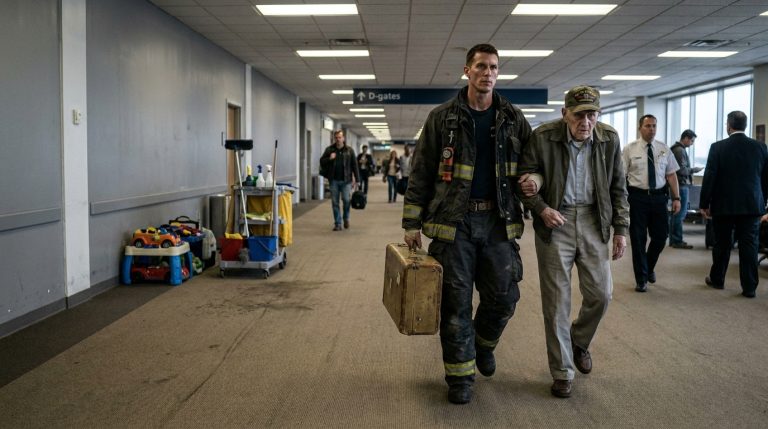
The fluorescent lights of the terminal hummed with a low, parasitic frequency that grated against the back of Carter’s skull. His dress shoes remained perfectly still, a dark anchor on the polished linoleum. He didn’t blink. Behind him, the rolling thunder of a thousand suitcases being dragged toward gates ceased, replaced by a jagged, uneven silence.
The supervisor’s back was stiff—a physiological tell of a man who had already decided to choose cowardice over compliance. Carter reached into his jacket, his fingers brushing the cold, serrated edge of his own service ID. It felt heavy, a physical reminder of the promise he’d made to the Reynolds family. He felt the phantom weight of the casket on the tarmac outside, shielded from the rain by only a thin plastic tarp, while the airline prioritized their schedule.
“You’re making a tactical error, son,” Carter said. His voice was not loud, but it possessed the gravity of a command. He didn’t say it to threaten; he said it to inform.
The supervisor stopped, his shoulder blades pinching together. He didn’t turn around. “It’s not my error, Colonel. It’s the policy. If I override this, I’m the one who loses my seat.”
Carter observed the man’s hands. They were trembling, hovering just inches from his desktop computer, where a single, unread notification was blinking in the corner of the screen—a memo from corporate headquarters. Carter’s eyes narrowed. It wasn’t a standard security alert. It was a routing override code. The realization settled in the pit of his stomach like lead. This wasn’t a security protocol failure; it was a planned exclusion.
A sudden, sharp chime echoed through the terminal—a traveler’s dropped cell phone hitting the tile. The sound was like a gunshot in the tense silence. Carter shifted his weight, his medals clinking against his chest, a harsh, metallic protest that echoed the rhythm of his own pulse.
He pulled his phone from his pocket, the screen glowing against his calloused palm. A message from Major Becket was waiting. The flight records don’t match the manifest, David. Look deeper.
Carter looked up, his gaze fixing on the frosted glass door where the supervisor had vanished moments earlier. He didn’t see a bureaucrat anymore; he saw a man hiding behind a thin veil of policy to protect a much uglier truth. He took a single, deliberate step toward the desk, the sound of his heel striking the floor a singular declaration of war. He hadn’t come to argue with the staff; he had come to pull the thread that would unravel the entire corporate charade. And now, he had the evidence that they weren’t just incompetent—they were complicit.
He felt the cold, familiar bite of his dog tags against his sternum as he exhaled, the air in the terminal turning thin and sharp. The game had changed. He wasn’t just escorting a fallen soldier home anymore; he was going to burn the system down to do it.
CHAPTER 2: The Tactical Retreat
The supervisor did not look back. He vanished into the frosted-glass cubicle of the airline’s back office, leaving Carter alone in the terminal’s main thoroughfare. The air around the counter had grown stagnant, thick with the scent of floor wax and the ozone tang of overheated electronics.
Carter stood his ground. He didn’t chase. In his years of service, he had learned that the predator who lunged first was the one who lost the initiative. He kept his posture relaxed—not the relaxation of a man at ease, but the controlled, predatory stillness of a soldier who has learned to wait out a storm.
Behind him, the murmur of the crowd began to sharpen. It was shifting from confused observation to something more dangerous: collective indignation. The young woman with the phone was still there, her camera lens a silent, obsidian eye tracking the airline’s every micro-movement.
“Colonel,” the Marine’s voice was a low rumble at his elbow. The older man hadn’t left. He was standing with his arms crossed, his gaze fixed on the empty space where the supervisor had been. “They’re stalling. That man isn’t calling a manager. He’s calling Legal.”
Carter felt the familiar, cold phantom of the desert—the dry heat, the smell of cordite, and the suffocating pressure of a chain of command that prioritized radio silence over the lives of those in the field. The feeling was a psychological trap; he forced his breathing to slow, grounding himself in the cool, polished hardness of the airport floor. This wasn’t a battlefield, but the logic was identical. Information was the currency of the engagement, and the airline was currently bankrupting itself.
“Let him call,” Carter replied, his voice barely rising above the hum of the ventilation system. “Legal won’t help them if the public is already holding the receipts.”
He turned his gaze toward the terminal’s digital departures board. His flight was listed, still marked as ‘Delayed,’ but the gate number had been cycled off, replaced by a generic ‘See Agent’ prompt. A standard move—deny information to force a surrender.
Carter began to move. He didn’t walk toward the office door; he moved to the waiting area adjacent to the counter. He took a seat in one of the hard, plastic chairs, crossing his legs with deliberate precision. He placed his travel documents on his lap, aligning them with the edge of the seat. The small, rhythmic clink of his dog tags against his brass buttons served as a metronome for his thoughts.
He was being watched. From the corner of his eye, he saw the second airline agent—the one who had been typing at the keyboard—trying to appear busy while keeping her eyes locked on him. She was anxious, tapping her fingernails against the counter in a staccato rhythm that betrayed her fear. Carter ignored her. He focused on the screen of his phone, scanning the early waves of social media traffic.
The story was moving fast. The video footage from the girl with the phone was already circulating. He saw his own face reflected in the screen—stoic, unflinching, a man who represented something the corporate machine had forgotten how to process.
“They’re going to try to move you, Colonel,” the Marine whispered, leaning in closer. “They’ll offer you a lounge, a hotel, a ‘private area’ just to get you out of the line of sight. Don’t take it. The moment you leave this floor, the narrative dies.”
“I have no intention of leaving,” Carter said, his eyes scanning the terminal’s perimeter. He noticed two airport security guards hovering near the entrance to the concourse. They were watching him, their hands resting near their belts. They were the secondary contingency, the muscle meant to escort him away once the paperwork for ‘trespassing’ was finalized.
Carter calculated the distance to the nearest exit and the position of the onlookers. If he moved too soon, he was a agitator. If he stayed exactly where he was, he was a martyr for the cause of simple, human dignity. He kept his hands visible, folded over his knees—a signal of non-aggression, even as his mind engaged in a tactical simulation of the coming hour.
The frosted glass door finally clicked open. The supervisor emerged, but his face had changed. The tired, professional veneer had been replaced by a thin, brittle mask of urgency. He was walking toward the security guards, his lips moving in a frantic, whispered script.
Carter felt a spike of adrenaline—not fear, but the cold clarity of a decision point. He adjusted his jacket, the fabric crisp against his shoulders. The supervisor was walking toward him now, flanked by the two guards. The terminal went quiet. The conversations, the announcements, the ambient noise of a thousands lives in transit seemed to fade into a vacuum.
Carter didn’t stand up. He watched the man approach, his gaze steady and unforgiving. He had the leverage, he had the evidence, and he had the attention of the world. All he had to do was hold his position.
“Colonel,” the supervisor began, his voice strained. “We’ve had an internal review of your request. There’s a change in the situation.”
Carter looked at the man’s hands. They were shaking. The game was escalating.
CHAPTER 3: The Fractured Narrative
Colonel Carter remained seated, his posture undisturbed, a monolith of calm in the swirling current of the airport terminal. He allowed the silence to stretch, a deliberate tactical pause that made the supervisor’s stuttering breath sound unnaturally loud.
“A change in the situation?” Carter repeated. His voice was steady, devoid of inflection. “You’ll have to be more specific, Mr. Henderson.”
The supervisor—Henderson—flinched at the use of his name, pulled from his badge. He glanced left, then right, seeking an escape route, but the two security guards flanking him were looking at Carter with growing uncertainty. They weren’t soldiers; they were private contractors, men paid to handle unruly travelers, not to escalate a situation that had already gone viral.
“We’ve been authorized to expedite your boarding, sir,” Henderson said, his voice dropping to a conspiratorial whisper. “But it has to be done through the service entrance. We can’t have… this.” He gestured vaguely toward the crowd of passengers holding phones, their screens glowing like fireflies in the dimming terminal light.
“I’m not interested in the service entrance,” Carter replied. He uncrossed his legs, the sound of his trousers’ fabric crisp and dry. “I arrived through the front, and I’ll board through the gate. If your system has an error, it’s your responsibility to correct it in the open. I don’t deal in back-alley arrangements.”
“Colonel, please,” Henderson leaned in, his face pale. “You don’t understand the pressures I’m under. HQ is on the line. If this gets any larger, it’s not just a delay anymore. It’s a breach of contract.”
Breach of contract.
Carter caught the phrase, cataloging it behind his eyes. He didn’t blink. The man wasn’t talking about aviation security; he was talking about money. He was talking about a high-value shipment—something that required the clearance of the cargo bay that was currently occupied by Private Reynolds’s casket.
“Which contract?” Carter asked.
Henderson froze. His eyes darted to the security guards, a silent plea for intervention, but the younger guard was watching the woman in the denim jacket, who was now recording the conversation with her phone held steady at chest height. The shift in power was palpable. The airline had lost its monopoly on the truth.
“I can’t discuss that, sir,” Henderson stammered, straightening his tie. It was a nervous, repetitive motion. “I just need you to follow me.”
“I’m staying right here,” Carter said, his voice carrying clearly to the surrounding crowd. He turned his head slightly, acknowledging the Marine who had been his unofficial ally in the line. “Major Becket is on his way. He can facilitate the transition to the private transport once he arrives. Until then, I am staying at this gate.”
The mention of the Department of the Army seemed to drain the last of the blood from Henderson’s face. He turned and signaled for the security guards to move closer, but they hesitated. The public pressure was a physical barrier now. Every person in the terminal was a witness, and in the digital age, a witness was a judge.
Carter took a moment to study the terminal’s architecture. He noticed a small, recessed maintenance panel near the counter, and above it, a camera lens that was pointed directly at the gate. It was standard, but its position suggested it had a clear, unobstructed view of the cargo loading zone. If he could access that feed—or if he could force the airline to acknowledge its existence—the truth behind the ‘error’ would be plain for anyone to see.
“You’re afraid of the internal audit, aren’t you?” Carter said, his voice low, intimate. “You’ve been ordered to clear the manifest for a specific cargo shipment—something time-sensitive, something that doesn’t belong in a civilian hangar. And my presence is the only thing standing in the way of that revenue.”
Henderson’s jaw tightened. He didn’t answer, but his silence was a confirmation more damning than any confession. He backed away, his hand twitching toward his radio.
“You’re making a mistake, Colonel,” Henderson hissed.
“No,” Carter stood up, his height giving him an immediate, commanding view of the space. “You made the mistake of thinking I was just a passenger. I’m the record of your failure.”
The terminal air felt electric, the atmosphere charged with the weight of the coming confrontation. Carter didn’t look at the guards. He didn’t look at the crowd. He looked directly at the frosted glass door, knowing that behind it, the administrative heart of this branch was failing. He began to walk toward the gate, not to board, but to claim the space that was rightfully his, his footsteps echoing with the iron-clad resolve of a man who knew exactly how far he had to go to reach the truth. The journey to the gate was only a few dozen yards, but in the unfolding reality of this mission, it felt like he was walking through the very center of the storm.
CHAPTER 4: The Manifest of Shadows
Carter did not wait for Henderson to recover. He moved with a practiced, measured efficiency, stepping around the supervisor and toward the counter. The younger security guard reached out, a reflexive, hesitant motion to block his path, but Carter didn’t even acknowledge him. He simply kept walking, his presence occupying the space with such absolute authority that the guard pulled his hand back, seemingly intimidated by the sheer friction of the moment.
Behind the counter, the computer terminal glowed with a dull, blue light. The agent who had originally denied the flight was gone—likely retreated into the deeper, secure recesses of the office—but she had left her login active. A common oversight born of panic.
Carter reached the workstation. He didn’t touch the keyboard initially; he observed the screen. There, minimized in the corner of the taskbar, was a document that shouldn’t have been there: Manifest_Override_09.pdf. It was an electronic document labeled with a high-priority routing code that looked more like a military logistical tag than a standard commercial shipping invoice.
“Step away from the station, Colonel!” Henderson’s voice cracked, sounding shrill against the low-frequency hum of the terminal. He had finally followed, but he lacked the physical nerve to initiate a physical confrontation. He stood five feet back, his hands balled into white-knuckled fists. “That is proprietary data. You are violating federal law!”
“I am a federal officer on a mission of state,” Carter replied, his voice calm, cutting through the supervisor’s hysteria. He leaned in closer to the screen. The document wasn’t just a shipping invoice. It was a transfer agreement between the airline and a private logistics firm, dated three days prior—the exact time the casket of Private Reynolds had been cleared for transit.
Carter’s eyes moved quickly, scanning the technical jargon. The ‘Cargo Override’ wasn’t for gold, or sensitive tech, or even high-value retail. It was a series of ‘unauthorized commercial bypass’ clauses that explicitly stated, ‘In the event of manifest contention, private contract logistics shall take precedence over military remains transit.’
The room seemed to tilt. This wasn’t a mistake. It was a business model.
“You didn’t just bump a flight,” Carter said, his voice quiet enough that Henderson had to step forward to hear him. “You sold the space in the cargo hold to a third-party logistics firm. You turned a fallen soldier’s journey home into a profit-maximizing logistics error.”
“You don’t know the full story,” Henderson whispered, his face flushing a deep, mottled red. “You think you’re the hero here? You’re just a nuisance. You have no idea what kind of pressure we’re under. This terminal is subsidized by those contracts. Without them, this whole branch goes dark.”
Carter looked at him—really looked at him. Henderson wasn’t a villain; he was a man who had traded his conscience for the stability of a payroll. The realization brought no joy, only a deepening sense of cold, tactical resolve. He reached out and tapped a single key on the keyboard, printing a copy of the manifest. The printer behind the desk began to churn, the rhythmic, mechanical whine sounding like the ticking of a bomb.
“The contracts aren’t my concern,” Carter said. “The promise I made to the Reynolds family is.”
He turned to the younger guard, who was now watching the printer output with eyes wide with realization. “Read it,” Carter commanded, his voice sharp enough to draw blood.
The guard hesitated, then looked down at the paper as it slid into the tray. His eyes scanned the document—the override clauses, the logistical codes, the clear and undeniable prioritization of profit over duty. The guard’s expression shifted from confusion to a mixture of disgust and shock. He looked up at Henderson, then at Carter.
“You said it was a security protocol,” the guard said, his voice hollow.
“It is,” Henderson lied, his voice wavering, but the lie had lost its weight. It hung in the air, a flimsy, tattered thing.
Carter took the document from the tray. He didn’t need to brandish it. He simply held it at his side, the weight of the paper acting as a physical anchor in the unfolding chaos. He knew that this single piece of evidence was enough to trigger a formal inquiry, but that wasn’t his immediate goal. He needed the flight. He needed the transport.
“I’m taking this to the Department of the Army’s liaison office here at the airport,” Carter said. “If you try to stop me, you won’t just be dealing with a viral video. You’ll be dealing with an investigation that will strip this operation down to the studs.”
He started to walk away from the counter, the manifest gripped firmly in his hand. The crowd in the terminal had grown, a silent, watchful ring of people who had been feeding off the tension, their phones recording every movement. As he stepped past the supervisor, he felt the man’s eyes burning into his back, a mixture of rage and terror.
He had the evidence. The decoy secret—the idea of a ‘security protocol’—was officially dead. Now, the deeper reality was starting to surface. If the airline was bold enough to sign contracts prioritizing cargo over a fallen soldier, who else was involved? And why had the military allowed this to continue until now?
He walked toward the center of the terminal, the rhythm of his own heartbeat matching the steady, measured cadence of his pace. He wasn’t out of the woods yet, but for the first time since he entered this terminal, he had the leverage he needed to force the door open. He knew Major Becket would be waiting. He knew the fight was about to escalate into something much larger than a delayed flight.
CHAPTER 5: The Paperwork War
The terminal seemed to pulse with a new, artificial tension. As Carter walked toward the restricted-access hallway leading to the Department of the Army’s liaison office, the high-pitched hum of the ventilation system spiked, then dropped to a near-silent vibration.
He didn’t run. He walked with the heavy, rhythmic gait of a man who owned the space he inhabited. Every few steps, he checked the manifest in his left hand. The paper was still warm from the printer, the ink barely set. Beside him, the Marine remained in his shadow, a silent, weathered bulwark against the curious glances of travelers.
“They’re closing the circuit, Colonel,” the Marine murmured, his voice a low scrape of gravel. “Look at the turnstiles.”
Carter glanced ahead. The automated barriers that usually flickered with a green ‘Proceed’ light were cycling into a steady, unblinking amber. Security presence had doubled; three men in tactical vests were standing at the mouth of the hallway, their posture stiff, eyes scanning the crowd with a focus that went beyond simple terminal policing. They weren’t looking for weapons; they were looking for him.
Carter stopped. The transition from the public concourse to the restricted hallway was a threshold he could not simply walk through. He adjusted his grip on the manifest, feeling the cool, sharp edges of the paper against his skin.
“They aren’t arresting me,” Carter noted, his eyes narrowing as he observed the security team’s hands—not on their holsters, but on their radios, their knuckles white. “They’re attempting to sequester the information.”
He turned to the Marine. “If I go through there, they’ll cut the feed. You stay here. Keep the recording going. If I’m not out in ten minutes, transmit the manifest to the regional press.”
“Colonel,” the Marine started, a flicker of concern crossing his weathered face.
“That’s an order,” Carter interrupted, his voice firm, leaving no room for debate.
He stepped forward, the sound of his dress shoes striking the floor with rhythmic, defiant intent. The security team moved to intercept, forming a phalanx of somber, gray-clad figures. The leader, a man with a graying mustache and eyes like flint, held up a hand.
“Sir, this area is currently restricted due to a technical systems upgrade. You’ll need to return to the public area.”
“Technical systems upgrade,” Carter repeated, the sarcasm thick enough to cut. He held the manifest up at chest height, revealing the logo of the logistics firm and the clear, cold language of the override clause. “Is that what we’re calling institutional corruption now? I’m here to speak with the Army liaison. Move aside.”
The leader glanced at the manifest, his face paling by a fraction of a degree. He recognized the code. He knew exactly what that document was. “Sir, I have direct orders from the branch manager. No one enters.”
“And I have direct orders from the Department of the Army,” Carter countered, his tone hardening into the edge of a blade. “I am here in an official capacity. You have two choices: step aside, or explain to your superiors why you are obstructing a federal investigation into the transport of military assets.”
The security guards exchanged a quick, nervous glance. The dynamic had shifted. They weren’t fighting a passenger; they were fighting a man who held a legal subpoena in his hand, even if he hadn’t labeled it as such. The weight of the uniform, the ribbons, the sheer, immovable presence of a man who had seen the world at its most fractured—it was a force of nature.
The leader hesitated, his jaw tightening. He looked at his radio, then back at Carter. “Wait here.”
He turned and retreated down the hallway, the sound of his boots echoing against the high ceiling. Carter stood perfectly still. He was, in essence, a prisoner of the terminal’s own bureaucracy, but the power had shifted. He wasn’t the one looking for an exit anymore. He was the one holding the door shut, waiting for the system to break against him.
He looked up at the security camera—the one he’d noticed earlier. He knew someone was watching from a control room somewhere in the belly of the terminal. They were terrified. They were waiting for him to make a move, to shout, to punch, to act like the very thing they wanted the public to see. He refused to give them that.
He waited. He breathed. He watched the seconds tick by on the terminal’s giant, wall-mounted clock, the rhythmic ticking syncopating with the heavy, metallic protest of his own dog tags. The hallway stretched ahead, a narrow, sterile passage of tile and shadow, leading to the answers he had promised the Reynolds family. The war wasn’t in the air anymore; it was here, on the ground, in the ink of a document, and he was the only one holding the pen.
CHAPTER 6: The Decoy Unmasked
Carter did not shift his weight. He remained standing in the center of the restricted hallway, his shoulders squared, his gaze fixed on the heavy double doors at the far end where the liaison office sat. The silence was absolute, save for the faint, rhythmic whine of the terminal’s environmental systems straining to keep the air moving.
He looked down at the manifest again. The paper felt brittle in his grip, the edges sharp enough to graze his skin. He began to process the implications of the document’s timestamp. It wasn’t just a breach of contract; it was a pre-meditated logistical maneuver that implicated mid-level administrative officials in three different regional hubs. This wasn’t a local issue. It was a regional infection.
“Colonel?”
The voice came from behind him—soft, hesitant. It was the young guard, the one who had seen the document’s contents. He had followed Carter into the hallway, his posture wavering between his obligation to the facility and his dawning realization of the truth.
Carter did not turn around. He continued to watch the doors. “You’re in the wrong place, son.”
“I just… I didn’t know,” the guard whispered. His boots scraped against the tile, a nervous, uneven sound. “They told us it was a high-priority medical supply. A transplant organ, something that couldn’t wait. They said if we didn’t clear the hold, someone would die.”
Carter felt a cold, jagged spike of fury, but he buried it beneath years of iron discipline. So, that was the decoy. A medical emergency. A classic, foolproof moral leverage point used to turn an honest man into a complicit gatekeeper.
“There was no organ,” Carter said, his voice a low, resonant calm that seemed to vibrate against the sterile walls. “Look at the shipping code. That’s a logistics override for commercial heavy-freight. You were played.”
The guard went silent. Carter heard a sharp, intake of breath—the sound of a young man’s moral foundation cracking in real-time. The flicker of the lights intensified, casting long, distorted shadows that danced like phantom figures against the floor. Carter’s own perception began to fray at the edges; the fatigue of the day, the weight of the medals, and the relentless pressure of the standoff started to blur the lines of his focus. Was the air truly cooling, or was it his own body, reacting to the stress of the mission?
He focused on the rhythm of his own pulse. One, two. One, two. He refused to let the paranoia—the creeping, illogical sense that the very walls were conspiring against him—take hold.
The heavy double doors at the end of the hallway finally groaned and swung open. A man in a sharp, slate-gray suit—not the military liaison, but a regional representative of the airline—stepped out. His eyes were cold, professional, and entirely unbothered by the unfolding crisis. He looked at the guard, then shifted his gaze to Carter.
“Colonel Carter,” the man said, his voice smooth as oil. “I think we’ve reached a point of unfortunate misunderstanding.”
Carter stepped forward, closing the distance. “I don’t deal in misunderstandings. I deal in facts. I have a manifest here that says you’ve been selling military cargo space to private logistics firms. That’s a federal violation of transport protocol, and I’m here to file a formal complaint.”
The man in the suit barely glanced at the paper. He smiled, a thin, joyless expression. “The manifest you’re holding is an internal draft. It has no legal standing. And as for your flight, the military liaison has already been notified of your ‘disruptive behavior’ in the terminal. Your escort status has been temporarily revoked, pending a security review.”
The words hit Carter with the physical weight of a solid object. He felt the blood leave his face. Revoked. They were going to pull the rug out from under him before he could reach the liaison.
“You can’t revoke a standing military order,” Carter said, his voice trembling for the first time—not with fear, but with the white-hot intensity of his resolve.
“Can’t I?” The man stepped aside, revealing the hallway behind him. It was empty. The liaison office was dark. “The liaison is in a meeting, Colonel. And you are trespassing in a restricted zone. You have exactly sixty seconds to return to the public terminal, or security will be forced to remove you. And I assure you, it won’t be as civil as our previous interactions.”
Carter looked past him, into the dark, silent office. The reality was staring him in the face: he had been outmaneuvered, not by force, but by the slow, grinding machinery of a system that knew how to absorb, delay, and eventually erase an individual’s defiance.
He didn’t move. He stood his ground, the manifest still clutched in his hand. He had reached the point where the decoy was gone, and the brutal, gray truth of his situation lay bare. They didn’t care about the soldier. They didn’t care about the promise. They only cared about the leverage. And right now, they held all of it.
CHAPTER 7: The Collateral Failure
The regional rep turned his back, expecting the security guards to finish the job. He walked toward the dark, silent office with the casual, rhythmic confidence of a man who believed the paperwork had already won the war. Carter didn’t follow. He stood still, the fluorescent light above him flickering with an erratic, insectoid pulse.
The security team didn’t move to force him out. They had watched the interaction, their eyes darting between the rep and the Colonel. The guard who had read the manifest held his ground, his hand hovering near his belt but doing nothing. They were waiting. They were no longer the airline’s muscle; they were witnesses to the collapse of the protocol.
Carter felt a sharp, metallic phantom of the past—the dust and heat of the desert, the weight of a stretcher in his arms, the sound of the wind across the scrubland. Private Reynolds had been a young man who had volunteered for a mission he knew was dangerous, driven by a simple, quiet belief in something larger than himself. Carter had promised the family he would bring him home. He hadn’t promised he would do it politely.
He realized then that the ‘revocation’ of his status was a calculated gamble by the regional rep. They wanted him to react in anger, to escalate, to give them the footage they needed to paint him as the aggressor.
Don’t give them the show.
Carter took a slow, deep breath, his lungs burning with the stale, recycled air of the terminal. He turned toward the Marine who stood at the hallway’s threshold, his face a mask of iron determination. Carter nodded, a tiny, almost imperceptible gesture.
The Marine pulled out his phone. He didn’t just record; he began to stream. He moved toward the center of the hallway, directly into the sightline of the security team, and started to speak—not to the guards, but to the thousands of people currently watching the digital feed.
“The regional office just revoked a serving Colonel’s escort status,” the Marine’s voice was steady, resonant, and broadcast with total clarity. “They are refusing to acknowledge the remains of a fallen soldier to facilitate the transit of commercial goods. If you are watching this, you know where we are. We need eyes on this office.”
The reaction was instantaneous. Within seconds, the distant, muffled sound of the terminal concourse changed. It wasn’t just noise anymore; it was the rising, focused roar of a crowd in motion. Passengers, travelers, veterans—they were converging on the hallway. The airline’s attempt to sequester the truth behind a ‘restricted zone’ was being overwhelmed by the physical reality of public outrage.
The regional rep, who had reached the office door, turned around at the sound of the growing swell. His face, once smooth and confident, twisted into a mask of pure, unadulterated panic. He saw the crowd pressing against the hallway entrance, the wall of phones, the sheer, undeniable mass of people who had decided they were no longer passengers, but participants.
“Close the doors!” the rep shouted at the security guards.
The guards didn’t move. They were looking at the manifest in Carter’s hand, then at the crowd, then at the man in the slate-gray suit. The guard who had read the manifest stepped forward, blocking the rep’s path to the office.
“I think we’re done here, sir,” the guard said, his voice flat, professional, and entirely devoid of deference.
Carter watched it happen—the system failing not because of an external force, but because the people tasked with maintaining it had suddenly decided they couldn’t stomach the cost of their own compliance. The ‘paperwork war’ had reached its pivot point. The institutional neglect was no longer hidden behind bureaucratic walls; it was exposed in the glare of a hundred camera lenses.
Carter didn’t smile. He didn’t gloat. He simply stood, a statue of quiet resolve, as the rep’s authority evaporated in the face of the mounting pressure. He had his leverage, he had his allies, and for the first time in this endless, grueling day, he had the advantage. The journey was not yet over, but the road ahead had finally cleared. The remains of Private Reynolds were no longer a cargo item; they were the focal point of a national reckoning. And Carter, as their guardian, would ensure they were brought home, not by the airline’s grace, but by the weight of a truth that could no longer be denied.
CHAPTER 8: The Weight of the Truth
The terminal’s atmosphere had undergone a violent transfiguration. The air was no longer thick with corporate deception; it was sharp, electric, and permeated with the sound of a thousand voices demanding to be heard. The regional representative remained standing by the dark office door, his face a canvas of professional ruin. He looked at the guard—the one who had stood against him—and then at the crowd, realizing that the ‘restricted zone’ was no longer a secure perimeter, but a glass box he had trapped himself inside.
Carter stepped into the personal space of the rep, the physical weight of his uniform—the medals, the ribbons, the ironed-stiff collar—acting as a physical barrier that the rep couldn’t circumvent.
“The liaison is in a meeting?” Carter asked. His voice wasn’t loud, but it cut through the din like a bell. He gestured to the empty, dark office behind the rep. “Strange. It seems the room is entirely devoid of people. Or perhaps it’s just devoid of accountability.”
The rep opened his mouth to speak, but the words failed him. The guard beside him stepped forward, handing a radio to the rep. “They’re asking for an update, sir. The Pentagon’s liaison office is on the line. They want to know why a Colonel in active status was refused transport, and why they were lied to about the cargo manifest.”
The rep’s hand shook as he took the radio. This was the Payoff—the inescapable downfall he had spent his entire career shielding himself from, only to see it dismantled by the simplest of tools: the truth.
“I…” the rep stammered into the radio, his voice a frail ghost of his former authority.
Carter reached out, not to strike, but to reclaim. He gently took the radio from the rep’s paralyzed fingers. He spoke into the device, his tone precise, cold, and final. “This is Colonel David Carter. I am at the restricted access point. The manifest has been verified. We are no longer discussing corporate policy. We are discussing the deliberate obstruction of a fallen soldier’s final journey. You will clear the tarmac and prepare for a direct transfer of the remains to a military aircraft, or I will authorize a federal inquiry into the entire regional logistics chain. You have five minutes.”
He dropped the radio. It clattered against the tile, a small, hollow sound of defeat.
The rep collapsed into a chair, the slate-gray suit suddenly looking like a costume from a play that had just ended. He had been defeated not by a superior force, but by the weight of his own calculated apathy. His methods—the secrecy, the redirection, the cold adherence to profit-driven policy—had become the very noose that ensured his professional extinction.
The Terminal, usually a place of chaotic transit, fell into a strange, atmospheric peace. The crowd, sensing the conclusion, began to disperse, their work done. The Marine nodded to Carter, a silent, respectful gesture of brotherhood before moving to stand guard over the hallway, letting the Colonel handle the final phase of the mission.
Carter walked to the edge of the concourse and looked out through the massive glass windows at the tarmac. There, under the biting light of the floodlamps, a military transport was moving into position. The rain had stopped, and the clouds were parting to reveal a sliver of cold, clear sky.
He reached into his pocket and touched the dog tags of Private First Class Jason Reynolds. He pulled them out, the metal cold and biting in his palm. He walked back to the hallway, where the logistics of the transport were now being handled with terrified efficiency by the airline staff, who were scrambling to fulfill the Colonel’s order before the ‘inquiry’ could arrive.
He found the symbolic closure he needed in the act of restoration. He knelt, checking the strap of the transport case that had been jostled during the standoff. He adjusted the fabric, ensuring the flag was draped with the proper, solemn grace.
The final Pillar—the Character Arc—settled into place in the quiet of the cooling terminal. He hadn’t just fought for a flight; he had fought to ensure that ‘honor’ wasn’t just a word printed on a recruitment poster, but a standard that had to be upheld even in the gray, rusted corners of bureaucracy. He felt the weight in his chest lift, not entirely gone, but manageable.
He stood up, looking at the young guard who had helped him—a kid who had realized, in the span of an hour, that his uniform meant something more than his paycheck. Carter offered a curt, respectful nod.
“You did the right thing,” Carter said.
The guard nodded, a look of profound, quiet growth in his eyes.
Carter turned toward the tarmac. The mission was coming to its end, not with a bang, but with the steady, reliable hum of a military engine ready to take the young soldier home. The world around him had settled into a fragile, earned peace, and as he stepped out to meet the transport, he carried the truth with him, no longer a burden, but a shield.