The Weight of the Echo: A Journey Through Honor, Memory, and the Reclamation of Lost Respect
CHAPTER 1: THE RUSTED ANCHOR
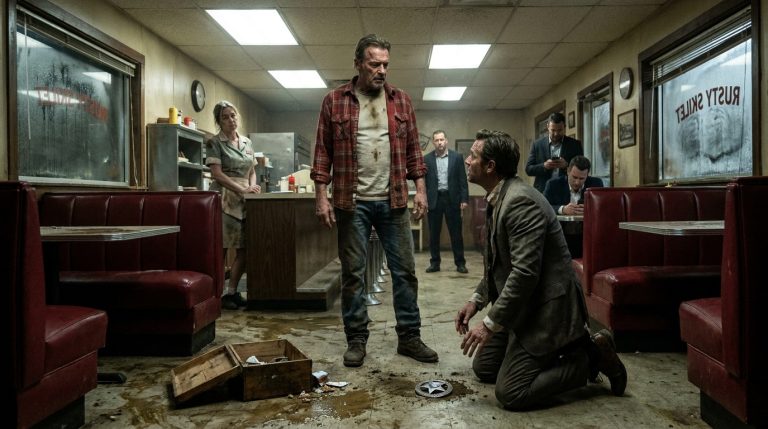
The overhead lights at the Rusty Anchor hummed with a low-frequency buzz, casting the bar in a jaundiced, flickering glow. Lloyd Harlland sat at his usual stool, his fingers tracing the condensation ring on the mahogany—a wooden landscape he had memorized over five years of quiet afternoons. To anyone else, the bar was a sanctuary. To Lloyd, it was a static point in a shifting, treacherous world.
Then, the air shifted. It became charged with the scent of expensive cologne and the sharp, metallic tang of unearned arrogance.
Is that supposed to be a tactical color, or are you just trying to make sure the enemy doesn’t miss?
The voice was young, vibrating with the kind of certainty that only comes from never having been proven wrong by a bullet. Lloyd didn’t turn. He stared into the depths of his bourbon, the amber liquid catching the light like stagnant pond water. His calloused hand, worn thin by decades of honest labor, remained still, a dead weight on the counter.
The corporal—Miller, if the name tag was to be believed—stepped into his periphery. The kid was immaculate, his dress blue blouse a sharp contrast to Lloyd’s frayed red flannel. Everything about Miller was precise, ironed, and entirely superficial.
I’m talking to you, Grandpa, Miller pressed, bolstered by the stifled laughter of the three Marines behind him.
Lloyd took a slow, deliberate sip. The burn in his throat was a familiar, grounded reality. He set the glass down, ensuring it landed perfectly in the center of the ring. He felt the weight of the photograph in his back pocket—the thin, cracked piece of history that felt heavier than a field pack.
I heard you the first time, son, Lloyd said. His voice wasn’t a growl; it was simply the sound of a man who had seen enough to know that volume was rarely the same thing as truth.
Miller bristled. That is Corporal Miller to you, civilian. And you are disrespecting the uniform by ignoring me.
Lloyd finally turned. He didn’t look at the uniform; he looked at the man inside it. He saw the flicker of something raw and deeply insecure beneath the high-and-tight haircut. He saw a boy trying to find his place in a story he hadn’t yet earned the right to tell. For a moment, Lloyd felt a sudden, sharp ache in his chest—a phantom pain from a lung that had once struggled for breath in the mud of the Asha Valley.
The photograph slipped from his wallet as he pulled out his tab, landing on the beer-soaked wood. Miller snatched it before Lloyd could move.
Hey, old bear, Miller sneered, reading the faded ink on the back. Is this your little imaginary friend club?
The laughter from the other Marines hit the room like buckshot. Lloyd felt the world tilt. The jukebox track drifted away, replaced by the suffocating, wet heat of triple-canopy jungle. The smell of hops vanished, replaced by the copper tang of blood and the rot of wet vegetation. He saw the red headband, the machine gun, the overwhelming, terrifying isolation of holding a line against an impossible tide.
He looked at Miller. The kid was holding the photo as if it were a toy, not realizing it was a tombstone. Lloyd reached out, his hand finally trembling, not from age, but from the effort of keeping the jungle from consuming the room.
Give that back, Lloyd said, his voice dropping into the register of a man commanding a perimeter.
Miller laughed, his ego ballooning with every second of the old man’s apparent distress. But he didn’t see the ice forming in Lloyd’s eyes. He didn’t see that he wasn’t looking at a civilian, but at a man who had already been through the end of the world once before.
And in the distance, Sully, the bartender, was already reaching for his phone, his thumb hovering over a number that didn’t belong to any local directory.
CHAPTER 2: THE ECHO CHAMBER
The music didn’t actually stop, but to Lloyd, it might as well have. It drifted away, losing its structure, turning into a low, buzzing static that mimicked the heat haze shimmering above a humid, broken landscape. The floor beneath his stool stopped being sticky, varnished wood and became a churned-up mire of red clay and decaying leaves. The smell of stale beer was erased, replaced by the heavy, suffocating scent of ozone, rot, and the sharp, metallic tang of blood that always hung in the air just before the world tore itself apart.
Lloyd didn’t blink. He sat with his hands resting on the bar, but his fingers were curled as if they were still wrapped around the grip of an M60, the barrel so hot it would blister skin. He was back there—Hill 881. It wasn’t a choice; it was a gravity he couldn’t escape.
His mind flashed to the rain—a deluge that didn’t wash things clean but only turned the world into a slick, sliding grave. He remembered the specific, grinding sound of his own breathing, punctuated by the rhythmic thrum-thrum-thrum of a machine gun that he was operating with the mechanical precision of a man who had left his soul somewhere behind him in the treeline.
Beside him, the boy—Miller—was still talking, his mouth moving in that rapid, frantic, impatient way young men move when they are certain they are the protagonists of history. The boy was an intrusion, a ghost from a different time who didn’t understand that he was trespassing on ground soaked in blood that had never fully dried.
“Look at this, boys,” Miller said, his voice echoing with a surreal, hollow quality, as if he were shouting across a canyon.
Lloyd focused on the physical sensation of the bar counter beneath his palms. He leaned into the friction, the wood grain biting into his skin. He needed the contact. It was the only thing keeping the jungle from fully reclaiming the room. He reminded himself that he was an old man in a frayed red shirt, sitting in a bar in the States, not a boy covered in mud and fury.
He saw the photo again, floating in Miller’s hand. It looked fragile, almost transparent, a piece of paper that held the weight of ghosts. The handwriting on the back—To the old bear from the survivors of Hill 881—seemed to bleed into the beer-soaked surface of the bar as Miller tossed it down.
“Old bear, that is your call sign,” Miller taunted, the laughter of the other Marines sharpening like knives. “What? Like the stuffed animal?”
Lloyd felt a profound, exhausting patience settle over him. It was the patience of a stone that had weathered a thousand storms. He looked at the boy, really looked at him. He saw the high-and-tight haircut, the sharp crease of the trousers, the single row of ribbons. It was a baby’s rack—a collection of symbols for things the boy had seen only in training manuals and recruitment videos.
“I am asking you to leave me alone,” Lloyd said. His voice was like grinding gravel, low and raspy.
He didn’t want to hurt them. That was the tragedy of it. He looked at Miller’s knuckles, white as he gripped the bar, and he saw the exact point where a simple, calculated redirection of force would shatter the boy’s wrist. He knew the physics of it—the leverage, the pivot, the follow-through. It was a language he spoke with absolute fluency, a language he had spent forty years trying to forget.
“You going to cry, old bear?” Miller challenged, leaning in.
The air around the stool felt cold, a draft that shouldn’t have been there. Lloyd closed his eyes for a fraction of a second. In that darkness, he saw the face of a young private—Mike—covered in mud, his eyes wide with the terror of a sucking chest wound. Lloyd had carried him, not because he wanted glory, but because the alternative was unthinkable.
He opened his eyes. The bar was back. The jukebox was playing a country song about a lost love, the irony of it hitting him like a physical blow. He wasn’t on a hill. He was at the Rusty Anchor.
Sully, the bartender, was watching from behind the counter. He had a look of growing, quiet dread. He knew the tremor in Lloyd’s left hand, the one that only stopped when something crashed, something loud enough to force the old man into a state of terrifying, perfect stillness.
Lloyd reached into his pocket for the crumpled bills to pay his tab, a final, desperate act of withdrawal. He had to leave. If he stayed, the pressure in the room would eventually force his hand, and he wasn’t sure what would happen when the ice finally shattered.
But as he moved, the wallet fell, the photo sliding out, exposed.
Miller snatched it. The boy’s arrogance was a wall, and Lloyd knew he was about to hit it. He reached out, his grip tightening on the edge of the bar until the wood creaked. He didn’t want the boy to see the ghosts, but the boy was already pulling the shroud back.
“Give that back,” Lloyd said, the command echoing with a authority that seemed to vibrate the very foundation of the room.
For a moment, the laughter died. Miller paused, holding the photo, his bravado wavering as he stared into eyes that held the depth of an ocean turned to ice. It was a fleeting, terrifying realization for the boy—that he had picked the wrong man to turn into a target.
CHAPTER 3: THE CALL TO ARMS
The ringing was incessant, a sharp, electronic jab against the thick, smoke-filled air of the bar. It pulled Miller’s focus, his hand hesitating for a fraction of a second as he held the photograph. That micro-second was all Lloyd needed. He didn’t snatch the photo back; instead, he simply let his own hand fall flat against the surface of the counter, his fingers covering the image of the men in the jungle, shielding it from the boy’s mocking eyes.
Sully, the bartender, took advantage of the distraction. He didn’t reach for a weapon, but he moved with a sudden, decisive grace, stepping around the end of the bar. “Phone’s for you, Sully,” one of the regulars called out from a nearby booth, though Sully didn’t need to be told. He was already halfway to the back office, his face pale and set in a grim, tight line.
Lloyd watched him go. He knew what that ring meant. He had given Sully that number years ago, written on a crinkled cocktail napkin—a last-resort insurance policy for a life he tried to keep quiet. He hadn’t expected it to ever be used, but as the ringing stopped, replaced by a sudden, heavy quiet, Lloyd felt a strange, cold clarity descend upon him.
Miller, feeling the momentum shift, tightened his grip on the front of Lloyd’s flannel shirt. “Don’t think you can hide behind a phone call, old man,” the corporal hissed, his liquid courage beginning to curd into genuine frustration. “You think you’re special? You think you get a pass because you’re a local?”
Lloyd didn’t fight him. He didn’t push back or swing. He simply breathed—in through the nose, out through the mouth—counting backwards from ten in his head. He knew the boy’s center of gravity was overextended, the way his shoulder dipped when he leaned in, the way his pulse was visible in the frantic, shallow rhythm of his throat. He could feel the boy’s fear beneath the arrogance, a raw, exposed nerve.
“I’m not looking for a pass, son,” Lloyd said, his voice quiet, steady, and devoid of the tremor that had haunted him moments before. “I’m looking for you to step back before you do something that you won’t be able to undo.”
The other Marines shifted, their laughter replaced by an uneasy, shuffling silence. They were starting to sense that the air in the room had changed, that the ‘Old Bear’ they had been mocking wasn’t a joke, but a wall.
Sully emerged from the back office. He didn’t return to the bar. He stood in the doorway, his phone gripped tightly in his hand. He looked at Lloyd, then at the group of Marines, and there was a frantic, desperate glimmer in his eyes that set off an alarm in the back of Lloyd’s mind.
“Lloyd,” Sully said, his voice low.
Lloyd nodded slowly. He didn’t ask what the call was. He knew. He looked back at Miller. The boy’s hand was still bunching the fabric of the red shirt.
“You don’t know what you’re holding,” Lloyd said, his gaze fixed on Miller’s eyes. “That photo? Those boys? They’re not just paper. They’re a debt that never gets paid. You’re playing with things that aren’t yours to toy with.”
“Stolen valor,” Miller spat, though the conviction in his voice was fraying. “I know a fake when I see one. You’re just a guy who likes the look of a veteran, dressing up to feel important.”
“If that’s what you need to believe to sleep at night,” Lloyd replied, his voice a flat, dead calm.
The front door of the Rusty Anchor didn’t just open; it seemed to be swept aside by an invisible force. The cool night air rushed in, carrying the scent of damp earth and city lights, and for a moment, the bar felt entirely too small, too cramped, and too artificial for what was about to walk through that threshold.
Lloyd didn’t look toward the door. He didn’t have to. He felt the shift in the room, the way the atmosphere compressed, the way even the air conditioning seemed to struggle to keep up with the sudden influx of gravity. He kept his eyes on Miller, who was now beginning to vibrate with a new, distinct kind of panic.
“Is everything okay, Corporal?” a voice boomed from the doorway—a voice that didn’t just command attention, but demanded it with the force of a landslide.
The Marines, almost instinctively, snapped to attention. It was a reflex, deep-seated and autonomic, ingrained through months of relentless, soul-crushing training. Miller’s hand dropped from Lloyd’s shirt as if it had been scorched. He pivoted, his heels clicking together with a jarring, rhythmic snap that echoed through the bar.
Lloyd stayed seated, his hand still resting over the photo. He felt a slow, tired smile touch his lips—a ghost of an expression that had no place on his scarred, weathered face. He looked up, and for the first time since the night began, he didn’t see the jungle. He saw the future, and he saw the man he had once carried through the mud, now standing in the doorway, draped in the heavy, gold-trimmed evening dress of a three-star general.
The Rusty Anchor had become a staging ground, and the silence that followed was the heaviest thing Lloyd had ever felt.
CHAPTER 4: THE GENERALS ARRIVAL
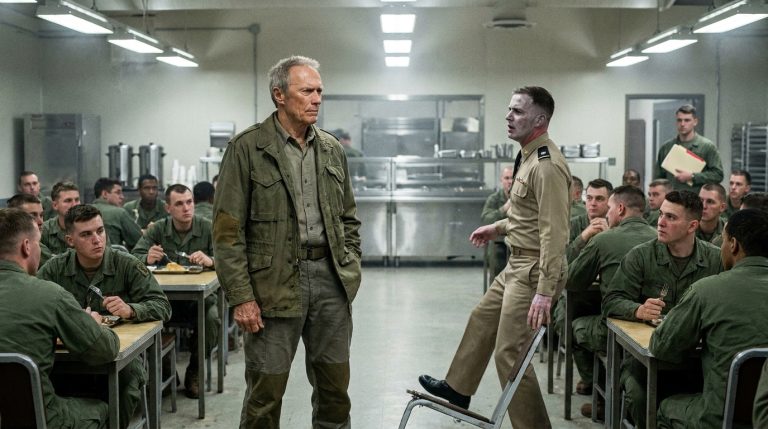
The salute didn’t just hang in the air; it anchored the room. General Michael “Iron Mike” Vance, a man whose reputation was a jagged mountain range of stern discipline and tactical brilliance, stood perfectly still. The gold bullion on his shoulders caught the flickering light, casting long, wavering shadows across the floorboards. His gaze, usually a terrifying instrument of assessment, was fixed on Lloyd with a vulnerability that felt entirely out of place in the Rusty Anchor.
Miller, his face a mask of sudden, dawning terror, looked back and forth between the General and the man in the frayed red shirt. His heels were clicked together so hard his ankles must have been aching, but he didn’t move. He couldn’t. The gravity of the room had shifted, and he was being pulled into a center he didn’t understand.
“Sir,” Miller whispered, his voice cracking. It was a plea for guidance, for an exit, for anything that would make sense of this tectonic realignment of his world.
Vance didn’t acknowledge him. He didn’t even blink. He continued to hold the salute—the most perfect, agonizingly precise salute Lloyd had ever seen. Five seconds. Ten. It was a silent conversation played out in the currency of muscle memory and shared ghosts.
Lloyd slowly swiveled on his stool. He looked at the General, his own posture slumping just enough to signal the familiarity that bypassed rank, privilege, and the decades of distance between them. He didn’t offer a return salute—that wasn’t how this worked—but he nodded, a slow, heavy tilt of his head that acknowledged the debt.
“Hello, Mikey,” Lloyd said. His voice was a rasp, a sound that seemed to pull the oxygen from the space between them.
The General dropped his hand. He didn’t offer a polite, bureaucratic greeting. He strode forward, the floorboards groaning under the weight of his dress shoes. He bypassed the terrified Marines as if they were nothing more than decorative furniture, their presence irrelevant to the gravity of his mission. He reached out and grasped Lloyd’s hand—not with a handshake, but with both of his own, clutching it with an intensity that bordered on the painful.
“I got here as fast as I could, Bear,” Vance said. The call sign hit the room like a detonator.
Miller’s knees buckled. He wasn’t just losing the argument; he was losing the ground he stood on. The man he had been mocking as a “stolen valor” fraud was being addressed by a three-star General with the intimacy of a brother-in-arms. The color drained from Miller’s face until he looked like a statue carved from ash.
Vance turned. The transformation was instantaneous. The warmth, the reverent light in his eyes, vanished, replaced by a cold, surgical fury. He pivoted to face the group of Marines, and the movement was so sharp it felt like a blade being unsheathed.
“Corporal,” Vance said. The word was quiet. It wasn’t a roar, but it felt louder than any shouting. “Do you know who this man is?”
Miller, trembling, forced himself to look up. “No, sir. I—I didn’t know, sir.”
Vance stepped into the boy’s personal space. The contrast was visceral: the pristine, midnight-blue uniform of the General against the terrified, sweat-streaked face of the corporal. “This man is Master Sergeant Lloyd Harland. Retired. Navy Cross. Silver Star with two clusters. Five Purple Hearts.”
Each medal was a punch. Every rank, every decoration, was a brick added to the wall that Miller had foolishly tried to climb over.
“He is the reason the Third Battalion made it out of the A Shau Valley in ’69,” Vance continued, his voice rising, vibrating with a suppressed, tectonic rage. “They called him ‘Old Bear’ because when his team was overrun, he didn’t run. He held a hill alone for six hours against an entire company of NVA regulars so his wounded could be evacuated.”
Vance pointed a gloved finger at his own chest, his voice dropping to a low, dangerous whisper. “I was one of those wounded, Corporal. I was a private. I had a sucking chest wound. This man carried me three miles through a monsoon with a bullet in his own leg.”
The room was deathly silent. The hum of the refrigerator seemed to scream in the vacuum. Sully, the bartender, stood in the corner, his eyes wide, his hands still clutching the cell phone as if it were a lifeline. He had known Lloyd for five years, but he hadn’t known this. He hadn’t known that the quiet, tired man who sat on the stool every Saturday was a living, breathing monument to a hell that had almost erased an entire generation.
Miller was crying now, the tears carving clean tracks through the sweat on his face. The reality of his career—his future, his identity—was evaporating in the heat of the General’s gaze. He was a force recon team leader, a man who prided himself on his physical and mental toughness, and yet, standing before the man he had called a fraud, he felt small, brittle, and utterly hollow.
“He is not a civilian,” Vance roared, the sound finally breaking free, reverberating off the stained, low ceiling of the bar. “He is a living monument! And you… you mocked him. You are not fit to wear the same colors as him. You are a disgrace to my Corps!”
Vance turned to the MPs who had followed him into the bar, their presence now a solid, immovable barrier behind him. “Arrest these Marines. Assault. Drunk and disorderly. Conduct unbecoming. Strip them of their rank. I want them in the brig before I finish my drink.”
The MPs moved forward, the sharp click of handcuffs echoing in the sudden, oppressive silence. But before the metal could touch Miller’s wrists, a single, soft word cut through the tension.
“Wait.”
Lloyd had stood up. He was unsteady, his hip clearly bothering him, but he held his ground. He looked at Miller, then at the General, and for the first time, Vance looked truly baffled. The ice was meeting the fire, and for a second, no one moved.
CHAPTER 5: THE ACT OF MERCY
Lloyd stood at the center of the bar, his frame casting a long, wavering shadow against the dim, yellowed walls. The MP’s hands were on the cuffs, the metal gleaming coldly in the overhead light, but the sound of the steel did not come. The General remained motionless, his eyes locked onto Lloyd’s, a silent conflict unfolding in the space between them. Vance was a man who lived by the blade of discipline, and yet, he was staring at the only person on earth who could compel him to lower it.
“Wait,” Lloyd repeated. His voice wasn’t loud, but it carried the weight of the hill he had once held, a command rooted in an authority that transcended the rank on Vance’s collar.
Miller was trembling so violently that the floorboards beneath his feet seemed to resonate with the sound of his shuddering. He looked at the General, his eyes wide and bloodshot, mirroring a total collapse of ego. He was a boy who had sought to be a predator, only to realize he was standing in the presence of something far older and more dangerous.
Vance shifted his gaze from Lloyd to the corporal. The General’s jaw was set like iron. “Bear, he drew blood,” Vance said, his tone tight, strained by the effort of holding back his own fury. “He mocked you. He insulted the memory of every man who didn’t come home from that ridge.”
“He’s a boy, Mike,” Lloyd said softly. He stepped forward, his gait slightly uneven, a reminder of the bullet he had carried for forty years. He stopped inches from Miller, who flinched as if expecting a blow. Instead, Lloyd reached out with a hand that had once operated a machine gun in the face of impossible odds and gently placed it on the corporal’s trembling shoulder.
“He’s a stupid, arrogant boy who wanted to feel big,” Lloyd continued, his voice barely above a whisper, yet it carried to every corner of the room. “If you throw him in the brig, you don’t teach him. You just ruin him. You turn him into something else—a man who hates the uniform because he blames it for his own failure.”
Vance’s face darkened, but he didn’t counter. He listened, his eyes darting to the black-and-white photograph that still rested on the bar top—the only object in the room that seemed to possess any true, enduring weight.
Lloyd turned his gaze to Miller. “Look at me, son.”
Miller blinked, his throat working as he tried to swallow his fear. He looked up, and for the first time, he didn’t see an old man, or a civilian, or a target. He saw a mirror. He saw the toll that true service actually took—not the clean, polished version he had envisioned, but the real, frayed, and exhausted reality.
“You wanted to be a tough guy,” Lloyd said, his voice quiet, lacking any malice. “But real toughness isn’t about how loud you yell or how crisp your uniform is. It’s about who you protect. Tonight, you attacked the weak, or what you thought was weak. That’s not courage, Miller. That’s cowardice.”
Lloyd reached up and adjusted the collar of Miller’s blouse, which had become skewered during the altercation. The gesture was intimate, a fatherly correction that carried more weight than any lecture the General could have delivered.
“If you want to be a Marine, then act like one,” Lloyd said. “Protect the old men. Don’t fight them. Don’t waste your strength on the easy targets.”
The General let out a long, ragged exhale. He looked at the MPs, his expression shifting from executioner to commander. “Stand down.”
The MPs retreated, the handcuffs disappearing back into their holsters. The tension in the bar didn’t evaporate; it merely transformed, settling into a heavy, somber atmosphere of unvarnished truth. Vance pivoted to face Miller again, his gaze still sharp enough to cut glass.
“You heard the man,” Vance roared, his voice returning to its booming, authoritative register. “You aren’t going to the brig. But God help you, Corporal, you’re going to wish you had.”
The General leaned in until he was inches from Miller’s face. “You are reporting to my Sergeant Major at 0500. You are on restriction until I say otherwise. And every paycheck you earn for the next six months is being diverted to a veterans’ charity of Master Sergeant Harlland’s choosing. Is that clear?”
“Crystal clear, sir,” Miller whispered, relief washing over him, followed immediately by the crushing weight of the penance he now had to pay.
“Get out of my sight,” Vance growled.
The four Marines scrambled for the door, their movements clumsy and stripped of their earlier arrogance. As Miller passed, he hesitated, his eyes lingering on the old man in the red shirt. He didn’t say anything, but the look he gave Lloyd was stripped of everything but a raw, painful recognition. He turned and vanished into the night.
The Rusty Anchor was quiet again, the hum of the cooling system providing the only soundtrack to the sudden, heavy peace. Vance looked at Lloyd, the anger finally bleeding out of him, leaving behind only the weary, shared exhaustion of two men who had lived through more than the world was ever meant to know.
“You haven’t changed, Bear,” Vance said, his voice dropping to a low, quiet murmur. “You’re still saving the ones who don’t deserve it.”
Lloyd simply shrugged, his eyes drifting back to the photograph on the bar. “Someone saved me once, Mikey.”
The memory hit him—not the jungle, but a lonely room years later, the cold metal of a pistol, and the knock at the door that had saved him from himself. The past wasn’t a separate place; it was the ground they were standing on.
CHAPTER 6: THE DENOUEMENT
The screen door of the Rusty Anchor groaned on its hinges, a sharp, metallic complaint that broke the stillness. Lloyd remained at the bar, his hand resting beside the now-dried photograph. The General had stepped out into the night, his security detail falling into a silent, synchronized formation behind him, leaving the bar to return to its own rhythm. The jukebox had stopped, and even the hum of the refrigerator seemed muted.
Sully approached, wiping his hands on a clean towel. He didn’t say a word. He didn’t ask about the General, or the Marines, or the history that had just been unspooled in his quiet dive bar. He simply reached over and replaced the empty glass in front of Lloyd with a fresh one, pouring a splash of bourbon with steady, respectful hands. Lloyd nodded—a small, stiff motion of his neck—and took the glass. The liquid was a steadying weight in his hand, a grounding reality that helped pull him back from the fragmented, suffocating landscape of Hill 881.
He wasn’t an Old Bear or a legend. He was just Lloyd, a man who liked a quiet drink and a chair in the shade.
The next morning, the air at his house was crisp, tasting of pine needles and damp earth. Lloyd spent the early hours in the yard, his hands moving with a practiced, rhythmic purpose as he repaired a section of fence that had been sagging for weeks. The friction of the wood, the smell of sawdust, the physical resistance of the hammer—these were the things that anchored him. He wasn’t thinking about the Marines or the General; he was thinking about the straightness of the post, the integrity of the line.
Weeks later, the package arrived. It was wrapped in heavy, brown paper, the corners crisp and deliberate. When he unwrapped it, he found a frame. Inside, a handwritten letter of apology, signed by four signatures that looked labored and sincere, and tucked into the corner, a new photograph. It showed Corporal Miller and his team standing in front of a monument, their uniforms clean, their expressions devoid of the arrogance that had filled the bar that night. They looked tired—a good, honest kind of tired—and for the first time, Lloyd saw them not as enemies, but as children who were finally beginning to understand the cost of the ground they walked on.
Lloyd took the frame to the mantle, where the black-and-white image of the boys in the jungle had sat for decades. He placed the new photo right next to the old one. He stood back, looking at the contrast: the mud-stained, hollow-eyed youth of his own past, and the weary, learning faces of the present.
He moved to his recliner, the worn leather familiar against his spine. He poured a small glass of iced tea, the condensation beads forming a cool, fragile landscape on the glass. He didn’t reach for the bourbon. He didn’t need the burn today. The sun began to dip below the horizon, painting the sky in colors that shifted from a vibrant, hopeful gold to a deep, melancholy violet.
He realized then that the truth was never about the medals or the stars or the history that people tried to carve into stone. The truth was simply the ability to keep going, to keep fixing the fence, to keep teaching the cubs how to walk, even when the memories of the jungle felt like they might swallow the world whole.
He didn’t need to be a hero; he just needed to be present. The ghosts weren’t gone, but they were quieter now, settling into the long shadows of the evening. The old man in the red shirt closed his eyes, his breathing slow and steady, content in the knowledge that for one more day, the line had been held, the lesson had been passed on, and the world had remained standing.