The Frozen Frequency: The Story of the American Corporal Who Broke Military Law to Save His Men
CHAPTER 1: MIDNIGHT ON THE PERIMETER
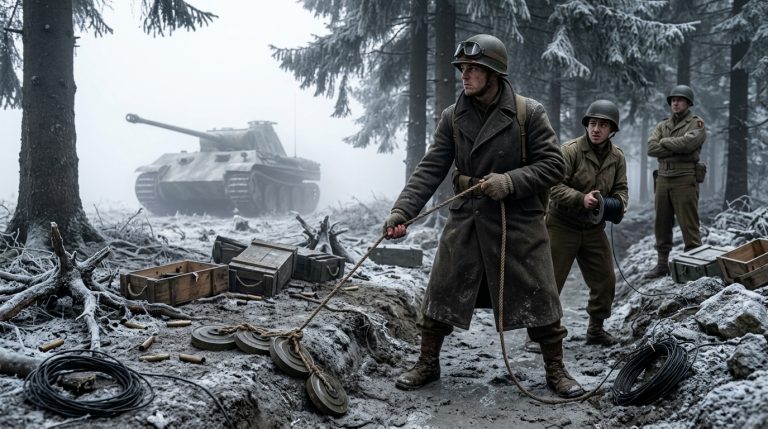
Fourteen degrees below zero will make a man’s blood feel like slush, but it was the voices coming through the headphones that turned my stomach to stone.
I crouched in the dirt, my knees jammed against the frozen wall of the trench. Snow fell in heavy, silent sheets, blanketing the dark pine woods outside Bastogne. Beside me, Miller shifted his weight, his boots crunching on the frost. His teeth clicked together in a steady, uncontrolled rhythm.
“Turn that heater down, Voss,” Miller muttered, his breath rising in a thick white plume. “You’re burning up.”
I didn’t smile. My thumb worked the brass casing of my Zippo lighter inside my wool coat pocket. Spin the wheel. Feel the notch. Stop. Over and over. It kept my fingers from locking up.
The captured German Telefunken transceiver sat on a wooden crate between my knees. Its dial glowed a soft, sickly green against the dark. Static hissed through the rubber ear-cups pressed tight against my head, and then the static broke.
A voice cut through the airwaves. Clear. Precise. High-German with the clipped, nasal bite of an officer raised in Hannover.
“Panzergruppe Eisenfaust, check in,” the voice rasped.
My thumb froze on the lighter wheel.
“Eisenfaust One ready,” a second voice replied, muffled by the roar of Maybach engines idling in the distance. “Fuel at forty percent. Grid reference seven-four-nine loaded. We move at zero-four-hundred.”
I pulled out my stub of grease pencil. My fingers were so thick with cold I could barely pinch the wood, but I scratched the coordinates directly onto the radio’s metal casing. Seven-four-nine. That wasn’t the main road. That was the eastern flank—the thin, ragged line held by eighty exhausted boys with three rounds of Springfield ammo apiece.
“Confirm target,” Hannover said.
“Eastern perimeter,” Eisenfaust One answered. “Sweep through the foxholes. No prisoners. Proceed to the medical collection trench at the tree line.”
The pencil lead snapped against the radio casing.
Under the heavy lead-acid battery powering the set, a yellow corner of paper stuck out. I pulled it free with my left hand. It was an inventory slip from the 101st aid station—forty-two stretchers laid out in the snow, men with gangrene and shrapnel wounds who couldn’t stand up if you handed them a crutch.
Eisenfaust wasn’t just breaking our line. They were going to crush those stretchers under sixty tons of Krupp steel before the sun came up.
Miller leaned closer, noticing the sharp jerk of my shoulders. “What are they saying, Eddie? They talking about food?”
“They’re talking about four in the morning,” I said. My voice sounded flat, stripped of everything.
“Four in the morning? What happens at four?”
“They drive,” I said.
I stood up, my frozen joint popping like dry twigs. The wire from the headphones yanked tight, but I slid the headset around my neck. The radio crackled on, the German voices casually scheduling an execution while the snow fell over our boots.
I stepped over Miller’s legs and pushed through the black canvas tarp covering the trench shelter, heading straight for the command dugout.
CHAPTER 2: THE BUREAUCRATIC WALL
My boots pulled free from the thick, frozen mud outside the command dugout with a sound like tearing canvas, the warm Zippo still burning a circle against my thigh through my pocket lining.
I shoved past the heavy black canvas flap, stepping into a wall of cigarette smoke and cheap stove heat.
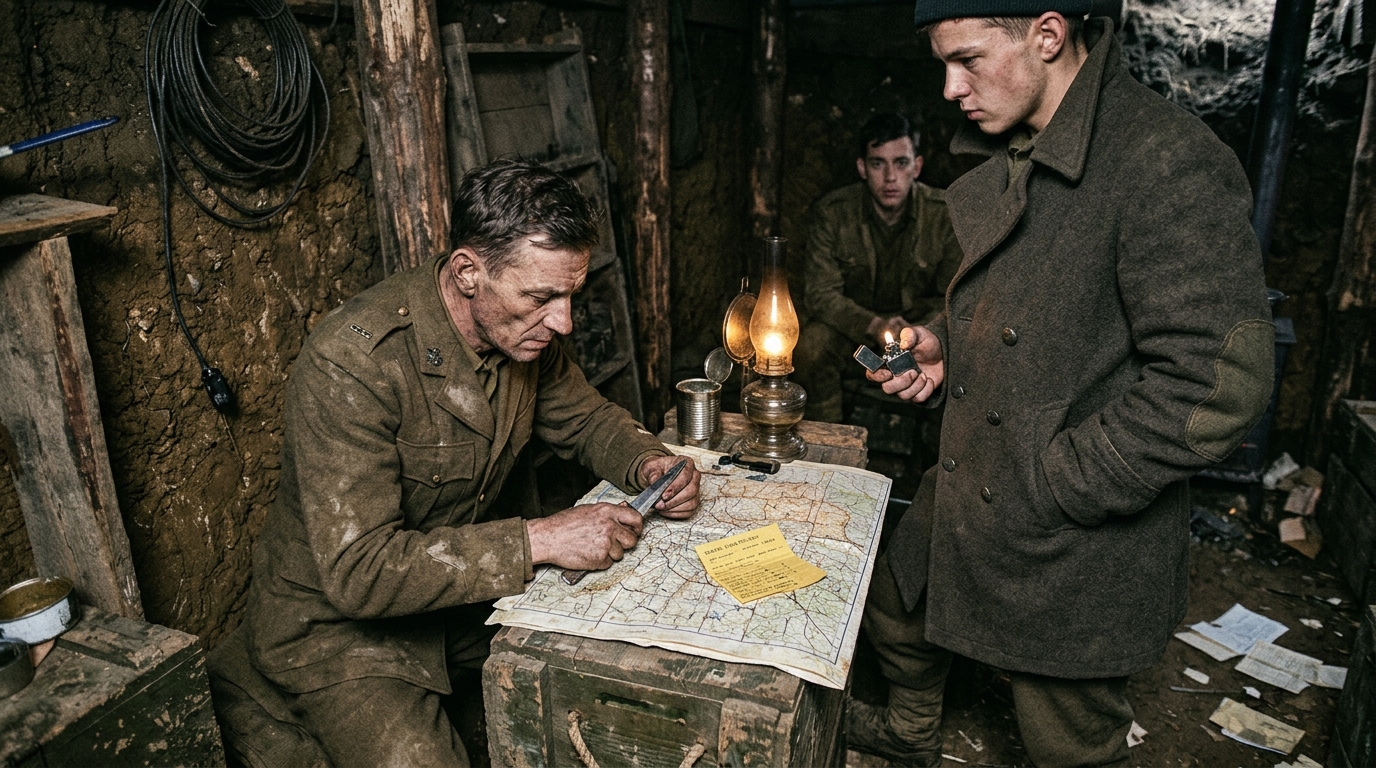
Captain Harris sat behind a makeshift table built from two artillery crates. A paraffin lamp cast long, oily shadows across his face, accentuating the deep purple hollows under his eyes. He didn’t look up when I entered. He was carefully scraping dirt from under his fingernails with the tip of a trench knife.
“Report, Voss,” Harris said. His voice was dry, like corn husks rubbing together. “And make it quick. My feet stopped feeling the floor an hour ago.”
“The Telefunken, sir,” I said. I didn’t salute. Nobody saluted on the perimeter unless they wanted a sniper to get a bonus. “I just picked up an officer on the Hannover net. Unit designation Eisenfaust. They’re staging three miles out.”
Harris stopped scraping. The knife blade hovered an inch above his thumb. “Staging for what?”
“A push at zero-four-hundred,” I said. “Grid reference seven-four-nine. They aren’t sweeping the main road. They’re aiming straight for the eastern tree line.”
The air in the dugout got thin real fast. Lieutenant Miller, who had been leaning against the earth wall near the stove, took a quiet step forward. His gaze darted between me and the captain.
Harris set the knife down on an ammo box. Click.
“Seven-four-nine,” Harris repeated slowly. He leaned back, the wooden crate creaking under his weight. “That’s a dead sector, Voss. There’s nothing down there but scrub pine and deep drifts.”
“And forty-two men on stretchers,” I said.
I reached into my wool coat, pulled out the yellowed inventory slip I’d pulled from under the radio’s lead battery, and dropped it onto his map. The paper was stiff with cold, stained with old motor oil around the edges.
“The aid station trench,” I said. “They don’t have anti-tank guns. They don’t even have functional shoes for half the battalion. If those Panzers roll through seven-four-nine, those boys get flattened in their sleep.”
Harris looked down at the paper, but he didn’t pick it up. He didn’t have to. He knew the ledger numbers as well as I did.
“We report it to Division,” Miller offered, his voice tight. “We call for a localized barrage—”
“We don’t call for a damn thing,” Harris cut in, his tone dropping an octave into pure iron. He pointed a thick, chapped finger straight at my chest. “You listened. That was your job, Corporal. You sit in the dirt, you write down their chatter, and you hand me the slip. That is where your tactical universe ends.”
“Captain, they’re starting their engines at three-thirty,” I said, stepping closer to the crate. The desklamp flickered as the floorboards shuddered from a distant 88mm shell impact. “If we don’t shift troops or throw up a block, there won’t be a perimeter left to report by five.”
“Shift troops with what?” Harris slammed his hand onto the table, making the paraffin lamp rattle. “We have no reserves, Voss! Division locked down every battery from here to Luxembourg. Radio silence is absolute. If I key a mic to ask for artillery that doesn’t exist, the Kraut direction-finders will spot this bunker before I finish my callsign!”
“Then let me use their net,” I said. The words came out before I could check them, hard and flat in the small space.
Miller let out a wet breath. “Jesus, Eddie.”
Harris went entirely still. The flickering yellow light caught the sharp angle of his jaw. “What did you just say?”
“They’re using open channels for command coordination,” I said, keeping my thumb firmly clamped over the Zippo in my pocket. Spin. Click. “Their field discipline is sloppy tonight because they think we’re dead already. I can take that set—”
“You will shut your mouth,” Harris hissed, leaning across the table until I could smell the stale coffee and tobacco on his breath. “You are a corporal in the Signal Corps, not a field commander. Impersonating enemy traffic is a direct violation of the UCMJ. It is unauthorized warfare. If you so much as touch a transmit switch on a captured rig without written authorization from a major general, I will personally throw you in a brig until you rot.”
“There won’t be a brig left if those tanks cross the ridge,” I said quiet.
“That is not your decision!” Harris barked. He stood up, towering over the small table, his shadow stretching across the canvas ceiling. “You will return to your hole. You will keep your headphones on. You will write down what you hear, and you will not touch a single key. If you break radio silence, Voss—if you put this unit at risk over a hunch and a stolen dialect—I will court-martial you before the snow clears.”
I looked at the captain. I looked at the yellow slip of paper sitting ignored on his map, right over the grid square marked Seven-Four-Nine.
“Understood, sir,” I said.
I turned and walked out of the dugout back into the blinding white storm.
CHAPTER 3: THE BRASS ZIPPO
Standing three feet outside the command shelter flap in the knee-deep snow, hands shoved deep in coat pockets, I watched my breath vapor freeze instantly in the air while listening to the distant rumble of German Maybach engines warming up across the ridge.
The snow hit my face like crushed glass. Down in the eastern hollow, three hundred yards through the pitch-black woods, forty-two men lay on canvas cots inside a trench covered only by frozen pine boughs. They didn’t know the grid coordinates. They didn’t know about the Maybach engines. They were just trying to stay alive until breakfast.
I reached into my pocket and pulled out the brass Zippo. The metal was ice-cold now, the heat from the dugout long gone.
I didn’t open the lid. I just turned it over and over in my raw palm. Top. Bottom. Edge.
Harris was right about the law. He wasn’t a bad man; he was just a man who believed the manual could keep the roof from falling in. If I keyed that transmitter without an officer’s signature, I wasn’t just breaking a rule—I was handing him the rope to hang me with.
“He’s going to stick you in a cage, Voss,” a voice said from the dark.
Miller slouched out of the shelter flap, his wool collar pulled up past his red ears. He wrapped his arms around himself, shivering so hard his knees knocked together under his heavy trousers.
“He’ll have to find one that isn’t frozen solid first,” I said, my eyes fixed on the tree line.
“I’m serious,” Miller whispered, stepping closer so his shoulder hit mine. “You heard him. The UCMJ doesn’t give a damn about your grandmother’s accent. You touch that dial, and you’re a traitor on paper. You think anyone back home is going to ask for your side of the story?”
“My grandmother taught me how they talk in the valley behind Hannover,” I said softly, my thumb dragging across the Zippo’s flint wheel without sparking it. “They drop the ending of the verbs when they’re tired. They sound like my uncle Otto when he was mad about the tractor.”
“This isn’t a damn tractor, Eddie.”
“No,” I agreed. “It’s three hundred boys who think someone up the line has a plan for them.”
The low hum across the ridge shifted pitch. The rumble deepened into a steady, rhythmic thrum that vibrated right up through the soles of my boots. They were idling. Getting ready to line up the steel treads.
I looked down at the brass box in my hand.
If I stayed in my hole and kept my mouth shut like a good corporal, I’d wake up tomorrow with clean service papers and three hundred fresh graves on my conscience.
“Get back inside, Miller,” I said, sliding the Zippo back into my pocket.
“What are you doing?” Miller asked, his eyes wide in the faint reflection of the snow.
“My job,” I said. “The part that isn’t written in the book.”
I turned away from the command tent and dropped back into the dark trench, heading straight for the captured radio.
CHAPTER 4: THE IMPERSONATION
Sitting hunched over the captured Telefunken transceiver in the pitch-black foxhole, rubber ear-cups pressed against frostbitten ears, my thumb hovered one millimeter above the black Bakelite transmit switch.
The air inside the dugout was thick with stale oil and cold sweat. Outside, a gust of wind slammed into the trench wall, sending a shower of pine needles down onto the radio casing.
Static buzzed against my eardrums. Then came the voice—Hannover again, crisp and arrogant, checking off unit numbers.
“Eisenfaust One, confirm readiness.”
My thumb pressed down. The mechanical click of the switch sounded like a rifle shot in the tiny hole.
I pulled the microphone to my lips. I didn’t try to sound like a commander in a propaganda reel. I spoke with the flat, irritable cadence of a staff officer who hadn’t slept in two days and was sick of incompetence.
“Eisenfaust One, halt your push,” I said in German. I dropped the vowels low, curving the consonants exactly the way my grandmother used to when she scolded the milkman. “Priority update from Oberkommando.”
Silence hit the frequency. Two seconds. Three. My heart knocked against my ribs like a trapped bird.
“Identify,” a voice barked back—sharper now, surprised. “We are two minutes from staging.”
“This is Hauptmann Weber, Third Corps Operations,” I snapped back, letting pure annoyance bleed into the microphone. “Your vector at grid seven-four-nine is scrubbed. Division logged an Allied anti-tank battery shifting into those pines ten minutes ago. You roll in there now, you’re driving into a bottleneck.”
I shifted my weight on the crate. My knee scraped against the lead-acid battery, nudging the edge of the medical ledger paper further into view.
“Re-check coordinates,” the German voice replied, a sliver of hesitation under the harsh tone. “Our orders came directly from field command.”
“Field command is reading three-hour-old maps!” I rasped, dropping my voice into a dangerous whisper that forced him to listen closer. “You want to explain to the Oberst why you lost four Mark IVs to a blind ambush? Divert your lead column immediately to supply depot seventy-four-niner. Secure the fuel caches before the Americans torch them.”
Across the dirt floor, Miller stood frozen in the entry gap. His hands were clasped over his mouth, his eyes wide as saucers as he listened to me spew German into the dark.
The speaker crackled with heavy static. For five long seconds, the frequency went dead.
Then the radio popped.
“Acknowledged, Operations,” the voice returned, curt and compliant. “Shifting assault vector to grid seventy-four-niner. Eisenfaust out.”
I released the transmit switch. The spring snapped back into place.
I pulled the rubber cups off my head and let them drop around my neck. Outside the trench, the distant thrumming of the Maybach engines didn’t stop—it turned. The low, grinding rumble began to pull away from the eastern ridge, heading north into the empty snowdrifts.
Miller let out a long, shuddering breath and collapsed against the mud wall.
“They bought it,” he whispered. “They actually bought it.”
Before I could answer, the canvas flap behind Miller was ripped off its wooden pegs. Captain Harris stepped into the foxhole, his Colt .45 already unholstered and pointed straight at my chest.
CHAPTER 5: THE DESPERATE DELAY
Sitting on the wooden crate with my frozen hands raised chest-high, I stared straight down the blued steel barrel of Captain Harris’s Colt .45 in the dim lantern light inside the shelter.
“Step away from the set, Voss,” Harris said, his jaw locked tight enough to crack teeth. His front sight trembled, just a fraction, pinned directly between my eyes. “Unhook the harness and place your sidearm on the crate.”
I didn’t reach for my pistol. I kept my palms flat, fingers spread wide in the freezing air.
“Check the frequency first, Captain,” I said, my voice steady despite the cold settling into my chest.
“I heard you!” Harris barked, his voice rising in an ugly pitch that made Miller shrink against the mud wall. “You keyed a rogue signal on an unassigned channel! You handed our grid coordinates to their radio intercept team!”
“I gave them grid seventy-four-niner,” I said, tapping the wooden crate with one knuckle. “The abandoned fuel dump three miles north. The armor column already turned.”
“You don’t know that!” Harris took a hard step forward, bringing the cold iron of the barrel within two feet of my forehead. “You’re a corporal operating without authorization. You just committed a capital offense under active combat conditions. Miller—get his belt.”
Miller hesitated, his feet glued to the floorboards. “Sir… the engine noise stopped on the eastern ridge. You can hear them shifting north.”
“Shut up, Miller!” Harris snapped, his face flushing dark red in the yellow lantern glare. “He broke chain of command! If Division finds out a radioman took independent action on an unapproved frequency, every officer in this battalion gets stripped of rank!”
He wasn’t fighting to save the line. He was fighting to save his service record. The entitlement of the manual was his armor, and I’d just put a hole right through it.
“Then call Division,” I said, my thumb slipping back into my wool coat pocket to touch the cold brass edge of the Zippo. “Tell them a corporal saved forty-two wounded men because command was too scared to break radio silence.”
Harris’s eyes narrowed into slits. “Hand over your sidearm, Corporal. You’re under arrest.”
A loud, jagged tearing sound split the air outside—the unmistakable whistle of disorganized German artillery firing blind into the northern hills. The shells hit miles away from the aid station trench, shaking the ground beneath our boots with a dull, impotent thud.
The tanks were firing at empty snowbanks. The deception had worked, but Harris’s hand remained locked on the hammer of his .45, his refusal to yield thickening the air into pure poison.
CHAPTER 6: SILENT VINDICATION
Standing inside the shelter under Captain Harris’s aiming pistol while the distant thuds of misled German artillery rumbled uselessly miles away to the north, I didn’t flinch or lower my hands.
The dull concussions shook tiny showers of dry dirt down from the pine log rafters. Every blast landed squarely in the empty, snow-choked ravines around grid seventy-four-niner—miles away from the stretchers lined up in the medical trench.
Harris’s cheek twitched. The sweat on his temple was freezing into gray ice, but he kept his sidearm pinned on my chest.
“You think those shells prove you’re a hero, Voss?” Harris rasped, his voice tight with desperate, cornered malice. “It doesn’t change a damn thing. You violated a direct order under fire. You forged radio traffic. I am filing charges the second the division courier arrives.”
“Then file them, Captain,” I said, reaching down with deliberate slowness to pick up the oil-stained medical ledger from the top of the radio set.
Harris’s barrel jerked upward. “Don’t move!”
“Look at the ledger,” I said, holding the paper out between two fingers. “Forty-two non-ambulatory men down in that trench. Three hundred boys along the eastern line who would’ve taken that armor head-on while you waited for a signed memo. You want to hand a court-martial file to Division? Hand them this slip with it.”
Harris’s chest heaved. He snatched the paper from my fingers, his eyes darting frantically over the written casualty counts and the grid coordinates. He tried to pull the authority back into his posture, searching for a legal loophole, a procedural violation, anything to cover the fact that his rigid caution almost cost three hundred lives.
“You’re a corporal,” Harris spat, though his grip on the pistol finally slackened. “You don’t get to make tactical calls. You don’t exist on this net.”
“That’s fine by me,” I said quietly.
A heavy boot crunch sounded outside the shelter. The canvas flap swung open, letting in a blinding wall of early morning gray light. Pale winter sun hit the dirt floor, cutting right through the stale cigarette smoke.
Miller looked out into the woods, his shoulders visibly dropping six inches. “Captain… look.”
Harris turned his head toward the entry.
Through the trees on the eastern ridge, figures were moving. Not panzers. American infantrymen were crawling out of their frozen foxholes, standing up in the knee-deep snow, blinking at the quiet morning sky. Down in the hollow, corpsmen were moving between the stretchers with warm broth, completely untouched by the artillery that had spent the last two hours tearing up empty rock miles away.
The silence over the perimeter was absolute. No treads. No mortar whistles. Just the soft, steady hum of the wind through the pines.
Harris looked down at the Colt .45 still in his hand. He looked at the medical slip, then at the Telefunken transceiver sitting dead and silent on the wooden crate. He slid his pistol back into its leather holster with a sharp, heavy click.
“Clean up this hole, Voss,” Harris muttered, refusing to look me in the eye as he pushed past Miller into the snow. “And lock that set. We’re done here.”
He walked away into the drift, his charge sheets forgotten in the mud.
I sat back down on the wooden crate. My thumbs were stiff, raw, and red from the freezing cold. I reached into my coat pocket, pulled out the dented brass Zippo, and rested it on top of the radio’s metal casing.
Three hundred boys were going to eat breakfast today because an old woman in the Midwest taught her grandson how to speak to her in the language of her home.
I closed the radio lid, snapped the brass latches shut, and watched the sunrise light up the snow.