The Iron Span at Remagen: Twenty-Seven Men, a Thousand Yards of Open Steel, and the Desperate Race Against the Clock
CHAPTER 1: THE ACCIDENTAL DISCOVERY
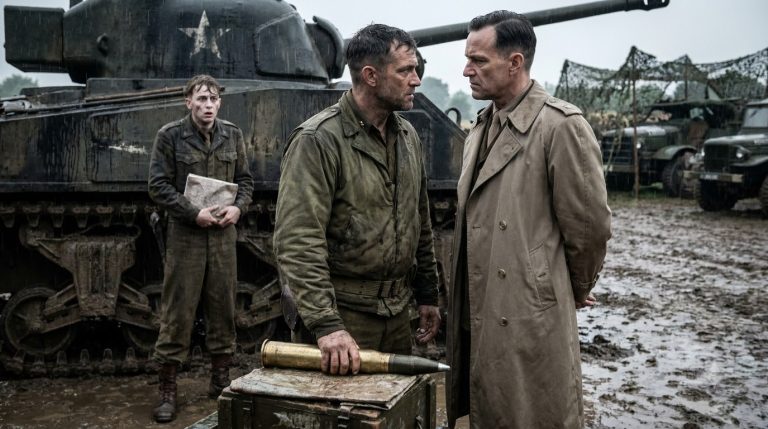
The mud on the track was thick enough to pull the treads right off an M4 Sherman.
Lieutenant Carl Timberman wiped a cold forearm across his forehead, smearing grease and wet grit into his skin.
Ahead of the column, the 9th Armored Division Combat Command B was simply pushing east because orders said to push east.
There was no grand strategy in the damp afternoon air, only the heavy rattle of diesel engines and the smell of half-burnt oil.
The scout jeep materialized through the gray haze of the German countryside, sliding sideways to a halt before kicking up a fresh spray of brown slush.
The sergeant inside didn’t bother cutting the engine; he just pointed a gloved finger toward the river line ahead.
Timberman didn’t feel a rush of glory or a spark of historic destiny.
He felt a deep, grinding ache in his lower back and the familiar, dry pull of thirst in the back of his throat.
He grabbed the handset, his fingers stiff against the hard plastic, and called it in to division headquarters.
The bridge at Remagen was still standing.
It rose out of the mist like a jagged iron spine across the wide, gray expanse of the Rhine, completely ignoring the absolute law of the retreat.
CHAPTER 2: THE HESITATION MATRIX
Captain Broka stared down at the tangled mass of copper cables looping across the concrete floor.
His fingers were stiff from the damp chill rising off the Rhine, and the heavy iron handle of the detonator box felt entirely too cold against his palm.
Outside the fortified slit of the bunker, the rhythmic clank of armor grew louder, shaking loose a fine powder of rust from the ceiling beams.
His orders from the high command were absolute, drilled into him through weeks of threats and executions.
Destroy the bridge. Leave nothing behind for the advancing columns.
Yet, through the thick glass of the observation slit, a dense stream of German refugees—women dragging wooden carts, children stumbling in the mud—was still flooding across the iron span.
If he throws the switch now, the bridge turns to dust, taking hundreds of his own people into the freezing water.
He hesitated, his thumb hovering over the safety catch, his jaw tightening until the muscle ticked against his cheek.
That single heartbeat of delay was all the margin the armored column needed.
A sharp metallic clang echoed from the eastern tower overhead, followed by the muffled, frantic shouts of his own engineers scrambling along the catwalks.
The cables were sparking, half-severed by an earlier artillery round that had clipped the anchorage just minutes prior.
Broka slammed his fist against the detonator housing, his breath catching in his throat as the red indicator light flickered and died.
CHAPTER 3: THE COLD IRON CHARGE
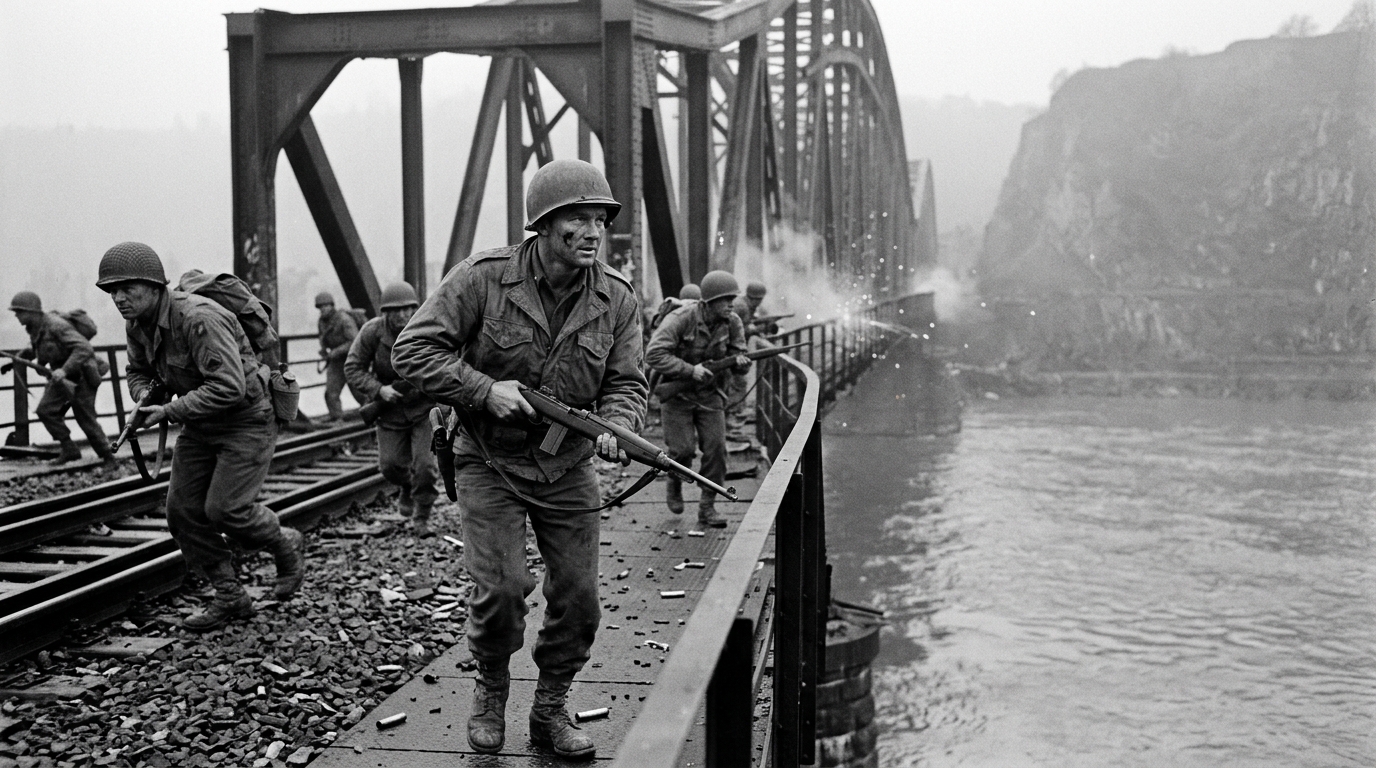
Lieutenant Carl Timberman kept his head low, his boots finding no purchase in the loose gravel as he hit the western approach of the bridge.
The acrid smell of burnt propellant stung his eyes, mingling with the heavy mist rising off the gray water below.
Behind him, the twenty-seven men of his platoon spread out across the black steel decking, each footfall ringing hollow against the girders.
There was no grand battle cry, only the heavy, ragged breathing of men carrying too much weight into a space that should have already been vaporized.
A heavy machine gun stuttered from the eastern cliffs, chewing a line of sparks across the steel plates just yards ahead of the lead scouts.
Timberman didn’t look back to check who was falling behind; he simply dropped lower, gripping his carbine until his knuckles turned bloodless.
The structure beneath them gave a sudden, sickening lurch as a distant artillery shell clipped the upper lattice work.
They were halfway across now, completely exposed under a cold afternoon sky, with every second ticking closer to a demolition that refused to happen.
CHAPTER 4: THE SEVERED WIRES
Lieutenant Carl Timberman slammed his shoulder against the low portal frame, his boots sliding half an inch on a dusting of powdered mortar.
A hundred yards down the high span, German engineers were scrambling over the primary terminal boxes, wrenching at blackened levers with desperate, gloved hands.
The expected wall of fire did not sweep the deck; instead, a series of dull, isolated thuds popped like wet firecrackers beneath the flooring.
The main charges were dead, choked by their own tangled wiring and the hasty rerouting forced by the refugee crush.
— Cut those secondary leads! — Timberman shouted, his voice cracking against the wind howling off the dark water.
Sergeant Miller dropped beside him, his breath coming in whistling gasps as he jammed a pair of lineman pliers into the junction box.
A shower of copper sparks showered over their knuckles, smelling sharply of ozone and burned rubber.
The bridge shuddered under their boots again, a heavy, grinding vibration that felt less like enemy artillery and more like the metal itself coming apart at the joints.
CHAPTER 5: THE EASTERN FOOTHOLD
The gravel on the far side of the river crunched under heavy boots with an unsettling finality.
Lieutenant Carl Timberman didn’t stop to look back at the thousand yards of open iron they had just crossed.
His men dropped behind low concrete barriers, their rifles already leveled toward the empty tree line flanking the road.
There was no cheering, only the dry, rasping sound of men sucking in cold air and checking the bolt actions of their rifles with grease-stained thumbs.
— Hold this ridge line and watch that northern embankment — Timberman muttered, wiping a streak of black grime across his chin.
Sergeant Miller jammed a steel stake into the frozen turf to anchor a heavy machine gun, his jaw clenched tight against the fatigue humming in his bones.
The bridgehead was secured on enemy soil, but the silence hanging over the woods ahead felt brittle, waiting to snap.
CHAPTER 6: THE UNRAVELING FOUNDATION
The heavy tools clinked against the damp stone flooring as the engineering squads swarmed across the rusted superstructure.
Lieutenant Carl Timberman stood near the western footing, watching bundles of unexploded cordage being hauled up from the dark channels below.
The structure was standing, but the metal groaned with a low, constant fatigue that no amount of grease or wire could fix.
Around him, exhausted men moved with stiff, mechanical precision, stripping away remaining hazards while artillery fire thudded harmlessly into the distant mud flats.
The command had been held, but the span itself was already dying a slow, internal death under the weight of its own history.
Timberman set his wrench down on a flat concrete block, his fingers stiff and bleeding slightly from the cold.
There were no medals or speeches coming tonight, only the quiet, unrelenting duty of holding a line that nature and time were already tearing apart.