The Weight of the Iron Line: A Technical Chronology of Point Cruz
CHAPTER 1: THE NINEPOUND ANCHOR
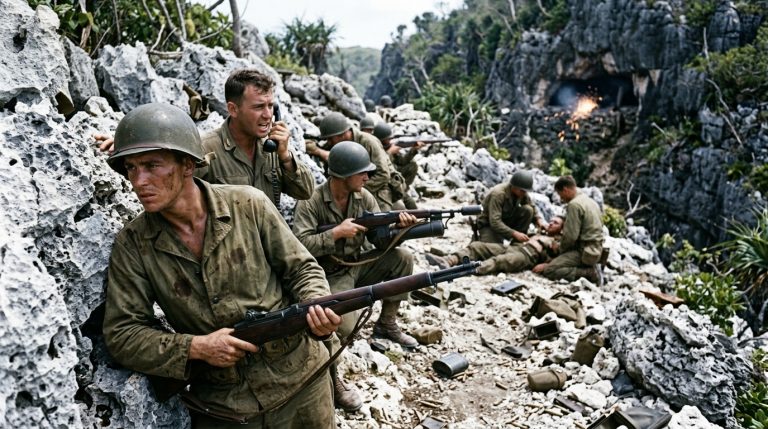
The concrete floor of the ruined Japanese bunker was cold, weeping moisture that smelled of old sulfur and stale rain. Second Lieutenant John George didn’t look back at the trail. He kept his cheek welded tightly to the walnut stock of the Winchester Model 70, his thumb tracing the smooth, commercial safety catch. The metal was cool, slick with a microscopic film of civilian gun oil that fought against the heavy, rotting humidity of Guadalcanal. Through the two-and-a-half-power Lyman Alaskan scope, the world was a desaturated circle of gray-green vines and rusted banyan leaves.
Two hundred and forty yards away, the jungle breathed. Every leaf looked like a blade; every shadow looked like a helmet.
“It’s a sporting piece, George,” Captain Morris’s voice echoed from the previous night’s briefing, dry and thick with the exhaustion of sixteen days on Mount Austin. “The armorer says it’s built for deer, not the line. You bring that target rifle into the groves, and you’re just carrying nine pounds of dead weight when the Arisakas start tapping.”
George hadn’t argued. Arguments didn’t shift iron sights. He had simply waited for the crate to clear military mail, spent three hours stripping the factory cosmoline with an old toothbrush, and loaded five rounds of thirty-ought-six hunting ammunition into the internal magazine. The Garands issued to the rest of the hundred and thirty-second were loud, semi-automatic, and heavy with eight-round en-bloc clips that clanked when they dropped. The Winchester was different. It was an instrument of friction and precision. When the bolt slid forward, it sounded like a safe door locking.
His eyes burned. He had been staring through the optics for forty minutes without moving a muscle in his left leg. The state championship at Camp Perry in 1939 had taught him the discipline of the bone-support position—how to let the skeleton carry the weight of the iron rather than the muscle. But Camp Perry didn’t have thirty-four dead Americans rotting in the high grass near the creek. It didn’t have eleven snipers who knew how to tie themselves into the ninety-foot canopy until they were nothing but extensions of the bark.
A physical discrepancy broke the rhythm of the grove.
Eighty-seven feet up in the primary fork of a massive banyan tree, a horizontal line flattened out where a vertical vine should have drooped. There was no wind. The heavy tropical air hung over Point Cruz like a wet wool blanket, yet the flat line shifted three inches to the left. A dark patch of canvas clothing emerged from the shadow of three intersecting limbs. The Japanese marksman was facing east, his body stabilized by a web of hemp rope, his long Arisaka Type 98 barrel pointing directly at the supply trail where the supply platoons filled their canteens.
George felt his pulse thumping in his throat. He didn’t squeeze yet. He calculated the drag. Two clicks right on the Griffin and Howe mount to compensate for the faint, steady drift of the coastal thermal rising from the Matanakau River. The trigger was set to three and a half pounds, smooth as broken glass.
Through the lens, he watched a secondary leaf twitch near the sniper’s shoulder. It wasn’t an accident. The Japanese soldier wasn’t just waiting; he was systematically counting the seconds between the distant artillery thuds, using the vibration of the American batteries to mask his own adjustments. He was a professional doing a job, completely unaware that the civilian crosshairs were currently settled on the center of his chest.
George held his breath halfway through the exhale. The jungle noise seemed to drop away, leaving only the sharp, chemical tang of gun oil in his nostrils and the hard press of the buttplate against his dungaree shirt. He pulled the smooth trigger.
The Winchester cracked, a single, sharp report that lacked the hollow ring of the military service rifles. The recoil bit straight back into his shoulder bone. Through the lingering puff of smoke, George watched the banyan fork. The horizontal line snapped violently backward. The dark shape jerked, lost its purchase on the wood, and began a long, heavy tumble through ninety feet of vines and branches, striking the iron-rich soil at the base of the tree with a dull, wet thud.
George didn’t lift his head. His right hand reached up, gripped the checkered bolt handle, and lifted it with a hard, mechanical flick. The empty brass casing flew out, spinning into the dark mud of the bunker floor with a metallic ping. He slammed the bolt forward, chambering the second round. The crosshairs never left the tree.
At the base of the trunk, the ferns were still moving, but thirty yards to the north, a different shadow began to slide down the bark of a smaller banyan.
CHAPTER 2: THE FIRST CLICK
The secondary shadow shifted with an intentional, fluid deceleration that baseline infantrymen never possessed. Through the desaturated circle of the Lyman Alaskan scope, the dark fabric of the sniper’s uniform scraped against the rough, moss-choked bark of the smaller banyan tree, flaking off ancient, wet wood scales that fell silently into the high sword grass below. John George did not swing the rifle with a sudden, panicked jerk. A sudden movement would scrape the heavy steel barrel across the raw concrete lip of the embrasure, sending a sharp metallic vibration through the damp air that any veteran marksman could isolate within a millisecond.
Instead, he drifted the weapon. He used the continuous weight of his left shoulder to slide the fore-end along his canvas pack, tracking the target’s descent by inches. The iron-rich mud under his boots gave slightly, a wet, sucking resistance that anchored his lower body to the concrete floor of the captured position.
The second marksman was lower now, passing fifty feet above the jungle floor. He wasn’t dropping in a panicked retreat; he was executing a textbook withdrawal, keeping the massive structural column of the main trunk strictly between his spine and George’s estimated sector. Only the edge of his left shoulder and the long, thin silhouette of his draped Arisaka barrel broke the clean perimeter of the wood.
George dialed the windage turret one click back to the left. The thermal draft from the river was cooling as the rain clouds began to stack heavily against the eastern ridges of Mount Austin, altering the density of the air across the two-hundred-and-forty-yard valley. Every calculation was cold, stripped of the frantic adrenaline that broke the accuracy of the green replacements in the line platoons. To George, the target was not a political ideology or an abstract enemy; it was a variable velocity problem that required a precise ballistic counterweight.
The Winchester’s receiver held four remaining rounds of thirty-ought-six ammunition. The smell of the initial shot—sharp, sulfurous, and hot—lingered in the low dome of the bunker, mixing with the pervasive stench of rusted reinforcement wire that wept orange streaks down the wet concrete walls. George adjusted his stance, pressing his right hip firmly against a stack of discarded, decaying ammunition crates to lock his skeletal frame into a zero-muscle alignment. The stock stayed welded to his jawline, the walnut grain cold and slick against his skin.
The target reached a massive, horizontal root cluster forty feet up. For a fraction of a second, the Japanese soldier had to transition from the vertical trunk to an outbound limb that extended toward the thicker canopy of the northern grove. He had to expose his center mass to maintain his balance.
George saw the foot come down. He saw the wet canvas tabs of the split-toe tabis catch the gray moss.
He didn’t wait for a clean silhouette. He aligned the crosshairs with the trailing edge of the bark, projecting the target’s forward momentum into the open space between the branches. The three-and-a-half-pound trigger arrived at its mechanical wall. The steel components met with an imperceptible internal click before the firing pin dropped.
The second detonation shattered the low hum of the valley’s insects. The heavy sporting barrel jumped upward three inches, the sharp, linear recoil driving the buttplate straight into George’s shoulder muscle with the familiar, dull impact of a well-worn tool. The blast wave cleared a small ring of moisture from the ferns directly outside the aperture, exposing the raw, red earth beneath.
Through the recovering lens, the banyan limb was empty. There was no theatrical leap, no dramatic pause. The second marksman had simply vanished from the branch, his body sliding sideways into the thick, tangled web of hanging aerial roots. A heavy clatter followed—the distinct, high-pitched ring of a service rifle striking ironwood—as his weapon tumbled through the lower canopy first, breaking branches in a vertical line before driving muzzle-first into the black mud.
George didn’t allow his eyes to wander from the lens. His right hand broke its grip, his fingers wrapping around the smooth, cold iron of the bolt handle. He lifted it sharply, feeling the mechanical friction of the primary extraction as the spiral flutes of the bolt pulled the expanded casing from the hot chamber. The brass popped free, bouncing off the concrete wall behind him with a dry, hollow rattle before settling into a puddle of brackish water near his heel.
He rammed the bolt home again, forcing the third cartridge into the breach. The steel ears of the receiver locked down with a heavy, final thud.
The grove had gone completely still. The distant thumping of the regimental mortars on the northern ridge seemed to belong to a different time zone. George lowered his breathing, taking slow, deliberate shallow draws through his nose to prevent his chest from lifting the rifle’s point of impact. The crosshairs remained fixed on the northern banyan, searching the dark vertical lines for the third variable.
According to the intelligence reports delivered by the scouts from L Company, the snipers didn’t operate as isolated units; they were deployed in coordinated grids, each shooter covering the blind spots of the adjacent platform. If two had fallen within less than thirty minutes, the remaining members of the section would already be recalculating their defensive arcs. They would be searching for the muzzle flash, the smoke, or the specific acoustic signature of the civilian Winchester.
George looked down the edge of the barrel, bypassing the scope for a single second to verify his peripheral limits. The concrete aperture gave him sixty degrees of lateral view. To his left, the old machine gun mount was a rusted mass of twisted metal, its iron shield flaking away in brittle, orange wafers that littered the floor. To his right, the entrance tunnel was a dark, sloping throat filled with broken sandbags and rotting palm fronds.
A sharp, metallic snap cut through the damp silence from the southwest sector.
It wasn’t a breaking branch or the drop of a coconut. It was the distinct, high-velocity crack of a military cartridge breaking the sound barrier within fifty yards of his position.
Before the sound could fully register in his ears, the sandbag directly to the left of George’s cheek exploded in a violent plume of gray dust and dry burlap fiber. The impact sprayed coarse river sand across the left side of his face, the stinging grit digging into his skin and clouding his vision. The force of the near-miss rattled the Lyman Alaskan mount, the shockwave vibrating through the steel receiver and into his fingertips.
George didn’t look up to identify the origin. He dropped his shoulder, letting his entire body slide sideways off the ammunition crates, collapsing his frame into the shallow drainage channel that ran along the interior base of the bunker wall. He pressed his back against the rough, weeping concrete, his left hand pinning the Winchester firmly to his chest to protect the optics from the flying debris.
The air above his head was thick with floating burlap dust and the heavy, bitter smell of freshly burned cordite from an entirely new direction. The third shooter had positioned themselves outside the standard grid, waiting for the first two engagements to isolate the exact location of the American sniper.
George wiped the sweat and sand from his right eye with the back of his muddy sleeve, his thumb never leaving the safety catch of the rifle. The hunt had ceased to be an exercise in long-range target mechanics. The line had shifted, and the friction was rising.
CHAPTER 3: THE GHOST PAIR
The fine, abrasive grit of the shattered sandbag ground into the sweat-slick skin of his left cheek as he lay motionlessly along the concrete floor. Above his boots, the three-inch gap of the embrasure framed a static slice of the jungle floor, hazy with suspended burlap fibers that refused to settle in the unmoving heat. John George did not touch his face. He kept his right arm pinned over the Winchester’s receiver, breathing through his teeth to muffle the rasp of sand in his throat.
The iron reinforcement rod protruding from the broken lip of the bunker wall sat two inches from his temple, its rusted skin flaking off in dry, red scales under the steady vibration of distant artillery. That single high-velocity round from the southwest had not been a random probe. The impact angle through the sandbag indicated an elevated shooter positioned significantly lower than the ninety-foot banyan canopy—somewhere in the mid-tier line of secondary growth, no more than fifty feet up.
He counted forty seconds by the steady thumping of his blood against the hard concrete deck. The third sniper was waiting for the smoke from his own muzzle to dissipate before checking the structural opening for a body.
George shifted his weight by a fraction of an inch, sliding his left knee along the wet masonry until his boot heel struck the empty brass casing he had dropped moments prior. The small, hollow ring of the metal against the stone was completely swallowed by the ambient chatter of the coastal grove. Slowly, without allowing the sling to clink against the swivels, he rose from the gutter, keeping his spine strictly parallel to the vertical slope of the bunker’s interior supports.
He did not place the rifle back onto the sandbag rest. Instead, he dropped to his left hip, bracing his shoulder against the raw, pockmarked face of the concrete block and extending the barrel through the dark shadow of the rightmost edge of the embrasure. The Lyman Alaskan scope was cloudy with a thin perimeter of dust, but the center wire remained sharp, bisecting the dense, interlocking maze of vines two hundred yards to the southwest.
Through the two-and-a-half-power lens, the perspective changed from the open banyan canopy to the dark, desaturated trunks of the younger coconut palms. The surface texturing was completely different here; the trunks were ringed with coarse, fibrous ridges that looked like rusted iron cable under the grey overcast sky.
A physical discrepancy marred the symmetry of a smaller trunk near the riverine bend.
Thirty yards north of the original banyan tree, a bundle of dead palm fronds hung at an unnatural angle. In a standard grove, the heavy, decayed fronds dropped vertically against the trunk, forming a thick skirt of brown fiber. This specific bundle was flared out by five inches, held wide by an internal brace that could only be a human knee wrapped in canvas bindings.
George did not click the turrets. The range was shorter—closer to one hundred and eighty yards—meaning the thirty-ought-six hunting round would strike approximately two inches high if he held for the center of the mass. He stabilized his breathing, letting the rifle’s heavy barrel sink into the soft fabric of his left forearm rather than the hard edge of the concrete masonry.
The target was retreating. He wasn’t dropping straight down the trunk; he was working his way backward along a secondary root structure that spanned the wet ditch separating the palms from the high grass. The dark fabric of his uniform was wet, coated in the gray river mud that served as excellent concealment against the older bark.
Through the optics, George tracked the slow, rhythmic calculation of the sniper’s movements. This marksman was an experienced veteran; he never moved during the brief lulls between the distant artillery thuds, choosing instead to advance only when the low, bass rumble from Mount Austin vibrated through the mud.
He was a mirror image of George himself—cautious, precise, and entirely dependent on the physical parameters of his environment.
George waited until the target reached the apex of the horizontal root cluster. For a fraction of a second, the Japanese marksman had to release his handhold on the upper vine to balance his long Arisaka Type 98 across his lap. His torso emerged from the overlapping leaves, a flat, dark plane against the desaturated gray background.
George pressed his cheek deeper against the cold walnut of the stock, the scent of the civilian oil sharp and clean against the foul, stagnant air of the ditch. He didn’t pull. He compressed the trigger with a steady, linear pressure that allowed his skeleton to absorb the resistance.
The Winchester roared within the small room. The muzzle blast was a flat, orange tongue that scorched the small ferns growing out of the embrasure’s outer lip. The heavy, linear recoil slammed the wood straight into the bone of his shoulder, the mechanical shock vibrating down his spine and into the concrete deck.
Through the recovering glass, the dark plane was gone. The horizontal vine was shaking violently, its wet leaves shedding drops of water in a rapid, vertical pattern that looked like gray rain against the dark background. A heavy, metallic clatter echoed from the base of the root cluster—the clear sound of a service rifle hitting ironwood before sliding into the thick, foul mud below.
George didn’t look down to verify the fall. He brought his right hand up, catching the bolt handle with his palm and lifting it with a sharp, mechanical snap. The empty brass popped from the receiver, spinning over his shoulder to strike the rear wall with a dry click before settling into the wet dirt at his feet.
He jammed the bolt forward, the steel locking lugs grinding into the receiver face with a heavy, metallic thud that signaled the fourth round was now in the chamber. The air in the bunker was growing steadily thicker, the white smoke from the two rapid detonations hanging in the damp room like a fog.
The grove remained silent, but George could feel the friction changing. The first three engagements had been mathematical, calculated at distance through the glass. But the third sniper had been close enough for George to hear the physical snap of his cartridge over the sound of the wind. They were no longer simply holding positions; they were actively closing the distance, shifting through the blind spots of the bunker to find the exact perimeter of his visibility.
He lowered his head until his brow rested against the cold steel of the receiver, listening to the small, rhythmic drip of water from the concrete roof. The line was narrowing, and the next click would not be his own.
CHAPTER 4: THE SANDBAG IMPACT
The cold vibration of the masonry leaked through the fabric of his utilities, a slow, damp chill that settled deep into his shoulder blades. John George did not lift his forehead from the receiver. He held his position in the shallow interior drainage gutter, listening to the small, rhythmic drip of water as it pooled near his boot heel. Above him, the air remained dense with the foul, chalky scent of pulverized concrete and scorched burlap.
The sandbag impact had not been an error in elevation; it was a deliberate alignment test. The entry hole through the left side of the embrasure was small, cleanly punched through the thick weave, but the exit crater on the inside wall was jagged, exposing a five-inch web of rusted iron reinforcement wire. The angle was razor-sharp, coming from a low, desaturated ridge to the southwest—a position that completely bypassed the protective lip of the bunker’s frontal sandbag line.
He reached down slowly, his fingers tracing the checkering on the Winchester’s grip. The wood was wet with his own sweat, the oil film resisting the thick humidity that crawled through the dark space.
If he rose to the embrasure now, the third marksman would have the crosshairs already locked onto the gray-green margin of the concrete edge. Standard target doctrine at Camp Perry dictated a reset—a complete psychological departure from the last shot to clear the vision. But here, the geometry was shifting in real-time. The Japanese sniper wasn’t operating from a fixed platform; he was using the reverse slope of the trail’s drainage ditch to slide closer, using the low, scrubby ironwood roots to mask his horizontal displacement.
George dragged his legs backward along the slick floor, his boots making a faint, scraping sound over the broken concrete debris. He moved toward the rear exit portal—a narrow, collapsing trench that fed into the secondary communication line of the old garrison.
He did not lift the rifle. He kept the nine-pound weapon balanced across his forearms, crawling on his side through three inches of stagnant, sulfurous water that tasted of old iron and rotted palm leaves. Every inch was paid for in friction. The sharp edges of spent brass casings dropped by the previous occupants bit through his trousers, leaving long, smarting scores along his shins.
The exit trench was shallow, its earthen walls held back by rotting coconut logs that had begun to buckle under the weight of the monsoon rains. The smell of wet clay was overwhelming here, a thick, suffocating blanket that deadened the acoustic ring of the distant mortar fire.
He stopped where the log wall met a massive, exposed banyan root.
Through the narrow split in the timber, he could see the southwestern ridge. The perspective was completely altered; he was now twenty feet lower than the bunker’s floor, looking up through a tangled screen of wild taro leaves and gray, fibrous vines. The Lyman Alaskan scope was useless at this angle, its two-and-a-half-power magnification turning the dense undergrowth into an unreadable smear of green and black.
He pulled his head back, using his naked eye to glass the margin where the mud met the ironwood roots.
A minute passed in absolute stillness. A small, blue-tailed lizard crawled across the barrel of the Winchester, its tiny claws clicking faintly against the blued steel before it vanished into the wet grass. George didn’t blink. He watched the light. The overcast sky was darkening, the heavy tropical clouds dropping lower over the Point Cruz groves, changing the contrast of the terrain from a desaturated gray to a deep, bruising purple.
A shadow flattened against the red clay seventy yards out.
It wasn’t a man standing, nor was it the classic silhouette of a helmet. It was the linear profile of a long, canvas-wrapped barrel being drawn backward through a narrow opening between two rotting logs. The movement was slow—almost microscopic—but it left a clean, dark track in the wet moss that covered the timber.
George aligned the iron sights of the Winchester, bypassing the optics entirely. His left elbow dug into the soft, rotting wood of the trench wall, creating a solid, three-point skeletal rest that locked the barrel into place. The front sight post—a clean, square blade of steel—settled into the center of the dark opening between the logs.
The third shooter wasn’t preparing to fire at the trench. He was still focused on the bunker’s embrasure seventy yards to the north, his body angled to catch the moment the American sniper attempted to clear the dust from the concrete shelf. His position was technically perfect, completely hidden from the primary observation post, but entirely exposed to the secondary drainage line.
He was working on a false assumption—believing the American would maintain his high ground rather than surrender the concrete protection for the mud.
George felt his index finger tighten against the glass-smooth trigger. The three-and-a-half-pound resistance vanished.
The Winchester’s report within the narrow trench was deafening, a flat, concussive slam that drove the air from his lungs and brought a shower of dry dirt down from the log roof. The heavy barrel snapped upward, the front sight blade lost in a sudden circle of white, chemical smoke.
Through the clearing air, the dark opening between the logs remained unchanged, but a long, thin object had slid forward into the high grass. The Arisaka barrel sat at an odd, broken angle, its iron sights buried in the mud, while a pair of heavy, canvas-wrapped shoulders rolled slowly out of the timber line, collapsing face-down into the wet ditch.
George didn’t reload immediately. He stayed down, his cheek pressed into the cold clay of the trench wall, his ears ringing with a high, persistent whistle that drowned out the hum of the grove. The third variable had been removed from the equation, but the friction wasn’t dropping.
Farther down the ridge, deep within the interior growth where the banyan trunks grew thick as columns, a faint, rhythmic clack-clack-clack began. It wasn’t the sound of a rifle. It was the distinct, mechanical signature of a small mortar plate being driven into the hard clay by a two-man crew. They weren’t hunting him with bullets anymore; they were mapping the grid.
CHAPTER 5: THE TRIANGULATION
The dry, rhythmic strike of metal hitting wood reverberated through the root structure against his shoulder. John George did not wait for the air to clear. His fingers instantly closed around the Winchester’s grooved receiver, the cold steel flaked with microscopic bits of dry clay as he hauled his frame out of the narrow trench apex.
The two-man mortar team down the ridge had already verified their orientation. The initial clack-clack-clack was followed by the flat, hollow pop of a high-explosive ninety-millimeter shell clearing the muzzle tube.
He did not stand. He threw his weight forward, sliding on his stomach across a slick expanse of rotting palm fronds that split open under his belt buckle, releasing a thick, sour stench of decomposing vegetation. The Winchester was tucked tightly beneath his torso, his forearms acting as runners against the exposed red clay. Behind him, the bunker he had occupied moments prior vanished in a deafening, orange-white concussive flash. The first mortar round tore through the concrete dome, spraying jagged chunks of reinforcement wire and red-hot masonry fragments across the very drainage channel where he had been tracking his windage.
The shockwave slapped the back of his boots, lifting his legs two inches off the ground and driving a wave of hot, sulfurous gas over his neck.
George kept moving. Every yard of displacement was calculated through the grinding resistance of the terrain. The next salvo would not be an approximation; the observers hidden along the mid-tier line had already mapped the exact physical boundary of the captured bunker. To survive, he had to break the logical geometry of their grid.
He scrambled into a deep, secondary erosion wash that skirted the northern perimeter of the grove. The wash was a narrow, steep-sided gutter filled with six inches of black, stagnant rainwater that tasted of iron and decay. The walls were held together by a dense mesh of fine, thread-like banyan roots that looked like rusted steel cables protruding from the mud.
He dragged the Winchester through the sludge, his thumb locked firmly over the muzzle cap to prevent the black silt from fouling the bore. The mechanical clearance of his bolt action depended entirely on the lack of grit within the receiver lugs; if a single grain of river sand jammed the primary extraction cam, the weapon would become nothing more than a nine-pound club.
A sharp, fracturing split from above signaled the arrival of the second salvo.
The shells struck twenty yards short of his new position, detonating in the high sword grass with a series of sharp, overlapping cracks that shredded the wild taro leaves into green confetti. A piece of jagged, jagged shell casing—hot enough to hiss in the wet air—sliced through a thick root three inches above his helmet, burying itself into the clay with a greasy trail of white smoke.
George didn’t stop to examine the shard. He worked his way up the northern lip of the wash, using a fallen ironwood trunk as a structural anchor to lift his torso from the water. The wood of the fallen tree was ancient, its bark long since rotted away to expose a smooth, desaturated grey surface that felt like cold stone against his palms.
He slid his left elbow over the curve of the trunk, anchoring his skeleton against the dense timber. The Lyman Alaskan scope was smeared with a thin film of black mud along its objective bell, but as he brought his eye to the rubber ocular piece, the center crosshairs still split the desaturated landscape with clinical precision.
The mortar crew was shifting. Through the gray haze of the smoke, three hundred yards out, two dark shapes were dismantling the baseplate from a hollowed-out root system between two banyans. They were moving with a rapid, professional rhythm—not out of panic, but following a strict tactical relocation sequence.
But as George tracked the loader’s shoulder through the two-and-a-half-power lens, his eye caught a strange, structural inconsistency in the terrain behind them.
Behind the mortar pit, hidden beneath an artificial canopy of woven palm fronds, sat three long, wooden crates marked with white stenciled characters. They weren’t standard ammunition boxes; their dimensions were too elongated, their corners reinforced with heavy, rusted iron bands that had been hammered flat against the timber. A series of small, glass ampoules and discarded paper wrappings littered the immediate perimeter of the cache, half-buried in the wet mud.
The Japanese markers weren’t just fighting for the ridge. They were protecting a supply node that had been established long before the hundred and thirty-second infantry had ever crossed the Matanakau River.
The mortar loader lifted the barrel tube, his torso turning to face the northern trail.
George stabilized his breathing, ignoring the persistent, high-pitched ringing in his left ear from the bunker explosion. He adjusted the windage turret two clicks right, compensating for the heavy, moisture-laden gust that was currently flattening the high grass across the center valley. The Winchester’s internal magazine held three rounds. The trigger reached its mechanical stop.
He squeezed.
The rifle cracked, its linear recoil driving the buttplate through his damp utility shirt and locking his shoulder against the ironwood log. Through the optic, the mortar loader stiffened, his arms relaxing their grip on the steel tube as he rolled backward over the rusted baseplate, his legs tangling in the woven palm canopy.
The second crewman did not reach for his sidearm. He did not attempt to recover the mortar. With an instantaneous, calculated reaction that mirrored George’s own training, he dropped to his knees, grabbed a small canvas satchel from the top of the elongated crates, and vanished into a deep, subterranean crawlway that ran beneath the massive root system of the central banyan tree.
George lifted the bolt handle with a sharp, practiced flick of his wrist. The empty brass casing flew clear of the receiver, spinning into the stagnant water of the wash with a faint, sizzling hiss. He slammed the bolt forward, driving the second-to-last cartridge into the hot chamber.
The smoke from his muzzle was a thin, white ribbon that hung over the ironwood log, dissolving slowly in the heavy rain that had begun to fall again in fat, cold drops. The grove was resetting its variables once more, but the presence of those reinforced crates changed the nature of the friction. This wasn’t an aggressive ambush grid; it was an intersection designed to keep the American scouts from looking too closely at what was buried beneath the roots.
He pressed his chest flat against the log, his eyes tracking the dark mouth of the crawlway where the second man had disappeared. The sky was turning the color of old zinc, and the water in the wash was beginning to rise against his boots.
CHAPTER 6: THE OBVIOUS BAIT
The cold water of the wash pooled against the brass eyelets of his boots, carrying a fine silt that ground into the metal joints. John George did not track the rain. He kept his torso anchored tightly over the desaturated trunk of the fallen ironwood, the Winchester Model 70 locked into his left shoulder blade. Through the two-and-a-half-power Lyman Alaskan scope, the dark mouth of the subterranean crawlway three hundred yards out was a static circle of blackness, surrounded by the rough, fibrous roots of the central banyan.
He did not lower the rifle to clear his vision. The physical details of the mortar pit remained burned into his retina: the abandoned baseplate, the elongated wooden crates with their hammered iron bands, and the scattered paper wrappings soaking in the gray mud.
To a standard infantry scout, the position was a broken prize—an asset abandoned in haste. But George’s mind held the cold memory of his target strings at Camp Perry. In a structured competition, an easy bullseye was usually the result of a perfectly calculated wind condition. In the coastal groves of Guadalcanal, an exposed asset left sitting in an open sightline was a geometric impossibility unless it had been calculated to pull an eye away from the flanks.
He shifted his gaze by two millimeters, drifting the crosshairs away from the crawlway to scan the mid-tier canopy of a palm grove one hundred and ninety yards to the north.
The fronds were dense here, heavy with the weight of the rain that turned the desaturated green fibers into dark, drooping mats. A single palm tree stood slightly forward of the line, its crown lower than the surrounding banyans, rising only forty feet from the muddy floor. It was an elementary position—too accessible, too visible from the elevated limestone ridges behind the American perimeter.
Through the lens, a dark patch of fabric emerged between two weeping fronds. It was the distinct profile of a sniper’s canvas shirt, the texture coarse and frayed where it rubbed against the trunk. The man was low, his shoulders hunched over an old Arisaka barrel that was pointed directly at the ironwood log where George currently lay.
George let his breath slide out through his nostrils, his skin cold where the wet clay had dried into a stiff crust.
The target was too clear. The dark canvas shirt did not move to break its outline, nor did the barrel adjust for the shifting draft coming from the river. The sniper was sitting perfectly still, a clean, unmoving mark that practically invited a thirty-ought-six hunting round into its center mass.
It was bait.
George did not pull the trigger. He left the safety catch locked forward and slowly rotated the objective bell of his scope toward the deep shadow line eighty yards northwest of the palm tree. If the visible shooter was the anchor designed to freeze his position, the actual hammer was somewhere within that three-dimensional maze of gray vines and hanging banyan pillars, waiting for the smoke of the Winchester to mark the ironwood log.
His eyes traced the vertical columns of wood, searching for a mechanical deviation in the natural clutter. The gray bark was wet, glistening with a slick film of moisture that caught the low, zinc-colored light from the cloud deck.
At eighty yards northwest, a cluster of thick aerial roots dropped from a massive banyan limb ninety-one feet above the ground. The roots formed a dense, caged cage that was completely dark from the outside. But inside that wooden pocket, five feet above the mud, a three-inch circle of desaturated iron emerged between two vines.
It was the glare shield of a Type 98 optical sight.
The real marksman wasn’t watching the bunker or the trail; his scope was aligned precisely on the center of the ironwood log, his barrel steady as a stone. He had calculated the escape route with the exact same pragmatic logic George had used to select his cover. The man was a veteran, his breathing likely synced to the same steady drum of the coastal tide, completely invisible to anyone whose eyes had been trapped by the low palm tree forty yards away.
George felt a drop of cold rainwater slide down his temple, cutting a clean track through the grit on his jaw. The geometry of the grove had resolved into a two-sided mirror. Both of them were specialists in the weight of copper and the drift of lead, and both of them were waiting for the other to break the silence.
He brought his right thumb back, the internal components of the safety moving with an imperceptible, oil-soft click. He could not engage the real threat behind the root cage first; the angle of the ironwood log blocked his barrel from clearing the lower vine without exposing his entire left shoulder to the decoy in the palm. He had to use the bait to shift the mirror.
He aligned the square blade of the crosshairs with the dark canvas shirt in the low palm tree, holding two inches low to account for the forty-foot elevation drop. The three-and-a-half-pound trigger reached its final mechanical resistance against his finger.
He didn’t hesitate. He compressed the steel.
The Winchester’s report ripped through the rain, a short, violent crack that drove a circle of gray water from the leaves beneath the barrel. The linear recoil punched straight into his collarbone, the mechanical shock vibrating through his teeth. Through the recovering glass, the dark canvas shirt in the palm tree vanished, tumbling backward out of the fronds to strike the mud below with a heavy, dead sound.
Instantly, without working the bolt or checking the fall, George lunged his entire body sideways, his shoulder catching the rough, mossy trunk of the ironwood log as he dragged his torso down into the black water of the erosion wash.
A millisecond later, a high-velocity Arisaka round struck the exact spot where his elbow had been resting, splitting the ancient gray timber with a sharp, dry report and spraying long, razor-like splinters of ironwood across the back of his canvas utility coat.
The third marksman had fired on the flash, but the mirror had already broken.
CHAPTER 7: THE DRAINAGE SWEEP
The sharp, high-pitched ringing in his left ear competed with the low, rhythmic thud of his own heart. John George pressed his cheek harder into the wet, abrasive bark of the fallen ironwood log. The splintering impact from the marksman’s shot had sent a shower of jagged, dry wood fiber into the folds of his collar, the small, sharp barbs scratching at the skin of his neck. He didn’t move. He lay in the shallow, black mud of the erosion wash, his body coiled against the curve of the trunk, the Winchester’s barrel resting silently across his forearm.
He was pinned. The marksman in the root cage had not fired blindly; the strike to the log had been a correction, a test of George’s current position relative to the cover. If George moved even a few inches, the sniper would see the shift in the silhouette against the wet clay.
The rain intensified, a sudden, heavy deluge that drummed against the broad taro leaves above, creating a chaotic wall of sound that masked his own breathing. George used the noise. He slowly pulled his right leg up, feeling the mud slide off his boot with a heavy, sucking sound. He had to cross the six-foot gap of the wash to reach the deeper drainage ditch that fed into the rear of the bunker system.
He didn’t run. He rolled.
He pushed his body away from the protection of the log, tumbling his frame down the steep, muddy bank of the wash into the standing water below. As he hit the ditch, he kept his momentum low, crawling frantically through the knee-deep muck while the rain camouflaged his movement.
He reached the opposite bank—a jagged slope of exposed soil held together by a thick web of rotting banyan roots—and dug his fingers into the earth. The soil was soft, saturated with the overflow from the heavy monsoon, yielding easily to his grip. He clawed his way up, his boots slipping on the wet clay, until he reached the sheltered line of the primary drainage system.
The ditch was narrow, no more than three feet across, but it offered a blind path toward the rear of the bunker where the original machine-gun nest had been set up by the Marines weeks earlier.
He moved in a low crouch, the Winchester held at a low carry, his eyes darting between the dense, dark shadows of the banyan pillars. His internal sense of direction was fighting the disorientation caused by the mortar barrage. He had to trust the physical landmarks: the broken, white-painted stake from the old survey line, the cluster of rusted canteen tins left in the mud by the retreating infantry, and the smell of the damp, sulfurous soil that had been turned over by the earlier explosions.
The rhythmic clack-clack-clack of the mortar crew returned, but it was distant now, muffled by the sheer density of the vegetation. George halted, pressing his back against the base of a massive tree, his eyes searching the dark, vertical lines of the forest.
He was being hunted through a series of logical progressions. The marksman in the root cage was pushing him into a trap—a specific zone where the drainage ditch narrowed into a bottleneck, exposed to the clearing where the rest of the section was likely waiting.
He looked down at the mud near his boot. A series of faint, irregular indentations were visible in the soft clay, leading toward the bottleneck—not the deep, heavy prints of a soldier in full kit, but the light, deliberate depressions of a man moving in sneakers or tabis, stepping exactly in the path of least resistance. They weren’t just hunting him; they were herding him.
He needed to break the line.
George turned away from the drainage ditch and plunged into the thick, overgrown underbrush that separated the wash from the secondary trail. He moved with a focused, desperate intensity, ignoring the vines that caught at his boots and the sharp, hooked thorns that snagged his sleeves. He had to gain elevation. If he could reach the small, limestone outcropping that overlooked the bottleneck from the east, he could flip the tactical geometry of the hunt.
The climb was grueling. The limestone was slick, covered in a thin, greasy layer of moss that made every foothold a precarious, shifting risk. He used the Winchester as a staff, jamming the buttplate into crevices to lever his weight upward. His hands were raw, the skin scraped and bleeding, but he didn’t slow.
He reached the crest of the outcrop at 10:22, his lungs burning with the heavy, humid air. He collapsed behind a jagged, waist-high shelf of white rock, the stone cold and hard against his chest. He looked down through the scope, his breath hitching in his throat.
The bottleneck was already occupied.
Two Japanese infantrymen were crouched in the mud, their rifles pointed directly at the mouth of the drainage ditch where George was supposed to emerge. They were waiting for his arrival, their movements fluid and practiced, completely unaware that he had bypassed their kill zone entirely by cutting through the upper ridge.
But as George aligned his crosshairs on the lead infantryman, his pulse slowed to a cold, steady thrum. He noticed a physical discrepancy near the infantrymen’s feet—a small, square object half-buried in the mud, wrapped in the same distinctive, weather-worn canvas as the crates he had seen by the mortar pit. It wasn’t ammunition. It was an medical kit—a field trauma bag, clearly labeled with the red-cross symbol of the medical service.
These men weren’t an infantry sweep. They were an evacuation security team. And they were guarding something far more fragile than a position.
CHAPTER 8: THE MUDDY BREACH
John George pulled the Winchester’s barrel back from the limestone shelf, the cold, gritty dust of the rock scraping against the blued steel. The red-cross marking on the canvas sat in the mud like a beacon, a stark, humanitarian contradiction to the lethal patrol currently sweeping the drainage ditch. He did not let his gaze linger on the symbol. Empathy was a variable that broke the accuracy of the internal trajectory map. He had to decide: hold the high ground and engage a target that wasn’t a combatant, or abandon his vantage point and risk being flushed from the ridge.
The infantrymen below had stopped moving. The lead soldier, a stocky man with mud-caked leggings, crouched near the drainage ditch, his rifle held at a low ready as he pointed toward the dense, dark mouth of the crawlway. They weren’t looking for him; they were signaling for something to exit the subterranean passage.
George felt a sudden, sharp drop in the barometric pressure as the rain turned from a steady drizzle into a hard, horizontal curtain that hammered against the limestone. The ridge was becoming a death trap. If he stayed on the high ground, the slick rock would make an accurate shot impossible once the drainage ditch became a torrent.
He slid backward, his boots finding purchase in the soft, saturated moss behind the rock shelf. He didn’t rise. He kept his spine compressed, his movements low and fluid, the way he had practiced in the tight, cramped interior of the Illinois state range. He began to crab-walk along the spine of the ridge, aiming for a thick cluster of ironwood that promised cover from the wind.
He hadn’t gone six feet when the brush below him erupted.
It wasn’t a gunshot. It was the frantic, desperate sound of a body hitting mud—a heavy, sliding collision followed by the rhythmic, jagged rasp of a man struggling to breathe. One of the infantrymen had reached the drainage ditch and tripped, his rifle clattering against a submerged rock. The sound was amplified by the monsoon wind, a sharp, metallic strike that cut through the roar of the rain.
George froze, his Winchester pressed against his chest.
Below, the second infantryman let out a short, sharp shout—a guttural command in Japanese that echoed off the limestone wall. The two men weren’t just searching for George anymore; they were panicked. The medical kit in the mud was clearly the priority, and the falling rain was turning the drainage ditch into a flooding canal, threatening to wash the supplies into the deeper, impassable ravines toward the river.
They were about to lose their payload.
George took a breath, his lungs tight with the damp, suffocating air. He moved to the edge of the limestone shelf, his body exposed for a singular, dangerous heartbeat. He didn’t use the optics; he trusted the iron-like sight of the Winchester in the low, gray gloom. He aligned the post with the lead soldier, who was currently knee-deep in the rising ditch, frantically grabbing for the canvas medical kit before it disappeared into the mud.
He pulled.
The Winchester slammed back, a harsh, grounding weight against his shoulder. The soldier in the ditch dropped into the surging water, his body twisting in a sudden, violent reaction to the impact. The second man didn’t look for the shooter. He immediately dove for the bank, dropping his rifle to throw his entire weight over the medical kit, shielding it from the rising current with his own torso.
George didn’t chamber the next round. He dropped into the mud behind the limestone shelf, his heart hammering against his ribs in a wild, discordant rhythm. The sound of the shot would have echoed off the ridge, and the infantry team—now alerted and desperate—would turn their search toward the high ground.
He heard the scrape of boots against rock. They were climbing.
He didn’t hesitate. He ejected the empty casing, hearing it bounce off the white limestone with a sharp, hollow ring that sounded like a bell in the wind. He worked the bolt, feeling the cold, steel resistance of the fifth round entering the chamber. He was out of stripper clips; the pack was gone, left in the crater at the bunker line. He had four rounds of ammunition left to clear the ridge of a team that had stopped fighting for the position and had started fighting for the salvage.
He scrambled down the rear slope of the outcrop, his boots skidding over the exposed tree roots, the Winchester held out in front of him like a lance. He had to put distance between himself and the ledge before the infantrymen established a firing line. The rain was masking his footsteps, but it was also blinding him, turning the world into a smear of grey, water-choked shadows where every pillar of wood looked like a man.
He reached the base of the ridge and dove into a shallow, root-choked depression where the banyan trees were spaced wide enough to allow for movement. The friction of the grove was intensifying; every shadow was becoming a variable, and every movement was a risk. He waited, his ears straining for the sound of movement above the drumming rain, his finger hovering just off the trigger guard, ready to force the next equilibrium.
CHAPTER 9: THE INFANTRY RESPONSE
The metallic scrape of boots against stone echoed through the trees, a harsh, deliberate sound that ignored the rhythmic drum of the rain. John George pressed himself into the depression of the root-tangled earth, his lungs burning with the sharp, acidic intake of damp oxygen. The two infantrymen were not retreating anymore. They were moving in a pincer, one climber staying low to watch the base of the ridge, the other scrambling upward with a frenetic, desperate speed.
He didn’t need to see them to know their pattern. They weren’t fighting for the ground; they were fighting for the time it took to move that medical bag.
George adjusted his grip on the Winchester. His palms were slick with a mixture of mud and cold sweat, the checkering of the wood biting into his skin. He had three rounds remaining in the magazine—a tight, unforgiving limit that narrowed his tactical options to simple, binary outcomes. He reached up, his fingers tracing the cold, recessed circumference of the bolt handle, and felt the familiar, reassuring resistance of a chambered cartridge.
The climber reached the mid-level plateau, twenty yards below George’s position. The man let out a strained, ragged breath—a sound of sheer physical exhaustion—before he hauled himself up onto a flat, moss-slicked slab of limestone. He stood for a heartbeat, his head turning, scanning the ridge line for a glimpse of movement.
George shifted his stance, his knee digging into a cluster of soft, decomposing leaves that threatened to slide. He had to disable the climber before the man could draw a clear bead on his position, but he couldn’t afford to burn his position to the main squad. He stayed below the lip of the ridge, relying on the shadow of a hanging banyan root to break his silhouette.
The infantryman took a step forward, his rifle lowered, his eyes fixed on the white limestone shelf where George had been moments before. He was exposed, his posture stiff with the adrenaline of the climb.
George didn’t rise. He remained prone, the Winchester’s stock pulled firmly into the hollow of his shoulder, the front sight blade silhouetted against the dark, rain-streaked bark of the tree behind the climber. He aligned the post with the man’s upper chest—a center-mass shot that was clinical, predictable, and necessary.
He pulled.
The crack of the Winchester was instantly swallowed by the storm. The climber jolted, his momentum arrested as he pitched backward off the slab, his body sliding with a wet, heavy thud into the thick carpet of ferns at the base of the ridge. The rifle he carried clattered against the rock, spinning into the dark, rain-soaked void of the ravine below.
The second infantryman below screamed—a short, jagged outburst of grief and fury—and immediately opened fire toward the ridge.
It wasn’t aimed fire. It was a suppressive sweep, a chaotic, rapid-fire cycle that tore through the canopy, clipping banyan vines and shattering the limestone shelf into a spray of stinging white dust. Bullets struck the trunk near George’s head, the impacts vibrating through the ancient ironwood with a deep, resonant hum that made his teeth ache.
George stayed low. He didn’t fire back. He let the man waste his magazine, counting the shots by the distinct, high-frequency ping of the Arisaka’s internal action. Eight rounds. He heard the metallic clink of an empty clip falling into the mud.
The silence that followed was heavy, punctuated only by the relentless drum of the monsoon rain.
George shifted his position, moving toward the southern slope of the ridge. He knew the infantryman would reload, but the man’s pace would be frantic, his dexterity failing under the pressure of the weather and the loss of his partner.
He reached the end of the ridge and peered over the edge. The second soldier was still down in the ditch, hunched over the canvas medical bag, shielding it with his body while his hands fumbled with a fresh ammunition strip. He was shaking—a visible, rhythmic tremor that made it difficult for him to feed the rounds into the loading gate.
George had two rounds left. The distance was forty yards, an easy, almost effortless shot under normal conditions. But his hands were trembling now too, the residual shock of the bunker blast and the frantic crawl through the wash finally catching up to his motor control. He let his head rest on the cool, wet stone, his eyes closing for a split second to steady his focus.
He wasn’t hunting a marksman anymore. He was dismantling a defense that had no interest in him. Every move the infantryman made was geared toward the bag, not toward the man on the ridge.
He leveled the Winchester, the crosshairs swimming slightly in the dim, gray light. The rain was turning into a sheet, the visibility dropping to barely thirty yards. He had to take the shot now, or the weather would bury the entire scene in an impenetrable veil of mist.
He didn’t wait for the man to raise his rifle. He triggered the shot, a deliberate, patient squeeze that felt as natural as breathing.
The infantryman dropped forward into the mud, his hand still clamped tight around the edge of the canvas bag. The ditch went silent. George didn’t move. He kept the crosshairs trained on the mud, his bolt handle resting under his palm, waiting to see if a third man would emerge from the crawlway to claim the sacrifice.
The grove, for the first time in four days, offered nothing back.
CHAPTER 10: THE MAKESHIFT RANGE
The silence of the Point Cruz grove was no longer a natural state; it was a pressurized, vibrating absence that signaled the end of the patrol. John George did not move for a long count of thirty, his cheek still pressed against the mud of the limestone ridge. The rain had slowed to a steady, rhythmic drip from the banyan canopy, each drop a tiny, sharp strike against the damp leaves. His Winchester, held firmly in his right hand, felt unnaturally heavy, the metal cold and slick against his skin.
He had two rounds left. The realization was not a panic-inducing thought but a mechanical limit he had to integrate into his next cycle of movement.
He rose from the mud in slow, segmented increments, testing the structural stability of his knees. The damp chill of the monsoon had seeped into his bones, and his limbs felt leaden, sluggish as if he were wading through thick, cooling mercury. He didn’t look back at the drainage ditch. The medical kit was abandoned, half-submerged in the surging, dark water, its red-cross symbol faded to a muddy, indistinct smear. It was a secondary detail now, a ghost of a mission he had intercepted by pure, cold geometry.
He moved toward the American perimeter, avoiding the main trail. He stepped only on the high, exposed roots that kept his boots out of the soft, audible mud of the low ground. Every motion was a deliberate exercise in displacement; he kept his body low, his shoulders hunched to break the natural silhouette against the gray, overcast backdrop of the ridge.
He reached the perimeter at 11:13, the wire fences of the encampment looming like a rusted, silent wall in the gloom. A Marine sentry, gaunt and hollowed by weeks of constant, grinding tension, challenged him from behind a sandbagged nest. George identified himself, his voice sounding thin and foreign in his own ears, like the dry rustle of dead leaves against stone.
The sentry didn’t offer a word. He simply gestured toward the battalion headquarters, a low, canvas-covered structure tucked into a hollow between two ridges.
George walked into the command tent and found Captain Morris waiting. The man looked older than he had on January 22nd; his eyes were rimmed with red, the skin beneath them sagging with the fatigue of a commander who had spent four days watching his battalion lose men to an enemy he couldn’t see.
Morris didn’t ask for the rifle. He didn’t ask about the mockery. He just stared at the mud-caked stock of the Winchester, then at the deep, dark gashes on George’s sleeves.
“Eleven,” George said, his voice flat, devoid of the cadence of a report. “Eleven confirmed. And the patrol team that was covering the rear.”
Morris stood, his hand resting on the edge of the map table, his fingers tapping a restless, uneven beat against the paper. “Division wants numbers, George. But more than that, they want a counter. The Marines are leaving, and the Japanese aren’t going to pull back just because we took the field. They’re digging in.”
George leaned his Winchester against the canvas center pole. The rifle looked like a piece of industrial equipment, its bluing worn thin at the contact points, its bolt handle scarred from the limestone rocks. It was a tool, a piece of physics that had performed its function.
“Forty men,” George said, the words feeling heavy, anchored in the reality of the last four days. “Expert marksmen. Give me the Springfields from the Marine cache. Give me three days of range time on the southern slope.”
Morris looked at him, searching for the crack, for the moment where the pressure would shatter the civilian composure. He didn’t find it. George was already running the ballistic variables for the heavier rifles, calculating the windage drift of the Unertle scopes and the way the heavier bullets would react to the dense, high-humidity canopy of the Matanakau riverbed.
The transition wasn’t a choice; it was a necessity of the machine. The industrial scale of the war was demanding a new, specialized integration, and George, the state champion from Illinois, was the only piece of hardware currently calibrated to lead the conversion.
He stepped back toward the rifle. His hands were shaking again, a tremor that rippled through his wrists every time the heavy rain surged against the tent canvas. He gripped the cold walnut stock, pulling it close to his chest, the weight of the bolt-action grounding him as he prepared for the next, inevitable iteration of the grind.
The grove had been cleared, but the map was still wide, and the pressure was only beginning to rise.
CHAPTER 11: THE TANAM BOA RIVER
The transition from the jungle to the field hospital was a jarring dissolution of reality. The deep, visceral dampness of the Tanam Boa riverbank—the taste of iron-rich mud, the suffocating humidity, the sharp report of Japanese fire—was replaced by the clinical, stinging scent of ether and iodine. John George lay on the narrow cot, his left shoulder wrapped in a thick, stifling layer of sterile gauze that felt like a hot iron pressed against his muscle.
He stared at the canvas roof of the tent, the light from the outside world filtering through in a dim, sickly yellow haze. The tremor in his hands, which had been a constant, frantic rhythm during the final stages of the sniper operation, had finally settled into a dull, aching fatigue.
Corporal Hayes, his spotter, stood near the tent entrance, his uniform dark with dried mud and the salt of long, unbroken days. He didn’t speak. He just held a small, crumpled envelope he had retrieved from George’s pack after the evacuation.
George signaled him closer, his voice rasping against the dry, sterile air of the hospital. “The bag, Hayes. Did they get it out?”
Hayes stepped forward, his boots making a soft, crunching sound on the tent floor. He placed the envelope on the small wooden crate serving as a nightstand. “They moved it, Lieutenant. The security teams—the ones you engaged—they weren’t trying to hold the river. They were clearing a path for a medical detachment. We found the logs, the ones you flagged near the cache. They weren’t ammo boxes. They were cold-storage containers.”
George felt a sudden, hollow weight settle in his chest, one that had nothing to do with the bullet in his shoulder. The realization arrived not with a thunderous epiphany, but with the cold, logical precision of a ballistic correction. The Japanese marksmen had never been fighting to hold the Point Cruz groves. They were the thin, desperate shield for a secret evacuation of five hundred critically ill soldiers—men suffering from the same malaria and dysentery that was currently decimating the American ranks.
The sniper section hadn’t been fighting an aggressive offensive; they were dismantling the only hope the enemy had of saving their own.
“They were protecting the sick,” George whispered, the words barely audible over the relentless hum of flies against the tent mesh.
Hayes looked away, his jaw tight. “They lost seventy-four men in twelve days, Lieutenant. Most of them didn’t even fire back until they were cornered. They just stayed in the trees, watching the trail, waiting for the order to clear the rear.”
The clinical detachment George had cultivated since Camp Perry fractured. He looked at his own hands, the skin stained a permanent, dark red by the ironwood dust and the mud of the Tanam Boa. The Winchester, which had been the anchor of his identity for three years, sat in a locked crate at the regimental headquarters, its scope now a witness to a reality he had systematically, efficiently, and blindly destroyed.
He had acted with the mathematical certainty of a champion, suppressing every human variable to achieve a zero-error outcome. He had won the engagement. He had cleared the grove. But the truth of the action—the layer of reality that remained locked behind the decoy of military necessity—was now fully exposed, a cold, jagged edge that left no room for the internal architecture he had used to justify his work.
He closed his eyes, the image of the red-cross kit in the mud refusing to fade. He had been so focused on the iron sights that he had never bothered to look at the landscape he was actually painting.
“They’re gone, Lieutenant,” Hayes said softly, his voice heavy with the finality of the campaign. “The evacuation at Cape Esperance was completed this morning. We reached the point, and there was nothing left but the ghosts.”
George didn’t respond. He turned his head to the side, watching the shadow of a tent pole stretch across the canvas floor as the afternoon light shifted. The war was ending on Guadalcanal, but the technical precision of his actions had etched a permanent, hollow tally into the mud of the grove. He had proved that a marksman could control the flow of a battle, but as the antiseptic air filled his lungs, he understood the cost of that control. He had cleared the path, and in doing so, he had silenced a struggle he was never meant to witness.
The silence that filled the tent was no longer tactical. It was final.
CHAPTER 12: THE BURMA TRANSFER
The rain had finally ceased, replaced by a low, humid stillness that pressed against the canvas of the field hospital like a weight. John George sat on the edge of his cot, the shoulder wound throbbing with a dull, insistent rhythm that anchored him to the present. Before him, the crate sat open. Inside, his Winchester Model 70 lay nestled in its waterproof case, the barrel wiped clean of all evidence of the Point Cruz engagement. He ran a thumb over the polished walnut stock, feeling the minute imperfections in the grain—the same wood that had rested against his jaw during those four days of relentless, surgical calculation.
He did not look at the rifle as an instrument of war; he looked at it as a witness. It was the only object that had navigated the full geometry of his choices, from the calculated extraction of the first marksman in the banyan tree to the final, necessary removal of the medical team near the drainage ditch. The clarity of his actions—the precision, the lack of hesitation, the absolute adherence to the ballistic variables—was now a cold, dead weight that refused to be dismissed.
He had believed he was dismantling a military threat. He had believed he was protecting the perimeter of a battalion that was bleeding out in the mud. And he had, in the most technical sense, succeeded. But the revelation of the red-cross kit, and the sight of those two infantrymen dying not for a ridge, but for the life of an unseen comrade, had shattered the structural integrity of his own narrative.
He stood, favoring his left side, and walked to the entrance of the tent. Outside, the staging ground for the Burma mission was already beginning to hum with the sound of men mobilizing. Trucks groaned under the weight of crates, and the smell of exhaust mixed with the thick, cloying rot of the jungle floor. He was being reassigned to the five-three-zero-seventh—the Marauders. Another mission, another sector, another set of technical problems to solve behind an enemy line.
He didn’t want the command. He didn’t want the rifles with the Unertle scopes or the men who looked at him with the same anticipation he had once felt for his own targets.
He reached into his pocket and pulled out a small, jagged splinter of ironwood—a fragment from the log he had used as a rest during the engagement in the wash. He held the shard, feeling its rough, splintered edge bite into the pad of his thumb. It was a tangible, physical reminder of the friction he had exerted on the grove. He had spent his life becoming a man of precise, measured force, a man who could calculate the trajectory of an object through three hundred yards of chaos, but he had never calculated the impact of that force on the world beyond the crosshairs.
“Lieutenant?”
Hayes was standing at the edge of the clearing, his face pale and drawn. He was holding a set of orders, the paper crinkled by the humidity. “Transport leaves at dawn. They’ve already moved the rifles to the cargo hold.”
George looked at the shard of wood, then tossed it into the deep, dark mud at his feet. It vanished instantly, swallowed by the wet, indifferent earth of Guadalcanal. He walked toward Hayes, his gait steady, his mind already shifting into the automated, technical rhythm of the upcoming deployment.
He understood now. There would be no absolution, no poetic correction for what had happened in the Point Cruz groves. There was only the gear, the terrain, and the next sequence of variables. He would take the Winchester to Burma. He would modify the scope, strip the wood, and refine the trigger, ensuring that the machine remained as precise as the man who operated it.
He would continue to function with the same cold, analytical intensity that had defined his rise in the service, but the internal architecture was permanently altered. He was no longer a marksman playing a game of physics; he was an operator in a system that demanded the total removal of the human variable. And as he stepped out into the rain, heading toward the transport that would carry him toward the next theater of the war, he felt the familiar, heavy weight of the rifle bag over his shoulder.
It was time to begin the next phase. The target was waiting, the windage was set, and the silence of the jungle was once again ready to be broken by the sharp, measured crack of a bolt-action steel. He walked into the gray light, his face a mask of absolute, professional resolve, leaving the ghosts of Point Cruz buried in the mud where they had fallen.