The Matanikau Seam: A Chronicle of Friction, Iron Discipline, and the Geography of Survival on Guadalcanal
CHAPTER 1: FIRST LIGHT
The jungle west of the Matanikau River did not wake up so much as it soured. Dawn on October 9, 1942, arrived as a gray greasy film over the canopy, dropping the temperature just enough to turn the sweat in the hollow of the point man’s collar into a cold grease.
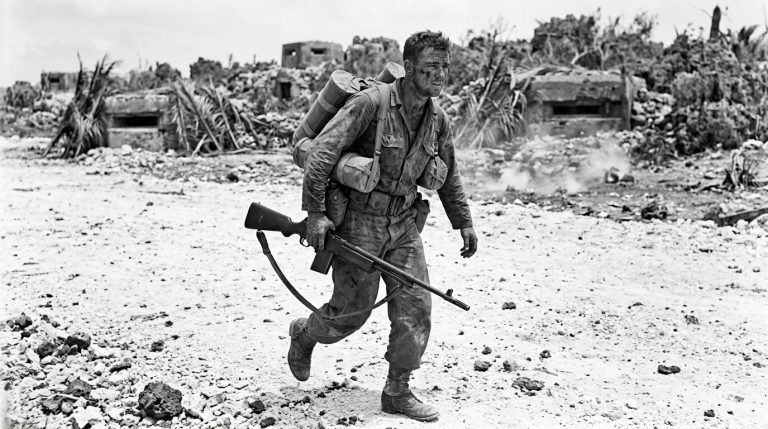
Corporal Miller crouched behind a fallen trunk that had long since surrendered its identity to fungi and the damp earth. His thumbs were white where they pressed against the receiver of his Springfield. The wood of the stock felt furred, swollen by eighty percent humidity until the bolt-action traveled with a heavy, gritty reluctance. Beneath his boots, the mud smelled of old iron and old teeth.
Thirty yards ahead, where the fern growth thinned into a limestone spine that dropped toward the river, a leaf turned. It didn’t turn with the lazy twist of the morning thermal. It dipped, stayed down, and rose three inches to the left.
Miller didn’t raise his head. He lowered his hip into the rot of the log, feeling the coarse weave of his utility trousers grate against his skin. Through a wedge-shaped opening in the roots, he watched a flat, circular silhouette rise out of the brush. Then another.
They weren’t charging. They didn’t have their bayonets fixed to catch the light. They slid forward in canvas-wrapped split-toe shoes, their bodies angled low, their rifles held across their chests to keep the barrels from scraping the low vines. They moved with the terrifying economy of men who knew exactly how much distance remained between their boots and the American airfield three miles behind Miller’s back.
The seam was open. The Matanikau wasn’t a defensive wall; it was a three-mile long leak through the clay, and a full regiment was beginning to drain through it.
Miller’s left eye twitched. An ant, red and hard-shelled, traveled up the skin of his wrist, its mandibles working the salt of his sweat. He didn’t slap it. He didn’t look at it. His gaze was locked on the third man in the enemy file—the one who wasn’t looking at the trail, but was instead pausing to check a leather case strapped to his hip.
A discrepancy caught Miller’s eye. Beside the deep, double-pronged impression of the Japanese tabi in the red clay, there was a single, clean indentation from a hard leather heel. An American heel.
The weight of the Springfield grew immense in his palms. His fingers knew the internal calculation without his brain having to speak it: if he took the shot now, the report would hit the ridge line, bounce off the limestone, and bring forty separate barrels down on his log before his bolt could dump the empty brass. If he didn’t shoot, the heel print would keep moving toward the airfield.
He drew his thumb back over the safety. The metal clicked—a tiny, metallic tink that sounded, to his ears, like an anvil dropping in an empty church.
CHAPTER 2: THE CANVAS THRESHOLD
The tiny metallic click of the safety selector switch seemed to hang in the damp air between the ferns like a visible wire. Miller did not breathe. He froze his thumb against the cold serrations of the Springfield’s iron, letting his pulse thud once, twice, heavy and thick against the rotting wood of the log beneath his chest.
Thirty yards away, the Japanese non-commissioned officer with the leather case did not look up. He didn’t drop to one knee, and he didn’t reach for his sidearm. But his left heel stopped mid-stride. The heavy leather heel—the one that left the deep, square indentation completely alien to the split-toe rubber tabi of the imperial infantry—lingered above the red clay for a fraction of a second before setting down with a soft, weighted crunch. The file behind him slowed in perfect, silent synchronicity, their canvas gaiters swishing against the wet grass like scythes through wheat.
Miller watched through the narrow fork of the dead roots. His world had narrowed to the dark green weave of the enemy’s utility shirts and the small, rectangular patch of sweat widening between the NCO’s shoulder blades. A single careless movement now, a single deep intake of the humid air, and the entire column would pivot. The jungle would explode into a crossfire of 6.5mm rounds before he could even cycle his bolt to chamber a second cartridge.
He waited, his muscles locking into an ache that felt like rusted iron. The red ant on his wrist bit down, a tiny prick of fire against his skin, but Miller’s hand remained as still as the limestone ridge itself.
Then, the NCO moved his hand. He didn’t reach for the leather case. He simply raised two fingers, signaling a slight correction in their course, away from the ridge line and down into the deeper, darker folds of the creek bed. The column slid after him, their silhouettes dissolving into the thick leafy shadows like ink in muddy water. The soft, rhythmic scraping of their gear faded until the only sound left was the distant, hollow roar of the surf against Lunga Point and the steady drip of condensation from the canopy.
Miller let the air out of his lungs in a slow, imperceptible hiss. His fingers were numb. He carefully eased the safety back into position, the small spring resisting his thumb with a dull, sticky friction before settling. He didn’t stand up. He didn’t even lift his chest from the mud. He began to slide backward, using his toes and the palms of his hands to drag his body through the fern roots, leaving a shallow groove in the black rot of the jungle floor. Every micro-movement was calculated to minimize the rustle of the leaves.
It took him ten minutes to clear the crest of the ridge and reach the reverse slope where the growth thickened into an impassable wall of lawyer vines. Only then did he rise into a low crouch, keeping his head beneath the level of the brush, and begin the long, exhausting trek back toward the main perimeter line. His boots sank three inches into the clay with every step, the suction pulling at his soles with a wet, heavy drag that burned the muscles in his calves. The air was growing hotter now, the gray morning film burning off into a blinding, white glare that made the sweat sting his eyes.
The division staff sector was a cluster of olive-drab canvas tents pitched under the deep shade of a banyan grove, just far enough from the line to escape the casual mortar fire but close enough to smell the cordite and the greasy stench of the galley pits. The canvas walls of the main operations tent were rolled up six inches from the mud to allow a trickle of dead air to pass through, revealing a floor made of splintered ammunition crates and a long trestle table covered in grease-stained maps.
Colonel William “Wild Bill” Whailing stood at the end of the table. He didn’t look like an officer who belonged on a division staff, and he certainly didn’t look like a marksman who had spent his youth winning silver cups on clean ranges. His uniform shirt was unbuttoned at the throat, the fabric salt-crusted and stained a dark yellowish-brown from the mud of the river. A short, unlit cigar stub was clamped between his back teeth, shifting slightly as his jaw worked. His eyes were small, pale, and remarkably clear against the gray, wrinkled skin of his face.
“The line is too thin, William,” General Archer said, his voice flat with the specific, leaden exhaustion that came from three months of malaria and bad water. The general didn’t look up from the map. He was holding a red grease pencil, his fingers tracing the blue grease-pencil line that marked the Matanikau River seam. “The first battalion is down to sixty percent operational capacity. I can’t give you three squads for an experiment when the third company is holding a five-hundred-yard front with two functional machine guns.”
“It’s not an experiment, General,” Whailing said. His voice wasn’t loud, but it had a hard, rasping edge to it, like two pieces of coarse sandpaper rubbing together in the dark. He didn’t point at the map. He kept his hands behind his back, his fingers locked together over his belt. “It’s a reorganization of human capital. Right now, your best shooters are buried three deep in regular rifle squads. They’re spending their days carrying water cans, digging latrines, and firing blind into the brush every time a land crab moves a leaf. You’re wasting the only tool that can actually see through those goddamned trees.”
“The manual doesn’t provide for a detached sniper element at the battalion level,” a light colonel from the G-3 section interrupted, his starched utility shirt looking ridiculously clean compared to Whailing’s salt-bitten cloth. He was standing near the field telephone, a clipboard balanced against his hip. “The doctrine states that precision fire is an auxiliary function of the standard infantry platoon. If we strip the expert marksmen from the companies, we lower the baseline confidence of the entire line.”
Whailing turned his head slowly. He didn’t look at the light colonel’s face; he looked at the pristine brass buttons on his collar, his pale eyes narrowing just enough to make the younger officer adjust his stance.
“The manual was written for a wheat field in France, son,” Whailing said softly, the cigar stub rolling to the opposite corner of his mouth. “The manual assumes you can see four hundred yards of front and coordinate your flanks with an operational radio. Out there past the river, your front is thirty feet of rotten vines and your radio is a wet box that picks up nothing but Japanese music from Rabaul. You don’t have a line out there. You have a sieve.”
He leaned over the table, his heavy leather boots creaking against the ammunition crates. He placed his palms flat on the map, right over the blue line of the Matanikau, his thick fingers covering the very sector Miller had just crawled out of.
“Give me forty eighty-rod woodsmen,” Whailing muttered, his voice dropping into a low, transactional growl. “Men who know how to sit in a swamp for eight hours without crying about the bugs. Men who don’t squeeze the trigger until they can see the color of the grease on the enemy’s rifle bolt. You give me those triggers, and I’ll give you an extra forty-eight hours before that regiment down there figures out where the gap in your perimeter is.”
The general looked up then, his face gray and hollowed by the yellow light filtering through the green canvas. He stared at Whailing for a long time, evaluating the stubborn tilt of the old marksman’s chin, the hard line of his jaw, and the absolute lack of compromise in his posture.
“You’re a difficult man, William,” the general said quietly. “You were a problem in San Diego, and you’re a problem here.”
“The terrain is difficult, General,” Whailing replied, his palms remaining flat on the map. “I’m just matching the climate.”
Miller stepped through the tent flap then, the wet canvas scraping against his pack. His face was streaked with red clay, and his uniform gave off the heavy, unmistakable stench of swamp rot. He didn’t salute—salutes were banned within three miles of the river—but he stood at attention, his boots sliding slightly on the wet wood floor.
Whailing didn’t look back at him. “Speak, Corporal.”
“They’re moving along the ridge, Colonel,” Miller said, his throat dry and cracked from the heat. “Third element in the file. He’s wearing Japanese utilities, but he’s carrying a leather case. And he’s leaving a heel print from an American issue field boot in the mud.”
Whailing’s hand didn’t move from the map, but his fingers tightened until the paper beneath his knuckles began to wrinkle. He didn’t look at the general. He looked at the light colonel by the phone.
“An American boot,” Whailing murmured, the rasp in his voice turning cold. “They aren’t just probing for a line. Someone’s showing them where the seam is.”
CHAPTER 3: THE RAW SPECIFICATION
The silence inside the operations tent hardened until the small rustle of the map’s edges beneath Whailing’s thick knuckles sounded like a tearing ligament. The light colonel by the field telephone didn’t speak; his hand remained fixed on his zinc clipboard, his thumb testing the sharp metallic corner of the paper clamp. General Archer slowly lowered his red grease pencil, its tip leaving a small, bloody smudge directly over the coordinates of the Matanikau’s western bend.
“A field shoe,” Archer said, his voice flat, devoid of the theatrical surprise a softer man might exhibit. He looked at Miller’s mud-caked leggings, then back at Whailing’s stone face. “A single replacement voucher from the supply depot at Kukum, or a battlefield salvage. The island is littered with the gear of the dead, William.”
“The Japanese infantry doesn’t wear nine-and-a-half EEE standard issue combat service boots, General,” Whailing said, his voice dropping into that rhythmic, abrasive scrape. He slowly lifted his hands from the map, leaving two dark, damp grease marks where his palms had anchored. “And they don’t carry their tactical field orders in an oiled leather pouch processed by the quartermaster at San Diego. Someone is walking that ridge who knows exactly how many paces exist between our perimeter stakes and the main fuel cache. We don’t have time to hold a court-martial, and we don’t have time to audit the warehouse. I want my hunters at the tree line by nightfall.”
Archer didn’t blink. He reached down, took a tin canteen from the floor crates, and unscrewed the rusted cap with three short, precise twists of his wrist. The smell of stale, warm iodine-filtered water escaped into the tent. “Take your forty triggers from the perimeter companies, Colonel. But if that seam breaks while your scouts are collecting leaves, the G-3 section will document that your detachment was the puncture point.”
Whailing didn’t offer a salute. He simply turned on his heel, his heavy leather soles grating against the ammunition boxes as he moved toward the tent flap. “Corporal Miller, with me. Get your rifle out of the mud.”
The physical transition from the command sector to the secondary defensive line was a quarter-mile slog through a ditch of red, churned muck that ran parallel to the main fighter strip. The white glare of the afternoon sun hit the coral runway, throwing a shimmering wave of heat across the parked F4F Wildcats. The smell of high-octane aviation fuel mixed with the stench of the tidal flats and the sour iron odor of the swamp. Miller followed two paces behind the colonel, his Springfield balanced across his shoulder, his boots making a wet, sucking sound with every step as they approached the assembly area of the 1st Battalion, 5th Marines.
Seventy men sat along the bank of a drainage trench under the shade of a frayed canvas awning. They were the candidates the company commanders had been eager to give up—not because they were the best shooters, but because they were the ones who didn’t fit into the tight geometry of the platoon line. They were the solitary men, the poachers from the hills of Kentucky, the quiet farmhands from the timber lines of Oregon, the ones who spent their off-duty hours scraping the carbon from their gas cylinders with pocketknives instead of playing cards on shelter halves.
Whailing stopped at the edge of the trench. He didn’t order them to attention. He stood with his hands locked behind his back, his small, pale eyes scanning the line of haggard, yellow-skinned faces. Most of them were shivering from the mid-day malaria spike, their wool shirts buttoned to the chin despite the ninety-five-degree heat.
“I don’t care about your service records,” Whailing said, his voice easily carrying over the low idle of a distant tractor on the runway. “And I don’t care if your platoon sergeant thinks you’re a genius with a cleaning rod. I need forty men who can live in a hole for forty-eight hours without their bowels turning to water from fear. I need men who know the difference between the sound of a falling coconut and the sound of an iron buckle hitting a limestone rock at thirty paces.”
He walked down the line, his boots kicking up small clods of dried mud. He stopped in front of a lean private whose utilities were shredded at the knees, exposing skin covered in infected tropical ulcers. The private was holding a ledger book he’d been using to stiffen his cartridge belt.
“Where’d you get that book, son?” Whailing asked.
“Supply clerk gave it to me for a wedge of chewing tobacco, sir,” the private muttered, his eyes fixed on Whailing’s chest. “Company C roster records from the August landings.”
Whailing reached out and took the ledger. His rough thumb flicked through the thick, yellowed pages. His eyes narrowed on the ink columns—the neat, typewriter-style entries of numbers, sizes, and serial allocations. He paused on a page near the back, his finger freezing over a line detailing the procurement of specialized technical equipment from the division staff warehouse. The ink was fresh—blue and dark, completely un-smudged by the salt water that had ruined the front of the book. It listed three leather document cases and four pairs of wide-fitting field shoes delivered to an unassigned staff section three days before the Matanikau flank began to buckle.
A cold certainty settled into the lines around Whailing’s mouth. The discrepancy wasn’t a salvage from a dead marine. It was an entry from a live pen inside the perimeter.
He handed the book back to the private without a word. He turned back to Miller, his face a hard mask of gray skin and deep wrinkles.
“Miller,” the colonel whispered, the sandpaper rasp of his voice tighter than usual. “Take the first twenty men who aren’t shaking from the fever. Check their weapon actions. If the bolt has more than half a millimeter of slop in the lug recess, throw them back in the trench. We go into the trees in twenty minutes, and I won’t have a single trigger that chatters when the wind dies.”
Miller stepped forward, his fingers sliding down the coarse canvas of his belt to reach his pouch. The air felt heavy, grease-filled, and thick with the scent of wet iron as the forty hunters began to separate themselves from the dying weight of the line.
CHAPTER 4: THE CALIBRATED CHASSIS
Miller’s fingers went down into his canvas belt pouch, his skin grazing the rough, woven grain of the webbing before his index finger hooked a dry, oil-slicked brass gauge. He did not let his focus drift to the sweat dripping from his chin onto the hot steel of his rifle barrel. He took two steps to the left, stopping in front of the first man in the trench who wasn’t visibly shaking from the afternoon fever.
“Rifle up,” Miller commanded. His voice was low, sand-scratched from the dust of the fighter strip.
The private—a lanky kid from the timber lines whose face had taken on the dull, tallowy yellow of the atabrine tablets—lifted his weapon. The Springfield’s parkerized receiver was gray, salt-pitted along the wood line where the salt air had eaten through the protective grease. Miller grabbed the bolt handle with his thumb and forefinger, lifting it with a short, upward jerk. He slid the action back, feeling the metallic drag of dry oil, then inserted the small brass gauge directly into the lug recess of the receiver ring. He closed the bolt, checking the resistance against his palm.
The metal met with a solid, unyielding thud. No slop. No vibration. The headspace was tight enough to survive the grit of the river crossings.
“Step out,” Miller said.
He moved down the trench line, his boots grinding into the dry coral dust that blew off the runway. The next four rifles passed through his hands with the same mechanical monotony—lift, slide, insert, measure, push. The physical work of checking the actions became a rhythm that suppressed the growing weight in his chest. But the fifth rifle, an older M1903 with a stock that had turned nearly black from gun oil, failed the test before the gauge was even out of his pocket. When Miller lifted the handle, the bolt assembly rattled inside the receiver track with a light, loose chatter, like a broken gear in a tractor housing.
“Back in the ditch,” Miller muttered, not looking at the private’s face.
“It still hits what I point at, Corporal,” the man argued, his voice a hoarse whisper. His knuckles were raw, split by the sharp grasses of the perimeter edge.
“It chatters,” Miller said, his gaze shifting briefly to Whailing, who remained ten paces away, his back turned to the runway while he studied the fresh ink entries in the ledger book. “A chattering bolt is a signature. When the wind drops in the trees, a Japanese observer three hundred yards out can hear that slop from across a limestone gully. Get another piece from the ordnance tent or stay behind the stakes.”
Whailing didn’t look up from the yellowed pages of the book, but his thumb traced the clean, un-smudged blue ink line over and over. To Whailing, the neat penmanship wasn’t just a ledger; it was a memory of the same arrogance that had cost him his line command in San Diego. The staff officers there had used the same fine-tipped fountain pens to log the redistribution of his training supplies while they sat under electric fans, three thousand miles from the salt-bite of a real beach. They had called him difficult because he refused to sign vouchers for equipment that existed only on paper. Now, the same blue ink was tracing a path across the Matanikau, and the price wasn’t being paid in standard office supplies. It was being calculated in the seventy dead bodies already logged along the river ridge.
The colonel closed the ledger with a dull, heavy slap that sounded like a shovel blade hitting dry turf. He slid the book into his own utility shirt pocket, buttoning the flap down with a deliberate twist of his calloused thumb.
“That’s twenty-two, Miller,” Whailing said, turning his head just enough to expose the white scar tissue behind his left ear. “Where are the other eighteen?”
“Three more passed the headspace check, sir,” Miller replied, wiping his greasy palms against his thighs. His trousers were stiff with dried river mud, the fabric scratching his skin like coarse burlap with every movement. “The rest are either too loose in the lug tracks or their barrels are completely dark from the damp. We’re fifteen triggers short of the specification.”
“We don’t wait for the supply trucks, Corporal,” Whailing said. He walked toward the group of twenty-five men who had stepped out of the ditch, his shadow falling long and sharp across the white coral dust. “These twenty-five will have to cover the same width of front. If a man runs out of brass out there, he doesn’t call for a runner. He inherits the clip of the man next to him.”
He stopped, his eyes checking the alignment of their cartridge belts, the position of their knives, and the absolute stillness of their hands. They weren’t a parade squad. They looked like a collection of rusted iron hinges—worn down, gray, but still functional under tension.
“You’re not a line platoon anymore,” Whailing told them, his rasping voice dropping below the whine of a Wildcat taxiing down the runway. “You don’t fire to keep your courage up. If you pull your trigger before you have an angle that breaks the enemy’s spine, you’ve just signed your own voucher to the burial detail at Lunga. You move in pairs. One shoots, one watches the flanks for the secondary feeler elements. If you lose your partner, you don’t fall back to the stakes. You anchor yourself to the nearest piece of limestone and wait for the light to change.”
He turned back toward the path that led down to the river, his heavy boots already finding the slope. “Miller, bring the ammunition crates. We cross the seam before the sun hits the top of the banyan trees.”
Miller didn’t answer. He picked up the heavy wooden box from the floor crates, the dry rope handles biting into his palms with a rough, burning friction that made his old blisters itch. He balanced the box against his hip, his fingers curling around the cold iron latch, and followed the old marksman down into the darkening brush where the white glare of the strip died instantly under the shadow of the vines.
CHAPTER 5: THE SEAM OF SILT
The weight of the ammunition box dragged Miller’s left shoulder downward, the coarse jute rope of the handle grinding directly into the open blisters across his palm. He took his first step off the hardened coral shoulder of the runway, his boot heel sliding through the top layer of hot, dry dust before sinking into the slick, tallow-colored clay of the ravine slope. Behind him, the twenty-four selected marksmen followed in single file, their Springfield rifles held flat against their utility jackets to keep the receivers from catching the low, sweeping vine tendrils.
Nobody spoke. The only sound was the wet, rhythmic thwack of canvas-wrapped legs cutting through the giant ferns and the heavy, industrial idle of the fighter strip fading behind them.
The descent grew steeper, the jungle canopy closing overhead like a green, vaulted iron roof that choked out the white glare of the sun. The temperature didn’t drop; it flattened, turning into a dead, grease-filled heat that smelled of fermenting wild ginger and old river silt. Whailing moved at the front of the file, his short, unlit cigar stub still clamped hard between his teeth, his wide shoulders tilting left and right as he picked a path through the limestone outcroppings. He didn’t use a machete; the blade made too clean a sound, a ringing ping that carried across water like a bell. Instead, he used his bare hands to part the thorn vines, his calloused palms ignoring the small, dark scratches that left beads of dark blood on his wrists.
Ten minutes into the descent, the sky above the upper canopy changed from gray-white to an opaque, bruised purple. A low, rolling vibration rumbled through the ground—not the concussive thump of a naval shell, but the heavy, dull thud of a tropical storm cell hitting the western ridges.
Within seconds, the rain arrived. It didn’t drop as individual screens; it fell as a single, solid sheet of lukewarm water that flattened the ferns and turned the red clay path into a rushing chute of orange silt. The friction of Miller’s wet utility shirt began to raw his armpits, the coarse fabric stiffening with every saturated inch. He adjusted his grip on the rope handle, his fingers slipping against the wet wood of the ammunition box as his boots slid three feet down a smooth limestone shelf.
“Hold the line,” Miller whispered back, his voice swallowed instantly by the roar of the water hitting the leaves.
The file halted, each man leaning his weight into the bank to anchor himself against the sudden wash of mud. At the front, Whailing stopped at the edge of the riverbed. The Matanikau had already begun to change. The muddy, fast-changing barrier that had been thigh-deep three hours ago was swelling, the yellow water lifting dead logs and mats of rotting vegetation, spinning them through the current with a heavy, brown momentum.
The old marksman knelt in the orange foam at the river’s lip. He reached down and plunged his forearm into the current, testing the pressure against his skin. The water was rising an inch every five minutes, the force of it dragging at his sleeve like a heavy hand.
Miller slid down beside him, setting the ammunition box onto a small shelf of black basalt. “The bottom’s shifting, Colonel. If we cross here with the crates, the current’s going to roll the tail end of the line down toward the sandbar.”
Whailing didn’t look at him. His pale eyes were fixed on a large banyan root that stretched across the narrowest section of the seam, thirty yards upstream. The water was boiling over the top of the wood, creating a white, roiling V-shaped wake that signaled a shallow limestone ledge beneath.
“We don’t have thirty minutes for the water to crest, Corporal,” Whailing said, the sandpaper rasp of his voice cutting through the roar of the downpour. He pulled the leather-bound ledger from his utility pocket, the water sheeting off the treated oilcloth cover without soaking the pages inside. He didn’t open it; he just pressed his thumb against the hard corners of the binding. “If the Japanese file reaches the secondary stakes before we’ve set the geometry of our hides, they won’t need a map to find the fuel cache. They’ll hear our line squads trying to clear their wet chambers.”
He stood up, his wet trousers clinging to the thick muscles of his thighs. He pointed his stubby index finger toward the banyan root.
“Pairs,” Whailing ordered, his eyes sweeping the twenty-four men who stood wedged between the vines. “Miller, you take the ammunition box across the center ledge. If a man loses his footing, he doesn’t drop his rifle to grab the root; he locks his arm around the stock and stays on his knees until the man behind him hooks his belt. We cross in the gray areas where the current breaks against the basalt.”
He stepped into the yellow water first, his heavy field boots disappearing into the silt. The current hit his knees with a dull, hollow thud, forcing his body into a hard, forward lean. He didn’t look back to see if they were following. He knew the type of men he had pulled from the trench—they were the ones who had survival figured out as a matter of maintenance, not bravado.
Miller picked up the ammunition box again, the wet rope cutting deeper into his raw palm. He stepped into the brown swirl, his boot finding the slick, grooved surface of the submerged limestone ledge. The weight of the iron-bound box was the only thing keeping his soles anchored to the bottom as the river dragged at his thighs, the smell of wet iron and old roots filling his throat with every ragged breath.
CHAPTER 6: THE SILENT ANCHOR
The brown silt of the far bank gave way with a loose, granular sigh as Miller dragged his right knee out of the roiling froth. The iron-bound corner of the ammunition crate dug directly into the muscle of his hip, its wet rope handle slick with river slime and gray slime-molds that left a bitter, chemical smell on his palms. He didn’t look back at the yellow swirl of the Matanikau. He kept his belly flat against the wet basalt ledge, his fingers hooking into the iron-hard crevices of the rock to hoist the ninety-pound box clear of the rising waterline.
Behind him, the remaining pairs of the detachment cleared the seam one by one. Their breath came in short, raspy hitches through noses clogged with mud and the sour stench of stagnant river pool water. No one reached to squeeze the moisture from their utility jackets; the heavy canvas was already stiff with embedded grit, the seams rubbing against raw thighs and collarbones like iron files.
Whailing was already ten yards up the limestone shelf, hunkered within the dark, dripping recess of a massive wild fig tree whose roots split the stone like rusted wedges. His pale eyes scanned the dense brush that clogged the ridge line thirty feet above them. The downpour had tapered into a thick, greasy mist that hung over the ferns, turning the afternoon light into a desaturated charcoal gray.
“Miller,” the colonel whispered. The sandpaper edge of his voice was completely level, untouched by the half-mile wade through the shifting bottom. “Divide the clips. Two bandoliers per pair. If a team has more than twelve rounds left in their canvas pouches when the sun clears that banyan line tomorrow, I’ll assume they were using their fingers to count instead of their sights.”
Miller slid on his stomach across the wet shale, his boots making a faint, dull scrape against the stone. He unlatched the iron buckle of the ammunition box, the rusted hinge resisting before snapping open with a dry clink that he covered with the palm of his grimy hand. Inside, the green zinc liners were clean, their rubber seals intact against the swamp rot. He began pulling out the five-round clips of .30-06 ammunition, the brass casings cold, bright, and dry against his skin.
He handed four clips to the nearest pair—two farmhands from the Willamette valley who had spent the last hour crawling through the lawyer vines with their rifle muzzles wrapped in grease-paper.
“Your sector is the lower draw,” Miller told them, his voice dropping into the TRANSACTIONAL tone of a supply clerk handling tool returns. “Where the creek beds flatten out into the mud lanes. You don’t fire at the point man. You let him pass until his third stride hits the black clay. Then you look for the leather strap of the ammunition case behind him.”
The private on the left—a kid whose knuckles were raw and gray with salt-sores—took the brass clips without a word. He didn’t check the spring tension of his follower; his fingers knew the feel of the machine without his eyes having to leave the brush line above. He slid the clips into his canvas belt pockets, the dry cloth snapping shut with a small, muffled pop.
Whailing watched the pairs separate, their silhouettes sliding into the gray mist until the ferns simply swallowed the dark green shape of their shirts. They didn’t leave trails; they moved sideways into the growth, using the natural angles of the basalt outcroppings to mask the depression of their boots.
The old marksman reached into his pocket and pulled out the leather-bound ledger book once more. The cover was smeared with orange river clay, but the blue ink inside remained sharp, clear, and perfectly precise. He leaned his back against the iron-hard trunk of the fig tree, his thumb sliding down the margin of the unassigned staff allocations. His face didn’t show anger; it showed the cold, arithmetic satisfaction of a mechanic who had found the exact tooth where the gear train was stripping.
“They’re going to push through the lower seam because they think the first battalion is still holding the line with paper strength,” Whailing said quietly, his gaze fixed on the ink columns. “The light colonel back at staff logged fifty-two replacements into Company C on Tuesday. He signed the ration vouchers with his own fountain pen.”
Miller paused, a half-empty bandolier balanced across his forearm. “Sir?”
“The men don’t exist, Corporal,” Whailing muttered, the cigar stub shifting to the center of his teeth with a dry scrape. “The replacements never cleared the beachhead at Lunga. They’re still sitting in the hospital tents with the shaking ague, or they’re on the manifests of the high-speed transports that turned back at San Cristobal. The G-3 section kept them on the active grid to keep the division perimeter looking complete on the morning report. The Japanese commander on that ridge has the same grid map. He knows Company C is holding five hundred yards of limestone with eighteen functional triggers.”
He closed the book and tucked it away, his fingers lingering on the coarse canvas of his shirt pocket.
“We aren’t here to save the airfield, Miller,” Whailing said, his pale eyes turning toward the darkening gully where the first enemy file would appear. “We’re here to correct the ledger.”
Miller didn’t answer. He took the last two bandoliers from the zinc box, slung them diagonally across his chest over his wet pack straps, and checked the bolt of his own Springfield. The metal traveled forward with a clean, greasy thud, the tight headspace locking the cartridge into the dark chamber with absolute, unyielding finality. He dropped into a low crawl, his belly finding the cold friction of the shale as he moved toward his own hide on the western flank of the fig tree’s root system.
The jungle around them grew perfectly still, the mist settling into the low hollows until the smell of the wet iron ammunition box was the only thing left in the dark.
CHAPTER 7: THE COLD ARCHITECTURE
The cold shale scraped through the knee seams of Miller’s trousers as he settled into the hollow between two protruding veins of the wild fig tree. He didn’t shift his weight after his hip bone found its seat against the stone; he let his body become part of the dark geometry of the roots. The grease on his Springfield’s bolt-head had an industrial, sulfurous odor that rose through the damp air, cutting through the thick, sweet stench of rotting moss.
Beside him, the iron-bound ammunition crate lay silent under a shroud of wet ferns, its raw rope handles resting in the mud like dead vines. Thirty yards up the gully, the jungle had stopped dripping. The white fog that followed the downpour had thickened into a low, motionless screen, truncating the tree line until only the thickest trunks remained visible.
Miller raised his left hand, his index finger resting lightly against the side of his receiver ring. He didn’t look back to see where Whailing had anchored himself. He knew the old man was six paces to his rear, tucked behind the thickest flank of the trunk, the oilcloth ledger book likely still resting against his ribs under his damp utility shirt.
A leaf twitched in the lower draw. It wasn’t the weight of a water drop; it was a short, sharp twitch that pulled a thin vine taut against a limestone boulder.
Miller lowered his cheek to the wood of his stock. The grain was swollen, rough against his jawline where three days of stubble had grown coarse. Through the iron aperture of his rear sight, the gray world of the gully sharpened into a narrow lane of wet clay and crushed ferns.
The point man of the Japanese file came through the fog first. He was low, his chest nearly dragging across the red mud, his arisaka rifle held in his right hand by the balance point. He didn’t look at the high banks; his gaze was fixed on the specific, narrow channel where the creek bed flattened out into the perimeter approaches.
Then came the second figure—the non-commissioned officer Miller had trailed along the western ridge line three hours prior. The leather document case was still strapped to his hip, its treated surface gleaming with a dull, oily luster under the gray mist.
As the NCO stepped over a fallen trunk, the movement pulled his utility jacket tight against his shoulder blades, exposing the strap of his binoculars. Miller’s gaze locked on the brass buckle that adjusted the leather harness. It wasn’t the standard, circular buckle used by the imperial forces; it was a square, parkerized steel slide, stamped with a small, clean number allocation that belonged exclusively to the reconnaissance sections of the first Marine division staff.
The discrepancy sat there in the gray lens of his sight like an ink blot. It wasn’t a piece of battlefield salvage. The strap had been cut and refitted with a specific zinc eyelet tool that only the depot at Kukum possessed.
Miller’s thumb didn’t move toward the safety. He kept his fingers loose around the small of the stock, the cold steel of the trigger guard resting against his second joint. The internal logic of the hunt had changed; the file ahead wasn’t just a force to be broken from the inside out—they were carrying the physical confirmation of the ledger entries Whailing had pulled from the trench.
The NCO paused, his hand going down to touch the flap of the leather case. He didn’t look back at the three men who made up the core of his machine-gun crew behind him. He reached inside the pouch and pulled out a small, folded sheet of grease-paper, his grimy thumb tracing a series of red lines that had been drawn with a technical ink pen.
Through the narrow slit in the roots, Miller could see the texture of that paper. It was heavy, linen-backed grid sheet, the kind used by the artillery coordinators back at division headquarters to chart the defensive registration sectors.
The Japanese unit was moving along the exact coordinate line where Company C’s fictitious replacements had been logged. They weren’t looking for a line; they were walking through a gate that had been left open on a piece of paper.
Miller felt a low, dull thud in his chest—the slow, arithmetic weight of realization that Whailing’s relief from command hadn’t been a matter of an officer’s difficult personality. It had been an extraction. They had cleared the old marksman off the line because his eyes were sharp enough to notice the gaps between the manifests and the mud.
He held his breath, the iron of his front sight post settling directly onto the center eyelet of the NCO’s square buckle. The silence in the gully had grown so absolute that he could hear the tiny, wet scrape of a snail moving across the rock three inches from his muzzle.
“Hold,” a voice didn’t say from behind him. It was just the small, dry click of Whailing’s tongue against his teeth—a signal that carried no farther than the root line but reached Miller’s ears with the clarity of a horn.
The enemy column continued its slide down the clay chute, their canvas gaiters leaving deep, long slots in the red earth that filled immediately with gray water. They were six paces from the black clay lane where the geometry of the hides had been drawn.
Miller’s finger remained loose inside the guard, the friction of the steel cold against his skin as the second layer of the trap began to turn beneath the floor of the jungle.
CHAPTER 8: THE PRECISION TRIGGER
The steel of the trigger blade was a cold crescent against the second joint of Miller’s index finger. He did not squeeze with a sudden impulse; he drew his pad backward in micro-increments, feeling the tiny, internal imperfections of the sear assembly slide against each other like two rusted iron faces. His heartbeat dropped into the gap between his ribs, a slow, leaden thudding that seemed to vibrate through the banyan root and down into the wet basalt beneath his chest.
Thirty yards down the chute, the Japanese non-commissioned officer remained static. His thumb was still pressed against the technical red ink lines of the linen grid map, his eyes evaluating the shallow ditch where the grass had been flattened. The square buckle of his division-issue binocular strap caught a fragment of the low, charcoal light, a single zinc glint in the middle of the gray fog.
The Springfield’s spring compressed. Then, the sear released.
The report did not roar through the gully; it cracked like a dry hickory limb snapping under a boot heel, a sharp, flat spat that was contained instantly by the heavy, wet canopy. The rifle didn’t jump. It recoiled straight back into Miller’s shoulder, the coarse weave of his utility jacket absorbing the punch with a short, rough jolt.
Through the gray lens of his aperture, the zinc buckle vanished. The NCO didn’t scream, and he didn’t stumble backward. His knees simply surrendered their leverage. The linen-backed map flew upward from his fingers, spinning once through the greasy mist before landing flat in the red clay. His torso dropped forward into the orange silt of the creek bed, his forehead striking a limestone boulder with a dull, hollow thud that carried no more weight than a water-logged branch hitting the bank.
Miller’s hands didn’t wait for the echo to clear. His right thumb hooked the bolt handle, pulling it up with a hard, violent twist that broke the sticky seal of the burnt powder. He slammed the assembly back, the extractor claw spitting the empty brass shell into the mud with a wet ping. He drove the bolt forward, chambering the next five-hundred-grain cartridge, his palm slamming the handle down into the lug track until the mechanism locked with an industrial thud.
The transition from the hide was already turning. Whailing’s doctrine was absolute: the first shot belonged to the hunter, but the second belonged to the ground.
Before the first empty shell had settled into the slime, Miller was sliding sideways out of the root fork. He didn’t lift his torso. He used the flat of his forearms and the inner edges of his boot soles to drag his body across the wet shale shelf, his utility trousers scraping against the rough basalt with a coarse, shredding sound. He moved twelve feet to his left, dropping behind a secondary spine of green limestone that was choked with sharp sword-grass.
From his new angle, he looked back through the stalks. The gully had collapsed into the specific, frantic order of disciplined infantry when the terrain ceases to make mechanical sense.
The point man had gone to earth, his belly pressed so tight into the mud that his pack looked like a natural mound of river rot. He didn’t fire blind. He lay with his arisaka barrel thrust forward into the ferns, his helmet head turning three inches to the left, then the right, his eyes searching the dark banyan line for a flash of sulfur smoke or the ring of iron.
Behind him, the machine-gun crew was attempting to execute their transition. Two men were dragging the heavy, finned barrel casing of a Type 92 gun off the open path, their hands slipping against the wet metal as they tried to reach the reverse slope of the ditch. They weren’t yelling. They moved in silence, their breaths coming in short, rhythmic grunts that Miller could hear across the thirty yards of stone.
A second crack came from six paces to Miller’s rear—the short, dry bark of Whailing’s piece.
The assistant gunner, who was hauling the iron ammunition chest by its zinc handle, spun hard to his right. The bullet didn’t hit his chest; it took him through the thick muscle of his hip, breaking his stride and dropping his center of gravity into the silt. The ammunition chest fell flat, its latches striking the stones with a bright, metallic rattle that signaled a loss of cohesion in their line of supply.
The Japanese column compressed. Without the NCO’s fingers to trace the technical pen lines on the linen map, the file behind the gun crew bunched into the bend of the trail—exactly where the limestone funnel narrowed into a two-pace bottle-neck. They didn’t run back toward the river, and they didn’t charge the fig tree. They waited for a command that was currently face-down in the orange clay.
Miller lifted his Springfield, his shoulder finding the wet indentation in his coat once more. His eye found the rear ring, the front post settling on the shoulder of the gunner who had grabbed the handles of the dropped ammunition box. The friction of the rain began again, a thin, cold drizzle that started to tarnish the bright brass clips inside his belt pockets, but his hand stayed steady against the stone.