The weight of a buried secret pulls two soldiers together across the silence of fifty years
CHAPTER 1: THE EDGE OF THE STOOL
The amber liquid in the tumbler didn’t move. Richard Kaine kept his gnarled thumbs locked around the base of the glass, watching a single bead of condensation slide down the glass, dragging a clear line through the fogged surface. The wood beneath his forearms was soft, seasoned by forty years of spilled draft beer and lemon oil, its grain worn smooth right where the regulars leaned. Behind him, the television droned out the statistics of a football game he couldn’t see clearly, the colors bleeding together into a pale blue haze.
“I’m serious,” the younger man said, his shadow falling across the polished lacquer of the bar. He didn’t sit, not yet. He slid his weight onto the next stool, his frame coiled like an overwound spring under a plain gray t-shirt. “This isn’t exactly the VFW hall, Pops. You look a little lost.”
Richard didn’t turn. To turn was to acknowledge the heat coming off the kid. He knew that heat; it was the restless, heavy air of men who spent their mornings running five miles with logs on their shoulders and their nights waiting for a green light to flash over an open ramp. The kid had a beard trimmed so tight it looked like charcoal drawn against his jawline. Behind him, four more of them sat in the corner booth, their broad chests and watchful eyes signaling a quiet, collective ownership of the room.
“Just having a drink,” Richard said. His voice was a low rumble, the phrase thick and dry from an 81-year-old throat that hadn’t used more than fifty words since Tuesday.
A chuckle drifted over from the booth. It wasn’t loud, just a small, sharp testing of the boundaries. The leader—Marcus, the bartender had called him earlier—leaned closer. His knuckles were clean, but his right forearm bore a small, pale scar shaped like an arrowhead, the kind left by a stray piece of gravel kicked up by a rotor blade.
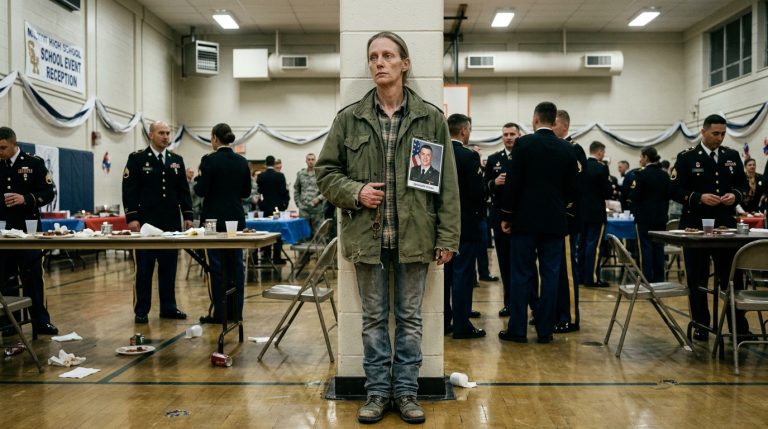
“That’s a lot of jacket for a warm night,” Marcus muttered. His hand reached out, his index finger hovering an inch from the faded field cotton draped over the back of Richard’s stool. The olive drab fabric was frayed down to the white warp threads at the cuffs, and the circular patch on the left sleeve was an unrecognizable web of gray embroidery, the original shape lost to decades of laundry soap and sunlight. “Where’d you pick that up? Flea market down by the state line?”
The smell of stale beer vanished.
For less than a heartbeat, the warmth of the glass beneath Richard’s fingers turned to cold, vibrating aluminum. The low hum of the bar’s cooler became the deafening, throat-tearing roar of a Pratt & Whitney engine beating against a monsoon sky over Pakse. He could taste the copper of his own tongue where he’d bitten it during the insertion; he could see Miller’s face, gray with greasepaint and sweat, leaning across the red-lit cabin to slap that very patch onto Richard’s shoulder before the lines went dark. The skull in the center had been bright silver then, clean as a new dime.
Richard blinked. The North Carolina humidity crept back into his skin. He reached out with one spotted hand and pulled the jacket closer to his flank, tucking the frayed sleeve under his elbow. “It’s just an old patch,” he murmured.
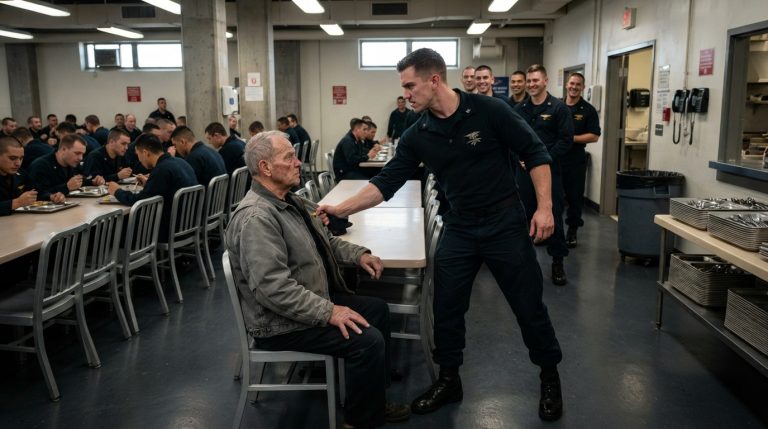
Marcus’s eyes narrowed, the casual mockery hardening into something direct and cold. He stood up fully now, his boots clicking once against the floorboards. “Men I know died for pieces of cloth like that, old man. Let’s see what’s under the collar.”
CHAPTER 2: THE LAMINATED CARD
Marcus’s fingers hovered close enough for Richard to feel the dry heat radiating from the young man’s skin. The faded cotton of the field jacket sat heavy against Richard’s arm, its loose threads catching the slight draft from the bar’s ceiling fan. Every muscle in Marcus’s forearm was defined, a roadmap of fresh, hard-earned training, twitching with the absolute certainty of youth.
“Men I know died for pieces of cloth like that, old man,” Marcus repeated, his voice dropping an octave, losing its performative volume for something much more transactional. “Let’s see what’s under the collar.”
Richard didn’t flinch. He didn’t pull back. His pale blue eyes remained fixed on the small, pale scar on Marcus’s arm. “There’s nothing under it but salt,” Richard said softly. “From fifty years of sweat.”
Behind Marcus, the four operators in the booth had shifted. They didn’t stand up in a rush; they moved with the synchronized economy of a team that didn’t need to speak to split a room. One of them, a broad-shouldered man with a shaved head, casually stood and stepped toward the front door, his back to the glass, blocking the exit without making it look like a blockade. The other three slid out of the vinyl booth, their boots making light, rhythmic thuds against the floorboards as they formed a loose, deliberate semi-circle around the stool.
Then, a sharp, rhythmic click-click-click pulsed directly into Richard’s right ear.
It wasn’t the bar’s cooler. It wasn’t the television. It was a precise, high-frequency static burst tunneling straight through his hearing aid, a sound he hadn’t heard since the signal towers at Ramasan went dark. It was the distinct digital handshake of an old encrypted proximity beacon—a relic that shouldn’t have had batteries, let alone a signal, anywhere within three thousand miles of Fort Bragg. The frequency was so high it made the marrow of his jaw ache, a familiar phantom pain that usually only arrived before a heavy mortar barrage.
Richard’s gaze flicked past Marcus’s shoulder. At the far end of the counter, the damp towel Sarah had been using lay abandoned in a twisted, gray heap on the wet wood. The door to her small back office was just settling into its frame, the brass latch clicking shut with a hollow, metallic finality.
Marcus noticed the track of Richard’s eyes. He didn’t look back at the office; instead, he used the distraction to close the remaining distance. His hand moved with blinding, practiced speed, his thick fingers clamping onto Richard’s left forearm. The grip was precise—not crushing enough to break bone, but perfectly positioned over the radial nerve to paralyze the fingers.
“You’re not listening, Pops,” Marcus murmured, his face inches away. The smell of cheap bourbon and mint gum rolled off him. “We’re going to take a nice, quiet walk out to the lot. We’ve got some friends over at the PMO who love looking into old supply records. If this jacket’s yours, you won’t mind the ride.”
The four operators closed the circle to three feet. The air in the bar grew dense, the casual chatter from the two mechanics at the corner table dying out instantly as they realized the weight of the men involved. The silence was absolute, save for the electronic clicking screaming inside Richard’s head.
Richard let his arm go completely limp in Marcus’s grasp. He didn’t fight the leverage. He knew that trying to pull against a twenty-six-year-old operator in peak physical condition was an invitation to a dislocated shoulder. Instead, he leaned his weight slightly forward, using the counter to stabilize his bad hip, his right hand remaining flat against the cold, damp surface of the bar near his glass.
“You have the fire, son,” Richard said, his voice entirely flat, devoid of the panic Marcus was clearly hunting for. “But you don’t know who laid the hearth.”
“I don’t need a history lesson from a guy who bought his pedigree at a surplus store,” Marcus snapped. He initiated a steady, upward pull, attempting to hoist Richard off the stool by his nerve alignment.
But Richard didn’t rise. He altered his center of gravity, sinking his weight into his heels, his gnarled fingers locking onto the underside of the oak bar rail with surprising, fibrous strength. It wasn’t an aggressive move; it was the stubborn, unyielding physics of an old anchor buried in deep mud.
Through the thin wood of the office door, the faint, muffled cadence of Sarah’s voice filtered out. She wasn’t yelling. She was reading off numbers—specifically, the sequence from the small, laminated card that had sat in her desk drawer since the winter the old general stopped coming in.
Marcus’s brow furrowed. The broad-shouldered operator by the door flicked his eyes toward the back hallway, his hand moving instinctively toward his right hip under his untucked shirt. “Marcus,” the man called out, his voice sharp. “The girl’s on a landline. She didn’t call local.”
“Wrap it up,” Marcus muttered, his patience dissolving. He brought his second hand up, locking his fingers onto Richard’s shoulder seam, preparing to break the old man’s hold on the bar rail by force. “We’re going. Now.”
The clicking in Richard’s ear suddenly stopped. It didn’t fade; it cut off cleanly, replaced by a low, rhythmic carrier tone that vibrated against his eardrum. Someone, somewhere within a five-mile radius, had just acknowledged the beacon. The air outside the bar’s frosted windows seemed to drop three degrees as the distant, low-frequency thrum of heavy engines began to roll across the asphalt of the outer highway.
CHAPTER 3: THE GRANITE ARRIVAL
The low-frequency vibration didn’t travel through the air; it came up through the ancient heart-pine floorboards, rattling the empty amber bottles stacked in the plastic crates beneath the counter. Marcus’s fingers remained locked onto Richard’s shoulder seam, but the downward leverage froze. The young operator didn’t look at the window, but his posture underwent an instantaneous structural shift—the loose, predatory slouch of a man handling an elderly civilian tightened into the coiled, defensive compression of a soldier processing an unmapped threat.
“Hear that?” the operator near the door muttered, his shoulder lifting slightly from the glass pane. His hand remained hooked into his waistband, his fingers tapping a fast, silent cadence against his hip. “Those aren’t commercial diesels.”
Richard felt the heavy, rhythmic beat of the engines settling deep in his chest. It was a sound he had tracked through the elephant grass of the Rung Sat zone and across the hard, frozen clay of the plateaus—the unhurried, synchronized growl of heavy-duty tactical platforms moving in a tight box formation.
Marcus didn’t release his grip on Richard’s arm, but his thumb shifted away from the nerve cluster, a subconscious regression from an offensive hold to a defensive anchor. “Hold what you got,” Marcus commanded his team, his voice dropping into a flat, raspy rasp that belonged in a operations huddle. “Nobody moves until we identify.”
The frosted glass of the bar’s front door flickered. The pale blue glare of the overhead television was suddenly swallowed by a massive, solid occlusion of light as three long, midnight-black SUVs cut across the gravel lot. They didn’t slide to a halt; they stopped with an unnatural, heavy precision, their suspensions settling simultaneously without a single squeal of rubber or hiss of air brakes. The silence that followed was total, an artificial vacuum that seemed to draw the remaining ambient noise right out of the room.
Through the thin wood of the office door, the sound of Sarah’s breathing was shallow, a quiet, ragged standard against the stillness.
Then the front door opened. The brass bell above the frame didn’t ring—it gave a short, choked click as a wide hand caught the metal striker, dampening the vibration before it could start.
Six men walked into the low light of the tavern. They weren’t wearing the standard issue load-bearing gear or the desert-tan canvas boots that populated the local surplus shops. They moved in dark, charcoal-gray civilian suits tailored close to the torso to minimize the profile of the composite plates beneath. They didn’t look at the mechanics at the corner table; they didn’t look at Marcus’s team. They deployed into a standard three-man wedge, clearing the sightlines to the bar in less than two seconds, their hands resting flat against their front lapels in an identical, neutral posture.
The man leading them was taller than Marcus by half a head, his short, salt-and-pepper hair cut close enough to reveal a long, pale scar that ran from the crown of his skull down to the top of his collar. His face looked as though it had been worked out of dry river stone with a dull chisel. His eyes, completely devoid of the restless heat that characterized Marcus’s team, locked onto the exact spot where Marcus’s hand was still clamped onto Richard’s faded field jacket.
It was Colonel Anderson.
Richard watched the color drain from Marcus’s jawline. It didn’t fade slowly; it left his skin in a sudden, violent wash, leaving the young operator’s face the color of old newspaper. Marcus’s hand snapped away from Richard’s shoulder so fast the loose threads of the jacket gave a small, sharp hiss as they released.
“Colonel,” Marcus stammered, his heels coming together against the floorboards with a hollow clatter that lacked any of the crisp discipline he’d practiced on the parade deck.
Anderson didn’t acknowledge the greeting. He didn’t look at Marcus’s four teammates, who had frozen in their semi-circle like wax figures left too close to a furnace. He stepped forward, his leather shoes moving across the sawdust and dried beer rings without making a single sound. He stopped exactly thirty-six inches from Richard’s stool, his chest rising and falling in a slow, unbroken cycle.
The silence in the bar became heavy, thick with the smell of wet wool and the ozone coming off the idling trucks outside.
Then Anderson’s knees went rigid. His spine straightened with a sharp, metallic snap that seemed to stretch the fabric of his tailored jacket across his shoulders. His right hand came up, his fingers forming a perfectly flat, unbroken plane that terminated exactly one inch above his right eyebrow. It was a salute that didn’t belong in a dive bar on the highway; it was the kind of salute given to a flag coming home.
“Mr. Kaine,” Anderson said, his voice a low, resonance that vibrated the glass tumbler on the counter. “Colonel David Anderson, Joint Special Operations. It is an absolute honor, sir.”
Richard sat still on the edge of his stool. He looked at the perfect angle of the colonel’s elbow, then down at his own gnarled, liver-spotted fingers resting against the old oak rail. The carrier tone in his hearing aid remained steady, a quiet, mechanical witness between two men who had lived through the same dark history, forty years apart.
Slowly, using the bar to support the weight of his bad hip, Richard pulled himself up. His spine didn’t straighten like Anderson’s—the old bone was too full of iron and old shrapnel for that—but he stood fully, his head tilting back slightly to meet the younger officer’s gaze. He gave a single, brief nod, his hand rising no higher than his third button before dropping back to his side.
“Anderson,” Richard said, his voice a dry whisper. “You’re late.”
Anderson dropped his hand, his expression unchanging, though a small muscle near his scar twitched once. He turned his head then, his clear, grey eyes shifting toward Marcus. The temperature in the immediate perimeter seemed to drop into sub-zero numbers.
“Captain,” Anderson murmured, his voice dropping into a quiet register that made the operator by the door take an involuntary half-step back. “Explain to me why your hand was on this coat.”
Marcus opened his mouth, but his throat seemed to have turned to dry sand. He looked at the colonel, then down at the faded, unrecognizable gray patch on Richard’s sleeve, his mind visibly fracturing as he tried to reconcile the frail old man on the stool with the posture of the commander standing before him. “Sir,” Marcus whispered, his eyes wide. “We… we flagged the insignia. Stolen valor protocol, sir. We thought he was a civilian running a scam.”
Anderson took one step closer to Marcus. He didn’t raise his voice; he didn’t lean in. He simply stood so close that Marcus had to tilt his chin up to maintain contact.
“You thought,” Anderson repeated, the words dripping with a cold, systemic contempt that was worse than a physical strike. “You are a tier-one asset, Captain. Your training cost this department three million dollars and seven years of selection. You are paid to execute tactical mandates with absolute surgical precision. You are not paid to play investigator in a highway tavern while intoxicated on state property.”
He turned his shoulder slightly, his voice expanding to fill every dark corner of the room, reaching back into the office where Sarah stood behind the door.
“This man,” Anderson said, pointing a single, rigid finger toward Richard’s faded field jacket, “designed the foundations of the house you live in. While your grandfather was still pulling duty in a motor pool, Reaper One was sitting in a hole three miles outside of Snuol with nothing but a field phone and a grease gun, holding an entire logistics regiment in place for nineteen hours so a division of infantry could cross the river.”
Marcus looked down at his own boots, his chest heaving as the weight of the words hit him. The four men behind him had dropped their gaze entirely, their jaws tight, their shoulders rounded under the crushing leverage of their own commander’s words.
“The patch you called a joke,” Anderson continued, his voice softening into something that sounded like old gravel rolling down a hill, “belongs to a unit that doesn’t exist on any ledger in the Pentagon. There were four of them in Shadow Forge. They didn’t get medals, Captain. They got a clean page in the archive and a mandate to go away when the wind shifted.”
The colonel looked back at Richard, his face softening by a fraction of a millimeter. “My office, tomorrow morning at five hundred hours, Captain. The entire team will be in utilities, slick. You’re going to spend the next thirty days in the basement archives reading the logs from seventy-one. Every single page. And if I see a speck of dust on any of those files, I’ll have your clearance pulled before the sun hits the pines.”
Marcus didn’t answer. He couldn’t. He gave a single, jerking nod, his head remaining bowed as Anderson turned his back on them, dismissing their presence as if they were nothing more than the exhaust fumes drifting through the open doorway.
CHAPTER 4: THE UNREDACTED RECORD
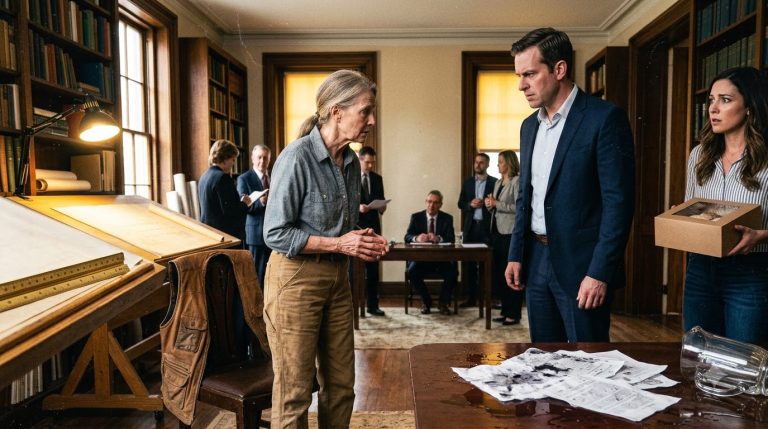
The heavy oak door of the bar had barely clicked shut behind the three black SUVs before the scene shifted to the gray concrete of the windowless operations sector. There was no time skipped in the transition; the cold air of the basement archives rose up through the soles of Marcus’s boots as he stood rigid before the metal shelving units. The mechanical hum of the building’s industrial HVAC system replaced the low drone of the tavern’s cooler, vibrating at the exact same frequency that had broken the quiet the night before.
Marcus held a cardboard storage box against his ribs. The corners were split, the fibrous gray paper pulp soft from decades of humidity, and the label on the side carried nothing but an eight-digit classification stamp in faded purple ink. Beside him, Derek and the other three operators moved in silence, their fingers turning the heavy iron handles of the rolling shelf racks. The screech of ungreased metal tracks cut through the room like a dry cough.
“This is it,” Derek muttered, pulling a thick, legal-sized binder from the deepest recess of the third row. The black vinyl cover was cracked, the edges peeling away in dry, brittle flakes that looked like ash. “Project Shadow Forge. File three of seven.”
Marcus set his box down on the zinc-topped examination table. The overhead neon tube flickered once, casting a harsh, desaturated glare across the white sheets of paper within. He didn’t sit. His spine was still sore from the rigid posture he had held under Colonel Anderson’s gaze, the phantom weight of his commander’s voice lingering in the small basement room.
When he turned the first page, his breath caught in his throat.
Nearly every paragraph was buried under thick, solid bars of black ink. The redactions weren’t precise; they were heavy, sweeping strokes that had bled through the paper over fifty years, staining the reverse side with dark, ghostly shapes. But here and there, names and logistics fragments broke through the mask like teeth in the dark.
Operation Nightshade. Tactical Element: Hunter-Killer Four.
Marcus followed the text with a clean, uncalloused fingertip. His eyes tracked a logistics manifest from August 1971. It didn’t list standard equipment or rations. It listed specialized medical supplies, high-frequency transponder assemblies, and a series of coordinates that terminated along the muddy banks of the Mekong, deep inside the denied sectors of Cambodia.
A sharp, digital chime cut through the low hum of the room.
Derek flicked his gaze toward the terminal screen at the end of the table. A high-priority system alert was flashing in the corner of the JSOC local area network. The digital handshake that Staff Sergeant Rodriguez had flagged the previous night had triggered an automated cross-check across the archive’s legacy database. A file discrepancy was opening in real-time, a small red warning light indicating that a secondary layer of data, hidden beneath the standard encryption, had just been uncoupled by the signal from Richard’s old hearing aid.
“Marcus,” Derek whispered, his finger hovering over the glass screen. “Look at the logistics log for the tracking units. The transponder signature that Rodriguez picked up last night—the one we thought was a decoy or a rogue signal—it isn’t registered to a modern foreign asset.”
Marcus stepped over, the air in his lungs turning cold as he leaned over the terminal. The screen displayed a technical schematic of an ancient, micro-miniaturized radio beacon, its components hand-soldered into the heavy lining of a standard-issue field jacket. The serial number matched the purple ink stamp on the cardboard box sitting on their table.
“It was never a stolen transponder,” Marcus said, his voice dropping into a flat, clear tone as the realization settled into his chest. He looked back at the paper files, his fingers turning to the final, unblacked section of the operational log. “The chip was welded into the gear before they went across the fence. It wasn’t meant to guide them back to a base. It was meant to keep the signal active after the team was liquidated. It’s a graveyard marker.”
The text beneath his thumb began to resolve into specific, unredacted detail. The names of three men—Miller, Vance, and Tolliver—were listed next to a single, handwritten annotation in the margin: Presumed KIA. No recovery authorized per Executive Directive. Only one name carried no status marker, nothing but a blank space where a final coordinate should have been.
Kaine, R. Call sign: Reaper One.
Marcus looked down at his own knuckles, the small, pale scar on his right arm looking small and insignificant against the weight of the paper sheets. He had spent his entire adult life believing that the uniform was a shield, that the chain of command was an absolute, unbreakable line of mutual protection. But the dry paper beneath his hand told a completely different story—a narrative of men who had been sent into the gray spaces of the world and left there, their names crossed out with heavy ink while their signals kept ticking in the dark.
“He didn’t buy that jacket,” Marcus murmured, his eyes fixed on the schematic of the soldered beacon. “He’s been carrying those three men around in his lining for fifty years. The signal didn’t stop because he never turned it off.”
Derek stood still, his arms crossed over his chest, his eyes tracking the red flashing warning on the monitor. The silence in the archive room became absolute, a heavy, historical weight that seemed to press down on all five operators, stripping away the last remnants of their casual arrogance. They weren’t the authors of the book; they were just the latest, youngest chapter, and the man they had cornered in the bar had been holding the spine together in the silence of the highway outskirts.
Marcus closed the vinyl binder. The snap of the cover was loud in the small concrete space, a sharp finality that signaled the end of their isolation. He reached out, his hand steady as he picked up the cardboard box, his fingers brushing against the faded purple ink of the classification stamp.
“Get the truck,” Marcus said quietly to Derek. “We’re going back.”
CHAPTER 5: THE SHARED SUNSET
The heavy metal door of the archive building clanged shut, the vibration running through the soles of Marcus’s boots as he carried the split cardboard box out to the idling utility truck. The three-week suspension from operational status hadn’t been a time-skip; it had been thirty days measured in eight-hour increments of dust, mildewed paper, and the rhythmic, hollow turning of unredacted logistics logs. Every single mile driven back down the dark state highway toward the outskirts of Fort Bragg was accounted for in the slow drop of the truck’s fuel needle and the steady, monotonous rhythm of the windshield wipers clearing a light mist from the glass.
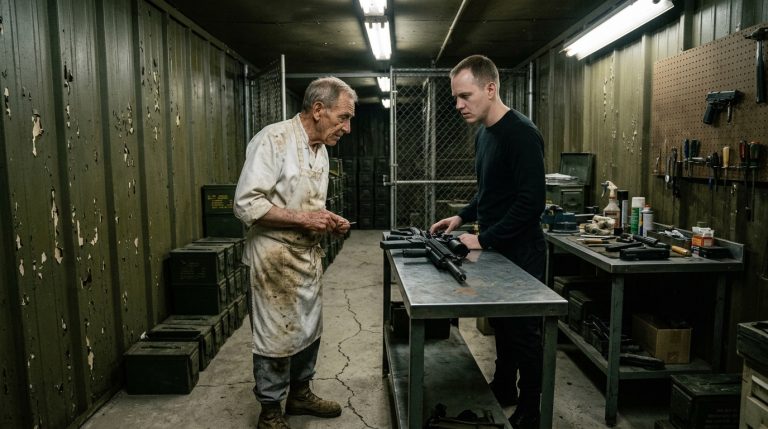
The gravel lot of Sarah’s bar appeared through the gray twilight exactly as it had three Tuesdays ago. Marcus killed the ignition. The engine gave one final, unhurried shudder before settling into silence, the cooling block ticking softly in the damp evening air. He didn’t jump out of the cab with the restless speed of an operator on leave. He reached across the bench seat, his fingers closing around a small, heavy object wrapped in a piece of oiled flannel cloth—a mechanical pocket-watch he had pulled from the personal effects locker in the deepest recess of the base storage depot.
The tavern door was light under his hand. The little brass bell above the frame gave a soft, single tinkle as he stepped inside, the sound no longer muffled by an aggressive grip.
The low hum of the beer cooler was exactly the same. The television mounted in the corner was dark tonight, the room lit only by the soft, amber glow of the neon beer signs reflecting off the cracked linoleum floor. At the far end of the counter, Richard Kaine sat on his usual stool, his gnarled thumbs locked around the base of a familiar tumbler, watching a slow bead of condensation trace its path down the glass.
Marcus walked across the floorboards, his boots making a quiet, deliberate sequence of thuds. He stopped two feet from the neighboring stool and remained standing, his shoulders squared but entirely devoid of the rigid, performative hostility he had brought into the room three weeks prior.
“Evening, sir,” Marcus said quietly.
Richard didn’t lift his gaze from the whiskey immediately. He waited until the moisture bead reached the bottom of the tumbler, then slowly turned his head, his pale blue eyes tracking up Marcus’s civilian shirt to settle on his face. The old man noted the change—the fire was still behind the eyes, but it had been banked, pulled back into the stove where it couldn’t catch the house on fire.
“Marcus,” Richard said, his voice the same low, dry rumble. He flicked his gnarled fingers toward Sarah, who was watching from the taps with her hands resting lightly on a fresh bar towel. “Get him what he’s drinking.”
Sarah nodded, her jaw settling out of its defensive line as she poured a single measure of amber liquid into a clean glass. She slid it across the wood, her eyes lingering on Marcus for half a second before she retreated back to the office hallway, leaving the two men alone in the corner of the bar.
Marcus sat down. He didn’t lean over the counter; he sat straight, his hands flat against the polished oak rail. He unrolled the flannel cloth, revealing the old silver pocket-watch. The casing was scratched, the metal dulled by decades of oxidation, and the glass face was split down the middle by a thin, clean fracture.
“We found this in the depot,” Marcus said, his voice entirely transactional, carrying the clean exposition of a man who had spent thirty days reading the unredacted truth under a neon tube. “File three of seven. Project Shadow Forge. It belonged to Miller, sir. The tracking log said it was returned with the field gear from the extraction site in seventy-one, but nobody ever claimed it.”
Richard’s gaze fell on the silver disk. His hand didn’t shake as he reached out, his thick, spotted index finger touching the fractured glass face. He didn’t pull the object closer; he simply held his finger against the crack, feeling the tiny ridge where the glass had split under the heat of a Cambodian afternoon.
“The transponder in your jacket lining,” Marcus continued softly, his voice matching the low carrier tone that had hummed through the room during their first encounter. “We saw the schematics on the JSOC network. The system thought it was a foreign asset signal because the frequency was retired forty years ago. It was a graveyard marker. You never turned it off because you were waiting for them to find the remaining files.”
Richard let out a long, slow breath, the sound like dry pine needles shifting in a light wind. “They didn’t want the files found, son. Three presidents signed the denial sheets. If you pull a thread on Shadow Forge, the whole sweater comes apart at the seams.”
“The colonel knows,” Marcus said. “He knew before he walked through that door. The suspension wasn’t a punishment for us, sir. It was the only way he could get us into the archive without a clearance flag hitting the main grid. He wanted us to read what happened at Snuol.”
Richard turned the pocket-watch over. The back casing was engraved with four tiny, hand-scratched initials, the silver worn thin where a thumb had rubbed against the metal during long nights in a listening post. “Miller always did have a loud watch,” the old man murmured, a faint, melancholic shadow of a smile touching the corners of his mouth. “You could hear the gears engaging from five yards out in the brush. I told him it’d get us killed one day.”
“It didn’t,” Marcus said. “The log said he held the perimeter while the chopper cleared the canopy. He stayed because the line was broken.”
“He stayed because I couldn’t walk,” Richard said. He tapped his left hip, where the old iron shrapnel sat deep against the joint. “The hip never set right after that. But he kept the fire pointed where it needed to go.”
Marcus reached into his pocket and pulled out a small, flat brass screwdriver—the kind used by armorers to adjust the sights on a precision rifle. He didn’t offer to take the watch back. He set the tool next to the flannel cloth. “The mainspring is jammed, sir. The teeth on the third gear are out of alignment from the impact. I thought… I thought you might want to set the timing right.”
Richard looked at the small tool, then up at Marcus’s face. The young captain didn’t speak; he didn’t offer a hollow apology or a speech about the honor of the uniform. He sat in the quiet of the dive bar, his posture neutral, sharing the weight of the old ledger without asking for a single word of absolution.
Slowly, Richard picked up the screwdriver. His gnarled hands, which had looked so heavy and slow against the counter, found a sudden, fibrous stability as he inserted the tip into the small access notch on the watch’s rim. With a tiny, clean twist, the back casing popped open, revealing the intricate, oxidized web of brass wheels and steel springs within. The smell of old machine oil and dried salt drifted up into the space between them.
Marcus watched the old man’s fingers work, the movement small and deliberate, a silent conservation of energy that had been learned fifty years ago in a world that didn’t exist on any map. Outside, the rain began to patter against the frosted glass windows, a steady, peaceful cadence that washed the dust from the gravel lot.
“You learn anything from all this, Captain?” Richard asked, his eyes never leaving the gears.
Marcus took a slow sip of his whiskey, the amber liquid warm against his throat. “I learned that the loudest man in the room is usually the one who hasn’t seen the bill,” he said quietly. “And that some markers aren’t meant to guide you home. They’re just there to remind you who paid for the ground you’re standing on.”
Richard gave the small center gear a fraction of a turn. With a sharp, metallic click, the balance wheel freed itself, the tiny steel hairspring expanding and contracting in a perfect, rapid rhythm. The quiet, steady tick of Miller’s watch filled the space between their stools, matching the unhurried pulse of the rain outside.
“That’s a good start,” Richard said, raising his glass an inch from the wood.
Marcus raised his own glass, the clear amber surfaces touching with a small, sharp ring that died out instantly into the quiet of the room. They sat together on the worn stools as the twilight faded into a deep, atmospheric blue, two soldiers from different centuries, bridging the gray space between them with the steady, unbroken ticking of a watch that had finally stopped waiting in the dark.