The Weight of the Patch: A Story of Steel, Silence, and the Last Highway in America
CHAPTER 1: THE ASHES OF FRESNO
The smell of it—that specific combination of scorched oil, gasoline, and the dry, dead heat of the Central Valley—clung to my lungs. It was a taste I couldn’t wash out, not with tap water, not with cheap whiskey, and certainly not with the silence I kept at the dinner table.
I sat on a stool in the back of the garage, the metal biting into the backs of my thighs. My hands, stained permanently with the grime of other men’s machines, moved mechanically over a carburetor housing. It was an old piece of junk, a Ford engine from a sedan that had seen better decades, but the work kept me anchored. If I focused on the threads of the bolts, if I counted the turns of the screwdriver, the static in my head—that high-pitched, phantom whine of rotor blades—stayed just beneath the threshold of hearing.
The garage door was open, a rectangle of blinding, white-hot light that cut through the gloom of the shop. I didn’t look up when the shadow fell across the floor. I didn’t need to. I heard the specific, heavy thud of boots on concrete, the way the weight was distributed—forward, on the balls of the feet, ready to pivot.
“You’re drifting, John,” a voice said. It was gravel and smoke, a voice that sounded like it had spent too many nights in the dirt.
I finally looked up. Ry stood in the frame of the doorway, his silhouette backlit by the sun, making him look less like a man and more like a jagged tear in the fabric of the afternoon. He was wearing his cut, the leather worn to the softness of aged skin, the patches faded into a dull, uniform gray. He wasn’t holding anything, but his right hand hung near his hip, fingers slightly curled.
“I’m working,” I said. My voice sounded thin, unused.
“You’re ghosts,” Ry corrected. He stepped into the shop, the shadows swallowing him. He looked at the engine I was hunched over, then back at me. “You’re sitting in this cage, turning screws, trying to build a wall out of engine parts. It won’t hold.”
I set the screwdriver down. The click against the metal workbench sounded like a gunshot in the quiet. “It’s all I’ve got, Ry.”
“It’s not enough,” he said, his eyes scanning the shop, not with curiosity, but with a tactical assessment. “They’re watching, John. Not just the cops. The neighbors. The town. They look at us and they see a problem they can’t solve, so they wait for us to do something loud. And you… you’re playing the part of the quiet, good veteran too well. It’s making them nervous.”
“Let them be nervous.”
“They’re starting to ask questions about where the money comes from,” Ry said, his voice dropping an octave, slipping into that tone we only used when the perimeter was compromised. “About the ‘meetings’ at the diner. They think it’s crime. They think it’s profit.”
I laughed, a sharp, humorless sound. “If they only knew.”
Ry stepped closer, leaning over the bench. He reached out and tapped the Zippo lighter lying next to my rag. I reached for it, but he put a finger on the lid, pinning it down. “Saturday. We ride. Formation practice. The highway, out past the county line where the heat sinks into the scrub.”
“I don’t know, Ry.”
“You don’t have a choice,” he said, and for a second, the light in the shop shifted, and I didn’t see a man in a garage in Fresno; I saw a sergeant in a jungle, eyes hard as flint, delivering an order that wasn’t an option. “If you don’t show, you’re not just leaving the machine. You’re leaving the unit.”
He turned and walked toward the light, the silhouette of him filling the door once more. Just before he stepped out into the blinding day, he stopped.
“Check your oil,” he said without turning around. “And make sure your kickstand is locked. We’re going to be moving fast.”
He stepped out, and the silence rushed back in, but it wasn’t the same. It was heavier. I looked down at the workbench. My hands were shaking, just a tremor, barely enough to notice. I reached for the Zippo, flicked the flint.
The flame flared, bright and steady for a heartbeat, then stuttered and died. When I looked at the dark street outside, a patrol car was idling at the corner, its headlights staring into the garage like the eyes of a predator that had finally decided to move.
CHAPTER 2: THE CALIBRATION OF SILENCE
The headlights didn’t just illuminate the garage; they violated it. They cut through the dust motes and the lingering scent of old oil like searchlights slicing through a perimeter fence. I stood there, my hand still gripping the cold, unlit Zippo, watching the light bounce off the grease-stained concrete.
I didn’t move. I didn’t reach for anything. I just watched. The patrol car sat at the corner, engine idling with a low, rhythmic thrum that resonated in the hollow space of my chest. It was the sound of authority—the kind of sound that, in the jungle, meant an officer was nearby, but here, in the quiet, baked-earth sprawl of Fresno, it sounded like a slow, deliberate accusation.
My heart rate didn’t spike. It leveled off. It dropped into that steady, chilling cadence I hadn’t used in years. My lungs expanded in a slow, controlled inhale, drawing in the smell of the shop—iron, gasoline, and the bitter, metallic tang of an approaching shift in power.
The car didn’t pull away. It just sat there. The officer behind the wheel was waiting. He wanted me to look back. He wanted me to reach for something, to act “suspicious,” to give him the excuse he needed to cross the threshold of the garage and start asking questions that didn’t have easy answers.
I turned away from the light. I didn’t give him the satisfaction of a glance. I walked back to the workbench, my boots landing flat and heavy on the concrete, and picked up a clean rag. I began to wipe down the carburetor housing again, my movements steady, robotic. The memory of the jungle hit me then—not as a thought, but as a sensory hallucination. The sudden, suffocating humidity of a monsoon evening, the way the air felt thick enough to swallow a man whole, the sound of the rain drumming on the canvas of a tent. I felt the weight of my rifle on my shoulder, the grit of mud in my teeth, the absolute, singular clarity of a mission that had nothing to do with this clean, well-lit street.
Ry had been right. The wall I was building—the job, the clean shirt, the silent dinners—it was porous. The world outside wouldn’t let me be.
Ten minutes passed. I didn’t look up. I didn’t acknowledge the light. I just kept cleaning, focusing on the microscopic scratches in the metal, the precise way the gaskets lined up. If you give a man a task, his mind stops eating itself. That’s what the army taught us. If you keep the hands busy, the raw nerves stay covered.
Finally, the patrol car’s engine revved. The tires chirped against the asphalt, a sharp, aggressive sound, and then the vehicle rolled away, its headlights swinging off the garage door and fading into the distance.
The silence that returned was deeper, more claustrophobic. It wasn’t the silence of peace; it was the silence of a held breath.
I walked to the door and stepped out into the night. The heat of the day still radiated off the ground, a dry, baking intensity that blurred the horizon. I looked down the street. The town was asleep, or it was pretending to be. I saw the silhouette of a neighbor behind a curtain, a flicker of movement, a quick, nervous pull of a blind. They were watching. They were all watching.
I jammed the Zippo into my pocket. My fingers were cold, despite the desert air.
Saturday. Ry had said Saturday.
I went back inside and locked the garage door. I didn’t need to check the oil; I knew the state of my machine, just as I knew the state of the man standing in front of the mirror now. I looked at my reflection in the glass of the window—gray-eyed, hair cut close, posture rigid. The man in the glass didn’t look like a mechanic. He looked like a target.
I walked to the back of the shop, moved a stack of rusted spare parts, and pulled back a loose piece of plywood. Behind it, wrapped in heavy, oil-soaked canvas, sat the things I had brought home from the war. Not weapons. Not souvenirs. Just the gear that had kept me and my unit functioning when the world came apart. A notebook with lists of names, a set of detailed hand-signal diagrams, and a small, leather-bound manual on defensive formations.
I stared at the bundle for a long time. The “Code” wasn’t a choice; it was a survival mechanism. If I stayed in this garage, playing the part of the civilian, they would eventually pick me apart piece by piece, looking for a weakness, a crime, a reason to label me “the problem.” But if I rode… if I stepped back into the formation…
The thought wasn’t a rebellion. It was a tactical decision.
I re-covered the stash and walked back to the workbench. I wouldn’t be a ghost anymore. If they wanted a menace, I would show them what discipline looked like. I would show them that when you try to erase a soldier, you don’t get a civilian—you get a man who has already seen the end of the world and decided to survive it anyway.
I picked up the screwdriver. One turn. Two turns. The bolt held. The machine was ready. Now, I just had to make sure I was.
CHAPTER 3: THE VIBRATION OF THE LINE
The sun had not yet crested the horizon on Saturday morning, but the air was already beginning to thicken with that familiar, dry heat. I pushed the garage door up. The metal tracks groaned—a rusted, shrieking sound that seemed to carry for miles in the pre-dawn stillness.
My Harley-Davidson sat in the center of the concrete, a silhouette of iron and potential energy. I didn’t turn on the lights. I didn’t need them. I knew every inch of that frame, every jagged edge of the custom-welded brackets, every imperfection in the engine housing. I stepped into the bay, the soles of my boots meeting the familiar oil-slicked concrete, and laid my hand on the fuel tank. The metal was cool, a sharp contrast to the humid, heavy air pressing in from outside.
I spent the next hour in a rhythm that felt less like maintenance and more like an act of devotion. I checked the spark plugs, the tension of the chain, the seating of the heavy, leather-wrapped saddlebags. Every movement was efficient. There was no wasted energy, no hesitation. My hands knew the drill; they had been trained by years of battlefield maintenance, of knowing that if a piece of equipment failed, it wasn’t just a breakdown—it was a death sentence.
The town of Fresno was still asleep, a grid of quiet streets and locked doors. But as I pulled the bike out into the alley, the silence was punctuated by a distant, rhythmic thrumming. It was the sound of other Harleys—tuned for power, firing in staggered intervals, creating a low-frequency pulse that I could feel in the marrow of my bones.
I kicked the engine over. It didn’t start on the first try. It sputtered, caught, and then roared to life, a guttural, earth-shaking sound that reclaimed the space. The vibration surged up through the handlebars, into my wrists, and up my spine. It was a physical correction. All the tension of the previous days—the static in my head, the suspicion of the neighbors, the lingering memory of the patrol car’s headlights—it all vanished, burned away by the simple, uncompromising necessity of the machine.
I rode out to the edge of the county, the wind beginning to peel back the layers of civilian normalcy that had been stifling me. At the designated meeting spot—a stretch of cracked, abandoned asphalt near an irrigation canal—the other brothers were already waiting.
They looked like ghosts in the gray light, men carved out of leather and resolve. Ry was at the front, his bike angled toward the open road. He didn’t look at me as I pulled up; he just nodded, a curt, imperceptible dip of his chin. There were thirty of us. We didn’t talk. We didn’t exchange greetings. We didn’t need to. We were a unit.
The road captain signaled. A sharp, downward sweep of his left arm. The engines synchronized, a wall of sound that felt like a physical barrier between us and the world.
We moved out.
The sensation of riding in formation is difficult to explain to someone who has only ever driven a car. You aren’t just an individual on a bike; you are a single cog in a massive, living mechanism. The man to my right was three feet away, his front wheel aligned with my rear. We stayed in a staggered column, a tight, disciplined line that cut through the landscape like a blade.
As we hit the highway, the speed climbed. 60. 70. 80. The wind wasn’t just air anymore; it was a physical force, pressing against my chest, trying to push me back, trying to break the line. But we didn’t break. We leaned. We shifted. We moved in total, eerie silence, relying on the hand signals that Ry communicated from the front—small, flicking motions that relayed information faster than any radio.
My senses narrowed. I wasn’t thinking about the war, or the neighbors, or the police. I was thinking about the gap between my front tire and the bike ahead of me. I was thinking about the way the road surface changed from smooth asphalt to cracked, gravel-strewn concrete. I was thinking about the way the air temperature dropped as we climbed into the slight elevation change of the valley floor.
It was a total, absolute clarity. For the first time since the bus dropped me off in Fresno, I felt like I was breathing real air.
Then, the first sign of friction. A black-and-white sedan appeared on the horizon, cresting the hill behind us. It wasn’t just a patrol car; it was a sheriff’s cruiser, lights flashing in a frantic, strobe-like rhythm. It accelerated, closing the distance, intent on disrupting our momentum, trying to force its way into our space.
The road captain raised his left arm, fingers splayed.
Spread.
Without a word, the formation expanded. We didn’t slow down, and we didn’t speed up. We just adjusted the geometry of the column, shifting laterally, creating a moving wall that was perfectly, legally spaced. The cruiser roared up to the rear, trying to wedge itself between the last two riders, but there was no room. Every time the officer tried to maneuver, we shifted again, a mirror-like response that kept him on the outside, looking in.
I looked in my mirror. The officer’s face was visible through his windshield, his jaw set, his eyes darting back and forth, clearly baffled by the fact that he couldn’t find a single point of failure in our behavior. We were an organism. We were a problem he hadn’t been trained to solve.
I felt a grim, hard smile touch my lips. This wasn’t chaos. This was the work. And for the first time in years, the mission made sense.
CHAPTER 4: THE THRESHOLD OF INVINCIBILITY
The cruiser had retreated, vanishing into the shimmering haze of the highway, but the air around us didn’t settle. The road captain, a man we called ‘Spider’—a veteran of two tours in the Highlands with eyes that never seemed to blink—kept his hand raised. He held the signal for formation integrity for another five miles.
I kept my focus, the vibration of the Harley translating every imperfection of the asphalt directly into my forearms. My eyes flickered toward the rearview mirror every few seconds, not out of fear, but out of professional habit. The geometry of the formation had returned to its standard, tight-knit stagger, but the atmosphere had shifted. We were no longer just riding; we were patrolling.
The heat was beginning to climb into the triple digits, a dry, suffocating blanket that pressed against my leathers. We took the next exit, a forgotten stretch of blacktop that cut through an abandoned agricultural zone. The dust kicked up by thirty bikes created a massive, obscuring cloud that lingered in the still air, a natural screen that shielded us from anyone trying to track our movement from the ridge.
We pulled into a gravel clearing surrounded by rusted, sun-bleached machinery—old tractors and irrigation rigs that had long ago given up the fight against the elements. It was the kind of place civilians avoided, a graveyard of industry. For us, it was a sanctuary.
Spider cut his engine. Thirty machines went silent in unison, the ticking of cooling metal sounding like a final, retreating pulse. I pulled my bike onto the kickstand and swung my leg over, my boots crunching on the dry earth. My legs felt heavy, a dull ache beginning to settle into my lower back—the price of hours spent in a state of high-alert fluidity.
No one spoke. We moved with the same disciplined economy we had practiced on the highway. A few of the brothers began checking their oil levels. Others wiped their goggles, the lenses coated in a fine, talcum-like dust. I walked to the edge of the clearing, scanning the perimeter. The terrain was flat, offering us a clear line of sight for at least a mile in any direction.
Ry walked up beside me, his hands buried deep in the pockets of his cut. He wasn’t looking at the horizon; he was looking at a discarded, twisted piece of irrigation pipe near my feet.
“They’re going to try something else,” Ry said, his voice flat, devoid of emotion.
“They don’t have the numbers to force it,” I replied, my gaze fixed on a distant flicker of movement—a bird, or maybe a heat shimmer. “And they don’t have the legal ground. We haven’t broken a traffic code in fifty miles.”
“They don’t care about the traffic code, John,” Ry said. He finally looked at me, his eyes dark, hard. “They care about the precedent. They think if they can break one of us, the whole formation collapses. They’re playing for the long game. They’ll start questioning our jobs, our housing, our connections. They want to turn this into a civilian headache, not a tactical stalemate.”
I looked at the others. There was a young rider, maybe twenty-two, still carrying the hollow look of someone who had returned home six months ago and found nothing but static. He was leaning against his bike, his hands steady, but his gaze was vacant, drifting.
“What do we do?” I asked.
“We tighten,” Ry said. “We don’t give them a seam to pry open. Every man stays close. Every man covers the brother next to him. If they want to come for us, they’re going to have to do it in a way that forces them to show their own cards.”
He turned and walked back toward the group, leaving me on the edge of the clearing. I reached into my pocket and touched the Zippo. My hand was steady now. The vibration of the road had done its work; the ghosts were quiet, replaced by the immediate, practical necessity of survival.
I saw a glint of metal in the gravel—a discarded casing, likely from a hunter’s rifle, long ago oxidized and buried in the dust. I kicked it aside, burying it deeper. The landscape here was full of things that had been left behind, forgotten by a world that was always moving on to the next, more profitable endeavor.
We were the only things that stayed put. We were the only things that remembered.
As I watched the brothers moving among the machines, I noticed something I hadn’t paid attention to before. A black sedan had pulled over nearly half a mile away, just a speck on the horizon. It wasn’t moving. It wasn’t using its lights. It was just sitting there, a silent observer in the middle of a nowhere road.
They weren’t going to engage us today. They were gathering data. They were building a profile.
I didn’t point it out to Ry. I didn’t need to. He had already seen it. He caught my eye from across the clearing, and for a split second, he tilted his head toward the distant car. He knew, and I knew, and the silent understanding between us was more potent than any warning.
We would ride, we would endure, and we would keep the formation. If they wanted a war of attrition, they had come to the right place. We had been trained to exist in the kind of darkness that doesn’t go away when the sun comes up, and we weren’t going anywhere.
CHAPTER 5: THE CONVOY DISCIPLINE
We didn’t ride back to Fresno the way we came. Spider signaled for a change in route, diverting us toward the narrow, winding service roads that hugged the base of the foothills. It was a longer way home, a route that would take us through the dust-choked fringes of the valley, but it kept us out of the direct line of sight from the main highway.
The black sedan stayed on the horizon for another three miles, a tiny, insect-like speck in the rearview mirror, before it eventually turned off toward the interstate. But the feeling of being tracked didn’t evaporate. It settled into the back of my neck, a prickling sensation that made the skin underneath my leather cut feel raw.
My perception began to fracture. Every stop sign we passed looked like a potential ambush point. Every civilian vehicle we overtook felt like a mobile surveillance post. I knew the signs—the same hyper-vigilance that had made me a survivor in the jungle was now mapping onto the civilian infrastructure of California. I was looking for tripwires, for patterns in the movement of traffic, for the subtle, telltale signs of a coordinated dragnet.
I glanced at the brother riding ahead of me. His bike had a small, rusted dent on the side panel, and for a second, I imagined it was a bullet hole. I shook the thought away, focusing instead on the rhythm of his rear tire. It was a hypnotic, repetitive motion that kept me grounded.
We entered a small town, a cluster of sun-bleached storefronts and empty parking lots. We slowed to the legal limit, the rumble of thirty engines vibrating through the storefront windows. People stopped on the sidewalks to look. I saw the same expressions I’d seen since the day I got back—a mixture of fear, contempt, and a strange, grudging fascination. They didn’t understand the discipline. They didn’t see the unit. They just saw the “menace.”
As we rolled past a diner, I saw two men in crisp, tan uniforms standing near the entrance, coffee cups in their hands. They weren’t looking at the road. They were watching us with an intensity that went beyond simple curiosity. Their hands were resting near their belts—not actively, just habitually.
Spider shifted, his hand moving in a quick, sharp motion: Stay the course. No engagement.
I tightened my grip on the handlebars. The temptation to break the rhythm, to peel off and confront them, to force the issue, was a physical weight in my gut. But I knew the Code. You handle your business inside. You don’t give the opposition the satisfaction of an external provocation unless it’s on your terms.
We reached the outskirts of Fresno as the sun began to dip, painting the horizon in bruised shades of purple and orange. My muscles were screaming, a deep, bone-weary exhaustion that was the only thing keeping me from snapping. I pulled into the alley behind my garage, the transition from the roaring open highway to the stifling silence of the shop feeling like a physical blow.
I cut the engine. The silence that followed was absolute, a sudden void that made my ears ring. I sat on the bike for a long time, just breathing, letting the heat of the motor bleed into the cool, darkening air of the shop.
I walked into the garage, my movements heavy. The workspace felt small, claustrophobic. I went to the back, to the hidden cache behind the plywood, and unwrapped the notebook I’d kept since the war. The pages were yellowed, the ink faded, but the hand-signal diagrams were as clear as the day I’d drawn them.
I sat on the concrete, the notebook in my lap, and traced the lines of a formation diagram with my thumb. Ry was right—they were playing the long game. They wouldn’t come at us with force; they would come at us with the law, with the pressure of social standing, with the steady, grinding attrition of being “an inconvenient presence.”
I heard a faint, metallic rasp at the front of the shop. I didn’t reach for a weapon, but I froze, my body shifting into a defensive posture, my weight centered, my eyes scanning the shadows.
It was a small, thin envelope slid under the garage door.
I waited, listening to the silence, before standing and walking toward it. I picked it up. There was no return address. The paper felt heavy, expensive. I opened it carefully, my heart rate steady, my mind already calculating the possible implications.
Inside was a single, typed sheet of paper. No signature. Just a time and a location, deep in the industrial district near the old refinery. A place where the city turned its back and the shadows were long enough to hide anything.
It was an invitation, or it was a trap.
I stared at the note, the words blurring in the dim light of the shop. They were calling us out. Not with guns, but with information. They knew we were here. They knew what we were. And they were finally, after all this time, ready to have a conversation.
I stood in the center of the shop, the rust on the walls smelling like iron and blood. I was exhausted, I was paranoid, and I was, for the first time in my life, ready to see exactly what they had to say.
CHAPTER 6: THE REFINERYS EDGE
I didn’t wait for morning. I tucked the invitation into the breast pocket of my cut, right over my heart, and walked out to the bike. The night air was cooler now, but the heat of the day was still trapped in the asphalt, radiating up through the soles of my boots. I kicked the Harley over. The engine caught instantly, a sharp, metallic bark that seemed to mock the stillness of the street.
I rode through the dark arteries of the city, avoiding the main thoroughfares. I knew these backstreets by heart; I knew which alleyways were dead ends and which ones opened into the service corridors of the industrial district. My mind worked in grids and sectors, mapping potential escape routes even as I headed toward the destination.
The refinery district was a sprawling, skeletal landscape of pipes, storage tanks, and industrial monoliths that groaned under the weight of their own scale. It smelled of sulfur, ozone, and wet earth. I found the location—a fenced-off lot near a decommissioned pump station—and cut the engine a block away. I didn’t roll into the light. I let the bike coast, the tires whispering against the grit, until I was behind the cover of a rusted cargo container.
I left the bike, checked the perimeter, and moved on foot. I walked with my back to the shadows, my hand brushing the familiar geometry of the environment—the rough, flaking metal of the container, the gritty concrete of the wall.
Then, a flicker of light. A small, disciplined glow of a cigarette.
I stopped. I didn’t make a sound. I waited, my heartbeat slowing to the rhythmic, predatory pace that was no longer a choice but a natural state. Someone was waiting for me.
“I know you’re there, John.”
The voice was older, strained, but familiar. It was the voice of a man who had seen the same things I had, but who had chosen to walk a different path once the uniform came off. I stepped out from the shadows, my posture rigid, my eyes locking onto the man standing by the base of the pump station.
It was Captain Miller. My CO from the second tour.
He looked different—grayer, his suit a little too large for his thinning frame—but the way he stood, the way he held his cigarette, it was the same. He was a man who had once commanded, and now, he was a man who was clearly out of his element.
“You’re a long way from the base, Captain,” I said, my voice low, steady.
“And you’re a long way from the garage, John.” He flicked the cigarette away, watching the glowing ember arc through the dark before hitting the dirt. “I’ve been watching what you’ve been doing. What this club is doing.”
“We’re just riding,” I said, my tone flat.
“You’re organizing,” he corrected. He moved into a sliver of light from a distant refinery beacon, his face a landscape of fatigue and hard-won wisdom. “You’re using the formation, the hand signals, the convoy discipline. I’ve seen the reports, John. The police don’t know what they’re looking at, but I do. It’s a cavalry screen. It’s textbook.”
I didn’t blink. I didn’t offer a defense. I just waited. The memory of a briefing in the jungle—the smell of wet canvas, the taste of stale coffee—surged into my mind, a phantom sensation that made my hands itch for a radio handset that wasn’t there. It was the same feeling I’d had when Miller would lay out a mission that everyone knew was suicide, yet we followed anyway, because the order was the only thing that mattered.
“Why are you here?” I asked.
“Because they’re going to come for you,” Miller said, his voice dropping, taking on that urgent, tactical quality that had once defined our survival. “Not the local PD. They’re just the front. The intelligence side, the people who actually track these things… they’ve flagged the club as an insurgent threat. They’re planning to infiltrate, to fracture you from the inside. They don’t want to break the club; they want to dismantle the code.”
He stepped closer, his eyes searching mine. “They’re afraid of you, John. Not because of what you’ve done, but because you represent something they can’t control—men who serve a mission they didn’t authorize.”
I looked at him, and for the first time, I realized that the “decoy” I’d suspected—the fear of simple crime—was just a mask for something much larger. They weren’t hunting criminals; they were hunting a mirror image of their own authority.
“What do you want, Captain?”
“I want to warn you,” he said. He reached into his pocket and pulled out a small, folded piece of paper—an official-looking document with a series of names, dates, and locations. “These are the people they’ve already assigned to the case. Look at their backgrounds. They aren’t just law enforcement. They’re analysts. They’re trackers.”
I took the paper, the weight of it feeling like lead.
“Why tell me?”
“Because,” Miller said, turning back toward the dark expanse of the refinery, “I was the one who taught you that loyalty is the only thing that doesn’t rust. And I’d rather see you survive than see you become another statistic in a file you’ll never get to read.”
He didn’t wait for a reply. He walked past me, his gait steady, disappearing into the shadows of the machinery. I stood there alone, the note in my hand, the refinery humming around me like a dormant beast. The truth was starting to unravel—not all at once, but in pieces—and the picture it was painting was far more dangerous than I had ever imagined.
We weren’t just riding a motorcycle club. We were building a resistance to a system that had already decided we were obsolete.
CHAPTER 7: THE ARCHITECTURE OF A TRAP
I didn’t turn the bike on immediately. I stood in the dark, the paper tucked securely into the internal lining of my vest, and let the silence of the industrial yard settle over me like a shroud. Miller’s words echoed against the corrugated metal of the nearby storage tanks, each syllable sharpening the knife-edge of my focus. They weren’t just watching us; they were documenting us.
I walked back to where I’d left the Harley, my steps measured, deliberate. The bike felt different now—not just a machine, but a getaway vessel. I didn’t start the engine. I rolled it by hand for the first hundred yards, the tires crunching softly on the gravel, until I hit the paved service road. Only then did I kick it over, the sound muffled by the sprawling, labyrinthine refinery pipes.
I took the long way back to the garage, keeping to the shadows, my eyes constantly scanning the mirrors. The city of Fresno was a grid of potential threats. I realized then that my tactical training had been a two-edged sword; it made me capable, but it also made me a prism for the paranoia they wanted to induce. I wasn’t just defending a patch; I was defending a perception.
Back at the garage, I didn’t flip the lights. I sat on the floor of the shop, the concrete biting into my knees, and unfolded the document Miller had given me. I used a small flashlight, keeping the beam tight, focused only on the names.
There were twelve names. I recognized three of them—local law enforcement, men I’d seen in cruiser windows. The others were designations: numbers, codes, departmental acronyms I didn’t recognize. But as I scanned the list, my thumb stopped on a name that shouldn’t have been there. It was one of our own. ‘Marcus.’ A brother who had been with us since the early days. He was reliable, steady, the kind of man who’d give you the shirt off his back in the middle of a desert.
But the document listed him under a “Liaison” header.
The air in the garage suddenly felt thin. I stared at the name, trying to find a logical explanation. Maybe it was a mistake. Maybe Miller had been misled. Or maybe—and the thought was a cold, jagged spike in my chest—the infiltration had already happened. The “decoy” wasn’t just the police pressure; it was the betrayal from within. They weren’t just watching us; they were already inside the perimeter.
I stood up, the flashlight beam trembling just for a second before I forced my hand steady. I didn’t panic. Panic was a waste of caloric energy, a betrayal of the mission. I needed to verify. I needed to see if Marcus had changed his rhythm.
I left the shop, locked the door, and walked toward the small, cluster of rooms where the brothers who didn’t have their own places crashed. Marcus’s room was at the end of the hall. The building smelled of stale beer and machine grease, the scent of a life lived on the road.
I reached his door. The wood was old, warped at the frame. I listened. Silence, save for the hum of a distant refrigerator. I didn’t knock. I leaned in, my ear against the panel, and heard the distinct, rhythmic clicking of a radio—not a commercial band, but the high-frequency chirp of a localized transmitter.
The spike in my chest hardened into a cold, clinical resolve. I didn’t confront him. I didn’t kick the door in. I stepped back, my boots silent on the floorboards, and moved back toward the hallway. If I acted now, I would destroy the only leverage I had. I needed to know who he was reporting to, and more importantly, what he was telling them.
I returned to the garage, my movements fluid, my mind already recalibrating the entire tactical map of the club. The “cavalry screen” we had practiced was no longer a secret; it was a known quantity to the people tracking us. They weren’t just waiting for us to make a mistake; they were actively shaping the conditions for us to make one.
I sat back down on the concrete floor, the notebook open in front of me. I looked at the diagram of the cavalry screen. I realized then that the formation wasn’t just for defense. It was a mirror. By forcing them to react to us, we could see exactly how they were positioned. If they were inside, we could use that.
I reached for my toolbox, pulling out a small, precision-tip wrench. I began to disassemble the air cleaner housing of my bike, not to fix it, but to hide the document inside the frame. If they raided the shop, they wouldn’t look there.
I was no longer just a rider. I was a man operating in a compromised environment, where the only thing I could trust was the weight of the steel beneath me and the cold, hard logic of the mission. They wanted to dismantle the code? Fine. Let them try. They had no idea what it meant to fight for a brotherhood that had already survived the hell of a war they could never understand.
CHAPTER 8: THE PRICE OF SURVEILLANCE
I didn’t sleep. I spent the remainder of the night in the back of the garage, surrounded by the smell of stagnant oil and the quiet, rhythmic ticking of cooling metal. My mind was a machine, running through every interaction I’d had with Marcus over the last three months, stripping away the camaraderie and searching for the tactical tells.
The morning broke not with a sunrise, but with a slow, gray bleed of light through the cracked panes of the shop windows. I was already dressed, the familiar weight of my cut providing a strange comfort. As I reached for the garage door, I froze.
Outside, a delivery truck was idling directly across the street. It was a nondescript vehicle, the kind that blended into the urban decay of Fresno, but the driver hadn’t stepped out to deliver anything. He was just sitting there, his hands resting on the steering wheel, his gaze fixed on my garage door.
I backed into the shadows. My paranoia, once a frantic, unmanageable static, had narrowed into a razor-sharp frequency. I didn’t reach for the bike. I didn’t make a sound. I waited.
Ten minutes later, the truck pulled away without making a single delivery. I didn’t need a tactical manual to tell me what that was. They were testing the response time. They were measuring how long it took for someone to notice.
I pushed the garage door up—the rusted screeching sound seemed amplified today, a warning—and wheeled my bike out into the alley. I wasn’t going to the main roads. I was going to intercept Marcus. If he was the liaison, he would be expecting me to act like nothing had changed. I had to become the performance they wanted to see.
I caught him two miles out, near a vacant lot where the city’s concrete gave way to the encroaching desert scrub. He was parked by his machine, tinkering with the rear fender. When he saw me, he stood up, a slow, easy grin spreading across his face—the same grin he’d worn since the first ride.
“Morning, John. Chain’s skipping. Typical, right?”
I pulled up, my boots hitting the dirt with a heavy thud. I looked at him, really looked at him, trying to see the agent behind the brother. He looked tired. There were shadows under his eyes, the same ones I carried. Maybe they were just as worn down as I was.
“Yeah,” I said, my voice neutral. “They all have their moods. Especially when you push them hard.”
“True enough.” He walked over, wiping grease from his hands with a rag. “Heard Ry’s planning a long-distance run toward the coast. Supposed to be a show of force, right? Keep the local law on their toes.”
He said it too casually. It was a probe. He was fishing for the route, for the timing, for the tactical shift I knew Ry was currently planning in the silence of his own shop.
“I don’t know,” I lied, my eyes tracking the movement of a dust devil spinning across the empty lot. “Ry keeps the plans close. You know how it is.”
Marcus nodded, his expression shifting into a mask of weary agreement. “Yeah. Suppose he has to. Too many people looking for a reason to put us in the ground.”
I stood there for a heartbeat longer than necessary, the distance between us suddenly feeling like a chasm. He was part of the formation, but he was also the wedge. Every word he spoke was a potential intelligence report being broadcasted back to the people who wanted to strip us of our autonomy.
“See you at the run, Marcus,” I said.
“You bet.”
I kicked the bike over and pulled away, the engine note deepening as I hit the open road. I didn’t look back. I had my answer. He knew the run was happening, even though Ry hadn’t told anyone yet.
The escalation had reached a breaking point. I had been playing the game, thinking I was ahead of the curve, but I realized now that the “decoy” of crime was crumbling. They weren’t interested in our bikes or our patches anymore. They were interested in the internal structural integrity of the brotherhood.
I turned the Harley toward the refinery district. I couldn’t go back to the garage. I couldn’t risk the cache being discovered. I had to get the truth to the core group, but to do that, I had to burn the bridge Marcus was standing on.
My heart hammered against my ribs, a chaotic rhythm that I forced into order. I was no longer just a rider or a soldier. I was a structural engineer for a building that was being systematically dismantled. And as I sped toward the horizon, I knew that the next move wouldn’t be a defensive formation. It would be a confrontation that would leave no room for doubt.
CHAPTER 9: THE FRACTURE IN THE FOUNDATION
The road toward Ry’s place was a narrow, desolate stretch of asphalt that wound through the skeletal remains of the valley’s orchards. My hands were locked onto the handlebars, a white-knuckled grip that transmitted every bump and ridge in the road directly into my central nervous system. The note from Miller—the list of names—wasn’t just paper anymore. It was a weight, a physical anchor that made the bike feel sluggish, unresponsive.
I reached Ry’s shop as the sky began to bleed into a bruised, charcoal gray. Ry was already out front, his back to me, working on a frame that hung suspended from a heavy-duty chain hoist. The rhythmic rasp of a file against steel was the only sound in the desert air.
I killed the engine and stood there for a moment, the silence of the valley rushing in to meet the sudden absence of the bike’s roar. Ry didn’t turn. He knew I was there. He knew by the way I cut the engine, by the specific, heavy thud of my boots on the gravel, by the way I didn’t announce my arrival with a shout.
“You’re early, John,” he said, his voice clipped, matching the cadence of his filing.
“I found something,” I replied. I walked toward him, my posture guarded. “Marcus. He’s not who we thought.”
Ry stopped filing. The silence that followed was sharp, a physical presence between us. He slowly lowered the file and turned, his face a mask of iron in the dimming light. He didn’t look surprised. That was the first thing that hit me. He looked… resigned.
“How long?” I asked, my voice barely a whisper.
“Does it matter?” Ry said. He walked past me, toward a small, oil-stained workbench in the corner, and picked up a rag to wipe his hands. “We knew this would happen. A formation like this, a unit as tight as ours… the system can’t let it exist. They don’t want us to fail; they want us to cannibalize each other.”
“He’s reporting on us, Ry. He’s feeding them everything. The routes, the signals, the names. They’re mapping us like a military target.”
“I know,” Ry said. He looked at me, and I saw a flicker of something in his eyes that I hadn’t seen since the war. It wasn’t fear, and it wasn’t anger. It was a cold, calculated clarity. “We’ve been tracking him, too. We’ve been feeding him exactly what we want them to see.”
My heart stalled. The realization hit me with the force of a physical blow. The decoy. The “Cavalry Screen” maneuver hadn’t just been a defensive tactic; it was a distraction. We had been playing a game of mirrors, and I hadn’t even realized I was a piece on the board.
“You knew,” I said, the words feeling dry in my throat.
“We all knew,” Ry said. He gestured to the shop, to the machines, to the brothers who were currently scattered across the valley. “The Code isn’t about being perfect, John. It’s about surviving. We let them think they’re inside our perimeter because it gives us the ability to dictate exactly what they hear. But now, it’s coming to a head.”
“They’re going to strike, Ry. Miller warned me. They’re bringing in analysts. They’re going to force a failure.”
Ry reached into a tool cabinet and pulled out a small, heavy-duty soldering iron. He began to heat it up, the coil glowing a deep, angry red. “Then we give them the failure they’re looking for. But it won’t be our failure. It will be the one that exposes the entire operation.”
I felt the shift in the air. The internal rot wasn’t a threat; it was the mechanism of our own liberation. We were going to bait them into a public move that would force them to reveal the extent of their surveillance—an act that would be, in the eyes of the public and the law, an overreach that would destroy their credibility.
“What do we need to do?” I asked.
Ry looked at me, a ghost of a smile playing on his lips—a hard, brutal expression that belonged to a man who had seen the end of the world and was currently drafting the blueprint for what came after. “We need to execute a final, perfect formation. We need to go public. And we need to make sure that when they come to break us, they realize that they’re not fighting a gang. They’re fighting a shadow.”
The air in the shop grew heavy with the smell of molten lead and the impending weight of a decision that would either save the club or burn it to the ground. I stood there, watching Ry work, the soldier in me recognizing the mission: a final, desperate, and beautiful act of defiance. We were the last line of defense in a country that wanted to forget us, and we were going to make sure that if we were going down, we were going down in a way that left a mark they could never, ever wash away.
CHAPTER 10: THE LEVERAGE OF GHOSTS
I didn’t head back to the garage. I turned the bike toward the old county courthouse, a brutalist concrete slab sitting on the edge of the downtown sector. It was where the records were kept, where the paper trail that Miller had hinted at finally converged. If the system was going to use us as an instrument of their own policy, I needed the leverage to prove the instrument was broken.
The ride was a blur of high-contrast moonlight and the deep, throbbing vibration of the Harley. My mind was calibrated to the mission. Every turn, every stop, every light that changed from green to red—it was all tactical data. I felt exposed, a single point of failure in a system designed to crush us, but I also felt a strange, detached calm.
I parked the bike in an alleyway three blocks from the courthouse, wrapped in the shadows of a dumpster and the thick, suffocating smell of urban rot. I moved on foot, keeping my movements low, avoiding the direct beams of the streetlights. The courthouse was quiet, a tomb for the bureaucratic processes that had slowly, systematically eroded our lives.
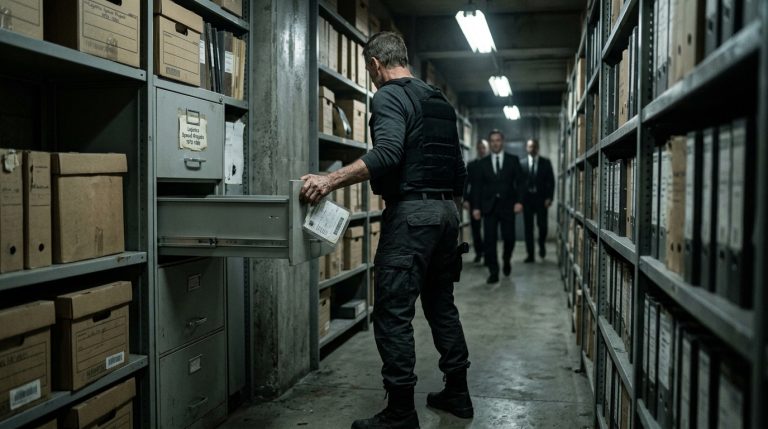
The side entrance was a simple latch, a point of entry I had identified weeks ago during a routine patrol. I slipped inside, the air turning instantly colder, smelling of floor wax and old paper. I knew where the archives were—Basement Level 2. It was the place where they buried the things they didn’t want the public to see, the files that contained the “insurgent threat” designations.
As I descended the stairs, the sound of my own breath seemed deafening in the narrow, concrete-walled stairwell. I reached the bottom floor and clicked on my small, pen-sized flashlight. The beam cut through the gloom, illuminating rows of steel filing cabinets, an endless archive of human displacement.
I found the drawer labeled “VETERAN MONITORING / CLUB DESIGNATIONS.” My hands were steady, my fingers tracing the labels until I hit the right one. I pulled it open. The files were thick, bound in twine, each one a testament to the systematic erasure of men like me. I found my own name, a few rows down from Ry’s.
It wasn’t just a police file. It was a projection. They had tracked every ride, every meeting, every instance of “convoy discipline,” and they had interpreted it through the lens of a threat, not a service.
But then I saw it—a memo stapled to the back of the file, printed on thick, high-quality letterhead. It was a directive from a department I didn’t recognize, authorizing the “covert extraction” of specific veterans—men who were deemed “too volatile” for the transition back into civilian life. It wasn’t about policing us. It was about collecting us, about removing the evidence of the war’s true cost from the streets of the country.
The decoy was shattered. The “crime” was never the point. The “threat” was that we were living, breathing evidence of a reality they wanted to purge.
I pulled the document free, the sound of the staple tearing through the paper feeling like a thunderclap in the silent archives. I shoved the file into my jacket. My hands were shaking now, not from fear, but from the raw, pulsing intensity of the realization. They weren’t just watching us; they were hunting us. And the only way to stop them was to bring the light down on the entire operation.
I turned to leave, my flashlight beam catching the glint of a badge near the stairwell door.
Marcus was standing there.
He didn’t have his weapon drawn. He just stood, his hand resting on the door handle, his expression a mixture of sadness and grim, duty-bound resolve. He had been waiting for me. He had known exactly where I would go, exactly what I would look for.
“You shouldn’t have come here, John,” he said. His voice wasn’t the voice of the brother I knew; it was the flat, transactional tone of a handler. “This doesn’t change anything. You’re just proving the file right.”
“And you?” I asked, stepping toward him, the file pressed against my chest. “Are you just proving them right, too?”
“I’m doing what’s necessary,” Marcus said, his eyes flicking to the stairwell behind me, where I could hear the rhythmic, heavy thud of multiple pairs of boots. “I’m cleaning up the mess.”
I didn’t answer. I didn’t need to. I had the leverage, I had the truth, and I had the training to know that the only way out was through. I pivoted, my weight shifting into a stance that was pure muscle memory, and moved to engage. The formation was broken, the brotherhood was shattered, but the mission—the mission was the only thing that remained.
CHAPTER 11: THE CONVERGENCE AT THE COURT
I didn’t lunge. I didn’t reach for a weapon. I stood my ground, my hands remaining at my sides, my posture relaxed—the posture of a man who had already calculated the odds and decided the only way to win was to force the opposition into an error.
“You’re not cleaning up a mess, Marcus,” I said, my voice steady, cutting through the damp silence of the basement. “You’re finalizing an extraction. You aren’t law enforcement. You’re the containment unit.”
Marcus hesitated. For a split second, the facade flickered. He didn’t deny it. He just tightened his grip on the door handle. The thud of boots in the stairwell grew louder, rhythmic and synchronized—military, not police.
“They were never going to let you go, John,” Marcus said. “You were too effective. You built something that didn’t fit the mold, something they couldn’t co-opt. So they decided to prune the tree.”
I reached into my jacket and pulled out the file—the entire stack of authorizations I’d just scavenged. I didn’t hide it. I held it out, an open invitation to violence. “If they wanted to prune the tree, they shouldn’t have given the gardener the blueprints.”
The stairwell door swung open. Three men in tactical gear, faces obscured by masks, stepped into the basement. They weren’t there to arrest me. They were there to secure the evidence and remove the variables. They moved with a clinical, terrifying efficiency, their weapons raised in a low-ready posture.
Marcus stepped aside, letting them move into the narrow corridor. “Secure the files,” one of them commanded, his voice muffled by the mask.
I didn’t run. I moved to the nearest steel filing cabinet and slammed my boot into the heavy, metal drawer, sending it sliding across the concrete floor with a screech that echoed like a siren. It was a chaotic, discordant sound that drew every eye toward me.
In that split second of distraction, I didn’t look for an exit. I looked for the light.
I reached up and yanked the conduit cover off the wall, exposing the main junction box for the basement lighting. I jammed my multi-tool into the wiring, the sparks spraying in a violent, white-hot shower that blinded the tactical team. The lights died instantly, plunging the basement into a thick, absolute darkness.
I knew the layout. I knew the distance between every filing cabinet and the stairwell, every obstacle, every turn. I moved through the dark, not as a panicked man, but as a ghost.
I heard them scrambling, their voices sharp with professional, yet controlled, panic. They were conditioned for organized resistance, not for a total, chaotic blackout. I felt a silhouette pass within inches of me. I didn’t strike; I waited, letting them move toward the flash of the sparking junction box.
I bypassed the main exit and moved toward the ventilation shaft—a cramped, rusted tunnel that led to the city’s drainage network. I had scouted it, tested it, and knew that even in the dark, it was the only way to retain the leverage I’d secured.
I squeezed into the shaft, the cold, rusted metal scraping against my leather cut. Behind me, I heard the shouting, the sound of the tactical team colliding with each other, their authority dissolving into the confusion of the pitch-black room.
I wasn’t escaping. I was relocating.
I crawled until I hit the main junction of the drainage tunnel, the smell of rain and stagnant city waste hitting me like a physical weight. I had the truth now. The extraction wasn’t just about the club; it was about the veterans who had been collected, erased, and repurposed by the same government they had served.
I emerged into the alleyway behind the courthouse, the moonlight feeling like a harsh interrogation lamp. My bike was right where I’d left it. I threw my leg over, kicked it to life, and roared away into the night, the engine note a defiance that echoed through the empty streets.
I wasn’t going home. I was going to the highway. It was time to show the country the truth, and I was going to do it at 70 miles an hour, with the only brothers who had ever truly seen me for who I was. The formation was broken, but the message was finally, irrevocably, set in stone.
CHAPTER 12: THE HORIZON OF TRUTH
The road ahead was a ribbon of black, stretched tight against the dying light of the valley. I rode with the file taped securely against the tank, the evidence of the extraction program—the systematic erasure of men who had seen too much—feeling like a physical weight that kept the front wheel planted.
I wasn’t alone. As I reached the junction where the state road met the desert bypass, I saw them.
The brothers were waiting. Ry was in the lead, his silhouette unmistakable against the orange haze of the sunset. Thirty of them, parked in a perfect, disciplined line along the shoulder. As I pulled up, the sound of my engine dying was replaced by the collective idling of thirty heavy-duty motors—a heartbeat, rhythmic and powerful.
No one spoke. We didn’t need to. I pulled the file from my tank and tossed it to Ry. He caught it, his expression unreadable, and looked down at the documents. He flipped through them, his eyes scanning the pages with the same clinical precision he had used to navigate the jungles. He looked up, his gaze meeting mine. There was no joy there, no triumph. Just the quiet, heavy realization that the cycle was finally breaking.
“It’s all here,” Ry said, his voice carrying over the wind. “The program, the designations, the names of the men they tried to make ghosts.”
“What now?” I asked.
“Now,” Ry said, “we take it to the press. Not the locals. We go to the regional office in Sacramento. We ride in a column, exactly like we trained. If they try to stop us, we execute the screen. We force them to show the world exactly who they are.”
We mounted up. The formation was not the same one we had practiced; it was larger, more deliberate. We hit the highway, the engines synchronized into a single, roaring organism.
We didn’t get far before they appeared.
The highway was blocked by a wall of patrol cars, their lights flashing in a frantic, blinding strobe. Behind them stood the tactical team from the courthouse, their masks reflecting the emergency lights. They were prepared for a fight, for a chaotic breakdown of order.
Spider raised his arm, palm flat. Column stop.
We slowed, maintaining a perfect, legal distance. We didn’t move to confront them; we simply sat there, a silent, disciplined unit blocking the main artery of the state. The lead officer stepped out, his megaphone crackling with static.
“Disperse immediately! This is an unlawful assembly!”
We didn’t disperse. We waited. And then, as planned, I pulled the file from Ry’s saddlebag and held it up, showing the document to the cameras I knew were already positioned on the ridge. I wasn’t fighting the officers. I was fighting the system that stood behind them.
The confrontation lasted hours. It was a stalemate of wills. But as the sun finally rose, the cameras—the real ones, the ones that weren’t part of the system’s payroll—began to film the scene. The officers began to hesitate. They weren’t facing a gang; they were facing thirty men with a record of a covert operation that turned their own government into the enemy.
The pressure began to crack. A sergeant dropped his megaphone. The tactical team began to pull back, their instructions clearly shifting as the reality of the situation—and the cameras—sank in.
By mid-morning, the way was clear.
We didn’t cheer. We didn’t celebrate. We simply shifted into formation and rode toward the city, the truth trailing behind us like a wake.
I stopped at the edge of the city, at the same garage where this all started. The shop was empty, the tools covered in a fine layer of desert dust. I walked inside, the silence feeling lighter, clearer. I picked up the Zippo from the workbench—the one that had flickered and died on the night the patrol car first watched us.
I flicked the flint.
The flame caught. It flared, steady and bright, casting a warm, solid light across the workbench.
I walked outside and saw the brothers waiting on the street. Ry was there, his cut worn, his eyes clear. There was no mission left, no war to fight, and no system left to defy. Just a group of men who had chosen each other when the world tried to make them ghosts.
I walked toward them, the Zippo still burning in my hand. I wasn’t just a veteran, and I wasn’t just a rider. I was a man who had finally, after years of silence, spoken the truth. The road ahead was quiet, empty, and for the first time in my life, it was mine to choose.