The Weight of the Exhaust: A Prairie Fraud Novel
CHAPTER 1: THE WEIGHT OF THE EXHAUST
The grease never truly left the pads of Marcus’s thumbs. Even now, kneeling in the coarse, black Nebraska dirt with the prairie wind scraping against his neck, the faint scent of hydraulic fluid and heavy-duty degreaser seemed to rise from his skin, competing with the raw, metallic tang of the earth. For twelve years under the iron bellies of Peterbilts, his world had been measured in compressed vertebrae, the relentless hiss of air brakes, and the gray, chemical fog of diesel exhaust. The fifty thousand dollars his grandfather left behind wasn’t an inheritance; it was an exit hatch.
He sifted a handful of the soil through his fingers. It was dry, crusted with the winter’s late freeze, but underneath lay the rich, heavy promise of something that didn’t require an oil pan to live.
Then came the sound.
Click. Click. Click.
It was a rhythmic, brittle strike—the unmistakable impact of hard composition plastic against stones that had remained undisturbed since the late sixties.
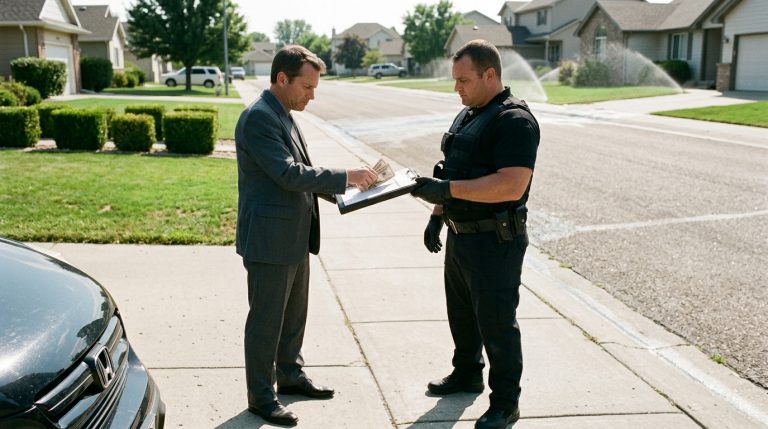
Marcus rose slowly, his joints popping with a familiar, metallic ache. Coming across the property line was a woman dressed for an executive boardroom, her cream-colored designer heels sinking half an inch into the tilled boundary line with every step. Her hair was frozen in a perfect, wind-resistant shell, and she carried a heavy, black vinyl binder clutched against her chest like a shield. Behind her, a quarter-mile to the east, the sprawling, multi-tiered silhouette of a California-style mansion sat like an alien monolith on a patch of aggressively watered, chemically emerald lawn.
“You’re the auction buyer,” she said. It wasn’t a question. She didn’t offer a hand, though her manicured nails flicked the edge of the binder. “I’m Brinley Fairmont. President of the Meadowbrook Estates Homeowners Association.”
Marcus looked past her shoulder. The horizon was an empty, desaturated slate of gray-green switchgrass and five scattered black Angus cows staring blankly through a sagging barbed-wire fence. “There aren’t any houses out here, ma’am. Just yours.”
“Twelve designated luxury plots,” Brinley corrected, her voice tightening into a practiced, sharp edge that smelled faintly of expensive lavender and fresh printer toner. She snapped the binder open, the plastic sleeves rattling in the wind. “Your parcel—Section 4, Agricultural Variant—was integrated into the Meadowbrook covenant by the previous owner. You bought the back taxes, Mr. Graham, which means you bought the back obligations.”
She pulled a single sheet of paper from the sleeve and held it out. The text was dense, crowded with amateurish margins and strange, pixelated formatting around the county seal at the header.
“Fifteen thousand dollars,” she said, her lips curling into a small, cold smirk that lacked any real human heat. “In outstanding maintenance assessments and architectural non-compliance fines. Paid to Meadowbrook Property Services LLC within ten business days, or we file a structural lien with the county commissioner tomorrow morning.”
Marcus didn’t take the paper. He looked down at the sheet, noticing the tiny, uneven spacing between the lines—the hallmark of a cheap inkjet printer running out of alignment. His mind, trained to look for the tiny fractures in steel, the microscopic leaks in a fuel line, registered the discrepancy instantly. This wasn’t a neighborhood dispute. It was a targeted shake-down.
“This is farm ground,” Marcus said, his voice dropping into the low, gravelly register of a man who spent his life speaking over the roar of eight-cylinder engines. “Been farm ground since before your husband bought his first polo shirt.”
“The law doesn’t care about your sentimentality, Mr. Graham,” Brinley whispered, leaning in just enough for the chemical sharpness of her perfume to crowd out the scent of the earth. “We have the signatures. We have the filing numbers. You can either pay the entry fee, or we’ll make sure this dirt is legally uninhabitable before you ever get a tractor out of the shed.”
She dropped the printed notice onto the hood of his old truck, turned on her heel, and began the long, awkward march back toward her manicured compound, her heels leaving sharp, deep punctures in the soil. Marcus watched her go, then reached down and picked up the paper. The ink was so fresh it left a dark gray smudge across his grease-stained thumb.
CHAPTER 2: THE BASEMENT GRAVE
“You’re checking the wrong ledger, Marcus, and you know it as well as I do,” Dolores said, her voice like gravel shifting under a heavy boot. She didn’t look up from her desk. Her gnarled fingers, stained a perpetual shade of violet-blue from fifty years of handling carbon copy receipts, tapped a rhythmic, impatient beat against the worn oak counter.
Marcus leaned heavily against the wooden partition, the scent of rusted iron and decomposing paper rising from the stacks behind her. “I know what my deed says, Dolores. It’s clean. Two hundred point three acres, clear title, bought straight from the state tax liquidation.”
“Deeds are just words until the county records them,” she muttered, finally lifting her bifocals on their thin silver chain. Her eyes were sharp, entirely devoid of the warmth usually found in small-town municipal buildings. She reached beneath the counter and dragged a heavy, leather-bound volume across the scarred wood. The friction created a harsh, raspy sound that scraped against Marcus’s raw nerves. “The Fairmont woman didn’t come here to ask questions. She came here with a filing knife.”
Marcus straightened his spine, his shoulders—widened by a decade of hoisting heavy cylinder heads—blocking out the pale morning light filtering through the high courthouse windows. “What did she file?”
Dolores didn’t answer with words. She slid the ledger across the counter. The corner of the heavy cover was split, exposing the gray, fibrous cardboard beneath the imitation leather—a rusted surface that had seen too many hands and too little care. “Look at the electronic log from Thursday morning. Three days before your auction even went live.”
Marcus pulled the heavy book closer, his rough, grease-stained thumb catching on the frayed edge of the paper. His eyes traveled down the ledger lines until they hit his own name, typed out in a cold, sterile font that mismatched the elegant cursive of the older entries.
Property Owner Consent Form: Annexation to Meadowbrook Estates Covenant.
Below the description was a signature. It was an ugly, jerky scrawl, the ink thick and uneven, as if someone had forced the pen across the page with their non-dominant hand. It was a crude imitation of his own handwriting—a forgery so blatant it made the copper taste of adrenaline spike beneath his tongue.
“I didn’t sign that,” Marcus said, his voice flat, dropping into the dangerous, quiet register he used when a hydraulic line blew in the shop. “I wasn’t even in the county on Thursday. I was forty miles west, pulling a transmission out of a Kenworth.”
“Doesn’t matter what you were pulling,” Dolores said, leaning closer until the faint smell of stale chicory coffee and old paper dust drifted between them. “It was submitted electronically. The system logged the IP address. Traced right back to that satellite dish sitting on the Fairmonts’ roof. But that’s not what should be turning your stomach, Marcus.”
She reached out, her gnarled index finger tapping a tiny, dark blemish at the very margin of the page. It wasn’t ink from a pen. It was a faint, grease-heavy thumbprint, smudged into the grain of the paper as if someone had tried to wipe it away with a rough cloth before the document was scanned into the state database.
“That’s Elmer Wickham’s ledger mark,” Marcus whispered, the dry prairie air suddenly freezing in his throat.
“Elmer’s dead, Marcus,” Dolores said softly, the pragmatism of a lifetime spent cataloging the town’s mortality hardening her face. “Died in the hospice care facility over in Lincoln six months ago. His family sold off the residual estate to pay the nursing bills. That’s how the parcel ended up on the auction block in the first place.”
Marcus felt the weight of his grandfather’s rusted adjustable wrench resting heavily in his canvas jacket pocket. It was a solid, reassuring presence against his hip. He looked back at the forged signature on the ledger. The Fairmonts hadn’t just target-hunted his land; they had calculated the exact micro-second between the old man’s passing and the state’s bureaucratic lag. They had manufactured a legal phantom to cloud his title before he could even lay a boot onto the dirt.
“If they filed this three days before the auction,” Marcus muttered, his fingers tracing the rough, fibrous texture of the paper, “they knew exactly who was bidding. They knew the state would clear the tax debt, and they wanted the land annexed the moment the gavel fell.”
“They don’t want your corn, Marcus,” Dolores said, her gnarled fingers closing the heavy ledger with a dull, hollow thud that echoed off the high marble walls of the room. “They want the space. The contractor who put up their mansion has been sniffing around the zoning board for eighteen months. They’re planning a multi-million dollar residential extension, and your two hundred acres is the only thing sitting between their driveway and the state highway.”
The realization settled over him like the heavy, gray soot from a cold exhaust pipe. The fifteen-thousand-dollar demand wasn’t a collection notice; it was a lever. A deliberate, high-friction maneuver designed to break his financial back before he could buy seed, forcing him into a foreclosure that would drop the land right back into their hands for pennies.
“Where are the original 1967 deed restrictions, Dolores?” Marcus asked, his jaw locking so tightly the muscles in his cheek twitched. “The ones from the original partition?”
Dolores looked toward the heavy, iron-reinforced door that led down into the courthouse basement—a place that smelled of dry rot, damp limestone, and forgotten secrets. “Down in the vault. Section Six. But I’m telling you, Marcus, that Fairmont woman spent three hours down there last week with a legal pad. Whatever is written on those old skins, she already knows how to twist it.”
Marcus turned toward the basement stairs, his boots clicking heavily against the worn stone steps. The air grew colder with every downward step, turning thick with the scent of subterranean earth and rusted iron shelving. He wasn’t a lawyer, and he didn’t know the intricate language of the state statutes, but he knew how to find the crack in a foundation. He knew that if you put enough pressure on a structural flaw, the whole machine would tear itself apart.
At the bottom of the stairs, the darkness was absolute until he threw the rusted toggle switch on the wall. A single, unshielded bulb flickered to life, casting long, skeletal shadows across rows of green steel filing boxes that stretched into the damp corners of the room. He walked past the years—1980, 1974, 1970—until his boots stopped in front of the scratched, dented drawer marked 1967: Agricultural Partitions.
He pulled the handle. The metal screeched in protest, dry rollers grinding against rusted tracks, a sound that felt like teeth scraping against concrete. Inside, wrapped in a brittle, yellowed band of ancient rubber, lay the original deed for Section Four.
Marcus pulled the document out, the paper cold and stiff against his calloused palms. He carried it to the small table beneath the hanging bulb, his breath misting faintly in the damp cellar air. As he unfolded the crisp, heavy parchment, a tiny piece of folded carbon paper slid from between the pages and fluttered to the concrete floor.
He reached down, his fingers brushing the cold stone to retrieve it. It was a receipt, dated November 12, 1967, stamped with a federal seal that had long since faded to a ghostly, desaturated gray. But it wasn’t the seal that stopped his pulse. It was the name written at the bottom in a bold, sweeping hand that didn’t belong to any farmer in Lincoln County.
CHAPTER 3: THE RUSTED SOLIDARITY
The smell of woodsmoke and charred beef did little to mask the heavy, mineral scent of the dry dirt tracking across the yard. Marcus leaned his forearms against the weathered iron railing of his flatbed trailer, watching the men and women of the county gather around the fire pit he’d cleared from the weeds. These weren’t suburbanites with manicured schedules. They were people with grease under their fingernails, skin burned dark by forty summers in the fields, and boots caked in the same desaturated gray clay that covered his own two hundred acres.
“They’re doing it to the north section too, Marcus,” Frank Kowalski said, his knuckles white around a sweating glass as he spat into the dust. Frank’s family had farmed the adjacent section since the Berlin Wall was still standing, but his posture was bent, carrying the exhaustion of a man who spent his nights recalculating loan interest. “Two months ago, Brinley showed up at my kitchen door with a surveyor from Omaha. Said our runoff was infringing on their aesthetic boundaries. Wanted four hundred dollars a month for voluntary community improvements or she’d tie us up in zoning violations.”
“You pay it?” Marcus asked. His thumb unconsciously traced the serrated adjustment screw of the heavy pipe wrench tucked into his belt.
“I gave her two thousand to clear the year,” Frank muttered, looking down at his boots. “My wife was sick. I didn’t have the clear head to fight her paperwork. It looked official, Marcus. Had the county seals and everything.”
“It’s a ghost line, Frank,” Marcus said, the grit in his voice scratching against the quiet hum of the wind. “She’s printing those sheets out of her own living room. I found the ledger down in the courthouse cellar. She forged Elmer Wickham’s name three days before my land ever hit the auction block.”
A collective murmur rippled through the small circle. Mr. DeLuca, who ran twenty head of cattle down by the dry creek bed, stepped forward, his face a map of deeply etched, sun-baked wrinkles. “She took eighteen hundred from us for what she called emergency road maintenance. The road’s still nothing but potholes big enough to swallow a calf. She told us if we didn’t sign the compliance forms, she’d bring in the state environmental reps to inspect our fuel storage tanks.”
Marcus looked past the gathered neighbors, his gaze fixing on the eastern ridge where the Fairmont mansion stood like a pristine, white tooth against the darkened prairie sky. The friction in his gut was a physical weight now, solid and unyielding. The Fairmonts weren’t just bad neighbors with an overbearing sense of civic pride; they were predators operating an interstate extraction machine, targeting the elderly, the tired, and the isolated because they knew the cost of a lawyer was more than a season’s crop value.
The sudden, sharp crunch of gravel cut through the conversation.
Down by the perimeter fence line, three vehicles—a dark minivan and two silver sedans—pulled onto the shoulder of the dirt road, their engines idling with a low, predatory hum. The doors swung open in unison. Six people emerged, clad in stiff, unwashed denim and carrying clipboards and professional cameras with long, heavy lenses that glinted in the dying afternoon light. They didn’t step onto his dirt, but they formed a perimeter along the rusted barbed wire, raising their lenses toward the gathered farmers.
“What the hell is this?” DeLuca growled, stepping toward his truck.
“Leave it,” Marcus said, his hand dropping flat onto DeLuca’s shoulder, the solid weight of his grip bringing the older man to a halt. “That’s exactly what they want. They want a video of a bunch of angry farmers swinging tire irons so they can file an emergency injunction.”
Marcus walked toward the fence alone, his boots sinking into the dry, unworked earth with every step. The friction of the wind whipped the dust into his eyes, but he kept his gaze locked on a middle-aged woman with an official-looking lanyard who was systematically photographing his tractor, his old pickup, and the foundation stones of his unfinished barn.
As he reached the wire, he noticed the license plates on the silver sedan closest to him. They weren’t Nebraska tags. They were desaturated blue-and-white plates from Colorado, covered in a thin layer of highway grit.
“You’re a long way from home to be worried about my grass,” Marcus said, stopping two feet from the wire.
The woman didn’t lower her camera. The shutter clicked three times in rapid, mechanical succession before she spoke. “We are documenting unmitigated hazards for the Meadowbrook Neighborhood Safety Committee, Mr. Graham. Unauthorized commercial gatherings, unpermitted structures, and potential agricultural fuel leakage.”
“You’re documenting a private barbecue on deeded ground,” Marcus said, his voice dropping into that cold, level frequency that made the camera shutter pause for a fraction of a second. He pulled his phone from his pocket, flipped the lens, and raised it, capturing her face, her lanyard, and the specific registration numbers on the Colorado plates. “And you’re doing it on behalf of a corporation that registered its business address to a UPS store mailbox in Phoenix three weeks ago.”
The woman’s expression hardened, her professional veneer slipping just enough to reveal the sharp, nervous calculation beneath. She turned back toward her vehicle without another word, gesturing for the others to follow. They retreated into their climate-controlled cabins with the practiced efficiency of a security detail that had completed its shift.
Marcus watched the dust from their tires settle back onto the weeds. He looked down at the rusted fence post beside him, the wire groaning under the tension of the wind. The decoy secret was clear now—the Fairmonts were pretending to enforce a local neighborhood covenant to freeze his operations, but the out-of-state muscle and the fake Arizona management company pointed to something much larger than a dispute over twelve luxury plots. They were running a multi-state land liquidation ring, using forged compliance liens to systematically cloud titles across three state borders until the owners broke and sold out.
He walked back to the trailer where Frank and DeLuca were waiting, their faces pale in the twilight.
“They’re building a file on you, Marcus,” Frank said, his voice trembling slightly. “They’re going to make you look like a lunatic to the county judge.”
“Let them build it,” Marcus said, reaching into his pocket and pulling out the business card Deputy Reynolds had slipped him at the diner earlier that morning. The gold federal eagle embossed on the corner was cold against his thumb. “I just spoke with Agent Santos from the rural fraud division. The Fairmonts think they’re setting a trap for a mechanic who doesn’t know how to read a ledger. Tomorrow, we give them the bait they’ve been looking for.”
CHAPTER 4: THE POISONED SEDIMENT
The air didn’t taste like early summer anymore. It tasted like an engine block crack, sharp and chemical, tearing through Marcus’s lungs before he even opened his eyes. By the time his boots hit the floorboards of the porch, the horizon wasn’t the clean, desaturated gray of a Nebraska dawn; it was stained with a thick, greasy yellow haze that hovered exactly three feet above his test corn rows.
He didn’t walk; he broke into a heavy, uneven run, his work boots kicking up clods of dry clay that crumbled under the sudden momentum. As he reached the perimeter of the twenty tilled rows, the friction in his chest tightened into an absolute knot. The deep green spikes of the heritage seed—the plants he had spent two weeks carefully dropping into the black dirt with a hand planter—were gone. In their place lay a blackened, melting sludge. Someone had systematically laid down a grid of raw petroleum across the acreage, the fluid eating through the cellular walls of the young stalks until they collapsed into the poisoned mud.
Marcus knelt at the edge of the first row, ignoring the chemical heat that seeped through the thick leather of his gloves. He dug his fingers into the soil. The rich, honest earth he had traded his wrench for was saturated, slick with a purple-black sheen that smelled violently of industrial diesel and low-grade solvent.
Beside the ruined row, half-buried in the shifting topsoil, lay a shard of high-density plastic. It was a fragment of a five-gallon commercial drum, its side scorched by an amateur attempt at incineration. Marcus pulled it from the dirt, the plastic rough and scraping against his calloused palms. Stamped into the remaining white surface was a small, laser-etched matrix code—a logistics label carrying an out-of-state distribution mark that didn’t belong to any farm supply store in the county.
“They didn’t just clip your wings, Marcus,” a low, steady voice said from behind him.
Marcus didn’t jump. He rose slowly, the plastic fragment clamped tightly in his hand as he turned to face Agent Santos. She wore a heavy canvas jacket that matched the desaturated tones of the prairie, her badge tucked discreetly behind her lapel, but her eyes were tracking the specific perimeter layout of the destruction with cold, geometric precision. Behind her, hidden beneath the shadow of his unfinished barn, the plain gray surveillance van sat with its rear doors slightly cracked, the mechanical hum of its internal recording hardware completely silent to the casual observer.
“This is agricultural sabotage,” Marcus said, his voice flat, his throat raw from the lingering fumes. “Three thousand dollars in certified heritage seed, dead before it could even tassel.”
“It’s a five-year federal enhancement on an interstate conspiracy charge,” Santos corrected, her boots crunching on the dry grass as she stepped closer to examine the charred plastic shard. “They took the bait, Marcus. They saw the hardware store posting about the fifty-thousand-dollar grant inspection, and they panicked. Desperate people don’t use lawyers; they use accelerants. They think if this ground fails the environmental assessment this morning, the state evaluator will disqualify your parcel on the spot.”
“The evaluator’s Bob,” Marcus muttered, his eyes tracking a fresh set of thin, low-profile tire tracks that cut straight across his boundary line and lead back toward the paved county road to the east. “He knows what clean dirt looks like.”
“Bob knows,” Santos said, reaching out to take the plastic fragment from his hand, sealing it inside a heavy, clear evidence pouch with a crisp, synthetic snap. “But the Fairmonts don’t know that Bob spent twenty-two years running enforcement for the department. They think they’ve bought themselves an easy out. Our technical surveillance team just picked up an encrypted cellular burst from the mansion. Chadwick called an Omaha line ten minutes ago. He’s bringing their own ‘consultants’ to the inspection boundary.”
The friction of the trap was visible now, but it was grinding against Marcus’s own timeline. He had spent his savings on this ground to escape the poison of the repair bays, and now the poison had followed him out into the open air, delivered by people who viewed two hundred acres of living soil as nothing more than a line item on a developer’s prospectus. He looked down at his boots, where the purple sheen of the fuel was slowly creeping into the surrounding weeds, killing the wild switchgrass with a slow, chemical rot.
“They’re coming across the line now,” the radio inside Santos’s pocket crackled, the voice of the hidden surveillance team low and distorted by static. “Four individuals. Foot movement from the eastern ridge. Subject Brinley Fairmont is in the lead.”
“Get back to the barn, Marcus,” Santos said, her posture shifting into the fluid, balanced stance of an officer preparing for an imminent breach. “Let the inspection begin. Let them present the documents. The moment they offer the transaction to Bob, we close the perimeter.”
Marcus didn’t move immediately. He reached down into his pocket, his fingers wrapping around the cold, heavy iron handle of his grandfather’s adjustable wrench. The steel was scratched, pitted by decades of hard labor, but it was solid. It was an anchor. He looked at the blackened rows one last time, the bitter taste of the oil lingering on his tongue, then turned and walked back toward the shadow of the equipment shed, his stride deliberate, every step measured by the heavy, ticking clock of a federal sting.
Through the gaps in the unweathered pine siding of the barn, he watched the white Department of Agriculture truck pull into the lane, its tires crunching heavily on the gravel. Bob Trestic emerged, a battered aluminum clipboard tucked under his arm, his government-issue khaki jacket flapping in the constant, dry wind. He didn’t look at the ruined corn; he walked straight to the soil sampling kit resting on the tailgate, his movements slow and bureaucratic, exactly as they had rehearsed in the diner.
And then, from the eastern fence line, the heels started clicking.
Brinley Fairmont didn’t stop at the boundary wire this time. She marched straight across the poisoned dirt, her cream-colored trousers stained at the cuffs with the very diesel her people had poured hours before. Behind her came Chadwick, his hands shoved deep into the pockets of a designer windbreaker, accompanied by two large men whose heavy, blocky shoulders and matching dark glasses screamed hired security.
“This inspection is unauthorized,” Brinley shouted, her voice cutting through the rustle of the dry grass like a hacksaw through sheet metal. She jammed her thick black binder directly between Bob and his clipboard. “This property is under active litigation for environmental non-compliance with the Meadowbrook Estates covenant. State grants cannot be allocated to a compromised title.”
Marcus watched through the slats, his knuckles turning white against the iron wrench. He could see Bob’s face—calm, unblique, his eyes dropping to the binder with the professional indifference of a man who had seen every form of small-town desperation twice before.
“Ma’am,” Bob said, his voice carrying clearly through the hidden microphone embedded in his collar line, “I’m executing a state-mandated agricultural assessment. If you have a property dispute, you take it up with the clerk.”
“We aren’t disputing it,” Chadwick stepped forward, his face flushed, a thin line of sweat cutting through the expensive moisturizer on his forehead. He reached into his jacket and pulled out a thick, legal-sized manila envelope, the paper heavy and stiff. He didn’t hand it to Bob; he laid it flat on the tailgate of the state truck, right next to the soil vials. “We’re offering an immediate administrative resolution. Ten thousand dollars in consulting fees to list this parcel as structurally non-viable in your report. We have the internal state documents right here to back it up.”
Marcus held his breath. The envelope sat on the rusted iron of the tailgate, the wind catching the edge of the paper, revealing the green, crisp margins of cold cash inside. The trap was sprung, the decoy secret of their fake authority was fully exposed, but as Brinley reached into her binder to pull out a second sheet of paper—a document bearing a bright red state seal that Marcus had never seen in any courthouse ledger—the rear doors of the gray surveillance van remained closed.
The silence hung over the yard like the heavy yellow smoke from the burning corn, long, thick, and unbroken.
CHAPTER 5: THE FINAL APPLIED TORQUE
The aluminum clipboard didn’t shake in Bob’s hands, but the sharp clack of his pen hitting the metal backing sounded like a primer cap igniting in the stillness.
“That’s ten thousand in cash, then,” Bob said, his voice flat, completely stripped of any bureaucratic inflection. He looked at the thick manila envelope sitting on the truck bed, its corners frayed by the dry prairie wind. “And you want the core sample reported as highly alkaline and dead. Unviable for federal organic allocation.”
“It’s an administrative adjustment,” Chadwick Fairmont said. He stepped closer to the tailgate, his expensive leather jacket stiff and creaking against the dust. His boots avoided the purple-slick edge of the poisoned crop line. “A processing fee for saving the county from an unproductive eyesore. Take the envelope, sign the non-compliance field log, and we can all get back to our lives.”
Brinley stepped beside her husband, her hand snapping the black vinyl binder shut with an aggressive, hollow strike. “The state has no business funding a grease-monkey’s hobby farm, Inspector. Sign the document. The local board has already approved the expansion layout.”
From behind the gaps in the unweathered pine siding of the barn, Marcus tightened his fist around his grandfather’s heavy adjustable wrench. The cold iron bit into the meat of his palm, a solid, unyielding weight. This was the moment the machine stripped its gears.
The heavy rear doors of the gray surveillance van swung open with a violent, metallic crash.
“Federal Bureau of Investigation! Stand down and keep your hands away from the vehicle!”
Agent Santos moved first, her boots hitting the gravel with a heavy, rhythmic weight that cut through the wind. Her service weapon was raised, the dark steel catching the dull light of the desaturated Nebraska sky. Behind her, three local sheriff’s cruisers tore down the dirt approach lane, their tires throwing up a massive screen of dry gray dust that rolled across the tilled field like a wave.
Chadwick’s face didn’t go pale; it went gray, the color of wet cement. He spun toward the eastern boundary, his feet slipping in the loose topsoil as he tried to break toward the fence line. He made it exactly twenty paces before Deputy Reynolds met him at the boundary wire. Reynolds didn’t waste time with dialogue; his large, sun-browned forearm caught Chadwick across the chest, the momentum driving the tech developer flat into the coarse, unworked earth. The impact made a dull, heavy sound as the dry dirt swallowed his designer jacket.
“Get your hands behind your back,” Reynolds growled, his knee dropping into the center of Chadwick’s shoulder blades with the practiced indifference of a country lawman. The sharp, mechanical click of steel handcuffs locking around Chadwick’s wrists echoed across the fence line.
Marcus stepped out from the shadow of the equipment shed, his heavy boots measuring the distance between his ruined heritage corn and the Fairmonts’ pristine boundary line. The dry wind carried the smell of the poisoned soil straight into Brinley’s face as Santos stepped into her path, a set of high-tensile zip-ties already clear in her left hand.
“Brinley Fairmont, you are under arrest for federal mail fraud, wire fraud, and conspiracy to commit property theft under Title 18 of the United States Code,” Santos said, her voice dropping like a hammer onto an anvil. “Furthermore, you are being detained for the attempted bribery of a federal officer and agricultural sabotage.”
“This is a mistake!” Brinley shouted, her heels sinking deeper into the dirt as she struggled against the grip on her arm. Her perfectly styled hair finally gave way to the prairie wind, whipping across her face in wild, tangled strands. “We have the prior annexation filings! The previous owner signed the covenant! Look at the records!”
“We looked,” Marcus said, stopping five feet from her. He reached into his coat pocket and pulled out the crisp, heavy parchment he had retrieved from the courthouse vault—the original 1967 deed restriction. He didn’t hand it to her; he held it close enough for her to see the blue federal seal and the unalterable signature of the land commissioner from sixty years ago. “Section Four has a permanent, federal agricultural protection clause built into the bedrock of the title. It can’t be annexed by a local housing board, it can’t be zoned for residential use, and it can’t be touched by a fake management company operating out of a mailbox in Phoenix.”
Brinley’s eyes darted from the parchment to the clear evidence bag Santos was holding—the bag containing the scorched plastic fragment with the out-of-state logistics code from their midnight raid. The internal calculation behind her eyes completely broke down, her lips twitching as the weight of the federal apparatus closed around her.
“The dead man didn’t sign your electronic consent form, Brinley,” Marcus whispered, the grit in his throat making his voice sound like iron dragging over concrete. “And you should have wiped your own grease off the ledger before you scanned it.”
Down the lane, the neighbors were already arriving. Frank Kowalski’s old red pickup pulled up alongside the fence, followed by DeLuca’s cattle truck. They stood by the rusted wire, their faces quiet, their eyes fixed on the tech bro covered in Nebraska clay and the president of Meadowbrook Estates being guided into the back of a plain gray transport van. There was no shouting, no cinematic speeches; just the quiet, heavy satisfaction of country people watching a bad engine finally throw its rod.
Dolores stepped out from the passenger side of Reynolds’s cruiser, her gnarled hands holding a stamped, certified folder from the county recorder’s office. She didn’t look at the Fairmonts as they were driven away. She walked straight to Marcus and dropped the folder onto the tailgate of the state truck, right next to the envelope of seized bribe money.
“The title is clear, Marcus,” she said, her voice steady against the wind. “The agricultural exemption is locked into the system. Nobody’s filing a lien on this dirt ever again.”
Marcus looked out over his two hundred acres. The blackened rows of corn would have to be plowed under, the soil treated with lime to neutralize the diesel, and the work started over from scratch. The fifty thousand dollars his grandfather left him was mostly gone, buried in the ground and spent on professional surveillance hardware, but the dirt beneath his boots felt solid now. It felt permanent.
He reached down, picked up his grandfather’s old adjustable wrench from the truck bed, and slipped it back into his pocket. He could hear the low, steady rumble of Frank’s tractor starting up in the next section, ready to help him turn the earth before the sun hit the horizon.