The Weight of Iron and Stolen Light: A Blue-Collar Extraction of Justice in Preston Estates
CHAPTER 1: THE MARGIN OF ERROR
The third rung of the fiberglass ladder had a hairline fracture near the left bracket that groaned whenever Marcus shifted his weight. It was eighty degrees in North Dallas on Christmas Eve morning—the kind of thick, unseasonable Texas heat that made the sap run out of the cedar shingles and turn tacky under a work boot. Marcus clamped a warm white LED spool between his thighs, his calloused thumb smoothing over the heavy-gauge commercial insulation of the wire. It was built to last twenty winters. It didn’t have the cheap, glittering sheen of the injection-molded plastic strands pulsing across the street, but it possessed weight.
“Marcus.”
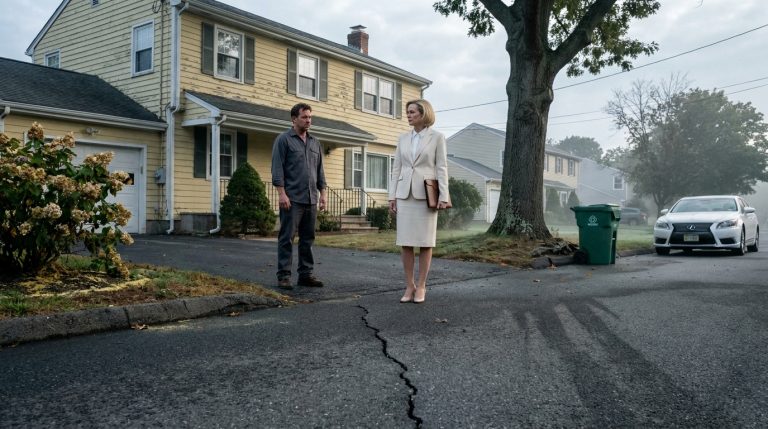
The voice didn’t rise; it drifted across the manicured St. Augustine turf like a cold draft through a poorly sealed casement window. Vivien Sterling stood at the base of his driveway, her thumb hooked into the lanyard of a digital clipboard. Her red Lululemon athletic gear was pristine, devoid of the sweat marks currently blooming across the back of Marcus’s gray chambray shirt.
Marcus didn’t descend. He reached up, snapping a heavy-duty nylon clip onto the fascia board. “Morning, Vivien. The cedar wreath still needs another anchor point on the gable.”
“It violates Code Section 4.2,” she said, her fingernails—perfectly square, capped in pale acrylic—tapping against the glass of her screen. “Insufficient decoration density. We have three news crews arriving at five for the Dallas Spectacle broadcast. Your frontage looks like a foreclosure asset.”
Marcus turned his head slowly, the plastic rung under his boots giving a dry, rhythmic click. Across the asphalt, Vivien’s property was a mechanical furnace of holiday production. Animatronic reindeer with chromium joints sheared through the hot air every ninety seconds; a dual-nozzle fog array pumped dry-ice vapor over her stone columns, leaving a gray, chemical slick on the concrete that smelled of heated glycerin. The sheer volume of it—the thousands of synchronized lumens pulsing to a low-frequency radio broadcast—vibrated through the soles of his boots.
“My family’s budget went to the medical center in Plano this autumn, Vivien,” Marcus said, his voice flat, retaining the gravelly low register of a man who spent forty hours a week speaking over industrial generators. “Jennifer’s third procedure isn’t covered under the small-business standard group plan. The lights are clean. They’re straight.”
“The community standards committee voted at seven this morning,” Vivien said, adjusting the strap of her visor. She didn’t look at his face; her eyes were fixed on the slight discoloration where his ladder rested against the gutter. “A three-hundred-dollar daily assessment begins at midnight. If the account remains delinquent through the New Year, the automatic lien protocol triggers.”
She turned, her designer trainers crunching precisely over the stray cedar needles on his driveway. Marcus didn’t answer. He watched her cross back toward her perimeter wall, his eyes dropping to the small, yellowed plastic dial of his residential utility meter bolted to the brick veneer of his garage. The glass disc inside was spinning with a silent, frantic velocity—far too fast for a house running three ceiling fans and a single strand of low-voltage white LEDs.
CHAPTER 2: THE BLUEPRINTS OF PRESTON
The workshop smelled of industrial solvent and thirty years of accumulated copper dust. It was a low-ceilinged space excavated beneath the garage floor, the walls lined with heavy-gauge steel shelving that hummed whenever the commercial HVAC units cycles on the properties above. Marcus Reed kept his palms flat against the zinc-plated layout table, his callouses catching on the grain of the blue-line schematic prints from November 2021. The paper was crisp, smelling faintly of old ammonia and the dry, dead air of the county archives.
To a layman, the lines were a chaotic grid of civic infrastructure. To Marcus, they were a legal ledger written in copper and steel.
His finger traced the primary feeder line—a three-phase, 480-volt commercial service that he had personally dropped into the easement behind what was now the country club golf course. He remembered the mud that week, the heavy yellow clay that stuck to his boots, and the thickness of the conduits. According to the original municipal authorization, the main junction box—Junction 14-Delta—was rated for residential distribution with a strict capacity ceiling. It was designed to feed eight homes on the south crescent. It was never intended to carry the continuous, multi-thousand-lumen draw of an commercial-grade synchronization matrix.
He adjusted the small brass magnifying glass over the meter schematic. His residential meter, registered under Reed Electrical Contracting LLC to leverage the small-business tariff, showed a steady, phantom load on the digital diagnostic readout he’d pulled from his smart-hub. A continuous 18-amp draw. Every ninety seconds, precisely when the animatronic reindeer across the street sheared through the humid Texas air, that draw spiked to 42 amps.
“Forty-two,” Marcus muttered into the silence of the bunker. His voice sounded like gravel being turned over with a flat spade.
He didn’t pull up his phone to calculate. The numbers were already burned into his retinas. At the commercial utility rate—forty percent higher than the standard domestic tier due to the peak-demand penalties Vivien’s committee had pushed through the zoning board three years ago—that current spike wasn’t a statistical error. It was an extraction.
He reached into his pocket and pulled out the small, notched brass copper lug he had cleared from his backup inventory earlier that evening. It was heavily oxidized, the surface marred by the green crust of cheap zinc alloy exposed to moisture. It didn’t belong in a modern master panel. It was an old piece of industrial salvage, the kind used by cut-rate municipal contractors in the late nineties to bridge non-standard meters.
If that lug was currently sitting inside the junction box behind the decorative juniper shrubs on his property line, it meant the connection wasn’t an accident of infrastructure. It was an engineering choice.
He looked toward the small, grease-stained window that looked out at the foundation piers of his home. Above him, he could hear the light, irregular footsteps of Jennifer. She was walking the floor again, the high-tensile surgical steel staples in her abdomen still pulling against her skin whenever the atmospheric pressure dropped. The pharmacy bills were stacked on the microwave upstairs, tucked under a magnetic clip shaped like a miniature hard hat. Fifteen thousand dollars in uncovered arrears. The three-hundred-dollar daily assessment from the HOA would clear out his remaining commercial operating capital by Tuesday afternoon.
He stood up, his knees making a dry, cracking sound that matched the creak of the fiberglass ladder from that morning. He didn’t put on his high-visibility work vest. In the dusty gray of Preston Estates after midnight, visibility was a liability. He picked up his primary tool roll—heavy ballistic nylon, weighted down with insulated Klein side-cutters and a dual-probe Fluke multimeter that had the yellow casing scarred by battery acid.
The back door clicked against the jamb with a dull, heavy thud. The Texas night was thick, the humidity sitting over the lawn like a wet canvas. The air smelled of hot cedar and the sharp, artificial vanilla vapor from Vivien’s fog machines, which were still running on an automated cycle even though the neighborhood windows were dark.
He walked along the property line, keeping his boots inside the unmanaged border where the wild bermuda grass grew tall against the cedar fence. His feet knew the slope of the land—the precise three-degree incline where the developer had skimped on the retaining wall, causing the silt to collect around the utility easement.
Ten feet from the decorative perimeter wall, tucked behind a dense screen of mature, unpruned junipers, sat the green steel transformer pad. The lock was an industry-standard barrel bolt, but when Marcus touched the zinc-coated casing, his fingers didn’t find the clean resistance of utility-grade grease. They found grit. A fine, metallic powder that smelled of fresh ozone and scorched vinyl.
He didn’t pull his flashlight yet. Instead, he leaned his weight against the steel housing, listening to the transformer’s internal hum. It wasn’t the steady, low-frequency 60-hertz drone of a normal residential step-down. It was a ragged, whistling vibration—the sound of an iron core being driven past its thermal saturation point by a load it was never engineered to carry.
Marcus knelt in the dirt, his knuckles scraping against the rough, rusted lower lip of the box where the soil moisture had eaten through the factory enamel. He reached down into the gap between the concrete pad and the earth, his fingers searching through the loose gravel until they struck something rigid. Not plastic conduit. Rigid, unthreaded galvanized iron pipe, buried three inches below the municipal code depth.
He pulled the Fluke meter from his roll, snapping the non-contact inductive clamp around the base of the pipe. The digital screen illuminated his face in a pale, green back-light, the numbers flickering before locking into a steady, unyielding register.
The current was moving. It wasn’t coming from the main street feeder. It was drawing directly from the subterranean bus-bar that connected to his shop’s commercial service panel forty yards away.
A step crunched in the dry juniper needles behind him. Not the light, clean stride of a designer sneaker, but the heavy, uneven drag of an ungreased work boot.
Marcus didn’t stand up. He kept his fingers locked around the cold iron pipe, his thumb shifting to the power toggle of his meter, killing the green light before the shadow could cross his hands.
“You’re out here late, Reed,” a voice said from the dark. It was dry, flat, and carried the specific chemical odor of cheap chewing tobacco.
Marcus slowly turned his head, his eyes adjusting to the desaturated gray of the shrub line. Standing at the edge of the easement was Danny Whitfield, his old commercial sub-contractor, holding an insulated trench spade like a walking stick.
CHAPTER 3: THE TRENCH AND THE CONDUIT
Danny Whitfield didn’t move his spade. The iron edge was sunk two inches into the soft black silt near the base of the juniper screen, his weight resting entirely on the weathered ash handle. In the dim spill of the neighbor’s synchronized amber LEDs, his face looked flat, cast in a desaturated gray that matched the salt-and-pepper stubble along his jawline.
“You shouldn’t be digging in the easement after the midnight cycle, Marcus,” Danny said. His voice was a low, dry rasp, stripped of the easy casualness he used on commercial job sites. He didn’t look down at Marcus’s hands, which were still covered in wet earth, fingers resting against the cold, unthreaded galvanized pipe.
Marcus didn’t alter his stance. His knees remained pressed into the damp clay, his thumb holding the kill-switch on his Fluke meter. “The current on this line isn’t a domestic drop, Danny. This is three-phase, scheduled under my commercial small-business layout from the 2021 expansion. You handled the trenching that November.”
Danny shifted his weight, the rubber sole of his boot grinding against a exposed cedar root with a dull, wet crunch. “Business was down eight percent that quarter. Material costs for structural copper went up forty percent in three weeks. People do what the board authorizes to clear their inventory.”
“The board doesn’t have the statutory authority to tap a commercial service line without an approved municipal layout utility easement,” Marcus said. He slowly stood up, the movement deliberate, letting the heavy ballistic nylon tool roll settle against his thigh with a metallic clink of wrenches. “And they don’t use old zinc-alloy lugs from the nineties to mask a continuous forty-two-amp draw. That’s not a code adjustment. That’s a structural extraction.”
Danny didn’t raise his spade, but his knuckles went white against the wood. “Vivien has the temporary seasonal work order filed with the precinct. Signed and cleared. She told the committee it was a communal balancing protocol to manage the operational load during peak winter demand.”
“A seasonal work order expires after forty-five days,” Marcus said, stepping out of the juniper shadow until his gray chambray shirt caught the faint, rhythmic pulse of the estate’s light display. “This line has been drawing current since November 2021. The galvanized iron is already rusting through the lower lip where it bridges my meter enclosure. It’s been down there twenty-four months, Danny. Every month, my commercial bill carries an eighteen-amp phantom baseline.”
Danny looked past Marcus toward the high silhouette of the Reed house. Upstairs, the small yellow nightlight in the guest bathroom flickered—a brief voltage drop as the estate’s secondary snow machine across the street kicked into its compression cycle. “She’s got the insurance papers, Marcus. The HOA files a structural utility expense report every single month with the commercial carrier in Dallas. Twelve hundred a month for auxiliary power infrastructure. I’ve seen the invoices on her desk.”
The words hung in the humid air, mixing with the chemical scent of heated glycerin from the fog arrays. Marcus felt a cold calculation settle behind his eyes. The physical reality of the trench was Layer 1—a crude, illegal bypass hidden under decorative landscaping to save on the estate’s extravagant display costs. But Danny’s mention of the insurance invoices shifted the calculus. If Vivien was filing monthly utility expense claims for twelve hundred dollars while physically siphoning the actual power for free from a neighbor’s commercial account, she wasn’t just cutting corners on holiday lights. She was running a parallel financial ledger.
“She’s claiming the expense?” Marcus asked, his voice dropping into a flat, level register.
“Twelve hundred a month,” Danny whispered, his gaze dropping to the wet grit on his boots. “Paid out from the community operations reserve. She told me the arrangement was managed efficiently to minimize internal audit visibility. I got eight grand to lay the pipe and drop the temporary casing. I was told it was an interim measure until the commercial transformer on the north side was balanced by the county.”
“It was never intended to be temporary,” Marcus said. He reached down, his fingers gripping the cold, rough handle of his insulated side-cutters inside the tool roll. “The galvanized line is anchored directly into the main subterranean bus-bar with a permanent weld. You don’t weld a forty-five-day temporary drop, Danny.”
Danny didn’t answer. He stood in the gray light, the spade resting slack against his shoulder, looking less like a commercial contractor and more like an asset that had outlived its utility.
Marcus stepped closer, the wet grass slick under his work boots. “The Texas penal code scales utility extraction over twenty-five hundred dollars as a third-degree felony. But systematic insurance fraud using fictitious operational invoices over ten thousand? That’s a first-degree structure. The district attorney doesn’t clear those with an HOA assessment.”
A sudden, sharp mechanical whine cut through the conversation. Across the street, the main distribution panel inside Vivien’s perimeter wall gave a heavy, synchronized click as the secondary transformer cycled on for the 1:00 AM diagnostic run. The ground beneath their feet vibrated with the sudden acceleration of stolen current.
Marcus looked down at his phone. The digital display remained dark, but the internal logging app was already registering the massive, unpermitted spike on his LLC’s meter profile. The absolute reality was still locked inside Vivien’s private corporate files, but the physical evidence was humming beneath the mud at his feet.
“Go home, Danny,” Marcus said, his voice flat, immutable as the iron pipe beneath the junipers. “Leave the spade.”
Danny stood silent for three seconds, then turned and walked down the unpaved easement road, his silhouette disappearing into the desaturated gray of the edge properties. Marcus didn’t watch him go. He knelt back down in the dirt, pulled his Fluke meter back out, and began tracing the exact coordinates of the secondary distribution junction, his fingers working by touch against the rusted metal casing.
CHAPTER 4: THE BRIBE IN THE ARCHIVES
The vibration of the cell phone against the zinc layout table sounded like a cicada trapped in a metal dynamic box. Marcus didn’t answer until the third cycle, his fingers adjusting the focus ring on the desk lamp until the stark white light hit the printout of the 2021 email logs.
“Reed,” he said, his voice flat, matching the cold gray geometry of the workshop walls.
“Marcus, it’s Sarah Story.” The attorney’s voice didn’t carry its usual structural composure; the line was thin, distorted by the static of a vehicle’s Bluetooth connection. “The county clerk just updated the docket registry. Vivien didn’t wait for the holiday stay. She processed an expedited civil injunction under the emergency management clause.”
Marcus reached out, his thumb catching on a rough edge of the rusted copper lug sitting beside the blueprints. “The daily assessment shouldn’t hit the county ledger until Tuesday morning.”
“She bypassed the standard assessment window,” Sarah said, the sound of interstate tires humming through the receiver. “She attached an engineering certificate signed by a third-party inspector. The filing claims your unpermitted, low-voltage installation creates a non-isolated ground loop that directly threatens the neighborhood’s main automated distribution grid. They’re not just looking for a daily penalty anymore, Marcus. They’ve filed a motion for an emergency eviction and structural extraction of your service drop. A marshal is scheduled to post the notice on your door by seven AM.”
Marcus looked up at the ceiling joists, where the dull, rhythmic thud of the estate’s secondary compressor hummed down through the foundation. The countermove was fast, calculated with a corporate precision that utilized the legal apparatus like an industrial shear. Vivien wasn’t defending her aesthetic standards; she was covering the physical connection before a municipal inspector could verify the origin of the three-phase load.
“Danny left his spade in the easement,” Marcus said, his voice dropping into the low, deliberate register of a man calculating structural tolerances under load. “He admitted to an eight-thousand-dollar cash draw from the contingency reserve to drop the permanent line. He called it an innovative resource allocation protocol.”
“Danny’s admission doesn’t clear the civil ledger if the physical evidence is unpermitted on your side of the property line,” Sarah replied, her tone sharpening against the static. “If that marshal executes the extraction order, the county crews will isolate your entire panel. Your home goes dark, and your contracting license goes into an automatic administrative freeze pending a structural safety review. You have four hours before the city offices open.”
Marcus didn’t answer immediately. He stood up, the ballistic nylon of his tool roll scraping against the steel leg of the layout table with a dry, abrasive friction. His eyes remained fixed on the printout of the HOA’s monthly insurance expense reports he had managed to pull through his corporate portal before the access token was revoked. The figures were listed under Auxiliary Maintenance: Section 4 Grid Safety. Twelve hundred dollars a month, paid out continuously to a blind holding company registered in Delaware under the name Sterling Core Ventures.
The decoy was the unpermitted holiday wire—a neighborhood dispute about density and aesthetics to satisfy the committee’s curiosity. The reality was a structural siphon designed to extract capital from the community fund while his private commercial meter carried the literal weight of the current. Vivien wasn’t just stealing power to make her lawn glow; she was siphoning the cash equivalent of that power into an asset account while using his small-business tariff to hide the operational deficit.
“The insurance claims are fraudulent, Sarah,” Marcus said, his hand tightening around the cold iron shaft of a wire-stripper. “She’s billing the reserve for electricity she’s physically extracting from my commercial service. It’s a parallel ledger.”
“Prove it before seven AM, or the ledger doesn’t matter,” Sarah said. The line clicked, leaving only the low-frequency hum of the transformer outside the basement window.
Marcus dropped the phone into his pocket and reached for his heavy-duty fluke meter. He didn’t lock the workshop door behind him. He moved through the narrow crawlspace beneath the floorboards, his boots dragging through the cold dust until he reached the primary service disconnect—the heavy, gray iron enclosure that controlled the master current flow from the street to his entire estate.
Inside the housing, the copper bus-bars were thick as his wrist, glowing under his flashlight beam with a dull, oil-slick iridescence. Right above the primary breaker, nestled deep behind the manufacturer’s safety shroud, sat a non-standard secondary relay—a small, black plastic module with a stamped serial number that had been deliberately scraped away with an emery cloth.
He brought his inductive clamp down on the relay’s output wire. The line was hot, the insulation soft to the touch from the continuous thermal load. The current wasn’t moving toward his shop; it was bleeding out through the foundation wall, down into the clay trench where Danny’s galvanized pipe sat waiting.
Marcus didn’t pull the breaker. He reached into his pocket and pulled out his terminal screwdriver, its insulated shaft catching the light as he positioned the tip against the calibration screw of the smart-relay array. One turn would isolate the loop, but it would also trigger an immediate telemetry alert on the estate’s central automation system across the street. He didn’t want an alarm. He needed the physical draw to remain active until the news van and the fire marshal’s vehicle cleared the front gates.
He looked at his watch. 3:42 AM. The air in the basement was growing colder, the humidity rising as the early morning fog began to settle over the high roofs of Preston Estates. He could hear the faint sound of an engine idling on the main crescent—the early delivery truck or the first local news vehicle tracking the pre-dawn setup for the Dallas Spectacle.
He pulled his hand back, leaving the screw intact. His active agency wouldn’t be found in a desperate midnight extraction; it would be delivered through the remote isolation app he had coded into his shop’s automated diagnostic platform during his winter downtime.
He climbed out of the crawlspace, his boots crunching over the dry clay of his back yard. Across the street, Vivien’s white Range Rover sat parked in her circular driveway, its pristine glass reflecting the amber, rhythmic pulse of eighty thousand watts of stolen light.
CHAPTER 5: THE STATIC HORIZON
The metal surface of the smartphone casing was cold against Marcus’s calloused thumb. The air at 8:15 PM was thick with the scent of unburned diesel from the idling Channel 5 production van and the sweet, cloying fog drifting across the lawns from Vivien Sterling’s main distribution line. On the temporary stage erected over the country club turf, Vivien stood directly before the forty-foot synchronized LED grid. Her crimson designer dress caught the rotating white strobe flashes, casting long, sharp shadows across the three hundred neighbors packed into the crescent.
“Our community investment requires unwavering adherence to excellence,” Vivien’s voice echoed through the high-tensile fiberglass speaker horns, clear and precise. “Properties that diminish our collective standards will face immediate administrative extraction. We protect our legacy.”
Marcus stood thirty paces back, near the unpruned edge of the juniper screen. His boots were sunk an inch into the soft clay easement where Danny’s buried iron trench lay hidden. He didn’t look at Vivien’s face. His eyes were fixed on the master status indicator on his diagnostic terminal interface. The real-time metric showed a continuous forty-two-amp extraction pulling through his business meter, registering every motorized cycle of her animatronic display as a parallel financial deficit on his account.
Behind him, Fire Marshal Johnson adjusted the heavy strap of his utility belt, his fingers resting near the flap of his official log folder. Two plainclothes investigators from the district attorney’s financial crimes unit stood motionless against the side of the news vehicle, their eyes locked onto the digital folder Marcus had uploaded to the precinct server twenty minutes prior.
“The telemetry is synchronized,” Marcus said, his voice a low, dry rasp that barely carried past the brush line.
“Execute the protocol, Mr. Reed,” Johnson replied.
Marcus tapped the red command box on the glass screen.
The reaction didn’t take two seconds. It occurred in the space between two alternating current cycles. Inside the gray transformer cabinet behind the junipers, the heavy, high-voltage copper contacts—the ones Marcus had personally balanced and verified—pulled apart with a sharp, pneumatic clack that vibrated through the mud under his soles.
Eighty thousand watts of synthetic holiday light collapsed into total inertia.
The forty-foot trees died mid-pulse. The rotating laser arrays froze, painting a single, static violet streak across the brick facade of Vivien’s house before the residual capacitors drained to zero. The animatronic reindeer ceased their mechanical shearing, their chromium joints locking with a loud, metallic screech that sounded like dry iron scraping against concrete. The fog injectors wheezed, dropping a final, stagnant cloud of white glycerin vapor across the dark lawn.
The sudden silence was absolute, heavy as wet canvas. Three hundred people stood frozen in the desaturated gray dusk, the only illumination coming from the harsh, battery-powered LED spots mounted on the Channel 5 camera rig.
In the middle of the dark stage, Vivien remained motionless at the microphone, her mouth slightly open, her face instantly drained of color under the reporter’s high-intensity lens.
“Actually, Vivien,” Marcus said, stepping out from the shadow of the junipers. His voice didn’t need a amplifier; it cut through the still, humid air with the flat weight of an industrial ledger. “The grid isn’t failing. The illegal bypass on my commercial meter just cleared its line.”
The news camera swiveled sixty degrees, the large optical lens catching Marcus’s gray chambray shirt and the heavy nylon tool roll strapped to his hip.
“This is absurd,” Vivien said, her fingers tightening around the cold metal trim of the lectern until her acrylic nails clicking against the casing. “Security, remove this man. He’s currently facing an administrative foreclosure.”
“The foreclosure filing is an asset concealment,” Fire Marshal Johnson said, stepping into the light beside Marcus, his brass shield glinting under the news spot. “Mrs. Sterling, your signature is on twelve monthly insurance expense reports for twelve hundred dollars each, filed under fictitious utility infrastructure upgrades. We have the digital archive from Sterling Core Ventures.”
The crowd erupted into a low, fragmented murmur—the sound of neighbors turning over a bad calculation in their heads. Tom Morrison stepped forward from the third row, his eyes shifting from the dark, dead display to the small, warm white light glowing from the porch of the Reed house. Marcus’s home remained fully lit, its modest LED strings powered by the independent battery bank hidden in his garage workshop. It stood like a clean, isolated island of current in a grid gone completely dark.
“She’s been siphoning the operations fund,” a voice shouted from the dark crescent. “Our dues were clearing her personal venture account.”
Vivien didn’t run. She stood on the plywood stage as the two district attorney investigators stepped up the side ramp, their movements methodical, unhurried. The older investigator pulled a pair of heavy steel restraints from his pocket, the metal clicking with a dry, transactional finality that matched the sound of Marcus’s circuit breakers.
“Vivien Sterling, you are under arrest for utility theft exceeding twenty-five hundred dollars, conspiracy to falsify commercial ledgers, and first-degree insurance fraud,” the investigator said, his voice flat as he pulled her wrists behind the red fabric of her dress.
Marcus didn’t watch them lead her toward the unmarked white sedan idling near the main gate. He looked down at his terminal screen. The phantom load on his small-business account had dropped to absolute zero. The current was clean. The line was straight.
Jennifer stood at the top of their driveway, her hand resting over her abdomen where the surgical staples were finally healing in the dry winter air. Emma stood beside her, her face illuminated by the simple, warm white light of the handcrafted cedar wreath. Marcus walked up the incline, his boots leaving dark, wet prints on the concrete, his fingers sliding his tools back into their matching slots inside the ballistic nylon roll.
“Is it clear?” Jennifer asked as he reached the threshold.
Marcus looked back once at the dark McMansions of Preston Estates, their synthetic grandeur swallowed entirely by the desaturated Texas night. “The circuit is isolated,” he said. “The line holds.”