The Weight of a Final Word: A Marine’s Journey to Reconcile the Silences of War
CHAPTER 1: THE CEDAR BLOCK
The house in Hubert, North Carolina, was designed for silence. It was a small brick ranch that sat on a quarter-acre of land, seven miles from the main gate of Camp Lejeune. Walter liked the distance; it was far enough to keep the base’s daily rhythm from bleeding into his own, but close enough to serve as a familiar anchor.
He stood in front of his closet, his left hand gripping the cool, smooth aluminum of his pharmacy-issue cane. His right hand—the one with the tremor that worsened when the air grew humid—reached for the garment bag. The zipper gave a faint, protesting rasp, a metallic sound that seemed to echo too loudly in the quiet bedroom.
Inside, the blues waited.
They were clean. They were perfectly pressed. They were a relic of a version of Walter that had ceased to exist decades ago. He unzipped the bag, the scent of cedar rising to meet him. It was a sharp, grounding smell, the scent of preservation. He reached in and touched the wool, the fabric rough against his calloused fingertips. He had brushed this uniform every three months for fourteen years. He had checked the brass buttons for tarnish, checked the alignment of the ribbons, and confirmed that every pin held its place with the rigid discipline of a sergeant major who had never learned how to quit.
His gaze drifted to the left breast pocket. There, pinned against the dark blue fabric, was a narrow strip of dark green and black. A single gold star sat at the center. It was a ribbon that didn’t appear in the standard manuals, a ribbon that existed in the margins of history, a ribbon that had been pinned to the chests of fewer than forty men.
He pulled the uniform out, the hangar clicking against the doorframe. He was seventy-nine, compressed by time and the specific erosion of decades of service. His left hip, a titanium relic of 2009, sent a sharp warning of protest as he shifted his weight. He ignored it. He was moving with the precision of a man who still had a mission, even if that mission was just to exist for another day.
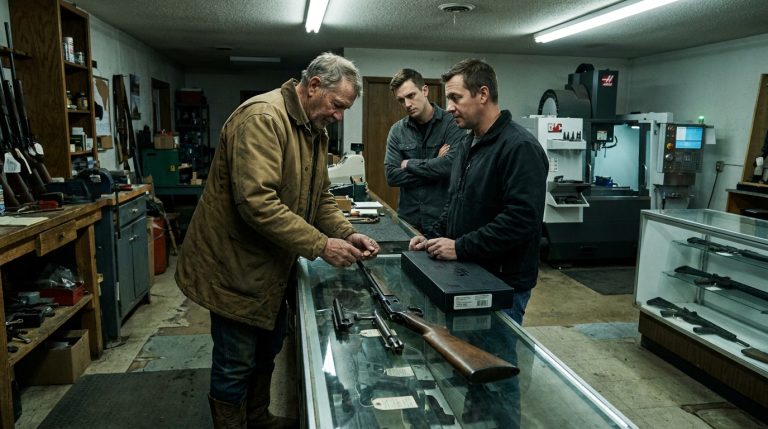
Then he reached into his pocket and pulled out the invitation. It was a cream-colored envelope, heavy, expensive, contrasting sharply with the utilitarian dust of his life. He had read the handwritten note on the back a dozen times. Sergeant Major Jessup, this year’s open house features a display of weapons and equipment from Vietnam era Force Reconnaissance Operations.
He stared at the words. They were a key. And as he stood in the dim light of his bedroom, the door in his memory that he had kept tightly locked for half a century began to creak open. He didn’t want to go. He wanted to hang the uniform back up, zip the bag, and go to the kitchen to start the coffee. But the name at the bottom of the card—Colonel Adevero—felt like an order he couldn’t disobey.
He moved toward the bathroom mirror, the floorboards groaning under his feet. He held the jacket up to his chest, checking the fit. The waist was tighter than it had been at the last funeral, and the collar sat higher, biting slightly into skin that had grown thinner with age. But it held.
He caught his own reflection. His eyes were cloudier than they used to be, but they were still steady. He looked at the ribbon again. The dark green, the black, the gold star. A chill moved down his spine, unrelated to the temperature of the house. He had been so careful for so long. He had been a ghost in his own neighborhood. And now, the past was reaching out, not as a memory, but as a demand.
He didn’t know it yet, but the cedar block he had clutched to preserve his past was the only thing standing between him and the truth that had been waiting for him in the shadows of the Lejeune armory.
CHAPTER 2: THE HANDWRITTEN NOTE
Walter set the uniform jacket down on the bed, smoothing the wool with a palm that felt suddenly dry, as if the fabric were pulling the moisture right out of his skin. The cane leaned against the bedside table, a slender, silver-grey presence that seemed to watch him. He didn’t want to move. If he kept his hand on the uniform, if he kept the jacket in his line of sight, he could pretend he was just performing a maintenance check. He could pretend the card in his pocket was nothing more than junk mail, a standard invitation to an event he had no intention of attending.
But the note on the back was still there, burning a hole in his pocket. Your presence would mean a great deal to the Marines who put it together.
He walked into the kitchen, his hip clicking with a rhythmic, mechanical protest that synced with the thud-click-thud of his cane on the linoleum. The kitchen was his sanctuary. Everything here was mapped by habit: the coffee tin on the left, the mugs on the second shelf, the spot by the window where the morning light hit the counter just right. He made the coffee slowly, the process a deliberate act of anchoring himself to the present. He needed the warmth, the smell of the grounds, the mundane reality of boiling water.
As the coffee dripped, he sat at the kitchen table. He took the card out again. Under the bright, artificial light of the kitchen, the ink of the handwritten note looked sharper, more urgent. It was a careful, upright script, the kind of handwriting taught in military academies—disciplined, legible, lacking in flourishes. It was the handwriting of a man who wrote reports, who gave orders, who kept secrets.
Colonel Adevero.
He had never met the man, but he knew the name. Everyone in the retired enlisted community knew the names of the commanding officers at Lejeune, the way people in small towns know the names of the local sheriff or the mayor. They were fixtures. But an invitation like this—a personal note added to a mass-produced card—that was an anomaly. It was a snag in the pattern.
He thought of Cal Polk’s funeral. The memory arrived unbidden, a phantom presence that pushed aside the smell of the fresh coffee. It had been 2012, San Diego. The air had been sharp with salt and the smell of eucalyptus. He remembered the feeling of the blues on his back then, the way the wool had felt heavier, thicker, a shroud that fit too well. He had stood by the grave, the sun bleaching the grass, watching the color guard fold the flag. He remembered the silence of that day—the profound, absolute silence of a man who had seen too much being lowered into the earth. It was a silence that carried the weight of everything they had never been able to say.
The silence in his kitchen now felt like that one. It was the same texture, a kind of muffled, pressurized quiet that made his ears ring.
He reached for the sugar, his fingers trembling—just a tremor, the same one the doctor attributed to “nerve damage, upper extremity, 1968.” He stared at his hand. It was the hand that had held a rifle, the hand that had signed the logbooks, the hand that had held David Pruitt as the life went out of him. It had been steady then. Why was it shaking now?
He was afraid. The realization hit him with the force of a physical blow. He wasn’t afraid of the Colonel, or the armory, or the journalists. He was afraid of the opening. He had spent fourteen years stitching the seams of his life shut, mending the fraying edges, keeping the internal decay contained within the walls of this small brick house. He had treated his own soul with the same maintenance schedule he applied to the Chevy Silverado: oil changes, tire rotations, rust prevention.
And now, the invitation was an invitation to pull at a thread.
He looked at the card again. He flipped it over. The printed front was generic, a picture of the base armory, dignified and imposing. But the back was personal. He tried to reconcile the two. If this were truly an open house, a simple PR event for families and civilians, why reach out to him? Why this specific mention of Vietnam-era Force Recon? It wasn’t an inquiry; it was a beckoning.
He pushed his coffee mug away. It clattered against the table, a lonely sound. He stood up, his hip protesting again, and walked to the wall where he kept his calendar. He looked at the date: October 19th. The event was in three days.
He felt a sudden, sharp need to see the uniform again. He walked back to the bedroom. The jacket lay on the bed, a dark, hollow shape in the dim light. He picked it up. The weight of it was familiar, a grounding pressure across his shoulders. He put it on.
The wool was cold against his skin, but as he buttoned the jacket, the warmth of his own body began to seep into the fabric. He stood in front of the full-length mirror, not looking at himself, but looking at the ribbon. The dark green, the black, the gold star. It caught the light. It was a small thing, an inch of fabric and a metal pin, but in the reflection of the mirror, it seemed to grow, to dominate the scene, to act as a beacon.
He saw the lines on his face—the map of a life that had been lived in extremes. He saw the grey in his hair, the thinning of his frame. He wasn’t the man who had worn this in ’68, and he wasn’t the man who had worn it in ’12. He was something else now, a creature of habit and memory, a relic of a war that had been fought in the dark.
He realized then that he couldn’t stay home. The silence of the house had become oppressive, a cage of his own making. He needed to know what the Colonel wanted. He needed to know if the history he was guarding was still a secret, or if someone else—someone with enough rank and enough curiosity—had started digging into the foundation of the lies.
He reached into his pocket and pulled out the card one last time. His finger traced the signature. Adevero.
“Alright,” he whispered. The word sounded foreign in the quiet room, a crack in the armor. “Let’s see what you’re looking for.”
He turned back to the mirror and adjusted his posture. The tremor in his hand seemed to subside, replaced by a cold, familiar focus. He was a Marine. He had been a Marine for thirty-three years, and even in the long, quiet retirement of the last fourteen, the training hadn’t left him. It had just gone dormant.
He took the uniform off, moving with the slow, deliberate care of a man preparing for a deployment. He laid it out on the bed, ready for the morning of the 19th. He checked the cedar block, ensuring the garment bag was ready. He looked at the closet, at the shadows lurking in the corners, and for the first time in fourteen years, he didn’t feel the need to shut the door.
He would go. He would walk through the door of that armory. He would show them the ribbon. And if they wanted to talk about Limestone Creek, he would see how much they really knew. He wasn’t a hero, and he wasn’t a victim. He was a witness. And it was time to bear witness to the silence.
He walked to the window. The sun was dipping below the horizon, casting long, bruised shadows across the lawn. He watched the light fade, the world outside turning to shades of grey and deep indigo. The house felt smaller, but for the first time, it didn’t feel like a grave. It felt like a staging area.
He stood there for a long time, watching the trees sway in the wind, listening to the hum of the distant highway. He was ready.
CHAPTER 3: THE ARMORY HERITAGE OPEN HOUSE
The morning of October 19th arrived with a sharp, clear light that seemed to expose the dust in every corner of the house. Walter was awake at 0400, his internal clock—set by thirty-three years of Marine Corps mornings—ignoring the fact that he no longer had a watch to stand. He performed his stretching routine with a grim, rhythmic efficiency, his titanium hip popping softly with each movement. He maintained the pace, not because he was eager, but because the discipline was the only thing that kept the creeping anxiety of the day at bay.
He dressed slowly. The process of putting on the dress blues was a ritual of remembrance. Each button, each clasp, each crease in the wool was a tactile reminder of the men he had served with. He checked his reflection one final time. The jacket was stiff, the collar high, the posture—he forced his spine to straighten, countering the years of gravity—was pure, unwavering Marine. He looked like a man who belonged to an era of iron and ink, a stark contrast to the modern, climate-controlled comfort of the home he had built for himself in retirement.
The drive to Camp Lejeune was a journey through terrain he knew by heart. The highway hummed beneath the tires of his 2006 Silverado, a sound he had listened to for thousands of miles. He kept the windows cracked, letting the crisp, early-autumn air circulate, the smell of damp pine and dry earth a constant reminder of the North Carolina landscape he had made his own. As he turned toward the main gate, he slowed, his eyes scanning the familiar structures—the perimeter fence, the guard booths, the distant line of barracks. Everything was exactly where it was supposed to be, a predictable, ordered world.
He pulled into the parking lot near the armory battalion at 0845. The building rose before him, a massive, windowless block of reinforced concrete, a fortress of ordnance that commanded the landscape. He parked the truck, sat for a moment in the silence of the cab, and took a deep, steadying breath. His right hand rested on his thigh; it was steady. He picked up the aluminum cane, stepped out of the truck, and adjusted his posture.
The walk to the entrance was a tactical exercise. He kept his stride measured, his eyes forward, his presence unobtrusive. He was a retired Sergeant Major entering an active-duty installation; he knew the protocol, the etiquette, the silent language of rank and recognition. As he reached the threshold, the armory’s double doors swung open, and the noise of the interior spilled out to meet him—the muffled cadence of conversation, the faint clatter of equipment, the ambient sound of a crowded space.
He stepped inside.
The armory was a cathedral of machinery. Sixty thousand square feet of climate-controlled space, the air carrying a faint, metallic tang of gun oil and cold steel. Rows of tables stretched out across the floor, covered in historical weaponry—Springfield 1903s, M1 Garands, the sleek, modern lines of the M27s. There were families moving through the rows, children pointing with wide-eyed wonder, retired Marines standing in groups, their conversation a low, rolling tide.
Walter felt the familiar friction of the crowd. He was a solitary man, and the presence of so many people—the casual proximity, the noise, the sheer density of the environment—hit him with an unexpected wave of claustrophobia. He paused inside the door, his cane clicking softly against the polished concrete, and allowed his eyes to adjust. He needed to find the Vietnam-era Force Reconnaissance display. It was the only reason he was here, the only reason he had bothered to put on the blues.
He saw it across the floor, a thirty-foot section of the space marked by easels holding historical photographs and glass cases filled with field gear. He began to walk toward it, his pace deliberate, his eyes fixed on the target. He navigated through the crowd with the practiced grace of a man who knew how to move in tight spaces, the cane serving as both a support and an extension of his will.
As he moved deeper into the floor, he felt the atmosphere shift. The sound around him began to recede, the voices of the visitors dimming into a background hum. He felt the weight of the past pressing in on him, the proximity of the weapons—the same type of gear he had carried through the canopy of the Laotian mountains, the same gear that had survived in the archives while the men who had carried it were slowly being reclaimed by the earth.
He stopped, his attention caught by a photograph on an easel: a patrol trekking through dense undergrowth, their faces obscured by mud and shadow. He looked at the gear, the way they held their rifles, the tension in their posture. He knew that patrol. He knew the weight of those packs, the way the sweat felt when you were deep in enemy territory, the silence you had to maintain just to exist. He stared at the image, his breath hitching, a brief, sharp memory of the heat and the insects and the endless, suffocating green.
He moved on, his heart hammering against his ribs. He was close now. He could see the glass cases, the reflection of the overhead lights dancing on the polished surfaces. He was ten feet away, five feet away. He prepared himself to face it—the artifact, the history, the proof.
Then, a movement caught his eye. A tall, trim figure, dressed in the crisp, imposing uniform of a Marine Colonel, detached itself from a group of journalists and turned toward him. The man’s gaze locked onto Walter’s uniform, moving with the precision of a trained observer—from the medals to the ribbon, from the ribbon to the cane, from the cane to the face.
Walter halted. He saw the recognition register in the man’s eyes, a sudden, sharp clarity that made the air in the room feel thinner. This was him. This was the man who had written the note. Colonel Adevero. The silence between them grew, heavy and absolute, as if the surrounding crowd had ceased to exist. Walter stood his ground, leaning on his cane, the weight of the past balanced on the dark green and black ribbon on his chest, ready for the conversation that was about to unfold.
CHAPTER 4: THE INTERCEPTION
Colonel Adevero did not move, but the air around him seemed to thicken. He was a man composed of straight lines and sharp angles, his uniform pressed to a degree of perfection that felt almost aggressive. When he spoke, his voice was measured, a low-frequency hum that cut through the background noise of the open house with the authority of a man accustomed to being heard.
“Sergeant Major,” he said, his eyes still fixed on the dark green and black ribbon on Walter’s chest. The gaze was not merely observant; it was predatory in its focus, a surgical assessment of a target. “I didn’t expect to see you here today.”
Walter stood his ground. He felt the weight of the cane in his hand, the familiar, cold grip of the aluminum. He kept his spine straight, the muscle memory of thirty-three years of service overriding the ache in his hip. He didn’t blink. He had been stared down by NVA officers, by agency bureaucrats, by men with more power than this colonel could ever dream of wielding. He knew how to hold his own against an appraisal.
“I received the invitation, Colonel,” Walter said, his voice flat, devoid of inflection. It was the voice of a man who provided facts, not justifications. “The note on the back intrigued me.”
Adevero’s mouth tightened, just a fraction—a microscopic tremor of surprise or recognition. “The note,” he repeated, as if tasting the words. “It was a professional courtesy. We don’t often get the opportunity to host veterans who have as extensive a history with Force Recon as your file indicates.”
“My file,” Walter said, the words heavy with subtext. “My file is a collection of redacted pages and missing dates, Colonel. If you’ve been reading it, you know that as well as I do.”
The Colonel stepped closer, the motion fluid, deliberate. He was close enough now that Walter could see the faint, starched lines of his collar and the metallic gleam of his rank insignia. There was a calculation in Adevero’s eyes, a flickering diagnostic process. He wasn’t just talking to a retired sergeant major; he was scanning a living repository of data that he had spent years attempting to unearth.
“I’ve read what’s available,” Adevero replied, his tone shifting into something more transactional, more pointed. “But documents aren’t people, Sergeant Major. Documents lack the… nuance of experience.”
The surrounding noise of the armory seemed to fade away, leaving them in a pocket of profound, pressurized silence. Children nearby were laughing as they handled inert rifles, and the distant murmur of the journalists continued, but to Walter, the world had narrowed down to this man and the question he was circling. Adevero wasn’t interested in the open house. He was interested in what lay behind the ribbon.
Walter felt a flicker of the same cold, tactical instinct he had used in the mountains—the ability to assess a threat before it fully manifested. He noticed something then, a small discrepancy in the Colonel’s posture. Adevero was holding a program booklet in his left hand, and his fingers were gripping the edges of the paper with a white-knuckled intensity that didn’t match his relaxed, authoritative demeanor. He wasn’t relaxed at all. He was waiting. He was hoping for something, and he was using the language of military protocol to bait a confession.
“Nuance is expensive, Colonel,” Walter said, holding the Colonel’s gaze. “Usually, people don’t want to pay the price for it.”
“I have the resources to cover the cost,” Adevero said, his eyes narrowing. “And I have the patience to wait for the story.”
He turned slightly, shifting his attention to the Force Reconnaissance display just a few feet away. His movement was a silent directive, an invitation that functioned as a command. He wanted Walter to walk with him. He wanted to place Walter in the context of the display, to see how the man reacted to the sight of the equipment and the photographs.
“There’s a piece of history over there,” Adevero said, gesturing toward the glass case, his voice dropping into a register of conspiratorial respect. “A display of Vietnam-era Force Recon operations. It’s a passion project of mine. I think you might find it… illuminating.”
Walter felt a surge of cold dread. He knew what was in those cases. He had seen the equipment in his mind’s eye a thousand times—the K-bar knives, the radio rigs, the maps of terrain that weren’t on any public record. If he walked over there, he was participating in Adevero’s narrative. He was stepping into a trap constructed of history and high-ranking curiosity.
But he was also a Marine, and he knew that retreat was rarely the best tactical response when the enemy had already identified your position.
“I’ve seen the history, Colonel,” Walter said, his voice steady. “Some of it is more familiar than you might imagine.”
“Then show me,” Adevero challenged, his eyes locked onto Walter’s. “Show me what looks familiar.”
Walter felt the weight of the cane, the texture of the aluminum against his palm. He looked at the Colonel, then at the display, then back at the Colonel. He took a single, deliberate step toward the cases. The game had shifted. The protocol of the open house had evaporated, leaving behind a raw, intellectual sparring match.
He didn’t know what the Colonel was hiding—whether it was an obsession with the mission or a deeper, more dangerous interest in the experiments that had occurred in those mountains—but he knew that he was now the center of gravity for the man in front of him.
“Lead the way,” Walter said.
They moved toward the display, the Colonel’s polished boots clicking in rhythm with the thud-click of Walter’s cane. Every step felt like a breach, a movement into a space that had been sanitized for the public but was, in reality, a site of buried truths. As they approached the glass, the light reflecting off the surface obscured the contents, turning the display into a blurred, shimmering window into the past.
Walter stopped when he was inches from the glass. He felt the phantom presence of the men he had served with, the men who had occupied this same equipment, who had been sustained by the same hope and shattered by the same reality. He took a deep breath, the smell of the room—gun oil and stale, recirculated air—filling his lungs. He was ready.
CHAPTER 5: THE CLEARING
The sharp, sudden burst of the siren sent a jolt through the armory, a high-pitched, insistent shriek that seemed to vibrate against the very marrow of Walter’s bones. Around them, the atmosphere transformed instantly. The easy, curated air of the open house vanished, replaced by a sudden, jagged alertness. Visitors stumbled, their conversations cut off, while staff NCOs moved toward the sound with the practiced, predatory grace of men who had been trained to respond to threats in milliseconds.
Colonel Adevero didn’t flinch. His hand stayed clamped on the program booklet, his knuckles white, his eyes fixed on Walter with a terrifying, unblinking intensity. He looked like a statue of a soldier, unmoved by the mechanical chaos erupting in the ceiling.
“Just a test,” Adevero said, his voice barely audible over the mechanical wail. It wasn’t a reassurance; it was a dismissal. He reached out and tapped the glass of the display case. “Ignore it. It happens. It’s part of the maintenance cycle.”
Walter looked at the Colonel, then back at the glass. He felt the tremor in his own hand, but he forced it to be still, pinning it to the cold, smooth surface of the case. He was looking at the map case—the leather cracked and salt-stained, the brass buckles dull with age. Beside it sat a compass that had guided men through terrain where cardinal directions meant nothing and survival was measured in inches of movement.
“The maintenance cycle,” Walter repeated, his voice raspy. “Is that what you call it when the noise gets too loud?”
Adevero leaned in, his face inches from Walter’s. The Colonel’s eyes were bloodshot, the pupils pinpricks in the harsh, sterile light of the armory. “I call it a necessary disruption, Sergeant Major. Sometimes, you need to see how people react when the floor drops out from under them.”
The alarm stopped as abruptly as it had begun, leaving a ringing, pressurized silence in its wake. The armory returned to its previous state—the low hum of voices, the clatter of weapons, the indifferent drift of the crowd—but the thin, fragile veneer of civility that had existed between them was gone. The Colonel had crossed a line. He had manufactured a moment of chaos to see if Walter would break, to see if he would reveal a reflex, a fear, a crack in his armor.
Walter felt a surge of cold, defensive clarity. He had been a sergeant major for a reason; he had spent a career assessing the hidden agendas of men who played at being gods. He realized now that Adevero wasn’t just researching history; he was actively attempting to recreate it, to peel back the layers of the past by forcing those who had lived it into a state of reactivated trauma.
“You’re testing me, Colonel,” Walter said. It wasn’t a question. “You aren’t here to document Limestone Creek. You’re looking for something that I haven’t surrendered.”
Adevero didn’t back down. He pulled a small, laminated card from his pocket—a copy of a document, yellowed and faded—and pressed it against the glass, just over the photograph of the twelve men. “I’m looking for the anomaly, Sergeant Major. I’m looking for why twelve men went in, and why, according to the official records of the regional Command, there were only eleven on the manifest for the extraction.”
Walter felt the air leave his lungs. He stared at the document. It was a fragment of a manifest, a series of typed names and ID numbers, the ink smudged by age and poor reproduction. He knew exactly what it was. It was a clerical error—or perhaps, a deliberate excision—from the night of the insert.
“That’s a mistake,” Walter said, his voice barely above a whisper. “There were twelve.”
“The record says eleven,” Adevero pressed, his voice dropping into a razor-sharp whisper. “It says that one man, one specific identity, was erased from the operational history before the mission had even concluded. Who was he, Walter? Who was the man that wasn’t supposed to be there, and why did he disappear before the final report was filed?”
Walter stared at the photograph in the case. David Pruitt’s grinning face, the two agency advisors, the men he had carried through the jungle—the men he had sworn to protect. He remembered the night of the extract, the chaos on the helicopter, the confusion of blood and darkness. He had known, even then, that the history they were writing was already being edited by hands they couldn’t see.
“You don’t know what you’re asking,” Walter said, the words feeling like shards of glass in his throat.
“I know exactly what I’m asking,” Adevero countered, his grip on the program booklet tightening until the paper crinkled, a dry, papery sound in the stillness. “I’m asking for the truth. I’m asking for the name that doesn’t appear on the manifest. I’m asking for the man who was meant to stay in those mountains.”
Walter looked at the Colonel’s face—a face devoid of empathy, replaced by an obsessive, mechanical hunger for data. He saw the trap clearly now. The “decoy” of the open house, the “display” of history—it was all a setup. Adevero wasn’t trying to honor the dead; he was trying to exhume a secret that had been buried with them.
Walter straightened his spine. He couldn’t give him the name. Not here. Not now. The man in the photograph—the one whose name had been erased—was the reason he had spent fifty-six years in silence. If he spoke that name, he wouldn’t just be breaking the silence; he would be triggering an avalanche.
“You want the truth, Colonel?” Walter asked, his voice hardening, the flat, disciplined tone of a command. “The truth is that you’re playing with fire in a room full of gunpowder. And if you keep digging, you’re not going to find a hero. You’re going to find a ghost who has no intention of being brought into the light.”
Adevero stood back, his face a mask of calculated frustration. He had miscalculated. He had assumed that the old man in the blues would be an easy conduit to the past, a brittle, aging repository of stories that were waiting to be tapped. He hadn’t accounted for the iron, for the discipline, for the fact that Walter Jessup was not a man who broke under the weight of his own history.
“We aren’t finished, Sergeant Major,” Adevero said, his voice cold, final. “The history belongs to the Corps. And I intend to claim it.”
“The history belongs to the men who carried it,” Walter replied. He turned, the aluminum tip of his cane clicking firmly against the concrete, and began the long walk back toward the entrance of the armory. He didn’t look back. He knew that the Colonel was still standing there, watching him, a man defined by a hunger that would not be sated. He had walked into the trap, and he had survived it, but the stakes had shifted. The secret was no longer just a burden he carried; it was a target on his back.
CHAPTER 6: THE GLASS CASE PHOTOGRAPH
The armory floor was a long, desolate stretch of grey, the overhead lights casting harsh, artificial shadows that seemed to stretch out like fingers reaching for his heels. Walter didn’t turn back. He could feel the weight of Adevero’s gaze on his back, a persistent, physical pressure that made the hairs on his neck stand up. He kept his stride steady, his cane clicking against the floor, each sound a sharp, defiant punctuation in the silence.
He didn’t make it to the exit. As he neared the storage vaults, the rows of massive, steel-reinforced doors that lined the far wall, he felt a sudden, dizzying wave of disorientation. The air in the armory shifted, the climate-controlled sterility giving way to a sudden, phantom warmth. For a heartbeat, the concrete beneath his boots seemed to soften into mud, and the sharp, clinical smell of gun oil was overtaken by the dense, suffocating aroma of rot and damp jungle vegetation.
He stumbled, his cane skidding on the smooth surface. He grabbed a display table for support, his fingers brushing against a cold, glass case. The physical contact snapped him back. The jungle faded, the mud vanished, and he was back in the armory, standing in front of a display of historical reconnaissance gear.
He steadied himself, his chest heaving, his heart hammering against his ribs like a trapped bird. He looked down at the display table. There, under the glass, was a photograph he hadn’t noticed before—a black and white image, cracked and folded, depicting a group of men standing before a helicopter.
He leaned in, his eyes focusing on the faded, grainy figures. His hand went still, the tremor in his fingers vanishing entirely. He knew these men. He knew the shape of their posture, the way they held their rifles, the specific, haunted set of their shoulders. He looked at the man second from the left—himself, twenty-three years old, eyes wide and fixed on a horizon no one else could see. And there, standing third from the right, was the man who had been erased.
The man who wasn’t on the manifest.
Walter felt the blood drain from his face. He had seen this photograph before, but never here, never in a public display, and never with such lethal clarity. He stared at the face of the man who had disappeared—a face that he had spent decades trying to forget, the face of a brother-in-arms whose very existence was a liability to the agency and a stain on the record of the Limestone Creek operation.
He reached out, his hand hovering over the glass. He could see his own reflection superimposed over the photograph, a ghost from the past merging with a ghost from the present. He realized then why Adevero had wanted him to see the display. It wasn’t about testing his resolve; it was about confirming the target. The Colonel knew that if Walter stood here, in front of the image of the man who never existed, he would recognize him.
The realization hit him with a terrifying, absolute force: he wasn’t being courted; he was being tracked. The Colonel hadn’t found him by accident. He had been waiting for Walter to emerge from his self-imposed exile, waiting for the moment when the silence would finally break, waiting to see if Walter would lead him to the rest of the truth.
He moved away from the case, his movements hurried, frantic. He needed to get out. He needed to be back in his truck, back on the highway, back in the quiet, dusty safety of his home in Hubert. But as he turned toward the entrance, he saw them—two master sergeants, standing near the door, their faces neutral, their posture blocking the exit. They weren’t looking at the crowd; they were looking at him.
He felt the cage closing. The armory, once a cathedral of history, had transformed into a sterile, soundproof holding pen. He glanced back at the display, the photograph of the twelve men staring out at him, a silent, damning testament to a secret that had claimed the lives of everyone in that picture except for him.
He knew now what the discrepancy was. It wasn’t a clerical error. It was a tactical, calculated erasure. The man in the photograph hadn’t just died; he had been removed from the mission log to obscure the true nature of the experiment they had been subjected to in those mountains. The “Limestone Creek” operation hadn’t been about intelligence gathering. It had been about human endurance, about testing the breaking point of the mind under extreme isolation and tactical, psychological pressure.
And Walter was the control group. He was the only one who had survived without breaking.
He felt a cold, jagged edge of anger rise in his chest. He looked at the master sergeants by the door, then back toward the storage vaults. He knew he couldn’t leave through the front. He looked at the side corridor, the one leading to the battalion offices—the heart of the archive. If he wanted to survive, he couldn’t just walk away; he had to destroy the paper trail that Adevero was using to hunt him down.
He stepped away from the crowd, his cane clicking softly against the concrete as he turned into the corridor. He didn’t know what he would find in the records, but he knew he couldn’t let the Colonel finish the experiment. He moved deeper into the dark, his footsteps echoing in the narrow, industrial space, the weight of the ribbon on his chest burning like a brand.
CHAPTER 7: THE PROMISE
The corridor was a claustrophobic vein of exposed pipes and conduits, the walls painted a institutional grey that had long ago succumbed to peeling and water stains. The air here was different—stagnant, smelling of dust and ozone. Walter moved with a stiff, unnatural rhythm, his left hip burning with every step. He kept his cane close to the wall, his senses dialed to a fine point of agony. He could feel the eyes of the building on him; he knew that modern armories were mapped by motion sensors and cameras, and he was currently a solitary, unauthorized variable in a system designed for precision.
He stopped at the first set of double doors—the records office. He didn’t have a key, and he didn’t have the luxury of time to pick a lock. He felt the cold, hard surface of the door, the metal vibrating with the deep-throated rumble of the ventilation system. He leaned his weight against it, listening. Nothing. No footsteps, no voices. Just the sterile, synthetic quiet of the battalion’s administrative heart.
He looked down at his right hand. The tremor was back, rhythmic and persistent, a betrayal of his aging nerves. He clenched his fist, forced it to be still, and then, using the rubber-tipped end of his cane, he pressed firmly against the strike plate of the door. It was a gamble, a test of standard-issue hardware versus the wear of time. The door groaned, a long, protesting screech of metal on metal, and then swung open just wide enough for him to slide through.
The office was a graveyard of paper. Filing cabinets stood like monoliths in the dim light, rows of grey steel reaching toward a dropped ceiling that seemed to press down on him. He moved into the center of the room, his eyes scanning the labels. He didn’t need to find everything. He only needed the Limestone Creek manifest.
He began pulling drawers. 1965… 1966… 1967. His fingers moved with the desperate, frantic speed of a man who knew he was being hunted. He knew Adevero was likely already moving, already coordinating a perimeter, already deciding how to handle the “anomaly” that had dared to step off the display floor and into the restricted zones.
When he reached the 1968 cabinet, he found it locked.
He didn’t hesitate. He swung the base of his cane with all the strength in his tired, aching arm, the heavy aluminum biting into the steel lock. Once, twice, a third time. The metal shattered, the drawer sliding open with a hollow, metallic slide. He sifted through the folders, his hands shaking so violently now he could barely read the labels.
After-Action Report: 10/1968. Operation Limestone Creek.
He pulled the folder out. It was thinner than it should have been. He opened it, the pages brittle, yellowed like old skin. He saw the signatures, the stamps—CLASSIFIED, RESTRICTED, EYES ONLY. He scanned the lists of personnel, his breath hitching as he reached the team manifest.
1. Sergeant Major J.R. Miller. 2. Staff Sergeant W.J. Jessup. 3. Corporal R. Lao…
He counted them.
Ten. Eleven.
The twelve lines were there, but the eighth line—the space where David Pruitt’s name should have been—was a blank, white void. A neat, surgical excision, the paper smooth where the ink had been chemically lifted from the surface. He wasn’t just missing; he had never been there. The agency advisor whose name he’d never known was also gone.
Walter felt the room tilt. He sat on the floor, his back against the filing cabinet, the folder held tightly against his chest. He looked at the white space, the haunting, empty room on the page where a human life had been systematically erased. He wasn’t just holding a document; he was holding the proof of a crime.
He heard it then—a soft, rhythmic sound, the distinct, measured tread of leather-soled shoes on concrete. They were approaching the door. He didn’t have to look to know who it was. The cadence was too familiar, too precise. It was the tread of a man who expected to be in command of every situation.
He stood up, his hip screaming, his legs feeling as though they were made of lead. He took the folder, tucked it deep inside his jacket—the coarse wool pressing against the brittle paper—and looked around the room. There was no other exit. He was cornered.
He walked to the window, the blinds drawn tight. He peered through the gap. The parking lot was empty, his truck sitting under the harsh, buzzing glow of a streetlight. It was fifty yards away. He looked at the door. The handle was beginning to turn, slow and deliberate.
“Sergeant Major,” a voice called out—Adevero’s voice, calm, resonant, and utterly devoid of doubt. “I know you’re in there. I know you’ve found what you were looking for. And I think we both know that you aren’t leaving this building until we have a much longer, much more private conversation about the man who didn’t exist.”
Walter took one last look at the folder inside his jacket, then turned to face the door, his cane held out before him like a staff, his jaw set in the hard, unforgiving line of a Marine who had run out of ground. He wasn’t going to negotiate, and he wasn’t going to surrender. He was going to finish what had started in the mountains of Laos, fifty-six years ago.
CHAPTER 8: THE TRUTH IN THE DUST
The door swung wide, the handle hitting the wall with a hollow, resounding thud. Colonel Adevero stood in the aperture, his silhouette framed by the harsh, overhead fluorescent lights of the hallway. He didn’t rush. He didn’t need to. He stood there with the practiced, terrifying patience of a man who held all the keys to the building. Behind him, the two master sergeants stood like silent sentinels, their faces unreadable, their postures relaxed but ready.
“You’re a stubborn man, Sergeant Major,” Adevero said, stepping into the room. His eyes went immediately to the shattered lock of the filing cabinet, then to Walter, who stood by the window with the folder pressed firmly against his ribs. “But stubbornness is a redundant trait when the game has already been decided.”
“The game wasn’t decided in this room,” Walter replied, his voice low, the tremor in his hand entirely gone, replaced by a cold, absolute stillness. “And it wasn’t decided in 1968. You’re still fighting a war that ended before you earned your first stripe, Colonel.”
Adevero stopped five feet away. He looked at the folder, then back at Walter’s face, his expression shifting from predatory confidence to a thin, clinical curiosity. “I’m not fighting a war. I’m correcting the record. That boy—Pruitt—he wasn’t just a casualty of a botched recon patrol. He was the variable. He was the subject who proved that the protocol didn’t work. The experiment was designed to force total psychological integration under extreme trauma. We needed to see if a man could function if his reality was systematically dismantled.”
“You killed them,” Walter said, the words heavy with a finality that seemed to pull the air from the room. “You didn’t study them. You broke them. And you erased them because they were evidence of your failure.”
“Failure is a relative term,” Adevero retorted, his voice rising, a sharp, metallic edge creeping into his tone. “The data we gathered from that ‘failed’ experiment informed three decades of tactical protocol. If a few Marines had to be scrubbed from the manifest to preserve the integrity of the research, that is a price the Corps has always been willing to pay. And you, Sergeant Major—you were the anomaly. You shouldn’t have survived the baseline. You should have broken. That is why I need the name. I need to understand why you were the one who held the line when the others simply… ceased to function.”
Walter looked at the folder, then at the man standing before him. He saw the rot—the institutional decay that had turned a protector into a predator. He saw the mirror image of the men who had ordered the insert in ’68, the same cold, calculating logic that had viewed human lives as expendable data points.
“I didn’t break because I wasn’t doing it for the protocol,” Walter said, his voice quiet, almost a whisper. “I was doing it for the men beside me. That’s the piece of data your files can’t record, Colonel. You can’t strip the humanity out of a Marine and expect the result to be predictable. Because we don’t operate on your logic. We operate on the bond that doesn’t show up on a manifest.”
He reached into his jacket, pulled out the folder, and held it out. Adevero took a step forward, his hand extending with a quick, reflexive greed. He thought he had won. He thought he had the final piece of the puzzle.
Walter opened his hand, letting the folder drop to the floor. But as it fell, he swung his cane—not at the Colonel, but at the light switch on the wall beside him, shattering the plastic casing with a sharp, explosive crack. The office plunged into darkness, the sudden transition leaving the room in a thick, suffocating black.
In the confusion, Walter didn’t move toward the door. He moved toward the window. He kicked the blinds aside, the metal clattering against the wall, and threw his weight against the frame. It was old, rusted, and stuck, but the force of his desperation—the weight of fifty-six years of silence finally finding its voice—was enough. The window shattered, the glass falling in a cascade of sharp, glittering diamonds.
He didn’t look back. He scrambled through the gap, the jagged edges of the frame tearing at his wool jacket, and hit the concrete of the parking lot with a jar that sent a shockwave through his artificial hip. He didn’t care. He scrambled toward the Silverado, the keys already in his hand.
He heard the office door burst open behind him, the shout of the master sergeants, the heavy, thundering tread of feet on the pavement. He threw himself into the cab, the engine turning over with a familiar, mechanical roar. He slammed it into gear, the tires spinning on the asphalt as he gunned it toward the exit gate.
He didn’t stop until he was ten miles outside the base, the silence of the night wrapping around him like a shroud. He pulled into a deserted overlook, the engine ticking as it cooled in the damp night air. He reached into his pocket and pulled out the small, framed photograph of David Pruitt that he had carried with him from Michigan.
He looked at the face, the cautious, hopeful smile of a boy who had died in the dark, believing he wasn’t afraid. He looked at the ribbon on his chest, then at the empty passenger seat.
He had the record. He had the truth. And the Colonel, for all his rank and all his institutional power, had nothing but the dust of an experiment that had failed the moment it tried to calculate the cost of a man’s loyalty.
Walter set the photograph on the dash, the small frame catching the moonlight. He picked up his phone, dialed a number he had held in his memory for weeks—the number for the sister in Traverse City—and waited for her to pick up. He had a message to deliver. The silence was over. He was done carrying it. He was finally, truly, setting it down.
The wind sighed through the pines, a low, rhythmic sound that reminded him of the jungle, but it wasn’t a memory anymore. It was just the wind. He breathed in, slow and deep, the air clear and cold, and for the first time in fifty-six years, the weight in his chest had shifted. He wasn’t the last man on the mountain. He was the witness, and the record was finally, finally straight.