The Iron in the Oak: A Hardboiled Saga of Land, Timber, and Reckoning
CHAPTER 1: THE RED SCAR ON THE FIELDSTONE
The aerosol reek reached my nose before the red paint stopped dripping.
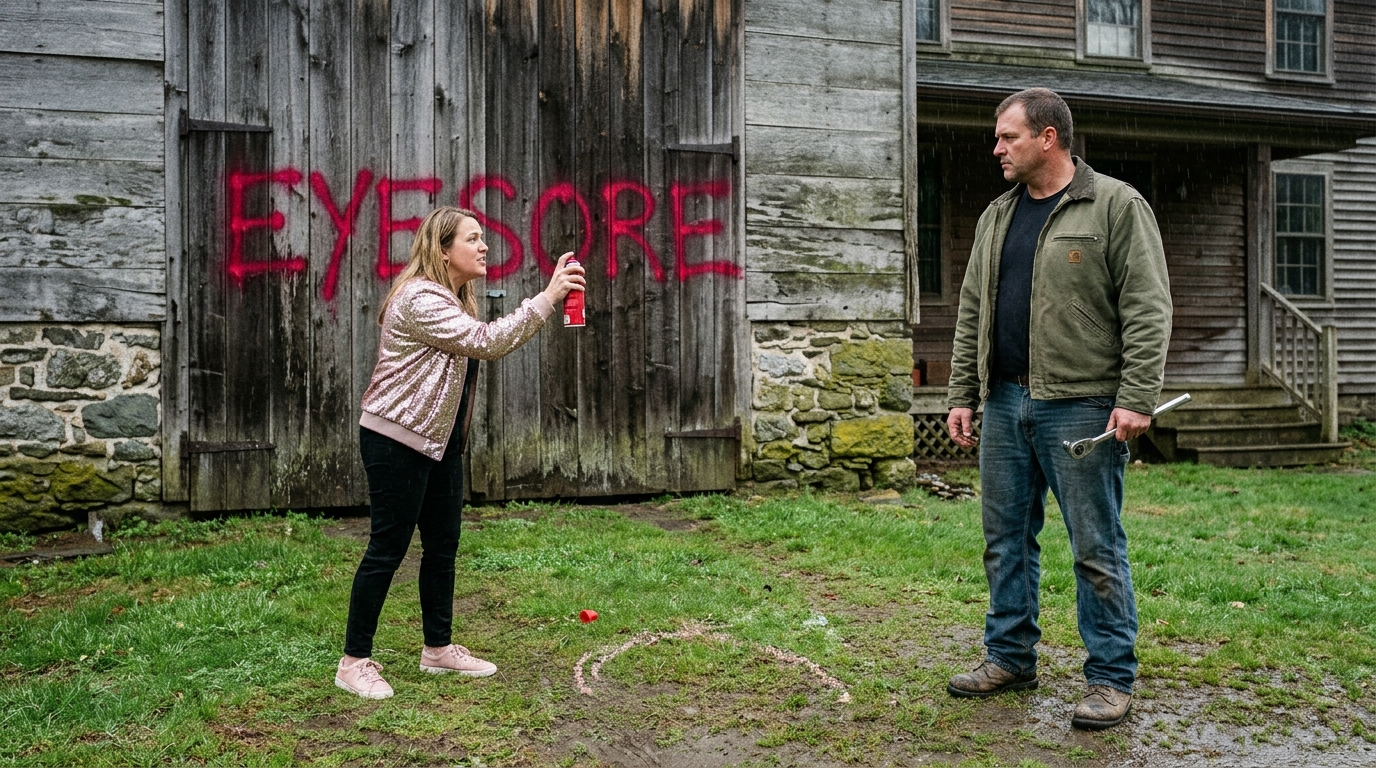
Fresh crimson enamel ran down the gray grain of 150-year-old white oak, pooling in a wet stickiness on the fieldstone foundation. The can hissed one last time. Fifty yards away, wet grass compressed beneath the heel of a pastel pink sneaker.
“That’ll teach you to respect the aesthetic harmony of this community, Major,” she said.
Karen Weatherbee. President of the Golden Meadows Homeowners Association. Her jacket’s pink sequins caught the morning light, glinting like broken glass. In her right hand, she held a cheap can of spray paint. Her thumbs were smudged red.
I didn’t answer. I didn’t step off the porch. In the desert, when a spotter draws a line in the sand, you don’t sprint to cross it. You mark the angle. You check the wind. You check your flanks.
In my right hand, my thumb rolled the heavy steel drive of a half-inch socket wrench. Click. Click. Click. The cold chrome grounded me.
“You’re on my deed,” I said. My voice didn’t rise. It stayed down in my chest, low and flat.
“This entire parcel falls under the master plan,” Karen said. She tapped the aluminum can against her thigh. Clang. Clang. “Your barn is an eyesore. I warned you three weeks ago. Section Four, Paragraph B. Demolition or compliance.”
“The barn was set on fieldstone in 1874,” I said. “The subdivision was cut into the mud six years ago.”
“The Accession Addendum doesn’t care about history, Mr. Davies.” She mispronounced the name again. She always did. It was a petty trick to establish rank. “You’ll receive the formal daily fine by certified mail. $1,000 a day starting at noon.”
She turned on her heel, her sneakers tearing small arcs of green out of my dew-soaked lawn. She walked back toward the paved boundary line where her golf cart sat idling.
I stayed still until her engine faded down the asphalt curve of Cypress Court.
I walked down the three timber steps to the base of the barn. Up close, the paint smelled like solvent and cheap acrylic. She had written EYESORE in jagged, three-foot capital letters across the main double doors.
I didn’t touch the paint. I looked at the ground beneath it.
A fresh boot-print sat pressed into the soft damp soil three inches from the foundation. Small, narrow heel. Diamond-pattern tread. Next to the print lay a small plastic red cap from the spray can, dropped in the grass and forgotten.
Click.
I spun the wrench drive once, setting the ratchet to reverse.
My house was 200 feet back, built from the same heavy oak as the barn. Sarah was inside, probably making Lily’s breakfast. They didn’t need to see this yet. They didn’t need the panic.
I pulled my phone from my canvas work jacket, stepped back six paces, and took three high-resolution shots of the wall. Then I angled the lens down, taking four more of the footprint and the discarded red cap lying in the grass.
The barn’s main support beams were two feet thick. Solid oak, cured over a century and a half. The wood had survived three blizzards, two droughts, and a fire in ’88 that scorched the north ridge. A coat of hardware-store enamel wasn’t going to rot the grain.
The threat wasn’t the paint. The threat was the authority behind it.
I walked back up to the house, wiping my boots on the rough sisal mat at the kitchen door. The smell of frying eggs and dark roast coffee hit me as I opened the screen.
Sarah was at the stove, her dark hair pinned up loosely. Lily sat at the wooden table, her drawing pad open, crayons scattered across the pine surface.
“Did the mail come early?” Sarah asked, turning with a spatula in hand. She looked at my face, and her smile flickered. “Jack? What’s wrong?”
“Nothing,” I said. I set the heavy socket wrench on the counter next to the coffee pot. The steel made a sharp, solid clink on the butcher block. “Going to need to make a few phone calls before the crew arrives.”
“Is it the HOA again?” Sarah set the spatula down. Her knuckles went white against the blue handle. “Jack, we paid the mailbox fine. We filed the engineering report.”
“They don’t want the mailbox, Sarah,” I said smoothly, pouring black coffee into a heavy ceramic mug. “They want the land.”
I didn’t wait for her to process it. I took a sip of the bitter, black liquid, pulled my keys from my pocket, and headed down the hallway toward my office.
I opened my laptop, pulled up the local land registry portal, and typed in our parcel ID. The accession paperwork from the previous owner sat in a PDF folder on my desktop. I opened the file, zoomed in 200 percent on the signature page, and studied the margins.
Near the bottom, beneath the notary seal, sat three small handwritten initials in blue ink: K.W.
Next to it was a reference code written in small, precise script: Escrow Account 409.
I pulled a yellow legal pad out of my drawer, uncapped a black ballpoint pen, and wrote the code down at the top of the page.
Outside, a heavy diesel engine rumbled down the driveway. The headlights swept across my office window, throwing long, hard shadows across the wall.
Marcus Thorne’s heavy dually truck had just pulled up to the barn.
CHAPTER 2: FRICTION IN THE TIMBER
The heavy steel door of the dually slammed shut with a sharp metallic crack that echoed off the damp fieldstone. Marcus Thorne stood in the gravel driveway, his boots sinking an inch into the wet gray stone. Rain was starting to come down hard now, fat drops smacking against the hood of his truck and turning the red enamel spray paint on the barn doors into a glistening, blood-colored smear.
“You’re late,” I said, stepping off the porch into the rain.
“Traffic on Forty-Four,” Marcus grunted, pulling a heavy canvas tool roll from the bed of his truck. He didn’t look at me; he looked directly past my shoulder at the word EYESORE cut into the ancient oak. “Classy. Karen’s handwriting hasn’t improved since middle school.”
“She used a red enamel. Acrylic base,” I said. “Sanded the grain slightly before she sprayed, or the moisture in the wood would have rejected it.”
“She’s methodical,” Marcus said. He unrolled the canvas on the tailgate, revealing a row of hardened steel pry bars, heavy framing hammers, and a heavy-duty impact driver. “Which means she’s scared. People only mark territory like that when they know their title is soft.”
Behind his dually, two more trucks turned into the lane—a beat-up white F-250 and a flatbed hauling two pallets of dark charcoal standing-seam metal roofing. Miller and Hank stepped out, their yellow oilskin coats slick with rain. They were old army guys, combat engineers who had built temporary bridges under mortar fire in the Euphrates valley. They didn’t ask questions about the spray paint. They looked at the pitch of the roof, checked the wind coming off the north ridge, and went straight to work unstrapping the metal sheets.
“We have three hours before her daily fine clock hits noon,” I said, thumbing the heavy socket wrench in my pocket. Click. Click. “She’s going to bring the county sheriff or an injunction.”
“Let her bring both,” Marcus said, pulling a laminated blue folder from inside his jacket. He handed it to me. “I ran the parcel history through the county clerk’s public terminal this morning. The accession agreement she’s leaning on isn’t recorded in the main deed book. It’s filed under a side ledger—The Accession Addendum.”
I took the folder. The paper was cold, damp around the edges from the rain. “What does that mean?”
“It means it was never properly cross-indexed when the developer broke ground,” Marcus said, his voice dropping an octave as Miller started up a gas-powered generator near the barn doors. The engine chugged to life, a steady, rhythmic thrum against the roar of the rain. “The previous owner signed it, sure. But the land transfer was routed through a third-party intermediary called Apex Landscaping LLC before it hit the HOA books.”
I opened the folder. Beneath the copy of the accession document, a line item was highlighted in yellow highlighter: Transfer Fee: $12,500. Destination: Escrow Account 409.
The same code I had found in the margins of my title paperwork an hour ago.
“Apex Landscaping is registered to a P.O. Box in Westford,” Marcus continued, watching Miller set the heavy aluminum extension ladder against the barn’s north wall. “Registered owner is a woman named Brenda Weatherbee. Karen’s sister.”
The ratcheting wrench in my pocket spun three times in rapid succession. Click-click-click.
“She isn’t trying to enforce community standards,” I said. “She’s using the HOA to process land value.”
“She’s skimming,” Marcus corrected cleanly. “The barn is just in the way of her sightlines. If this structure stands, your property stays classified as agricultural historical. If she gets a demolition order, the parcel automatically defaults to commercial-transition under Section Four of the subdivision charter. That opens a corridor straight to the state highway.”
A high-pitched whine cut through the rain as Hank fired up a circular saw, slicing through the rotten cedar shingles at the edge of the eave. Dark, water-logged wood chips rained down into the wet grass, mixing with the red enamel runoff near the fieldstone base.
“Hey! Davies!”
The voice came from fifty yards down the driveway, thin and sharp against the noise of the generator.
Karen Weatherbee was standing at the edge of the asphalt, wearing a bright yellow raincoat over her pink tracksuit. Beside her stood a young county deputy in a pristine beige uniform, his hand resting casually on the plastic grip of his sidearm. His hat was wrapped in a clear plastic cover against the downpour.
I didn’t rush down the driveway. I walked slowly, my boots crushing the wet gravel, Marcus trailing two paces behind my right shoulder like a flanker in a urban stack.
“That’s him, Officer,” Karen yelled, pointing a gloved finger at the ladder leaning against the barn. “Unapproved structural modification! Total disregard for a lawful cease-and-desist order!”
Deputy Miller—no relation to my buddy on the roof—looked uncomfortable. He adjusted his gun belt, his eyes shifting from the red paint on the barn to the four heavy-set men in oilskins working efficiently on the roof beams above.
“Mr. Davies,” the deputy said, raising his voice to clear the sound of the saw. “Mrs. Weatherbee called in a property dispute and an active building code violation.”
“This is a private agricultural structure, Deputy,” I said, stopping six feet short of the property line. “We’re performing emergency structural maintenance on a historical building to prevent water damage from this storm. State Statute 42-A explicitly exempts agricultural maintenance from residential HOA architectural review.”
“That statute doesn’t apply to Golden Meadows!” Karen snapped, her face flushed red beneath her hood. “The Accession Addendum binds this parcel to our board!”
Marcus stepped forward, pulling the blue folder out from under his arm. He didn’t look at Karen. He looked directly at the deputy.
“Deputy, my name is Marcus Thorne. I’m Mr. Davies’s legal counsel. If you attempt to halt work on this structure without a signed injunction from a circuit court judge, you are assisting in the unlawful exposure of a private historic asset to environmental destruction.” Marcus held out a single sheet of paper. “Here is our formal Notice of Preservation filed with the State Historic Preservation Office three hours ago. The barn is under state protection pending a structural audit.”
The deputy looked at the paper, then looked at Karen. “Ma’am… do you have a court order?”
“I am the President of the Association!” she practically shrieked, her voice cracking on the high note. “I have the authority to issue daily fines and halt work!”
“Fines are a civil matter, ma’am,” Deputy Miller said, stepping back half a pace. “If they have a historical filing, I can’t force them off the roof without a judge’s signature. I suggest you contact the board’s legal team.”
“This is absurd!” Karen turned her glare on me, her small eyes dark with a mixture of malice and cold frustration. “You think you’re clever, Major. You think a few sheets of tin and an old lawyer are going to save this heap of rot? By Friday, the board will own the title to this ground.”
She turned and marched back down the wet pavement, her yellow coat flapping in the wind like a torn tarp. The deputy gave me a curt nod, looking almost relieved, and followed her back to his cruiser.
I turned back toward the barn. Up on the roof, Hank and Miller were already dragging the first heavy sheet of charcoal metal into place, the impact drivers humming as the self-tapping screws bit deep into old, dry oak.
“She’s going to court on Thursday,” Marcus said, watching the cruiser pull away into the rain.
“Good,” I said, watching the water run off the fresh metal sheet. “That gives us forty-eight hours to find out what’s inside Escrow Account 409.”
CHAPTER 3: THE NIGHT VISION TRAP
The tail lights of Marcus’s dually disappeared around the curve of Cypress Court, red reflections bleeding out into the wet asphalt before fading entirely.
Rain still rattled against the charcoal metal sheets Hank and Miller had anchored over the barn’s roof beams. The structure was dry now, sealed tight under twelve hundred pounds of cold standing-seam steel. But the lower double doors still wore that wet red scar—acrylic enamel sinking deeper into the dry grain of the oak with every passing hour.
I turned back to the house, my boots dragging a trail of gravel onto the porch mat.
In the kitchen, Sarah had cleared the breakfast plates. Lily was sitting at the counter, her pencil scratching softly against a sheet of wide-ruled paper. She looked up as I stepped in, her eyes flicking to the brass socket driver still tucked into my palm.
“Is the lady in the yellow coat coming back, Daddy?” she asked.
“No, sweetie,” I said, setting the driver down on the butcher block with a dull thud. “She’s done for the day.”
Sarah didn’t speak. She wiped the stainless steel sink with a rag, her motions sharp, repetitive, grinding the wet cloth into the metal until it squeaked. Her thumb pressed so hard against the rim that the nail showed white under the skin. She was terrified of the bank notices, terrified of the certified mail that arrived every Tuesday like clockwork.
I touched her shoulder once—a brief, dry pressure—and walked past her into my office.
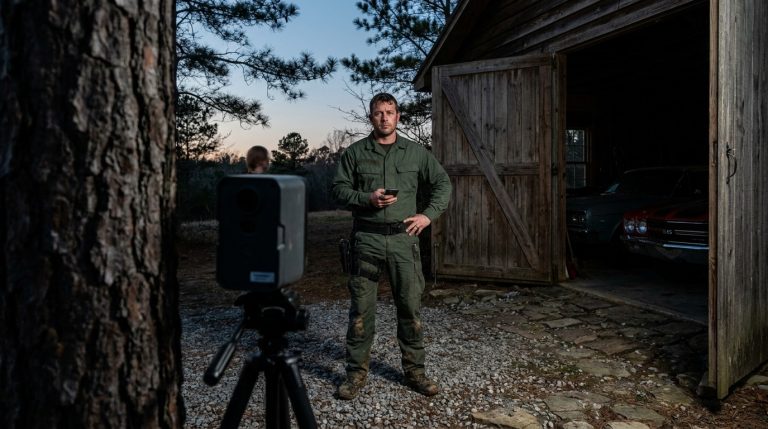
The room smelled of old paper and lukewarm coffee. On the oak desk sat four black hard-shell cases, freshly unboxed. Inside were four wide-angle infrared security cameras, industrial grade, encased in cast-aluminum housing rated for sub-zero impact.
I didn’t call an installation crew. I didn’t register the devices on the home network router.
I spent the next two hours running shielded coaxial cable through the crawlspace, drilling low-profile quarter-inch entry holes through the barn’s soffits, and anchoring the brackets high beneath the overhangs. Camera One covered the main approach from the subdivision sidewalk. Camera Two locked onto the fieldstone foundation and the defaced oak doors. Camera Three swept the dark corridor between the tree line and the north wall. Camera Four hung ten feet up inside the barn’s central aisle, its lens aimed through the loft window straight toward Karen Weatherbee’s back patio.
By 2100 hours, the house was dark. Sarah and Lily were asleep down the hall.
I sat in the swivel chair in my office, illuminated only by the faint green back-glow of a standalone 1080p monitor. The unit wasn’t hooked to the internet; it drew power from an isolated uninterrupted power supply on the floor and fed directly to a high-capacity solid-state drive mounted behind the desk frame.
On the screen, four green-tinted quadrants flickered in the dark. The night-vision illuminators bounced off the rain-slick grass, turning the lawn into a pale, glowing field.
2200 hours passed. The generator hummed softly from the garage, charging the back-up battery bank.
2315 hours. A stray dog crossed the corner of Frame One, its eyes burning like white embers in the infrared beam before it trotted north toward the highway.
I leaned forward, pulling a fresh legal pad toward me. On the top line, I wrote the date and the exact time stamp showing in the lower right corner of the feed: 23:42:01.
Then I noticed the discrepancy.
Frame Four—the internal view looking out through the loft window—showed a faint, periodic drop in frame rate. Every forty-five seconds, the timecode skipped two milliseconds. It wasn’t a mechanical glitch in the camera. It was a local frequency signal interference coming from outside the barn, bleeding through the unshielded wire of the HOA’s street lamp fifty yards away.
A wireless bridge. Someone was tapping into the local utility pole network.
My thumb clicked the brass socket driver twice in the dark. Click. Click.
At 02:14 hours, a shadow detached itself from the gap between two garage walls on Cypress Court.
It didn’t use the sidewalk. It moved along the shadow of the cedar fence, staying low, heavy boots dragging slightly through the wet turf. The figure wore a dark rain jacket with the hood pulled tight around its face, carrying a small, heavy tote bag in its left hand.
Frame One picked up the entry. I zoomed the digital crop in 300 percent.
The gait was heavy on the right heel. A pronounced left-side compensation—the exact physical footprint I had photographed in the damp mud beneath the barn doors twelve hours prior.
The figure reached the edge of my property line, paused under the overhang of the ancient oak tree, and looked up toward the house. My office window was blacked out with heavy canvas drapes, but a faint leak of light showed around the frame. The intruder stared at that sliver of light for six seconds, assessing the threat.
Then the hood slid back two inches to clear the line of sight.
In the pale green glow of the infrared sensor, the features locked into high resolution: the tight, thin lips; the deep-set lines around the nose; the pale, blotchy skin of a woman who hadn’t slept in forty-eight hours.
Karen Weatherbee.
She unzipped the tote bag, pulled out a fresh aluminum aerosol can, and shook it once. The sound didn’t carry through the glass of my office, but on the audio track of Camera Two, the high-pitched rattle of the internal mixing ball registered as a sharp spike on the waveform monitor.
She stepped up to the fieldstone base, raised the nozzle, and began spraying over the fresh metal trim Hank had installed that afternoon.
I didn’t leap out of my chair. I didn’t flip the exterior floodlights. I didn’t charge out the back door with a flashlight.
I reached out, clicked the mouse, and set the recording frame rate from 30 to 60 frames per second, locking the focal plane directly onto her right hand. On the screen, the blue ink mark on her thumb—the signature mark from The Accession Addendum ledger—was clearly visible against the white plastic body of the spray can.
She worked for three minutes, her shoulders shaking with a rapid, frantic energy, painting long red strokes across the clean gray steel.
When she finished, she didn’t run. She stood back in the rain, wiping her forehead with the back of her sleeve, staring at the destruction with a strange, hollow satisfaction. She took two steps backward, dropped the empty can into her tote bag, and turned to walk back toward the subdivision.
Except she didn’t put the cap back on.
As she turned, the plastic red cap slipped from her coat pocket, bouncing once off the wet fieldstone before settling into the deep grass right next to the footprint she had left that morning.
On the monitor, the timecode read 02:21:04.
I pressed the record lock button on the hard drive. A small green LED on the front panel turned solid red, indicating the file was encrypted and written to non-volatile memory.
I stood up from the desk, pulled my heavy work coat off the back of the chair, and reached for the keys to Marcus Thorne’s office.
The midpoint trap was set. The decoy secret—her petty vandalism and zoning harassment—was recorded in crystal-clear digital detail. But as I stared at the frozen image of her thumb on the spray can, I saw the secondary label on the aluminum chassis sticking out of her bag: a commercial shipping tag marked Property of Apex Landscaping LLC.
The leak wasn’t coming from the HOA. It was coming from inside her sister’s books.
CHAPTER 4: PAPER TRAIL TRAPS
The key ring clinked against the brass socket driver in my pocket as I grabbed it off the desk.
On the monitor, the timestamp read 02:21:04, locked under a solid red status LED. Outside, the rain had turned into a steady, freezing drizzle that rattled against the glass like thrown sand. I pulled my heavy canvas jacket over my shoulders, zipped it to the chin, and stepped out the side office door into the dark garage.
Five minutes later, my truck’s tires crushed the wet gravel of Marcus Thorne’s driveway three miles down the ridge.
His porch light was already on. Through the front window, I could see him sitting at his dining table under a low hanging lamp, surrounded by open manila folders and legal pads. He opened the front door before I reached the top step, holding a steaming mug of black tea.
“You’re moving fast for three in the morning,” Marcus said, stepping back to let me in. The warm air inside smelled of tobacco and damp paper.
“She came back,” I said. I pulled an encrypted thumb drive from my pocket and set it on the polished mahogany table next to a stack of bank ledger copies. “Camera Two got her in sixty frames a second. Clear face, clear thumbprint, clear paint brand.”
Marcus picked up the drive, weighed it in his palm, and set it next to a spread of corporate filings. “That gives us the criminal trespass and property destruction. A slam dunk for Deputy Miller.” He paused, his thumb rubbing the corner of a yellow ledger page. “But that’s just the decoy. Look at this.”
I leaned over the table, resting my forearms on the wood.
Spread across the table were three years of certified bank disclosures from the Golden Meadows HOA main operating fund, obtained through the state auditor’s portal after Marcus threatened a mandamus filing.
“The board’s official reserve balance sits at four hundred and twelve thousand dollars on paper,” Marcus said, pointing a thick pen at a column of figures. “Supposed to be set aside for road repaving and storm drain maintenance. But look at the routing numbers on the outgoing disbursements.”
I followed the tip of his pen.
Every quarter, a flat sum of eighteen thousand dollars moved out of the primary reserve into Escrow Account 409. From there, within forty-eight hours, the funds were split into three separate wire transfers. Forty percent went to Apex Landscaping LLC for “seasonal grounds management.” Thirty percent went to a vendor called Cedar Ridge Contracting for “court maintenance.” The remaining thirty percent bounced through a regional clearing house directly into a personal line of credit registered to Karen Weatherbee.
“She isn’t just skimming the access fees,” I said, my voice dropping. “She’s hollowed out the entire association reserve.”
“Half a million dollars over four years,” Marcus said flatly. “And here’s the trigger: the county water district is running a main pipeline down the state highway next spring. They require a hundred-foot easement. If your barn sits on agricultural land, the county pays you for the land rights. But if the board forces a demolition order under The Accession Addendum, your parcel defaults to community common-ground.”
“And the county pays the HOA,” I said.
“The county pays Escrow Account 409,” Marcus corrected, tapping the paper. “Six hundred thousand dollars in public eminent domain funds. Enough to fill the hole in the reserve before the annual state audit in November and leave her with a clean sixty-thousand-dollar profit.”
The brass ratchet in my pocket clicked once in the quiet room. Click.
The entire structure of her campaign—the daily fines, the mailbox violations, the certified letters, the middle-of-the-night spray painting—wasn’t a suburban power trip. It was an emergency cover operation for a half-million-dollar embezzlement scheme that was eighty days away from collapsing under a state audit.
“She’s backed into a corner,” Marcus said, leaning back in his chair. “A cornered bureaucrat with half a million in fraud on her neck doesn’t negotiate. She accelerates.”
“Then we cut the timeline,” I said.
I reached across the table, grabbed a fresh sheet of legal paper, and pulled Marcus’s pen toward me.
“Draft three documents right now,” I told him. “First, a civil complaint for malicious prosecution and property destruction naming her personally, backed by the video drive. Second, a formal demand for an emergency injunction halting all HOA board actions pending an independent forensic audit.”
“And the third?” Marcus asked, his eyes narrowing.
“The draft of a class-action lawsuit on behalf of every homeowner in Golden Meadows for breach of fiduciary duty and fraud,” I said. “We don’t file it with the court clerk yet. We hand-deliver all three to her foyer at eight o’clock this morning.”
Marcus stared at me for three seconds, then a slow, cold grin spread across his face. He picked up his pen, unclipped his tablet, and pulled a fresh stack of legal pleading paper out of his briefcase.
“Eight o’clock,” he said. “I’ll have the sheriff’s deputy on standby in the driveway.”
Outside, the rain began to taper off, replaced by the pale, cold gray of a November dawn breaking over the ridge.
CHAPTER 5: THE TENMINUTE CHECKMATE
The heavy brass lion-head knocker struck the dark mahogany door twice, the sound echoing through the cavernous foyer of Karen Weatherbee’s house like a hammer on a cold anvil.
Outside, the cold morning mist hung thick over the manicured hedges of Cypress Court. Deputy Miller’s patrol car sat at the curb, its engine idling silently in the driveway, exhaust curling up into the gray air.
“Eight o’clock sharp,” Marcus said softly, adjusting the lapels of his dark charcoal suit. He carried a heavy leather briefcase in his left hand. “She’s inside. I saw the curtain twitch.”
I didn’t answer. In my right jacket pocket, my thumb spun the chrome drive of the socket wrench once. Click.
The deadbolt turned with three distinct metallic clicks. The heavy door swung open six inches.
Karen stood in the gap, wearing a silk dressing gown, her hair pulled back into a messy knot. Her face was pale, dark circles bruising the skin beneath her eyes. When her gaze landed on me, her mouth hardened into a thin, white line. Then her eyes shifted to Marcus’s suit and the leather briefcase, and a sharp flicker of hesitation crossed her features.
“What do you want?” she snapped, her voice tight, devoid of its usual sing-song cadence. “I’m not discussing board business without the association attorney present.”
“We aren’t here for board business, Karen,” Marcus said smoothly. He didn’t push the door, but he set his foot firmly against the threshold, locking the frame in place. “My name is Marcus Thorne. I represent Mr. Davies.”
“I have nothing to say to you,” she said, attempting to lean her weight against the door.
Marcus held the mahogany panel steady with two fingers against the brass trim. “You can hear us out right here, or we can step inside. If we leave this doorstep, the next conversation happens in a deposition room after we file this with the county clerk.”
He pulled a thick, stapled document from his briefcase. The cover page bore large, bold lettering: CIVIL COMPLAINT: DAVIES V. WEATHERBEE (INDIVIDUAL CAPACITY).
Karen’s jaw twitched. “That’s ridiculous. You can’t sue me personally for board actions. The board has liability coverage.”
“HOA insurance covers negligence, Karen,” Marcus said, his voice dropping into a low, implacable register. “It explicitly excludes intentional criminal acts.”
He reached into his jacket, pulled out a seven-inch tablet, tapped the screen once, and held it up three inches from her face.
The screen lit up with green-tinted infrared video. On the display, Karen—dressed in her dark hoodie—staggered across my wet lawn under the cloak of night, raised a spray can, and methodically defaced the barn wall. The timecode burned brightly in the corner: 02:21:04.
Karen’s skin drained of color. Her lips parted, but no sound came out. Her right hand, holding the edge of the door, began to tremble.
“That’s… that isn’t real,” she stammered, her voice cracking. “That’s a digital fabrication.”
“Deputy Miller is standing at your driveway gate,” Marcus replied flatly. “He holds the chain-of-custody log for the spray can recovered from the community dumpster behind the clubhouse—the one bearing your right thumbprint over the label from Apex Landscaping LLC. We also have the paint chip analysis from the fieldstone foundation. The felony warrant for criminal mischief and historic property destruction is drafted. It only needs the judge’s signature.”
She backed up two paces into the foyer, her knees visibly shaking beneath the silk gown. “You… you can’t do this over a barn.”
“It was never about the barn, was it?” I said, stepping into the foyer. My boots clicked sharply against her white marble tile. “The barn was just sitting on the easement you needed to cover the hole in the accounts.”
Marcus pulled a second, even thicker dossier from his briefcase, setting it down on her glass-topped foyer table with a sharp, heavy thud.
“This is the draft for a class-action lawsuit on behalf of all seventy-four homeowners in Golden Meadows,” Marcus said, pointing to the line items. “Breach of fiduciary duty. Wire fraud. Embezzlement. We traced the quarterly disbursements from the main operating fund through The Accession Addendum ledger straight into Escrow Account 409.”
Karen collapsed into an ornate armchair near the coat rack, her hands clutching her head. “No… no, you don’t understand…”
“We understand completely,” Marcus said. “You used your sister’s shell company to siphon half a million dollars out of the reserve fund. You needed the county highway easement money to replace the missing capital before the state audit in November.”
The foyer went completely silent except for the frantic, ragged sound of her breathing. The illusion of her petty suburban power was entirely gone, stripped away to reveal a desperate, cornered thief facing five to ten years in a state penitentiary.
“What…” She looked up, her eyes wide, watery, brimming with pure terror. “What do you want?”
Marcus pulled three single-page documents from his briefcase and laid them out neatly beside a silver pen on the marble table.
“Terms of absolute settlement,” Marcus said. “You have ten minutes.”
“First,” Marcus instructed, “you will write a personal check from your private asset account—not the HOA—to Mr. Davies for the sum of two hundred and seventy-five thousand dollars. That covers the chemical restoration of the timber, our full legal fees, and punitive damages for malicious harassment.”
Karen flinched as if struck, but Marcus didn’t pause.
“Second, you will execute this letter of immediate resignation from the presidency and the architectural review committee. Third, you will sign a sworn affidavit admitting to the vandalism, which we will hold in escrow. If you ever break this agreement, it goes straight to the District Attorney.”
“Two hundred and seventy-five thousand…” she whispered, her voice hollow. “It will wipe out my personal savings.”
“It leaves you enough to sell this house and leave the county,” I said, staring down at her. “Which brings us to the final term. Your house goes on the market within thirty days. You are done in this community.”
She sat frozen for forty seconds, watching the second hand sweep across Marcus’s watch. She looked at the video still frozen on the tablet, then at the deputy standing near his cruiser outside her window.
“My checkbook…” she choked out. “It’s in the desk.”
She stood up slowly, her body moving like an old machine lacking oil. She walked to the small mahogany desk in the corner, pulled out a leather-bound checkbook, and sat down. Her hand shook so violently she had to rest her wrist against the blotter to stabilize the pen.
I watched the ink transfer to the paper.
Payable to Jackson Davies.
Amount: $275,000.00.
Her signature at the bottom was a jagged, desperate scrawl—the final stroke of a pen that dismantled her reign over Golden Meadows in three seconds.
She tore the check from the book with a soft, paper-ripping sound and pushed it across the marble top. Marcus inspected every line, confirmed the routing numbers against his bank file, and nodded.
Then she signed the resignation letter. She signed the affidavit. She signed the settlement agreement.
“The video stays private,” Marcus said, gathering the signed originals into his briefcase. “The class-action filing is suspended, provided the board completes a full independent audit without your interference. Have a good day, Mrs. Weatherbee.”
We turned and walked out the front door, leaving her sitting alone in her cavernous, quiet foyer.
CHAPTER 6: IRON OAK AND QUIET GROUND
Marcus snapped the brass latches of his leather briefcase shut, the sound cutting through the morning stillness of Karen Weatherbee’s driveway.
Deputy Miller leaned against the fender of his cruiser, watching us walk down the curved brick path. He didn’t ask what was inside the briefcase or why Karen’s front door slammed shut behind us with a desperate, heavy thud. He simply looked at my face, took a slow breath of the cool autumn air, and gave a single nod.
“Everything squared away, Jack?” the deputy asked softly.
“It’s settled,” I said. “You won’t be called out to Cypress Court again.”
He nodded once more, pushed off the fender, and climbed into his vehicle. The engine turned over with a low purr, and the cruiser rolled slowly down the asphalt, leaving Marcus and me standing beside his dually in the quiet morning light.
Marcus looked down at the certified bank draft resting inside his jacket pocket. “The check clears in forty-eight hours. The resignation letter and the affidavit are already secured in my office safe. Her house will have a ‘For Sale’ sign on the lawn by Monday.”
“What about the association?” I asked, my hand resting against the cold steel tailgate of his truck.
“The board’s vice president received a copy of the audit summary an hour ago,” Marcus said, pulling his keys from his pocket. “They’re holding an emergency session tonight to dissolve the architectural review committee and freeze all disbursements to Apex Landscaping LLC. Every dollar siphoned through Escrow Account 409 will be clawed back through civil recovery. The Accession Addendum is dead letter.”
He opened his truck door, set his briefcase on the passenger seat, and turned to look at me. “You fought this like a combat zone, Davies.”
“It’s just land, Marcus,” I said, thumbing the brass socket driver in my pocket. “You hold your ground or you don’t.”
He grinned, climbed into the cab, and fired the engine. The dually pulled away, its heavy tires crunching over the wet gravel before merging onto the main road toward town.
I walked the three hundred yards back to my parcel on foot.
The morning sun had cleared the ridge, casting long, sharp shadows across the dew-covered grass. In the sunlight, the barn stood tall against the clear blue sky. The new charcoal standing-seam metal roof gleamed, straight and dark, replacing the sagging cedar shingles Hank and Miller had torn away.
At the base of the doors, two men from the historic restoration firm were already at work. They didn’t use power sanders or harsh wire brushes. They worked with soft chemical poultices and hand scrapers, painstakingly drawing the red acrylic paint out of the porous white oak without marring the ancient grain underneath.
The harsh crimson letters—the mark she had left in the dark—were fading into thin red streaks, washing away into the dirt until only the dark, silver-gray wood remained.
I walked past them, stepped through the side pedestrian door, and stood in the central aisle of the barn.
The air inside smelled of cured timber, sawdust, and the rich, earth scent of dry fieldstone. Sunlight streamed through the high loft windows, cutting bright dust-moted beams across the concrete floor. Overhead, the main oak beams—two feet thick, notched and pegged by hand a hundred and fifty years ago—held the weight of the structure with absolute silence.
I walked over to my workbench in the corner, set my jacket over a stool, and picked up a hand plane.
The steel blade was slightly dull from the week’s dampness. I sat on the wooden bench, pulled a medium-grain sharpening stone from the drawer, and applied three drops of mineral oil to the gray surface.
Slink. Slink. Slink.
I worked the steel blade across the stone in smooth, steady figure-eights, feeling the edge refine under my thumb.
The house door creaked open outside, and a moment later, light footsteps crossed the threshold of the barn.
Sarah walked in, carrying two ceramic mugs of hot coffee. She wore her thick wool sweater, her dark hair catching the warm sunlight from the loft. Behind her, Lily ran straight toward the wooden staircase leading to the loft studio, her sneakers squeaking on the fresh pine boards.
“Can I set my easel up by the south window, Daddy?” Lily called down, her voice echoing off the soaring oak rafters.
“Far south window is yours, Lily,” I called back. “Watch the step on the landing.”
Sarah set one of the mugs on the corner of my workbench, right next to the brass socket driver. She didn’t look at the paper files or ask about the bank draft. She looked at the main doors where the restorers were finishing their work, then up at the high, solid oak trusses overhead.
“It’s quiet,” she said softly, her hands wrapped around the warm mug.
“It’s going to stay quiet,” I said, laying the sharpened plane blade back into its cast-iron body and tightening the brass thumbscrew until it locked.
She leaned against the edge of the workbench, watching me adjust the depth of the iron. “No more certified letters?”
“No more letters. No more fines. The board belongs to the neighborhood now.” I took a sip of the hot black coffee, feeling the heat settle deep in my chest. “The barn is ours, Sarah. Every beam, every stone.”
A faint smile touched the corners of her eyes—the first real smile I had seen on her face since the first white envelope arrived in January. She reached out, touched my arm, and then turned to head up the stairs to help Lily set up her painting canvases in the sunlit loft.
I stood alone at the workbench for a moment, listening to the soft scrape of Lily’s easel legs against the pine floor above and the quiet hum of the autumn wind against the new steel roof.
I picked up a scrap block of rough-hewn white oak, clamped it into the bench vise, and set the sole of the hand plane against the edge.
I leaned forward, driving the plane smooth and flat across the wood. A long, thin curl of fresh oak shaved off the top, falling softly onto the workbench, revealing the clean, unblemished grain underneath.
The land was quiet. The iron was set. The ground was ours.