The Ghost of Mamba 5: A Silent Reckoning Beneath the Weight of Buried Military Secrets
CHAPTER 1: The Long Shadow
The rain began as a thin, gray veil over the D.C. sprawl, turning the asphalt into a slick, obsidian mirror. Elias Vance sat in the passenger seat of a nondescript taxi, his hands folded neatly over the silver pocket watch resting in his lap. The glass face, etched with a jagged, starburst fracture, seemed to catch the passing streetlights, splintering the illumination into cold, sharp slivers.
He wasn’t looking at the city. He was looking at the way the driver’s knuckles tightened on the steering wheel every time they stopped. The man was young, nervous, and glancing at the rearview mirror with a frequency that betrayed his lack of training. He was a tail, but a clumsy one.
“You’re making a mistake, son,” Elias said. His voice was steady, cutting through the low hum of the windshield wipers like a blade through silk.
The driver jumped, his shoulders hunching toward his ears. “I—I don’t know what you’re talking about, sir. Just taking you to the station.”
“You’ve taken the same left turn three times,” Elias noted, his gaze tracking the silhouette of the black SUV that had been tracking them since they pulled out of the cemetery gates. It stayed exactly three car lengths back, maintaining a distance that suggested professional surveillance rather than curiosity.
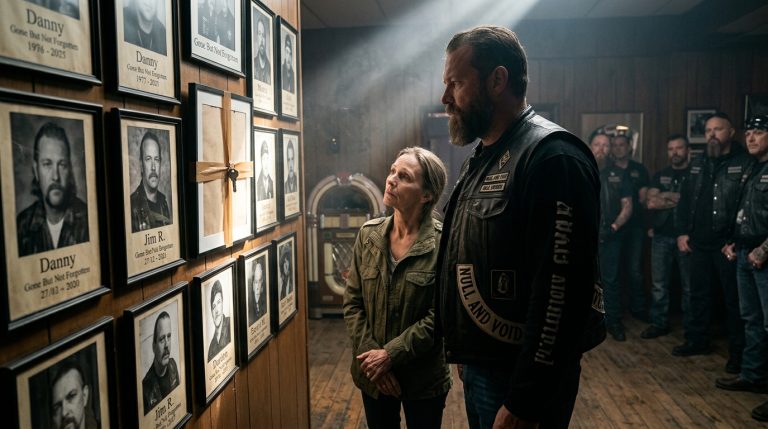
Elias felt the familiar, cold weight of the past settling into his joints. The funeral had been a public performance, a necessary catharsis for the family, but it had also signaled his return to a board where he was once a master piece. The military establishment didn’t just want him gone; they wanted him categorized, filed, and buried alongside the general.
He reached into his breast pocket and withdrew a small, laminated card—the credentials he had been handed by Colonel Davies as he left the cemetery. It was a temporary pass, supposedly granting him access to the general’s private archives. Elias turned it over, his thumb tracing the embossed seal. It felt too light. Too smooth.
He didn’t need to be a cryptographer to know that the seal was a digital tracker.
“Pull over,” Elias said, his voice dropping into the command register that had once made entire platoons move as one.
“I can’t, sir. I have orders to—”
Elias leaned forward, placing a single, calloused finger on the driver’s shoulder. The effect was immediate; the man’s breathing hitched, his entire body locking into a rigid, paralyzed state. It wasn’t physical force—it was the projection of absolute, unassailable presence.
“You have a choice,” Elias murmured, his eyes fixed on the black SUV now slowing to a crawl fifty yards behind them. “You can continue this charade and find yourself answering for a security breach that will end your career before it begins, or you can drop me at the next corner, turn your car around, and report that you lost me in the traffic.”
The driver looked at the rearview mirror, then at the man beside him. He saw the cold, dark soil of Elias’s eyes, and he saw the abyss. He didn’t argue. He signaled sharply and drifted toward the curb.
As the door clicked open, the damp air of the city hit Elias like a physical blow. He stepped out onto the concrete, the sound of his footsteps muffled by the rhythm of the rain. He stood for a heartbeat, feeling the vibration of the black SUV’s engine as it surged forward, realizing its prey was no longer in the vehicle.
Elias walked into the narrow, shadowed mouth of an alleyway, his movements economical, fluid. He reached the end of the passage and stopped, turning his head just enough to see the SUV brake hard at the curb. Two figures stepped out, dressed in the dark, featureless suits of institutional enforcers.
They looked toward the taxi. Elias looked toward the heavy, iron door of a nearby service entrance, noticing a small, fresh scrape on the lock—a sign that someone had been there within the hour.
He realized then that the archive access card wasn’t just a tracker. It was a beacon, and someone had already triggered the silent alarm inside.
CHAPTER 2: The Silent Threshold
The rain didn’t fall so much as it materialized, a freezing mist that coated the brickwork of the alley in a slick, dark sheen. Elias stood before the iron door, his fingers hovering just millimeters from the metal. He could feel the cold radiating from it, a biting contrast to the phantom warmth that suddenly bloomed in his chest—a memory of humid jungle air, the smell of damp rot, and the claustrophobic thickness of a night mission.
CHAPTER 2: The Architecture of Silence
The iron door didn’t groan when Elias pushed; it yielded with the calculated silence of a well-oiled machine. This wasn’t a random service entrance; it was the rear access to the Metropolitan Archives, a brutalist concrete monolith that housed the city’s most sensitive paper records.
Elias stepped inside, his boots finding no purchase on the slick floor, but his balance remained absolute. He pulled the door shut just as the heavy, rhythmic thud of car doors echoed from the alley. They were out. They were searching. He didn’t need to look back to know the two men in the featureless suits were moving with the synchronized, predatory gait of agency cleaners.
The hallway was a cavern of fluorescent hum and sterility. The air here tasted of ozone and aging cellulose, a sharp, metallic tang that for a fraction of a second dissolved into something else. The smell of damp, rotting palm fronds and the thick, suffocating heat of a night jungle in 1974 washed over him. He saw the flicker of a distant muzzle flash in the dark, the silhouette of a younger Thorne—Wally, back then—clutching a map that was bleeding ink. The memory was intrusive, a phantom limb of a life that was supposed to have been incinerated in the furnace of history.
Elias blinked, and the jungle vanished. He was back in the sterile white hallway, his fingers tracing the edge of his pocket watch. He hadn’t come here to relive the dead; he had come to verify why they were currently being exhumed by those who wanted them buried permanently.
He walked with an economy of motion that wasted nothing. He knew the building’s layout. He knew the cameras, not because he had blueprints, but because he understood how people built cages. They always left gaps in the line of sight, blind spots created by the arrogance of believing they were the only ones who knew how to secure a perimeter.
He moved toward the archives wing, avoiding the main atrium. Every shadow he stepped into seemed to absorb his presence. Behind him, he heard the faint, rhythmic scrape of shoes on concrete. They were inside.
He reached the heavy steel cage that barred the lower archive levels. It was locked with a digital keypad, a modern refinement over the old mechanical tumblers. He didn’t have a code, but he had the card Colonel Davies had provided. He pulled it from his pocket, noting the slight unevenness in the lamination. It was a beacon, yes, but beacons worked both ways. If it emitted a signal to track him, it also contained the handshake protocol to interface with the system.
He jammed the card into the reader. The light blinked amber, then green. The lock clicked, a sound that seemed to shatter the silence of the corridor.
As he stepped into the subterranean depths of the archives, the temperature plummeted. Here, the records were kept at a constant, chilling humidity to preserve the brittle paper. He bypassed the index terminals—too slow, too exposed—and headed straight for the restricted section labeled ‘Logistics: Special Projects 1970-1980’.
His heart, a slow, steady drum, didn’t quicken. He wasn’t afraid. He was cold, a sensation that originated from the realization that his friend, the man they were burying today, had been trying to reach these very shelves before his ‘natural’ death.
He pulled the drawer open. The files were there, neatly arranged, but they were empty.
A hollow, synthetic sound echoed from the corridor behind him—the high-pitched whine of a security drone activating. He hadn’t just tripped a silent alarm; he had walked into a trap that had been waiting for the exact moment the beacon entered the building. The folders were not empty because they were missing; they were empty because they had been scrubbed clean.
Elias stood still, his hands resting on the edge of the metal drawer. He had assumed he was tracking the past. He realized now that he was being guided into a cul-de-sac. He wasn’t the hunter; he was the primary evidence, and the net was tightening. He closed his eyes and listened, not to the drone, but to the silence that followed. There were footsteps approaching, but not the frantic pace of the agency men from the alley. These were measured, heavy, and accompanied by the faint, distinct click of a safety being disengaged.
He had expected a cleanup crew. He had been met by a surgical strike. Elias pivoted, his shadow stretching long and distorted against the wall of files, and prepared to meet the person who had been holding the other end of his history for forty years.
CHAPTER 3: The Audit
Elias didn’t turn. He listened, his body angled toward the darker recesses of the shelf rows. The footsteps were rhythmic, heavy, and lacked the hesitation of a subordinate. He counted the stride: slow, deliberate, each heel-strike echoing against the polished concrete with a dull thud.
He reached into the empty drawer he had just opened and pushed the metal backing hard with his thumb. It was a standard-issue storage unit, but the slide mechanism was stiffer than it should have been. With a sharp, practiced click, the back panel dropped into the space behind the cabinet.
CHAPTER 3: The Audit
The fluorescent lights overhead shuddered, a staccato pulse of light that made the world seem to move in frames rather than a continuous flow. Elias stood motionless in the center of the restricted aisle, his hand still resting on the cold, empty steel of the file cabinet drawer. The silence that followed the drone’s activation was heavy, pressurized by the knowledge that he was no longer just an observer. He was a variable that needed to be zeroed out.
He didn’t turn around immediately. He used the reflection in the polished steel of the adjacent cabinets. A figure moved in the periphery of the aisle, long, elongated shadows dancing across the floor. The lights flickered again, and for a fleeting, disorienting second, the person approaching seemed to possess a stature that shifted—now tall and commanding, now hunched and weary. It was an optical trick of the light, a symptom of a mind that had spent too many years parsing reality from the distortions of high-stakes environments.
“You’re checking files that haven’t existed for decades, Sergeant Major,” a voice said. It was smooth, devoid of inflection, and carried the practiced authority of someone who had never had to raise their voice to be obeyed.
Elias turned, his movements slow, deliberate, and entirely calm. A man stood at the end of the aisle. He was dressed in a suit that cost more than most people made in a year, his gray hair cropped with military precision, and his hands resting comfortably at his sides. He wasn’t holding a weapon. He didn’t need to. He held the archive, the building, and the narrative.
“They existed this morning,” Elias replied. His voice was a low, steady hum, entirely unaffected by the man’s presence.
“They existed as ghosts,” the man countered, stepping forward into the pool of light. He was Julian Vane, a name Elias had heard whispered in the deepest, darkest channels of the Agency during the waning years of the Cold War. Vane was a curator of secrets—a man who didn’t fight wars, but decided which parts of them were fit for public consumption. “Ghosts are meant to stay in the periphery, Elias. Why did you insist on stepping into the light?”
“Because the light is where the truth belongs.”
Vane smiled, a thin, bloodless expression that didn’t reach his eyes. “Truth is a commodity, Sergeant Major. Like gold or oil. It has a price, and more importantly, it has a shelf life. Thorne knew that. He spent forty years enjoying the security that his silence purchased. Why would you try to destroy his legacy just as it’s being codified?”
Elias felt the weight of his pocket watch in his pocket. The cracked glass was a physical anchor, a testament to the reality of what had been sacrificed. “Thorne didn’t want to be codified. He wanted to be remembered for what he was, not what you manufactured.”
Vane chuckled, a dry, rasping sound. He reached into his jacket pocket, but Elias’s posture barely shifted—a subtle, microscopic redistribution of weight that made him ready to react to any kinetic escalation. Vane produced not a weapon, but a sleek, matte-black tablet. He tapped the screen, and the aisle lights dimmed, focusing the illumination onto the floor between them.
“I have the digital trail of your visit,” Vane said, his tone turning transactional. “I have the logs showing a breach by a retired non-commissioned officer who, due to his classified history, technically has no legal right to exist on these premises. I can make this look like a mental breakdown, or I can make it look like a tragic incident. You are the architect of the Mamba operations, Elias. You know as well as I do that you are the last living proof of the ‘unauthorized’ protocols. If you walk out of here, you aren’t just walking out of an archive. You are walking into a terminal conflict.”
Elias looked at the man. He saw a mirror image—not of his physical self, but of the burden. Vane was also a prisoner of the secrets he kept. He was just as much a captive of the Mamba shadow as Elias was, only he had chosen to be the warden rather than the prisoner.
“You’re afraid,” Elias observed. The observation wasn’t a taunt; it was a cold, clinical fact. “You’re afraid that if the truth surfaces, the entire structure you’ve spent your life maintaining will collapse under its own weight.”
Vane’s eyes tightened, the only sign of the ripple Elias had caused in his composed exterior. “I am managing a necessity.”
“You’re managing a corpse,” Elias said. He began to move. He didn’t rush toward Vane, nor did he retreat. He walked directly toward the exit, forcing Vane to either step aside or engage.
Vane didn’t move. He stood his ground, his hand hovering near his jacket again. As Elias closed the distance, the air grew thick with the anticipation of a violent collision. Elias was five feet away, then four. He could see the pulse thumping in Vane’s neck. Three feet. Two.
Just as Elias reached him, Vane stepped back, his face a mask of calculated indifference. “Go, then. But realize this, Sergeant Major: the archives weren’t scrubbed because we feared what you would find. They were scrubbed to lead you to the exact conclusion you’ve just reached. You’re a ghost in a maze of our design, and every step you take only confirms the narrative we’ve already written for you.”
Elias walked past him, his shoulder brushing against Vane’s, a deliberate, grounding contact. He didn’t look back. He exited the vault, the cold air of the corridor greeting him like a reprieve. He had the truth of the empty files, but he now possessed a more dangerous realization: Vane hadn’t been protecting the archives. He had been waiting for Elias to confirm his role in the drama.
Elias reached the stairs, his mind already calculating the path of least resistance to the one person who hadn’t been part of the system’s design—the analyst he had met years ago, the one who kept the paper files that no digital scrub could reach. He stepped out into the night, the rain now a downpour, and began the long walk toward the city’s forgotten industrial quarter.
CHAPTER 4: The Transit Veins
The rain had intensified into a driving deluge, turning the D.C. streets into a blurred montage of neon streaks and shimmering puddles. Elias stepped out of the archive building’s shadow and into the suffocating humidity of the night. He didn’t hail a cab. He didn’t check his phone. He moved with a measured, predatory efficiency, his collar turned up against the wind, his eyes scanning the periphery for the telltale silhouette of a tail.
The transit station was a subterranean cathedral of gray concrete and yellow warning lines. The air was heavy with the smell of ozone, damp wool, and the metallic tang of heavy machinery. Elias bypassed the main turnstiles. He knew the maintenance passages, the forgotten arteries of the city that hadn’t been retrofitted with modern surveillance. He walked past the humming vending machines and into a stairwell that smelled of stagnant water and discarded memories.
Every footfall was calculated. He felt the weight of his own existence—the history he carried—as a physical burden. Julian Vane’s words echoed in his mind, not as a threat, but as a diagnostic. He was being managed. Vane wanted him to move, wanted him to chase the ghosts of the Mamba project, because the motion itself justified the surveillance.
Elias reached the lower platform, his boots crunching on loose grit. He stopped at a rusted iron drop-box, a relic of a time when information traveled on paper, not through fiber-optic cables. He hesitated, his hand resting on the lock. It was a long shot, a desperate measure, but it was the only way to bypass the digital web Vane had spun around him.
He didn’t use a key. He used the flat of his pocket watch, sliding it into the hinge. With a sharp, practiced twist, the metal shrieked and the box swung open. Inside, nestled beneath a layer of dust and grime, was a small, tightly folded slip of paper.
He unfolded it. The handwriting was erratic, hurried, but unmistakably the General’s. It was a single line, scrawled in the margins of what looked like an old logistics report: The architect doesn’t leave the building.
Elias stared at the paper as the train rumbled into the station, the screech of steel on steel vibrating through the platform. The note wasn’t a warning; it was a realization. Thorne had known that the Mamba operations were never meant to be decommissioned. They were meant to be internalized. The “Architect” hadn’t just designed the missions—the system had designed the Architect to become a permanent component of its own self-preservation.
He felt a chill that had nothing to do with the damp subterranean air. If he was the Architect, and the Architect was never meant to leave, then his entire life—the missions, the sacrifices, the silence—had been an elaborate, long-form containment protocol.
The train doors hissed open. Elias didn’t board. He watched the few commuters spill out, their faces illuminated by the harsh, flickering cabin lights. He was being hunted by the very structure he had helped forge. The emptiness he had found in the archive earlier today made sense now. The files hadn’t been scrubbed because they were secret. They had been scrubbed because they were evidence of himself.
He tucked the note away, his fingers brushing against the cold, cracked face of his watch. He realized then that Vane wasn’t just his opponent; Vane was the curator of his own prison.
He turned away from the platform, his steps echoing into the darkness of the service tunnel. He needed to find the source of the protocol. He needed to understand the “Mamba” operations from the perspective of the machine that had initialized them.
He walked into the labyrinth, the darkness swallowing him whole. Behind him, he heard the faint, metallic click of a transit gate being breached. They were closer than he’d anticipated. He adjusted his pace, not running, but increasing the intensity of his focus. The audit was no longer about finding the General’s records; it was about reclaiming the agency of his own existence from a system that still viewed him as a proprietary asset.
He reached a maintenance junction where the pipes groaned under the pressure of the city’s infrastructure. He pulled a small, outdated radio from his inner pocket—a device he hadn’t used in over a decade. He turned the dial, the white noise filling the tunnel. He wasn’t looking for a broadcast; he was looking for the heartbeat of the network. A rhythmic, low-frequency pulse began to bleed through the static.
It was a beacon, but not one belonging to Vane. It was a signal from the old Guard, the ones who had been erased long before Thorne. He followed the pulse, his eyes fixed on the shadows ahead, knowing that with every step, he was moving further from the protection of his identity and closer to the raw, unvarnished truth of what he had truly served for all these years.