The Iron Architecture of Grace: A Modern Standard of the Unbroken Soul
CHAPTER 1: THE WEIGHT OF DUST
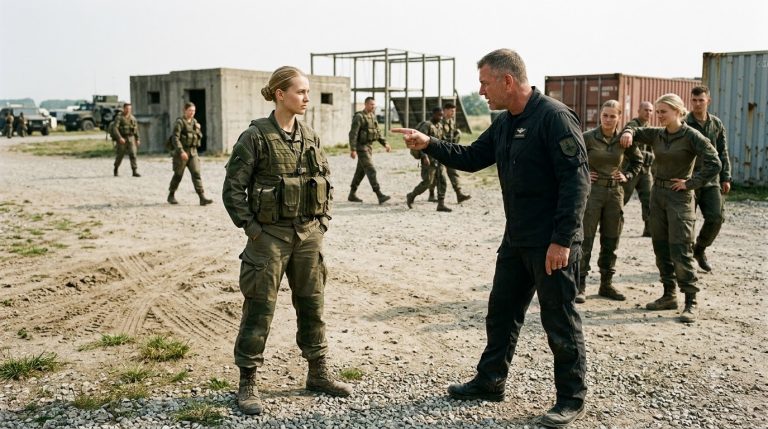
“Look at the shoulder, Marines,” Gunnery Sergeant Tyler Brennan said, his voice dropping into a low, rhythmic rasp that cut cleanly through the wet heat of the training pit. “That is the precise boundary line between an asset and a liability.”
The thirty young men in bleached-out utility uniforms did not turn their heads—their training forbade the movement—but thirty pairs of eyes flicked toward the chainlink perimeter. Beyond the galvanized wire stood Bobby Kendrick. He was seventy-three, and his frame had the slight, downward curve of an old pine subjected to decades of mountain wind. His hands, thick-knuckled and scarred across the meat of the thumbs, rested lightly in the diamond gaps of the fence. He wore a denim jacket that had lost its deep indigo long before the boys in the dirt were born. Near the seam of the left shoulder, a ragged, circular tear sat open, its white structural threads frayed into a small, pale web against the dark skin beneath.
Brennan stepped out of the soft sand of the pit, his boots leaving clean, geometric impressions in the earth. Every line of his uniform was an argument against decay; his trousers were pinned with starch, his ribbons sat in a perfect, rigid block above his breast pocket, and his jaw held the hard, unyielding set of a man who viewed human weakness as a correctable logistical error.
“The old core likes to talk about history,” Brennan said, stopping three feet from the fence, his shadow completely swallowing Bobby’s lower torso. He didn’t look at Bobby’s face; his eyes were locked onto the ragged hole. “But history that doesn’t maintain its gear is just clutter. If you can’t take twenty minutes to run a needle and thread through your own canvas, you don’t get to stand there and judge the pace of the modern machine.”
Bobby didn’t pull his hands from the wire. He didn’t blink against the low, white glare of the afternoon sun hitting the concrete behind the instructor. A faint scent of old chicory oil and dry wool drifted from the denim, an anomalous texture against the sharp, chemical tang of gun oil and fresh sweat that defined the pit.
“Just watching, son,” Bobby said. His voice was small, dry, and carried the slow, unhurried cadence of the Montana timberline. “The balance on that armbar was short. If the boy on the bottom had his hip an inch lower, he’d have taken your knee with him into the dirt.”
A quiet stillness dropped over the nearest line of Marines. Brennan’s chest stayed motionless for one full inhalation. He took a single step closer, the metal of his belt buckle nearly touching the wire. His face remained empty of anger, replaced by the dangerous, calculating pity of a predator that had identified a flaw in the terrain.
“This is a closed school, sir,” Brennan said, the word sir landing with the cold weight of a spent casing. “The tactics practiced here are bought with recent blood. We don’t have room for casual observations from the gallery. Especially from those who chose to leave their discipline in the past.”
He reached out, his hand moving with the effortless, practiced speed of a close-quarters instructor, and flicked his index finger directly into the frayed center of the hole in Bobby’s shoulder.
The fabric didn’t give. But under Brennan’s finger, beneath the rough, unwashed denim, there was something else—a hard, square ridge of thick paper tucked deeply into the interior lining, shifting with a dry, metallic rattle that sounded exactly like the safety selector of an M16 dropping into full-automatic in the dark.
CHAPTER 2: THE PAPER CAUSEWAY
The dry, mechanical rattle of the paper tucked inside the lining didn’t just vibrate against Tyler Brennan’s fingertip; it seemed to travel straight up the radius bone of his forearm, cold and thin. His hand remained suspended against the faded denim of the old man’s shoulder, his knuckles pale under the harsh glare of the noon sun.
Bobby didn’t flinch away from the touch. His posture remained perfectly still, his weight evenly balanced between his worn boots, his old hands retaining their light, loose grip on the galvanized chainlink fence. To the young Marines watching from the sand of the combat pit, it looked like a standard standoff—an instructor asserting presence over an intruder. But within the space between the two men, the air had grown dense, tasting faintly of iron filings and old water.
“You’ve got something structural under the seam, sir,” Brennan said, his voice dropping an octave, losing its theatrical drill-field ring. His eyes narrowed, focusing purely on the micro-movements of Bobby’s collarbone. “That isn’t a standard patch. That’s heavy stock.”
“It’s a lining, son,” Bobby replied softly. He didn’t look down at Brennan’s hand. His gaze remained fixed on the far end of the training facility, where the low-slung concrete barracks shimmered under the heat waves rising from the blacktop. “Keeps the shape of the shoulder. Things lose their shape if you don’t keep a spine in them.”
Brennan didn’t withdraw his finger immediately. The pragmatic instinct that had kept him alive through two deployments in the Helmand Province told him that the density of the object wasn’t uniform; it had thickness, a layered stiffness that suggested folded document paper, kept dry against fifty-five years of sweat and coastal fog by the heavy weave of the denim. The “Weaponized Silence” he usually deployed against insubordinate corporals felt clumsy here, blunted by the absolute lack of resistance from the man across the wire.
“Gunny!”
The sharp bark of Staff Sergeant Miller broke the micro-second lock between them. Miller had stepped out of the pit, his utility blouse dark with salt rings across the shoulder blades. He wasn’t looking at Bobby; his eyes were fixed on the access road that wound down from the main headquarters building. “We’ve got a heavy movement coming down the ridge. Three black utility vehicles, high velocity.”
Brennan slowly let his hand drop to his side, his thumb unconsciously rubbing the tip of his index finger where the texture of the hidden document had left a faint, dry impression. He turned his torso thirty degrees, scanning the dirt road. The low, deep rumble of six-liter diesel engines was already vibrating through the soles of his boots before the vehicles crested the gravel rise. They weren’t moving at the administrative speed limit of fifteen miles per hour; they were running hot, their tires spitting red clay against the scrub oak lining the ditch.
“Form them up,” Brennan commanded, his tone instantly shifting back to the dry, transactional rhythm of the training pipeline. He didn’t look back at Bobby, but his internal monologue was already running through the possibilities. An unannounced inspection from the base commander usually meant an administrative audit, but three vehicles moving in a tight, tactical convoy meant something far more senior. “Get the boys out of the sand. Line them up along the northern bulkhead. Now.”
The thirty Marines scrambled, their boots churning the soft sand into low dust clouds that hung in the stagnant air. Bobby didn’t move from his position by the fence. He simply shifted his hands down two rungs of the chainlink, his thumbs tucked into the pockets of his faded cargo pants, watching the black Suburbans lurch to a synchronized halt less than twenty feet from the pit’s gate.
The doors didn’t open immediately. The engines continued to idle, a heavy, rhythmic thrum that filled the small valley with the smell of unburnt fuel and hot rubber. Brennan stood at the front of his formation, his arms pinned straight down his seams, his eyes locked on the lead vehicle’s dark glass. He could feel the small, frayed details of the old man’s jacket still lingering in his peripheral vision—the pale white threads of the tear catching the light like wire.
The rear door of the second vehicle swung open with a heavy, pressurized click. A full colonel stepped out first, his face set in a rigid mask of bureaucratic urgency, followed immediately by a sergeant major whose chest was a dense, multi-colored block of operational history. But it was the third man who made Brennan’s throat go dry.
Lieutenant General Marcus Hayes.
The silver stars on the general’s soft cap caught the direct sunlight, casting tiny, sharp glints across the gravel. Hayes didn’t look toward the formation of instructors. His eyes, heavily hooded and lined by decades of desert glare, swept the chainlink perimeter with the cold efficiency of an artillery officer surveying a landing zone. He didn’t see the immaculate uniform of Gunnery Sergeant Brennan; his focus went directly past him, locking onto the faded red t-shirt and the torn denim shoulder standing by the galvanized wire.
Brennan felt a cold prickle of sweat start at his hairline and trace a slow line down his temple. The general wasn’t carrying an inspection folder. His hands were empty, his fingers slightly curled, his stride long and deliberate as he bypassed the main entrance to the training pit and headed directly toward the fence line where the old man stood.
“Staff,” Brennan muttered out of the side of his mouth, his voice barely carrying to Miller. “Hold the line. Nobody moves until I clear the ground.”
Brennan broke from the formation, his boots striking the hard-packed clay with rhythmic precision as he moved to intercept the general’s path, intending to offer the standard administrative report. But as he drew within five paces, General Hayes didn’t even adjust his head toward him. The general’s gaze was fixed entirely on Bobby Kendrick, and for the first time in his career, Brennan saw an institutional giant’s posture lose its stiff, regulatory arrogance, replaced by something old, heavy, and deeply quiet.
CHAPTER 3: THE SHATTERED MEASURE
General Hayes’s right boot struck the hard clay a mere inch from the shadow of Brennan’s shoulder, yet his focus remained entirely forward, cutting through the gunnery sergeant’s presence like a clean wind through dry grass. Brennan’s hand remained frozen at the temple of his soft cap, his chest locked in the rigid, unbreathing peak of a formal salute, while the three silver stars on the general’s collar swept past his peripheral vision.
The general stopped precisely two inches from the galvanized steel of the fence. For three seconds, the absolute stillness of the valley was broken only by the rhythmic, low-frequency chugging of the idling Suburbans behind them. The afternoon sun caught the fine, white dust settled into the deep creases of Hayes’s neck, highlighting the weathered, leather-like texture of thirty-five years under canvas. He looked at Bobby Kendrick, and Bobby looked back through the silver diamonds of the wire, his thumbs remaining loosely hooked into the cotton pockets of his cargo pants.
Then, with a deliberate, heavy movement that seemed to drag the weight of the entire command structure with it, General Hayes raised his right hand.
It wasn’t the brisk, mechanical salute of a base commander acknowledging an administrative officer. His arm rose slowly, the elbow tracing a wide, old-fashioned arc before the edge of his hand settled sharply against the brim of his cap. The fingers were pressed tight, the palm perfectly flat, held with a trembling, static intensity that made the fabric of his sleeve hum against his skin. It was the salute a private gives a sovereign, or an engine gives its architect.
Brennan’s arm dropped to his side by sheer reflex, his knuckles rapping against his starch-stiffened trousers with a dull slap. The blood inside his ears felt loud, a rhythmic, pulsing heat that blurred the edges of his vision. Behind him, the thirty Marines in the training pit remained anchored in the sand, their jaws slightly dropped, their eyes shifting between the immaculate uniform of the three-star general and the faded denim jacket of the old man who hadn’t even pulled his hands out of his pockets.
“Mr. Kendrick,” Hayes said. His voice didn’t have the raspy bark of the drill field; it was low, heavy with the gravelly resonance of the old artillery regiments, carrying across the sand pit without the need for volume. “Sir, it is an honor to find you on this line.”
Bobby slowly pulled his right hand from his pocket. The skin across his knuckles was thin, spotty with age, but the wrist was thick and steady. He didn’t return the salute; instead, he simply pressed his palm against the rough zinc coating of the chainlink, his fingers curling slightly around the wire.
“You’ve put on weight, Marcus,” Bobby said softly, his Montana drawl cutting through the formal density of the moment like a dry leaf scraping across gravel. “And your boy here says my jacket’s unserviceable.”
The general’s hand came down, his arm dropping to his seam with a sharp pop, but his eyes didn’t leave Bobby’s face. A small, dark leather portfolio was tucked under his left bicep, its brass corners tarnished to a dull green. As he shifted his weight, the flap of the portfolio parted slightly, revealing the corner of an official Department of Veterans Affairs medical transport log pinned beneath an unrelated legal brief.
Brennan noticed it—the pale green border of a critical-care tracking sheet, a document that had no business being in a tactical commander’s administrative pouch. The realization struck his chest like a blunt instrument: this convoy hadn’t been rerouted by a sudden schedule change. The general had been looking for this specific old man.
Hayes turned his head forty-five degrees, his gaze finally descending upon Brennan. The warmth that had been in his eyes when looking at Bobby vanished instantly, replaced by the flat, grey coldness of an incoming storm front over the high desert.
“Gunnery Sergeant,” Hayes said, the syllables landing like iron wedges. “Your school is running close-quarters drills today.”
“Yes, General,” Brennan said, his throat tightening so rapidly the words felt thin, almost brittle. He forced his chin back, attempting to reclaim the rigid symmetry of his posture, but the small, quarter-sized tear in Bobby’s jacket seemed to loom larger in his vision, an unreadable marker that had suddenly overwritten his entire curriculum. “We are executing Section Four of the advanced instructor pipeline. Aggression and structural dominance.”
“Dominance,” Hayes repeated. He didn’t raise his voice, but he stepped toward the gate of the pit, his polished boots kicking a small spray of dry gravel into the soft sand where the lance corporals stood. He stopped by the wooden post that held the training schedule. “Marines, line up on the interior bulkhead. Staff Sergeant Miller, bring your notebooks. I am going to read you a different standard.”
The general unclasped the brass latch of the leather portfolio. He didn’t pull out the legal brief; his fingers bypassed it completely, reaching for a sheet of old, yellowed onionskin paper that sat behind the medical logs. The paper was so thin the typing on the reverse side showed through in a faint, blue lattice.
“On January 24th, 1968,” Hayes began, his voice dropping into the rhythmic, unhurried cadence of an official citation, though he didn’t look down at the page; he knew the words by heart, his eyes sweeping across the young faces in the dirt. “A six-man reconnaissance patrol from the Fifth Marines was caught in the open 200 meters northwest of the perimeter wire at Khe Sanh. The command bunker checked the math. The North Vietnamese Army had two battalions dug into the draws. The captain ordered the gate locked. He told the radio operator that the patrol was already ghosted.”
Brennan looked at Bobby. The old man hadn’t turned around to face the audience. He remained looking through the wire toward the empty blacktop, his shoulder slightly tilted, his fingers still resting on the zinc link. The small, white threads around the hole in his denim jacket stirred slightly in the exhaust from the Suburbans.
“But one nineteen-year-old corporal didn’t care about the captain’s math,” Hayes continued, his voice rising slightly, carrying the distinct, metallic ring of truth into the corners of the concrete barracks. “He went out alone. He didn’t take an assistant, and he didn’t ask for a smoke screen because a smoke screen would have given the NVA an active target line. He crossed two hundred meters of raw clay that had been mined forty-eight hours prior by our own engineers. He brought the first two back on his hips. On the third trip, he took a seven-point-six-two round through the right thigh and a piece of casing through the left shoulder seam. That is the hole you were flicking your finger at, Gunnery Sergeant.”
The silence that followed was absolute. Brennan felt his balance shift toward his heels, his boots sinking slightly into the clay. The young corporate in the front row of the formation—the one who had chuckled only five minutes before—had his eyes fixed on the dirt, his knuckles white where he held his training pads.
“The third man he carried was named Marcus Hayes,” the general said softly, his fingers closing the leather portfolio with a sharp leather snap. “He was eighteen, and his pelvis was in five pieces inside his trousers. He didn’t know who was carrying him until he smelled the dry wool of a civilian jacket someone had packed in a sea bag from Montana. For fifty-five years, this man has refused the pension adjustments, refused the regional dinners, and refused to let us fix the canvas that took the metal meant for me.”
Hayes stepped back until he was level with Brennan. The heat from the sun was beginning to drop, casting long, purple shadows across the training pit. “Gunnery Sergeant, you will turn this formation over to Staff Sergeant Miller. You and your primary instructors will report to my office at 0600 tomorrow. We are going to examine the difference between a tool and a spirit.”
“Yes, General,” Brennan whispered. He didn’t look at the men. He couldn’t. His gaze was fixed on the small, square protrusion within the lining of Bobby’s shoulder—the hidden document that had rattled under his finger. The mystery had shifted from a ragged hole to a deeper, heavier structure, and he was the one who had been left outside the wire.
CHAPTER 4: THE CHRONICLE PIECE
The dust raised by the general’s departing Suburbans did not dissipate quickly; it drifted in low, lazy ribbons across the chainlink fence, hanging over the empty sand where the training formation had broken down. Tyler Brennan stood perfectly rigid in the center of the vacated pit, his eyes fixed on the gray spot where Bobby Kendrick’s boots had sat in the clay. The silence of the base was no longer the controlled preparation of an instructor team; it was a vast, operational vacuum that seemed to press against his temples with the weight of an oncoming storm.
He did not go home that night. By 0545 the following morning, Brennan was standing outside the glass-paneled doors of the Marine Corps History Division, a low-slung concrete annex tucked away on the western edge of the base, far from the kinetic rattle of the training ranges. The air inside the building smelled of old linoleum, cedar chips, and the distinct, dry rot of paper that had survived tropical campaigns only to disintegrate under fluorescent light.
Staff Sergeant Miller was already there, sitting on a metal crate with a plastic folder across his lap, his knuckles gray from dust. He didn’t offer a standard greeting when Brennan walked in. He simply gestured with a blunt chin toward a heavy oak desk at the back of the archives room, where a steel locker marked Kendrick, R.—Historical Asset 104 sat with its latch thrown open.
“The general’s office called down at midnight,” Miller said, his voice flat, stripped of its standard tactical ring. “They didn’t give us an audit list, Gunny. They just told us to index the physical legacy. Every letter, every unfiled voucher, every transit report from the fifth regiment between sixty-seven and sixty-nine. We’re the clerks now.”
Brennan pulled out the heavy metal chair, the iron casters groaning against the rough floor. He sat down, his hands resting on the cold surface of the desk. His uniform was still immaculate, but the starched creases felt less like armor now and more like a constraint. He reached into the steel locker, his fingers contacting the first layer of gray cardboard boxes.
“We don’t skim,” Brennan said, his voice dropping into a quiet, transactional rhythm that felt hollow even to himself. “If the general wants an inventory, we give him every line item. Start with the medical transport records from sixty-eight.”
For four hours, the only sound in the small annex was the dry rasp of paper being shifted out of folders. Brennan’s fingers grew gray with carbon dust as he moved through the administrative aftermath of a forgotten valley. He found the transport logs—the same green-bordered sheets he had spotted in the general’s portfolio the previous afternoon. But as his fingers systematically sorted through the dates, a strange discrepancy began to emerge from the numbers.
According to the official logs, Chief Warrant Officer Robert Kendrick had been flagged for administrative tracking by the Third Marine Division every single month for the last twelve years. Every specialized physical, every regional health-care transport request, and every denial of special institutional support had a carbon duplicate routed directly to the personal office of General Marcus Hayes.
Brennan stopped his hand over a file dated three years prior. This wasn’t a historical archive; it was an ongoing case file. The general hadn’t discovered Bobby by accident at the fence line. He had been tracking the old man’s systemic physical decline, watching him refuse every dollar of his pension and every offer of medical transport from a reclusive cabin in the hills, using the official inspection of the close-quarters school as a tactical cover to bring the institutional weight of the Marine Corps down upon a hero who refused to be saved.
The realization—the decoy secret—hit Brennan’s chest with a dry, hollow thud. He had thought the general was punishing him for a breach of etiquette. In reality, Brennan’s arrogance had merely been the catalyst that allowed Hayes to break through Bobby’s isolation.
He leaned back, his thumb rubbing against the seam of his utility trousers. But as he looked at the open box, his eye caught a separate ledger—an original field journal kept by Captain Evelyn Marsh, the commanding officer of Redcloud 6 during the siege of Khe Sanh. The leather cover was cracked and smelled of old mold, its pages stuck together by the humidity of a South China Sea transit fifty years dead.
Brennan carefully wedged his thumb between the pages, his touch light, remembering the texture of the thick, square stock he had felt inside the lining of Bobby’s denim jacket the day before. He turned to the entry for January 24th, 1968.
The handwriting was small, tight, and erratic, written with a dying ballpoint pen that left deep, white impressions in the paper where the ink had failed.
“…six ghosted past the wire,” the text read, the blue script faded to a pale lavender. “Kendrick went out without a helmet. Told him it was suicide. He didn’t look back. Brought Hayes in with his hip shattered. When the corman took Hayes, I checked Kendrick’s coat. Found the metal had gone clear through his side. I tucked the unmailed parcel into his interior casing. The one meant for the family in Billings. Told him to keep it closed. Some truths don’t belong in the ledger…”
Brennan froze. The paper described by Captain Marsh wasn’t an administrative patch, and it wasn’t a standard citation. The letter hidden inside the old man’s jacket wasn’t about the battle Bobby had survived; it was something else, something locked away by a dying commander that stayed hidden under the frayed white threads of the shoulder seam. The true reality remained hidden, protected by the old man’s refusal to let the world sew up his jacket.
“Gunny,” Miller whispered, his hand stopping over a drawer of old casualty tags. He was looking at the small window facing the coastal highway. “Look at the time. It’s fourteen hundred. We’ve got forty boxes left, and the general’s driver is outside.”
Brennan didn’t look up from the lavender script. He slowly closed the journal, his fingers feeling the cold, stiff texture of the leather. The strategic landscape had shifted beneath his boots, and for the first time in his career, he realized that the heaviest burdens weren’t carried in a rucksack, but in the silent, unexamined spaces between the lines of an official report.
CHAPTER 5: THE OCEANSIDE HORIZON
The heavy oak doors of the base archives and the frantic, red-clay rhythm of the training pipelines slowly dissolved across six months of silent reflection, replaced at last by the low, rhythmic wash of the Pacific surf against the Oceanside pier. The mid-afternoon sun didn’t glare with the harsh, white intensity of the summer drills; it hung low and amber over the coastal highway, casting long, soft shadows that turned the fraying edges of the world into something gentle and settled.
Gunnery Sergeant Tyler Brennan stood just inside the threshold of the small, wood-paneled coffee shop, his fingers lightly touching the brim of his civilian cap. He wasn’t wearing the immaculate, starched utilities that had once defined his entire sense of presence. In his soft gray flannel and dark denim, his posture retained its baseline precision, but the rigid, predator-prey calculation had drained from his shoulders, leaving a quiet, listening stillness in its place.
His eyes scanned the room, bypassing the steel espresso machines and the generic coastal art, until they locked onto a corner booth near the window.
Bobby Kendrick sat alone, a white porcelain mug cradled between his thick-knuckled hands. The afternoon light fell across his face, accentuating the deep, map-like lines of his skin. He was wearing the same faded denim jacket, its left shoulder still bearing the ragged, quarter-sized hole, its pale structural threads catching the golden hue of the sunset.
Brennan took a slow breath, feeling the weight of the historical field journals he had spent half a year indexing still lingering in his muscle memory. Every unmailed letter and every medical log he had cataloged under General Hayes’s direction had led to this micro-second. He walked forward, his boots making a soft, rhythmic thud against the hardwood floor.
“Mr. Kendrick, sir,” Brennan said, stopping two feet from the edge of the table. He kept his hands loose at his sides, his voice low and devoid of the theatrical arrogance that had once cut through the training pits. “May I join you?”
Bobby didn’t look up immediately. He watched the steam rise from his mug, his thumbs tracing the smooth ceramic edge. Then, with a slow, unhurried tilt of his head, his gray eyes met Brennan’s. There was no anger in them, no sharp edge of vindication—only the weary, deep understanding of an old pine that had survived the timberline.
“Sit down, son,” Bobby said, gesturing with a light nod toward the empty bench opposite him. “The coffee’s hot, and the wind’s coming off the water. It’s a good day for a quiet room.”
Brennan slipped into the booth, the leather cushion giving way under his weight with a soft huff. He didn’t rush into speech. For two full minutes, the two men sat in an unbroken, context-aware silence, while the low drone of traffic on the highway provided a steady, domestic baseline to the room.
“The program is fully integrated now,” Brennan said finally, his fingers tracing a faint scratch on the wooden tabletop. “The Kendrick Standard. We don’t teach them just how to throw an armbar or lock a joint anymore. We make them read the logs. We make them look at what a person carries when the uniform comes off.”
Bobby set his mug down with a tiny, muted click. “Tools are easy to build, Tyler. You can sharpen an edge in an hour. But if the man holding the blade doesn’t know why he’s staying in the hole, the edge just cuts the wrong things. I’m glad you figured that part out.”
“I found Captain Marsh’s field journal,” Brennan said softly, his voice dropping into the quietest register of the room. He leaned forward slightly, his eyes descending to the frayed cotton threads on Bobby’s left shoulder. “In the archives. I know about the tracking sheets General Hayes kept. And I know about the letter tucked inside your lining. The one meant for the family in Billings.”
Bobby’s hands grew completely still against the porcelain. The soft light from the window illuminated the fraying white weave of the tear, and for a fleeting second, the old man’s chest seemed to hold the breath of a nineteen-year-old corporal trapped in the red mud of Khe Sanh.
“Evelyn Marsh was a good captain,” Bobby whispered, his Montana drawl thickening slightly with the memory. “He made the only choice the numbers allowed. But when he died covering our extraction five days later, he left that parcel in my care. It wasn’t a tactical report, Tyler. It was his final grace—a letter admitting he had ordered those six boys ghosted because he was scared. He asked me to carry it until the world was ready to understand that a commander can break just like a private.”
With a slow, deliberate movement, Bobby reached into the interior breast pocket of his jacket. His fingers didn’t pull at a jagged seam; instead, they carefully slid behind the heavy, reinforced cotton backing he had sewn inside fifty-five years ago. He drew out a small, square packet of thick, yellowed paper. The edges were worn smooth by the friction of his own skin, but the structural integrity of the paper remained unbroken, held together by a faded red wax seal that had never been cracked.
“I didn’t keep the jacket torn out of pride,” Bobby said, his eyes locking onto Brennan’s with an absolute, human clarity. “I kept it torn because as long as the hole stayed open, nobody would look for what was tucked inside the lining. They’d just look at the scar. They’d see the medal I never wore, and they’d stop asking questions. But the truth isn’t the metal, son. The truth is the burden we keep dry for the ones who didn’t make the transit.”
He laid the square packet on the table between them. The paper looked like kintsugi art against the dark wood—a broken piece of history preserved by five decades of shared isolation.
Brennan reached out, his hand trembling slightly as his index finger touched the smooth, aged surface of the document. He didn’t open it. He didn’t need to. The internal alignment of his entire worldview had completed its transition. The antagonist within his own professional identity—the arrogant instructor who believed only in structural dominance—had been completely dismantled, not by a physical strike, but by the quiet, unyielding architecture of grace.
“We’re setting the module permanently into the academy pipeline tomorrow,” Brennan said, his eyes rising to meet the old man’s. “General Hayes will be there. He wants you to sit on the line.”
Bobby smiled, a brief, faint movement that softened the deep lines around his eyes. He reached across the table and placed his thick, weathered palm over Brennan’s hand, his fingers firm and warm.
“I’ll be in the back row, Tyler,” Bobby said softly, his gaze turning back to the golden horizon outside the window where the sun was finally sinking into the sea. “Where the quiet men sit. Go back to your Marines. Teach them how to breathe.”
Brennan nodded, a single, deep movement of his chin. As he stood up from the booth and walked back out into the cool, salt-tinged air of the Oceanside evening, he felt the final remnants of his old posture lift from his chest. The scars on the outside had found their true measure, and the narrative had finally come to rest in the quiet grace of a world lived in peace.